
Canada Robotic Platform Market (2024-2029)

The Canada Robotic Platform Market was valued at $378.1 Million in 2024 and projected to reach to $473.2 Million by 2029, representing a compound annual growth rate of 4.6%. Canada's robotic platform market is poised for steady expansion through 2029, supported by accelerating digital transformation initiatives and labor market pressures across manufacturing and logistics sectors.


| Market Size in | USD 26.32 MN |
| Market Forecast in | |
| CAGR | |
| Forecast Period | |
| Units Considered | Value (USD MN) |
Canada Robotic Platform Market Trends and Insights
- This steady expansion reflects Canada's increasing adoption of automation technologies across manufacturing, logistics, and semiconductor sectors.
- Canada's strategic position in North America and investment in advanced manufacturing capabilities are driving demand for robotic platforms that enhance operational efficiency and reduce labor costs. The Canadian market benefits from strong government support for industrial innovation and a skilled workforce capable of implementing complex robotic solutions.
- Canada's robotic platform market is experiencing growth driven by the need for precision automation in electronics assembly and semiconductor fabrication.
- By 2029, Canada is expected to solidify its role as a key hub for robotic platform deployment in North America, with expanding applications in emerging sectors such as healthcare and autonomous systems..
Key Market Statistics
- CAGR (2024-2029) 4.6% CAGR
- Market Size, 2024 ~USD 378.1 Million
- Forecast, 2029 ~USD 473.2 Million
- Country Canada
Canada Robotic Platform Market Overview
Market Valuation :
Canada's robotic platform market is valued at $378.1 million in 2024, with projected growth to $473.2 million by 2029, driven by increased automation adoption across key industrial sectors.
Growth Trajectory :
The Canadian market demonstrates a steady CAGR of 4.6% through 2029, slightly below the global average of 5.9%, reflecting a mature but expanding automation landscape with consistent investment momentum.
Sectoral Drivers :
Manufacturing, logistics, and semiconductor industries are primary growth catalysts in Canada, with companies increasingly deploying robotic platforms to enhance operational efficiency and address labor shortages.
Strategic Position :
Canada's proximity to the U.S. market and investments in advanced manufacturing infrastructure position it as a key hub for robotic platform adoption and innovation in North America.
Canada Robotic Platform Market Dynamics
- The 4.6% CAGR reflects sustained investment in automation technologies as Canadian enterprises seek competitive advantages and operational resilience.
- Key growth drivers include semiconductor production expansion, e-commerce logistics demands, and government incentives for advanced manufacturing.
- While growth trails the global average, Canada's market demonstrates strong fundamentals with increasing adoption among mid-sized manufacturers and emerging opportunities in specialized robotics applications.
- Regional supply chain integration with the U.S.
- and Mexico further strengthens market dynamics, positioning Canada as a critical automation hub within North America's industrial ecosystem..
Market Ecosystem
Related Ecosystem
Drones And Robotics
- Sensors
- Articulated Robots
- Cartesian Robots
- Scara Robots
- Actuators
- ABB India Limited
- KUKA AG
- MOMENTIVE PERFORMANCE MATERIALS INC.
- STAUBLI INTERNATIONAL AG
- Fanuc Corporation
Aviation
- Narrow Body Aircraft
- Wide Body Aircraft
- Military Helicopters
- Special Mission Aircraft
- Fighter Aircraft
- HONEYWELL INTERNATIONAL INC.
- COLLINS AEROSPACE
- Thales group
- Safran group
- HEICO Corporation
Fandb Processing And Technology
- Dairy Products
- Bakery Products
- Filtration Equipment
- Heat Exchanger
- Acetic Acid
- Gea group
- John Bean Technologies Corporation
- Alfa Laval Corporate AB
- AZELIS HOLDINGS SA
- SPX FLOW INC
Key Takeaways
- Canada's robotic platform market is valued at $378.1 million in 2024 with a projected CAGR of 4.6% through 2029.
- Canada's market is expected to reach $473.2 million by 2029, driven by automation adoption in manufacturing and semiconductor sectors.
- Canada benefits from government innovation initiatives and a skilled workforce supporting robotic platform implementation.
- Canada's strategic North American location positions it as a growing hub for precision automation and advanced manufacturing applications.
Robotic Platform Market Report Scope
| Report Metric | Details |
|---|---|
| Base Year | 2024 |
| Fastest Growing Segment | PROCESSING (Application) |
| Forecast Period | 2024-2029 |
| Growth Rate | CAGR of 5.9% from 2024 to 2029 |
| Largest Segment | INDUSTRIAL ROBOTS (Robot) |
| Market Size Base Year (Billions) | ~USD 9.76 (2024) |
| Revenue Forecast (Billions) | ~USD 13 (2029) |
| Segments Covered | Robot, Application, Type, End-Use Industry, Manufacturing Industry, Deployment |
Canada Robotic Platform Market Report Segmentation
6 segment dimensions are covered across the global market.
By Robot
- Industrial Robots
- Service Robots
By Application
- Assembling & Disassembling
- Cleaning
- Cleanrooms
- Delivery
- Dispensing
- Entertainment, Education & Personal
- Handling
- Medical Assistance
- Processing
- Warehouse
- Welding & Soldering
By Type
- Mobile
- Stationary/Fixed
By End-Use Industry
- Healthcare
- Logistics & Transportation
- Manufacturing
- Other End-Use Industries
- Residential
- Retail & E-Commerce
By Manufacturing Industry
- Automotive
- Electrical & Electronics
- Food & Beverages
- Metals & Machinery
- Pharmaceuticals & Cosmetics
- Plastics, Rubber & Chemicals
By Deployment
- On-Cloud
- On-Premise
Target Audience
- Robotic Platform Manufacturers : Manufacturers need Canada-specific market sizing and growth forecasts to develop localized go-to-market strategies, identify high-potential customer segments, and allocate R&D resources for Canadian market expansion.
- Industrial Automation Integrators : System integrators require detailed Canadian market insights to assess demand trends, competitive positioning, and sectoral opportunities in manufacturing and logistics to guide service offerings and sales strategies.
- Manufacturing & Logistics Enterprises : Operations leaders need market intelligence to benchmark automation adoption rates, understand competitive pressures, and justify capital investments in robotic platforms within the Canadian industrial context.
- Investment & Private Equity Firms : Investors require Canada-specific market data to evaluate acquisition targets, assess growth potential of automation companies, and identify emerging opportunities in the $378M+ Canadian robotic platform sector.
- Government & Economic Development Agencies : Policy makers and economic development organizations need market insights to design incentive programs, attract foreign investment, and support Canadian automation sector competitiveness in North America.
Reasons to Buy this Report
- Market-Specific Sizing Data : Access precise valuation metrics for Canada's robotic platform market with verified 2024 baseline ($378.1M) and 2029 forecasts ($473.2M), enabling accurate budget allocation and ROI projections for Canadian operations.
- Competitive Landscape Intelligence : Understand Canada-specific market dynamics, regional player positioning, and sectoral concentration across manufacturing, logistics, and semiconductors to identify partnership and expansion opportunities.
- Growth Trajectory Analysis : Leverage the 4.6% CAGR benchmark against global 5.9% to assess Canada's market maturity, identify underperforming segments, and pinpoint high-growth subsectors for targeted investment strategies.
- Regulatory & Infrastructure Insights : Gain actionable intelligence on Canadian government incentives, supply chain integration with North America, and sector-specific adoption barriers to optimize market entry and expansion strategies.
- Strategic Decision Support : Make informed decisions on resource allocation, product localization, and partnership development with comprehensive Canada-focused market data supporting executive planning and stakeholder presentations.
Frequently asked questions
What is the current size of Canada's robotic platform market?
Canada's robotic platform market is valued at $378.1 million in 2024.
What is the projected market size for Canada's robotic platform market by 2029?
Canada's robotic platform market is forecast to reach $473.2 million by 2029.
What is the CAGR for Canada's robotic platform market?
Canada's robotic platform market is expected to grow at a compound annual growth rate of 4.6% from 2024 to 2029.
Which industries are driving growth in Canada's robotic platform market?
Manufacturing, logistics, semiconductor fabrication, and emerging sectors such as healthcare and autonomous systems are key growth drivers in Canada's market.
What factors support Canada's robotic platform market expansion?
Canada's market expansion is supported by government innovation initiatives, a skilled workforce, strategic North American positioning, and increasing demand for precision automation.
RESEARCH METHODOLOGY
The research study involved the extensive use of secondary sources, directories, and databases (annual reports or presentations of companies, industry association publications, directories, technical handbooks, World Economic Outlook (WEO), trade websites, Hoovers, Bloomberg Businessweek, Factiva, and OneSource) to identify and collect information useful for this technical, market-oriented, and commercial study of the Robotic platform market. Primary sources mainly comprise several experts from the core and related industries, along with preferred suppliers, manufacturers, distributors, service providers, system providers, technology developers, alliances, and standards and certification organizations related to various phases of this industry’s value chain.
Secondary Research
Various secondary sources have been referred to in the secondary research process to identify and collect information important for this study. The secondary sources include annual reports, press releases, and investor presentations of companies; white papers; journals and certified publications; and articles from recognized authors, websites, directories, and databases. Secondary research has been conducted to obtain key information about the industry’s supply chain, market’s value chain, the total pool of key players, market segmentation according to the industry trends (to the bottom-most level), geographic markets, and key developments from both market- and technology-oriented perspectives. The secondary data has been collected and analyzed to determine the overall market size, further validated by primary research.
Primary Research
In the primary research process, various primary sources from the supply and demand sides have been interviewed to obtain qualitative and quantitative information for this report. The primary sources from the supply side include industry experts, such as CEOs, vice presidents, marketing directors, technology & innovation directors, and related key executives from key companies and organizations operating in the Robotic platform market across four major regions: North America, Europe, Asia Pacific, and RoW (South America, Africa, Middle East). Primary data has been collected through questionnaires, e-mails, and telephonic interviews. Approximately 40% and 60% of primary interviews have been conducted from the demand and supply sides, respectively.
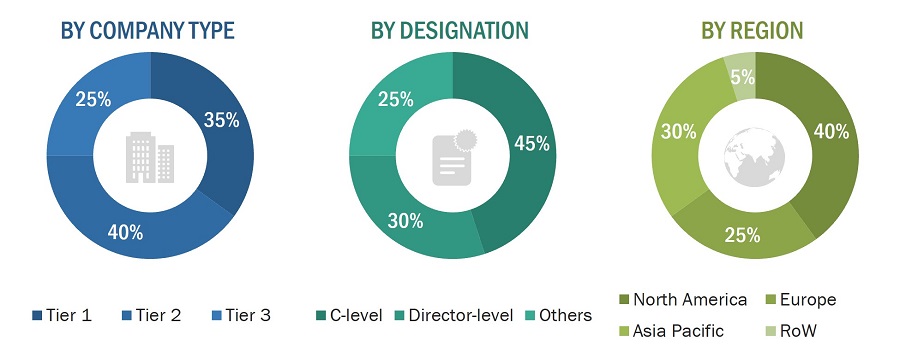
To know about the assumptions considered for the study, download the pdf brochure
Market Size Estimation
In the complete market engineering process, both top-down and bottom-up approaches have been used along with several data triangulation methods to perform market estimation and forecasting for the overall market segments and subsegments listed in this report. Key players in the market have been identified through secondary research, and their market shares in the respective regions have been determined through primary and secondary research. This entire procedure includes the study of annual and financial reports of the top market players and extensive interviews for key insights (quantitative and qualitative) with industry experts (CEOs, VPs, directors, and marketing executives).
In this approach, important players, such IBM (US), NVIDIA Corporation (US), Amazon.com (US), and Google Inc. (US) have been identified. After confirming these companies through primary interviews with industry experts, their total revenue has been estimated by referring to annual reports, SEC filings, and paid databases. Revenues of these companies pertaining to the business units (Bus) that offer Robotic platform have been identified through similar sources. Industry experts have reconfirmed these revenues through primary interviews.
Robotic Platform Market: Bottom-Up Approach
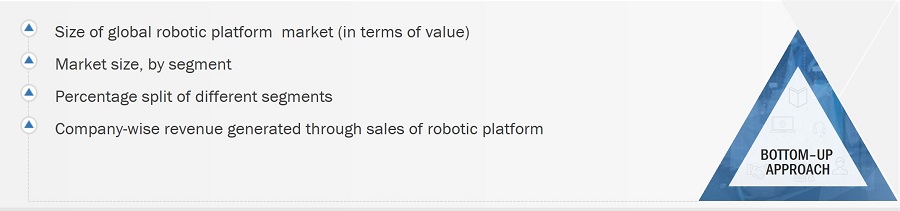
The bottom-up approach has been employed to arrive at the overall size of the Robotic platform market from the revenues of key players and their share in the market.
Robotic Platform Market: Top-Down Approach
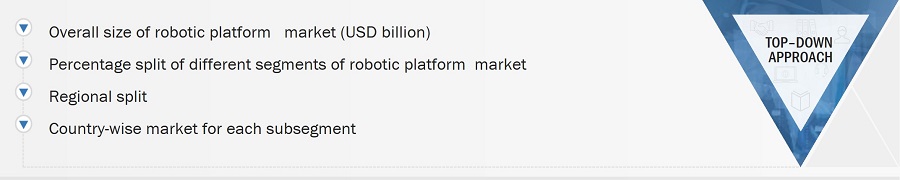
In the top-down approach, the overall market size has been used to estimate the size of the individual markets (mentioned in the market segmentation) through percentage splits from secondary and primary research. The most appropriate immediate parent market size has been used to implement the top-down approach to calculate the market size of specific segments. The top-down approach has been implemented for the data extracted from the secondary research to validate the market size obtained.
Each company’s market share has been estimated to verify the revenue shares used earlier in the supply-side approach. The overall parent market size and individual market sizes were determined and confirmed in this study by the data triangulation method and the validation of data through primaries. The data triangulation method used in this study is explained in the next section.
Data Triangulation
After arriving at the overall market size from the market size estimation process explained earlier, the total market was split into several segments and subsegments. Data triangulation and market breakdown procedures have been employed to complete the overall market engineering process and arrive at the exact statistics for all segments and subsegments, wherever applicable. The data has been triangulated by studying various factors and trends from both the demand and supply sides. Along with this, the Robotic platform market has been validated using both top-down and bottom-up approaches.
Market Definition
A Robotic Platform encompasses a suite of tools, libraries, and frameworks created to streamline the development, deployment, and administration of robotic systems. It offers a comprehensive environment for coding robot behaviors, integrating hardware, and implementing intricate algorithms for tasks like navigation, perception, and manipulation. These platforms typically include modules for motion planning, sensor data processing, machine learning, simulation, and human-robot interaction, supporting multiple programming languages and extensibility through APIs. Their goal is to simplify hardware complexities, enable fast prototyping, and encourage code reuse across diverse robotic applications, alongside features for system monitoring, debugging, and remote operation, crucial for both research and industrial robotics.
Key Stakeholders
- Robotic platform providers
- Robotic platform service providers
- Robot manufacturers
- Technology providers
- Robots software providers
- Government bodies, venture capitalists, and private equity firms
- Robotic platform consulting companies
- Robotic Platform related associations, organizations, forums, and alliances
- Venture capitalists, private equity firms, and start-up companies
- Research organizations
Report Objectives
- To define, describe, and forecast the global Robotic platform market, in terms of value, based on robot, deployment, type, end-user industry, and geography
- To forecast the market size, in terms of value, for various segments, with respect to four main regions—North America, Europe, Asia Pacific, and Rest of the World (RoW)
- To provide detailed information regarding the major factors influencing the growth of the Robotic platform market (drivers, restraints, opportunities, and industry-specific challenges)
- To provide an ecosystem analysis, case study analysis, patent analysis, technology analysis, ASP analysis, Porter’s Five Forces analysis, and regulations pertaining to the market.
- To offer a comprehensive overview of the value chain of Robotic platform market ecosystem
- To strategically analyze micromarkets1 with respect to individual growth trends, prospects, and contributions to the total market
- To analyze opportunities for the market stakeholders by identifying high-growth segments of the Robotic platform market
- To benchmark players within the market using the proprietary Competitive Leadership Mapping framework, which analyzes market players on various parameters within the broad categories of market rank and product offering
- To strategically profile the key players and comprehensively analyze their market shares and core competencies2 and provide a detailed competitive landscape for market leaders
- To analyze competitive developments such as partnerships, collaborations, agreements, and joint ventures; mergers and acquisitions; expansions; and product launches and developments in the Robotic platform market
- To evaluate the impact of the recession on the Robotic platform market
Available Customizations
With the given market data, MarketsandMarkets offers customizations according to the company’s specific needs. The following customization options are available for the report:
Company Information
- Detailed analysis and profiling of additional market players (up to 7)
Get the Full Robotic Platform Market Report
Full forecast, segment splits, and company analysis for all Robotic Platform Market.
- US Robotic Platform Market
- Mexico Robotic Platform Market
- Germany Robotic Platform Market
- UK Robotic Platform Market
- France Robotic Platform Market
- Spain Robotic Platform Market
- Italy Robotic Platform Market
- Rest Of Europe Robotic Platform Market
- China Robotic Platform Market
- Japan Robotic Platform Market
- India Robotic Platform Market
- South Korea Robotic Platform Market
- Rest Of Asia Pacific Robotic Platform Market
- Middle East Robotic Platform Market
- Africa Robotic Platform Market
- South America Robotic Platform Market
Need a Tailored Report?
Customize this report to your needs
Get 10% FREE Customization
Customize This Report
