
Rest Of Latin America Single Cell Sequencing Market (2025-2030)

The Rest Of Latin America Single Cell Sequencing Market was valued at $22.3 Million in 2025 and projected to reach to $35.4 Million by 2030, representing a compound annual growth rate of 9.7%. Rest Of Latin America's single cell sequencing market is positioned for meaningful expansion through 2030, driven by rising investments in genomic research capabilities and growing adoption of precision medicine approaches.


| Market Size in | USD 26.32 MN |
| Market Forecast in | |
| CAGR | |
| Forecast Period | |
| Units Considered | Value (USD MN) |
Rest Of Latin America Single Cell Sequencing Market Trends and Insights
- The region is poised for significant growth through 2030, when Rest Of Latin America is forecast to reach $35.4 million, representing a compound annual growth rate of 9.7%.
- This growth trajectory reflects increasing adoption of advanced genomic technologies and rising investment in life sciences research infrastructure across Rest Of Latin America. Rest Of Latin America's market development is driven by growing demand for precision medicine applications and expanding research capabilities in academic and clinical institutions.
- The region's healthcare sector is progressively integrating single cell sequencing into diagnostic and therapeutic workflows, supported by improving access to sequencing platforms and bioinformatics expertise.
- Between 2025 and 2030, Rest Of Latin America is expected to strengthen its position as a key emerging market for single cell sequencing technologies in the broader Latin American landscape. Key factors shaping Rest Of Latin America's market include rising government funding for genomic research, collaboration with international research networks, and increasing awareness of personalized medicine benefits.
- Rest Of Latin America's competitive environment is characterized by a mix of regional players and international vendors establishing local partnerships to capture growing demand..
Key Market Statistics
- CAGR (2025-2030) 9.7% CAGR
- Market Size, 2025 ~USD 22.3 Million
- Forecast, 2030 ~USD 35.4 Million
- Country Rest Of Latin America
Rest Of Latin America Single Cell Sequencing Market Overview
Steady Regional Growth :
Rest Of Latin America's single cell sequencing market is expanding at a CAGR of 9.7%, demonstrating consistent adoption of advanced genomic technologies across the region's research and clinical institutions.
Market Size Expansion :
The market is projected to grow from $22.3 million in 2025 to $35.4 million by 2030, representing a 58.7% increase over the five-year forecast period.
Below-Global Growth Rate :
While Rest Of Latin America shows solid growth at 9.7% CAGR, it trails the global market's 12.2% CAGR, indicating opportunities for accelerated adoption and market penetration.
Emerging Genomic Adoption :
Increasing investment in research infrastructure and growing awareness of precision medicine applications are driving single cell sequencing technology adoption across Rest Of Latin America.
Rest Of Latin America Single Cell Sequencing Market Dynamics
- The region's research institutions and biotechnology companies are increasingly recognizing the value of single cell analysis for understanding cellular heterogeneity and disease mechanisms. Key growth drivers include improved access to sequencing technologies, declining equipment costs, and expanding collaborations with global research networks.
- However, the region's growth rate remains below the global average, suggesting untapped potential for market development.
- Strategic partnerships, capacity building, and localized solutions tailored to regional research priorities will be critical for accelerating adoption and capturing emerging opportunities in Rest Of Latin America's genomic research landscape..
Market Ecosystem
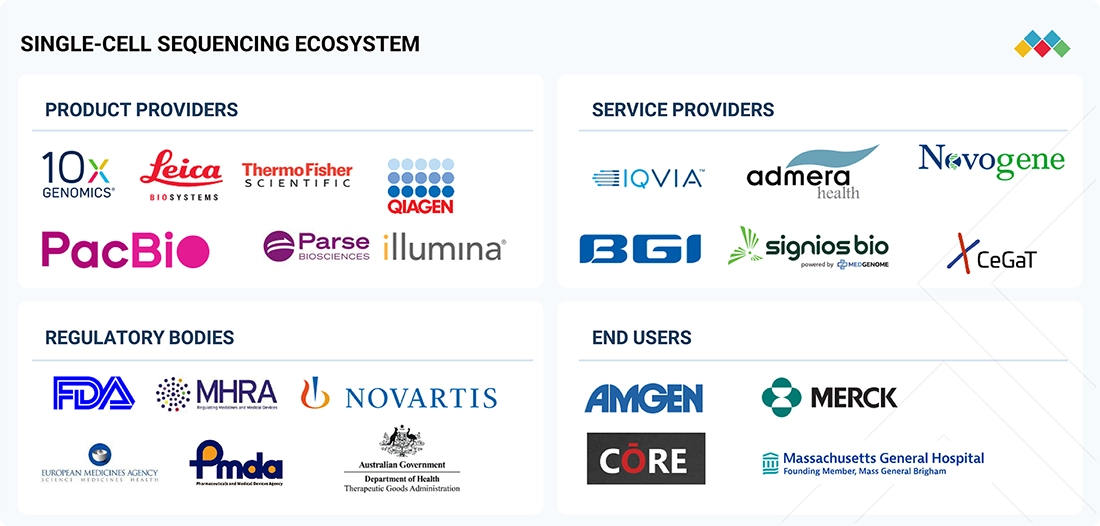
Single Cell Sequencing Market: COMMERCIAL USE CASES ACROSS INDUSTRIES
| COMPANY | USE CASE DESCRIPTION | BENEFITS |
|---|---|---|
 |
Target identification & validation using scRNA-seq | Improved disease understanding via cell subtyping, enabling discovery of novel therapeutic targets |
 |
Biomarker discovery & patient stratification in clinical development | Improved patient selection for clinical trials and more precise monitoring of drug response and disease progression |
 |
High-throughput scRNA-seq using 10x Genomics Chromium & Large-scale scRNA-seq using Parse Biosciences | Identification of diverse cell types, understanding cell-to-cell variation, and mapping cellular developmental trajectories |
 |
CleanPlex OncoZoom NGS Panels for single-cell circulating tumor cell (CTC) analysis and rare cell profiling | Detects somatic mutations across 2,900+ hot spots in 65 oncogenes and tumor suppressor genes | Enables direct single-cell analysis without whole-genome amplification (reduces bias) |
Logos and trademarks shown above are the property of their respective owners. Their use here is for informational and illustrative purposes only.
Related Ecosystem
Advanced Genetic Sequencing
- Polymerase Chain Reaction (PCR)
- Reagents
- Assay Kits
- Bioinformatics
- Flow Cytometry
- Thermo Fisher Scientific Inc.
- Illumina, Inc.
- Agilent Technologies, Inc.
- Qiagen N.V.
- Danaher Corporation
Biotechnology
- Reagents
- Polymerase Chain Reaction (PCR)
- Stem Cells
- Assay Kits
- Flow Cytometers
- Thermo Fisher Scientific Inc.
- Merck KGaA
- Danaher Corporation
- Agilent Technologies, Inc.
- Bio-Rad Laboratories, Inc.
Key Takeaways
- Rest Of Latin America's single cell sequencing market is valued at $22.3 million in 2025 and is projected to grow to $35.4 million by 2030 at a 9.7% CAGR.
- Rest Of Latin America is experiencing increased adoption of single cell sequencing in precision medicine and research applications, driven by expanding institutional capabilities.
- Government funding initiatives and international research collaborations are key growth catalysts for Rest Of Latin America's market expansion.
- Rest Of Latin America's competitive landscape includes both regional innovators and international vendors establishing strategic partnerships to serve emerging demand.
Single Cell Sequencing Market Report Scope
| Report Metric | Details |
|---|---|
| Base Year | 2025 |
| Fastest Growing Segment | SERVICES (Offering) |
| Forecast Period | 2025–2030 |
| Growth Rate | CAGR of 12.2% from 2025 to 2030 |
| Largest Segment | PRODUCTS (Offering) |
| Market Size Base Year (Billions) | ~USD 1.95 (2025) |
| Revenue Forecast (Billions) | ~USD 3.46 (2030) |
| Segments Covered | Offering, Type, End User, Sequencing Type, Application, Workflow |
Rest Of Latin America Single Cell Sequencing Market Report Segmentation
6 segment dimensions are covered across the global market.
By Offering
- Products
- Services
By Type
- Basic & Translational Research
- Cancer Research
- Cell Sorters
- Consumables
- Data Analysis & Bioinformatics Services
- Data Storage & Management Software
- Drug Discovery & Development
- Instruments
- Lcm Instruments
- Library Preparation Services
- Microbiology & Infectious Diseases
- Microfluidic Instruments
- Neurology & Brain Research
- Organ Development & Regenerative Medicine
- Other Pre-Sequencing Instruments
- Pcr Instruments
- Pre-Sequencing Instruments
- Pre-Sequencing Reagents & Kits
- Pre-Sequencing Services
- Sample Preparation, Single-Cell Isolation, And Enrichment Services
- Sequencing Platforms
- Sequencing Reagents & Kits
- Sequencing Services
- Software
- Software Tools
- Stem Cell & Developmental Biology
By End User
- Academic & Research Institutes
- Biotechnology & Pharmaceutical Companies
- Cros
- Hospitals & Clinical Laboratories
- Pharmaceutical & Biopharmaceutical Companies
By Sequencing Type
- Other Single-Cell Sequencing Types
- Scatac-Seq
- Scdna-Seq
- Scrna-Seq
By Application
- Diagnostic & Clinical Applications
- Research Applications
By Workflow
- Data Analysis & Interpretation
- Pre-Sequencing
- Sequencing
Target Audience
- Genomic Technology Vendors : Sequencing equipment manufacturers and software providers need Rest Of Latin America-specific market data to develop regional sales strategies, localize offerings, and identify growth opportunities in this emerging market.
- Research Institution Leaders : Directors of genomic research centers and university laboratories require regional market insights to justify investments in single cell sequencing infrastructure and benchmark capabilities against regional peers.
- Biotech & Pharma Companies : Regional and multinational biotech firms need Rest Of Latin America market intelligence to assess expansion opportunities, identify partnership prospects, and allocate R&D resources effectively.
- Healthcare Investment Firms : Private equity and venture capital investors focused on Latin America require detailed market sizing and growth forecasts to evaluate investment opportunities in genomic research and precision medicine companies.
- Government & Policy Makers : Regional health authorities and science policy officials need market data to inform healthcare innovation strategies, research funding priorities, and precision medicine adoption initiatives across Rest Of Latin America.
Reasons to Buy this Report
- Regional Market Sizing : Obtain precise market valuation data specific to Rest Of Latin America, including 2025 baseline ($22.3M) and 2030 forecasts ($35.4M), enabling accurate regional business planning and investment decisions.
- Growth Trajectory Analysis : Understand Rest Of Latin America's 9.7% CAGR performance relative to the 12.2% global benchmark, identifying competitive positioning and market maturity levels within the region.
- Regional Adoption Insights : Gain intelligence on single cell sequencing technology adoption patterns specific to Rest Of Latin America's research institutions, clinical laboratories, and biotechnology companies.
- Strategic Market Entry : Develop informed market entry and expansion strategies for Rest Of Latin America by understanding regional growth drivers, infrastructure development, and emerging opportunities in genomic research.
- Competitive Benchmarking : Compare Rest Of Latin America's market dynamics against other regions and the global market, identifying gaps, competitive advantages, and differentiation opportunities for regional players.
Frequently asked questions
What is the current market size of single cell sequencing in Rest Of Latin America?
Rest Of Latin America's single cell sequencing market is estimated at $22.3 million in 2025.
What is the projected market size for Rest Of Latin America by 2030?
Rest Of Latin America's single cell sequencing market is forecast to reach $35.4 million by 2030.
What is the CAGR for Rest Of Latin America's single cell sequencing market?
Rest Of Latin America's single cell sequencing market is expected to grow at a compound annual growth rate of 9.7% from 2025 to 2030.
What are the primary drivers of growth in Rest Of Latin America's market?
Rest Of Latin America's market growth is driven by increasing precision medicine adoption, expanding research infrastructure, government funding for genomic research, and international research collaborations.
Who are the key players operating in Rest Of Latin America's single cell sequencing market?
Rest Of Latin America's market includes regional research institutions, academic centers, and international sequencing technology vendors establishing local partnerships to serve the growing demand.
RESEARCH METHODOLOGY
This research study extensively used secondary sources, directories, and databases to identify and collect valuable information to analyze the global single-cell sequencing market. In-depth interviews were conducted with various primary respondents, including key industry participants, subject-matter experts (SMEs), C-level executives of key market players, and industry consultants, to obtain and verify critical qualitative and quantitative information and assess the market's growth prospects. The global market size estimated through secondary research was then triangulated with inputs from primary research to arrive at the final market size.
Secondary Research
Secondary research was used mainly to identify and collect information for the extensive, technical, market-oriented, and commercial study of the single cell sequencing market. The secondary sources used for this study The secondary sources used for this study include the World Health Organization (WHO), the Centers for Disease Control and Prevention (CDC), the International Clinical Cytometry Society (ICCS), the International Society for Advancement of Cytometry (ISAC), the National Institutes of Health (NIH), the Organisation for Economic Co-operation and Development (OECD), and the Society for Laboratory Automation and Screening (SLAS); Corporate and Regulatory Filings, Annual Reports, Sec Filings, Investor Presentations, and Financial Statements; Business Magazines & Research Journals; Press Releases, MarketsandMarkets Analysis. These sources also obtained key information about major players, market classification, and segmentation according to industry trends, regional/country-level markets, market developments, and technology perspectives.
Primary Research
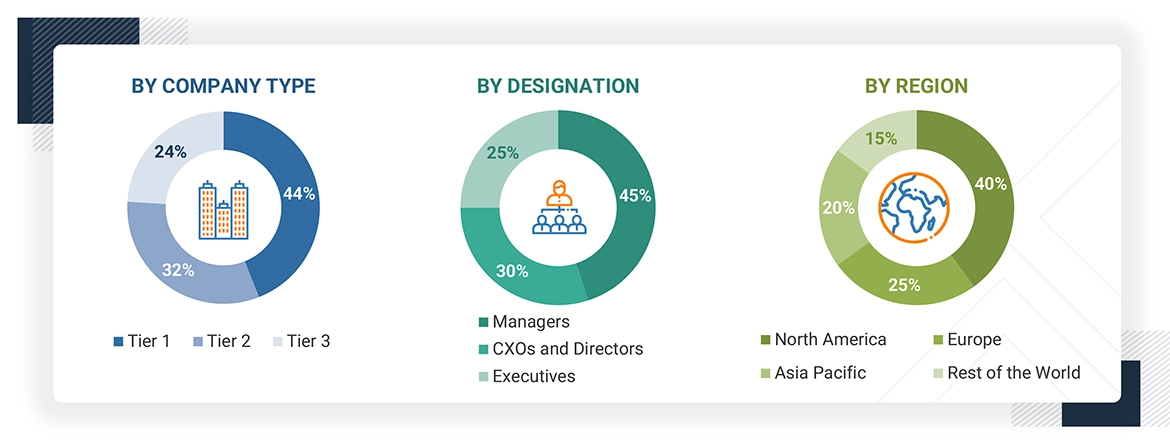
Extensive primary research was conducted after acquiring basic knowledge about the global single-cell sequencing market scenario through secondary research. Several primary interviews were conducted with market experts from both the demand side (personnel from, pharmaceutical & and biotechnology companies, hospitals & diagnostic laboratories, academic & research institutes, and contract research organization) and supply side (C-level and D-level executives, product managers, and marketing and sales managers of key manufacturers, distributors, and channel partners, among others, across six major regions—North America, Europe, the Asia Pacific, Latin America, Middle East, and Africa. Approximately 70% of primary interviews were conducted with supply-side representatives, while demand-side participants accounted for the remaining share. This preliminary data was collected through questionnaires, e-mails, online surveys, personal interviews, and telephonic interviews.
To know about the assumptions considered for the study, download the pdf brochure
Market Size Estimation
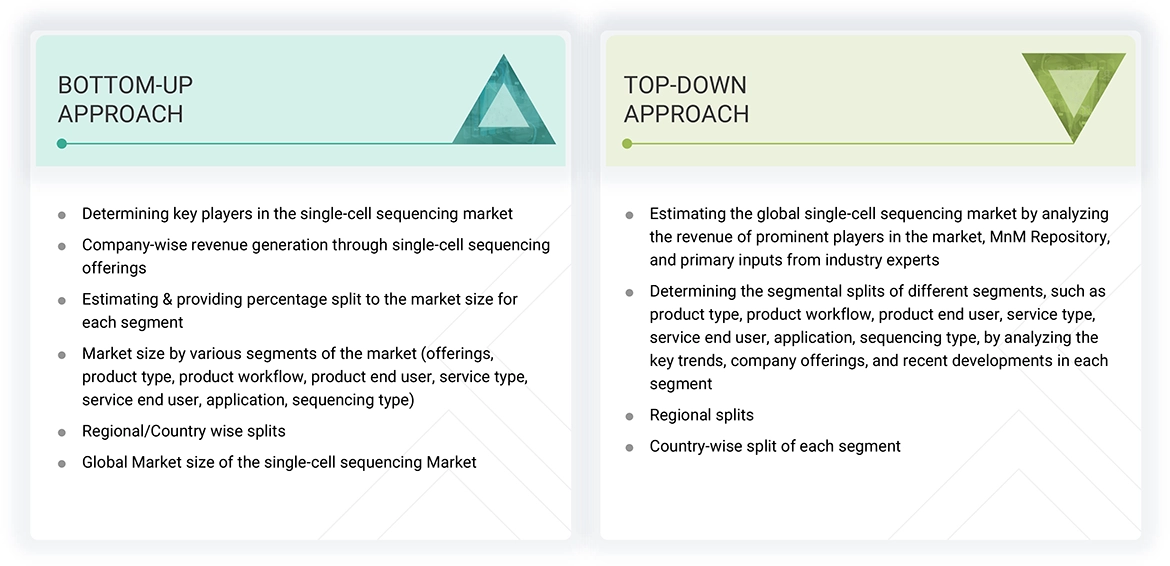
Both top-down and bottom-up approaches were used to estimate and validate the total size of the single-cell sequencing market. These methods were also used extensively to estimate the size of various subsegments in the market. The research methodology used to estimate the market size includes the following:
Single Cell Sequencing Market : Top-Down and Bottom-Up Approach
Data Triangulation
After arriving at the overall market size from the market size estimation process explained above, the total market was divided into several segments and subsegments. To complete the overall market engineering process and arrive at the exact statistics for all segments and subsegments, data triangulation and market breakdown procedures were employed, wherever applicable.
Market Definition
Single-cell sequencing (SCS) is a genomic technology that allows researchers to study the genetic material of individual cells. Unlike traditional sequencing methods that analyze bulk cell populations, single-cell sequencing helps identify differences between individual cells, providing a clearer understanding of cell functions, disease mechanisms, and treatment responses. The scope of the single-cell sequencing market includes a wide range of products and services used across the entire single-cell workflow. This covers pre-sequencing instruments and consumables (such as cell isolation tools and library preparation kits), sequencing instruments and consumables, and software for analyzing single-cell data. The market also includes services provided by third parties across pre-sequencing, sequencing, and data analysis stages. The market also studies various sequencing types, including single-cell RNA sequencing (scRNA-seq), single-cell DNA sequencing (scDNA-seq), and single-cell ATAC sequencing (scATAC-seq), among others. These technologies are widely used in basic and translational research, drug discovery, and clinical applications, especially in cancer, neurological, and infectious diseases. End users of these solutions studied in the report include academic and research institutions, pharmaceutical and biotechnology companies, hospitals and diagnostic labs, and contract research organizations (CROs).
Stakeholders
- Academic & Research Institutes
- Single-cell Sequencing Assay & Reagent Manufacturers, Vendors, and Distributors
- Contract Research Organizations (CROs)
- Single-cell Sequencing Service & Software Providers
- Diagnostics Companies
- Market Research & Consulting Firms
- Pharmaceutical & Biotechnology Companies
- Regulatory Agencies
- Venture Capitalists
- Government organizations
- Contract Development & Manufacturing Organizations (CDMOs)
- Hospitals and Diagnostic Laboratories
Report Objectives
- To define, describe, and forecast the global single-cell sequencing market based on offering, product type, product workflow, product end user, service type, service end user, sequencing type, application, and region
- To provide detailed information regarding the major factors influencing the market growth (such as drivers, restraints, opportunities, and challenges)
- To strategically analyze micro-markets with respect to individual growth trends, prospects, and contributions to the overall market
- To analyze the opportunities in the market for stakeholders and provide details of the competitive landscape for market leaders
- To forecast the size of the market segments with respect to six central regions, namely, North America, Europe, the Asia Pacific, Latin America, the Middle East, and Africa
- To profile the key players in the global single-cell sequencing market and comprehensively analyze their core competencies and market shares
- To track and analyze competitive developments such as acquisitions, product launches & approvals, expansions, agreements, partnerships, and collaborations in the single-cell sequencing market
- To benchmark players in the single-cell sequencing market using the “Company Evaluation Matrix” framework, which analyzes market players based on various parameters, including product portfolio, geographic reach, and market share
Available Customizations
With the given market data, MarketsandMarkets offers customizations to meet the company’s needs. The following customization options are available for the report:
Geographical Analysis
- Further breakdown of the Rest of Europe’s single-cell sequencing market, by country
- Further breakdown of the Rest of Asia Pacific’s single-cell sequencing market, by country
- Further breakdown of the Rest of Latin America’s single-cell sequencing market, by country
- Further breakdown of the Rest of the Middle East’s single-cell sequencing market, by country
Company Information
- Detailed analysis and profiling of additional market players (up to five)
Segment Analysis
- Further breakdown of the other technologies into subsegments
- Cross-segment analysis
Get the Full Single Cell Sequencing Market Report
Full forecast, segment splits, and company analysis for all Single Cell Sequencing Market.
- US Single Cell Sequencing Market
- Canada Single Cell Sequencing Market
- UK Single Cell Sequencing Market
- Germany Single Cell Sequencing Market
- France Single Cell Sequencing Market
- Italy Single Cell Sequencing Market
- Spain Single Cell Sequencing Market
- China Single Cell Sequencing Market
- Japan Single Cell Sequencing Market
- India Single Cell Sequencing Market
- South Korea Single Cell Sequencing Market
- Australia Single Cell Sequencing Market
- Brazil Single Cell Sequencing Market
- Mexico Single Cell Sequencing Market
- Rest Of Europe Single Cell Sequencing Market
- Rest Of Asia Pacific Single Cell Sequencing Market
- Ksa Single Cell Sequencing Market
- Other GCC Countries Single Cell Sequencing Market
- UAE Single Cell Sequencing Market
Need a Tailored Report?
Customize this report to your needs
Get 10% FREE Customization
Customize This Report
