
Brazil Solvent Recovery and Recycling Market (2023-2028)

The Brazil Solvent Recovery and Recycling Market was valued at $18.9 Million in 2023 and projected to reach to $23.2 Million by 2028, representing a compound annual growth rate of 4.2%. Brazil's solvent recovery and recycling market is positioned for consistent growth driven by the country's expanding chemical manufacturing base and strengthening environmental regulations.


| Market Size in | USD 26.32 MN |
| Market Forecast in | |
| CAGR | |
| Forecast Period | |
| Units Considered | Value (USD MN) |
Brazil Solvent Recovery and Recycling Market Trends and Insights
- Brazil's chemical manufacturing sector and increasing regulatory pressure on waste management are driving adoption of solvent recovery technologies across industrial operations.
- In Brazil, environmental compliance and cost reduction incentives are encouraging manufacturers to invest in sustainable solvent recycling solutions. The market in Brazil reflects growing awareness of circular economy principles within the country's industrial base.
- Brazil's pharmaceutical, coating, and chemical processing industries are primary end-users seeking efficient solvent recovery systems.
- Between 2023 and 2028, Brazil is expected to see steady demand as companies balance operational efficiency with stricter environmental standards.
- Brazil's market growth is supported by both domestic industrial expansion and international sustainability commitments..
Key Market Statistics
- CAGR (2023-2028) 4.2% CAGR
- Market Size, 2023 ~USD 18.9 Million
- Forecast, 2028 ~USD 23.2 Million
- Country Brazil
Brazil Solvent Recovery and Recycling Market Overview
Market Valuation :
Brazil's solvent recovery and recycling market reached USD 18.9 million in 2023, with projections to expand to USD 23.2 million by 2028, representing steady growth in the region's industrial sustainability sector.
Chemical Manufacturing Growth :
Brazil's robust chemical manufacturing sector is a primary driver of solvent recovery adoption, as producers seek cost-effective solutions to manage industrial waste streams and improve operational efficiency.
Regulatory Compliance Pressure :
Increasing environmental regulations and waste management compliance requirements in Brazil are compelling industrial operators to invest in solvent recovery technologies to meet stringent sustainability standards.
Regional Growth Rate :
The Brazilian market is expanding at a CAGR of 4.2% through 2028, slightly below the global average of 5%, reflecting steady but measured adoption of recovery technologies across local industries.
Brazil Solvent Recovery and Recycling Market Dynamics
- Industrial operators are increasingly recognizing the dual benefits of solvent recovery—cost reduction through recycled material reuse and compliance with Brazil's evolving waste management standards.
- The market's 4.2% CAGR reflects growing awareness among manufacturers of the economic and environmental advantages of recovery systems. Looking ahead to 2028, Brazil's market will be shaped by continued industrialization, particularly in petrochemicals and specialty chemicals, alongside government initiatives promoting circular economy practices.
- Investment in advanced recovery technologies and infrastructure development will be critical to capturing market opportunities.
- Companies that align their offerings with Brazil's regulatory framework and local manufacturing needs will be well-positioned to capitalize on this expanding market segment..
Market Ecosystem
Related Ecosystem
Bulk Chemicals And Inorganics
- Corrosion Inhibitors
- Glycol Ethers
- Acetic Acid
- Acetone
- Ammonium Nitrate
- Basf se
- DOW CHEMICAL COMPANY
- Exxon Mobil Corporation
- AZELIS HOLDINGS SA
- Sinopec limited
Membranes
- Reverse Osmosis
- Acetone
- Acrylonitrile Butadiene Styrene (ABS)
- Bioremediation
- Cartridge Filters
- Veolia
- Toray Industries, Inc.
- PALL CORPORATION
- DuPont de Nemours, Inc.
- Pentair plc
Water Purification
- Corrosion Inhibitors
- Cartridge Filters
- Fiberglass
- Reverse Osmosis
- Acetone
- Veolia
- Basf se
- CALGON CARBON CORPORATION
- SOLENIS
- Kemira oyj
Key Takeaways
- Brazil's solvent recovery market reached USD 18.9 million in 2023 with a 4.2% CAGR through 2028.
- Brazil's pharmaceutical and coating industries are primary drivers of solvent recycling adoption.
- Environmental regulations and cost efficiency are key motivators for Brazil's market expansion.
- Brazil is projected to reach USD 23.2 million in market value by 2028.
Solvent Recovery and Recycling Market Report Scope
| Report Metric | Details |
|---|---|
| Base Year | 2023 |
| Fastest Growing Segment | CRESOL (Solvent Type) |
| Forecast Period | 2023-2028 |
| Growth Rate | CAGR of 5% from 2023 to 2028 |
| Largest Segment | OTHER SOLVENT TYPES (Solvent Type) |
| Market Size Base Year (Billions) | ~USD 1.08 (2023) |
| Revenue Forecast (Billions) | ~USD 1.384 (2028) |
| Segments Covered | Solvent Type, End-Use Industry |
Brazil Solvent Recovery and Recycling Market Report Segmentation
2 segment dimensions are covered across the global market.
By Solvent Type
- 1,4-Dioxane
- 2-Aminoethanol
- Acetone
- Butanol
- Cresol
- Dmac (N, N-Dimethylacetamide)
- Dmf (N, N-Dimethylformamide)
- Dmso (Dimethyl Sulfoxide)
- E-Caprolactam
- Nmp (N-Methyl-2-Pyrrolidone)
- Other Solvent Types
- Propanol
- Terephthalic Acid
By End-Use Industry
- Chemicals
- Electronics
- Other End-Use Industries
- Paints & Coatings
- Pharmaceuticals
- Printing
BRAZIL: SOLVENT RECOVERY AND RECYCLING MARKET, BY END-USE INDUSTRY, 2023–2028
| Segment | 2023 | 2024 | 2025 | 2026 | 2027 | 2028 | CAGR (%) |
|---|---|---|---|---|---|---|---|
| CHEMICALS | 3.9 | 4 | 4.2 | 4.4 | 4.6 | 4.7 | 4.1 |
| ELECTRONICS | 2.1 | 2.1 | 2.2 | 2.3 | 2.4 | 2.5 | 3.7 |
| OTHER END-USE INDUSTRIES | 1.9 | 2 | 2.1 | 2.2 | 2.3 | 2.3 | 3.8 |
| PAINTS & COATINGS | 4.5 | 4.7 | 4.9 | 5.2 | 5.4 | 5.6 | 4.4 |
| PHARMACEUTICALS | 3.4 | 3.5 | 3.6 | 3.8 | 4 | 4.1 | 4 |
| PRINTING | 3.1 | 3.3 | 3.4 | 3.6 | 3.8 | 4 | 4.7 |
| TOTAL | 18.9 | 19.6 | 20.4 | 21.4 | 22.5 | 23.2 | 4.2 |
Target Audience
- Chemical Manufacturers : Brazilian chemical producers need market data to evaluate solvent recovery investments, optimize waste management costs, and ensure compliance with local environmental regulations.
- Technology Providers : Solvent recovery equipment and technology vendors require Brazil-specific market insights to identify growth opportunities, assess demand, and develop localized product offerings.
- Industrial Investors : Private equity and industrial investors evaluating opportunities in Brazil's sustainability sector need reliable market sizing and growth forecasts to support investment decisions.
- Environmental Consultants : Sustainability and environmental compliance consultants serving Brazilian industries require market intelligence to advise clients on solvent recovery adoption and regulatory alignment.
- Government & Policy Makers : Brazilian regulatory bodies and policy makers need market data to inform environmental policies, circular economy initiatives, and industrial sustainability programs.
Reasons to Buy this Report
- Localized Market Intelligence : Gain Brazil-specific insights into market size, growth trajectories, and regional dynamics that differ from global trends, enabling targeted business strategy development for the Brazilian market.
- Regulatory Landscape Understanding : Understand Brazil's unique environmental compliance requirements and waste management regulations driving solvent recovery adoption, critical for market entry and operational planning.
- Competitive Positioning : Identify growth opportunities within Brazil's chemical manufacturing sector and assess competitive dynamics specific to the region to inform product development and market expansion strategies.
- Investment Decision Support : Make informed investment and partnership decisions in Brazil's solvent recovery sector with reliable market forecasts, valuation data, and growth projections through 2028.
- Sector-Specific Insights : Access detailed analysis of how Brazil's chemical manufacturing, petrochemicals, and specialty chemicals industries are driving demand for solvent recovery and recycling solutions.
Frequently asked questions
What is the current size of Brazil's solvent recovery market?
Brazil's solvent recovery and recycling market was valued at USD 18.9 million in 2023.
What is the forecast for Brazil's solvent recovery market by 2028?
Brazil's market is projected to reach USD 23.2 million by 2028, growing at a 4.2% CAGR.
Which industries drive solvent recovery demand in Brazil?
Brazil's pharmaceutical, coating, and chemical processing industries are the primary end-users of solvent recovery solutions.
What factors are accelerating growth in Brazil's solvent recovery market?
Environmental regulations, cost reduction incentives, and circular economy awareness are key growth drivers in Brazil.
How does Brazil's market growth compare to global trends?
Brazil's 4.2% CAGR is slightly below the global average of 5%, reflecting regional industrial maturity and regulatory adoption rates.
RESEARCH METHODOLOGY
The study involved four major activities in estimating the current market size for solvent recovery and recycling. Exhaustive secondary research was done to collect information on the market, peer market, and parent market. The next step was to validate these findings, assumptions, and sizing with industry experts across the value chain through primary research. Both top-down and bottom-up approaches were employed to estimate the complete market size. After that, the market breakdown and data triangulation methodologies were used to estimate the market size of segments and sub-segments.
Secondary Research
In the secondary research process, various sources have been referred to for identifying and collecting information for this study. The secondary sources include annual reports, press releases, and investor presentations of companies; white papers, journals, and certified publications; and articles from recognized authors, directories, and databases. Secondary data has been collected and analyzed to arrive at the overall market size, which is further validated by primary research. Secondary research has been used to obtain key information about the value chain of the industry, monetary chain of the market, the total pool of key players, market classification and segmentation according to industry trends to the bottom-most level, and regional markets. It was also used to obtain information about the key developments from a market-oriented perspective.
Primary Research
The solvent recovery and recycling market involves a variety of stakeholders across the value chain, including raw material suppliers, manufacturers, and end-users. For this study, both the supply and demand sides of the market were interviewed to gather qualitative and quantitative information. Key opinion leaders from various end-use sectors were interviewed from the demand side, while manufacturers and associations were interviewed from the supply side.
Primary interviews helped to gather insights on market statistics, revenue data, market breakdowns, market size estimations, market forecasting, and data triangulation. Primary research also helped to identify trends related to material type, component, end-use industries, and region. C-level executives from the demand side, such as CIOs, CTOs, and CSOs, were interviewed to understand their perspective on suppliers, products, and component providers, which will affect the overall market.
Breakdown of Primaries
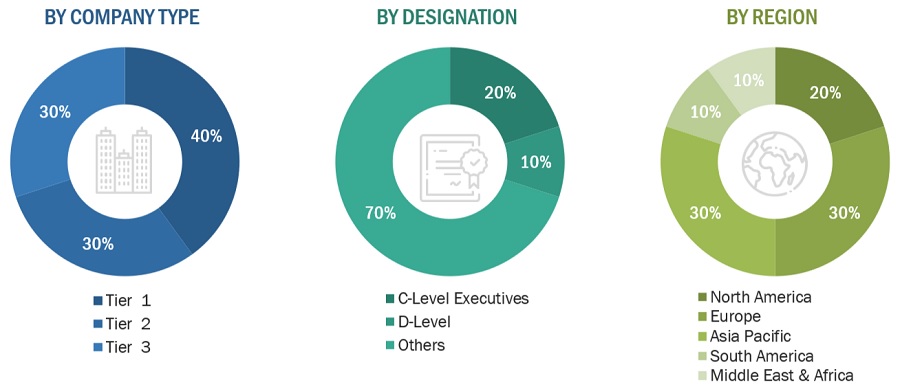
Note: Tier 1, Tier 2, and Tier 3 companies are classified based on their market revenue in 2022 available in the public domain, product portfolios, and geographical presence.
Other designations include sales representatives, production heads, and technicians.
To know about the assumptions considered for the study, download the pdf brochure
Market Size Estimation
- The top-down approach was used to estimate and validate the size of various submarkets for solvent recovery and recycling for each region. The research methodology used to estimate the market size included the following steps:
- The key players in the industry have been identified through extensive secondary research.
- The supply chain of the industry has been determined through primary and secondary research.
- The global market was then segmented into five major regions and validated by industry experts.
- All percentage shares, splits, and breakdowns based on type, end-use industry, and country were determined using secondary sources and verified through primary sources.
All possible parameters that affect the markets covered in this research study were accounted for, viewed in extensive detail, verified through primary research, and analyzed to get the final quantitative and qualitative data. This data was consolidated and added with detailed inputs and analysis and presented in this report.
Solvent Recovery And Recycling Market: Bottum-Up Approach
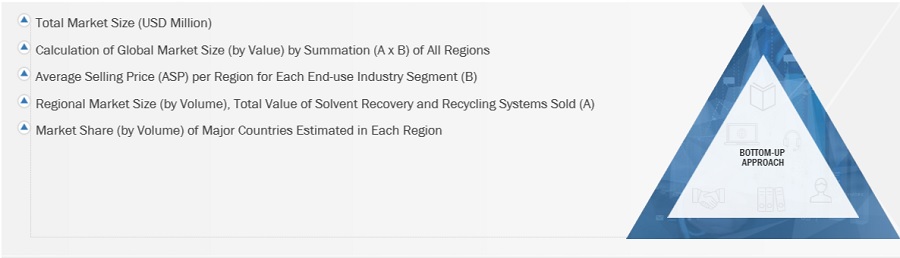
Source: Secondary Research, Interviews with Experts, and MarketsandMarkets Analysis
To know about the assumptions considered for the study, Request for Free Sample Report
Solvent Recovery And Recycling Market: Top-Down Approach
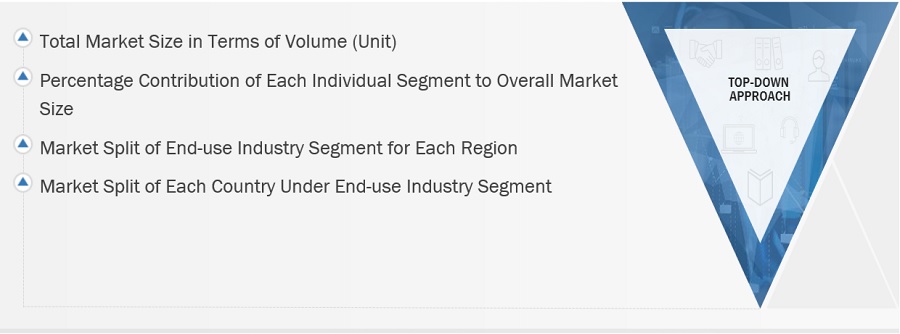
Source: Secondary Research, Interviews with Experts, and MarketsandMarkets Analysis
Data Triangulation
After arriving at the overall market size—using the market size estimation process explained above—the market was split into several segments and sub-segments. To complete the overall market engineering process and arrive at the exact statistics of each market segment and sub-segment, the data triangulation, and market breakdown procedures were employed, wherever applicable. The data was triangulated by studying various factors and trends from both the demand and supply of solvent recovery and recycling and their applications.
MARKET DEFINITION
Solvent recovery and recycling involve the process of extracting and reusing useful materials from waste or by-product solvents generated during manufacturing. This process is a form of waste reduction and is widely used to reduce waste generation and minimize the need to produce new solvents. Solvent recovery typically uses a multi-stage distillation process to separate solvents into their components at lower-than-boiling point temperatures, resulting in recovered solvents that are virtually indistinguishable from virgin solvent products. The recovered solvents can then be repurposed, reducing the need to produce new solvents and eliminating a large amount of waste, while also removing potentially hazardous substances from the environment. The solvent recycling process can be performed using a variety of technologies, including distillation, and the requalified recovered solvents can be used for manufacturing different products or solutions, making the process both cost-effective and environmentally friendly.
STAKEHOLDERS
- Manufacturers of solvent recovery and recycling systems
- Manufacturers In End-use Industries
- Traders, Distributors, and Suppliers
- Regional Manufacturers’ Associations
- Government & Regional Agencies and Research Organizations
The main objectives of this study are as follows:
- To analyze and forecast the size of the solvent recovery and recycling market in terms of value and volume.
- To provide detailed information about the key factors (drivers, restraints, opportunities, and challenges) influencing the market
- To analyze and forecast the market by solvent type, end-use industry, and region.
- To forecast the size of the market with respect to five regions: Asia Pacific, Europe, North America, South America, and the Middle East & Africa, along with their key countries
- To strategically analyze micromarkets1 with respect to individual trends, growth prospects, and their contribution to the overall market
- To analyze opportunities in the market for stakeholders and provide a competitive landscape for the market leaders.
- To analyze competitive developments in the market, such as investment & expansion, joint venture, partnership, and merger & acquisition
- To strategically profile key players and comprehensively analyze their market shares and core competencies2.
- Notes: Micromarkets1 are the sub-segments of the solvent recovery and recycling market included in the report.
- Core competencies2 of companies are determined in terms of their key developments, SWOT analysis, and key strategies adopted by them to sustain in the market.
Available Customizations:
MarketsandMarkets offers the following customizations for this market report.
- Additional country-level analysis of solvent recovery and recycling market
- Profiling of additional market players (up to 3)
Get the Full Solvent Recovery and Recycling Market Report
Full forecast, segment splits, and company analysis for all Solvent Recovery and Recycling Market.
- US Solvent Recovery and Recycling Market
- Canada Solvent Recovery and Recycling Market
- Mexico Solvent Recovery and Recycling Market
- Germany Solvent Recovery and Recycling Market
- France Solvent Recovery and Recycling Market
- Spain Solvent Recovery and Recycling Market
- UK Solvent Recovery and Recycling Market
- Italy Solvent Recovery and Recycling Market
- China Solvent Recovery and Recycling Market
- India Solvent Recovery and Recycling Market
- Japan Solvent Recovery and Recycling Market
- South Korea Solvent Recovery and Recycling Market
- South Africa Solvent Recovery and Recycling Market
- Argentina Solvent Recovery and Recycling Market
- Rest Of Europe Solvent Recovery and Recycling Market
- Rest Of Asia Pacific Solvent Recovery and Recycling Market
- GCC Countries Solvent Recovery and Recycling Market
- -Rest Of GCC Solvent Recovery and Recycling Market
- Rest Of South America Solvent Recovery and Recycling Market
Need a Tailored Report?
Customize this report to your needs
Get 10% FREE Customization
Customize This Report
