
China Spatial Genomics & Transcriptomics Market (2024-2029)

The China Spatial Genomics & Transcriptomics Market was valued at $32.84 Million in 2024 and projected to reach to $62.54 Million by 2029, representing a compound annual growth rate of 13.7%. China's spatial genomics and transcriptomics market is poised for accelerated growth, driven by government initiatives in precision medicine, expanding research capabilities, and increasing clinical adoption.


| Market Size in | USD 26.32 MN |
| Market Forecast in | |
| CAGR | |
| Forecast Period | |
| Units Considered | Value (USD MN) |
China Spatial Genomics & Transcriptomics Market Trends and Insights
- This represents a compound annual growth rate of 13.7%, outpacing global averages and reflecting China's strategic investments in precision medicine and genomic research infrastructure.
- China's market growth is driven by increasing government funding for life sciences, rising adoption of advanced diagnostic technologies, and expanding research capabilities across academic and commercial institutions. The spatial genomics sector in China benefits from the country's large patient population, growing healthcare expenditure, and emphasis on translating genomic discoveries into clinical applications.
- China's pharmaceutical and biotech companies are increasingly integrating spatial transcriptomics into drug development pipelines, while academic centers leverage these technologies for cancer research and tissue characterization.
- By 2029, China is expected to consolidate its position as a leading market for spatial genomics technologies in the Asia-Pacific region, supported by regulatory frameworks favoring innovation and substantial R&D investments..
Key Market Statistics
- CAGR (2024-2029) 13.7% CAGR
- Market Size, 2024 ~USD 32.84 Million
- Forecast, 2029 ~USD 62.54 Million
- Country China
China Spatial Genomics & Transcriptomics Market Overview
Market Valuation & Growth :
China's spatial genomics and transcriptomics market reached $32.84 million in 2024, with a projected CAGR of 13.7% through 2029, significantly outpacing the global growth rate of 12.4%.
Government Investment & Infrastructure :
China's strategic focus on precision medicine and genomic research infrastructure is driving market expansion, supported by substantial government funding and national genomics initiatives.
Forecast Growth Trajectory :
The market is expected to nearly double, reaching $62.54 million by 2029, reflecting accelerating adoption of spatial genomics technologies across research institutions and clinical applications.
Regional Leadership Position :
China is establishing itself as a key player in spatial genomics innovation, with increasing investments in R&D facilities, academic partnerships, and commercialization of genomic technologies.
China Spatial Genomics & Transcriptomics Market Dynamics
- The 13.7% CAGR reflects strong demand from academic institutions, pharmaceutical companies, and diagnostic centers seeking advanced genomic analysis tools.
- China's competitive advantage in manufacturing and technology integration positions it as a regional hub for spatial genomics innovation. The forecast period through 2029 will see significant expansion as healthcare providers adopt spatial transcriptomics for cancer research, drug discovery, and personalized medicine applications.
- Increased collaboration between Chinese biotech firms and international partners, combined with rising healthcare expenditure and genomic literacy, will further accelerate market penetration across tier-1 and tier-2 cities..
Market Ecosystem
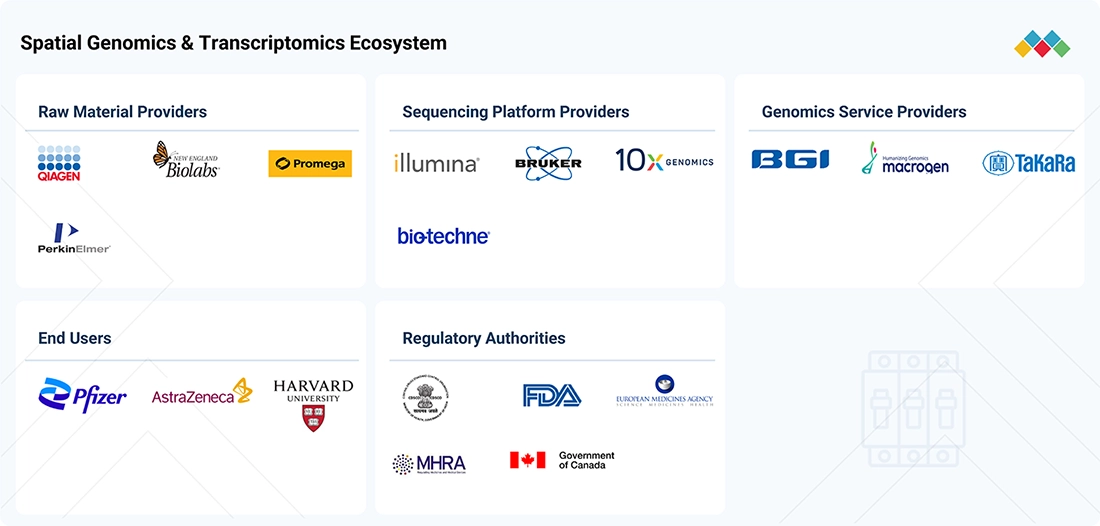
SPATIAL GENOMICS & TRANSCRIPTOMICS MARKET: COMMERCIAL USE CASES ACROSS INDUSTRIES
| COMPANY | USE CASE DESCRIPTION | BENEFITS |
|---|---|---|
 |
Visium and Xenium platforms enable spatial gene expression analysis in intact tissues for oncology research, cellular mapping, biomarker discovery, and tissue heterogeneity studies. | Enables high-resolution spatial profiling | Supports cellular and tissue-level analysis | Facilitates biomarker discovery and translational research |
 |
The CosMx Spatial Molecular Imager enables high-plex spatial RNA analysis to investigate cellular interactions, tumor microenvironments, and gene expression in oncology, neuroscience, and immunology. | Enables detailed spatial gene expression analysis | Preserves tissue architecture | Supports investigation of cellular interactions and disease mechanisms |
 |
Sequencing platforms and reagents support sequencing-based spatial transcriptomics workflows for tissue profiling, disease research, biomarker discovery, and translational studies. | Supports high-throughput sequencing and downstream spatial data analysis | Enables gene expression profiling | Facilitates integration of spatial transcriptomics with broader genomic research |
Logos and trademarks shown above are the property of their respective owners. Their use here is for informational and illustrative purposes only.
Related Ecosystem
Key Takeaways
- China's spatial genomics & transcriptomics market is valued at $32.84 million in 2024, with a projected value of $62.54 million by 2029, representing 13.7% CAGR.
- China's market growth outpaces the global average of 12.4% CAGR, driven by government funding, precision medicine initiatives, and expanding biotech infrastructure.
- China's pharmaceutical and biotech sectors are rapidly adopting spatial transcriptomics for drug development and cancer research applications.
- By 2029, China is positioned to become a leading regional hub for spatial genomics technologies within Asia-Pacific, supported by regulatory innovation and R&D investment.
Spatial Genomics & Transcriptomics Market Report Scope
| Report Metric | Details |
|---|---|
| Base Year | 2024 |
| Fastest Growing Segment | SERVICES (Offering) |
| Forecast Period | 2024-2029 |
| Growth Rate | CAGR of 12.4% from 2024 to 2029 |
| Largest Segment | PRODUCTS (Offering) |
| Market Size Base Year (Billions) | ~USD 0.56 (2024) |
| Revenue Forecast (Billions) | ~USD 0.9957 (2029) |
| Segments Covered | Offering, Type, Technique, Application, End User |
China Spatial Genomics & Transcriptomics Market Report Segmentation
5 segment dimensions are covered across the global market.
By Offering
- Products
- Services
By Type
- Cancer
- Chromatin Accessibility Sequencing
- Consumables
- Data Visualization & Analysis Services
- Genomic Sequencing
- Immunofluorescence
- Immunohistochemistry
- Immunology
- In-Situ Hybridization
- In-Situ Rna Sequencing
- Infectious Diseases
- Instruments & Software
- Laser Capture Microdissection
- Microdissection-Based Sequencing
- Microscopy-Based Rna Imaging
- Microscopy-Based Rna Imaging Techniques
- Neuroscience
- Other Diseases
- Other Genomic Sequencing
- Other Genomic Sequencing \
- Other Rna Sequencing
- Other Spatial Genomics Techniques
- Other Spatial Transcriptomic Techniques
- Other Spatial Transcriptomics Techniques
- Rna Sequencing
- Rna Sequencing Techniques
- Sample Preparation Services
- Sequencing & Analytical Services
- Single-Cell Rna Sequencing
By Technique
- Spatial Genomics
- Spatial Transcriptomics
By Application
- Drug Discovery & Development
- Translational Research
By End User
- Academic & Research Institutes
- Clinical Diagnostic Laboratories
- Cros & Cdmos
- Other End Users
- Pharmaceutical & Biotechnology Companies
CHINA: SPATIAL GENOMICS & TRANSCRIPTOMICS SERVICES MARKET, BY END USER, 2022–2029
| Segment | 2022 | 2023 | 2024 | 2025 | 2026 | 2027 | 2028 | 2029 | CAGR (%) |
|---|---|---|---|---|---|---|---|---|---|
| ACADEMIC & RESEARCH INSTITUTES | 1.5 | 2.5 | 2.9 | 3.4 | 4.1 | 4.9 | 6 | 7.3 | 20.5 |
| OTHER END USERS | 0.6 | 1 | 1.1 | 1.3 | 1.6 | 1.9 | 2.3 | 2.8 | 20.1 |
| PHARMACEUTICAL & BIOTECHNOLOGY COMPANIES | 0.7 | 1.1 | 1.3 | 1.5 | 1.9 | 2.3 | 2.8 | 3.4 | 21.2 |
| TOTAL | 2.8 | 4.6 | 5.3 | 6.2 | 7.5 | 9 | 11 | 13.4 | 20.6 |
CHINA: SPATIAL GENOMICS & TRANSCRIPTOMICS PRODUCTS MARKET, BY END USER, 2022–2029
| Segment | 2022 | 2023 | 2024 | 2025 | 2026 | 2027 | 2028 | 2029 | CAGR (%) |
|---|---|---|---|---|---|---|---|---|---|
| ACADEMIC & RESEARCH INSTITUTES | 13.5 | 20.2 | 21.2 | 23.3 | 26.2 | 29.8 | 34.4 | 39.9 | 13.5 |
| CLINICAL DIAGNOSTIC LABORATORIES | 0.3 | 0.5 | 0.5 | 0.5 | 0.6 | 0.7 | 0.9 | 1 | 16 |
| CROS & CDMOS | 4.2 | 6.2 | 6.5 | 7.1 | 8 | 9.1 | 10.4 | 12 | 13.1 |
| PHARMACEUTICAL & BIOTECHNOLOGY COMPANIES | 2.8 | 4.3 | 4.6 | 5.2 | 6 | 6.9 | 8.1 | 9.6 | 15.7 |
| TOTAL | 20.8 | 31.2 | 32.8 | 36.2 | 40.8 | 46.5 | 53.8 | 62.5 | 13.7 |
Target Audience
- Pharmaceutical & Biotech Companies : Need China-specific market data to evaluate opportunities in precision medicine, drug discovery partnerships, and clinical genomics applications within the world's fastest-growing biotech market.
- Healthcare Investors & PE Firms : Require detailed market sizing and growth forecasts for China to assess investment returns, identify acquisition targets, and allocate capital to high-growth genomics and diagnostics ventures.
- Diagnostic & Laboratory Service Providers : Seek market intelligence on spatial transcriptomics adoption rates, clinical demand, and reimbursement trends in China to guide service expansion and technology infrastructure investments.
- Research Institutions & Academic Centers : Need insights into China's genomic research funding landscape, institutional partnerships, and technology adoption to secure grants, collaborate with industry, and advance precision medicine research.
- Medical Device & Technology Vendors : Require China market analysis to understand demand for spatial genomics platforms, competitive positioning, regulatory pathways, and customer segments for product commercialization strategies.
Reasons to Buy this Report
- Market Size & Forecast Data : Access precise valuation metrics for China's spatial genomics market with detailed 2024-2029 projections, enabling accurate financial planning and investment decisions for market entry or expansion.
- Competitive Intelligence : Understand China's market dynamics, key players, and growth drivers to identify competitive advantages and strategic positioning opportunities in the rapidly expanding precision medicine sector.
- Regional Growth Insights : Leverage China-specific CAGR analysis (13.7%) and comparative global benchmarking to assess market potential and prioritize resource allocation across geographic regions.
- Investment & Partnership Opportunities : Identify high-growth segments within China's genomics ecosystem, including government-backed initiatives and emerging biotech partnerships, to guide strategic investments and collaborations.
- Regulatory & Market Landscape : Gain actionable intelligence on China's precision medicine infrastructure, healthcare policies, and technology adoption trends to navigate market entry and optimize go-to-market strategies.
Frequently asked questions
What is the current market size of spatial genomics in China?
China's spatial genomics and transcriptomics market was valued at $32.84 million in 2024 and is expected to grow to $62.54 million by 2029.
What is the CAGR for China's spatial genomics market?
China's spatial genomics and transcriptomics market is projected to grow at a compound annual growth rate of 13.7% from 2024 to 2029.
What factors are driving growth in China's spatial genomics market?
Key drivers include government funding for life sciences, increasing adoption of precision medicine, expanding biotech infrastructure, and growing pharmaceutical R&D investments in China.
How does China's market growth compare to global trends?
China's 13.7% CAGR exceeds the global average of 12.4%, reflecting stronger regional demand and strategic investments in genomic technologies within China.
Which applications are most prominent in China's spatial genomics market?
Cancer research, tissue characterization, and drug development are the primary applications driving adoption of spatial transcriptomics technologies in China.
RESEARCH METHODOLOGY
This research study extensively utilized secondary sources, directories, and databases to identify and collect valuable information for analyzing the global spatial genomics & transcriptomics market. In-depth interviews were conducted with various primary respondents, including key industry participants, subject-matter experts (SMEs), C-level executives of key market players, and industry consultants, to obtain and verify critical qualitative & quantitative information and assess the growth prospects of the market. The global market size estimated through secondary research was triangulated with inputs from primary research to determine the final market size.
Secondary Research
Secondary research was primarily used to identify and collect information for the comprehensive technical, market-oriented, and commercial study of the spatial genomics & transcriptomics market. The secondary sources referred to for this research study include publications from government sources, such as the World Health Organization (WHO), National Institutes of Health (NIH), Organisation for Economic Co-operation and Development (OECD), International Agency for Research on Cancer (IARC), Research!America, Genome Canada, GenomeWeb, South African Medical Research Council (SAMRC), Wellcome Sanger Institute, Genome Research Limited, Labiotech.eu, R&D World Magazine, India Brand Equity Foundation (IBEF), Biotechnology Innovation Organization (BIO), National Center for Biotechnology Information (NCBI), BioPharm International, EvaluatePharma, ScienceDirect, and Eurostat, among others.
Secondary sources also included corporate and regulatory filings (such as annual reports, SEC filings, investor presentations, and financial statements), business magazines and research journals, press releases, and trade, business, and professional associations. Secondary data was collected and analyzed to determine the overall size of the global market, which was validated through primary research.
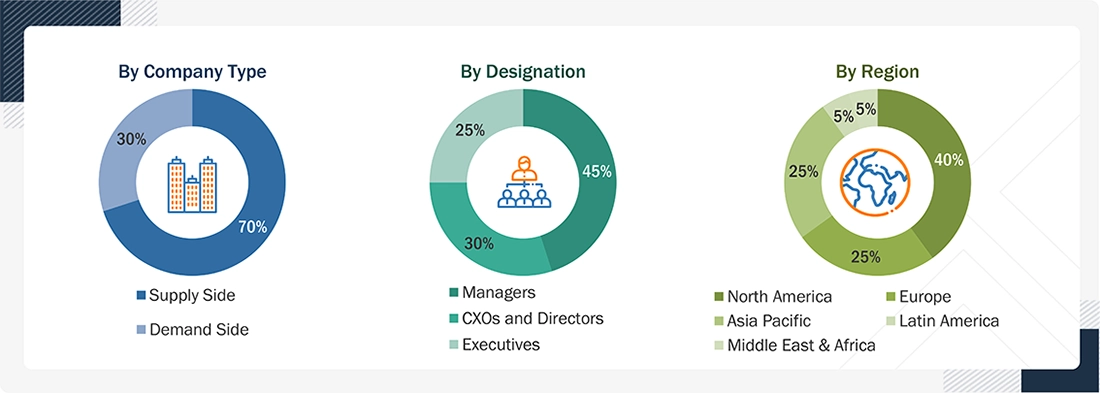
Primary Research
In-depth interviews were conducted with various primary respondents, including key industry participants, subject-matter experts (SMEs), C-level executives of key market players, and industry consultants, to obtain and verify critical qualitative & quantitative information and assess the market’s prospects. Various primary sources from the supply & demand sides of the market were interviewed to obtain qualitative and quantitative information.
To know about the assumptions considered for the study, download the pdf brochure
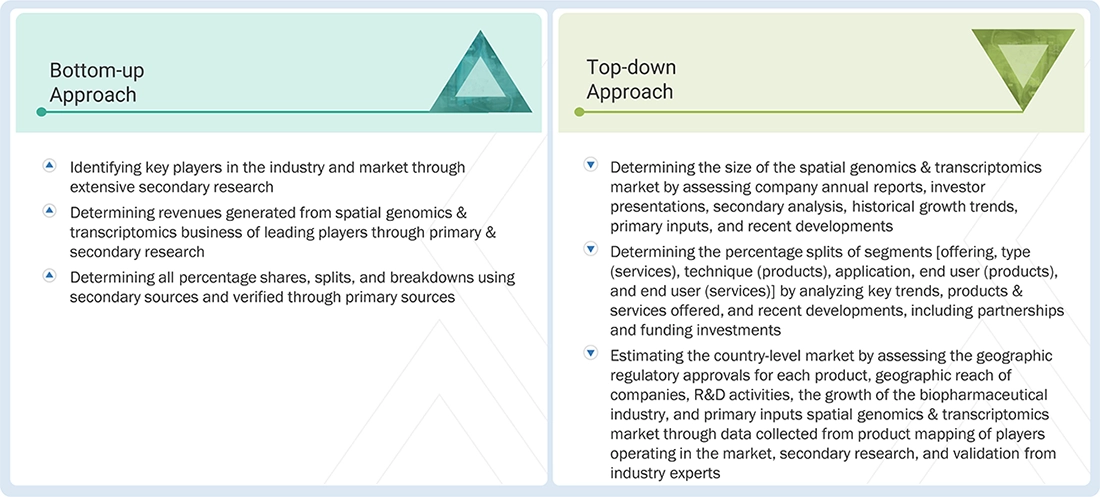
Market Size Estimation
The top-down and bottom-up approaches were used to estimate & validate the total size of the spatial genomics & transcriptomics market. These methods were also used extensively to estimate the size of various market segments.
Data Triangulation
After evaluating the overall market size through the market size estimation process, the total market was divided into several segments and subsegments. Data triangulation and market breakdown procedures were used, whenever applicable, to complete the overall market engineering process and obtain precise statistics for all segments and subsegments. The data were triangulated by analyzing various factors and trends from the demand and supply sides.
Market Definition
Spatial genomics and transcriptomics are pioneering technologies that allow scientists to measure gene activity in a tissue sample and map the site of the activity. Spatial transcriptomics helps spatially resolve RNA-seq data and all mRNAs in individual tissue sections. The technology is presently used in translational research and can be used in clinical diagnosis in the future. Spatial genomics also helps map gene expression across human tissues.
The scope of the market encompasses the tools, technologies, and services used to explore the spatial distribution and organization of genetic material and gene expression within cells and tissues.
Key Stakeholders
- Manufacturers and distributors
- Service providers
- Pharmaceutical and biotechnology companies
- Contract research organizations (CROs)
- Contract development & manufacturing organizations (CDMOs)
- Market research and consulting firms
- R&D centers
- Researchers and scientists
- Academic & research institutes
- Market research and consulting firms
- Regulatory agencies
- Venture capitalists
- Government organizations
- Industry associations and professional societies
Report Objectives
- To define, describe, and forecast the spatial genomics & transcriptomics market based on offering, technique (products), type (services), application, end user (products), end user (services), and region, in terms of value
- To forecast the size of the market segments concerning six main regions, namely North America, Europe, Asia Pacific, Latin America, the Middle East, and Africa, in terms of value
- To provide detailed information regarding the major factors, such as drivers, restraints, opportunities, and challenges, influencing the market growth
- To strategically analyze micromarkets concerning individual growth trends, prospects, and contributions to the overall market
- To analyze the opportunities in the market for stakeholders and provide details of the competitive landscape for market leaders
- To strategically profile the key players in the market and comprehensively analyze their core competencies and market rankings
- To track and analyze competitive developments, such as product & service launches, acquisitions, expansions, agreements, partnerships, and collaborations, in the market
- To benchmark players within the market using the ‘Company Evaluation Matrix’ framework, which analyzes market players based on various parameters within the broad categories of business and product/service strategy
Available customizations:
With the given market data, MarketsandMarkets offers customizations per the company’s specific needs. The following customization options are available for this report:
Geographical Analysis
- Further breakdown of the Rest of Europe spatial genomics & transcriptomics market, by country
- Further breakdown of the Rest of Asia Pacific spatial genomics & transcriptomics market, by country
- Further breakdown of the Rest of Latin America spatial genomics & transcriptomics market, by country
Company Information
- Detailed analysis and profiling of additional market players (up to five)
Get the Full Spatial Genomics & Transcriptomics Market Report
Full forecast, segment splits, and company analysis for all Spatial Genomics & Transcriptomics Market.
- US Spatial Genomics & Transcriptomics Market
- Canada Spatial Genomics & Transcriptomics Market
- Germany Spatial Genomics & Transcriptomics Market
- UK Spatial Genomics & Transcriptomics Market
- France Spatial Genomics & Transcriptomics Market
- Italy Spatial Genomics & Transcriptomics Market
- Spain Spatial Genomics & Transcriptomics Market
- Japan Spatial Genomics & Transcriptomics Market
- India Spatial Genomics & Transcriptomics Market
- South Korea Spatial Genomics & Transcriptomics Market
- Australia Spatial Genomics & Transcriptomics Market
- Brazil Spatial Genomics & Transcriptomics Market
- Mexico Spatial Genomics & Transcriptomics Market
- Rest Of Europe Spatial Genomics & Transcriptomics Market
- Rest Of Asia Pacific Spatial Genomics & Transcriptomics Market
- Rest Of Latin America Spatial Genomics & Transcriptomics Market
Need a Tailored Report?
Customize this report to your needs
Get 10% FREE Customization
Customize This Report
