
France Sulfur Based Micronutrients Market (2024-2029)

The France Sulfur Based Micronutrients Market was valued at $12.11 Million in 2024 and projected to reach to $16.04 Million by 2029, representing a compound annual growth rate of 5.8%. France's sulfur based micronutrients market is poised for moderate but stable growth through 2029, supported by the country's commitment to sustainable agriculture and precision farming practices.


| Market Size in | USD 26.32 MN |
| Market Forecast in | |
| CAGR | |
| Forecast Period | |
| Units Considered | Value (USD MN) |
France Sulfur Based Micronutrients Market Trends and Insights
- France represents a significant segment within the European micronutrient landscape, driven by the country's robust agricultural sector and increasing adoption of specialized fertilizer solutions.
- The market in France reflects steady demand from both conventional and precision farming operations seeking to optimize crop yields and soil health. The growth trajectory for France's sulfur based micronutrients market is supported by rising awareness among French farmers regarding micronutrient deficiencies and their impact on productivity.
- France's commitment to sustainable agriculture and regulatory frameworks promoting balanced nutrient management further bolster market expansion through 2029.
- The country's established distribution networks and strong agricultural research institutions position France as a key market for sulfur-based micronutrient innovations within Europe..
Key Market Statistics
- CAGR (2024-2029) 5.8% CAGR
- Market Size, 2024 ~USD 12.11 Million
- Forecast, 2029 ~USD 16.04 Million
- Country France
France Sulfur Based Micronutrients Market Overview
Market Valuation :
France's sulfur based micronutrients market reached USD 12.11 million in 2024, reflecting steady demand from the country's established agricultural sector and premium fertilizer adoption rates.
Growth Trajectory :
The French market is projected to expand at a CAGR of 5.8% through 2029, reaching USD 16.04 million, demonstrating consistent growth despite being below the global average of 8.8%.
Agricultural Foundation :
France's robust agricultural sector, including viticulture, cereal production, and specialty crops, drives significant demand for sulfur-based micronutrient solutions to enhance soil health and crop yields.
European Positioning :
As a key European market, France represents a significant segment within the continent's micronutrient landscape, with strong regulatory frameworks supporting sustainable and specialized fertilizer adoption.
France Sulfur Based Micronutrients Market Dynamics
- The French agricultural sector's emphasis on quality production, particularly in wine regions and specialty crops, creates consistent demand for micronutrient solutions that enhance soil composition and plant nutrition.
- Regulatory support for environmentally responsible farming methods further strengthens market prospects. The market's 5.8% CAGR reflects France's mature agricultural infrastructure and established farmer adoption patterns.
- Growth will be driven by increasing awareness of sulfur deficiency in soils, adoption of advanced fertilizer technologies, and compliance with EU sustainability directives.
- Investment in agricultural innovation and organic farming transitions will continue to support market expansion through the forecast period..
Market Ecosystem
Related Ecosystem
Speciality Chemicals
- Corrosion Inhibitors
- Polyetheretherketone (PEEK)
- Acrylonitrile Butadiene Styrene (ABS)
- Epoxy Resin
- Polycarbonate
- Basf se
- DOW CHEMICAL COMPANY
- Evonik industries ag
- Clariant ag.
- Solvay sa
Fandb Logistics Cold Chain And Packaging
- Rigid Packaging
- Acrylics
- Active Packaging
- Dairy Products
- Gravure Process
- Amcor plc
- Basf se
- Essentra plc
- Sonoco Products Company
- AZELIS HOLDINGS SA
Fandb Processing And Technology
- Dairy Products
- Bakery Products
- Filtration Equipment
- Heat Exchanger
- Acetic Acid
- Gea group
- John Bean Technologies Corporation
- Alfa Laval Corporate AB
- AZELIS HOLDINGS SA
- SPX FLOW INC
Key Takeaways
- France's sulfur based micronutrients market is valued at USD 12.11 million in 2024 with projected growth to USD 16.04 million by 2029.
- France demonstrates a steady 5.8% CAGR, reflecting moderate but consistent market expansion driven by agricultural modernization.
- French farmers increasingly recognize sulfur deficiency as a critical yield-limiting factor, boosting demand for targeted micronutrient solutions.
- France's regulatory environment and sustainability initiatives create favorable conditions for sulfur-based micronutrient adoption through the forecast period.
Sulfur Based Micronutrients Market Report Scope
| Report Metric | Details |
|---|---|
| Base Year | 2024 |
| Fastest Growing Segment | FRUITS & VEGETABLES (Application) |
| Forecast Period | 2024-2029 |
| Growth Rate | CAGR of 8.8% from 2024 to 2029 |
| Largest Segment | NON- CHELATED (Form) |
| Market Size Base Year (Billions) | ~USD 0.45 (2024) |
| Revenue Forecast (Billions) | ~USD 0.69 (2029) |
| Segments Covered | Application, Type, Form |
France Sulfur Based Micronutrients Market Report Segmentation
3 segment dimensions are covered across the global market.
By Application
- Cereals & Grains
- Fruits & Vegetables
- Oilseeds & Pulses
- Other Crop Type Applications
By Type
- Sulfur- Bentonite- Boron
- Sulfur- Bentonite-Boron
- Sulfur-Bentonite
- Sulfur-Bentonite- Molybdenum
- Sulfur-Bentonite-Boron
- Sulfur-Bentonite-Copper
- Sulfur-Bentonite-Iron
- Sulfur-Bentonite-Manganese
- Sulfur-Bentonite-Zinc
- Sulfur-Bentonite- Boron
By Form
- Chelated
- Non- Chelated
Target Audience
- Agricultural Input Suppliers : Fertilizer manufacturers and distributors need France-specific market data to assess market potential, identify growth opportunities, and develop localized product strategies for French farmers.
- Agribusiness Investors : Investment firms and venture capitalists require detailed France market analysis to evaluate investment opportunities in agricultural chemicals, micronutrient solutions, and sustainable farming technologies.
- Farm Management Consultants : Agricultural advisors and consultants need France-specific insights to recommend appropriate sulfur-based micronutrient solutions tailored to regional soil conditions and crop requirements.
- Government & Policy Makers : French agricultural ministries and EU policymakers use market data to inform agricultural policy, sustainability initiatives, and support programs for micronutrient adoption in farming.
- Research & Development Teams : Chemical and agricultural companies conducting R&D need France market intelligence to guide product development, innovation priorities, and commercialization strategies for the French market.
Reasons to Buy this Report
- Localized Market Intelligence : Gain France-specific insights into market size, growth rates, and forecast projections that differ from global trends, enabling targeted business strategy development for the French agricultural sector.
- Agricultural Sector Dynamics : Understand the unique drivers of France's sulfur micronutrient demand, including viticulture requirements, cereal production needs, and specialty crop cultivation patterns specific to French farming regions.
- Regulatory & Compliance Framework : Access detailed information on French and EU regulatory requirements for micronutrient products, sustainability standards, and compliance pathways essential for market entry and expansion.
- Competitive Positioning : Identify market opportunities and competitive gaps within France's established agricultural market, enabling informed decisions on product positioning, pricing, and distribution strategies.
- Investment & Growth Planning : Utilize France-specific CAGR data and forecast projections to support investment decisions, business planning, and resource allocation for agricultural chemical companies targeting the French market.
Frequently asked questions
What is the current market size of sulfur based micronutrients in France?
France's sulfur based micronutrients market was valued at USD 12.11 million in 2024 according to verified market data.
What is the projected market size for France by 2029?
France's sulfur based micronutrients market is forecast to reach USD 16.04 million by 2029, representing growth from the 2024 baseline.
What is the CAGR for France's sulfur based micronutrients market?
France's sulfur based micronutrients market is expected to grow at a compound annual growth rate of 5.8% between 2024 and 2029.
Why is France's market growth rate different from the global average?
France's 5.8% CAGR reflects regional agricultural practices, regulatory frameworks, and farmer adoption rates specific to the French market, which differ from global dynamics.
What factors are driving growth in France's sulfur based micronutrients market?
Key drivers include increased awareness of sulfur deficiency in French soils, adoption of precision agriculture, sustainability regulations, and the country's strong agricultural research infrastructure.
RESEARCH METHODOLOGY
The study involved four major activities in estimating the current size of the sulfur based micronutrients market. Exhaustive secondary research was done to collect information on the market, peer markets, and parent market. The next step was to validate these findings, assumptions, and sizing with the industry experts across the Sulfur based micronutrients value chain through primary research. Both top-down and bottom-up approaches were employed to estimate the complete market size. Thereafter, market breakdown and data triangulation were used to estimate the market size of segments and subsegments.
Secondary Research
Secondary sources for this research study include annual reports, press releases, and investor presentations of companies; white papers; certified publications; and articles by recognized authors; gold- and silver-standard websites; Sulfur based micronutrients manufacturing companies, regulatory bodies, trade directories, and databases. The secondary research was mainly used to obtain key information about the industry’s supply chain, the total pool of key players, market classification, and segmentation according to industry trends to the bottom-most level and regional markets. It has also been used to obtain information about key developments from a market-oriented perspective.
Primary Research
The sulfur based micronutrients market comprises several stakeholders, such as raw material suppliers, technology support providers, sulfur based micronutrients manufacturers, and regulatory organizations in the supply chain. Various primary sources from both the supply and demand sides of the market were interviewed to obtain qualitative and quantitative information. Primary sources from the supply side included industry experts such as Chief Executive Officers (CEOs), vice presidents, marketing directors, technology and innovation directors, and related key executives from various key companies and organizations operating in the sulfur based micronutrients market. Primary sources from the demand side included directors, marketing heads, and purchase managers from various sourcing industries. Following is the breakdown of the primary respondents:
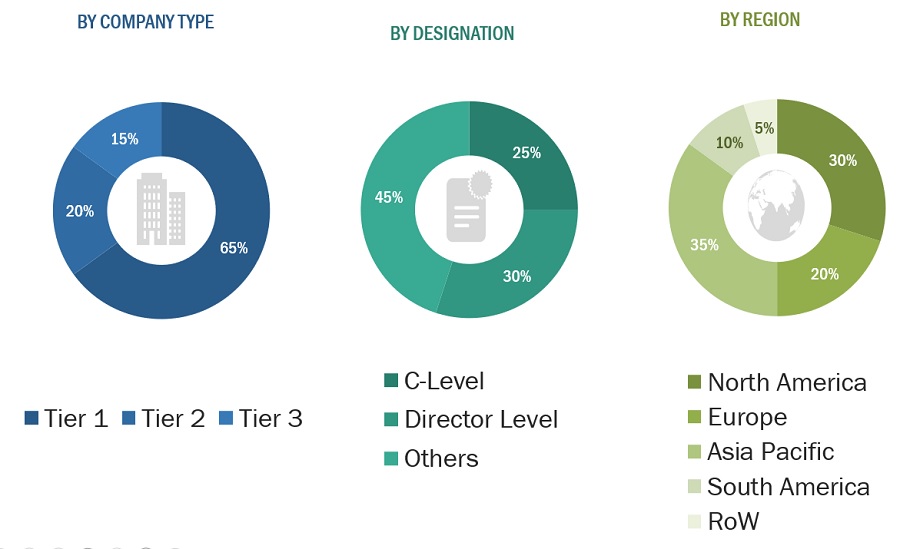
To know about the assumptions considered for the study, download the pdf brochure
Market Size Estimation
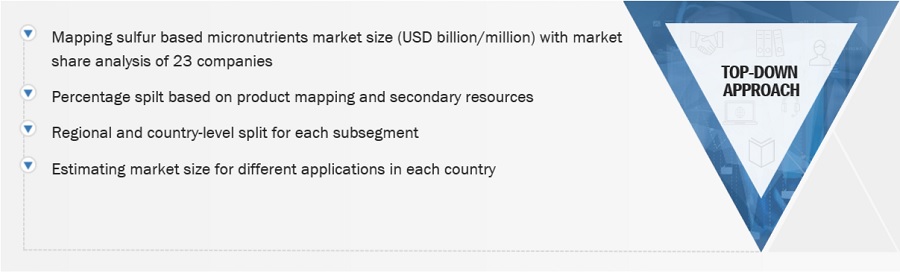
Both the top-down and bottom-up approaches have been used to estimate and validate the total size of the sulfur based micronutrients market. These approaches have also been used extensively to estimate the size of various dependent subsegments of the market. The research methodology used to estimate the market size included the following:
The following segments provide details about the overall market size estimation process employed in this study:
- The key players in the market were identified through secondary research.
- The market shares in the respective regions were identified through primary and secondary research.
- The value chain and market size of the sulfur based micronutrients market, in terms of value, were determined through primary and secondary research.
- All percentage shares, splits, and breakdowns were determined using secondary sources and verified through primary sources.
- All possible parameters that affect the market covered in this research study were accounted for, viewed in extensive detail, verified through primary research, and analyzed to obtain the final quantitative and qualitative data.
- The research included the study of annual and financial reports of the top market players and interviews with industry experts, such as CEOs, VPs, directors, sales managers, and marketing executives, for key insights, both quantitative and qualitative.
Global Sulfur Based Micronutrients Market Size: Bottom-Up Approach
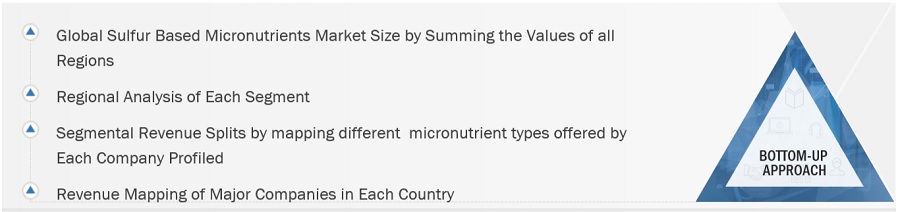
To know about the assumptions considered for the study, Request for Free Sample Report
Global Sulfur Based Micronutrients Market Size: Top-Down Approach
Data Triangulation
After arriving at the overall market size using the market size estimation processes as explained above, the market was split into several segments and sub-segments. To complete the overall market engineering process and arrive at the exact statistics of each market segment and subsegment, the data triangulation and market breakdown procedures were employed, wherever applicable. The data was triangulated by studying various factors and trends from both the demand and supply sides in the sulfur based micronutrients sector.
Market Definition
Sulfur-based micronutrients are essential nutrients required by plants in relatively small quantities for optimal growth and development. Sulfur plays a crucial role in various biochemical processes within plants, including the synthesis of amino acids, proteins, and enzymes. It is also a key component of certain vitamins and coenzymes necessary for plant metabolism. Sulfur-based micronutrients, along with other micronutrients like iron, manganese, zinc, copper, boron, and molybdenum, are important for chlorophyll formation, which is essential for photosynthesis, and they contribute to overall plant health and productivity.
Key Stakeholders
- Raw material manufacturers
- Technology support providers
- Manufacturers of sulfur based micronutrients
- Traders, distributors, and suppliers
- Regulatory Bodies and Government Agencies
- Research & Development (R&D) Institutions
- End-use Industries
- Consulting Firms, Trade Associations, and Industry Bodies
- Investment Banks and Private Equity Firms
Report Objectives
- To analyze and forecast the market size of sulfur based micronutrients market in terms of value
- To provide detailed information regarding the major factors (drivers, restraints, challenges, and opportunities) influencing the regional market
- To analyze and forecast the global sulfur based micronutrients market on the basis of sulfur based micronutrients type, application, and region
- To analyze the opportunities in the market for stakeholders and provide details of a competitive landscape for market leaders
- To forecast the size of various market segments based on five major regions: North America, Europe, Asia Pacific, South America, and Rest of World, along with their respective key countries
- To track and analyze the competitive developments, such as acquisitions, partnerships, collaborations, agreements and expansions in the market
- To strategically profile the key players and comprehensively analyze their market shares and core competencies
Available Customizations
With the given market data, MarketsandMarkets offers customizations according to the client-specific needs.
The following customization options are available for the report:
- Additional country-level analysis of the sulfur based micronutrients market
- Profiling of additional market players (up to 5)
Product Analysis
- Product matrix, which gives a detailed comparison of the product portfolio of each company.
Get the Full Sulfur Based Micronutrients Market Report
Full forecast, segment splits, and company analysis for all Sulfur Based Micronutrients Market.
- US Sulfur Based Micronutrients Market
- Canada Sulfur Based Micronutrients Market
- Mexico Sulfur Based Micronutrients Market
- Germany Sulfur Based Micronutrients Market
- UK Sulfur Based Micronutrients Market
- Poland Sulfur Based Micronutrients Market
- Spain Sulfur Based Micronutrients Market
- Italy Sulfur Based Micronutrients Market
- China Sulfur Based Micronutrients Market
- India Sulfur Based Micronutrients Market
- Japan Sulfur Based Micronutrients Market
- Australia Sulfur Based Micronutrients Market
- Vietnam Sulfur Based Micronutrients Market
- Brazil Sulfur Based Micronutrients Market
- Argentina Sulfur Based Micronutrients Market
- South Africa Sulfur Based Micronutrients Market
- Rest Of Europe Sulfur Based Micronutrients Market
- Rest Of Aisa Pacific Sulfur Based Micronutrients Market
- Rest Of Row Sulfur Based Micronutrients Market
- Türkiye Sulfur Based Micronutrients Market
- Rest Of South America Sulfur Based Micronutrients Market
Need a Tailored Report?
Customize this report to your needs
Get 10% FREE Customization
Customize This Report
