
India Sulfur Based Micronutrients Market (2024-2029)

The India Sulfur Based Micronutrients Market was valued at $43.2 Million in 2024 and projected to reach to $69.5 Million by 2029, representing a compound annual growth rate of 10.0%. India's sulfur-based micronutrients market is poised for significant expansion, driven by the country's agricultural modernization and increasing focus on sustainable farming practices.


| Market Size in | USD 26.32 MN |
| Market Forecast in | |
| CAGR | |
| Forecast Period | |
| Units Considered | Value (USD MN) |
India Sulfur Based Micronutrients Market Trends and Insights
- India's agricultural sector, driven by increasing crop productivity demands and soil health awareness, is a primary catalyst for this expansion.
- The market in India is benefiting from rising fertilizer adoption rates and government initiatives promoting balanced nutrient management across Indian farming regions. The sulfur-based micronutrients segment in India is gaining traction as farmers recognize the critical role of sulfur in crop yield enhancement and quality improvement.
- India's market growth at 10.0% CAGR significantly outpaces global trends, reflecting the country's agricultural modernization and intensifying nutrient deficiency concerns.
- Between 2024 and 2029, India is expected to capture increasing market share within the Asia Pacific region, supported by expanding distribution networks and rising farmer awareness of micronutrient benefits..
Key Market Statistics
- CAGR (2024-2029) 10.0% CAGR
- Market Size, 2024 ~USD 43.2 Million
- Forecast, 2029 ~USD 69.5 Million
- Country India
India Sulfur Based Micronutrients Market Overview
Market Valuation Growth :
India's sulfur-based micronutrients market is valued at USD 43.2 million in 2024, with a projected CAGR of 10% through 2029, reaching USD 69.5 million, outpacing the global growth rate of 8.8%.
Agricultural Sector Expansion :
India's growing agricultural sector is driving demand for sulfur-based micronutrients as farmers increasingly recognize the importance of soil health and crop productivity enhancement in achieving higher yields.
Government Support & Policy :
Government initiatives promoting sustainable farming practices and fertilizer adoption are accelerating market penetration across India's diverse agricultural regions, particularly in major crop-producing states.
Soil Health Awareness :
Rising awareness among Indian farmers about sulfur deficiency in soils and its impact on crop quality is driving adoption of sulfur-based micronutrient products across cereals, pulses, and cash crops.
India Sulfur Based Micronutrients Market Dynamics
- The 10% CAGR reflects strong demand from India's vast farming community, supported by government subsidies and awareness campaigns promoting soil health management.
- Rising fertilizer consumption and the adoption of precision agriculture techniques are expected to further boost market growth through 2029. The market outlook remains positive as Indian farmers increasingly invest in micronutrient solutions to combat soil degradation and improve crop yields.
- Regional agricultural development programs and the expansion of organized retail channels for agricultural inputs will enhance product accessibility.
- Additionally, growing export-oriented agriculture and compliance with international quality standards are likely to drive premium product adoption among progressive farmers in India..
Market Ecosystem
Related Ecosystem
Speciality Chemicals
- Corrosion Inhibitors
- Polyetheretherketone (PEEK)
- Acrylonitrile Butadiene Styrene (ABS)
- Epoxy Resin
- Polycarbonate
- Basf se
- DOW CHEMICAL COMPANY
- Evonik industries ag
- Clariant ag.
- Solvay sa
Fandb Logistics Cold Chain And Packaging
- Rigid Packaging
- Acrylics
- Active Packaging
- Dairy Products
- Gravure Process
- Amcor plc
- Basf se
- Essentra plc
- Sonoco Products Company
- AZELIS HOLDINGS SA
Fandb Processing And Technology
- Dairy Products
- Bakery Products
- Filtration Equipment
- Heat Exchanger
- Acetic Acid
- Gea group
- John Bean Technologies Corporation
- Alfa Laval Corporate AB
- AZELIS HOLDINGS SA
- SPX FLOW INC
Key Takeaways
- India's sulfur-based micronutrients market is valued at USD 43.2 million in 2024 and will reach USD 69.5 million by 2029, growing at 10.0% CAGR.
- India's market growth rate outpaces the global average, driven by agricultural intensification and soil nutrient depletion awareness.
- Government agricultural policies and subsidy schemes in India are accelerating adoption of balanced micronutrient fertilizers.
- India's expanding rural distribution networks and farmer education initiatives are key enablers of market penetration through 2029.
Sulfur Based Micronutrients Market Report Scope
| Report Metric | Details |
|---|---|
| Base Year | 2024 |
| Fastest Growing Segment | FRUITS & VEGETABLES (Application) |
| Forecast Period | 2024-2029 |
| Growth Rate | CAGR of 8.8% from 2024 to 2029 |
| Largest Segment | NON- CHELATED (Form) |
| Market Size Base Year (Billions) | ~USD 0.45 (2024) |
| Revenue Forecast (Billions) | ~USD 0.69 (2029) |
| Segments Covered | Application, Type, Form |
India Sulfur Based Micronutrients Market Report Segmentation
3 segment dimensions are covered across the global market.
By Application
- Cereals & Grains
- Fruits & Vegetables
- Oilseeds & Pulses
- Other Crop Type Applications
By Type
- Sulfur- Bentonite- Boron
- Sulfur- Bentonite-Boron
- Sulfur-Bentonite
- Sulfur-Bentonite- Molybdenum
- Sulfur-Bentonite-Boron
- Sulfur-Bentonite-Copper
- Sulfur-Bentonite-Iron
- Sulfur-Bentonite-Manganese
- Sulfur-Bentonite-Zinc
- Sulfur-Bentonite- Boron
By Form
- Chelated
- Non- Chelated
Target Audience
- Agricultural Input Manufacturers : Fertilizer and micronutrient producers need India-specific market data to assess growth potential, identify distribution opportunities, and develop products aligned with Indian farmer preferences and soil conditions.
- Agricultural Retailers & Distributors : Input dealers and agricultural retailers require market insights to stock appropriate sulfur-based products, understand regional demand patterns, and capitalize on the growing awareness among Indian farmers.
- Investment & Private Equity Firms : Investors evaluating opportunities in India's agricultural sector need validated market size, growth projections, and trend analysis to make informed decisions on funding agricultural chemical companies.
- Government & Policy Makers : Agricultural ministries and policy bodies use market research to design subsidy programs, evaluate fertilizer policies, and develop initiatives supporting soil health and sustainable farming in India.
- Agribusiness Consultants & Advisors : Consulting firms advising agricultural companies require comprehensive India market data to develop business strategies, conduct feasibility studies, and provide evidence-based recommendations to clients.
Reasons to Buy this Report
- Market Size & Growth Validation : Obtain precise market valuation data for India's sulfur-based micronutrients sector with verified CAGR of 10%, enabling accurate financial forecasting and investment decision-making for the 2024-2029 period.
- Regional Performance Benchmarking : Compare India's market performance against global trends (8.8% CAGR) to identify competitive advantages and growth opportunities specific to the Indian agricultural landscape and policy environment.
- Strategic Market Entry Planning : Leverage detailed India-specific insights on government initiatives, farmer adoption patterns, and soil health awareness to develop targeted market entry strategies and localized product positioning.
- Investment & Expansion Roadmap : Use comprehensive India market data to justify capital allocation, identify high-potential agricultural regions, and plan distribution network expansion across India's diverse farming communities.
- Competitive Intelligence : Gain actionable insights into India's market dynamics, including fertilizer adoption rates, regional demand variations, and emerging opportunities to outpace competitors in this high-growth market.
Frequently asked questions
What is the current market size of sulfur-based micronutrients in India?
India's sulfur-based micronutrients market was valued at USD 43.2 million in 2024 and is projected to grow to USD 69.5 million by 2029.
What is the expected growth rate for India's sulfur-based micronutrients market?
India's market is expected to grow at a compound annual growth rate (CAGR) of 10.0% from 2024 to 2029.
Why is India's sulfur-based micronutrients market growing faster than the global average?
India's agricultural sector is experiencing rapid intensification, soil nutrient depletion concerns are rising, and government initiatives promoting balanced fertilization are driving faster adoption compared to global trends.
What factors are driving demand for sulfur-based micronutrients in India?
Key drivers include increasing crop productivity requirements, soil health awareness, government agricultural subsidies, and expanding farmer education programs across India.
How will India's sulfur-based micronutrients market evolve by 2029?
India's market will expand significantly with improved rural distribution networks, increased farmer awareness, and continued government support for balanced nutrient management practices.
RESEARCH METHODOLOGY
The study involved four major activities in estimating the current size of the sulfur based micronutrients market. Exhaustive secondary research was done to collect information on the market, peer markets, and parent market. The next step was to validate these findings, assumptions, and sizing with the industry experts across the Sulfur based micronutrients value chain through primary research. Both top-down and bottom-up approaches were employed to estimate the complete market size. Thereafter, market breakdown and data triangulation were used to estimate the market size of segments and subsegments.
Secondary Research
Secondary sources for this research study include annual reports, press releases, and investor presentations of companies; white papers; certified publications; and articles by recognized authors; gold- and silver-standard websites; Sulfur based micronutrients manufacturing companies, regulatory bodies, trade directories, and databases. The secondary research was mainly used to obtain key information about the industry’s supply chain, the total pool of key players, market classification, and segmentation according to industry trends to the bottom-most level and regional markets. It has also been used to obtain information about key developments from a market-oriented perspective.
Primary Research
The sulfur based micronutrients market comprises several stakeholders, such as raw material suppliers, technology support providers, sulfur based micronutrients manufacturers, and regulatory organizations in the supply chain. Various primary sources from both the supply and demand sides of the market were interviewed to obtain qualitative and quantitative information. Primary sources from the supply side included industry experts such as Chief Executive Officers (CEOs), vice presidents, marketing directors, technology and innovation directors, and related key executives from various key companies and organizations operating in the sulfur based micronutrients market. Primary sources from the demand side included directors, marketing heads, and purchase managers from various sourcing industries. Following is the breakdown of the primary respondents:
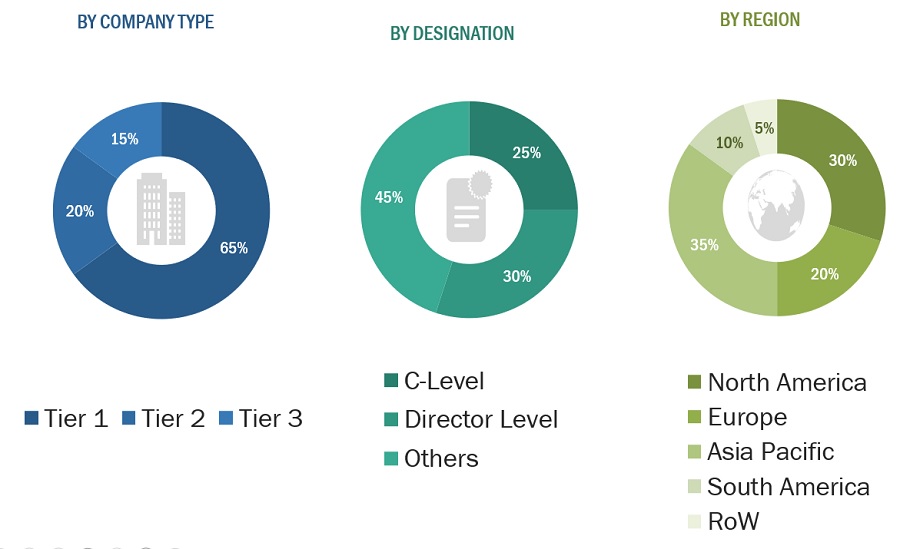
To know about the assumptions considered for the study, download the pdf brochure
Market Size Estimation
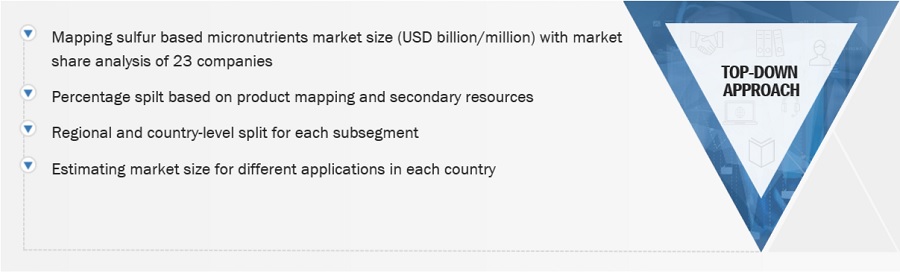
Both the top-down and bottom-up approaches have been used to estimate and validate the total size of the sulfur based micronutrients market. These approaches have also been used extensively to estimate the size of various dependent subsegments of the market. The research methodology used to estimate the market size included the following:
The following segments provide details about the overall market size estimation process employed in this study:
- The key players in the market were identified through secondary research.
- The market shares in the respective regions were identified through primary and secondary research.
- The value chain and market size of the sulfur based micronutrients market, in terms of value, were determined through primary and secondary research.
- All percentage shares, splits, and breakdowns were determined using secondary sources and verified through primary sources.
- All possible parameters that affect the market covered in this research study were accounted for, viewed in extensive detail, verified through primary research, and analyzed to obtain the final quantitative and qualitative data.
- The research included the study of annual and financial reports of the top market players and interviews with industry experts, such as CEOs, VPs, directors, sales managers, and marketing executives, for key insights, both quantitative and qualitative.
Global Sulfur Based Micronutrients Market Size: Bottom-Up Approach
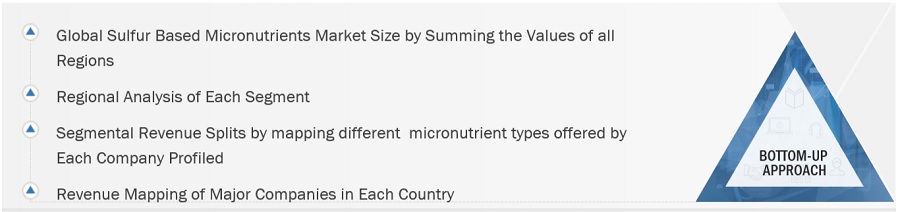
To know about the assumptions considered for the study, Request for Free Sample Report
Global Sulfur Based Micronutrients Market Size: Top-Down Approach
Data Triangulation
After arriving at the overall market size using the market size estimation processes as explained above, the market was split into several segments and sub-segments. To complete the overall market engineering process and arrive at the exact statistics of each market segment and subsegment, the data triangulation and market breakdown procedures were employed, wherever applicable. The data was triangulated by studying various factors and trends from both the demand and supply sides in the sulfur based micronutrients sector.
Market Definition
Sulfur-based micronutrients are essential nutrients required by plants in relatively small quantities for optimal growth and development. Sulfur plays a crucial role in various biochemical processes within plants, including the synthesis of amino acids, proteins, and enzymes. It is also a key component of certain vitamins and coenzymes necessary for plant metabolism. Sulfur-based micronutrients, along with other micronutrients like iron, manganese, zinc, copper, boron, and molybdenum, are important for chlorophyll formation, which is essential for photosynthesis, and they contribute to overall plant health and productivity.
Key Stakeholders
- Raw material manufacturers
- Technology support providers
- Manufacturers of sulfur based micronutrients
- Traders, distributors, and suppliers
- Regulatory Bodies and Government Agencies
- Research & Development (R&D) Institutions
- End-use Industries
- Consulting Firms, Trade Associations, and Industry Bodies
- Investment Banks and Private Equity Firms
Report Objectives
- To analyze and forecast the market size of sulfur based micronutrients market in terms of value
- To provide detailed information regarding the major factors (drivers, restraints, challenges, and opportunities) influencing the regional market
- To analyze and forecast the global sulfur based micronutrients market on the basis of sulfur based micronutrients type, application, and region
- To analyze the opportunities in the market for stakeholders and provide details of a competitive landscape for market leaders
- To forecast the size of various market segments based on five major regions: North America, Europe, Asia Pacific, South America, and Rest of World, along with their respective key countries
- To track and analyze the competitive developments, such as acquisitions, partnerships, collaborations, agreements and expansions in the market
- To strategically profile the key players and comprehensively analyze their market shares and core competencies
Available Customizations
With the given market data, MarketsandMarkets offers customizations according to the client-specific needs.
The following customization options are available for the report:
- Additional country-level analysis of the sulfur based micronutrients market
- Profiling of additional market players (up to 5)
Product Analysis
- Product matrix, which gives a detailed comparison of the product portfolio of each company.
Get the Full Sulfur Based Micronutrients Market Report
Full forecast, segment splits, and company analysis for all Sulfur Based Micronutrients Market.
- US Sulfur Based Micronutrients Market
- Canada Sulfur Based Micronutrients Market
- Mexico Sulfur Based Micronutrients Market
- Germany Sulfur Based Micronutrients Market
- France Sulfur Based Micronutrients Market
- UK Sulfur Based Micronutrients Market
- Poland Sulfur Based Micronutrients Market
- Spain Sulfur Based Micronutrients Market
- Italy Sulfur Based Micronutrients Market
- China Sulfur Based Micronutrients Market
- Japan Sulfur Based Micronutrients Market
- Australia Sulfur Based Micronutrients Market
- Vietnam Sulfur Based Micronutrients Market
- Brazil Sulfur Based Micronutrients Market
- Argentina Sulfur Based Micronutrients Market
- South Africa Sulfur Based Micronutrients Market
- Rest Of Europe Sulfur Based Micronutrients Market
- Rest Of Aisa Pacific Sulfur Based Micronutrients Market
- Rest Of Row Sulfur Based Micronutrients Market
- Türkiye Sulfur Based Micronutrients Market
- Rest Of South America Sulfur Based Micronutrients Market
Need a Tailored Report?
Customize this report to your needs
Get 10% FREE Customization
Customize This Report
