
Japan Sustainable Manufacturing Market (2024-2029)

The Japan Sustainable Manufacturing Market was valued at $13125.5 Million in 2024 and projected to reach to $23477.3 Million by 2029, representing a compound annual growth rate of 12.3%. Japan's sustainable manufacturing market is positioned for significant expansion through 2029, driven by the nation's proactive environmental policies and the semiconductor industry's critical role in global supply chains.


| Market Size in | USD 26.32 MN |
| Market Forecast in | |
| CAGR | |
| Forecast Period | |
| Units Considered | Value (USD MN) |
Japan Sustainable Manufacturing Market Trends and Insights
- Japan's commitment to environmental regulations and circular economy principles is driving adoption of sustainable practices across semiconductor fabrication and electronics production facilities.
- The country's advanced technological infrastructure and stringent environmental standards position Japan as a regional leader in sustainable manufacturing innovation within Asia Pacific..
Key Market Statistics
- CAGR (2024-2029) 12.3% CAGR
- Market Size, 2024 ~USD 13125.5 Million
- Forecast, 2029 ~USD 23477.3 Million
- Country Japan
Japan Sustainable Manufacturing Market Overview
Market Valuation Growth :
Japan's sustainable manufacturing market in semiconductors and electronics reached $13,125.5 million in 2024, with projections to grow to $23,477.3 million by 2029, representing a robust 12.3% CAGR.
Regulatory Leadership :
Japan's stringent environmental regulations and commitment to circular economy principles are accelerating the adoption of sustainable manufacturing practices across semiconductor fabrication plants and electronics production facilities.
Technology Innovation :
Japanese manufacturers are investing heavily in green technologies, energy-efficient processes, and waste reduction systems to maintain competitive advantage in the global sustainable electronics market.
Industry Transformation :
Major Japanese semiconductor and electronics companies are integrating sustainability into core operations, driving demand for eco-friendly materials, renewable energy integration, and advanced manufacturing techniques.
Japan Sustainable Manufacturing Market Dynamics
- Japanese manufacturers are increasingly adopting circular economy models, renewable energy sources, and waste minimization technologies to meet both domestic regulations and international sustainability standards.
- The market's 12.3% CAGR outpaces the global average of 11.3%, reflecting Japan's leadership in green manufacturing innovation. The outlook remains positive as Japanese electronics and semiconductor companies leverage their technological expertise to develop sustainable production methods.
- Investment in R&D for eco-friendly materials, energy-efficient fabrication processes, and advanced recycling systems will continue to fuel market growth.
- Additionally, Japan's commitment to carbon neutrality by 2050 and increasing consumer demand for sustainable electronics will further accelerate market expansion through the forecast period..
Market Ecosystem
Related Ecosystem
Semiconductor Materials And Components
- Sensors
- Gallium Nitride (GaN)
- Digital Signal Processor (DSP)
- Natural Language Processing (NLP)
- Silicon Carbide
- Texas Instruments Incorporated
- Samsung
- APPLIED MATERIALS, INC.
- Stmicroelectronics
- Lenovo
Automotive Electronics And Electrical Equipment
- Battery Electric Vehicle (BEV)
- Light Commercial Vehicles (LCVs)
- Fuel Cell Electric Vehicle (FCEV)
- Sensors
- Hybrid Electric Vehicle (HEV)
- BOSCH LIMITED
- DENSO Corporation
- Continental ag
- Panasonic Holdings Corporation
- Texas Instruments Incorporated
Industrial Iot
- Sensors
- Pressure Sensors
- Flow Sensors
- Gas Sensors
- Image Sensors
- Siemens ag
- ABB India Limited
- HONEYWELL INTERNATIONAL INC.
- Emerson Electric Co.
- SCHNEIDER ELECTRIC SE
Key Takeaways
- Japan's sustainable manufacturing market will grow from $13.1B (2024) to $23.5B (2029), representing a 12.3% CAGR.
- Japan leads Asia Pacific in implementing sustainable semiconductor and electronics manufacturing practices driven by regulatory compliance.
- Japan's advanced technology ecosystem enables rapid adoption of green manufacturing technologies and waste reduction initiatives.
- Japan's market growth outpaces the global average of 11.3% CAGR, reflecting strong regional demand for sustainable electronics production.
Sustainable Manufacturing Market Report Scope
| Report Metric | Details |
|---|---|
| Base Year | 2024 |
| Fastest Growing Segment | GREEN HYDROGEN (Offering) |
| Forecast Period | 2024-2029 |
| Growth Rate | CAGR of 11.3% from 2024 to 2029 |
| Largest Segment | RECYCLED STEEL (Offering) |
| Market Size Base Year (Billions) | ~USD 214.99 (2024) |
| Revenue Forecast (Billions) | ~USD 367.2 (2029) |
| Segments Covered | Offering, Application |
Japan Sustainable Manufacturing Market Report Segmentation
2 segment dimensions are covered across the global market.
By Offering
- Bioplastics & Biopolymers
- Green Hydrogen
- Natural Fiber Composites
- Recycled Aluminum
- Recycled Carbon Fiber
- Recycled Lithium-Ion Batteries
- Recycled Plastics
- Recycled Steel
- Water Recycle And Reuse
By Application
- Aerospace & Defense
- Agriculture & Horticulture
- Automotive
- Automotive & Transportation
- Building & Construction
- Chemical
- Coatings & Adhesives
- Consumer Applications
- Consumer Goods
- Electronics & Electricals
- Equipment Manufacturing
- Grid Injection
- Industrial
- Marine
- Mobility
- Non-Automotive
- Packaging
- Power
- Shipbuilding
- Sporting Goods
- Textiles
Target Audience
- Japanese Semiconductor Manufacturers : Need detailed market insights to optimize sustainable manufacturing investments, benchmark against competitors, and align production strategies with Japan's environmental regulations and circular economy mandates.
- Electronics Production Companies : Require market data to identify sustainability technology opportunities, assess competitive positioning in Japan's growing green manufacturing sector, and plan capital investments in eco-friendly facilities.
- International Investors & PE Firms : Seek Japan-specific market analysis to evaluate investment opportunities in sustainable manufacturing, understand growth potential, and assess risk factors in the Japanese semiconductor and electronics sector.
- Supply Chain & Equipment Vendors : Need market intelligence to identify customer opportunities, develop targeted solutions for Japanese manufacturers, and understand demand drivers for sustainable manufacturing equipment and materials.
- Government & Policy Makers : Require comprehensive market data to evaluate the effectiveness of sustainability policies, plan industrial development initiatives, and support Japan's environmental and economic objectives in manufacturing.
Reasons to Buy this Report
- Market Size & Growth Data : Access precise valuation metrics for Japan's sustainable manufacturing sector with detailed 2024-2029 forecasts, enabling accurate investment planning and competitive benchmarking specific to the Japanese market.
- Regulatory Landscape Intelligence : Understand Japan's unique environmental regulations and circular economy requirements driving sustainable manufacturing adoption, critical for compliance strategy and operational planning in the region.
- Competitive Positioning : Identify market opportunities and competitive dynamics specific to Japan's semiconductor and electronics manufacturers, with insights into technology adoption rates and sustainability initiatives by major players.
- Investment Decision Support : Make informed investment decisions with Japan-specific market analysis, growth projections, and sector trends that outpace global averages, supporting strategic capital allocation in the region.
- Strategic Planning Resources : Develop targeted go-to-market strategies for Japan with localized insights on manufacturing practices, technology preferences, and sustainability priorities of Japanese semiconductor and electronics companies.
Frequently asked questions
What is the current size of Japan's sustainable manufacturing market?
Japan's sustainable manufacturing market was valued at $13,125.5 million in 2024 and is expected to reach $23,477.3 million by 2029.
What is the projected growth rate for Japan's sustainable manufacturing sector?
Japan's sustainable manufacturing market is projected to grow at a compound annual growth rate (CAGR) of 12.3% from 2024 to 2029.
Which industries drive sustainable manufacturing adoption in Japan?
The semiconductor and electronics industries are the primary drivers of sustainable manufacturing adoption in Japan, supported by strict environmental regulations.
How does Japan's growth compare to global sustainable manufacturing trends?
Japan's 12.3% CAGR exceeds the global average of 11.3%, demonstrating Japan's accelerated adoption of sustainable manufacturing practices.
What factors are accelerating sustainable manufacturing in Japan?
Japan's growth is driven by stringent environmental regulations, corporate sustainability commitments, advanced technology infrastructure, and circular economy initiatives in electronics production.
RESEARCH METHODOLOGY
The study utilized four major activities to estimate the size of the sustainable manufacturing market. Exhaustive secondary research was conducted to gather information on the market and its peer and parent markets. The next step was to validate these findings, assumptions, and sizing with industry experts across the value chain through primary research. Both top-down and bottom-up approaches were employed to estimate the total market size. Finally, market breakdown and data triangulation methods were utilized to estimate the market size for different segments and subsegments.
Secondary Research
In the secondary research process, various sources were used to identify and collect information on the sustainable manufacturing market for this study. Secondary sources for this research study include corporate filings (such as annual reports, investor presentations, and financial statements), trade, business, and professional associations, white papers, certified publications, articles by recognized authors, directories, and databases. The secondary data was collected and analyzed to determine the overall market size, further validated through primary research.
List of key secondary sources
|
Sources |
WebLink |
|
Processing Magazines |
www.processingmagazine.com |
|
U.S. Environmental Protection Agency |
www.epa.gov |
|
The Organisation for Economic Co-operation and Development (OECD) |
https://www.oecd.org/about/ |
|
Chinese Association of Automation |
|
|
Association for the Advancement of Artificial Intelligence (AAAI) |
Primary Research
To gather insights on market statistics, revenue data, market breakdowns, size estimations, and forecasting, primary interviews were conducted. Additionally, primary research was used to comprehend the various technology, application, vertical, and regional trends. Interviews with stakeholders from the demand side, including CIOs, CTOs, CSOs, and customer/end-user installation teams using sustainable manufacturing offerings and processes, were also conducted to understand their perspective on suppliers, products, component providers, and their current and future use of sustainable manufacturing, which will impact the overall market. Several primary interviews were conducted across major countries of North America, Europe, Asia Pacific, the Middle East and Africa, and Latin America.
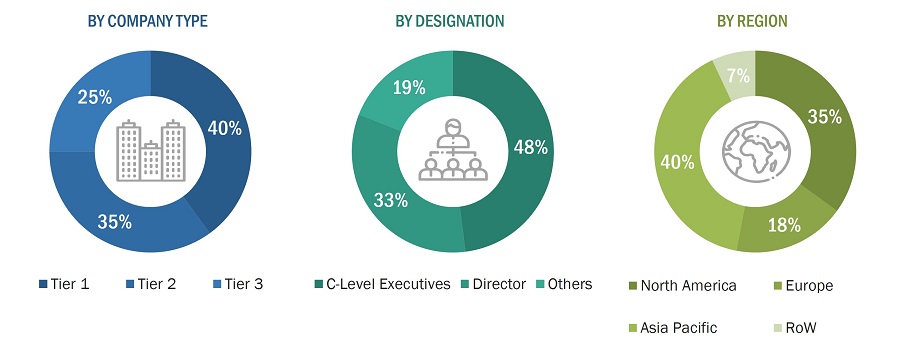
To know about the assumptions considered for the study, download the pdf brochure
Market Size Estimation
To estimate and validate the size of the sustainable manufacturing market and its submarkets, both top-down and bottom-up approaches were utilized. Secondary research was conducted to identify the key players in the market, and primary and secondary research was used to determine their market share in specific regions. The entire process involved studying top players’ annual and financial reports and conducting extensive interviews with industry leaders such as CEOs, VPs, directors, and marketing executives. Secondary sources were used to determine all percentage shares and breakdowns, which were then verified through primary sources. All parameters that could impact the markets covered in this research study were accounted for, analyzed in detail, verified through primary research, and consolidated to obtain the final quantitative and qualitative data.
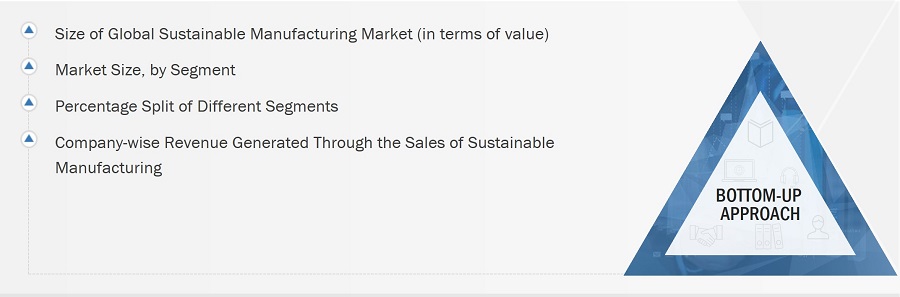
Global Sustainable Manufacturing Market Size: Botton Up Approach
- Identifying various sustainable offerings manufacturers
- Analyzing the penetration of each component through secondary and primary research
- Analyzing integration of Sustainable manufacturing in different applications through secondary and primary research
- Conducting multiple discussions with key opinion leaders to understand the detailed working of sustainable manufacturings and their implementation in multiple applications; this helped analyze the break-up of the scope of work carried out by each major company
- Verifying and cross-checking the estimates at every level with key opinion leaders, including CEOs, directors, operation managers, and finally with the domain experts at MarketsandMarkets
- Studying various paid and unpaid sources of information, such as annual reports, press releases, white papers, and databases
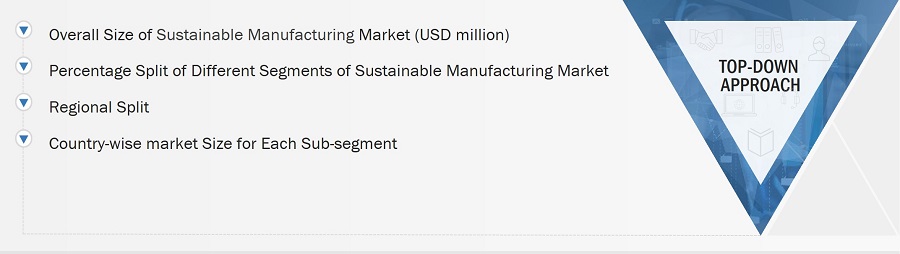
Global Sustainable Manufacturing Market Size: Top-Down Approach
The top-down approach has been used to estimate and validate the total size of the sustainable manufacturing market.
- Focusing initially on the R&D investments and expenditures being made in the ecosystem of the sustainable manufacturing market, further splitting the market based on offerings and region, and listing the key developments
- Identifying leading players in the sustainable manufacturing market through secondary research and verifying them through brief discussions with industry experts
- Analyzing revenue, product mix, geographic presence, and key applications for which products are served by all identified players to estimate and arrive at percentage splits for all key segments
- Discussing splits with industry experts to validate the information and identify key growth pockets across all key segments
- Breaking down the total market based on verified splits and key growth pockets across all segments
Data Triangulation
Once the overall size of the Sustainable manufacturing market was determined using the methods described above, it was divided into multiple segments and subsegments. Market engineering was performed for each segment and subsegment using market breakdown and data triangulation methods, as applicable, to obtain accurate statistics. To triangulate the data, various factors and trends from the demand and supply sides were studied. The market was validated using both top-down and bottom-up approaches.
Market Definition
Sustainable manufacturing is a production approach that minimizes environmental impacts while conserving energy and natural resources. It focuses on efficient use of materials and energy, waste reduction, emissions control, and circular economy practices to extend product life cycles. Sustainable manufacturing also emphasizes social responsibility through fair labor practices and safe working conditions. This approach benefits businesses by reducing costs, improving compliance with regulations, enhancing brand reputation, and meeting consumer demand for eco-friendly products, while contributing to broader environmental goals such as carbon emissions reduction.
Key Stakeholders
- Sustainable metarials providers
- Sustainable metarials Suppliers
- Sustainable manufacturing Integrators
- Sustainable manufacturing distributors
- Sustainable manufacturing software solution providers
- Research organizations
- Analysts and strategic business planners
- Venture capitalists, private equity firms, and startups
- Educational Institutes and Universities
- Component Suppliers and Distributors
- Logistics and shipment companies
Report Objectives
- To define, describe, and forecast the sustainable manufacturing market based on offering & application and region
- To forecast the size of the market segments for four major regions—North America, Europe, Asia Pacific (APAC), and the Rest of the World (RoW)
- To provide detailed information regarding the major factors influencing the growth of the market (drivers, restraints, opportunities, and challenges)
- To strategically analyze micromarkets1 with respect to individual growth trends, prospects, and contributions to the total market
- To study the complete value chain and allied industry segments and perform a market value chain analysis.
- To provide ecosystem analysis, case study analysis, patent analysis, technology analysis, pricing analysis, Porter’s five forces analysis, key stakeholders and buying criteria, key conferences and events, and regulatory bodies, government agencies, and regulations pertaining to the market
- To strategically profile the key players and comprehensively analyze their market shares and core competencies2.
- To analyze the opportunities in the market for stakeholders and describe the competitive landscape of the market.
- To analyze competitive developments such as collaborations, agreements, contracts, partnerships, mergers & acquisitions, product launches, and research & development (R&D) in the market
- To analyze the impact of the recession on the sustainable manufacturing market
Available Customizations:
With the given market data, MarketsandMarkets offers customizations according to the specific requirements of companies. The following customization options are available for the report:
- Detailed analysis and profiling of additional market players (up to 5)
- Additional country-level analysis of the sustainable manufacturing market
Product Analysis
- Product matrix, which provides a detailed comparison of the product portfolio of each company in the sustainable manufacturing market.
Get the Full Sustainable Manufacturing Market Report
Full forecast, segment splits, and company analysis for all Sustainable Manufacturing Market.
- Canada Sustainable Manufacturing Market
- Mexico Sustainable Manufacturing Market
- US Sustainable Manufacturing Market
- France Sustainable Manufacturing Market
- Germany Sustainable Manufacturing Market
- UK Sustainable Manufacturing Market
- Rest Of Europe Sustainable Manufacturing Market
- China Sustainable Manufacturing Market
- India Sustainable Manufacturing Market
- Rest Of Asia Pacific Sustainable Manufacturing Market
Need a Tailored Report?
Customize this report to your needs
Get 10% FREE Customization
Customize This Report
