High Flow Nasal Cannula Market

High Flow Nasal Cannula Market by Product (Systems, Consumables & Accessories (Humidifiers, Interfaces)), Patient Type (Neonatal & Pediatric), Application (Acute Respiratory Failure, COPD), End User (Hospitals), & Region - Global Forecast to 2031



HIGH FLOW NASAL CANNULA MARKET SIZE, SHARE & GROWTH SNAPSHOT
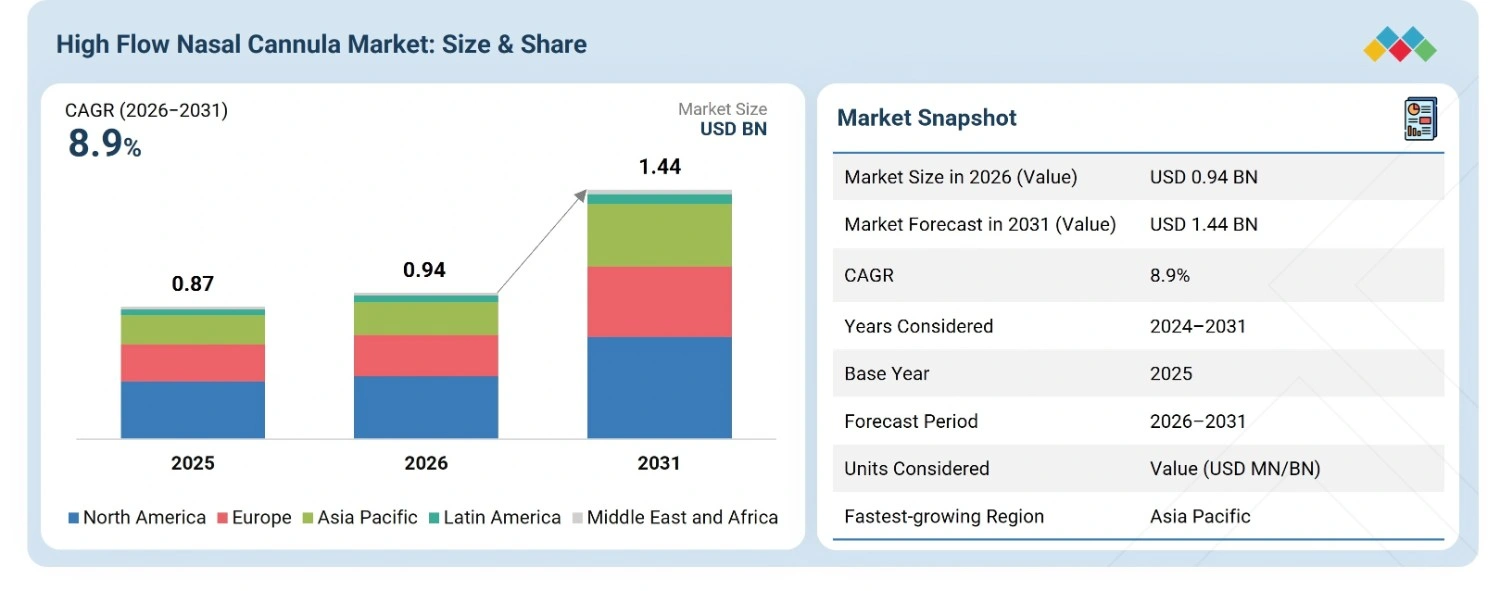
Source: Secondary Research, Interviews with Experts, MarketsandMarkets Analysis
The global high-flow nasal cannula (HFNC) market is projected to grow from USD 0.94 billion in 2026 to USD 1.44 billion by 2031, at a CAGR of 8.9% during the forecast period. The market was valued at USD 0.87 billion in 2025. The market is experiencing significant growth due to the rising prevalence of acute and chronic respiratory diseases, increasing cases of hypoxemic respiratory failure, and the growing adoption of non-invasive respiratory support across hospitals and critical-care settings. HFNC therapy delivers heated and humidified oxygen at high flow rates, enabling more consistent oxygen delivery while reducing anatomical dead space, improving mucociliary function, lowering the work of breathing, and providing a mild level of positive airway pressure. These clinical advantages, along with greater patient comfort and tolerance compared with conventional non-invasive ventilation (NIV) masks, have contributed to its increasing use across intensive care units, emergency departments, neonatal and pediatric care, post-extubation management, and perioperative settings.
KEY TAKEAWAYS
-
MARKET SNAPSHOT:
Base Year Market Size (2025): USD 0.87 Billion
Current Market Size (2026): USD 0.94 Billion
Forecast Market Size (2031): USD 1.44 Billion
CAGR (2026–2031): 8.9% -
SEGMENT LEADERSHIP:
Regional Leader: North America accounted for the largest share of the high-flow nasal cannula market in 2025.
Product Leader: Consumables & accessories segment accounted for a larger market share than the systems segment in 2025.
Patient Type Leader: Adult segment accounted for the largest market share in 2025.
Application Leader: Acute respiratory failure treatment segment accounted for the largest market share in 2025.
End User Growth Leader: Hospitals segment is expected to exhibit the highest growth rate during the forecast period. -
MARKET OUTLOOK & COMPETITIVE LANDSCAPE:
Fisher & Paykel Healthcare Limited was recognized as a star player due to its established strong product portfolio.
The high-flow nasal cannula (HFNC) market is driven by the increasing prevalence of acute and chronic respiratory disorders, rising cases of hypoxemic respiratory failure, and growing demand for non-invasive respiratory support in intensive care and emergency settings. HFNC offers several clinical advantages over conventional oxygen therapy, including more reliable oxygen delivery, improved oxygenation, reduction in work of breathing, enhanced secretion clearance, and upper-airway dead-space washout. Its greater patient comfort and tolerance compared with conventional oxygen masks and non-invasive ventilation (NIV) further support adoption, as patients can communicate, eat, and drink while receiving respiratory support. Expanding clinical applications are another major growth driver. HFNC is increasingly used for acute hypoxemic respiratory failure, post-extubation respiratory support, pre-oxygenation before intubation, perioperative care, bronchoscopy, emergency department care, and during breaks from NIV or CPAP.
TRENDS & DISRUPTIONS IMPACTING CUSTOMERS' CUSTOMERS
The HFNC market is undergoing a shift in revenue opportunities as healthcare providers increasingly adopt high-flow respiratory support across hospitals, home-care settings, long-term care facilities, ambulatory care centers, and specialty respiratory clinics. This evolution is driven by changing customer priorities, including the need to expand non-invasive respiratory support programs, improve respiratory care efficiency, reduce ICU burden, enable earlier discharge, and extend respiratory therapy into home and long-term care environments. As a result, future revenue opportunities are expected to move beyond traditional HFNC systems and equipment toward smart HFNC systems, advanced humidification and condensation-control solutions, HFNC-enabled multi-modal respiratory systems, nasal interfaces, heated circuits, patient-specific consumables, and home-care solutions, creating new avenues for market growth and customer value.

Source: Secondary Research, Interviews with Experts, MarketsandMarkets Analysis
MARKET DYNAMICS

Level
-
Growing burden of acute and chronic respiratory diseases

-
Increasing preference for non-invasive respiratory support


Level
-
High acquisition and recurring consumable costs

-
High medical oxygen requirement


Level
-
Expansion of HFNC into home and long-term care settings

-
Large untapped opportunity in emerging economies


Level
-
Early identification of HFNC treatment failure

-
Need for continuous clinical monitoring and trained personnel

Source: Secondary Research, Interviews with Experts, MarketsandMarkets Analysis
Driver: Growing burden of acute and chronic respiratory diseases
The growing burden of acute and chronic respiratory diseases is a major driver of the high-flow nasal cannula (HFNC) market. The increasing prevalence of conditions such as pneumonia, chronic obstructive pulmonary disease (COPD), asthma, and acute hypoxemic respiratory failure is creating greater demand for effective respiratory support. HFNC provides heated and humidified oxygen at high flow rates, helping improve oxygenation and reduce the work of breathing. Its increasing use in intensive care units, emergency departments, and post-extubation care is further supporting market expansion.
Restraint:High acquisition and recurring consumable costs
High acquisition and recurring consumable costs can limit the adoption of HFNC systems, particularly in cost-sensitive healthcare markets and smaller healthcare facilities. HFNC requires dedicated equipment along with regularly replaced consumables such as nasal cannulas, heated breathing circuits, and humidification chambers. The ongoing requirement for these components increases the overall cost of therapy compared with conventional oxygen delivery methods, which may discourage adoption where healthcare budgets and reimbursement coverage are limited.
Opportunity: Expansion of HFNC into home and long-term care settings
The expansion of HFNC into home and long-term care settings represents a significant growth opportunity for the market. Increasing demand for respiratory support outside hospitals, particularly among patients requiring prolonged oxygen therapy or management of chronic respiratory conditions, is creating opportunities for more compact, user-friendly, and home-compatible HFNC systems. Technological advancements in device portability, humidification, oxygen delivery, and remote patient monitoring could further facilitate the adoption of HFNC in home-care and long-term care environments.
Challenge:Early identification of HFNC treatment failure
Early identification of HFNC treatment failure remains a key clinical challenge that can affect market adoption and treatment outcomes. Although HFNC can provide effective respiratory support, some patients may continue to deteriorate and eventually require non-invasive or invasive mechanical ventilation. Delays in recognizing treatment failure can increase the risk of adverse outcomes. Therefore, accurate patient monitoring, timely assessment of respiratory status, and clear clinical criteria for escalation of care are essential for the safe and effective use of HFNC.
HIGH FLOW NASAL CANNULA MARKET: COMMERCIAL USE CASES ACROSS INDUSTRIES
| COMPANY | USE CASE DESCRIPTION | BENEFITS |
|---|---|---|
 |
Provides an integrated nasal high-flow system that delivers heated and humidified respiratory gases at high flow rates for patients requiring non-invasive respiratory support. It is used across hospital and acute-care settings, including intensive care, respiratory wards, emergency care, and post-extubation management. | Provides consistent delivery of heated and humidified gases, supports oxygenation, improves patient comfort, reduces work of breathing, and enables flexible respiratory support across a broad range of clinical applications. |
 |
Provides an interface for connecting Vapotherm high-flow therapy to patients who require heated and humidified high-flow respiratory support. The adapter is compatible with Vapotherm high-flow systems such as Precision Flow. | Extends high-flow therapy to patients, supports delivery of conditioned respiratory gases, improves patient comfort, and provides flexibility in respiratory support while maintaining compatibility with the Vapotherm therapy platform. |
 |
Provides a heated respiratory tube for high-flow therapy that helps deliver warmed and humidified gases from the therapy device to the patient interface. Heated tubing is an important component of HFT systems for maintaining gas conditioning and reducing condensation within the breathing circuit. | Helps maintain appropriate gas temperature and humidity, minimizes condensation, improves patient comfort, supports consistent delivery of respiratory gases, and contributes to effective long-term high-flow therapy. |
 |
Provides a nasal patient interface designed to deliver heated and humidified respiratory gases during high-flow oxygen therapy. The cannula is intended for use with Hamilton Medical ventilators and high-flow oxygen therapy devices in hospital and long-term acute-care settings. | Provides a comfortable patient interface for high-flow therapy, supports efficient delivery of heated and humidified gases, facilitates non-invasive respiratory support, and enables use across appropriate patient populations. |
 |
Provides active humidification of respiratory gases used in the Dräger Hi-Flow Star HFNC solution. The humidifier works with the HFNC circuit to condition oxygen-enriched gas before delivery through the nasal cannula to spontaneously breathing patients requiring high-flow respiratory support. | Maintains heated and humidified gas delivery, improves patient comfort, helps prevent drying of the upper airways, supports secretion clearance, and contributes to effective HFNC therapy. |
Logos and trademarks shown above are the property of their respective owners. Their use here is for informational and illustrative purposes only.
MARKET ECOSYSTEM
The high-flow nasal cannula (HFNC) market ecosystem comprises a diverse network of manufacturers, healthcare providers, and regulatory bodies that collectively support the development, commercialization, adoption, and regulation of HFNC technologies. Manufacturers such as Fisher & Paykel Healthcare, Dräger, Hamilton Medical, ResMed, Vapotherm, BD, Masimo, and Medline contribute through the development of HFNC systems, respiratory interfaces, humidification technologies, circuits, and related consumables. End users, including hospitals, clinics, and specialized healthcare institutions such as AdventHealth, Mayo Clinic, Mount Sinai, Apollo Hospitals, and other healthcare providers, drive product adoption based on clinical requirements and patient needs. Regulatory bodies, including the US FDA, European Medicines Agency (EMA), UK regulatory authorities, and other national agencies, establish safety, quality, and performance requirements governing the approval and commercialization of HFNC products. Together, these stakeholders form an interconnected ecosystem influencing product innovation, regulatory compliance, clinical adoption, and market growth.

Logos and trademarks shown above are the property of their respective owners. Their use here is for informational and illustrative purposes only.
MARKET SEGMENTS

Source: Secondary Research, Interviews with Experts, MarketsandMarkets Analysis
High Flow Nasal Cannula Market, By Product
Consumables and accessories account for the largest share of the high-flow nasal cannula (HFNC) market by product type, owing to their frequent use and recurring replacement during respiratory therapy. In contrast to HFNC systems, which represent higher-value capital equipment purchased less frequently, products such as nasal cannulas, heated breathing circuits, humidification chambers, adapters, and connectors need to be replaced regularly to ensure proper functionality, infection control, and patient safety. The rising number of HFNC treatments across intensive care units, emergency departments, and other clinical settings, along with increasing adoption among neonatal, pediatric, and adult patient populations, is further supporting demand for these products. Their recurring consumption and replacement cycle provides manufacturers with a steady revenue stream, strengthening the segment’s leading position in the HFNC market.
High Flow Nasal Cannula Market, By Patient Type
Adults aged 18–64 years account for the largest share of the high-flow nasal cannula (HFNC) market by patient type, driven by the high burden of respiratory conditions and the extensive use of HFNC therapy in adult care settings. This population accounts for a significant number of hospitalizations related to acute hypoxemic respiratory failure, pneumonia, chronic respiratory diseases, and other conditions requiring supplemental oxygen and non-invasive respiratory support. The growing application of HFNC across intensive care units, emergency departments, post-extubation management, and perioperative care further fuels demand within this segment. Moreover, the availability of a wide range of adult-specific HFNC systems, nasal cannulas, and heated breathing circuits supports their widespread clinical use, contributing to the segment’s dominant market position.
High Flow Nasal Cannula Market, By Application
Acute respiratory failure accounts for the largest share of the high-flow nasal cannula (HFNC) market by application, driven by the increasing adoption of HFNC as a non-invasive respiratory support therapy for patients experiencing acute hypoxemic respiratory failure. HFNC delivers heated and humidified oxygen at high flow rates, which helps improve oxygenation, alleviate respiratory distress, reduce the work of breathing, and enhance patient comfort. Its increasing clinical acceptance as an alternative to conventional oxygen therapy in appropriate patients is supporting widespread use across intensive care units, emergency departments, and other acute-care settings. The rising prevalence of pneumonia, pulmonary infections, acute respiratory distress, and exacerbations of underlying cardiopulmonary diseases is further increasing the demand for HFNC therapy in this application. Moreover, the growing preference for non-invasive respiratory support and the ability of HFNC to potentially prevent or delay invasive mechanical ventilation in suitable patients are contributing to the segment’s leading market position.
High Flow Nasal Cannula Market, By End User
Hospitals account for the largest share of the high-flow nasal cannula (HFNC) market by end user, primarily owing to the extensive utilization of HFNC across intensive care units, emergency departments, respiratory care units, and post-operative settings. Hospitals treat a high number of patients with acute hypoxemic respiratory failure and other respiratory conditions requiring advanced oxygen and non-invasive respiratory support, making them the primary users of HFNC systems. The increasing adoption of HFNC in the management of critically ill patients, who require continuous monitoring and rapid intervention, further strengthens demand within the hospital segment. Additionally, hospitals possess advanced critical-care infrastructure, trained healthcare professionals, oxygen delivery systems, and patient-monitoring equipment, facilitating the effective and frequent use of HFNC therapy. The expanding application of HFNC for post-extubation respiratory support, pre-oxygenation, perioperative care, and emergency respiratory management is also contributing to the segment’s dominant market position.
REGION
Asia Pacific to be fastest-growing region in global high-flow nasal cannula (HFNC) market during forecast period
Asia Pacific is expected to register the highest CAGR in the high-flow nasal cannula (HFNC) market, driven by the rising prevalence of respiratory disorders, increasing healthcare expenditure, and expanding healthcare infrastructure across emerging economies such as China, India, Japan, and South Korea. The growing number of hospitals and intensive care units, coupled with increasing awareness and adoption of non-invasive respiratory support technologies, is creating significant demand for HFNC systems in the region. In addition, the large patient population, improving access to advanced respiratory care, and increasing investments in healthcare modernization are supporting market expansion. Furthermore, growing adoption of HFNC in neonatal, pediatric, and adult care, along with the increasing availability of cost-effective HFNC devices from regional manufacturers, is expected to accelerate market penetration. Improvements in critical-care infrastructure and the gradual shift toward advanced respiratory management are likely to create substantial growth opportunities, enabling Asia Pacific to achieve the highest CAGR during the forecast period.

HIGH FLOW NASAL CANNULA MARKET: COMPANY EVALUATION MATRIX
In the high-flow nasal cannula market matrix, Fisher & Paykel Healthcare Limited (Star) leads due to its strong global presence, advanced tumor ablation product portfolio, extensive installed base, strong physician adoption, and continuous investment in innovative technologies and solutions. Micomme Medical (Emerging Leader) is gaining visibility because of its growing focus on minimally invasive and energy-based technologies, cost-effective solutions, strong expertise in endoscopy, and increasing adoption of its advanced tumor ablation systems across hospitals and ambulatory surgical centers.

Source: Secondary Research, Interviews with Experts, MarketsandMarkets Analysis
KEY MARKET PLAYERS
- Fisher & Paykel Healthcare Limited (New Zealand)
- ResMed (US)
- Vapotherm (US)
- Hamilton Medical AG (Switzerland)
- Drägerwerk AG & Co. KGaA (Germany)
- Micomme Medical (China)
- Shenzhen Comen Medical Instruments Co., Ltd. (China)
- Flexicare (Group) Limited (UK)
- Masimo (US)
MARKET SCOPE
| REPORT METRIC | DETAILS |
|---|---|
| Market Size (Value) in 2026 | USD 0.94 Billion |
| Revenue Forecast (Value) in 2031 | USD 1.44 Billion |
| Growth Rate | CAGR of 8.9% from 2026 to 2031 |
| Actual Data | 2024-2031 |
| Base Year | 2025 |
| Forecast Period | 2026-2031 |
| Units Considered | Value (USD Million/Billion), Volume (Million Units) |
| Report Coverage | Revenue Forecast, Company Ranking, Competitive Landscape, Growth Factors, and Trends |
| Segments Covered |
|
| Regional Scope | North America, Asia Pacific, Europe, Latin America, Middle East & Africa |
WHAT IS IN IT FOR YOU: HIGH FLOW NASAL CANNULA MARKET REPORT CONTENT GUIDE

DELIVERED CUSTOMIZATIONS
We have successfully delivered the following deep-dive customizations:
| CLIENT REQUEST | CUSTOMIZATION DELIVERED | VALUE ADDS |
|---|---|---|
| Product Analysis | Comparison of top HFNC products: Systems and Consumables |
|
| Company Information |
|
Insights on revenue shifts toward emerging applications and device innovations |
| Geographic Analysis |
|
Country level demand mapping for new product launches and localization strategy planning |
RECENT DEVELOPMENTS
- April 2026 : Vapotherm received FDA 510(k) clearance for its All Patient Circuit, enabling the HVT 2.0 high-velocity therapy system to provide therapy across 2–45 L/min using a single disposable circuit, including neonatal and infant settings.
- February 2025 : Hamilton Medical announced that the HAMILTON-HF90, its standalone high-flow oxygen therapy device, became available in all CE markets. The system is designed for high-flow oxygen therapy across emergency, intermediate-care and ICU environments and supports mobility/transport within healthcare facilities.
Table of Contents
 Exclusive indicates content/data unique to MarketsandMarkets and not available with any competitors.
Methodology
This study involved four major activities in estimating the current high-flow nasal cannula market size. First, extensive secondary research was conducted to gather information on the market, including related and parent markets. The next step involved validating these findings, assumptions, and sizing with industry experts across the value chain through primary research. Both top-down and bottom-up approaches were employed to estimate the complete market size. After that, market breakdown and data triangulation were used to estimate the market size of segments and subsegments.
Secondary Research
The secondary research process involved the widespread use of secondary sources, directories, databases (such as Bloomberg Businessweek, Factiva, and D&B Hoovers), white papers, annual reports, company house documents, investor presentations, and SEC filings of companies. Secondary research was used to identify and collect information useful for the extensive, technical, market-oriented, and commercial study of the high-flow nasal cannula market. It was also used to obtain important information about the key players and market classification and segmentation according to industry trends to the bottom-most level, and key developments related to market and technology perspectives. A database of the key industry leaders was also prepared using secondary research.
Primary Research
In the primary research process, various sources from both the supply and demand sides were interviewed to obtain qualitative and quantitative information for this report. The primary sources from the supply side include industry experts such as CEOs, vice presidents, marketing and sales directors, technology & innovation directors, and related key executives from various key companies and organizations operating in the high flow nasal cannula market. The primary sources from the demand side included industry experts, purchase & sales managers, doctors, and personnel from research organizations. Primary research was conducted to validate the market segmentation, identify key players in the market, and gather insights on key industry trends and key market dynamics.
Breakdown of primary Respondents

Note: Companies are classified into tiers based on their total revenue. Tier 1 = >USD 10.00 billion, Tier 2 = USD 1.00 billion to USD 10.00 billion, and Tier 3 = <USD 1.00 billion. C-level primaries include CEOs, CFOs, COOs, and VPs. Other designations include sales managers, marketing managers, business development managers, product managers, distributors, and suppliers.
To know about the assumptions considered for the study, download the pdf brochure
Market Size Estimation
For the global market value, annual revenues were calculated based on the revenue mapping of major product manufacturers and OEMs active in the high-flow nasal cannula market. All the major product manufacturers were identified at the global and/or country/regional level. Revenue mapping for the respective business segments/sub-segments was done for the major players. Also, the high-flow nasal cannula market was split into various segments and sub-segments based on:
- List of major players operating in the products market at the regional and/or country level
- Product mapping of various high-flow nasal cannula manufacturers at the regional and/or country level
- Mapping of annual revenue generated by listed major players from high-flow nasal cannula (or the nearest reported business unit/product category)
- Revenue mapping of major players to covered.
- Extrapolation of the revenue mapping of the listed major players to derive the global market value of the respective segments/subsegments
- Summation of the market value of all segments/subsegments to arrive at the high-flow nasal cannula market
The above-mentioned data was consolidated and added with detailed inputs and analysis from MarketsandMarkets and presented in this report.
High Flow Nasal Cannula Market: Top-Down and Bottom-Up Approach

Data Triangulation
After arriving at the overall size of the high-flow nasal cannula market through the above-mentioned methodology, this market was split into several segments and subsegments. The data triangulation and market breakdown procedures were employed, wherever applicable, to complete the overall market engineering process and arrive at the exact market value data for the key segments and subsegments. The extrapolated market data was triangulated by studying various macro indicators and regional trends from both demand- and supply-side participants.
Market Definition
The high-flow nasal cannula (HFNC) market comprises medical devices, systems, consumables, and accessories used to deliver heated and humidified oxygen at high flow rates through a nasal interface. HFNC is widely used for respiratory support in neonatal, pediatric, and adult patients across intensive care units, emergency departments, and other clinical settings.
Key Stakeholders
- High-flow nasal cannula system manufacturers, suppliers, and providers
- Contract research organizations (CROs)
- Academic & private research institutions
- Research & development (R&D) companies
- Academic institutions & private research institutions
- Regulatory agencies
- Contract manufacturing organizations (CMOs)
- Environmental & safety regulatory bodies
- Public & private research institutions
- Hospitals & clinics
- Interventional radiologists
Report Objectives
- To define, describe, and forecast the high-flow nasal cannula market by product, patient type, application, end user, and region
- To provide detailed information regarding the major factors influencing market growth (such as drivers, restraints, opportunities, and challenges)
- To analyze the micromarkets with respect to individual growth trends, prospects, and contributions in the market
- To analyze opportunities for stakeholders and provide details of the competitive landscape for market leaders
- To forecast the size of the market segments with respect to five regions: North America, Europe, Asia Pacific, Latin America, and the Middle East & Africa
- To profile key players and analyze their market shares
- To analyze competitive developments such as product launches, agreements, expansions, and acquisitions
- To benchmark players within the market using the proprietary “Company Evaluation Matrix” framework, which analyzes market players based on various parameters within the broad categories of business and product excellence strategy
Available customizations:
With the given market data, MarketsandMarkets offers customizations as per your company’s specific needs. The following customization options are available for the report:
Geographic Analysis
- Further breakdown of the Rest of Europe high-flow nasal cannula market into Russia, Switzerland, Denmark, Austria, and others
- Further breakdown of the Rest of Asia Pacific high-flow nasal cannula market into South Korea, Taiwan, and others
- Further breakdown of the Rest of Latin America high-flow nasal cannula market into Argentina, Colombia, Chile, Ecuador, and others
- Further breakdown of the Southeast Asia high-flow nasal cannula market into Malaysia, Singapore, New Zealand, and others
Competitive Landscape Assessment
- Market share analysis, by region (North America and Europe), which provides market shares of the top 3-5 key players in the high-flow nasal cannula market
- Competitive leadership mapping for established players in the US


Personalize This Research
- Triangulate with your Own Data
- Get Data as per your Format and Definition
- Gain a Deeper Dive on a Specific Application, Geography, Customer or Competitor
- Any level of Personalization
Let Us Help You
- What are the Known and Unknown Adjacencies Impacting the High Flow Nasal Cannula Market
- What will your New Revenue Sources be?
- Who will be your Top Customer; what will make them switch?
- Defend your Market Share or Win Competitors
- Get a Scorecard for Target Partners

Custom Market Research Services
We Will Customise The Research For You, In Case The Report Listed Above Does Not Meet With Your Requirements
Get 10% Free CustomisationTESTIMONIALS

JAYANT RAJPUROHIT
Director of Market Insights, Data and Analytics
SFI Health,
Leading Pharmaceutical Companywww.sfihealth.com/

We at SFI Health approached MarketsandMarkets for an Opportunity Assessment on "Incidence and Prevalence of Focus Indications" as we wanted to know the most attractive HCPs like Physician, Functional MD, Naturopath and Pharmacist. The project was critical for us to ensure our focus on the right target which would enable sustainable growth and profitability for SFI Health. The business insights provided exceeded our expectations and we were extremely impressed. The team at MarketsandMarkets is highly professional and detail oriented and very well understood our business needs. MarketsandMarkets offers a unique combination of expertise and dedicated engagement model. We identified 2 new products to be launched in coming months, based on the research findings provided by MarketsandMarkets. We are happy with the services and would strongly recommend MarketsandMarkets to my peers in the industry.

BEATRIZ DE LA CALLE
Head of Commercial Analytics
Qualicaps,
Leading Pharmaceutical Companywww.qualicaps.com/

We partnered with MarketsandMarkets for an assessment study on hard empty capsules. The team was extremely professional in understanding our business requirements and we received timely responses to all our queries. The market intelligence and the recommendations has met our business requirements. We were extremely impressed to see the final study results; it really exceeded our expectations. The market intelligence offered by MarketsandMarkets, and clarity on next steps will help us achieve our business objective for the Year 2021. We are happy with the services and would strongly recommend MarketsandMarkets to my peers in the industry.

Bob Williams,
Senior Director Business Development & Innovation
Bracco Diagnostics Inc.,
Italian Multinational in life sciences sector and a World Leader in imaging diagnosticsimaging.bracco.com/us-en
We were pleased with targeted insights that MarketsandMarkets identified from a custom study on the 'Radiation Dose Management Solutions Market'. Your team identified and characterized the market participants as well as underlying trends accurately. This study was useful to Bracco in formulating business strategies for our dose monitoring product lines and we thank MarketsandMarkets for the job well done.
Cody Coonradt,
Market Development and Strategy Manager
3M Health Information Systems,
Leader in Health care Coding, Payment & Analytics Solutions.www.3m.com/3M/en_US/health-information-systems-us
The value for our organization comes from three things: depth of research, specificity of segments and being easy to work with. As important as the first two are, the third can't be underestimated. MarketsandMarkets, maybe more than any other research vendor, wants to know what is top of mind for our team and what big questions we are grappling to answer.
Their customer first approach and high value engagement model, have given us great analysis and excellent value for money






Growth opportunities and latent adjacency in High Flow Nasal Cannula Market