Influencer Marketing Platform Market

Influencer Marketing Platform Market by Marketing Type (Content Marketing, Event Promotion, Thought Leadership), Application (Campaign Management, Analytics, Influencer Relationship Management, Social Listening, Product Seeding) - Global Forecast to 2031




OVERVIEW
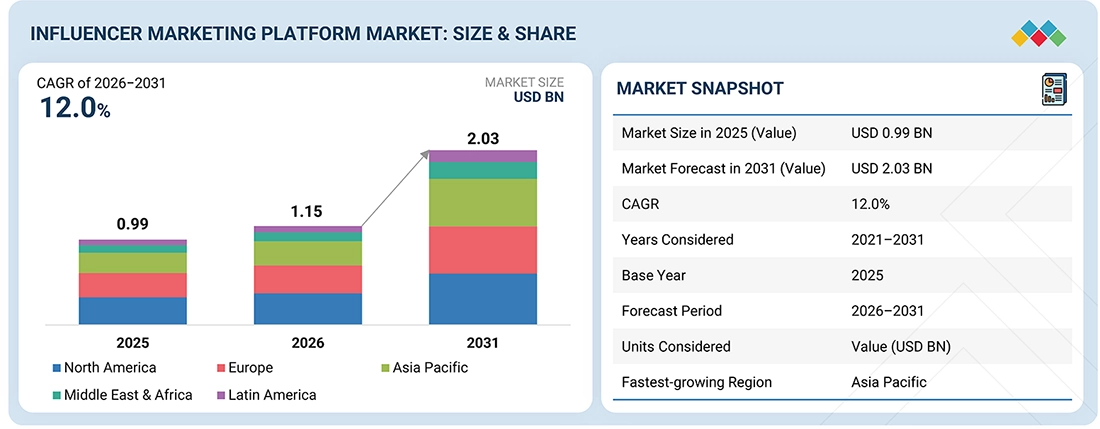
Source: Secondary Research, Interviews with Experts, MarketsandMarkets Analysis
The influencer marketing platform market is estimated at USD 1.15 billion in 2026 and is expected to reach USD 2.03 billion by 2031, reflecting an annual growth of 12.0% during the forecast period. This projected increase reflects a steady shift in how brands structure digital engagement. In many sectors, traditional online advertising is delivering lower interaction rates, partly due to content saturation and changing audience behavior. Influencer partnerships offer brands a more focused way to reach specific communities. Creators often maintain consistent relationships with their audiences, which can translate into higher engagement when brand messaging feels aligned and relevant.
KEY TAKEAWAYS
-
By RegionNorth America is estimated to account for the largest market share of 31.9% in 2026
-
By OfferingBy offering type, mobile-based software is projected to grow at the highest CAGR of 11.4%.
-
By ApplicationsBy application, the search & discovery segment is expected to dominate the market.
-
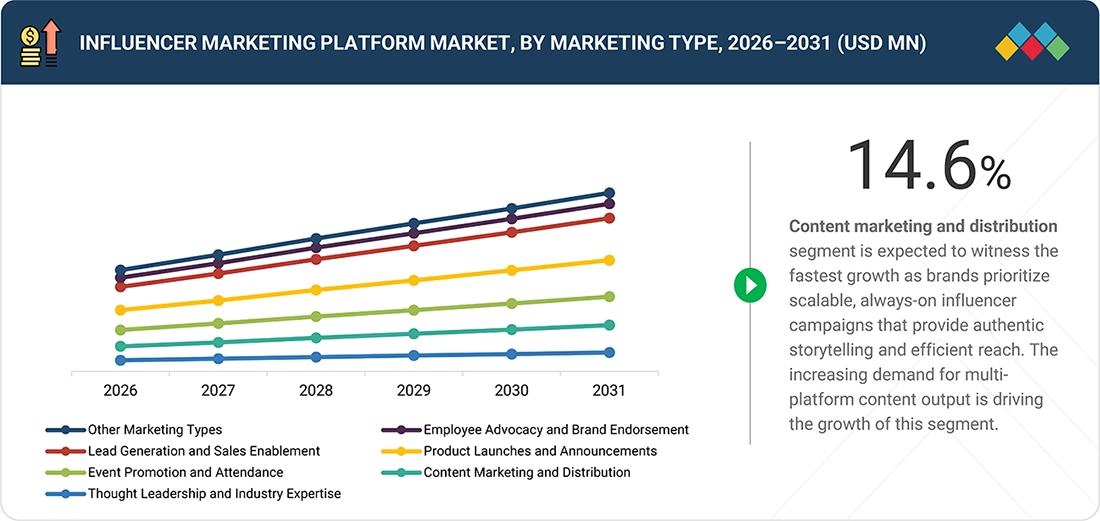
By Marketing TypeContent marketing and distribution is projected to grow at the highest CAGR of 14.6% during the forecast period.
-
By End UsersBy end user, the retail & eCommerce segment is expected to hold the largest market share in 2026.
-
Competitive Landscape- Key PlayersIZEA, impact.com, and Launchmetrics were identified as leading players in the market due to their strong product innovation, broad industry coverage, and solid operational and financial performance.
-
Competitive Landscape-StartupsHypeAuditor, Influencity, and Insense have distinguished themselves among startups and SMEs through robust product portfolios and effective business strategies.
Influencer marketing platforms are used to organize and monitor campaigns. They bring together influencer identification, communication, execution tracking, and performance reporting within one system. Marketing teams typically review creators based on audience characteristics, engagement trends, and content style. Dashboards provide ongoing visibility into results. Clear campaign parameters and measurable outcomes help companies expand influencer activity without losing operational control.
TRENDS & DISRUPTIONS IMPACTING CUSTOMERS' CUSTOMERS
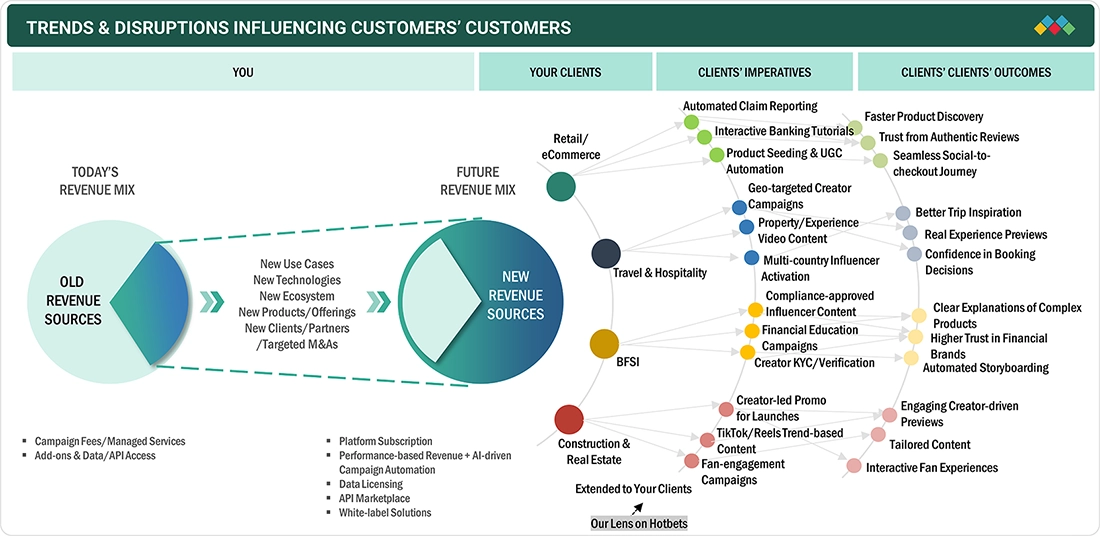
The market is forecast to grow at 12.0% annually through 2031. Continued investment in data tools and automation supports this outlook. Many platforms now include audience validation checks, performance forecasting tools, fraud detection systems, and automated workflows. Vendors are also expanding integration with CRM and commerce systems to strengthen attribution tracking. This convergence will change the business revenue mix for influencer marketing platform vendors in the next 3-5 years.
Source: Secondary Research, Interviews with Experts, MarketsandMarkets Analysis
MARKET DYNAMICS

Level
-
Growing demand for creator-driven, authentic brand engagement

-
Rise of performance-based influencer campaigns and measurable ROI expectations


Level
-
Fragmented creator ecosystems and inconsistent platform interoperability

-
Privacy restrictions and limited access to granular user-level data


Level
-
Advanced discovery, predictive analytics, and automated workflow optimization

-
Expansion into social commerce enablement and creator monetization tools


Level
-
Ensuring creator authenticity, brand safety, and compliance at scale

-
Maintaining trust across creators, brands, and platforms amid rapid ecosystem changes

Source: Secondary Research, Interviews with Experts, MarketsandMarkets Analysis
Driver: Growing demand for creator-driven, authentic brand engagement
Spending on creator-led campaigns is increasing across multiple industries. In several cases, brands are reallocating funds that were previously directed toward broad display advertising. Engagement with traditional formats has declined, especially in environments overwhelmed by paid content. Short-form video usage and in-app shopping features are adding further momentum to influencer adoption. Platforms are being used to coordinate creator selection, manage execution across channels, and document campaign outcomes in a structured format.
Restraint: Fragmented creator ecosystems and inconsistent platform interoperability
Fragmentation across social networks continues to create operational friction. No two platforms use identical reporting structures or technical standards. When campaign data is pulled from multiple channels, alignment is not automatic. Marketing teams often need to reconcile differences before making performance comparisons. This lack of standardization can slow cross-channel evaluation.
Opportunity: Advanced discovery, predictive analytics, and automated workflow optimization
There is an increasing focus on discovery tools and workflow automation in the industry. Brands are seeking more clarity before allocating budgets, closely examining audience authenticity and anticipated campaign performance during the planning phase. Approval processes have become more structured, and comprehensive tracking is now a standard practice. When influencer platforms integrate directly with CRM systems or e-commerce databases, it becomes easier to connect campaign activities to actual sales outcomes.
Challenge: Ensuring creator authenticity, brand safety, and compliance at scale
Concerns about authenticity and disclosure continue to surface in influencer campaigns. Engagement numbers are not always reliable, and sponsorship labeling is not always consistent, which can be an issue in regulated industries. For this reason, platforms rely on monitoring tools and verification steps instead of depending entirely on creator-reported metrics. As influencers become active across a wider range of platforms, maintaining consistent oversight requires more structured internal review processes.
INFLUENCER MARKETING PLATFORM MARKET: COMMERCIAL USE CASES ACROSS INDUSTRIES
| COMPANY | USE CASE DESCRIPTION | BENEFITS |
|---|---|---|
 |
McDonald’s partnered with Linqia to boost brand awareness, drive consideration, and increase foot traffic through an influencer-led campaign. Over four weeks, Linqia activated 20 African-American influencers aged 18–35 across major social platforms to promote McDonald’s Trick.Treat.Win! initiative. | The campaign generated 540K incremental visits, delivered a 23% lift in in-store traffic, drove 82.4K engagements, and achieved 98% positive brand sentiment, validating the effectiveness of Linqia’s targeted influencer strategy. |
 |
Bowlero collaborated with impact.com and its Studio team to execute a TikTok- and Instagram-focused influencer campaign aimed at increasing bookings and communicating its signature “unforgettable guest experience.” Studio managed influencer sourcing, content creation, and performance tracking across 10 creators. | The campaign exceeded expectations, delivering 4.4M impressions and reaching 2.8M individuals. TikTok content delivered standout performance, achieving a 6.7% engagement rate and outperforming Instagram, significantly boosting visibility among target audiences. |
 |
To reach younger audiences and address declining brand awareness, Interstate Batteries partnered with Aspire to shift from traditional campaigns to influencer-driven content. Aspire enabled precise talent selection and optimized content performance across platforms like TikTok, focusing on niche creators in van life and fishing. | The campaign delivered 5.3M organic impressions, a 5.6% engagement rate, and 300K engagements. Paid TikTok ads performed 182% above industry benchmarks, strengthening brand reach and securing expanded future budgets. |
 |
Walmart partnered with Linqia to promote its Goodies subscription box service by activating 65 influencers across parenting, food, and lifestyle categories. The campaign aimed to drive awareness and convert subscribers, supported by a dedicated “Skip the Line” special offer. | Influencer content generated 11.5M potential impressions. 25% of “Skip the Line” email subscribers converted to paying customers. Linqia content also drove 113% more traffic to the Goodies invite and promotions page. |
Logos and trademarks shown above are the property of their respective owners. Their use here is for informational and illustrative purposes only.
MARKET ECOSYSTEM
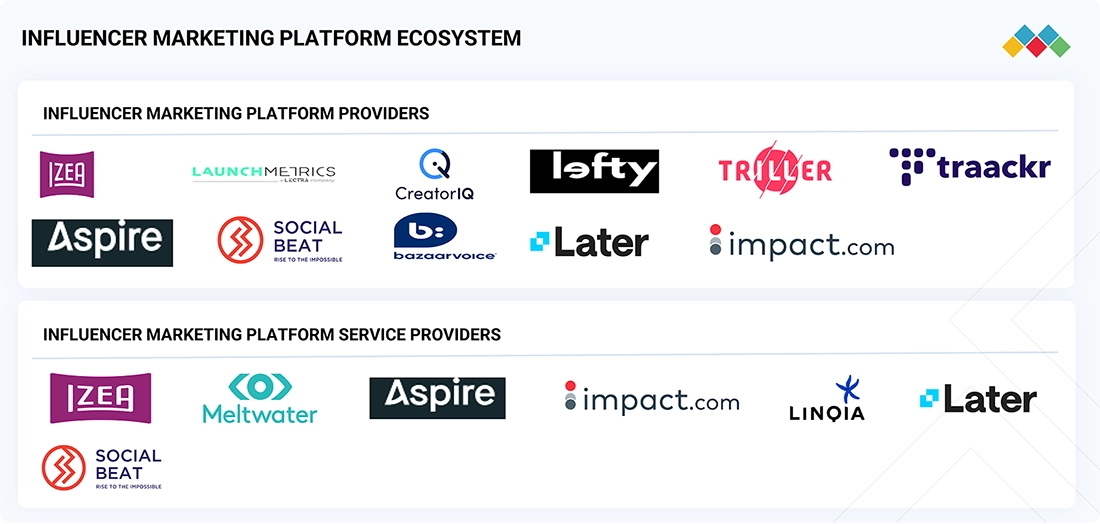
The market ecosystem includes both technology platforms and service-focused firms. Some companies primarily provide the software layer that supports discovery, execution, and reporting. Others concentrate on strategy, campaign management, and performance evaluation. In many cases, brands work with both, depending on internal capability and campaign scale.
Logos and trademarks shown above are the property of their respective owners. Their use here is for informational and illustrative purposes only.
MARKET SEGMENTS
Source: Secondary Research, Interviews with Experts, MarketsandMarkets Analysis
Influencer Marketing Platform Market, by Offering
Web-based platforms make up the largest portion of the offering segment. Many companies prefer them because they are relatively easy to roll out and can be accessed directly through a web browser. In most cases, there is no need for complex installation or specialized infrastructure. Marketing teams across different locations can log in, track campaign progress, and review results from a single system. This makes day-to-day coordination more manageable, especially for distributed teams.
Influencer Marketing Platform Market, by Marketing Type
Content marketing and distribution represent the fastest-growing marketing type segment. Brands are increasing reliance on influencers for content creation and digital distribution. Platforms coordinate workflows from briefing and approval to publication and performance review. Sustained demand for ongoing content supports segment expansion.
Influencer Marketing Platform Market, by Application
Search and discovery remain the largest application segment. These tools enable brands to screen influencers based on audience profile, engagement behavior, and content alignment. Structured filtering improves selection accuracy and reduces evaluation time.
Influencer Marketing Platform Market, by End-use Industry
Healthcare and life sciences is the fastest-growing end-user segment. Organizations in this sector use influencer campaigns to support education, awareness, and wellness initiatives. Regulatory frameworks require documented review procedures and compliance monitoring. Influencer marketing platforms provide systems that facilitate structured governance.
REGION
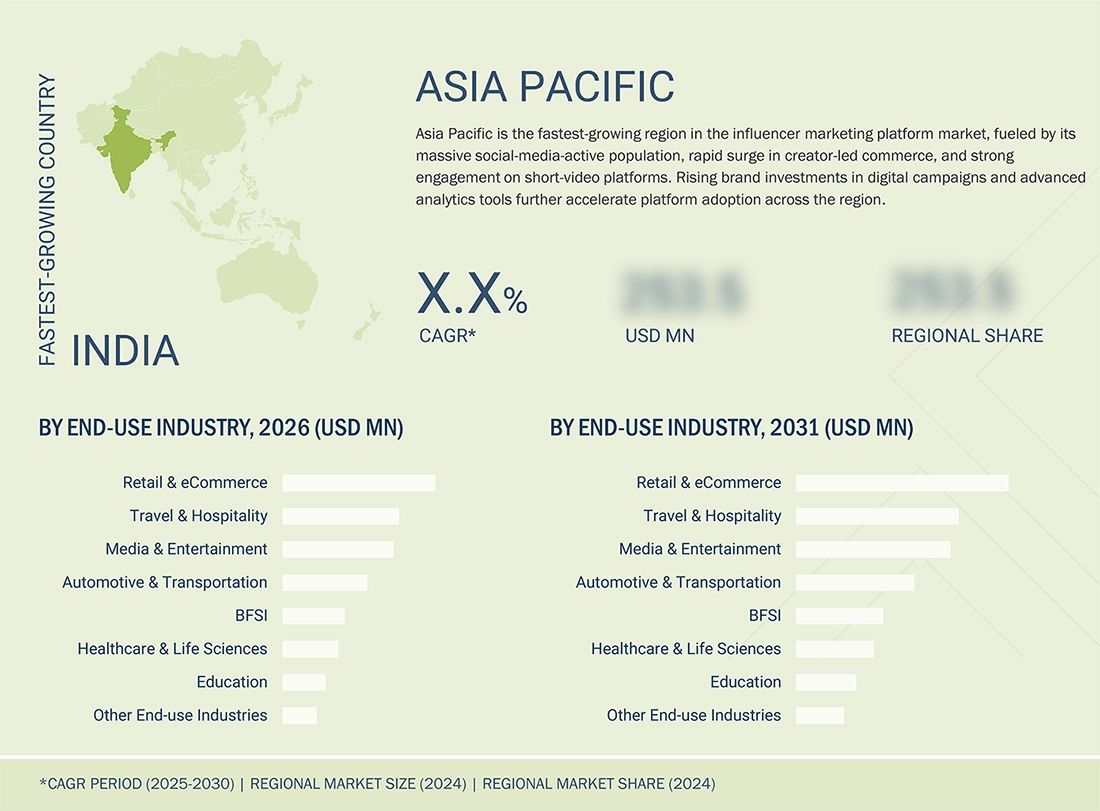
Asia Pacific to be fastest-growing region in global influencer marketing platform market during forecast period
Asia Pacific is projected to record the highest regional growth rate. Expanding social commerce participation and strong adoption of short-video platforms are contributing factors. Brands in fashion, beauty, and consumer electronics are increasing influencer partnerships to engage mobile-focused audiences. Growth in direct-to-consumer operations and cross-border e-commerce further supports demand in the region.
INFLUENCER MARKETING PLATFORM MARKET: COMPANY EVALUATION MATRIX
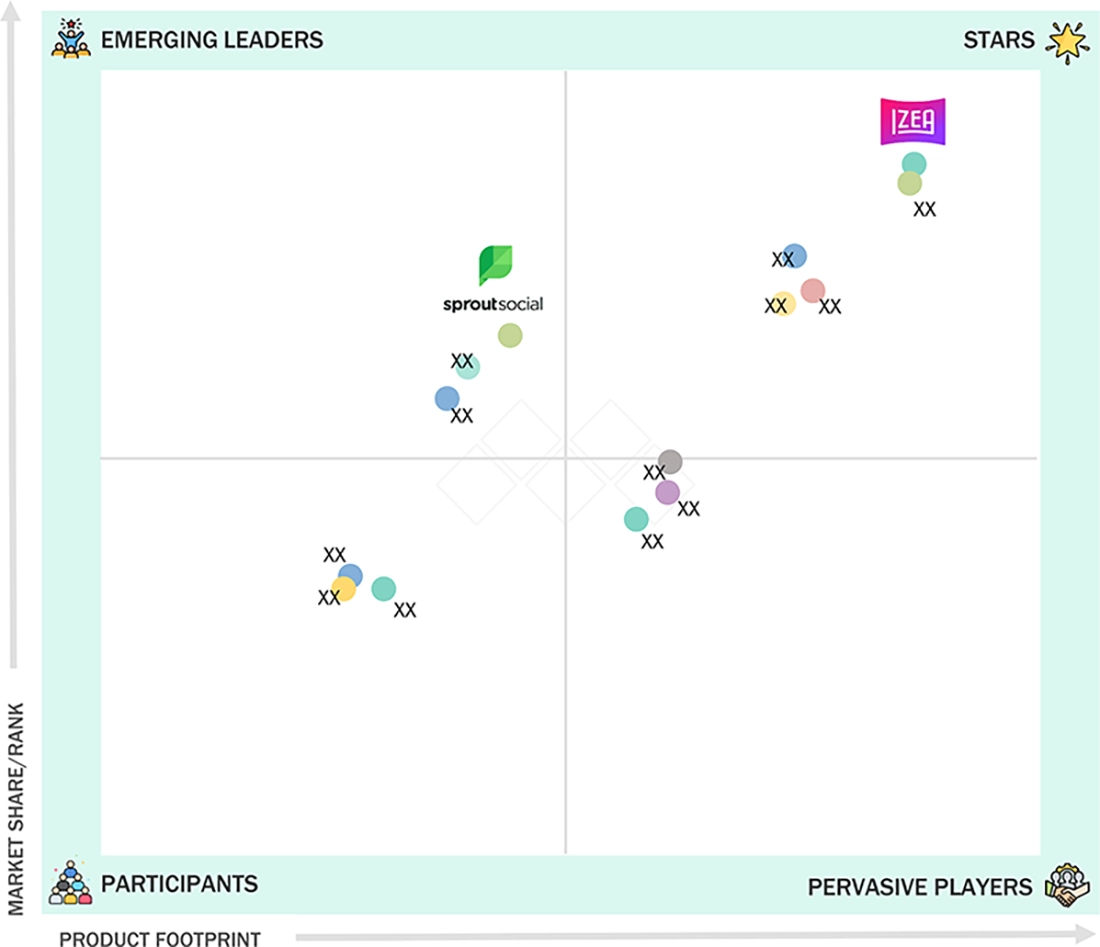
Within the competitive landscape, IZEA (Star) maintains a strong position due to its creator marketplace, campaign management tools, analytics capabilities, workflow systems, and established market presence. Sprout Social (Emerging Leader) is expanding beyond social media management into influencer discovery and relationship coordination. Its development is supported by integrated analytics functions, unified platform features, and continued system enhancements.
Source: Secondary Research, Interviews with Experts, MarketsandMarkets Analysis
KEY MARKET PLAYERS
- Izea Worldwide (US)
- Launchmetrics (US)
- Triller (US)
- Traackr (US)
- Upfluence (US)
- Meltwater (US)
- Aspire.io (US)
- CreatorIQ (US)
- Later (US)
- Impact.com (US)
- Linqia (US)
- Onalytica (UK)
- Social Beat (India)
- GRIN (US)
- BazaarVoice (US)
- Pattern (US)
- Lefty (France)
- Sprout Social (US)
- Intellifluence (US)
- Insense (US)
- Captiv8 (US)
MARKET SCOPE
| REPORT METRIC | DETAILS |
|---|---|
| Market Size in 2025 (Value) | USD 0.99 Billion |
| Market Size in 2026 (Value) | USD 1.15 Billion |
| Market Forecast in 2031 (Value) | USD 2.03 Billion |
| CAGR | 12.0% |
| Years Considered | 2021–2031 |
| Base Year | 2025 |
| Forecast Period | 2026–2031 |
| Units Considered | USD Billion |
| Report Coverage | Revenue Forecast, Company Ranking, Competitive Landscape, Growth Factors, and Trends |
| Segments Covered |
|
| Regions Covered | North America, Asia Pacific, Europe, Middle East & Africa, Latin America |
WHAT IS IN IT FOR YOU: INFLUENCER MARKETING PLATFORM MARKET REPORT CONTENT GUIDE
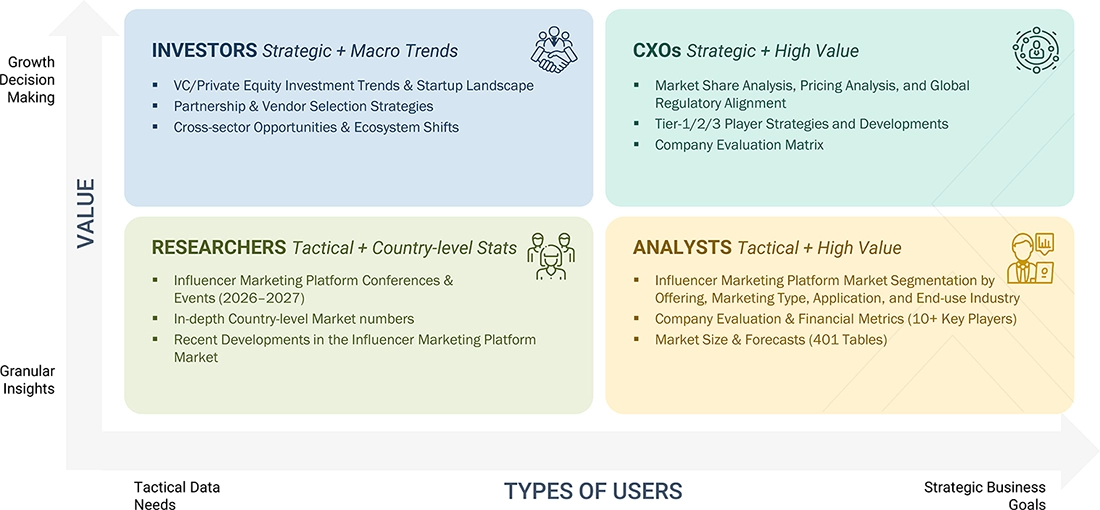
DELIVERED CUSTOMIZATIONS
We have successfully delivered the following deep-dive customizations:
| CLIENT REQUEST | CUSTOMIZATION DELIVERED | VALUE ADDS |
|---|---|---|
| Digital Marketing Technology Vendor |
|
|
| Marketing Analytics & Insights Firm |
|
|
RECENT DEVELOPMENTS
- June 2026 : CreatorIQ announced a strategic data partnership with Dentsu that integrates Dentsu’s audience strategy data with CreatorIQ’s creator database. The integration enables brands to match target-audience attributes directly against creator follower and viewership data, improving creator discovery, evaluation and campaign activation within the CreatorIQ platform. The development directly enhances the functionality of an influencer marketing platform and represents a substantive platform-level partnership.
- June 2026 : impact.com unveiled multiple new creator-commerce and AI capabilities across its partnership platform, including autonomous partnership agents, creator discovery integrations, in-platform social amplification, Creator Benchmark Reporting and expanded creator-data integrations. The new capabilities enable brands to discover, activate, measure and optimize creator partnerships within a unified platform, making this a substantial product-development milestone directly relevant to the Influencer Marketing Platform market.
- June 2026 : Aspire.io introduced an integration with the YouTube Creator Partnerships API, enabling customers to discover YouTube creators, streamline branded-content workflows and evaluate campaign performance using first-party creator data. Aspire also introduced its public API, allowing campaign, creator and program analytics to be integrated into customers’ own BI tools and workflows. These additions materially expand the platform’s creator-discovery, campaign-management and analytics capabilities and directly qualify under Influencer Marketing Platform
- May 2026 : Later launched Creator AEO, an offering built specifically for creator marketing that helps brands influence how they appear across large language models and AI-powered discovery through third-party content and creator-driven conversations. Powered by Later EdgeAI, the launch extends Later’s influencer-marketing platform into AI-driven discovery while using creator and commerce data to support campaign-performance optimization. This is a direct new-product development for an Influencer Marketing Platform.
- May 2025 : Sprout Social expanded its influencer marketing capabilities by enhancing the Tagger by Sprout Social platform, introducing improved AI-powered influencer discovery and campaign analytics tools to help brands identify creators and measure campaign performance more effectively.
Table of Contents
 Exclusive indicates content/data unique to MarketsandMarkets and not available with any competitors.
Methodology
The research methodology for the influencer marketing platform market report involved extensive use of secondary sources and directories, as well as various reputable open-source databases, to identify and collect relevant information for this technical and market-oriented study. In-depth interviews were conducted with various primary respondents and high-level executives from multiple companies offering influencer marketing platform software, services, and industry consultants to obtain and verify critical qualitative and quantitative information and assess market prospects and industry trends.
Secondary Research
During the secondary research process, various secondary sources were consulted to identify and collect information for the study. The secondary sources included annual reports, press releases, and investor presentations of companies; white papers; and certified publications.
Secondary research was used to gather key information on the industry’s value chain, the market’s monetary chain, the overall pool of key players, market classification, and segmentation based on industry trends, regional markets, and key developments from both market- and technology-oriented perspectives.
Primary Research
In the primary research process, a diverse range of stakeholders from both the supply and demand sides of the influencer marketing platform ecosystem were interviewed to gather qualitative and quantitative insights specific to this market. From the supply side, key industry experts, including chief executive officers (CEOs), vice presidents (VPs), marketing directors, technology & innovation directors, and technical leads from vendors offering influencer marketing platform software & services, were consulted. Additionally, system integrators, service providers, and IT service firms that implement and support the influencer marketing platform were included in the study. On the demand side, input from IT decision-makers, infrastructure managers, and business heads from prominent industry verticals was collected to understand user perspectives and adoption challenges within the targeted industries.
The primary research ensured that all crucial parameters affecting the influencer marketing platform market, including technological advancements and evolving use cases, as well as regulatory and compliance needs, were considered. Each factor was thoroughly analyzed, verified through primary research, and evaluated to obtain precise quantitative and qualitative data for this market.
Once the initial phase of market engineering was completed, including detailed calculations for market statistics, segment-specific growth forecasts, and data triangulation, a second round of primary research was conducted. This step was crucial for refining and validating critical data points, such as influencer marketing platform offerings (software, services), industry adoption trends, the competitive landscape, and key market dynamics like demand drivers (growing demand for creator driven, authentic brand engagement, rise of performance based influencer campaigns and measurable ROI expectations), challenges (maintaining visual consistency and temporal stability in longer sequences), opportunities (advanced discovery, predictive analytics, and automated workflow optimization), and restraints (fragmented creator ecosystem and inconsistent platform interoperability).
In the comprehensive market engineering process, the top-down and bottom-up approaches, along with several data triangulation methods, were extensively employed to estimate and forecast the overall market segments and subsegments listed in this report. Extensive qualitative and quantitative analysis was conducted across the complete market engineering process to capture critical information/insights throughout the report.
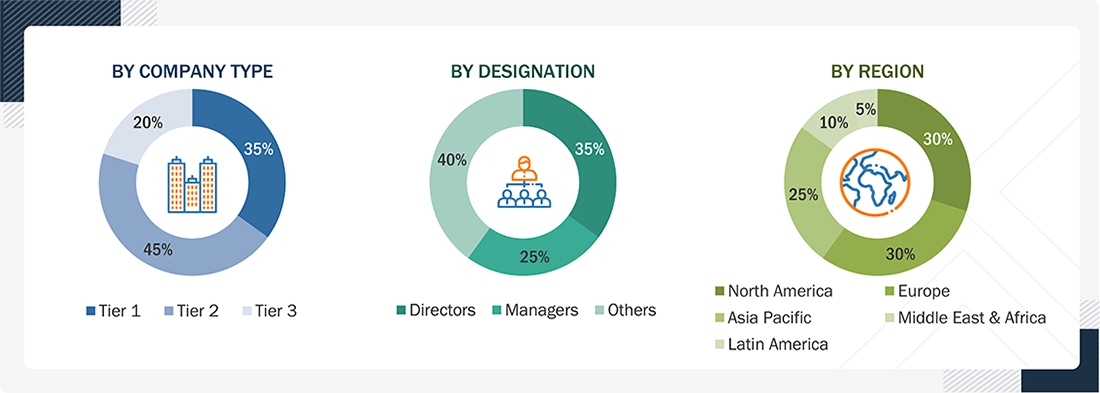
Note: The tiers of companies are defined based on their total revenue as of 2024; Tier 1 = revenue more than USD 500 million, Tier 2 = revenue between USD 100 million and 500 million, and Tier 3 = revenue less than USD 100 million.
To know about the assumptions considered for the study, download the pdf brochure
Market Size Estimation
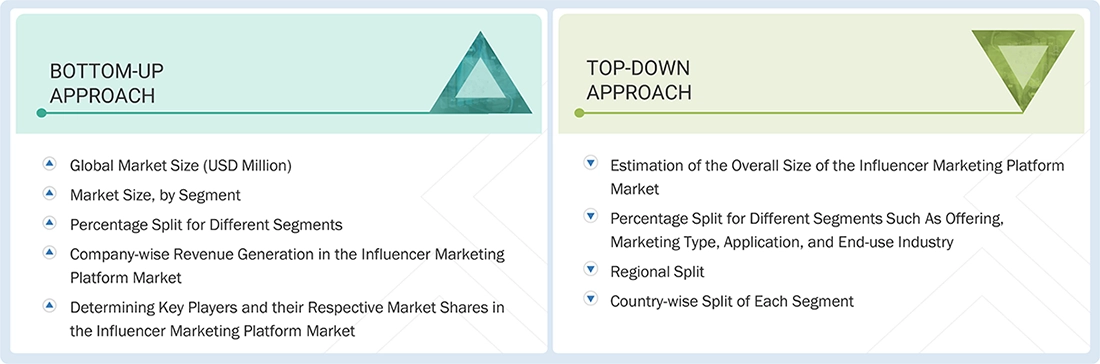
The top-down and bottom-up approaches were employed to estimate and forecast the influencer marketing platform market and its dependent submarkets. This multi-layered analysis was further reinforced through data triangulation, which incorporated primary and secondary research inputs. The market figures were also validated against the existing MarketsandMarkets repository for accuracy.
Influencer Marketing Platform Market : Top-Down and Bottom-Up Approach
Data Triangulation
The market was divided into several segments and subsegments after determining the overall market size using the market size estimation processes described above. To complete the overall market engineering process and determine the exact statistics for each market segment and subsegment, data triangulation and market segmentation procedures were employed, wherever applicable. The overall market size was then used in the top-down approach to estimate the size of other individual markets by applying percentage splits to the market segmentation.
Market Definition
According to impact.com, an influencer marketing platform is a unified solution that enables brands to discover creators, manage partnerships, and execute data-driven campaigns across digital channels. It provides end-to-end capabilities, including influencer identification, workflow automation, content collaboration, performance tracking, and transparent attribution. By leveraging AI-powered insights and user-friendly interfaces, the platform ensures brands can activate the right creators, deliver authentic content, and optimize outcomes across social ecosystems. This technology plays a pivotal role in strengthening customer engagement, scaling creator-led marketing, and ensuring measurable, compliant campaign execution.
Key Stakeholders
- Influencer Marketing Platform Vendors
- Influencer Marketing Software Providers
- Managed Campaign Service Providers
- Support and Creator Management Service Providers
- System Integrators (SIs)/API Integration Partners
- Agencies and Value-added Resellers (VARs)
- Independent Software Vendors (ISVs)
- Cloud Service Providers
- Social Media and Technology Providers
Report Objectives
- To define, describe, and predict the influencer marketing platform market by offering (software, services), application, marketing type, end user, and region
- To provide detailed information related to major factors (drivers, restraints, opportunities, and industry-specific challenges) influencing market growth
- To analyze opportunities in the market and provide details of the competitive landscape for stakeholders and market leaders
- To forecast the market size of segments with respect to five main regions: North America, Europe, Asia Pacific, the Middle East & Africa, and Latin America
- To analyze each submarket with respect to individual growth trends, prospects, and contributions to the overall influencer marketing platform market
- To analyze competitive developments, such as partnerships, product launches, and mergers & acquisitions, in the influencer marketing platform market
- To analyze the impact of macroeconomic factors on the influencer marketing platform market across all regions
Available customizations:
Using the provided market data, MarketsandMarkets offers customizations tailored to the company’s specific needs. The following customization options are available for the report.
Product Analysis
- Product comparative analysis, which gives a detailed comparison of innovative products being offered by prominent vendors
Geographic Analysis
- Further breakup of additional European countries by offering, application, marketing type, and end user.
- Further breakup of additional Asia Pacific countries by offering, application, marketing type, and end user.
- Further breakup of additional Middle East & African countries by offering, application, marketing type, and end user.
- Further breakup of additional Latin American countries by offering, application, marketing type, and end user.
Company Information
- Detailed analysis and profiling of additional market players (up to five)
Key Questions Addressed by the Report
What is the current Influencer Marketing Platform Market size?
Influencer Marketing Platform Market size at USD 1.15B in 2026, reaching USD 2.03B by 2031.
Which component dominated the Influencer Marketing Platform market?
The content marketing and distribution segment accounted for the largest revenue share of 14.6%.
What is the Influencer Marketing Platform market growth rate?
The global Influencer Marketing Platform market is expected to grow at a CAGR of 12.0% from 2026 to 2031, reaching USD 2.03 billion by 2031.
What is driving growth in the Influencer Marketing Platform Market?
Growth is driven by rising creator-led marketing, AI-powered campaign optimization, demand for measurable ROI, and centralized influencer management.
Which is the fastest-growing regional market?
Asia Pacific is the fastest-growing region over the forecast period.


Personalize This Research
- Triangulate with your Own Data
- Get Data as per your Format and Definition
- Gain a Deeper Dive on a Specific Application, Geography, Customer or Competitor
- Any level of Personalization
Let Us Help You
- What are the Known and Unknown Adjacencies Impacting the Influencer Marketing Platform Market
- What will your New Revenue Sources be?
- Who will be your Top Customer; what will make them switch?
- Defend your Market Share or Win Competitors
- Get a Scorecard for Target Partners

Custom Market Research Services
We Will Customise The Research For You, In Case The Report Listed Above Does Not Meet With Your Requirements
Get 10% Free CustomisationTESTIMONIALS






Growth opportunities and latent adjacency in Influencer Marketing Platform Market