Large Caliber Ammunition Market Size, Share & Growth Factors

Large Caliber Ammunition Market by Artillery (130 MM, 155 MM), Tank (105 MM, 120 MM, 125 MM), Mortar (60 MM, 81 MM, 120 MM), Naval (57 MM, 76 MM, 127 MM), Rocket (70 MM, 122 MM), End User, Guidance, Component - Global Forecast to 2031




LARGE CALIBER AMMUNITION MARKET OVERVIEW
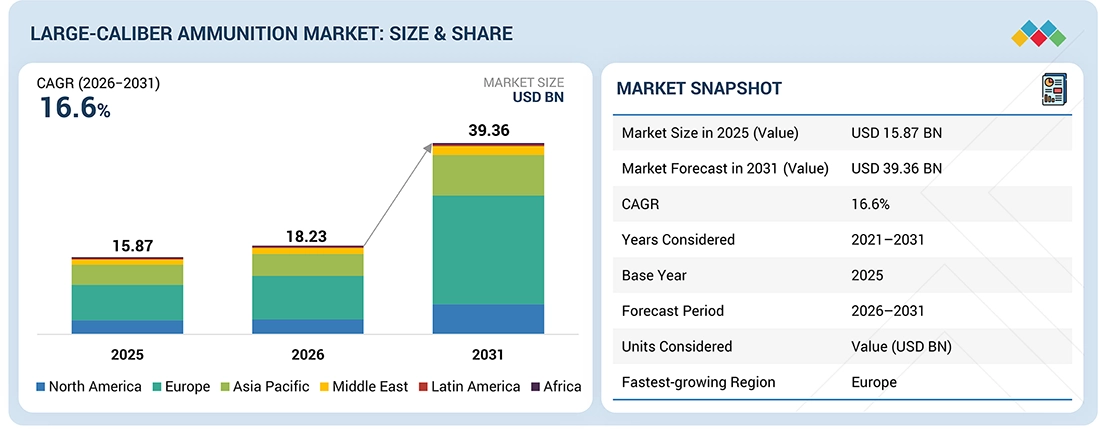
The Large Caliber Ammunition Market is projected to reach USD 39.36 billion by 2031 from USD 18.23 billion in 2026, at a CAGR of 16.6% from 2026 to 2031. The market is driven by rising defense budgets, ongoing regional conflicts, and the modernization of artillery systems across major military forces. Increased demand for longer-range, precision-guided shells and higher stockpiling requirements to strengthen combat readiness are also supporting steady procurement growth.
LARGE CALIBER AMMUNITION MARKET Size & Forecast
• 2025 Market Size (Value): USD 15.87 Billion
• 2031 Market Forecast (Value): USD 39.36 Billion
• CAGR: 16.6% during 2026-2031
• European Large-Caliber Ammunition Market: 49.1% of the Market in 2025
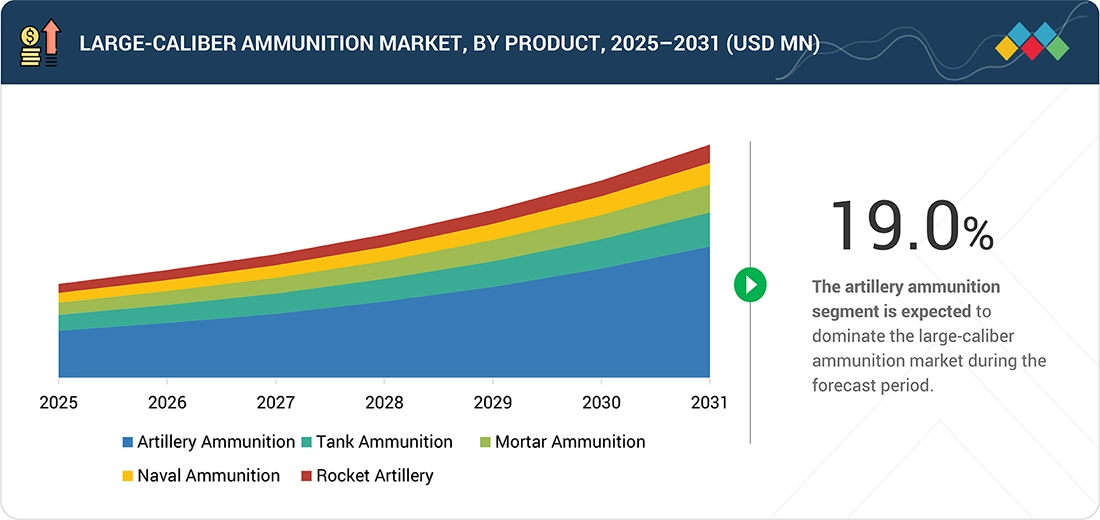
• Artillery Ammunition Segment: CAGR of 19.0%
Source: Secondary Research, Interviews with Experts, MarketsandMarkets Analysis
KEY TAKEAWAYS
-
By RegionThe European large-caliber ammunition market accounted for 49.1% of the market in 2025.
-
By ProductThe artillery ammunition segment is expected to register the highest CAGR of 19.0%.
-
By End UserThe military segment is projected to grow at the highest rate from 2026 to 2031.
-
By ComponentThe projectiles and warheads segment is expected to dominate the market.
-
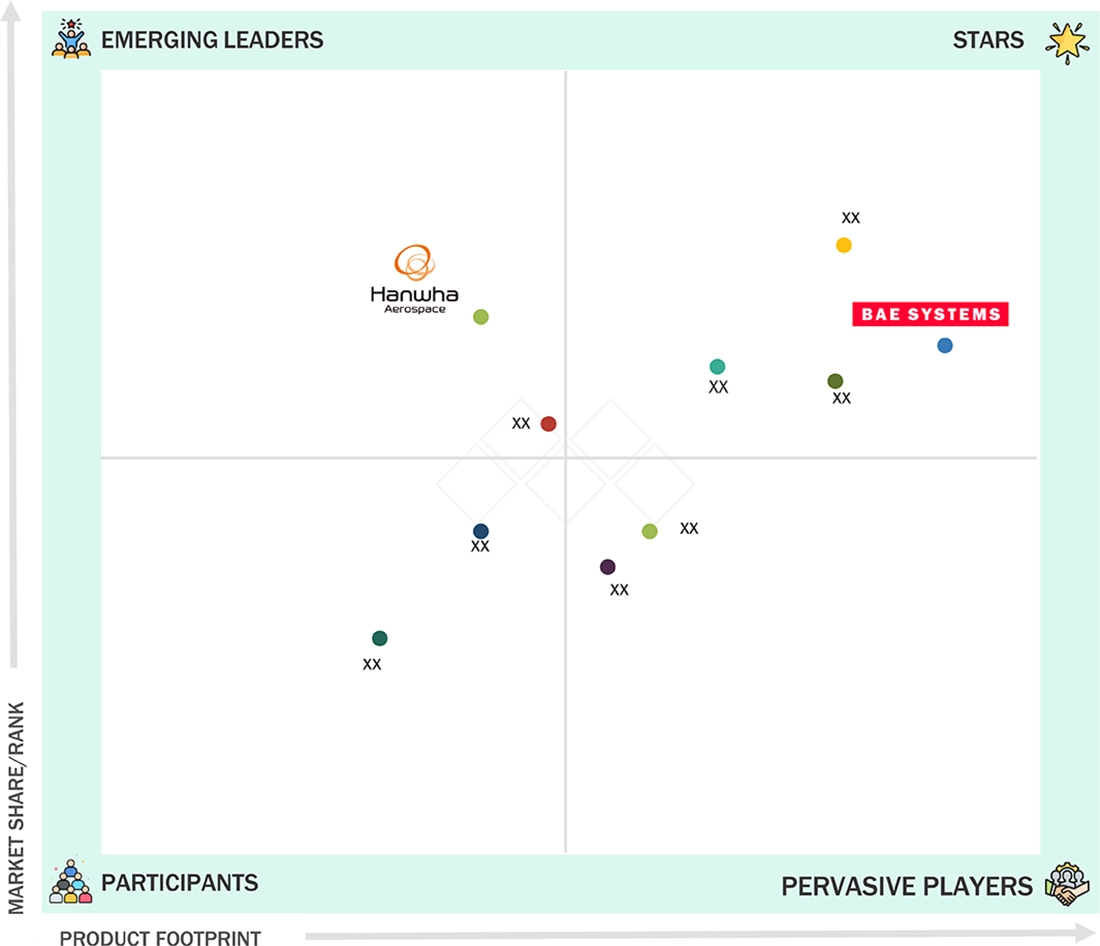
COMPETITIVE LANDSCAPE - KEY PLAYERSBAE Systems, Nammo AS, and Elbit Systems Ltd were identified as some of the star players in the large-caliber ammunition market (global), given their strong market share and product footprint.
-
COMPETITIVE LANDSCAPE - OTHER PLAYERSNIEWIADÓW POLISH MILITARY GROUP JOINT STOCK COMPANY has distinguished itself among startups and SMEs by securing a strong foothold in specialized niche areas, underscoring its potential as an emerging market leader.
The Large Caliber Ammunition Industry is driven by increased procurement to replenish war reserves, higher stockpiling levels, and rising demand for extended-range ammunition. The market is expected to grow steadily as countries expand production capacity and secure long-term supply contracts for large-caliber ammunition.
TRENDS & DISRUPTIONS IMPACTING CUSTOMERS' CUSTOMERS
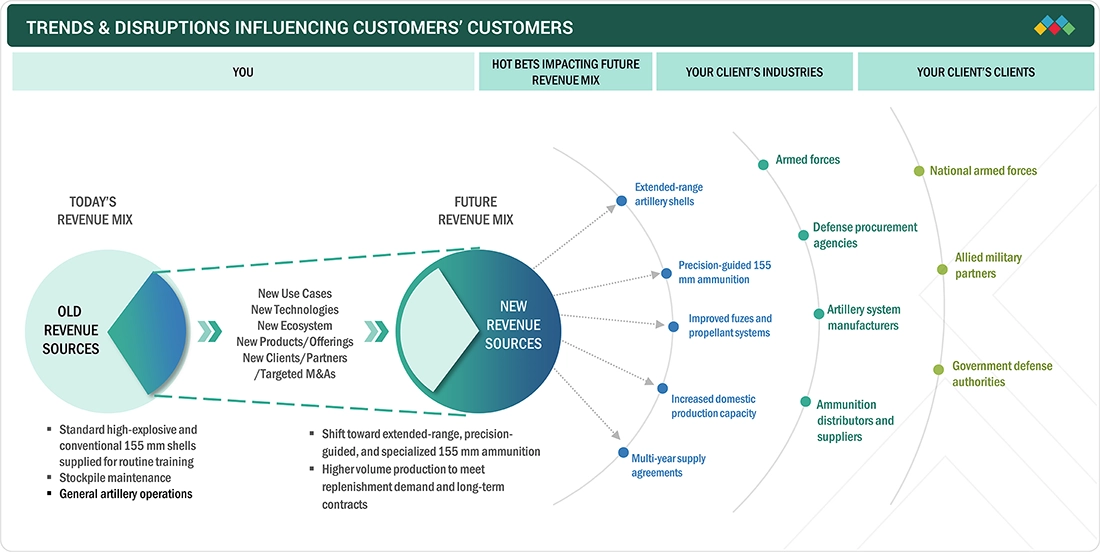
The impact on customers’ business in the large-caliber ammunition market comes from changing military needs and supply pressures. Armed forces and defense agencies are shifting from standard shells to extended range, and precision guided Large-caliber ammunition, while increasing domestic production and signing multi-year supply agreements. These changes affect procurement planning, budgets, and supplier selection and increase demand for manufacturers with strong production capacity and advanced capabilities.
Source: Secondary Research, Interviews with Experts, MarketsandMarkets Analysis
LARGE CALIBER AMMUNITION MARKET DYNAMICS

Level
-
Rising artillery use in active conflicts

-
Expansion of defense budgets focused on strengthening long-range firepower capabilities


Level
-
Production capacity constraints due to limited availability of explosives and propellant materials

-
Export controls and regulatory restrictions affecting cross-border ammunition trade


Level
-
Demand for extended-range and precision-guided shells

-
Long-term procurement contracts to rebuild and maintain national ammunition stockpiles


Level
-
Scaling manufacturing output quickly while maintaining safety and quality standards

-
Securing stable supply chains for critical components such as fuzes and propellants

Source: Secondary Research, Interviews with Experts, MarketsandMarkets Analysis
Drivers: Rising artillery use in active conflicts
Increased artillery use in ongoing war zones has led to higher consumption of 155 mm ammunition. Armed forces are refilling depleted stockpiles to maintain readiness. This continued demand is supporting steady procurement and production planning across the market.
Restraint: Production capacity constraints due to limited availability of explosives and propellant materials
Limited availability of key raw materials, such as explosives and propellants, is restricting production output. Manufacturers are operating at or near full capacity, making it difficult to meet sudden increases in demand. This constraint is slowing delivery timelines and affecting supply stability.
Opportunity: Demand for extended-range and precision-guided shells
There is a growing demand for 155 mm shells that offer longer range and improved accuracy. Armed forces are seeking ammunition that improves effectiveness while reducing collateral damage. This creates opportunities for manufacturers investing in advanced shell designs and guidance technologies.
Challenge: Scaling manufacturing output quickly while maintaining safety and quality standards
Rapidly increasing production volumes while maintaining strict safety and quality standards is a major challenge. Ammunition manufacturing involves sensitive materials and regulated processes that limit how fast facilities can expand. Companies must balance higher output with compliance and risk management requirements.
LARGE CALIBER AMMUNITION MARKET: COMMERCIAL USE CASES ACROSS INDUSTRIES
| COMPANY | USE CASE DESCRIPTION | BENEFITS |
|---|---|---|
 |
Supply of extended-range 155 mm ERFB ammunition to address shortages caused by rising operational demand and limited global production capacity. | Reliable delivery | Expanded production capacity | Improved long-range fire capability | Supply stability |
 |
Framework agreement for joint production and certification of 155 mm shells in Poland to address European supply shortages. | Local production expansion | Reduced external dependency | Improved regional availability | Strengthened supply security |
 |
Development of indigenously designed 155 mm smart ammunition to improve the low accuracy of conventional shells. | Higher precision (reduced CEP) | Increased lethality | Indigenous guidance capability | Reduced reliance on foreign systems |
 |
Development of a ramjet-powered, guided extended-range artillery shell to address the requirement for long-range combat scenarios beyond the typical 20 km range of conventional artillery. The solution combines features of a missile and an artillery shell, achieving ranges of up to 150 km with precision guidance capability. | Extended range (up to 150 km) | High accuracy | Precision strike capability | Enhanced destructive effectiveness | Improved operational reach |
Logos and trademarks shown above are the property of their respective owners. Their use here is for informational and illustrative purposes only.
LARGE CALIBER AMMUNITION MARKET ECOSYSTEM
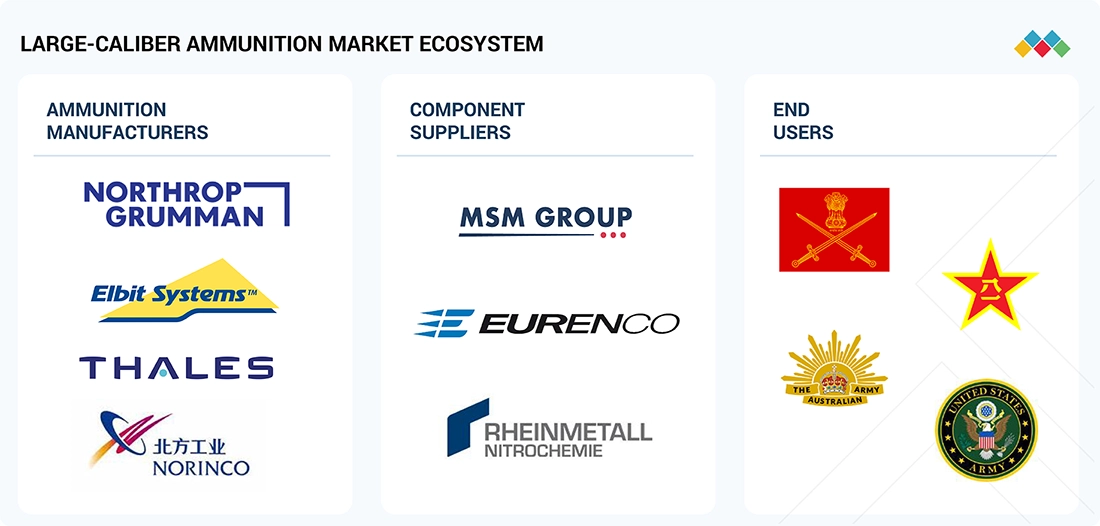
The large-caliber ammunition market ecosystem includes ammunition manufacturers, component suppliers, and end users. Companies such as Northrop Grumman, Thales, Elbit Systems, and NORINCO produce 155 mm artillery shells and complete rounds. They work with component suppliers like MSM Group, Rheinmetall Nitrochemie, and Eurenco for propellants and other key materials. The main end users are national armed forces that purchase 155 mm ammunition through government defense programs and supply contracts.
Logos and trademarks shown above are the property of their respective owners. Their use here is for informational and illustrative purposes only.
LARGE CALIBER AMMUNITION MARKET SEGMENTS
Source: Secondary Research, Interviews with Experts, MarketsandMarkets Analysis
Large-caliber Ammunition market, By Product
Artillery ammunition holds the largest share in the large-caliber ammunition market mainly because it is widely used in modern ground warfare and consumed in high volumes. Calibers like 105 mm, 130 mm, 155 mm, and 203 mm are commonly deployed in towed and self-propelled artillery systems for long-range fire support and area suppression. Regular procurement for operational readiness, continuous stockpiling, and ongoing upgrades of artillery platforms in many countries are supporting its strong market position.
Large-caliber Ammunition market, By End User
The military segment accounts for the largest share since large-caliber ammunition is mainly developed for defense and combat use. Armed forces around the world depend on these rounds for tanks, artillery systems, and other heavy platforms, which keeps procurement steady. Rising defense budgets, growing geopolitical tensions, and the need to maintain proper reserves for training and active duty are further strengthening the military’s leading position in this market.
Large-caliber Ammunition market, By Non-guidance
Non-guided ammunition dominates this segment because it is more cost-effective and produced in large quantities. It is also easily compatible with existing artillery systems. These conventional rounds are widely used in training exercises, area bombardment, and extended combat operations, resulting in strong volume demand. The lower unit cost compared to guided variants allows bulk buying and long-term stockpiling, which helps it maintain the largest share.
Large-caliber Ammunition market, By Component
Projectiles and warheads hold the largest share as they are the main functional part of large-caliber ammunition. They carry the explosive payload and directly impact the munition’s performance in operations. High production levels, regular replenishment needs, and improvements in explosive materials and design are contributing to their dominant position in the large ammunition market.
LARGE CALIBER AMMUNITION MARKET REGIONS
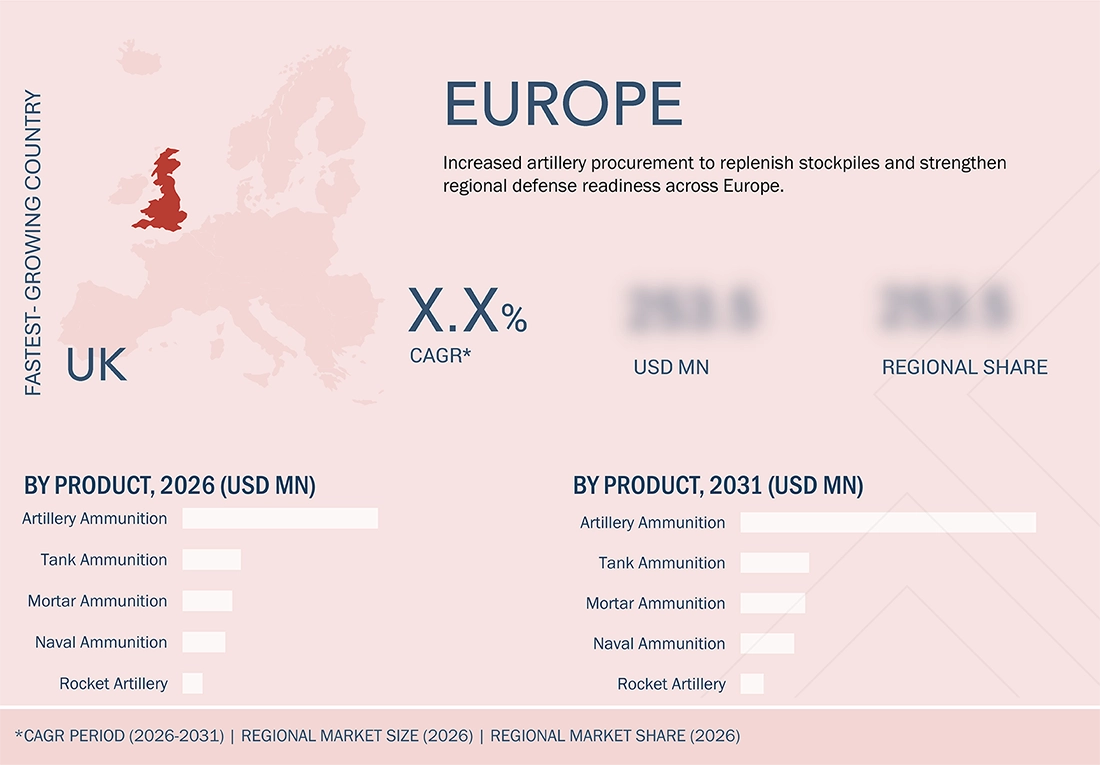
Europe is expected to be the fastest-growing region in the large-caliber ammunition market during the forecast period
The European large-caliber ammunition market is expected to register the highest CAGR during the forecast period. It is supported by urgent stockpile replenishment and increased artillery use. Many European countries are expanding their local manufacturing capacity to strengthen supply security and reduce reliance on external sources. Higher defense spending and coordinated regional procurement programs are supporting sustained demand for large-caliber ammunition.
LARGE CALIBER AMMUNITION MARKET: COMPANY EVALUATION MATRIX
In the large-caliber ammunition market matrix, Nammo AS (Star) has a strong production base and supplies standard and extended range artillery shells used by NATO forces. The company is expanding its production capacity and improving its ammunition designs, which helps maintain a steady supply and a strong market position. In the large-caliber ammunition market matrix, Hanwha Aerospace (Emerging Leader) is increasing its role by expanding production of 155 mm artillery shells and related components. The company is growing its capacity to meet rising global demand and strengthening its position through new contracts and partnerships.
Source: Secondary Research, Interviews with Experts, MarketsandMarkets Analysis
LARGE CALIBER AMMUNITION MARKET KEY PLAYERS
List of Top Large Caliber Ammunition Market Companies
- BAE Systems (UK)
- Nammo AS (Norway)
- Elbit Systems Ltd (Israel)
- General Dynamics Corporation (US)
- Rheinmetall AG (Germany)
- Northrop Grumman (US)
- KNDS (Netherlands)
- Yugoimport SRDP J.P (Serbia)
- Norinco Group (China)
- Munitions India Ltd (India)
- Thales (France)
- Hanwha Aerospace (South Korea)
- ST Engineering (Singapore)
- Poongsan Corporation (South Korea)
LARGE CALIBER AMMUNITION MARKET SCOPE
| REPORT METRIC | DETAILS |
|---|---|
| Market Size in 2025 (Value) | USD 15.87 Billion |
| Market Forecast in 2031 (Value) | USD 39.36 Billion |
| Growth Rate | CAGR of 16.6% during 2026-2031 |
| Years Considered | 2021-2031 |
| Base Year | 2025 |
| Forecast Period | 2026-2031 |
| Units Considered | Value (USD Billion) |
| Report Coverage | Revenue forecast, company ranking, competitive landscape, growth factors, and trends |
| Segments Covered |
|
| Regions Covered | North America, Asia Pacific, Europe, Latin America, Middle East, and Africa |
WHAT IS IN IT FOR YOU: LARGE CALIBER AMMUNITION MARKET REPORT CONTENT GUIDE
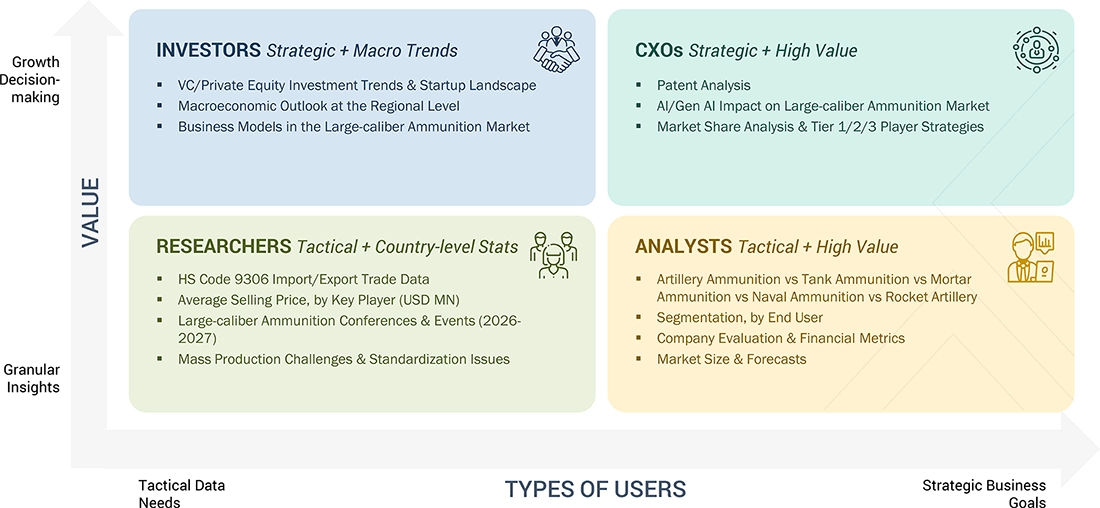
DELIVERED CUSTOMIZATIONS
We have successfully delivered the following deep-dive customizations:
| CLIENT REQUEST | CUSTOMIZATION DELIVERED | VALUE ADDS |
|---|---|---|
| Leading Manufacturer | Additional segment breakdown for countries | Additional country-level market sizing tables for segments/sub-segments covered at the regional/global level to gain an understanding of market potential by each country |
| Emerging Leader | Additional company profiles | Competitive information on targeted players to gain granular insights on direct competition |
| Regional Market Leader | Additional country market estimates | Additional country-level deep dive for a more targeted understanding of the total addressable market |
RECENT DEVELOPMENTS
- July 2025 : Rheinmetall Denel Munition secured a multi-year contract worth hundreds of millions of euros from a European NATO country for the supply of 155mm Assegai artillery projectiles and propelling charges. The deliveries will take place from 2025 to 2027. The ammunition will be integrated into the customer’s artillery systems to support long-range fire capability.
- July 2025 : Sweden signed ammunition supply agreements with Nammo AS for artillery munitions for the Swedish Armed Forces. The deals cover artillery shells, propellant charges, and 155 mm high-explosive extended-range grenades for Sweden’s artillery systems.
- February 2023 : The US Army awarded a USD 993.8 million contract to General Dynamics Ordnance & Tactical Systems and American Ordnance to compete for orders to produce 155 mm M795 high-explosive artillery projectiles.
Table of Contents
 Exclusive indicates content/data unique to MarketsandMarkets and not available with any competitors.
Methodology
The study involved four major activities in estimating the current size of the Large Caliber Ammunition Markett. Exhaustive secondary research was done to collect information on the market, its adjacent markets, and its parent market. The next step was to validate these findings, assumptions, and sizing with industry experts across the value chain through primary research. Demand-side analysis was conducted to estimate the overall market size. After that, market breakdown and data triangulation procedures were employed to estimate the sizes of various segments and subsegments within the Large Caliber Ammunition Markett.
Secondary Research
During the secondary research process, various sources were consulted to identify and collect information for this study. The secondary sources included government sources, such as SIPRI, corporate filings, including annual reports, press releases, and investor presentations from companies, white papers, journals, and certified publications, and articles from recognized authors, directories, and databases.
Primary Research
Extensive primary research was conducted after acquiring information regarding the Large Caliber Ammunition Markett scenario through secondary research. Several primary interviews were conducted with market experts from the demand and supply sides across major countries of North America, Europe, the Asia Pacific, the Middle East, Latin America, and Africa. Primary data was collected through questionnaires, emails, and telephonic interviews.
To know about the assumptions considered for the study, download the pdf brochure
Market Size Estimation
The top-down and bottom-up approaches were used to estimate and validate the size of the Large Caliber Ammunition Markett. The research methodology used to estimate the size of the market included the following details:
• Key players in the Large Caliber Ammunition Markett were identified through secondary research, and their market shares were determined through a combination of primary and secondary research. This included a study of the annual and financial reports of the top market players, as well as extensive interviews with leaders, including directors, engineers, marketing executives, and other key stakeholders of leading companies operating in the market.
• All percentage shares, splits, and breakdowns were determined using secondary sources and verified through primary sources.
• All possible parameters that affect the markets covered in this research study were accounted for, viewed in extensive detail, verified through primary research, and analyzed to obtain the final quantitative and qualitative data on the Large Caliber Ammunition Markett. This data was consolidated, enhanced with detailed inputs, analyzed by MarketsandMarkets, and presented in this report.
Data Triangulation
After determining the overall market size, the total market was divided into several segments and subsegments. The data triangulation and market breakdown procedures explained below were implemented, wherever applicable, to complete the overall market engineering process and arrive at the estimated market numbers for the market segments and subsegments. The data was triangulated by studying various factors and trends from the demand and supply sides. Additionally, the market size was validated using top-down and bottom-up approaches.
Market Definition
Ammunition is the material fired, launched, or used from weapons such as rifles, machine guns, artillery, and launchers. It includes bullets, shells, cartridges, and projectiles that deliver force to engage targets. Ammunition is used by military and law enforcement forces for combat, security operations, training, and mission support.
Key Stakeholders
- Ammunition Manufacturers
- Component Suppliers
- System Integrators
- End Users
- Regulatory and Certification Bodies
- Raw Material Suppliers
- Logistics and Distribution Providers
Report Objectives
- To define, describe, and forecast the Large Caliber Ammunition Markett based on caliber, end user, guidance, and component
- To forecast the size of different segments of the market with respect to North America, Europe, Asia Pacific, the Middle East, Latin America, and Africa
- To identify and analyze the drivers, restraints, opportunities, and challenges influencing the growth of the market
- To identify industry trends, market trends, and technology trends currently prevailing in the market
- To analyze micro markets with respect to individual growth trends, prospects, and their contribution to the overall market
- To analyze the degree of competition in the market by analyzing recent developments adopted by leading market players
- To provide a detailed competitive landscape of the market, along with a ranking analysis of key players, and an analysis of startup companies in the market
- To strategically profile the key market players and comprehensively analyze their core competencies
- To provide a detailed competitive landscape of the market, along with a market share analysis and revenue analysis of key players
Available customizations:
MarketsandMarkets offers the following customizations for this market report:
- Additional country-level analysis of the Large Caliber Ammunition Markett
- Profiling of other market players (up to 5)
Product Analysis
- Product matrix, which provides a detailed comparison of the product portfolio of each company in the Large Caliber Ammunition Market
Key Questions Addressed by the Report
What is the projected size of the global large caliber ammunition market by 2031?
The global large caliber ammunition market is projected to grow from USD 18.23 billion in 2026 to USD 39.36 billion by 2031, registering a CAGR of 16.6%. Growth is supported by rising defense budgets, regional conflicts, artillery modernization, demand for extended range ammunition, and higher stockpiling requirements. Pasted text
What are the major factors driving the large caliber ammunition market?
Rising artillery use in active conflicts and expanding defense budgets focused on long range firepower are major growth drivers. Increased procurement to replenish war reserves, higher stockpiling levels, and demand for extended range ammunition are also supporting market expansion. Pasted text Pasted text
Which region is expected to grow the fastest in the large caliber ammunition market?
Europe is expected to register the highest CAGR during the forecast period. Urgent stockpile replenishment, increased artillery use, expansion of local manufacturing capacity, higher defense spending, and coordinated regional procurement programs are supporting growth. Pasted text
Which product segment is expected to register the highest growth?
The artillery ammunition segment is expected to register the highest CAGR of 19.0%. Its growth is supported by high volume use in modern ground warfare, regular procurement, stockpiling, and upgrades of artillery platforms. Pasted text Pasted text
Which end user segment is expected to grow the fastest?
The military segment is projected to grow at the highest rate from 2026 to 2031. Large caliber ammunition is primarily developed for defense and combat use, while rising defense budgets, geopolitical tensions, and requirements for training and operational reserves support continued procurement. Pasted text Pasted text
Which component segment is expected to dominate the large caliber ammunition market?
The projectiles and warheads segment is expected to dominate the market. These components form the main functional part of large caliber ammunition, carry the explosive payload, and directly influence munition performance. Pasted text Pasted text
Which ammunition type currently holds the largest share of the market?
Artillery ammunition holds the largest share of the large caliber ammunition market. Calibers such as 105 mm, 130 mm, 155 mm, and 203 mm are widely used in towed and self propelled artillery systems, while regular procurement and stockpiling support demand. Pasted text
What are the major opportunities in the large caliber ammunition market?
Demand for extended range and precision guided shells represents a major opportunity. Long term procurement contracts to rebuild and maintain national ammunition stockpiles also create sustained opportunities for manufacturers. Pasted text
What are the major challenges facing the large caliber ammunition market?
Scaling manufacturing output rapidly while maintaining safety and quality standards is a major challenge. Manufacturers also face difficulties securing stable supply chains for critical components such as fuzes and propellants, while limited availability of explosives and propellant materials can restrict production. Pasted text Pasted text
Which companies are recognized as leading players in the global large caliber ammunition market?
Key companies include BAE Systems, Nammo, Elbit Systems, General Dynamics, Rheinmetall, Northrop Grumman, KNDS, Yugoimport, Norinco Group, Munitions India, Thales, Hanwha Aerospace, and ST Engineering. BAE Systems, Nammo, and Elbit Systems are identified as Star players, while Hanwha Aerospace is identified as an Emerging Leader in the company evaluation matrix. Pasted text Pasted text Pasted text


Personalize This Research
- Triangulate with your Own Data
- Get Data as per your Format and Definition
- Gain a Deeper Dive on a Specific Application, Geography, Customer or Competitor
- Any level of Personalization
Let Us Help You
- What are the Known and Unknown Adjacencies Impacting the Large Caliber Ammunition Market
- What will your New Revenue Sources be?
- Who will be your Top Customer; what will make them switch?
- Defend your Market Share or Win Competitors
- Get a Scorecard for Target Partners

Custom Market Research Services
We Will Customise The Research For You, In Case The Report Listed Above Does Not Meet With Your Requirements
Get 10% Free CustomisationTESTIMONIALS
Growth opportunities and latent adjacency in Large Caliber Ammunition Market






Bernard
Jun, 2026
Can we isolate regional opportunities within Europe to understand why the region accounts for nearly half of the global market, and which countries are driving the highest procurement volumes?.
Joshua
Jun, 2026
How deeply does the study assess the transition from conventional to guided large-caliber ammunition, especially with increasing adoption of programmable fuzes and precision navigation systems?.