Lead Acid Battery Recycling Market

Lead Acid Battery Recycling Market by Source (Automotive, Industrial, and Consumer & Electronic Appliance) and Region (Asia Pacific, Europe, North America, South America, and Middle East & Africa) - Global Forecast to 2030




OVERVIEW
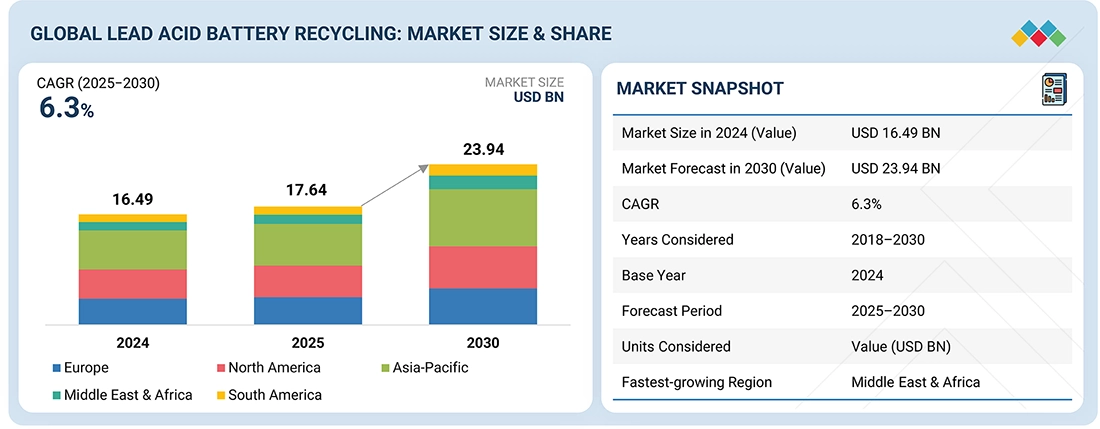
Source: Secondary Research, Interviews with Experts, MarketsandMarkets Analysis
The global lead acid battery recycling market is projected to grow from USD 17.64 billion in 2025 to USD 23.94 billion by 2030, at a CAGR of 6.3% during the forecast period. Lead acid batteries are a prominent part of the battery recycling market because of their cost, durability, and high power, especially in automotive, UPS, and backup energy applications. They are also the primary source of lead consumption in the world. The market for lead acid batteries is significantly dependent on the recycling of batteries. The battery recycling process is very efficient, cost-effective, and most of the lead content can be recovered and reused in new batteries. Strong regulatory frameworks across many regions contribute to the growth of formal recycling of lead acid batteries. Growing concern about minimizing environmental and health risks also support the growth of organized lead-acid battery recycling.
KEY TAKEAWAYS
-
BY REGIONThe Middle East & Africa is expected to register the highest CAGR of 8.3% during forecast period.
-
BY SOURCEBy source, the automotive and Industrial batteries segment is expected to dominate the market.
-
Competitive Landscape - Key PlayersCall2Recycle, Inc., The Doe Run Company, and Cirba Solutions were identified as some of the star players in the global lead acid battery recycling market, given their strong market share and product footprint.
-
Competitive Landscape - StartupsEnvirostream Australia Pty Ltd., Metalex Products Ltd., SMC Recycling, and others have distinguished themselves among startups and SMEs by securing strong footholds in specialized niche areas, underscoring their potential as emerging market leaders.
The widespread use of lead-acid batteries in cars, industries, and power backup applications generates a steady and reliable flow of batteries that have reached the end of their lifespan. The presence of lead in large quantities, a well-established recycling technique, and the very strong economic value of lead from recycling make the process not only cost-effective but also highly appealing commercially. Moreover, the application of very strict environmental standards and the launch of producer responsibility programs in many areas are turning informal collection and recycling into legal practices, while the constantly growing concern about sustainability and resource security is making recycled lead more attractive for battery production to an even greater extent.
TRENDS & DISRUPTIONS IMPACTING CUSTOMERS' CUSTOMERS
The impact on consumers' businesses arises from evolving customer trends or market disruptions. As ecosystem players serve a broader base of vehicle, industrial, utility, telecom, and backup power users, this transition is expected to raise secondary lead availability, lower production costs, and improve sustainability and regulatory outcomes for customers. These megatrends are expected to drive growth and increase the revenue of the market.
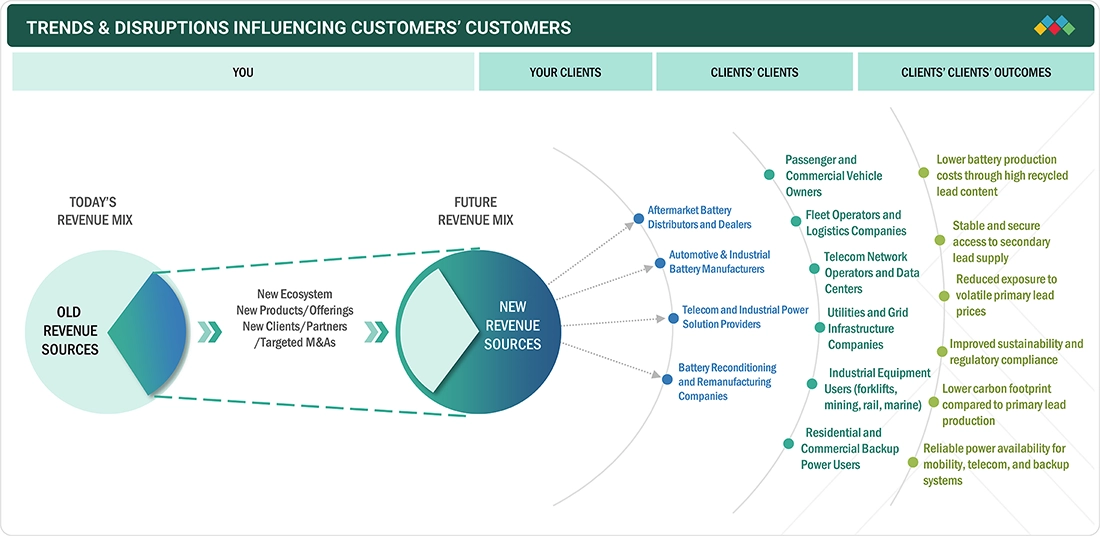
Source: Secondary Research, Interviews with Experts, MarketsandMarkets Analysis
MARKET DYNAMICS

Level
-
High replacement rate of automotive SLI batteries generating consistent end-of-life volumes


Level
-
Safety risks associated with storage and transportation


Level
-
Growth in backup power and energy storage demand


Level
-
Rising EV adoption reducing demand for lead-acid batteries in new vehicle platforms

-
Declining Li-ion battery prices

Source: Secondary Research, Interviews with Experts, MarketsandMarkets Analysis
Driver: High replacement rate of automotive SLI batteries generating consistent end-of-life volumes
One of the foremost factors that heavily support the global lead-acid battery recycling market is the ongoing and regular replacement of automotive SLI batteries, which consequently creates a continuous and reliable volume of end-of-life batteries. The efficiency of the recovery process is greatly assisted by the presence of very well-established collection networks primarily through dealerships and service centers. Furthermore, the recycling of lead has become financially attractive due to its high recyclability and economic value, thereby making the recycling process commercially viable. All these factors, along with the aforementioned high recyclability and economic value of lead, have made it very difficult for the recyclers to not have a consistent supply of feedstock.
Restraint: Safety risks associated with storage and transportation
Lead, sulfuric acid, and other hazardous materials reflect safety and environmental risks, which are slowing the market growth. The handling of these risks requires not only the imposition of strict rules about the environment and workers’ safety, but also has the side effect of increasing the operating and investment costs. Small recyclers often struggle to keep up with the regulations. As a result, the growth in capacity in certain places may be limited.
Opportunity: Growth in backup power and energy storage demand
The increasing need for backup power and stationary energy storage in various sectors, such as telecom, data centers, and industrial facilities, presents a significant market opportunity. Lead acid batteries are still the most common choice due to their heavy-duty performance and low prices. The continuous expansion of telecom networks and improved power supply efficiency have also been factors driving the demand for batteries. Consequently, this also boosts the volume of recycling.
Challenge: Declining Li-ion battery prices
The major challenge to the lead acid battery recycling market is declining prices of lithium-ion batteries and their increasing adoption in the automotive and energy storage sectors. With lithium-ion batteries becoming increasingly competitive in terms of pricing, they are gradually replacing lead-acid batteries in new setups and car models. This trend might significantly cut down the later demand for lead-acid batteries and, after a while, might restrict the amount of lead-acid batteries that are no longer usable for recycling.
Lead Acid Battery Recycling Market: COMMERCIAL USE CASES ACROSS INDUSTRIES
| COMPANY | USE CASE DESCRIPTION | BENEFITS |
|---|---|---|
 |
Call2Recycle manages extensive, producer-responsibility-driven battery collection and recycling programs, mainly helping automotive OEMs, dealerships, retailers, and operators of fleets in the management of end-of-life lead-acid batteries. The company handles the collection, transportation, and downstream recycling of compliant batteries through certified partners, allowing for the safe and traceable take-back of batteries in various areas. | It helps OEMs and distributors fulfill their regulatory and stewardship obligations while also reducing the environmental and safety risks associated with improper battery disposal. Besides the above-mentioned benefits, it also ensures, through responsible material recovery and minimized landfill dependency, that the sustainability credentials of the entire automotive value chain have been strengthened. |
 |
Cirba Solutions offers comprehensive recycling services for lead acid batteries that include collection, dismantling, material separation, and even advanced metal recovery. It is a company primarily focused on the vehicle and factory sectors, serving them by recycling used batteries and converting them into raw materials that can be reused in the production of new batteries and other applications. | The process improves the circular economy to an extent, leading to the recovery of lead and other valuable components, and integration into new battery production is made possible. It is a great aid to supply-chain resilience, reduces environmental impact, and provides a customer-friendly approach to safety and recycling standards compliance. |
 |
The primary focus of Elemental lies in the efficient smelting and refining operations of recycling batteries from automobiles and industries that are no longer in use. The process they undertake involves extracting lead and other materials from batteries that are no longer in use, and then returning the refined outputs to the automotive and energy storage supply chain. | This process not only lessens the dependence on lead mining but also gives manufacturers of batteries better raw materials. In addition, it allows carmakers and industrial consumers to meet EPR requirements and at the same time promotes the region's independence in recycled materials. |
 |
East Penn is involved in lead-acid battery recycling, where it takes back old automotive and industrial batteries, recycles them in-house, and gets lead, plastic, and electrolyte back for their new batteries. | They achieve better control of costs and security of supply due to the internal use of recycled lead. The environmental impact is significantly reduced, and waste is significantly reduced; thus, the company’s reputation as a vertically integrated and sustainability-oriented battery manufacturer is further strengthened. |
 |
Gravita India’s battery recycling services cover automotive, industrial, and backup power applications. The company’s operations include collecting worn-out batteries and refining them into secondary lead and alloys which are further used for manufacturing new batteries. | By providing recycled lead, the company supports the domestic & export markets and also contributes towards sustainable battery production. It also facilitates customers in complying with environmental regulations while reducing their reliance on virgin lead minerals and enhancing overall resource efficiency. |
Logos and trademarks shown above are the property of their respective owners. Their use here is for informational and illustrative purposes only.
MARKET ECOSYSTEM
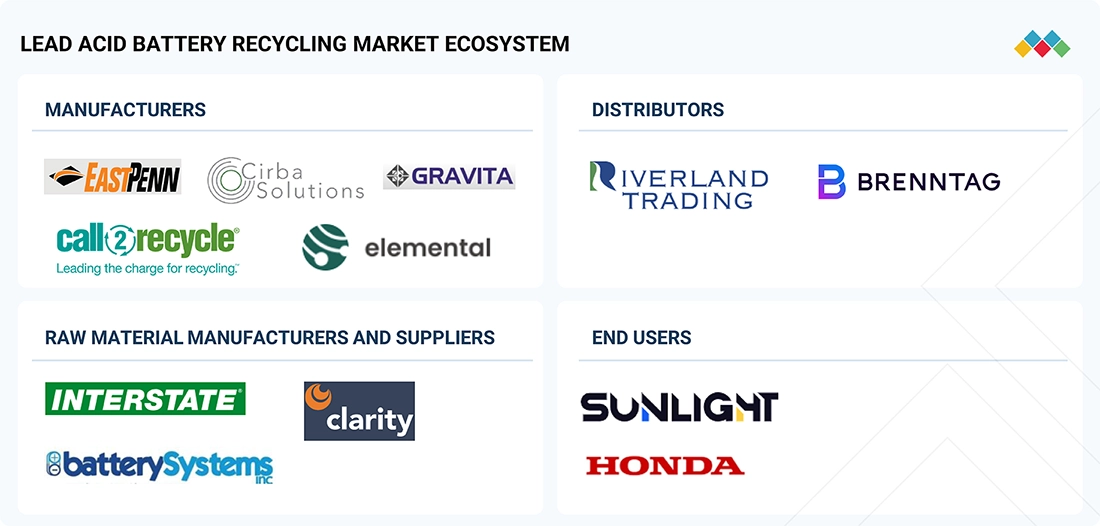
The global lead acid battery recycling ecosystem consists of raw material suppliers (e.g., Battery Systems Inc., Interstate Batteries, and others), producers (e.g., east penn manufacturing company, Call2Recycle, and others), distributors (e.g., Brenntag N.V., Riverland Trading), and end users (e.g., Sunlight Group, Honda, and others).
Logos and trademarks shown above are the property of their respective owners. Their use here is for informational and illustrative purposes only.
MARKET SEGMENTS
Source: Secondary Research, Interviews with Experts, MarketsandMarkets Analysis
Global Lead Acid Battery Recycling Market, By Source
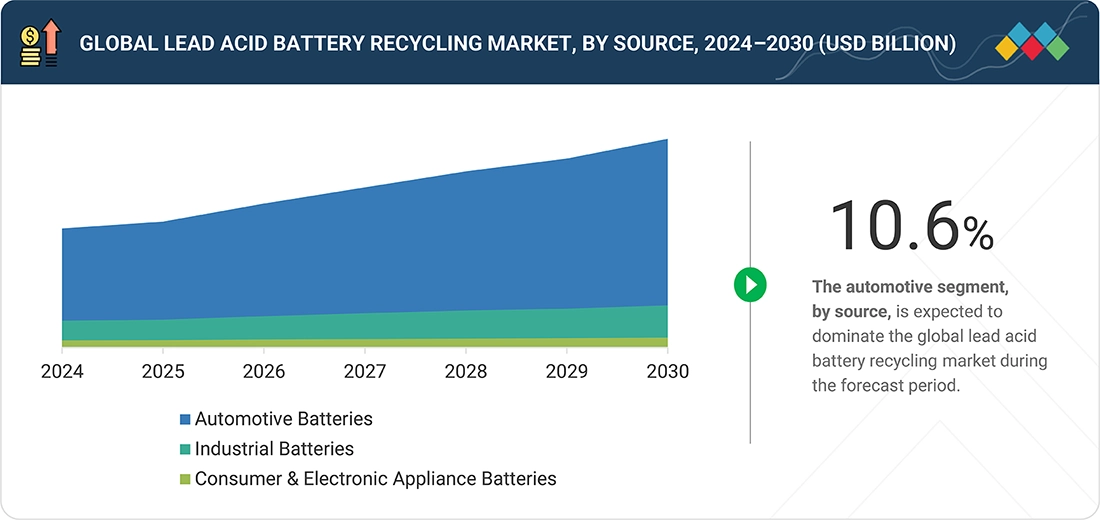
The automotive batteries segment accounts for the major share of the overall lead acid battery recycling market, marked by the tremendous and consistently growing worldwide vehicle population. The continuous transition of starter, lighting, and ignition (SLI) batteries yields a steady and predictable output of waste batteries for recycling. High collection percentages through car dealers, service stations, and aftermarket routes, combined with the good economic value of recoverable lead, make automobile batteries very appealing to recyclers. Moreover, legislation for take-back and manufacturers' environmental programs are facilitating legal recycling, and thus contributing to the continuous increase of this already large source segment.
REGION
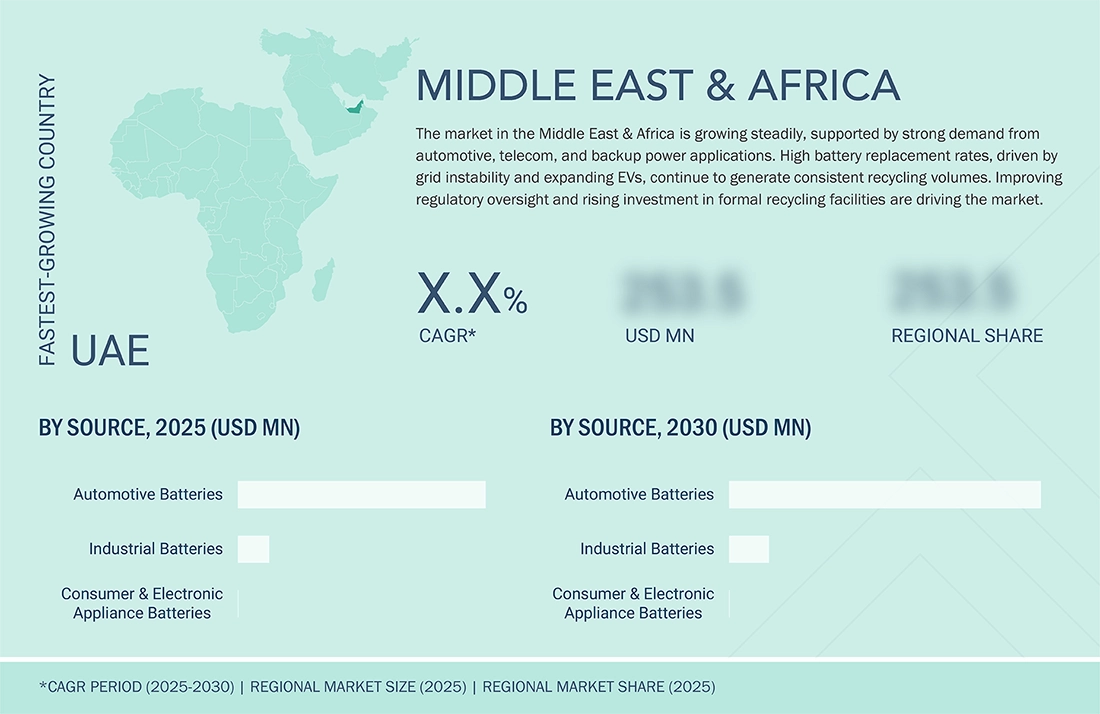
Middle East & Africa to be fastest-growing region in global lead acid battery recycling market during forecast period
The Middle East & Africa is emerging as the fastest-growing region in the global lead acid battery recycling market due to the huge demand from the automotive, telecom, and backup power sectors in the region. Factors such as increasing vehicle ownership, unstable grid power supply situations in several nations, and the continuous application of lead-acid batteries in the telecom, industrial, and other sectors are all contributing to the generation of end-of-life batteries in consistent quantities. Furthermore, the implementation of better regulatory controls and the increasing funding for up-to-standard recycling plants have turned the tide for legal recycling, thereby maintaining the overall market growth in the region.
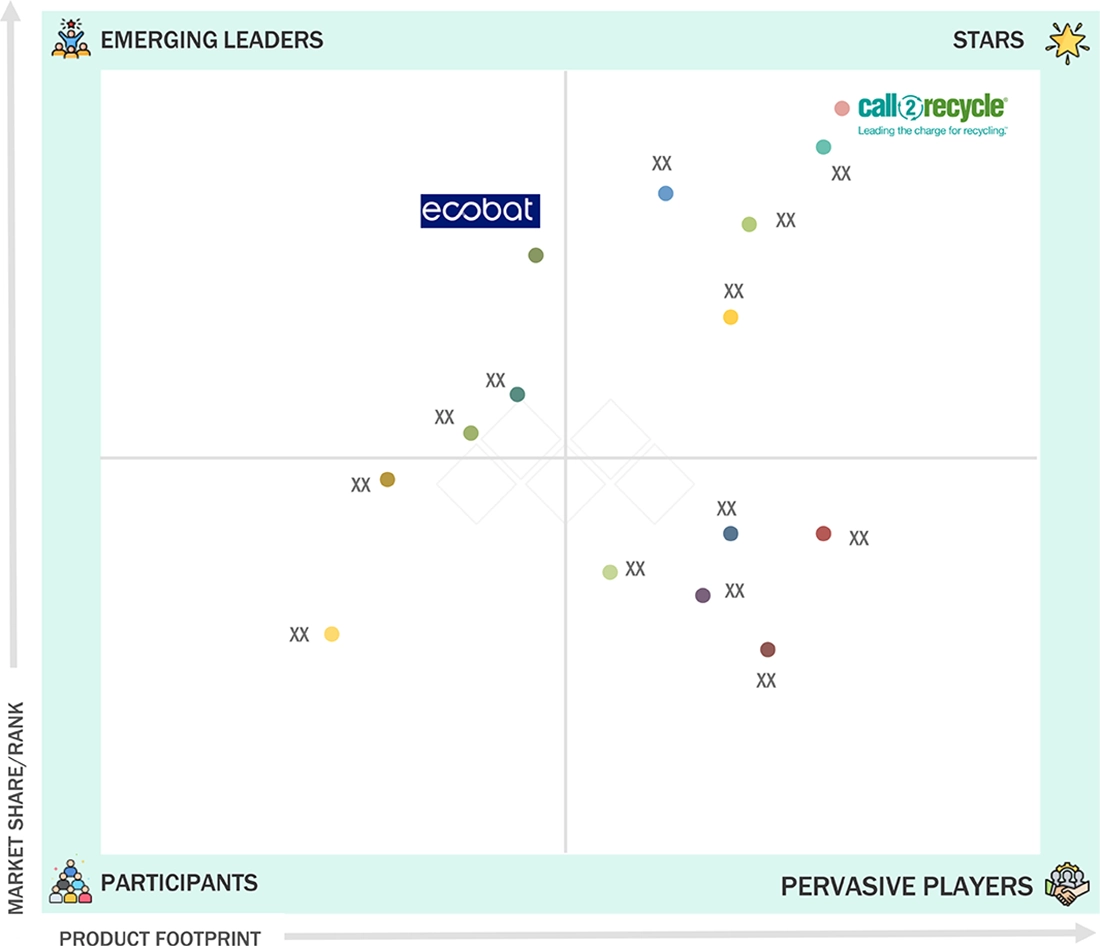
Lead Acid Battery Recycling Market: COMPANY EVALUATION MATRIX
In the global lead acid battery recycling market matrix, Call2Recycle, Inc. (Star) leads with its integrated supply chain to maximize market reach and product diversification. Players under the Stars category primarily focus on new service & technology launches, as well as acquiring leading market positions through the provision of broad portfolios, catering to different requirements of customers. They are also focused on innovations and are geographically diversified. They also have broad industry coverage. Apart from that, they have strong operational and financial strength and endeavor to grow organically and inorganically in the market. Ecobat (Emerging Leader) has a strong potential to build strategies to expand their business and stay on par with the star players.
Source: Secondary Research, Interviews with Experts, MarketsandMarkets Analysis
KEY MARKET PLAYERS
- Call2Recycle, Inc. (US)
- Cirba Solutions (US)
- Element Resources (US)
- East Penn Manufacturing Company (US)
- Gravita India Ltd. (India)
- Exide Industries Ltd. (India)
- The Doe Run Company (US)
- Ecobat (UK)
- Enersys (US)
- Aqua Metals Inc. (US)
- Gopher Resource (US)
- Terrapure (Canada)
- Envirostream Australia Pty Ltd. (Australia)
- Metalex Products Ltd. (Canada)
- SMC Recycling (US)
MARKET SCOPE
| REPORT METRIC | DETAILS |
|---|---|
| Market Size in 2024 (Value) | USD 16.49 BN |
| Market Forecast in 2030 (Value) | USD 23.94 BN |
| CAGR (2025–2030) | 6.3% |
| Years Considered | 2018–2030 |
| Base Year | 2024 |
| Forecast Period | 2025–2030 |
| Units Considered | Value (USD Billion) |
| Report Coverage | Revenue forecast, competitive landscape, growth factors, and trends |
| Segments Covered | By Source (Automotive Batteries, Industrial Batteries, and Consumer & Electronic Appliance Batteries) |
| Regions Covered | Asia Pacific, Europe, North America, South America, and Middle East & Africa |
WHAT IS IN IT FOR YOU: Lead Acid Battery Recycling Market REPORT CONTENT GUIDE
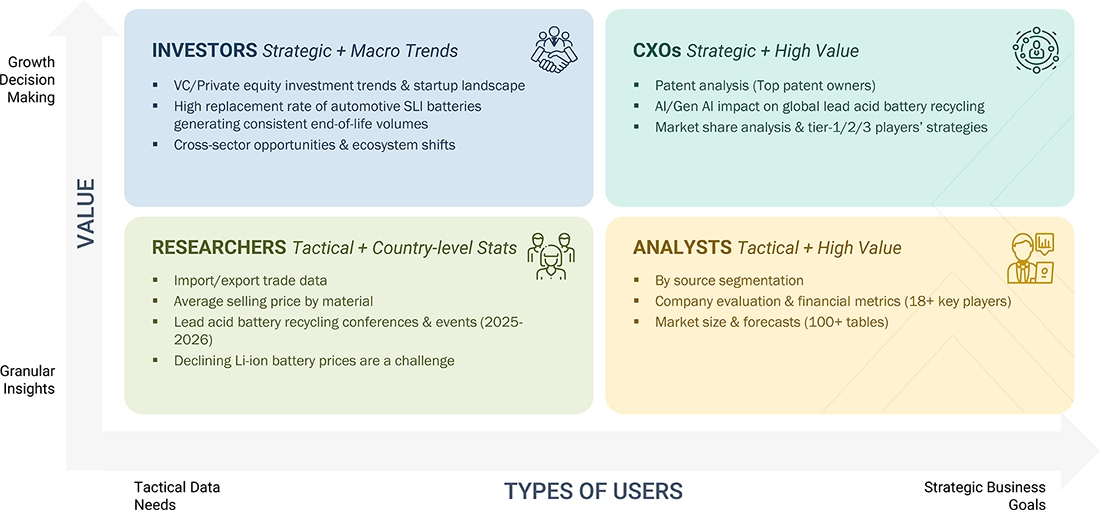
DELIVERED CUSTOMIZATIONS
We have successfully delivered the following deep-dive customizations:
| CLIENT REQUEST | CUSTOMIZATION DELIVERED | VALUE ADDS |
|---|---|---|
| Assess regulatory compliance requirements for lead-acid battery recycling across key regions, including producer responsibility obligations and hazardous waste handling rules | Reviewed regional and cross-border regulations covering battery take-back, transport, storage, and secondary lead processing, and mapped compliance requirements for recyclers and aggregators operating in multiple markets | Improved regulatory readiness, reduced compliance risk, and enabled smoother cross-regional recycling operations |
| Understand how end-of-life automotive and industrial lead-acid batteries can be efficiently collected and routed back into formal recycling channels | Identified collection pathways through dealerships, service centers, fleets, telecom operators, and scrap aggregators, and designed optimized logistics flows aligned with regional battery volumes | Lowered collection and transportation costs, improved feedstock reliability, and reduced dependency on informal collection networks |
| Evaluate available recycling technologies for lead-acid batteries and their suitability for different operating scales | Compared conventional battery breaking, smelting, and refining routes based on recovery efficiency, operating costs, environmental compliance, and scalability | Supported informed investment decisions and improved recovery yields while maintaining regulatory and environmental standards |
| Examine opportunities to strengthen circularity in lead-acid battery supply chains | Analyzed closed-loop recycling models linking battery manufacturers, recyclers, and secondary lead users with material flow mapping from collection to reuse | Enhanced circular-economy alignment, improved supply security of recycled lead, and reduced reliance on primary lead sources |
RECENT DEVELOPMENTS
- April 2023 : Cirba Solutions signed a Memorandum of Understanding (MoU) with Honda to collect, process, and return recycled battery materials to be used as raw material feedstock for Honda’s battery supply chain for application in future electric vehicle batteries.
- April 2022 : Call2Recycle, Inc. announced its partnership with Li Industries to enhance its battery sorting and recycling using Li Industries’ innovative technology. Both companies will be refining their approach to lithium-ion battery processing, with the commercialization of their process expected in 2023.
- March 2022 : Chloride Metals Limited, the subsidiary of Exide Industries, started commercial production at its manufacturing facility of battery recycling in Haldia, West Bengal (India). The total installed capacity of the plant is 108,000 MT per annum.
Table of Contents
 Exclusive indicates content/data unique to MarketsandMarkets and not available with any competitors.
Methodology
The study involved four major activities in estimating the current market size of lead acid battery recycling. Exhaustive secondary research was done to collect information on the market, the peer market, and the parent market. The next step was to validate these findings, assumptions, and sizes with industry experts across the value chain of lead acid battery recycling through primary research. Both top-down and bottom-up approaches were employed to estimate the complete market size. After that, market breakdown and data triangulation were used to estimate the size of the segments and sub-segments of the market.
Secondary Research
The research methodology used to estimate and forecast the access control market begins with capturing data on revenues of key vendors in the market through secondary research. In the secondary research process, various secondary sources, such as Hoovers, Bloomberg BusinessWeek, Factiva, World Bank, and Industry Journals, were referred to for identifying and collecting information for this study. These secondary sources included annual reports, press releases & investor presentations of companies; white papers; certified publications; articles by recognized authors; notifications by regulatory bodies; trade directories; and databases. Vendor offerings have also been taken into consideration to determine market segmentation.
Primary Research
The lead acid battery recycling market comprises several stakeholders, such as such as battery suppliers, processors, recycling companies, and regulatory organizations in the supply chain. Various primary sources from both the supply and demand sides of the market were interviewed to obtain qualitative and quantitative information. Primary sources from the supply side included industry experts such as Chief Executive Officers (CEOs), vice presidents, marketing directors, technology and innovation directors, and related key executives from various key companies and organizations operating in the lead acid battery recycling industry. Primary sources from the demand side included directors, marketing heads, and purchase managers from various sourcing industries.
To know about the assumptions considered for the study, download the pdf brochure
Market Size Estimation
Both the top-down and bottom- up approaches were used to estimate and validate the total size of the lead acid battery recycling industry. These methods were also used extensively to determine the size of various sub-segments in the market. The research methodology used to estimate the market size included the following:
- The key players were identified through extensive primary and secondary research.
- The value chain and market size of the lead acid battery recycling market, in terms of value, were determined through primary and secondary research.
- All percentage shares, splits, and breakdowns were determined using secondary sources and verified through primary sources.
- All possible parameters that affect the market covered in this research study were accounted for, viewed in extensive detail, verified through primary research, and analyzed to obtain the final quantitative and qualitative data.
- The research included the study of reports, reviews, and newsletters of top market players, along with extensive interviews for opinions from key leaders, such as CEOs, directors, and marketing executives.
Data Triangulation
After arriving at the overall market size using the market size estimation processes as explained above, the market was split into several segments and sub-segments. To complete the overall market engineering process and arrive at the exact statistics of each market segment and subsegment, the data triangulation and market breakdown procedures were employed, wherever applicable. The data was triangulated by studying various factors and trends from both the demand and supply sides in the automotive and non-automotive sources.
Market definition
Lead acid battery recycling refers to the process of collecting and reprocessing used batteries to recover valuable materials and reduce environmental impact. It involves the safe and responsible disposal of batteries, followed by the extraction and recycling of materials such as precious metals (e.g., lead, lithium, copper, nickel, cobalt) and other components (e.g., plastic, acid) that can be reused or repurposed. Lead acid battery recycling helps conserve natural resources, minimize pollution, and prevent hazardous substances from entering the environment.
Key Stakeholders
- Governments and research organizations
- Battery manufacturers
- Electric vehicle manufacturers
- Mining companies
- Oil companies expanding into alternative energy
- Recycling associations and Industrial bodies
- Battery recycling manufacturers/traders
Report Objectives:
- To analyze and forecast the market size of lead acid battery recycling in terms of value
- To provide detailed information regarding the major factors (drivers, restraints, challenges, and opportunities) influencing the regional market
- To analyze and forecast the global lead acid battery recycling market on the basis of source, chemistry, and region
- To analyze the opportunities in the market for stakeholders and provide details of a competitive landscape for market leaders
- To strategically analyze the micromarkets with respect to individual growth trends, growth prospects, and their contribution to the overall market
- To forecast the size of various market segments based on five major regions: North America, Europe, Asia Pacific, South America, and the Middle East & Africa, along with their respective key countries
- To track and analyze the competitive developments, such as new technology launches, joint ventures, partnerships, contracts, collaborations, acquisitions, agreements, investments, and expansions, in the market
- To strategically profile the key players and comprehensively analyze their market shares and core competencies
Available Customizations:
With the given market data, MarketsandMarkets offers customizations according to the client-specific needs.
The following customization options are available for the report:
- Additional country-level analysis of the lead acid battery recycling market
- Profiling of additional market players (up to 5)
Product Analysis
- Product matrix, which gives a detailed comparison of the product portfolio of each company.
Key Questions Addressed by the Report
Which end-use industries are expected to exhibit the highest growth in the Lead Battery Recycling Market?
Automotive service centers, industrial battery users, and power backup system providers are expected to show the highest CAGR due to expanded battery usage and recycling mandates.
Who are the leading companies in the Lead Battery Recycling Market?
Major players include Retriev Technologies, Exide Industries, Ecobat Technologies, Riverside Resource Recovery, and G&P Batteries & Recycling.
What factors are driving growth in the Lead Battery Recycling Market?
Growth is driven by increasing automotive and industrial battery use, strict environmental regulations, and rising focus on sustainable resource recovery.
What are the primary challenges faced by companies in the Lead Battery Recycling Market?
Challenges include regulatory compliance costs, environmental and health safety concerns, and fluctuating lead and scrap prices.
What are the prominent applications of recycled lead from the Lead Battery Recycling Market?
Recycled lead is mainly used in manufacturing new batteries, ammunition, radiation shielding, and lead-based alloys across industries.


Personalize This Research
- Triangulate with your Own Data
- Get Data as per your Format and Definition
- Gain a Deeper Dive on a Specific Application, Geography, Customer or Competitor
- Any level of Personalization
Let Us Help You
- What are the Known and Unknown Adjacencies Impacting the Lead Acid Battery Recycling Market
- What will your New Revenue Sources be?
- Who will be your Top Customer; what will make them switch?
- Defend your Market Share or Win Competitors
- Get a Scorecard for Target Partners

Custom Market Research Services
We Will Customise The Research For You, In Case The Report Listed Above Does Not Meet With Your Requirements
Get 10% Free CustomisationTESTIMONIALS
We at Nissan Chemicals Corporation have been clients of MarketsandMarkets for more than a year now. We recently consulted MarketsandMarkets for a study, the team at MarketsandMarkets was extremely professional and organized. The business insights were very detailed and aligned well with our expectations that really helped us formulate the Business Plans and device new strategies for development themes. MarketsandMarkets offers a unique combination of expertise and dedicated engagement model. Their research findings have helped us in designing our Pricing Strategy which will make it easier for us to predict the future sales and profits for the next ten years. We look forward to working with MarketsandMarkets in the future.
VP of Strategy & New Business Development
Leading Specialty Chemical Company
The MarketsandMarkets Engagement Model, composed of both the Knowledge Store and advisory custom research, has greatly helped us in understanding our markets and making strategic decisions. The Knowledge Store is a fast way to allow everyone in our organization to understand more about most any market they are interested in. The ability to then get custom research done and get answers to specific strategic questions and market insight has been spectacular. The Markets and Markets team feel more like colleagues than vendors and their services have helped us change our culture where statements of things like growth opportunities and competitive position are always backed by industry research.

Rich Gibson,
Director, Corporate Strategy
Milliken & Company,
Leading Industrial Manufacturer of specialty chemical, floor covering, performance and protective textile materials, and healthcaremilliken.com
MarketsandMarkets is a trusted resource that helps us to better understand markets that are near-adjacencies-whether its technology, value chain or geography. Their Knowledge Store platform provides a dashboard of markets and their characteristics which is easy to use and saves us time.
Adam Shaw,
Market Development and Strategy Manager
AdvanSix Inc. USA,
An American Leader in Chemicalswww.advansix.com
The Knowledge Store from MarketsandMarkets is a valuable tool which has helped my team acquire greater insight in to the end markets that our business serves. This has enabled us to help our company build stronger strategies throughout our planning process.
TOSHIO KINOSHITA
Senior Chif Consultion Research & Consulting Division
Mitsubishi Chemical Research Corporation,
Leading Manufacturer of Chemical Productswww.mitsubishichem-res.co.jp/en/

We recently engaged with MarketsandMarkets for a study, the team not only clearly understood our business objectives but was also extremely professional in the way they handled the entire project. The study was efficiently conducted in a phase-wise manner, and the engagement model furnished us with high-quality business insights that far exceeded our expectations at each phase. We were especially happy that MarketsandMarkets could provide us with both, an English as well as a Japanese version of the study. A special thanks to the Analyst Team and Client Services Team, whose fluency in Japanese enhanced our comfort level, as we could converse with them in our preferred language.
Independent entrepreneurs
Arrow Precision
We approached MarketsandMarkets for study on Proppants Market, and their work exceeded our expectations. The study conducted was comprehensive and enabled us to view the market through the various dimensions. In addition, the team was extraordinarily responsive throughout the process and resolved our queries on time. I strongly recommend MarketsandMarkets and will certainly consider them for additional market assessments we will need in the future.
Global engineering company, Japan
Deputy Manager,
Strategic Planning OfficeThe high-quality insights shared by the MarketsandMarkets team helped us understand the pharmaceutical plant designers in a specific geography. It also captured the risks that we may likely face in communicating with our potential partners. The study would enable us identify partners, which would impact our future growth.






Growth opportunities and latent adjacency in Lead Acid Battery Recycling Market