Liquid Biopesticides Market

Liquid Biopesticides Market by Type (Bioinsecticides, Biofungicides, Bionematicides), Crop Type (Cereals & Grains, Oilseeds & Pulses), Formulation, Source (Microbials, Biochemicals), Mode of Application, and Region - Global Forecast to 2030




OVERVIEW
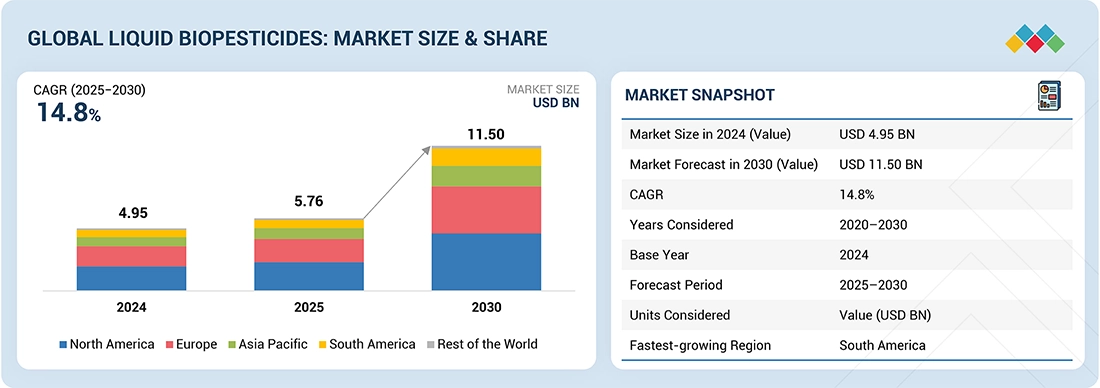
Source: Secondary Research, Interviews with Experts, MarketsandMarkets Analysis
The liquid biopesticides market is expected to grow from USD 5.76 billion in 2025 to USD 11.50 billion by 2030, with a CAGR of 14.8% during the forecast period. Globally, farmers and agribusinesses are increasingly opting for liquid biopesticides over chemical pesticides, as they seek sustainable and eco-friendly methods to protect their crops. Concerns about the environment and health are also driving this shift. Supportive regulations in major regions, such as the US, EU, and Asia Pacific, are easing the approval and sale of biological crop protection products.
Market Size and Forecast:
- Market Size Value in 2024: USD 4.95 Billion
- Market Size Value in 2025: USD 5.76 Billion
- Revenue Forecast in 2030: USD 11.50 Billion
- Growth Rate: CAGR of 14.8% from 2025 to 2030
- Base year: 2024
- Forecast period: 2025–2030
- North America dominated the global liquid biopesticides market, with a share of 39.1% in 2024.
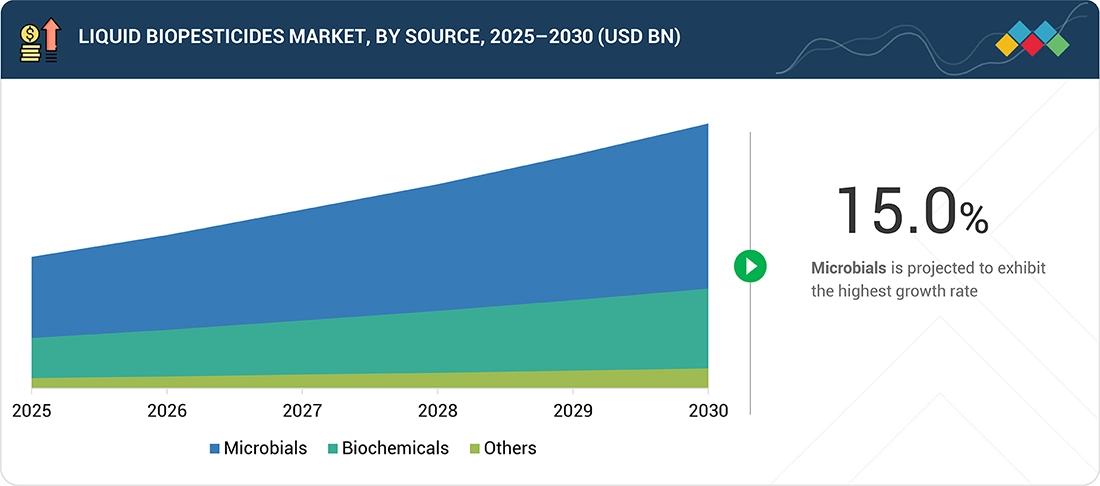
- The microbials segment is projected to grow at the fastest CAGR of 15.0% from 2025 to 2030.
Key Market Trends and Insights
- By Type: The Bioinsecticides segment accounts for a significant share of the liquid biopesticides market, driven by increasing demand for environmentally friendly crop protection solutions and growing adoption of biological pest management practices.
- Industry Developments: Growers are increasingly adopting liquid biopesticides due to their ease of application, compatibility with integrated pest management programs, and effectiveness in supporting sustainable agricultural production.
- Market Drivers: Rising demand for organic food products, increasing awareness regarding the environmental impact of chemical pesticides, supportive regulatory frameworks, and growing focus on sustainable farming practices are supporting market growth.
- Future Opportunities: Significant opportunities are emerging in microbial-based crop protection products, precision agriculture applications, integrated pest management solutions, and advanced biopesticide formulations designed to improve efficacy and crop productivity.
KEY TAKEAWAYS
-
BY REGIONNorth America dominated the global liquid biopesticides market, with a share of 39.1% in 2024.
-
BY TYPEBy type, the bionematicides segment is expected to register the highest CAGR of 15.8%.
-
BY SOURCEBy source, the microbials segment is projected to grow at the fastest CAGR of 15.0% from 2025 to 2030.
-
BY FORMULATIONBy formulation, the suspension concentrates segment will grow the fastest during the forecast period.
-
BY MODE OF APPLICATIONBy mode of application, the foliar spray segment is expected to dominate the market.
-
BY CROP TYPEBy crop type, the fruits & vegetables segment is expected to grow at the highest rate.
-
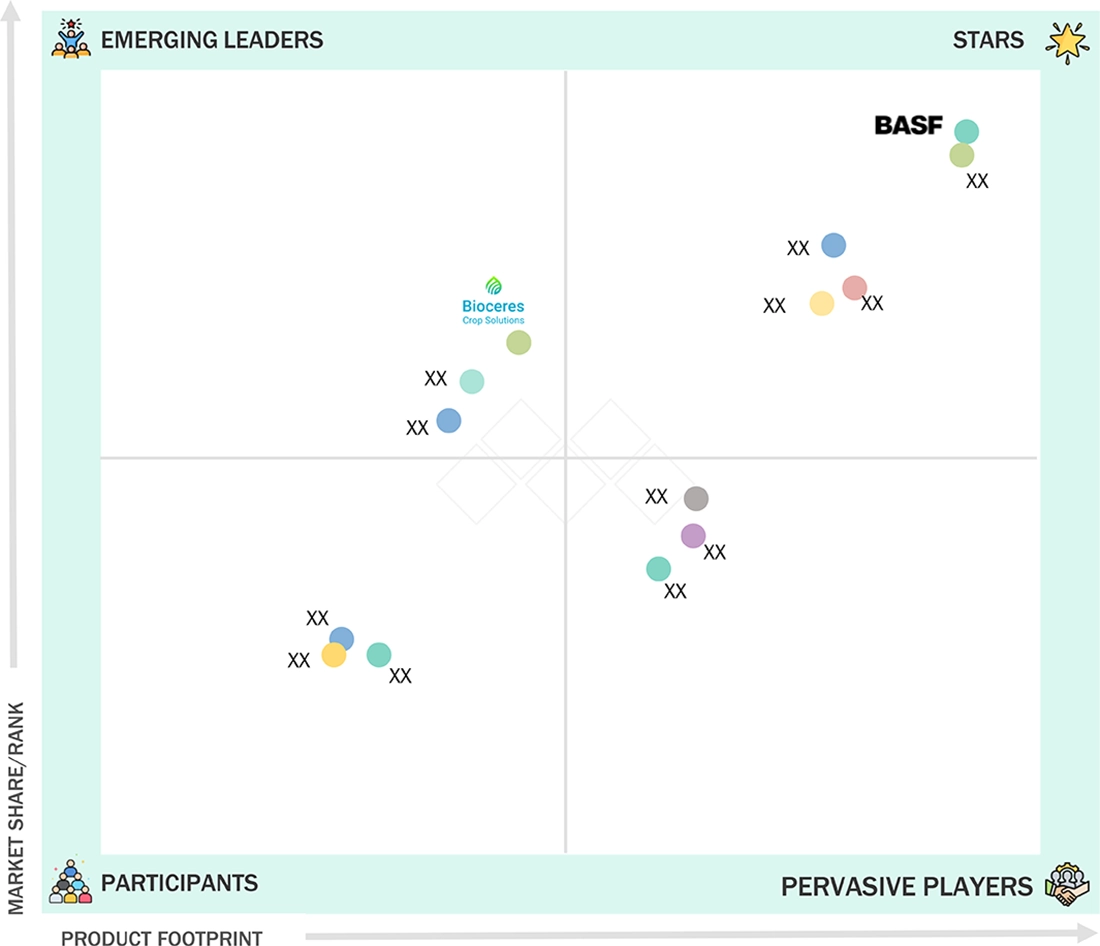
COMPETITIVE LANDSCAPE - Key PlayersBASF SE, Syngenta, BioFirst Group, and Koppert were identified as Star players in the liquid biopesticides market, as they have focused on innovation, broad industry coverage, and strong operational & financial strength.
-
COMPETITIVE LANDSCAPE - Startups/SMEsBionema, Rovensa Next, and Bioceres Crop Solutions have distinguished themselves among startups and SMEs due to their robust product portfolios and effective business strategies.
The global liquid biopesticides market is fueled by the rapid shift toward sustainable farming, as growers favor formulations that are easy to apply, provide uniform coverage, and are compatible with drip and foliar systems. Growing concerns about chemical residues, the expansion of organic agriculture, and supportive regulatory frameworks are further increasing demand. Additionally, liquid formulations offer better shelf stability and quicker field adoption, making them the preferred choice for modern integrated pest management programs.
TRENDS & DISRUPTIONS IMPACTING CUSTOMERS' CUSTOMERS
Changes in customer trends or disruptions impact consumers’ businesses. These shifts impact the revenues of end users. Consequently, the revenue impact on end users is expected to affect the revenues of liquid biopesticide manufacturers.
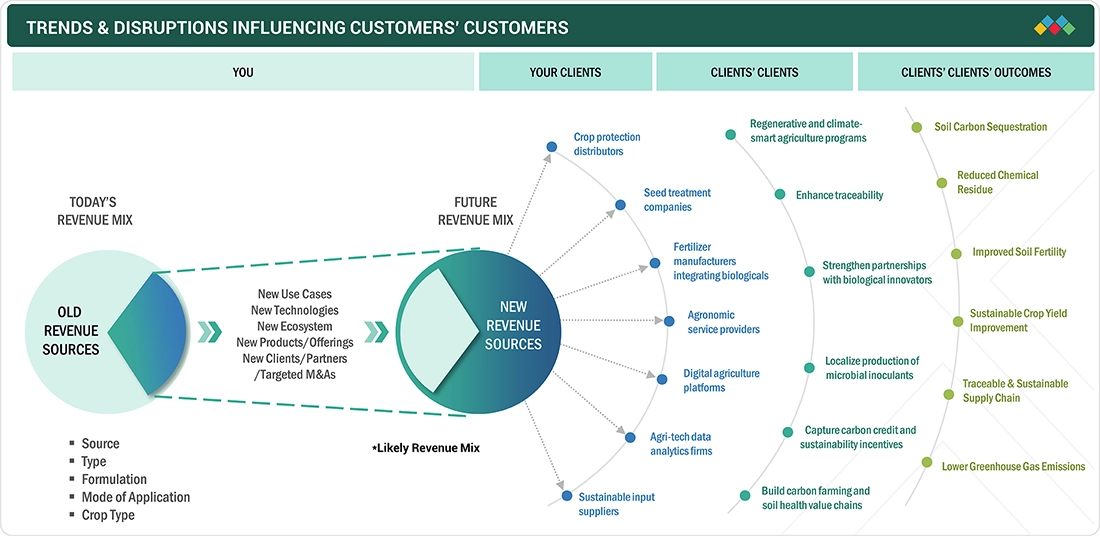
Source: Secondary Research, Interviews with Experts, MarketsandMarkets Analysis
MARKET DYNAMICS

Level
-
Rising demand for residue-free and organic food

-
Easy application and strong compatibility with modern spraying and drip systems


Level
-
Shorter shelf life and storage sensitivity

-
Higher production and formulation costs than chemicals


Level
-
Growing use of precision farming and fertigation technologies

-
Advancements in microbial stabilization and encapsulation


Level
-
Inconsistent field performance across climates

-
Low grower awareness in emerging markets

Source: Secondary Research, Interviews with Experts, MarketsandMarkets Analysis
Driver: Rising demand for residue-free and organic food
The rising demand for residue-free and organic food is a major driver in the global liquid biopesticides market, as consumers and regulators increasingly advocate for safer and cleaner farming practices. This trend is motivating growers to replace chemical pesticides with liquid biopesticides, which provide effective pest control without leaving harmful residues. Consequently, farmers growing high-value fruits, vegetables, and export crops are adopting liquid formulations to meet strict food safety standards and access premium organic markets.
Restraint: Shorter shelf life and storage sensitivity
Shorter shelf life and storage sensitivity pose significant barriers in the global liquid biopesticides market, as these formulations often contain living microbial ingredients that degrade rapidly when exposed to heat, light, or mishandling. This restricts their distribution range, increases cold-chain requirements, and raises the risk of reduced field effectiveness, causing many growers and dealers to hesitate before stocking or relying on liquid biopesticides compared to more stable chemical options.
Opportunity: Growing use of precision farming and fertigation technologies
The increasing adoption of precision farming and fertigation systems presents a significant opportunity for the global liquid biopesticides market, as these technologies demand solutions that can be applied precisely, uniformly, and in real-time. Liquid formulations integrate smoothly with drip lines, smart sprayers, and controlled dosing equipment, enabling targeted delivery that enhances effectiveness and minimizes input waste. As farms worldwide adopt automated and sensor-based application methods, the demand for liquid biopesticides compatible with these advanced systems continues to grow.
Challenge: Inconsistent field performance across climates
Inconsistent field performance in various climates remains a significant challenge in the global liquid biopesticides market, as temperature, humidity, and UV exposure can substantially impact microbial survival and effectiveness. These changes often cause variable results from one region or season to another, making growers hesitant to rely solely on liquid biologicals for pest and disease control.
LIQUID BIOPESTICIDES MARKET: COMMERCIAL USE CASES ACROSS INDUSTRIES
| COMPANY | USE CASE DESCRIPTION | BENEFITS |
|---|---|---|
 |
Uses liquid biopesticides within its biosolutions portfolio to support integrated pest and disease management across specialty and row crops | Supports sustainable crop protection, improves resistance management, and reduces reliance on conventional chemicals |
 |
Develops and commercializes liquid biopesticides through its Natural Plant Protection platform to enhance crop health and resilience | Enables sustainable yield protection, lowers environmental impact, and supports regenerative agriculture practices |
 |
Offers liquid-formulated biopesticides for pest and disease control in conventional and organic farming systems | Ensures effective control with low residues, supports organic compliance, and enhances environmental sustainability |
Logos and trademarks shown above are the property of their respective owners. Their use here is for informational and illustrative purposes only.
MARKET ECOSYSTEM
Some of the leading companies in this market are well-established, financially stable manufacturers of liquid biopesticides. These companies have been operating for over ten years, offering diversified portfolios, cutting-edge technologies, and strong global sales and marketing networks. Notable companies in this market include BASF SE (Germany), Syngenta Group (Switzerland), BioFirst Group (Belgium), and Koppert (Netherlands).
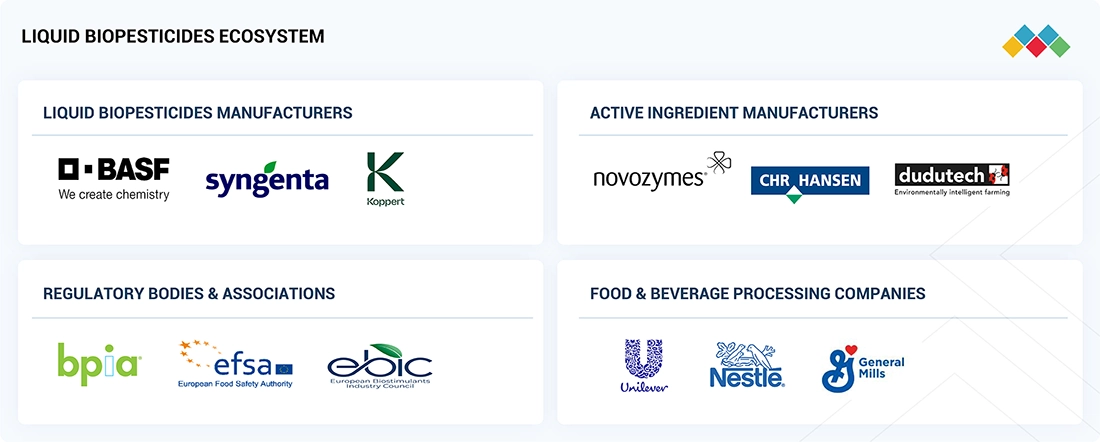
Logos and trademarks shown above are the property of their respective owners. Their use here is for informational and illustrative purposes only.
MARKET SEGMENTS
Source: Secondary Research, Interviews with Experts, MarketsandMarkets Analysis
Liquid Biopesticides Market, By Type
The type segment comprises biofungicides, bioinsecticides, bionematicides, bioherbicides, and other biopesticides. Bioinsecticides hold the largest share in the type segment of the liquid biopesticides market in Europe. This dominance stems from the widespread use of bioinsecticides against major pests in high-value crops, such as fruits, vegetables, and vineyards, coupled with stricter EU regulations that limit the use of chemical insecticides and a growing demand for residue-free produce. Their proven efficacy, safety profile, and compatibility with integrated pest management practices continue to drive strong adoption across the region.
Liquid Biopesticides Market, By Source
The source segment comprises microbes, biochemicals, and others. In the liquid biopesticides market, microbes hold the highest share within the source segment due to the widespread adoption of microbial-based products, such as Bacillus thuringiensis, Beauveria bassiana, and Trichoderma species, which offer effective, broad-spectrum pest and disease control while being highly compatible with organic farming practices and integrated pest management systems.
Liquid Biopesticides Market, By Formulation
The form segment comprises soluble liquid concentrates, suspension concentrates, and emulsifiable concentrates. Suspension concentrates hold the largest share in the liquid biopesticides market because they offer superior stability, longer shelf life, and consistent efficacy compared to other liquid formulations. Their fine particle dispersion enables better adhesion, improved coverage, and uniform application across diverse cropping systems. Additionally, suspension concentrates are easy to mix, compatible with most spraying systems, and minimize issues like settling or clogging, making them the preferred choice for growers seeking reliable and high-performance biological crop protection solutions.
Liquid Biopesticides Market, By Mode of Application
The mode of application segment includes foliar spray, soil treatment, seed treatment, and other modes of application. Foliar spray holds the highest share within the mode of application segment, driven by its simplicity, cost-effectiveness, and rapid action against pests and diseases on the plant surface, making it the preferred method for high-value crops such as fruits, vegetables, grapes, and greenhouse produce.
Liquid Biopesticides Market, By Crop Type
The crop type segment includes cereals & grains, fruits & vegetables, oilseeds & pulses, and other crop types. In the liquid biopesticides market, the fruits and vegetables category dominates the crop type segment. This dominance is fueled by the region's large-scale cultivation of crops like grapes, apples, tomatoes, berries, and greenhouse-grown vegetables. Additionally, the vulnerability of these crops to pests and diseases, combined with widespread adoption of integrated pest management practices, further solidifies fruits and vegetables as the dominant application area for biopesticides across the continent.
REGION
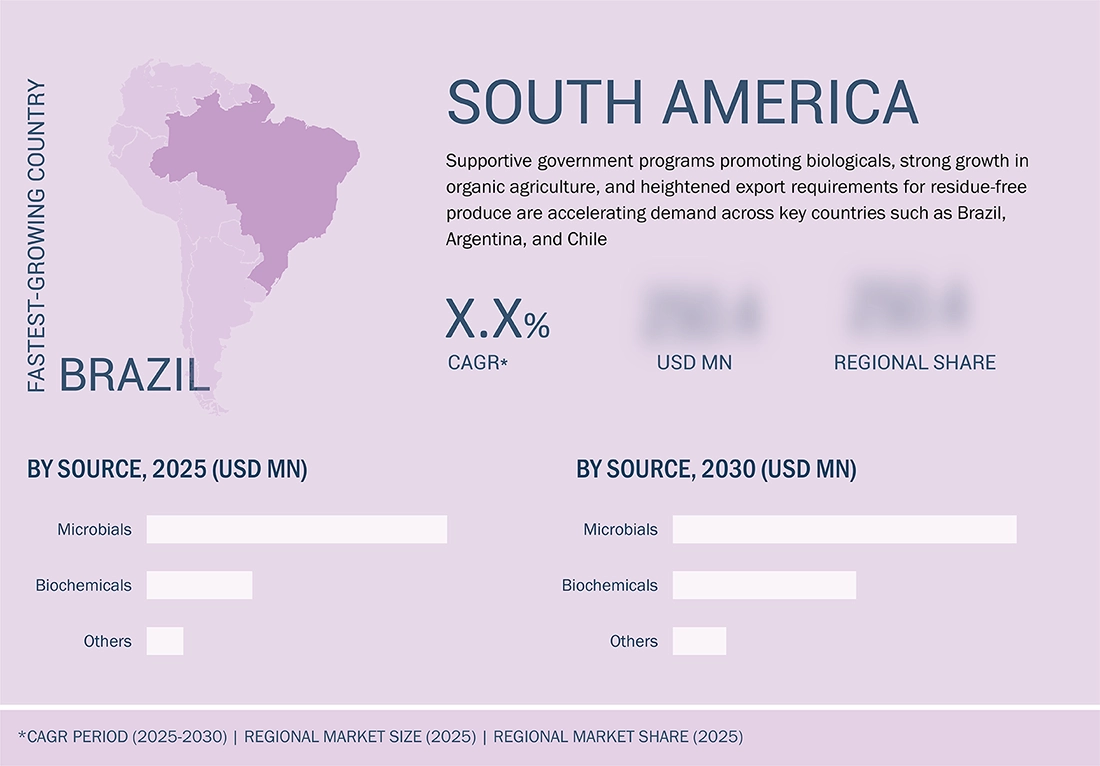
South America is expected to be the fastest-growing country in the liquid biopesticides market during the forecast period
South America is the fastest-growing region in the global liquid biopesticides market, driven by the rapid expansion of high-value crops, rising pest pressure, and increasing adoption of sustainable farming practices. Supportive government programs promoting biologicals, strong growth in organic agriculture, and heightened export requirements for residue-free produce are driving demand across key countries, including Brazil, Argentina, and Chile. The region’s large agricultural base and shift toward integrated pest management further reinforce its strong growth trajectory.
LIQUID BIOPESTICIDES MARKET: COMPANY EVALUATION MATRIX
In the liquid biopesticides market matrix, BioFirst Group (Star) leads the market, leveraging its innovative microbial and biochemical solutions to capture significant market share and drive sustainable crop protection across key agricultural regions. Koppert (Emerging Leader), meanwhile, is emerging as a strong player fueled by its cutting-edge microbial technologies and strategic acquisitions that position it to challenge established players with high-performance, eco-friendly alternatives.
Source: Secondary Research, Interviews with Experts, MarketsandMarkets Analysis
KEY MARKET PLAYERS
- BASF SE (Germany)
- BioFirst Group (Belgium)
- Syngenta (Switzerland)
- Koppert (Netherlands)
- Novonesis Group (Denmark)
- Bayer AG (Germany)
- Bioceres Crop Solutions (Argentina)
- UPL (India)
- Andermatt Biocontrol AG (Switzerland)
- Corteva (US)
- Rovensa Next (Spain)
- Sustainable Agro Solutions, S.A.U. (Spain)
- DE SANGOSSE Group (France)
- Certis Belchim B.V. (Netherlands)
- Seipasa, S.A. (Spain)
MARKET SCOPE
| REPORT METRIC | DETAILS |
|---|---|
| Market Size in 2025 (Value) | USD 5.76 Billion |
| Market Forecast in 2030 (Value) | USD 11.50 Billion |
| Growth Rate | CAGR of 14.8% during 2025-2030 |
| Years Considered | 2020-2030 |
| Base Year | 2024 |
| Forecast Period | 2025-2030 |
| Units Considered | Value (USD Million/Billion), Volume (KT) |
| Report Coverage | Revenue forecast, company ranking, competitive landscape, growth factors, and trends |
| Segments Covered |
|
| Region Covered | North America, Europe, Asia Pacific, South America, Rest of the World |
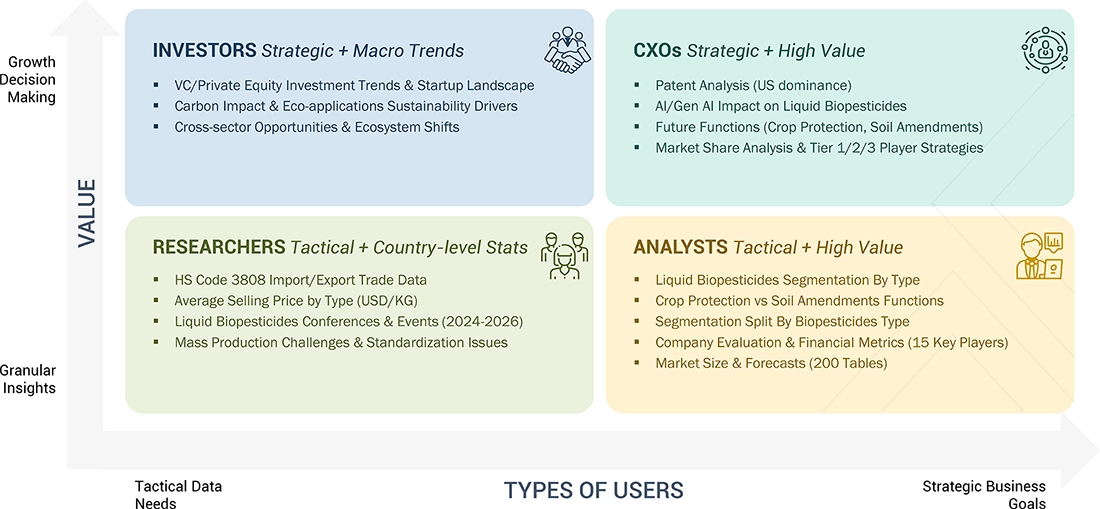
WHAT IS IN IT FOR YOU: LIQUID BIOPESTICIDES MARKET REPORT CONTENT GUIDE
DELIVERED CUSTOMIZATIONS
We have successfully delivered the following deep-dive customizations:
| CLIENT REQUEST | CUSTOMIZATION DELIVERED | VALUE ADDS |
|---|---|---|
| Europe-based Liquid Biopesticides Manufacturers |
|
|
| Asia Pacific Liquid Biopesticides Innovators |
|
|
| Global Liquid Biopesticides Distributor |
|
|
RECENT DEVELOPMENTS
- July 2024 : Gowan Brasil introduced Perimeter, its first biological fungicide developed in partnership with the US-based Gowan Company, at Hortitec 2024.
- May 2024 : Bioceres Crop Solutions Corp announced that Brazil's Ministry of Agriculture and Livestock (MAPA - Ministério da Agricultura e Pecuária) has approved three new bio-insecticidal and bio-nematocidal solutions derived from inactivated cells of the company’s proprietary Burkholderia platform.
- January 2024 : UPL introduced the bioinsecticide Zebu for pastures in Brazil. This biological insecticide targets insects directly and is recommended for controlling pests such as the root froghopper (Mahanarva fimbriolata), pasture froghopper (Zulia entreriana), and grassland froghopper (Deois flavopicta).
- January 2024 : Certis Biologicals launched Convergence biofungicide, a potent crop protection solution designed for corn, soybeans, and peanuts
Table of Contents
 Exclusive indicates content/data unique to MarketsandMarkets and not available with any competitors.
Methodology
The study involved four major activities in estimating the current size of the Liquid Biopesticides Market. Exhaustive secondary research was done to collect information on the market, peer market, and parent market. The next step was to validate these findings, assumptions, and sizing with industry experts across the value chain through primary research. Both top-down and bottom-up approaches were employed to estimate the complete market size. After that, market breakdown and data triangulation were used to estimate the market size of segments and subsegments.
Secondary Research
This research study involved the extensive use of secondary sources—directories and databases such as Bloomberg Businessweek and Factiva—to identify and collect information useful for a technical, market-oriented, and commercial study of the Liquid Biopesticides Market.
In the secondary research process, various sources such as annual reports, press releases & investor presentations of companies, white papers, certified publications, articles from recognized authors, gold & silver standard websites, directories, and databases were referred to identify and collect information. This research study involved the extensive use of secondary sources—directories and databases such as Bloomberg Businessweek and Factiva—to identify and collect information useful for a technical, market-oriented, and commercial study of the Liquid Biopesticides Market.
Secondary research was mainly used to obtain key information about the industry’s supply chain, the total pool of key players, and market classification and segmentation as per the industry trends to the bottom-most level, regional markets, and key developments from both market- and technology-oriented perspectives.
Primary Research
Extensive primary research was conducted after obtaining information regarding the Liquid Biopesticides Market scenario through secondary research. Several primary interviews were conducted with market experts from both the demand and supply sides across major countries of North America, Europe, Asia Pacific, the Middle East & Africa, and South America. Primary data was collected through questionnaires, emails, and telephonic interviews. The primary sources from the supply side included various industry experts, such as Chief X Officers (CXOs), Vice Presidents (VPs), Directors from business development, marketing, research, and development teams, and related key executives from distributors and key opinion leaders. Primary interviews were conducted to gather insights such as market statistics, data on revenue collected from the products and services, market breakdowns, market size estimations, market forecasting, and data triangulation. Primary research also helped in understanding the various trends related to type, crop type, mode of application, source, formulation, and region.
Market Size Estimation
Both the top-down and bottom-up approaches were used to estimate and validate the total size of the Liquid Biopesticides Market. These approaches were also used extensively to estimate the size of various dependent submarkets. The research methodology used to estimate the market size includes the following:
- Key players were identified through extensive secondary research.
- The industry’s value chain and market size were determined through primary and secondary research.
- All percentage share splits and breakdowns were determined using secondary sources and verified through primary sources.
- All the possible parameters that affect the markets covered in this research study were accounted for, viewed in extensive detail, verified through primary research, and analyzed to obtain the final quantitative and qualitative data.
- The following figure provides an illustrative representation of the complete market size estimation process implemented in this research study for an overall estimation of the Liquid Biopesticides Market in a consolidated format.
The following sections (bottom-up & top-down) depict the overall market size estimation process employed for the purpose of this study.
Data Triangulation
After arriving at the overall market size from the estimation process explained above, the total market was split into several segments and subsegments. Data triangulation and market breakdown procedures were employed, wherever applicable, to estimate the overall Liquid Biopesticides Market and arrive at the exact statistics for all segments and subsegments. The data was triangulated by studying various factors and trends from the demand and supply sides. Along with this, the market size was validated using both the top-down and bottom-up approaches.
Market Definition
Biopesticides have pesticide properties originating from natural living organisms, including microorganisms, plants, and animals. Biopesticides are gaining prominence due to their safer and ecofriendly nature.
The Environmental Protection Agency has defined biopesticides as follows:
“Biopesticides include naturally occurring substances that control pests (biochemical pesticides), microorganisms that control pests (microbial pesticides), and pesticidal substances produced by plants containing added genetic material (plant-incorporated protectants) or PIPs.“
Stakeholders
- Agriculture pesticide manufacturers & suppliers
- Associations and industry bodies
- Biopesticide manufacturers & suppliers
- Biopesticide traders, retailers, and distributors
- Commercial research & development (R&D) institutions
- Venture capitalists and investors
- Government, regulatory bodies, and research organizations
- Technology providers to biopesticide & microbial companies
- Public hygiene organizations, government regulatory institutions, and food safety agencies
-
Associations and industry bodies:
- Food and Agriculture Organization (FAO)
- European Food Safety Authority (EFSA)
- British Pest Control Association (BPCA)
- National Pest Management Association (NPMA)
- National Pest Technicians Association
- Confederation of Europe Pest Management Association (CEPA)
- International associations and industry bodies such as Biopesticide Industry Alliance (BPIA) and the International Biocontrol Manufacturers Association (IBMA)
- Organization for Economic Co-operation and Development (OECD)
Report Objectives
COMPETITIVE INTELLIGENCE
- Identifying and profiling the key players in the Liquid Biopesticides Market
-
Providing a comparative analysis of market leaders based on the following:
- Product offerings
- Business strategies
- Strengths and weaknesses
- Key financials
- Understanding the competitive landscape and identifying the major growth strategies adopted by players across the country
- Providing insights on key product innovations and investments in the Liquid Biopesticides Market
- This research report categorizes the Liquid Biopesticides Market based on type, crop type, mode of application, source, formulation, and region.
Target Audience
- Biopesticides traders, retailers, and distributors
- Biopesticides manufacturers & suppliers
- Related government authorities, commercial research & development (R&D) institutions.
- Regulatory bodies, including government agencies and NGOs.
- Commercial research & development (R&D) institutions and financial institutions.
- Government and research organizations.
- Venture capitalists and investors.
- Technology providers to Biopesticides companies.
- Associations and industry bodies.
Available Customizations
With the given market data, MarketsandMarkets offers customizations according to company-specific scientific needs.
The following customization options are available for the report:
PRODUCT ANALYSIS
- Product Matrix, which gives a detailed comparison of the product portfolio of each company.
GEOGRAPHIC ANALYSIS
With the given market data, MarketsandMarkets offers customizations according to company-specific scientific needs.
- Further breakdown of the Rest of Europe into Netherlands, Greece, and Poland.
- Further breakdown of the Rest of Asia Pacific into New Zealand and Vietnam.
- Further breakdown of the Rest of South America into Chile, Peru, Colombia, and Paraguay.
COMPANY INFORMATION
- Detailed analyses and profiling of additional market players (up to five)
Key Questions Addressed by the Report
What is the projected size of the global liquid biopesticides market?
The global liquid biopesticides market is projected to grow from USD 5.76 billion in 2025 to USD 11.50 billion by 2030, at a CAGR of 14.8% during the forecast period. Growth is driven by rising demand for sustainable crop protection, organic farming, and integrated pest management solutions.
Which segment holds the largest share of the liquid biopesticides market?
The bioinsecticides segment accounts for a significant share of the liquid biopesticides market. By mode of application, the foliar spray segment dominates the market, while the suspension concentrates segment is projected to witness the fastest growth among formulations.
What are the key trends driving the liquid biopesticides market?
Key trends include increasing adoption of organic farming, growing use of microbial-based crop protection products, rising demand for residue-free food, expansion of integrated pest management (IPM), and greater compatibility of liquid formulations with modern spraying and drip irrigation systems.
Which region holds the largest share of the liquid biopesticides market?
North America holds the largest share of the liquid biopesticides market, accounting for 39.1% of the global market in 2024. The region's leadership is supported by strong regulatory support, widespread adoption of biological crop protection products, and increasing organic farming practices.
Who are the key players in the liquid biopesticides market?
Key companies operating in the liquid biopesticides market include BASF SE (Germany), BioFirst Group (Belgium), Syngenta (Switzerland), Koppert (Netherlands), Novonesis Group (Denmark), Bayer AG (Germany), Bioceres Crop Solutions (Argentina), UPL (India), Andermatt Biocontrol AG (Switzerland), and Corteva (US).


Personalize This Research
- Triangulate with your Own Data
- Get Data as per your Format and Definition
- Gain a Deeper Dive on a Specific Application, Geography, Customer or Competitor
- Any level of Personalization
Let Us Help You
- What are the Known and Unknown Adjacencies Impacting the Liquid Biopesticides Market
- What will your New Revenue Sources be?
- Who will be your Top Customer; what will make them switch?
- Defend your Market Share or Win Competitors
- Get a Scorecard for Target Partners

Custom Market Research Services
We Will Customise The Research For You, In Case The Report Listed Above Does Not Meet With Your Requirements
Get 10% Free CustomisationTESTIMONIALS

Business Innovation Director
US Based Leading Agribusiness,
Food and Ingredients ManufacturerI highly appreciate the team's efficiency for a well conducted study that helped us clarify some blind spots in food and agricultural niche markets. Although compiling information for B2B markets is very difficult, the MnM team pulled out the task successfully. The quality of research, level of insights, and responsiveness of team were commendable.






Growth opportunities and latent adjacency in Liquid Biopesticides Market