Merchant Hydrogen Generation Market

Merchant Hydrogen Generation Market Delivery Mode (Large On-site Plant & Pipeline, Bulk & Cylinder (Gas), Bulk (Liquid), Small On-site), State (Gas, Liquid), Region - Global Forecast to 2030




OVERVIEW
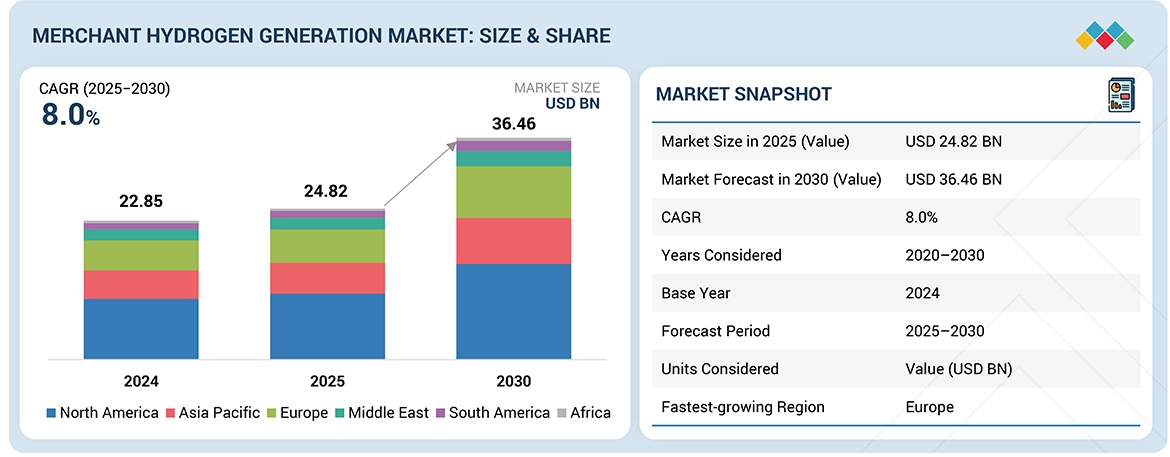
Source: Secondary Research, Interviews with Experts, MarketsandMarkets Analysis
The merchant hydrogen generation market is expected to reach USD 36.46 billion by 2030, up from USD 24.82 billion in 2025, growing at a CAGR of 8.0%. It is driven by increasing demand from sectors like transportation, refineries, and ammonia and methanol production, which prefer flexible hydrogen sourcing without significant on-site investments. A key trend is the development of hydrogen corridors and regional pipeline infrastructure, especially in Europe and North America, which support economies of scale and cross-border trade.
KEY TAKEAWAYS
-
BY STATEGas accounted for the largest market share of 95.9% in the merchant hydrogen generation market in 2024.
-
BY DELIVERY MODEThe bulk (liquid) segment is likely to record the highest CAGR of 8.7% during the forecast period.
-
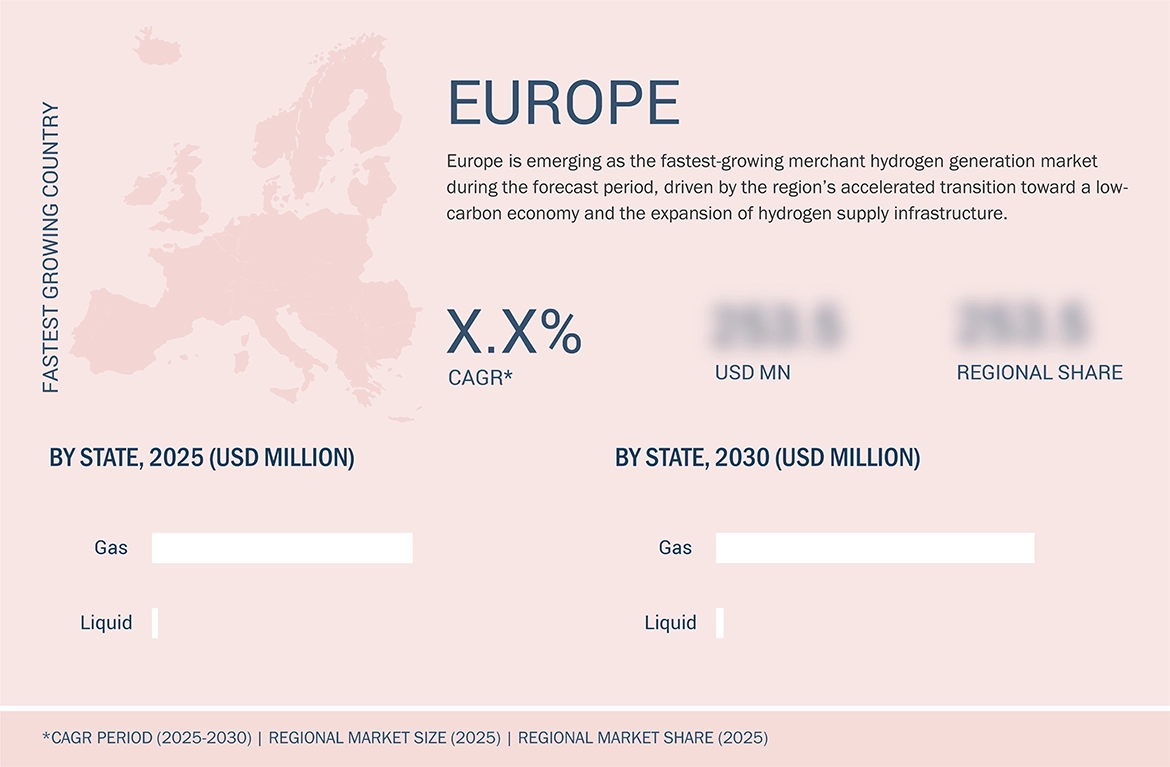
BY REGIONEurope is projected to be the fastest-growing region at a CAGR of 9.3% in the merchant hydrogen generation market.
-
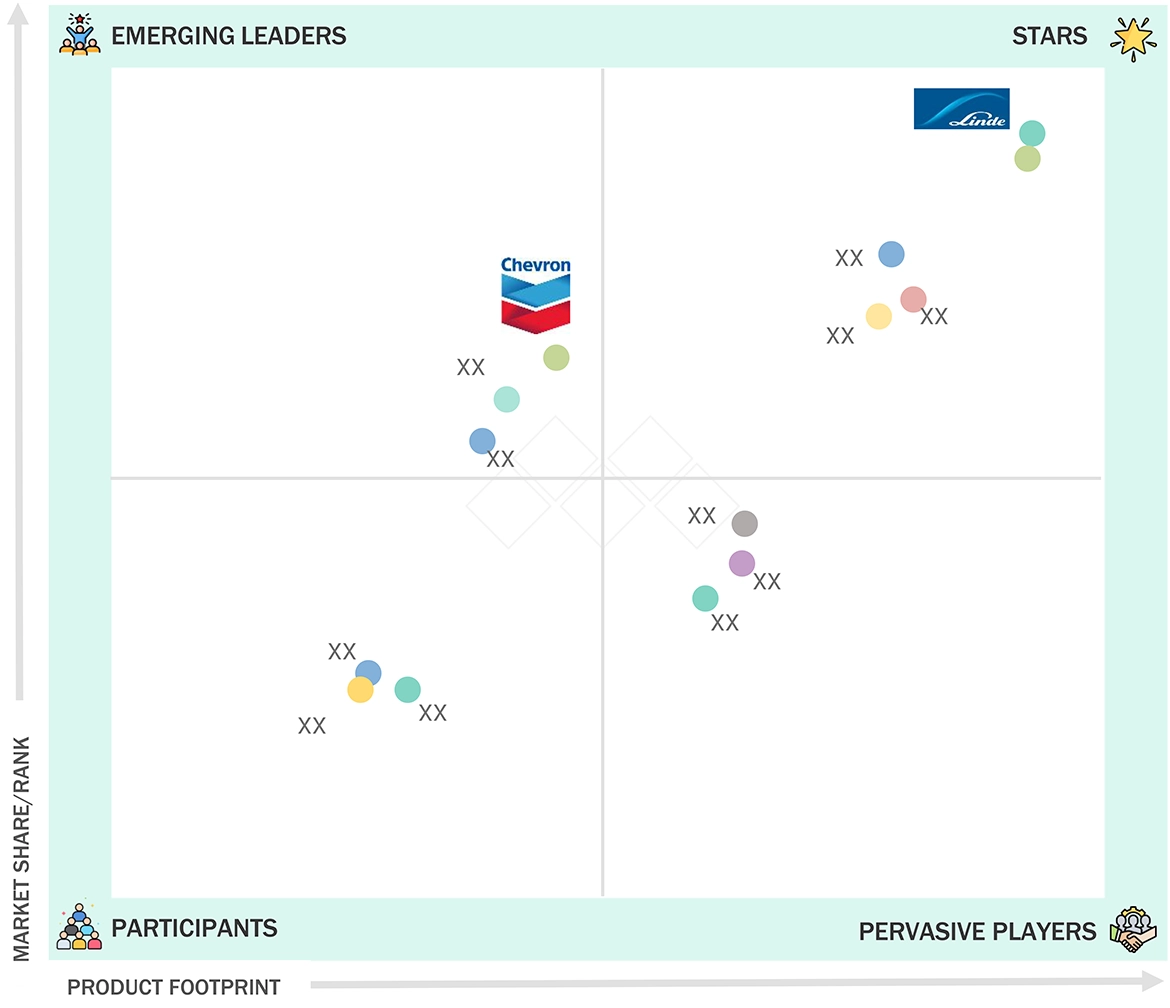
COMPETITIVE LANDSCAPECompanies such as Linde PLC, Air Products and Chemicals, Inc., Chevron Corporation, Exxon Mobil Corporation, and Air Liquide have formed strategic agreements and are the leaders in the merchant hydrogen generation market, actively pursuing growth-oriented strategies.
The growing emphasis on low-carbon hydrogen, hydrogen infrastructure, strict pollution control laws, and consumer preferences for cleaner fuels have contributed to the market growth.
TRENDS & DISRUPTIONS IMPACTING CUSTOMERS' CUSTOMERS
The merchant hydrogen generation market is going through a major change as suppliers move away from traditional methods like steam methane reforming (SMR) and coal gasification toward low-carbon and green hydrogen technologies to cut emissions and reach sustainability goals. Growing focus on decarbonization is speeding up the adoption of advanced production methods, including water electrolysis (alkaline, PEM, and SOEC), methane pyrolysis, and carbon capture–enabled hydrogen. At the same time, increasing investments in clean hydrogen infrastructure, power-to-gas technologies, and fuel cell uses are changing market dynamics. Hydrogen suppliers are broadening their technology options and strengthening distribution networks to support new applications such as fuel cell mobility, green ammonia, smart refineries, and integrated energy systems. These changes are bringing downstream benefits like lower emissions, better energy efficiency, and more flexibility in hydrogen supply, while also supporting the shift from traditional captive production to scalable, technology-driven merchant hydrogen supply models aligned with the evolving global hydrogen economy.
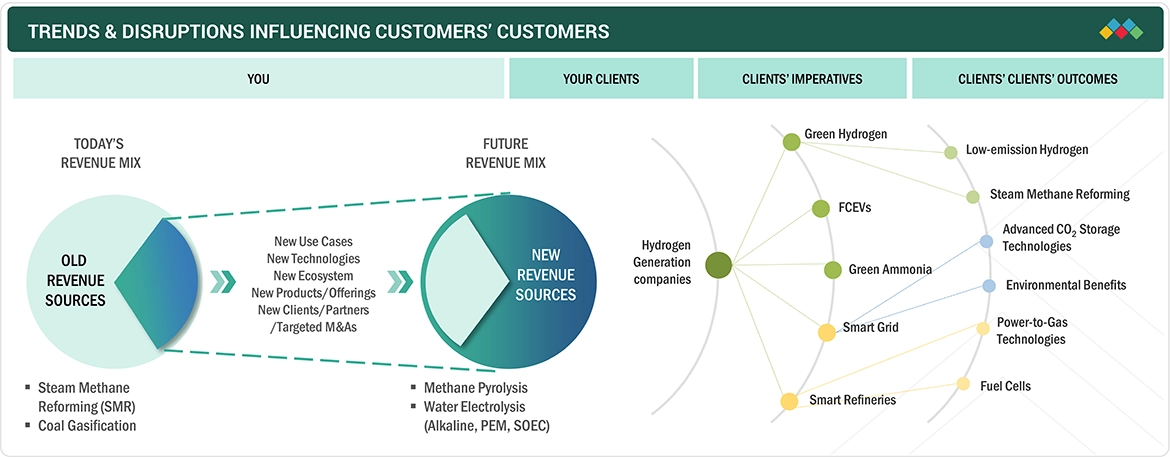
Source: Secondary Research, Interviews with Experts, MarketsandMarkets Analysis
MARKET DYNAMICS

Level
-
Enforcement of stringent regulations

-
Government initiatives for developing hydrogen economy


Level
-
Energy loss during hydrogen production

-
Limited hydrogen infrastructure


Level
-
Rising emphasis on achieving net-zero carbon emission targets

-
Increasing investment in low-emission fuels


Level
-
High costs associated with renewable hydrogen production

Source: Secondary Research, Interviews with Experts, MarketsandMarkets Analysis
Driver: Government initiatives for developing hydrogen economy
Countries in North America are increasingly focusing on developing a hydrogen economy as part of their broader strategies to achieve energy transition, climate objectives, and economic resilience. Hydrogen, especially green hydrogen produced using renewable energy, is seen more and more as a crucial solution to decarbonize hard-to-abate sectors like steel, cement, chemicals, and heavy transportation. To speed up this transition, various governments have launched comprehensive plans, policies, subsidies, and incentive programs to support hydrogen development. For instance, Canada introduced the Clean Hydrogen Investment Tax Credit (CHITC) in 2022, which took effect in 2023. This refundable tax credit applies to eligible clean hydrogen assets acquired and operational from 28 March 2023 through 31 December 2034, aiming to boost investment in qualified hydrogen projects.
Restraint: Energy loss during hydrogen production
Hydrogen is a synthetic energy carrier that transports energy generated by various processes. Water electrolysis converts electrical energy into hydrogen. However, besides producing hydrogen, high-grade electrical energy is also used to compress, liquefy, transport, transfer, or store the medium. Energy is required for hydrogen production, and ideally, this energy input should match the energy content of the synthetic gas. Methods like electrolysis and reforming involve energy transformations, where electrical energy or the chemical energy of hydrocarbons is converted into the chemical energy of hydrogen. Unfortunately, energy losses are inevitable at every step of hydrogen creation. During production, about 30% of the energy used for electrolysis is lost, and an additional 10–25% is lost during conversion to other forms. Energy input is also necessary to deliver green hydrogen, whether as fuel for vehicles or through pipelines. Using hydrogen in fuel cells results in further energy loss.
Opportunity: Rising emphasis on achieving net-zero carbon emission targets
Hydrogen production in North America is expected to change significantly as the region moves toward net-zero emissions. Growing demand for hydrogen and supportive policies are speeding up the shift to low-carbon production methods, especially electrolysis and hydrogen with carbon capture (CCUS). As part of the global transition, hydrogen production could reach about 200 Mt by 2030 and nearly 500 Mt by 2050, mainly driven by clean hydrogen technologies. In North America, hydrogen will be vital in reducing emissions in hard-to-decarbonize sectors such as steel, chemicals, heavy-duty transportation, shipping, and aviation, where direct electrification is still challenging.
Challenge: High costs associated with renewable hydrogen production
Green hydrogen, produced using renewable or other low-carbon energy sources, is emerging as a key solution for decarbonizing energy-intensive sectors such as steel, cement, chemicals, heavy-duty transport, shipping, and aviation. However, its commercial adoption remains limited because green hydrogen currently costs two to four times more than gray hydrogen produced from fossil fuels. This cost gap is driven by high electrolyzer capital costs, limited access to low-cost renewable electricity, and underdeveloped hydrogen infrastructure for production, storage, and distribution. To address these challenges, governments are introducing supportive policies to scale up production and reduce costs. For instance, the European Union’s REPowerEU plan targets 10 million tons of green hydrogen production by 2030, while Japan’s Contracts for Difference (CfD) program subsidizes the cost gap between low-carbon hydrogen and conventional fuels. Such initiatives aim to accelerate green hydrogen deployment and support the global energy transition.
MERCHANT HYDROGEN GENERATION MARKET: COMMERCIAL USE CASES ACROSS INDUSTRIES
| COMPANY | USE CASE DESCRIPTION | BENEFITS |
|---|---|---|
 |
SSAB, along with Vattenfall and LKAB, launched the HYBRIT (Hydrogen Breakthrough Ironmaking Technology) initiative to reduce carbon emissions from steel production in Sweden by replacing coal-based blast furnace methods with hydrogen-based Direct Reduced Iron (DRI) technology. The project uses green hydrogen produced through a 4.5 MW pilot electrolyzer powered by renewable electricity to enable fossil-free steel manufacturing. The initiative shows the feasibility of using green hydrogen at scale in heavy industry and supports the move toward low-carbon steel production. | The HYBRIT initiative significantly cuts carbon emissions from steel manufacturing by removing fossil fuels from the ironmaking process. The project supports widespread adoption of fossil-free steel production, enhances sustainability in one of the most carbon-heavy industries, and helps meet national decarbonization goals. Once fully implemented, the technology could reduce Sweden’s total CO2 emissions by about 10%, while creating a scalable pathway to decarbonize global steel production. |
 |
The National Renewable Energy Laboratory partnered with Electric Hydrogen to develop high-performance electrolyzer components that can accelerate the scaling of renewable hydrogen production. The USD 3.6 million, three-year collaboration focuses on identifying degradation mechanisms in electrolysis cells and validating improved electrolyzer designs capable of operating at higher stack currents. The initiative combines NREL’s research expertise with Electric Hydrogen’s technology development capabilities to advance next-generation electrolyzer systems for large-scale clean hydrogen production. | The partnership promotes the development of more efficient and durable electrolyzer components, enabling cost savings and enhanced performance in renewable hydrogen production systems. By improving electrolyzer reliability and scalability, the collaboration helps speed up the deployment of clean hydrogen across industries and opens new decarbonization opportunities for sectors such as heavy industry, chemicals, and energy. The initiative also boosts innovation in hydrogen technologies, supporting the commercialization of advanced renewable hydrogen solutions and contributing to the wider transition toward low-carbon energy systems. |
Logos and trademarks shown above are the property of their respective owners. Their use here is for informational and illustrative purposes only.
MARKET ECOSYSTEM
The hydrogen generation ecosystem includes technology providers, EPC contractors, hydrogen producers, and end users who collectively support the development, deployment, and use of hydrogen solutions. Technology providers such as Plug Power, Nel ASA, and Linde supply essential technologies such as electrolyzers, hydrogen generation systems, and supporting infrastructure. EPC companies like Technip Energies, ANDRITZ, and Black & Veatch assist with designing, integrating, and scaling up hydrogen production facilities. Hydrogen producers and suppliers, including Air Liquide, Air Products, and Messer Group, are vital in producing, distributing, and supplying hydrogen to various sectors. End users like TotalEnergies, Doosan Group, and ElringKlinger apply hydrogen in refining, mobility, power generation, and industrial manufacturing. This interconnected ecosystem promotes cooperation along the hydrogen value chain, fostering technological advancements, extensive hydrogen deployment, and the transition toward low-carbon energy systems.
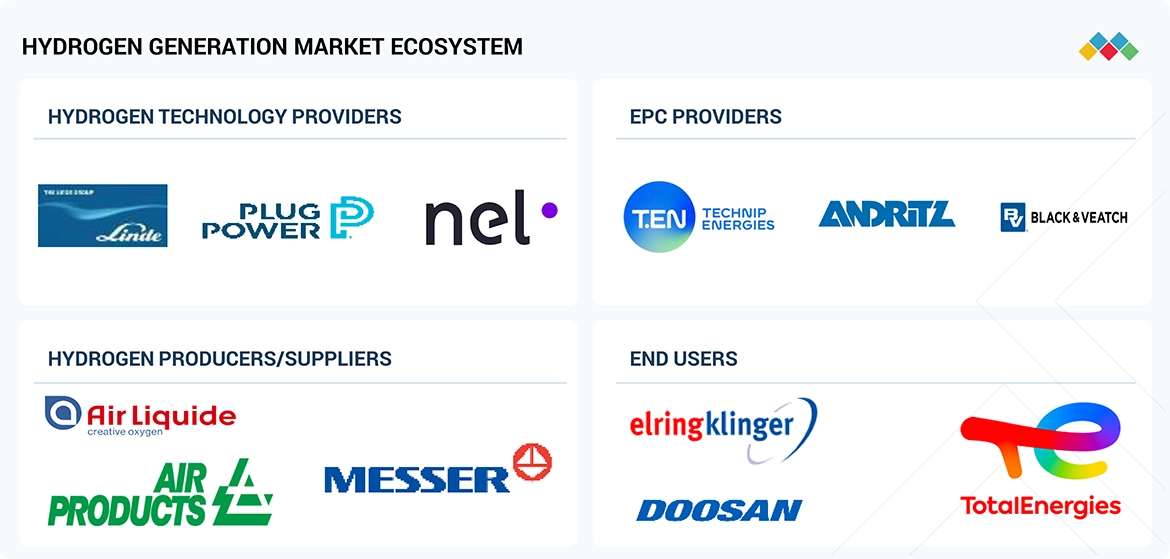
Logos and trademarks shown above are the property of their respective owners. Their use here is for informational and illustrative purposes only.
MARKET SEGMENTS
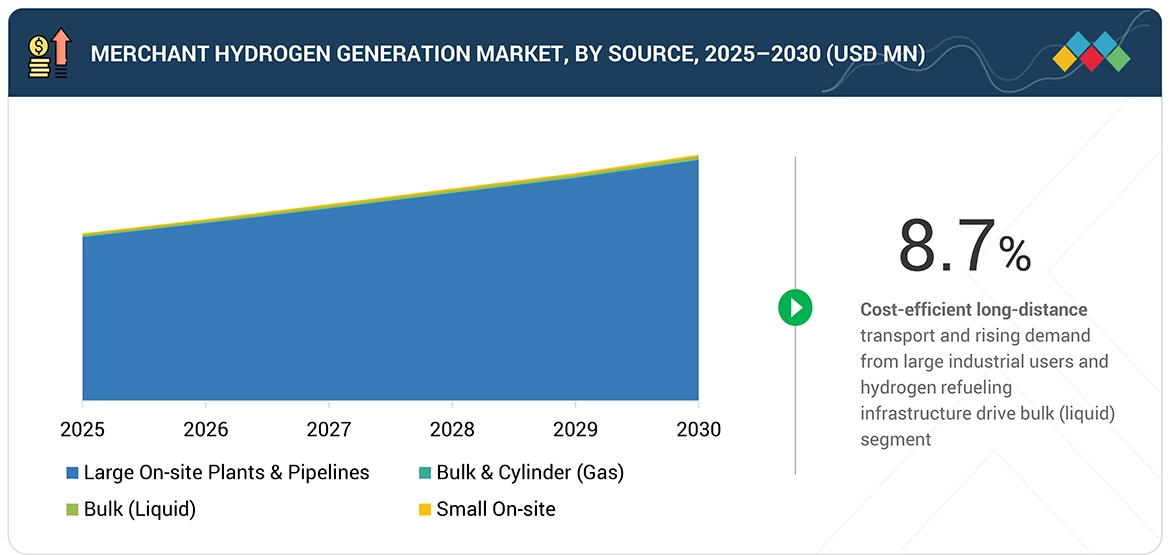
Source: Secondary Research, Interviews with Experts, MarketsandMarkets Analysis
Hydrogen Generation Market, By State
The merchant hydrogen generation market, by state, is divided into gas and liquid forms. Hydrogen can exist in different physical states depending on temperature and pressure, mainly as gaseous and liquid hydrogen. Gaseous hydrogen is commonly used in applications like fuel cell transportation, power generation, industrial processes, ammonia production, and hydrogenation reactions in the chemical industry. Liquid hydrogen, on the other hand, is stored in highly insulated cryogenic tanks to keep the extremely low temperatures needed for safe storage and transportation.
Hydrogen Generation Market, By Delivery Mode
Merchant hydrogen producers usually operate large centralized facilities that supply hydrogen to multiple customers, while some also set up smaller on-site units to meet local low-volume demand. Hydrogen is delivered through various methods—such as pipelines, compressed gas trucks, and cryogenic liquid tankers—depending on distance, demand, and regional infrastructure. Liquid hydrogen delivery is more suitable for long-distance transport and high-volume supply, whereas compressed gaseous delivery is preferred for smaller stations with lower demand. Based on these distribution methods, the merchant hydrogen market is segmented by delivery mode into large on-site plants and pipelines, bulk & cylinder (gaseous form), bulk (liquid form), and small on-site units.
REGION
Europe is expected to be the fastest-growing market in during the forecast period
Europe is emerging as the fastest-growing market for merchant hydrogen production during the forecast period, driven by the region’s accelerated shift toward a low-carbon economy and the expansion of hydrogen supply infrastructure. Growth is supported by increasing demand from sectors such as mobility, power generation, refining, and industrial applications, which are relying more on flexible off-site hydrogen supply. Additionally, strong policy support for clean hydrogen, carbon pricing mechanisms, and the development of regional hydrogen corridors and distribution networks are further fueling market growth. A key trend shaping the market is the rise of large-scale green hydrogen production facilities that supply hydrogen through pipelines, tanker trucks, and refueling stations to meet both domestic demand and export opportunities.
MERCHANT HYDROGEN GENERATION MARKET: COMPANY EVALUATION MATRIX
Linde PLC has become one of the most influential and well-positioned leaders in the market under study, supported by its strong global presence, advanced hydrogen production technologies, and extensive infrastructure across both conventional and low-carbon hydrogen value chains. The company benefits from its leadership in large-scale steam methane reforming (SMR), electrolyzer integration capabilities, and increasing investments in clean hydrogen projects, positioning it strongly in industrial and mobility applications. Chevron Corporation is one of the emerging leaders in North America for the hydrogen generation market, leveraging its robust natural gas portfolio, expanding carbon capture and storage (CCS) capabilities, and strategic investments in blue hydrogen to align with regional decarbonization goals.
Source: Secondary Research, Interviews with Experts, MarketsandMarkets Analysis
KEY MARKET PLAYERS
- Linde PLC (Ireland)
- Air Products and Chemicals, Inc. (US)
- Chevron Corporation (US)
- Exxon Mobil Corporation (US)
- Air Liquide (France)
- ENGIE (France)
- Ørsted A/S (Denmark)
- Messer SE & Co. KGaA (Germany)
- Iwatani Corporation (Japan)
- Petroliam Nasional Berhad (PETRONAS) (Indonesia)
- Uniper SE (Germany)
MARKET SCOPE
| REPORT METRIC | DETAILS |
|---|---|
| Market Size in 2025 (Value) | USD 24.82 BN |
| Market Forecast in 2030 (Value) | USD 36.46 BN |
| Growth Rate | CAGR of 8.0% from 2025-2030 |
| Years Considered | 2020-2030 |
| Base Year | 2024 |
| Forecast Period | 2025-2030 |
| Units Considered | Value (USD BN) |
| Report Coverage | Revenue Forecast, Company Ranking, Competitive Landscape, Growth Factors, and Trends |
| Segments Covered |
|
| Regions Covered | North America, Asia Pacific, Europe, Middle East, South America, Africa |
WHAT IS IN IT FOR YOU: MERCHANT HYDROGEN GENERATION MARKET REPORT CONTENT GUIDE
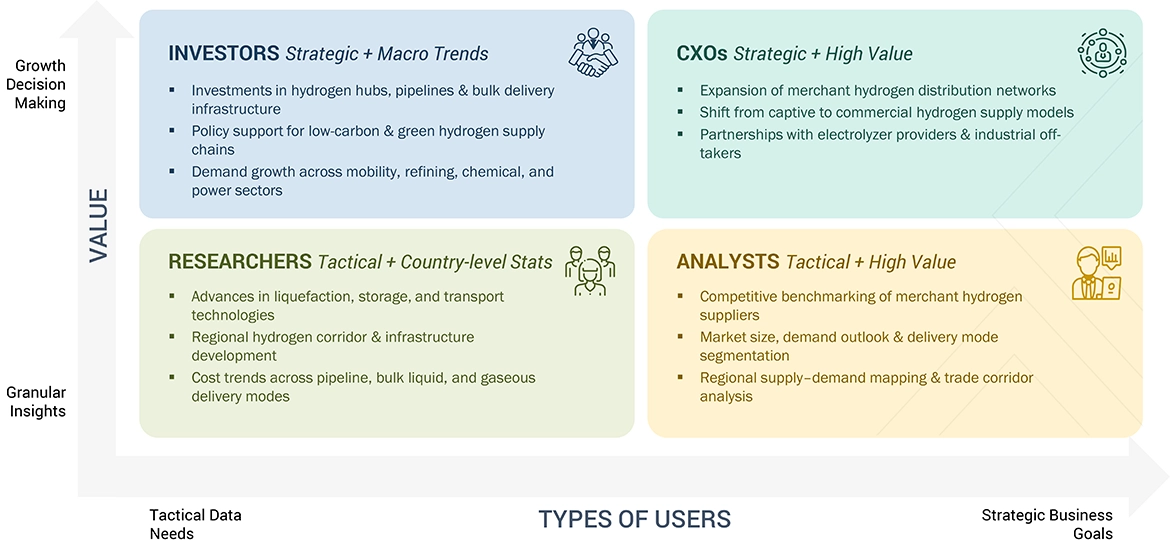
DELIVERED CUSTOMIZATIONS
We have successfully delivered the following deep-dive customizations:
| CLIENT REQUEST | CUSTOMIZATION DELIVERED | VALUE ADDS |
|---|---|---|
| Company profiling | Competitive Landscape & Key Player Benchmarking Customization |
|
RECENT DEVELOPMENTS
- August 2024 : Linde entered into a long-term agreement with Dow Inc. to provide clean hydrogen for Dow’s Path2Zero initiative in Fort Saskatchewan, Canada. The company will commit over USD 2 billion towards constructing and operating a hydrogen production facility capable of capturing over 2 million tons of CO2 annually. Anticipated to commence operations in 2028, the plant will facilitate Dow’s decarbonization objectives and supply low-carbon hydrogen and industrial gases to neighboring industries.
- June 2024 : ExxonMobil joined forces with Air Liquide to develop what is expected to become the world’s largest low-carbon hydrogen project at ExxonMobil’s Baytown, Texas facility. Air Liquide will invest up to USD 850 million to build and operate four air separation units that supply oxygen and nitrogen for hydrogen and ammonia production. The project aims to produce 1 billion cubic feet of hydrogen daily while capturing over 98% of CO2 emissions, supporting large-scale low-carbon hydrogen and ammonia manufacturing.
- May 2023 : Air Products and Chemicals, Inc. signed a USD 1 billion investment agreement with the Government of the Republic of Uzbekistan and Uzbekneftegaz JSC (UNG) to buy, own, and operate a natural gas-to-syngas processing facility in Qashqadaryo Province, Uzbekistan.
- October 2021 : Linde PLC opened a large-scale hydrogen production plant in Texas. This facility will provide high-purity hydrogen.
Table of Contents
 Exclusive indicates content/data unique to MarketsandMarkets and not available with any competitors.
Methodology
The study involved major activities in estimating the current size of the Merchant hydrogen generation market. Exhaustive secondary research was done to collect information on the peer and parent markets. The next step was to validate these findings, assumptions, and sizing with industry experts across the value chain through primary research. Both top-down and bottom-up approaches were employed to estimate the complete market size. Thereafter, market breakdown and data triangulation were used to estimate the market size of the segments and subsegments.
Secondary Research
The secondary sources referred to for this research study include annual reports, press releases, investor presentations of companies, white papers, certified publications, articles from recognized authors, and databases of various companies and associations. Secondary research was mainly used to obtain key information about the industry’s supply chain, the market’s monetary chain, the total pool of key players, market classification and segmentation according to industry trends to the bottom-most level, regional markets, and key developments from market- and technology-oriented perspectives.
Primary Research
In the primary research process, various primary sources from the supply and demand sides were interviewed to obtain qualitative and quantitative information for this report. Primary sources from the supply side include industry experts, such as CEOs, vice presidents, marketing directors, technology & innovation directors, and related key executives from various companies and organizations operating in the Merchant hydrogen generation market.
In the complete market engineering process, the top-down and bottom-up approaches and several data triangulation methods were extensively used to perform market estimation and market forecasts for the overall market segments and subsegments listed in this report. Extensive qualitative and quantitative analysis was conducted on the complete market engineering process to list key information/insights throughout the report.
To know about the assumptions considered for the study, download the pdf brochure
Market Size Estimation
The top-down and bottom-up approaches were used to estimate and validate the size of the Merchant Hydrogen Generation Market and to evaluate the sizes of various other dependent submarkets. Key players in the market were identified through secondary research, and their shares in the respective regions were determined through primary and secondary research. This entire procedure included the study of annual and financial reports of top market players and extensive interviews for key insights with industry leaders, such as CEOs, VPs, directors, and marketing executives. All percentage shares, splits, and breakdowns were determined using secondary sources and verified through primary sources. All possible parameters that affect the markets covered in this research study were accounted for, viewed in extensive detail, verified through primary research, and analyzed to get the final quantitative and qualitative data.
Data Triangulation
After arriving at the overall market size from the estimation process explained below, the total market was split into several segments and subsegments. The data triangulation and market breakdown procedures were employed, wherever applicable, to complete the overall market engineering process and arrive at the exact statistics for all the segments and subsegments. The data was triangulated by studying various factors and trends from the demand and supply sides.
Market Definition
Hydrogen is the lightest and most abundant element in the universe, widely valued for its exceptional energy-carrying capacity. It can be produced either as a primary product or as a by-product from diverse energy sources, including renewables (wind and solar), fossil fuels (coal and natural gas), and nuclear power. Due to its high energy content per unit mass, hydrogen serves as a highly versatile energy carrier. It is critical in various industrial processes, chemical manufacturing, and emerging clean energy applications. The hydrogen generation market is defined as the sum of the revenue generated by companies producing hydrogen through various technologies, such as electrolysis, steam methane reforming (SMR), auto thermal reforming (ATR), partial oxidation (POX), and coal gasification.
Stakeholders
- Fuel cell electric vehicle (FCEV) manufacturers
- Government organizations
- Hydrogen charging station owners
- Hydrogen fuel pump developers and operators
- Hydrogen generation equipment manufacturers and suppliers
- Hydrogen generation infrastructure developers
- Institutional investors
- Merchant hydrogen producers
- Methanol producers
- Refinery operators
- Research institutes
Report Objectives
- To describe and forecast the Merchant Hydrogen Generation market, by technology, generation and delivery mode, application, source, and region, in terms of value
- To describe and forecast the Merchant Hydrogen Generation market, by technology, generation and delivery mode, application, source, and region, in terms of volume
- To forecast the market size across four key regions: North America, Europe, Asia Pacific, the Middle East, Africa, and South America, along with country-level analysis, in terms of value and volume
- To provide detailed information regarding key drivers, restraints, opportunities, and challenges influencing the growth of the hydrogen generation market
- To provide the supply chain analysis, trends/disruptions impacting customer business, ecosystem analysis, regulatory landscape, patent analysis, case study analysis, technology analysis, key conferences & events, the impact of AI/Gen AI, pricing analysis, porter’s five forces analysis, regulatory analysis, and the impact of 2025 US tariff on the hydrogen generation market
- To analyze opportunities for stakeholders and provide a detailed competitive landscape of the market leaders
- To strategically analyze micromarkets with respect to individual growth trends, prospects, and contributions to the overall market size
- To benchmark players within the market using the company evaluation matrix, which analyzes market players based on several parameters within the broad categories of business and product strategies
- To compare key market players with respect to product specifications and applications
- To strategically profile key players and comprehensively analyze their market rankings and core competencies
- To analyze competitive developments, such as contracts, agreements, expansions, investments, acquisitions, partnerships, collaborations, and joint ventures, in the hydrogen generation market.
Available Customizations
MarketsandMarkets offers customizations according to the specific needs of the companies using the given market data.
The following customization options are available for the report :
Product Analysis
- Product matrix, which gives a detailed comparison of the product portfolio of each company
Geographic Analysis as per Feasibility
- Further breakdown of the hydrogen generation market, by country for the Europe, Asia Pacific, North America, Middle East, Africa, and South America regions
Company Information
- Detailed analysis and profiling of additional market players (up to five)


Personalize This Research
- Triangulate with your Own Data
- Get Data as per your Format and Definition
- Gain a Deeper Dive on a Specific Application, Geography, Customer or Competitor
- Any level of Personalization
Let Us Help You
- What are the Known and Unknown Adjacencies Impacting the Merchant Hydrogen Generation Market
- What will your New Revenue Sources be?
- Who will be your Top Customer; what will make them switch?
- Defend your Market Share or Win Competitors
- Get a Scorecard for Target Partners

Custom Market Research Services
We Will Customise The Research For You, In Case The Report Listed Above Does Not Meet With Your Requirements
Get 10% Free CustomisationTESTIMONIALS

Kimberly Murphy
GLOBAL MARKETING DIRECTOR
Bently Nevada,
Leading Condition Monitoring & Asset Protectionwww.bakerhughesds.com/bently-nevada

MarketsandMarkets™ showed consistent rigor for success and relentlessly worked with Bently Nevada stakeholders to positively impact go-to-market strategy. Their proactiveness and flexibility has been instrumental in achieving the objectives to grow our sales pipeline in key industrial markets.

DARRICK HUEBER
Business Development Leader
Nexus Controls LLC,
Leading Manufacturer of Automation System & Electrical Panelswww.bakerhughesds.com/nexus-controls

We partnered with MarketsandMarkets to expand our business further by tapping into new industrial segments. It was critical for us to gather crucial business insights about specific markets to achieve this goal. MarketsandMarkets engagement model and client services helped us provide those insights, it was really impressive and valuable for my business. The team was extremely flexible and helpful.

Mike Schoff
Global Industrial Commercial Strategy Leader
Nexus Controls LLC
Leading Manufacturer of Automation System & Electrical Panelswww.bakerhughesds.com/nexus-controls
We consulted MarketsandMarkets for potential Partner Identification. Overall, it was a good experience. The insights provided through interviews conducted by the team helped us put together the questionnaire required for discussion with the selected partners. Their ability to provide insights through interviews with customers in a timely manner was quite impressive.






Growth opportunities and latent adjacency in Merchant Hydrogen Generation Market