Middle East & Africa Penetration Testing Market

Middle East & Africa Penetration Testing Market by Service Type (Manual Penetration Testing, Automated Penetration Testing), Attack Surface (Network Security, Cloud Security, OT/ICS Systems, Application Security Pentesting) - Forecast to 2031




OVERVIEW

Source: Secondary Research, Interviews with Experts, MarketsandMarkets Analysis
The Middle East & Africa penetration testing market size is expected to grow from USD 0.20 billion in 2025 to USD 0.37 billion by 2031 at a CAGR of 10.9% during the forecast period. As digital services and infrastructure expand in the region, cyber threats are increasing rapidly among organizations. The rising threat environment, along with growing regulatory focus on cyber resilience and national cybersecurity initiatives, is fueling a swift shift toward structured penetration testing to identify vulnerabilities and safeguard critical assets.
KEY TAKEAWAYS
-
BY SERVICE TYPEBy service type, the manual penetration testing segment is expected to dominate the market, with a share of 76.3% in 2025.
-
BY ATTACK SURFACEBy attack surface, the cloud security pentesting segment is expected to grow the fastest, at a CAGR of 13.0% during the forecast period.
-
BY DEPLOYMENT MODEBy deployment mode, the on-premises segment will hold the largest market size during the forecast period.
-
BY ORGANIZATION SIZEBy organizations size, the SMEs segment will grow at the highest CAGR of 12.6% during the forecast period.
-
BY VERTICALBy vertical, healthcare will be the fastest-growing segment during the forecast period.
-
COMPETITIVE LANDSCAPE - KEY PLAYERSKey players in the Middle East & Africa penetration testing market include Help AG, CPX, and Pentera. These companies provide a complete range of offensive security services such as vulnerability testing, red teaming, cloud security testing, and adversary emulation. Their strong regional presence, connections with enterprises and government entities, and focus on compliance-based security validation make them popular partners for large organizations seeking ongoing risk assessment and resilience enhancement.
-
COMPETITIVE LANDSCAPE - STARTUPSNew entrants such as SecureMisr, DTS Solution, and RedLeggs are expanding by offering specialized penetration testing, application security testing, and structured vulnerability validation services. Their regional expertise, responsive communication, and cost-effective delivery attract mid-sized businesses and rapidly digitizing organizations in the region.
The increasing focus on third-party and supply chain risk management is compelling organizations to demand penetration testing validation of vendors and partners during procurement and security due diligence activities.
TRENDS & DISRUPTIONS IMPACTING CUSTOMERS' CUSTOMERS
The Middle East & Africa market in penetration testing is rapidly evolving because of the fast implementation of cloud infrastructure, smart city technologies, 5G, and industrial IoT in the most critical sectors. AI-powered security tools and simulated attacks are accelerating the transition to continuous testing. Simultaneously, AI-facilitated cyberattacks and the growing IT-OT convergence are disrupting conventional periodic evaluations, compelling the need to test offensive security validation and adversary emulation in complex digital systems in real time.

Source: Secondary Research, Interviews with Experts, MarketsandMarkets Analysis
MARKET DYNAMICS

Level
-
National digital transformation and smart infrastructure expansion

-
Rising targeted attacks on energy, BFSI, telecom, and government


Level
-
High compliance and data sovereignty costs

-
Shortage of skilled offensive security talent


Level
-
Rapid expansion of cybersecurity workforce development and regional training initiatives

-
Increasing third-party and supply chain security validation requirements in enterprise procurement


Level
-
Fragmented regulatory landscape across MEA

-
Uneven cybersecurity maturity and budget constraints

Source: Secondary Research, Interviews with Experts, MarketsandMarkets Analysis
Driver: National digital transformation and smart infrastructure expansion
Across the Middle East & Africa, governments and businesses are quickly deploying digital services, smart infrastructure, and mobile-first platforms, which increases reliance on interconnected online systems. As more critical operations migrate to cloud and digital environments, the attack surface naturally widens, creating more opportunities for threat actors. The growing threat is pushing organizations to focus on structured penetration testing and proactive security checks to better protect vital systems and services.
Restraint: High compliance and data sovereignty costs
In the Middle East & Africa, meeting compliance and data sovereignty requirements can be particularly costly because regulations and cybersecurity rules differ significantly from one country to another. Businesses often need to establish country-specific audit procedures, keep certain data stored within national borders, and align their security testing practices with various legal standards. For companies operating across multiple countries, this adds layers of complexity and increases operational costs and budget pressures.
Opportunity: Rapid expansion of cybersecurity workforce development and regional training initiatives
Across the Middle East & Africa, governments and companies are heavily investing in cybersecurity education, certification programs, and practical training academies to close the regional talent gap. National initiatives, university collaborations, and private sector bootcamps are producing more skilled security professionals. As technical maturity advances, organizations become more aware of offensive security practices, boosting long-term demand for structured penetration testing and advanced security validation services.
Challenge: Fragmented and evolving regulatory landscape across Asia increasing compliance complexity
The fragmented regulatory environment in the Middle East & Africa causes inconsistency in compliance expectations and security standards. Regional organizations face different incident reporting regulations, breach notification periods, and data protection rules, making it difficult to establish common penetration testing governance frameworks across various jurisdictions.
MIDDLE EAST & AFRICA PENETRATION TESTING MARKET: COMMERCIAL USE CASES ACROSS INDUSTRIES
| COMPANY | USE CASE DESCRIPTION | BENEFITS |
|---|---|---|
 |
A government organization in the UAE contracted Help AG to perform extensive penetration testing and red teaming of its digital services platform and internal infrastructure to determine its vulnerability to advanced persistent threats and confirm security controls are in line with national cybersecurity requirements. | Enhanced resilience of services to the citizens, approved network segmentation controls, increased compliance consistency with national frameworks, and increased detection and response preparedness to targeted attacks |
 |
A major regional bank conducted a structured vulnerability assessment and penetration testing on its online banking and mobile payment systems to identify exploitable vulnerabilities and improve compliance with regulatory requirements. | Less risk of transaction fraud and credential-based attacks, better remediation schedules, better API and application security posture, and better audit preparedness |
 |
A leading energy and utility company undertook industrial control system and network penetration testing to identify vulnerabilities in IT-OT converged environments that support operational infrastructure. | Better safeguarding of the critical operational systems, authenticated separation between the IT and OT networks, lower chances of ransomware spreading, and overall operational cyber resilience |
Logos and trademarks shown above are the property of their respective owners. Their use here is for informational and illustrative purposes only.
MARKET ECOSYSTEM
The market ecosystem for Middle East & Africa penetration testing encompasses various specialized areas, such as network security pentesting, application security pentesting, cloud security, OT ICS systems pentesting, and social engineering security pentesting. It includes global cybersecurity firms, niche offensive security vendors, and platform-based innovators providing both manual and automated testing services. The ecosystem reflects a growing demand for diverse testing capabilities in response to expanding enterprise attack surfaces and increasing regulatory requirements.

Logos and trademarks shown above are the property of their respective owners. Their use here is for informational and illustrative purposes only.
MARKET SEGMENTS

Source: Secondary Research, Interviews with Experts, MarketsandMarkets Analysis
Middle East & Africa Penetration Testing Market, By Service Type
Manual penetration testing dominates in the Middle East & Africa, as regulated industries such as BFSI, telecom, and government rely on expert-led assessments to identify complex vulnerabilities and ensure compliance.
Middle East & Africa Penetration Testing Market, By Attack Surface
Cloud security penetration testing is the fastest-growing segment, driven by rapid multi-cloud adoption, digital banking expansion, and increasing migration of enterprise workloads to hybrid cloud environments.
Middle East & Africa Penetration Testing Market, By Organization Size
SMEs are the fastest-growing sector, supported by increasing cybersecurity awareness, rising regulatory pressure, and greater adoption of subscription-based testing models across emerging digital businesses.
Middle East & Africa Penetration Testing Market, By Deployment Mode
On-premise deployments hold a significant share, driven by strict data sovereignty laws and the need for greater control over sensitive information in government, BFSI, and critical sectors. Many large enterprises and state-owned organizations prefer localized infrastructure to comply with standards and audits. Concerns about security risks from external cloud exposure also support the ongoing demand for on-premises solutions.
Middle East & Africa Penetration Testing Market, By Vertical
The healthcare sector is the fastest-growing in the Middle East & Africa penetration testing market as hospitals and online health systems face increasing ransomware attacks. The digitization of patient records and related medical devices is expanding, driving the demand for thorough penetration testing services.
REGION
The UAE is the fastest-growing market for penetration testing in the Middle East
The UAE is the fastest-growing market for penetration testing in the Middle East due to ongoing digital transformation, smart city initiatives, and strong national cybersecurity policies. Rising cyber threats targeting finance, government, and critical infrastructure are increasing the demand for structured and continuous security validation services.

MIDDLE EAST & AFRICA PENETRATION TESTING MARKET: COMPANY EVALUATION MATRIX
NetSPI (Leading Player) maintains a strong position in the penetration testing market with its pentesting platform, comprehensive testing services for networks, applications, and cloud environments, supported by a robust enterprise presence and compliance-driven engagements across the Middle East & Africa. Pentera (Emerging Player) is gaining momentum through its automated attack emulation and exposure validation platform, enabling organizations to continuously test security controls and proactively identify exploitable gaps.

Source: Secondary Research, Interviews with Experts, MarketsandMarkets Analysis
KEY MARKET PLAYERS
- Rapid7 (US)
- IBM (US)
- Pentera (US)
- NetSPI (US)
- Sophos (UK)
- Invicti (US)
- HackerOne (US)
- Synack (US)
- Bishop Fox (US)
- NowSecure (US)
- Coalfire (US)
- Fortinet (US)
- Terra Security (Israel)
- CPX (UAE)
- Wattlecorp (UAE)
- DTS (UAE)
- DeepStrike (US)
- PentestME (UAE)
- Buguard (Saudi Arabia)
- RedTeam Labs (Saudi Arabia)
MARKET SCOPE
| REPORT METRIC | DETAILS |
|---|---|
| Market Size in 2024 (Value) | USD 0.18 Billion |
| Market Forecast in 2031 (Value) | USD 0.37 Billion |
| Growth Rate | CAGR of 10.9% from 2025 to 2031 |
| Years Considered | 2019–2031 |
| Base Year | 2024 |
| Forecast Period | 2025–2031 |
| Units Considered | Value (USD Million/Billion) |
| Report Coverage | Revenue Forecast, Company Ranking, Competitive Landscape, Growth Factors, and Trends |
| Segments Covered |
|
WHAT IS IN IT FOR YOU: MIDDLE EAST & AFRICA PENETRATION TESTING MARKET REPORT CONTENT GUIDE

DELIVERED CUSTOMIZATIONS
We have successfully delivered the following deep-dive customizations:
| CLIENT REQUEST | CUSTOMIZATION DELIVERED | VALUE ADDS |
|---|---|---|
| Leading Solution Provider (India) |
|
Insights into regulatory-driven demand, government and critical infrastructure engagement capabilities, competitive differentiation, pricing structures, and partnership models within the UAE’s rapidly expanding digital and sovereign infrastructure ecosystem |
| Leading Service Provider (Japan) |
|
Clear visibility into competitive positioning, sector specialization, compliance-driven service capabilities, and go-to-market strategies suited for South Africa’s regulated and evolving cybersecurity landscape |
RECENT DEVELOPMENTS
- December 2025 : INE Security strengthened its regional education ecosystem through collaborations with Red Nexus Academy, RedTeam Hacker Academy, and Abadnet Institute to broaden localized cybersecurity training, including practical penetration testing labs and skill-building across the Middle East. These partnerships enhance workforce development for offensive security roles.
- February 2025 : NetSPI established itself in the Middle East by forming a strategic distribution partnership with TRINEXIA, a local value-added cybersecurity distributor. The partnership enables companies in the region to access the high-quality security features provided by NetSPI, such as Penetration Testing as a Service, Attack Surface Management, and Breach and Attack Simulation.
Table of Contents
 Exclusive indicates content/data unique to MarketsandMarkets and not available with any competitors.
Methodology
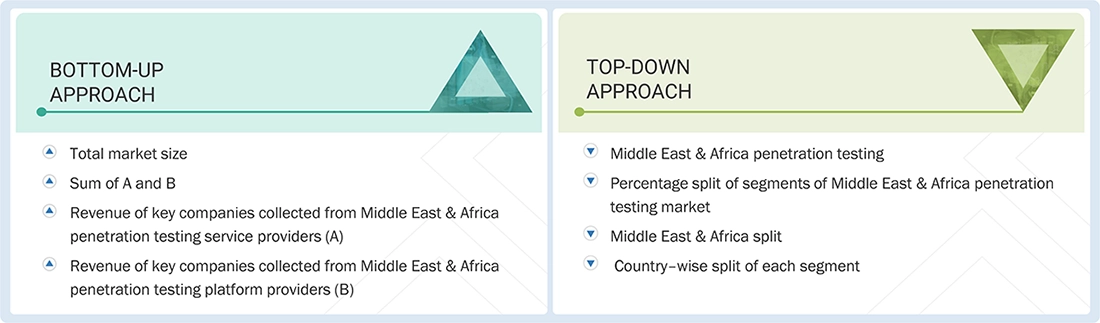
Secondary research was conducted to collect information useful for this technical, market-oriented, and commercial study of the Middle East & Africa Penetration Testing Market. The next step involved validating these findings, assumptions, and sizing with industry experts across the value chain using primary research. Different approaches, including top-down and bottom-up methods, were employed to estimate the total market size. After that, the market breakup and data triangulation procedures were used to estimate the market size of the segments and subsegments of the Middle East & Africa Penetration Testing Market.
Secondary Research
During the secondary research process, various secondary sources were consulted to identify and collect information relevant to the study. The secondary sources included annual reports, press releases, investor presentations of penetration testing vendors, forums, certified publications, and whitepapers. The secondary research was mainly used to obtain key information about the industry’s supply chain, the total pool of key players, market classification and segmentation according to industry trends to the bottom-most level, regional markets, and key developments from both market- and technology-oriented perspectives, all of which were further validated by primary sources.
Primary Research
In the primary research process, various primary sources from both the supply and demand sides were interviewed to obtain qualitative and quantitative information for this report. The primary sources from the supply side included various industry experts, including chief executive officers (CEOs), vice presidents (VPs), marketing directors, technology and innovation directors, and related key executives from various key companies and organizations operating in the Middle East & Africa Penetration Testing Market.
In the market engineering process, top-down and bottom-up approaches were extensively used, along with several data triangulation methods, to perform market estimation and forecasting for the overall market segments and subsegments listed in this report. Extensive qualitative and quantitative analysis was performed on the complete market engineering process to list key information/insights throughout the report.
After the complete market engineering process (including calculations for market statistics, market breakups, market size estimations, market forecasts, and data triangulation), extensive primary research was conducted to gather information and verify & validate the critical numbers arrived at. The primary research was also conducted to identify segmentation types, the competitive landscape of Middle East & Africa Penetration Testing Market players, and key market dynamics, such as drivers, restraints, opportunities, challenges, and key strategies.
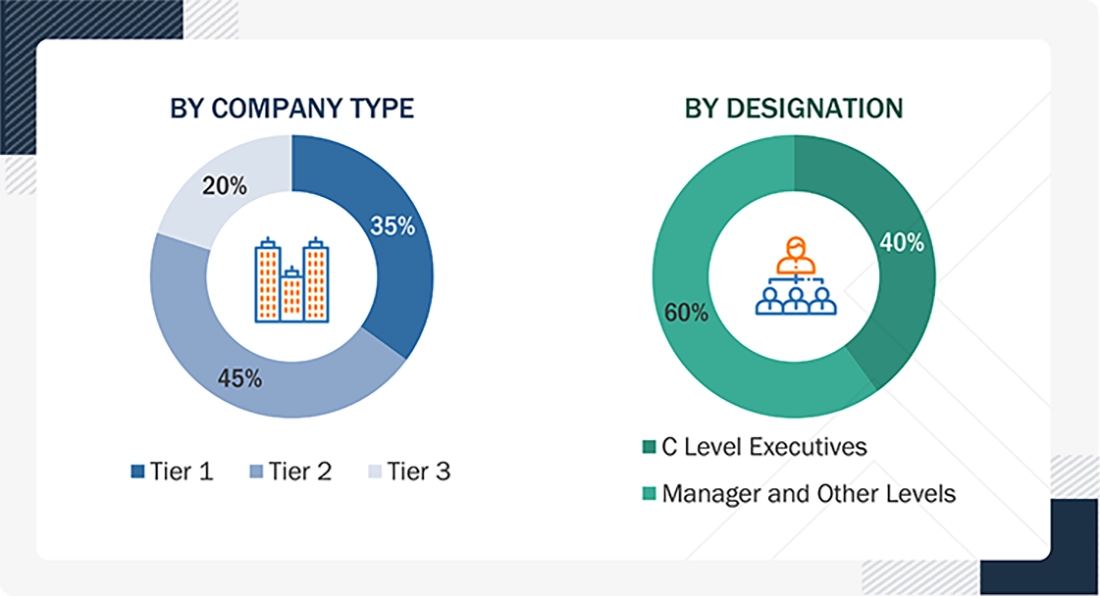
Note: Tier 1 companies have revenues exceeding USD 10 billion; Tier 2 companies have revenues between USD 1 billion and USD 10 billion; and Tier 3 companies have revenues ranging from USD 500 million to USD 1 billion. Other designations include sales, marketing, and product managers.
Source: Industry Experts
To know about the assumptions considered for the study, download the pdf brochure
Market Size Estimation
Top-down and bottom-up approaches were employed to estimate and validate the size of the Middle East & Africa Penetration Testing Market, as well as the size of various dependent subsegments within the overall Middle East & Africa Penetration Testing Market. The research methodology used to estimate the market size includes the following details: critical players in the market were identified through secondary research, and their market shares in the respective regions were determined through primary and secondary research. This entire procedure involved studying the annual and financial reports of the top market players, and extensive interviews were conducted with key industry leaders, including CEOs, VPs, directors, and marketing executives, to gather valuable insights.
All percentage splits and breakdowns were determined using secondary sources and verified through primary sources. All possible parameters that affect the market covered in this research study were accounted for, viewed in extensive detail, verified through primary research, and analyzed to get the final quantitative and qualitative data. This data was consolidated and added to detailed inputs and analysis from MarketsandMarkets.
Data Triangulation
The market was split into several segments and subsegments after arriving at the overall market size using the market size estimation processes explained above. The data triangulation and market breakup procedures were employed, wherever applicable, to complete the overall market engineering process and arrive at the exact statistics of each market segment and subsegment. The data was triangulated by studying various factors and trends from both the demand and supply sides.
Market Definition
According to MarketsandMarkets, penetration testing is a proactive cybersecurity assessment approach in which authorized professionals simulate real-world cyberattacks on networks, applications, systems, or devices to identify exploitable vulnerabilities, assess the effectiveness of security controls, and provide remediation recommendations to reduce organizational risk and strengthen the overall security posture.
Key Stakeholders
- Chief Technology and Data Officers
- Consulting Service Providers
- Cybersecurity Professionals
- Business Analysts
- Information Technology (IT) Professionals
- Government Agencies
- Investors and Venture Capitalists
- Small and Medium-sized Enterprises (SMEs) and Large Enterprises
- Third-party Providers
- Consultants/Consultancies/Advisory Firms
Report Objectives
- To describe and forecast the Middle East & Africa Penetration Testing Market by service type, attack surface, organization size, deployment mode, vertical, and region from 2025 to 2031, and analyze the various macroeconomic and microeconomic factors that affect market growth
- To forecast the market size of five major regions: North America, Europe, Asia Pacific, the Middle East & Africa, and Latin America
- To analyze the subsegments of the market with respect to individual growth trends, prospects, and contributions to the overall market
- To provide detailed information regarding major factors (drivers, restraints, opportunities, and challenges) influencing the growth of the market
- To analyze opportunities in the market for stakeholders and provide details of the competitive landscape of major players
- To profile key market players, provide a comparative analysis based on the business overviews, regional presence, product offerings, business strategies, and key financials, and illustrate the competitive landscape of the market
- To analyze competitive developments, such as mergers & acquisitions, product developments, partnerships and collaborations, and research & development (R&D) activities, in the market
Customization Options
With the given market data, MarketsandMarkets offers customizations based on company-specific needs. The following customization options are available for the report:
Geographic Analysis
- Further breakdown of the Asia Pacific market into countries
- Further breakdown of the North American market into countries
- Further breakdown of the Latin American market into countries
- Further breakdown of the Middle East & African market into countries
- Further breakdown of the European market into countries
Competitive Landscape Assessment
- Detailed analysis and profiling of additional market players (up to 5)
Key Questions Addressed by the Report
What is the projected size of the Middle East and Africa (MEA) Penetration Testing Market by 2031?
The MEA Penetration Testing Market is projected to grow from USD 0.20 billion in 2025 to USD 0.37 billion by 2031, at a CAGR of 10.9%.
What are the major trends shaping the MEA Penetration Testing Market?
Key trends include AI-assisted penetration testing, continuous security validation, DevSecOps integration, cloud security testing, API security assessments, and automated vulnerability management.
Who are the leading companies in the MEA Penetration Testing Market?
Key market players include IBM, Deloitte, KPMG, PwC, Wipro, Tata Consultancy Services (TCS), HCLTech, Rapid7, Trustwave, and DXC Technology.
What opportunities are emerging in the MEA Penetration Testing Market?
The market is creating opportunities through smart city projects, cloud adoption, critical infrastructure protection, IoT security, managed security services, and increasing cybersecurity compliance initiatives.
Which service type is expected to dominate the MEA Penetration Testing Market in 2025?
The manual penetration testing segment is expected to dominate the MEA Penetration Testing Market, accounting for 76.3% of the market share in 2025.


Personalize This Research
- Triangulate with your Own Data
- Get Data as per your Format and Definition
- Gain a Deeper Dive on a Specific Application, Geography, Customer or Competitor
- Any level of Personalization
Let Us Help You
- What are the Known and Unknown Adjacencies Impacting the Middle East & Africa Penetration Testing Market
- What will your New Revenue Sources be?
- Who will be your Top Customer; what will make them switch?
- Defend your Market Share or Win Competitors
- Get a Scorecard for Target Partners

Custom Market Research Services
We Will Customise The Research For You, In Case The Report Listed Above Does Not Meet With Your Requirements
Get 10% Free CustomisationTESTIMONIALS






Growth opportunities and latent adjacency in Middle East & Africa Penetration Testing Market