Midstream Oil & Gas Filtration Market

Midstream Oil & Gas Filtration Market by Filter Technology (Coalescer Filter, Cartridge Filter, Mechanical), Filter Media (Activated Carbon, Metallic, Synthetic Polymer), Application (Gas Processing Plant, Compression Stations, Storage & Distribution), Filtration Phase, and Region – Global Forecast to 2030




OVERVIEW
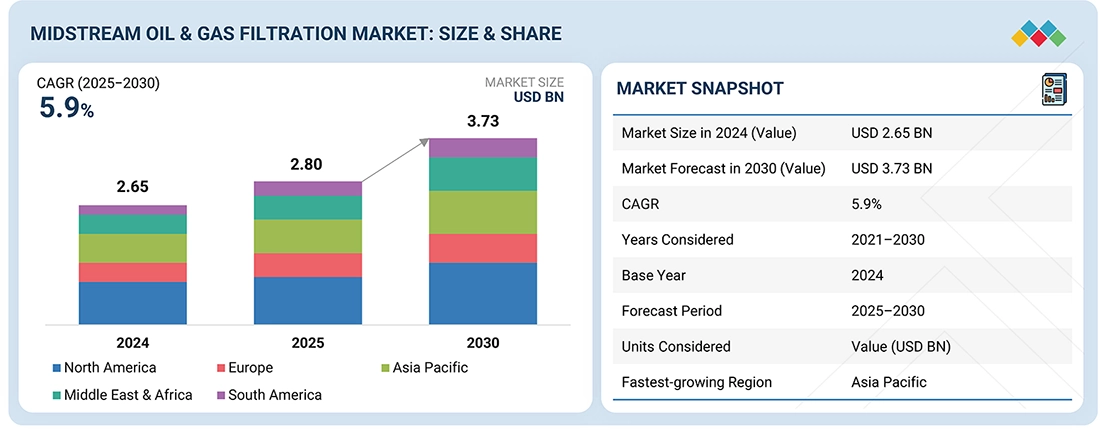
Source: Secondary Research, Interviews with Experts, MarketsandMarkets Analysis
The midstream oil and gas filtration market is expected to grow from USD 2.80 billion in 2025 to USD 3.73 billion by 2030, at a CAGR of 5.9% during the forecast period. Key factors driving this growth include the expansion of pipeline networks, increased natural gas processing and LNG capacity, and stricter safety and environmental regulations. Operators are focusing on removing particulates, liquids, and contaminants to protect compressors, turbines, and downstream equipment. Developing advanced filtration solutions that withstand high pressure, high flow rates, and corrosive conditions while delivering high-quality results presents new opportunities to improve asset reliability. This approach reduces unplanned downtime and maintains consistent hydrocarbon quality across transportation and storage systems.
Midstream Oil & Gas Filtration Market Size and Forecast:
- Market Size Value in 2024: USD 2.65 Billion
- Market Size Value in 2025: USD 2.80 Billion
- Revenue Forecast in 2030: USD 3.73 Billion
- Growth Rate: CAGR of 5.9% from 2025 to 2030
- Data available from 2021 to 2030
Midstream Oil & Gas Filtration Market Trends and Insights
- Market Growth: Midstream Oil & Gas Filtration Market growth is driven by expanding pipeline networks, increasing LNG and natural gas processing capacity, and stricter environmental and safety regulations requiring advanced filtration solutions.
-
Growing Trends: The Midstream Oil & Gas Filtration market is witnessing increased adoption of smart filtration systems, predictive maintenance technologies, and high-performance filter media to improve operational reliability and reduce downtime.
- Growth Opportunities: Rising hydrocarbon production, analytics for filtration lifecycle monetization, digitalization, and predictive maintenance are creating significant Midstream Oil & Gas Filtration market opportunities.
- Market Share Analysis: The coalescer filters segment dominated the Midstream Oil & Gas Filtration market, accounting for 27.0% of the market share in 2024.
KEY TAKEAWAYS
-
BY RegionIn 2024, North America dominated the midstream oil & gas filtration market, accounting for 41.4% of the market in terms of value.
-
By Filter TechnologyBased on filter technology, the coalescer filters segment led the midstream oil & gas filtration market in 2024, with a 27.0% share in terms of value.
-
By Filter MediaThe synthetic polymer segment is expected to record the highest CAGR of 6.5%, in terms of value, during the forecast period.
-
By ApplicationBy application, LNG processing is the fastest-growing segment of the midstream oil & gas filtration market.
-
By Filtration PhaseOil filtration is the fastest-growing filtration phase segment of the midstream oil & gas filtration market.
-
COMPETITIVE LANDSCAPE- KEY PLAYERSCompanies such as Pall Corporation, Pentair, and Eaton were identified as some of the star players in the global midstream oil & gas filtration market, given their strong market share and product portfolios.
-
COMPETITIVE LANDSCAPE- STARTUPSCleanova, Critical Process Filtration, and Smiths Group, among others, have distinguished themselves among specialized filtration suppliers and players by securing strong footholds in specialized niche areas, underscoring their potential as emerging market leaders.
Midstream oil and gas filtration systems are specialized solutions used to extract all impurities, such as particulates, liquids, aerosols, and contaminants, from gas and liquid hydrocarbon streams under high-pressure and high-flow operating conditions. These solutions are crucial for protecting compressors, turbines, pipelines, and downstream processing equipment while ensuring consistent hydrocarbon quality during transportation and storage. Advanced filtration technologies include high-efficiency coalescers, particulate filters, and separation systems specifically designed to operate in harsh conditions with variable feed compositions. They adhere to stringent safety and environmental regulations at various locations along the pipeline, including gas processing plants, LNG terminals, and storage facilities.
TRENDS & DISRUPTIONS IMPACTING CUSTOMERS' CUSTOMERS
The midstream oil and gas filtration market is experiencing growth primarily due to stricter environmental regulations and the need to protect pipelines, compressors, and processing equipment from damage. The development of digitalization and the implementation of smart filtration systems are key drivers of this growth, as these advancements not only improve reliability but also reduce maintenance downtime. However, the market faces challenges such as oil price volatility, high initial investment requirements for advanced filtration technologies, and supply chain constraints. Additionally, the postponement of pipeline projects and difficulties in integrating new systems with existing infrastructure are negatively impacting the demand for filtration systems.
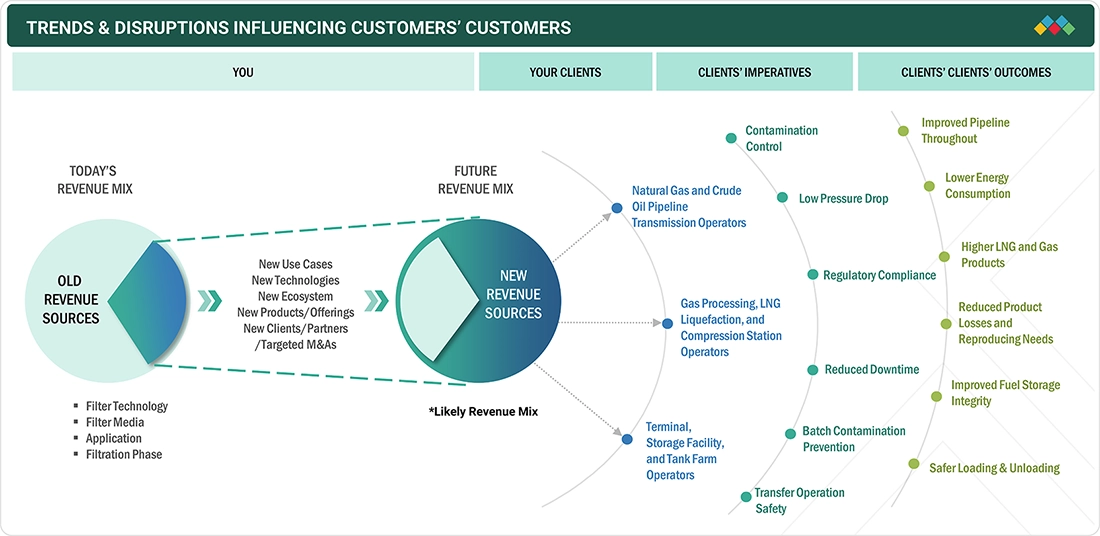
Source: Secondary Research, Interviews with Experts, MarketsandMarkets Analysis
MARKET DYNAMICS

Level
-
Surge in LNG and midstream capacity buildout

-
Tightening emissions/methane & air-pollution regulations


Level
-
CAPEX volatility & project delays reduce equipment orders

-
High upfront cost and long payback hinder adoption in developing regions


Level
-
Rising production of hydrocarbon & associated gas

-
Digitalization, predictive maintenance, & analytics for filtration lifecycle monetization


Level
-
Supply-chain stress, raw-material inflation and delivery lead times

-
Operational challenges such as feed variability, fouling, and higher O&M costs

Source: Secondary Research, Interviews with Experts, MarketsandMarkets Analysis
Driver: Surge in LNG and midstream capacity buildout
The primary driver for the demand for heavy-duty filtration equipment and services is the global trend of sanctioned liquefied natural gas (LNG) exports and midstream projects. Final investment decisions (FIDs) related to LNG liquefaction have seen a significant increase in recent years. The International Energy Agency (IEA) reported that over 90 billion cubic meters per year (bcm/yr) of additional capacity was sanctioned in 2025. Furthermore, the LNG Capacity Tracker indicates that projects already at FID or under construction could add more than 300 bcm/yr of export capacity by 2030.
Restraint: CAPEX volatility & project delays reduce equipment orders
The fluctuations in oil and gas prices, along with the resulting changes in upstream and midstream capital expenditure, continue to be significant barriers to the growth of the filtration market. When operators reduce or delay planned investments in new facilities and maintenance, large filtration purchases—such as skid-mounted coalescers, engineered separators, and modular filter packages—are often among the first items postponed. This is due to their high costs and the fact that their installation is usually linked to larger brownfield or greenfield projects. As a result of these deferrals, financial pressures and stricter lending terms lead owners to prioritize immediate production and safety work over efficiency upgrades, thereby delaying filter retrofitting.
Opportunity: Rising production of hydrocarbon & associated gas
The increasing oil production in prolific fields has led to a rise in the volumes of associated gas and variations in the quality of gas feed. This, in turn, has subjected midstream systems to higher levels of solids, condensate, and water carryover, creating a demand for more robust and higher-capacity filtration and multi-stage separation trains. In 2024, the production of associated gas in the US reached approximately 18.5 billion cubic feet per day (Bcf/d), representing a 6% increase compared to the previous year. This growth is primarily attributed to activity in the Permian Basin, which has increased the load on gathering and processing equipment and has led to more frequent element replacements and service cycles. Similar trends can be seen in certain regions of Latin America and the Asia Pacific, where heightened upstream activities and fluctuations in refinery throughput are introducing variable contaminants into pipelines and processing hubs. This scenario presents opportunities for filtration suppliers who can provide multi-stage solutions (including coalescers, particulate filters, and glycol/water treatment), sturdy elements capable of handling high solids loading, anti-fouling media, and condition-based replacement programs. Operators focused on maximizing uptime are willing to invest in longer-lasting elements, modular skid upgrades, and integrated diagnostics. This creates opportunities for filtration vendors to offer upgraded hardware, premium consumables, and bundled lifecycle services in key production areas.
Challenge: Supply-chain stress, raw-material inflation, and delivery lead times
The filtration market relies heavily on fabricated steel, specialty alloys, elastomers, and engineered media. Each of these components is impacted by global supply chain disruptions and fluctuations in commodity prices, which can drive up costs and extend delivery times. Steel production and consumption patterns have been inconsistent, with analyses from the OECD and EU showing mixed demand and varied inventory levels that create uncertainty in pricing and availability for fabricators. Between 2022 and 2025, supply chain shocks, including logistics bottlenecks, fluctuating shipping rates, and regional disruptions, have prompted buyers to adopt regional sourcing strategies and build strategic stockpiles. While these measures can help mitigate risks, they also increase working capital requirements and diminish the advantages of global sourcing. As a result, midstream filtration vendors are facing higher costs for housing and skids, longer delivery times for critical components like flanges and valves, and challenges in meeting accelerated engineering, procurement, and construction (EPC) schedules for LNG or pipeline projects in the Middle East and the Asia Pacific. Smaller suppliers are likely to suffer the most; they may struggle to absorb rising raw material costs and often lack multi-regional supply options. This could lead to missed delivery service level agreements (SLAs) and exposure to penalties. In contrast, larger OEMs that vertically integrate or have regional fabrication capabilities can gain a competitive advantage, but they must allocate capital to maintain buffer capacity.
MIDSTREAM OIL & GAS FILTRATION MARKET: COMMERCIAL USE CASES ACROSS INDUSTRIES
| COMPANY | USE CASE DESCRIPTION | BENEFITS |
|---|---|---|
 |
Gas and liquid filtration across pipeline networks and compressor stations | Protects compressors, reduces pressure drop, and improves system reliability |
 |
Coalescing and particulate filtration in gas processing and gathering systems | Ensures consistent gas quality, lowers maintenance costs, and improves uptime |
 |
High-efficiency filtration before LNG liquefaction and boil-off gas handling | Prevents cryogenic equipment fouling and improves operational efficiency |
 |
Filtration during crude and refined product transport and storage operations | Maintains product quality and reduces contamination and rework risk |
Logos and trademarks shown above are the property of their respective owners. Their use here is for informational and illustrative purposes only.
MARKET ECOSYSTEM
The midstream oil and gas process relies on a sophisticated filtering system that includes media and equipment suppliers. These suppliers provide advanced filter elements, housing, and separation technologies to system integrators and OEMs. These entities design and deliver high-quality filtration solutions for above-ground flow, processing, and transportation. Once the filtration solutions are developed, intermediaries and service companies facilitate the connection between OEMs and operators. They handle installation, monitor system performance, and provide maintenance support for the filtration systems that protect pipelines, compressor stations, gas processing plants, and storage terminals from solids, liquids, and other contaminants. Collectively, these players work together to ensure a seamless process that begins with acquiring specialized filtration technologies and ends with the delivery of clean, specification-compliant hydrocarbons to downstream facilities such as refineries, petrochemical plants, power generators, and export terminals. This collaboration ultimately integrates into essential energy systems and infrastructure.
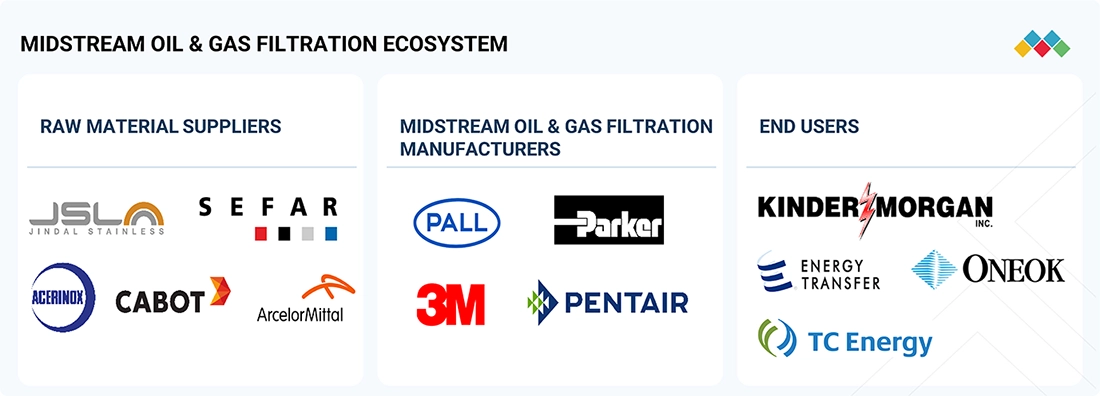
Logos and trademarks shown above are the property of their respective owners. Their use here is for informational and illustrative purposes only.
MARKET SEGMENTS
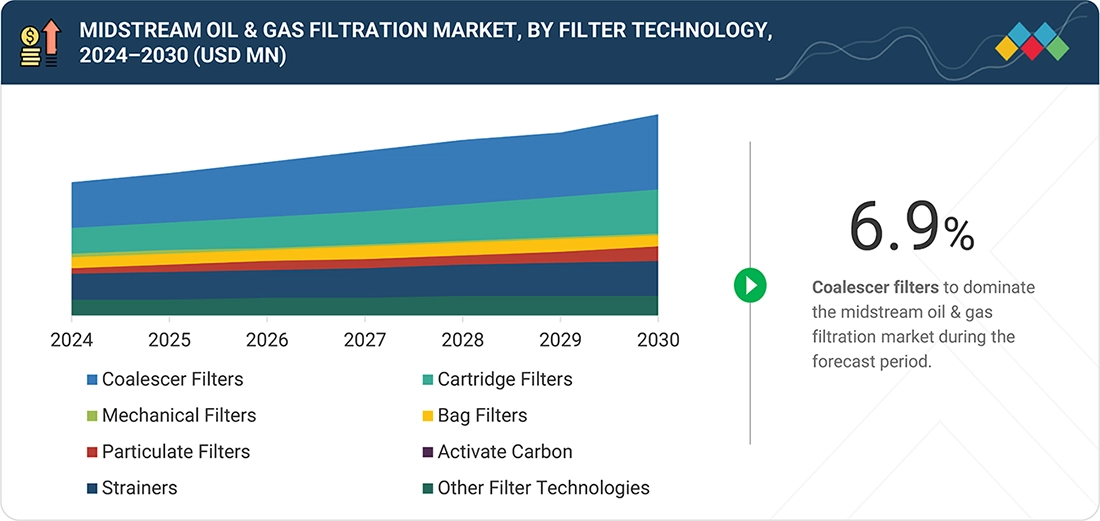
Source: Secondary Research, Interviews with Experts, MarketsandMarkets Analysis
Midstream Oil & Gas Filtration Market, by Filter Technology
The midstream oil and gas filtration market is divided into several categories: coalescer filters, cartridge filters, mechanical filters, bag filters, particulate filters, activated carbon filters, strainers, and other filtration technologies. Coalescer filters hold the largest market share due to their high effectiveness in removing water, liquid aerosols, and even the smallest particles from hydrocarbon and gas streams. This technology has become a cornerstone of the industry. Such filtration processes are essential in midstream operations, including the transportation of crude oil, the processing of natural gas, and the conditioning of fuels.
Midstream Oil & Gas Filtration Market, by Filter Media
Fiberglass filter media holds the largest market share due to its material properties, which meet the stringent requirements of midstream operations. Fiberglass media offers exceptional filtration efficiency and dirt-holding capacity that no other type can match. It is capable of capturing very fine particulate matter and contaminants that could potentially harm equipment or compromise product quality. The structure of fiberglass filter media allows contaminants to be captured not only on the surface but also throughout the media. This results in a longer service life and reduces the frequency of replacements. This feature is particularly advantageous in continuous, high-flow midstream operations, where even a minute of inactivity can be costly.
Midstream Oil & Gas Filtration Market, by Application
Based on application, the gas processing plant is the largest segment in the midstream oil and gas filtration market. This market is divided into several applications: gas processing plants, compression stations, LNG processing, pipeline transportation, storage and distribution, and other applications. In terms of value, the gas processing plant segment accounted for the largest market share, driven by rising demand for natural gas and LNG. This increased demand necessitates that the gas be cleaned and of high quality before transportation and export. Gas processing facilities often handle gas with higher impurity levels, including water, sulfur, carbon dioxide (CO2), and solids. This situation drives the need for more advanced filtration and separation systems. Additionally, stricter environmental regulations and pipeline quality standards require gas processing plants to upgrade their filtration systems.
Midstream Oil & Gas Filtration Market, by Filtration Phase
By filtration phase, oil filtration holds the largest market share. This segment is witnessing growth in the midstream sector as the complexity of crude oil (including heavier, sour, and blended types) necessitates more effective removal of solids, water, and contaminants before transportation and storage. Concerns about pipeline integrity and flow assurance are driving increased demand for filtration systems to prevent corrosion, fouling, and equipment damage. Additionally, more stringent quality and safety regulations are compelling operators to invest in advanced oil filtration systems that minimize downtime and reduce maintenance costs.
REGION
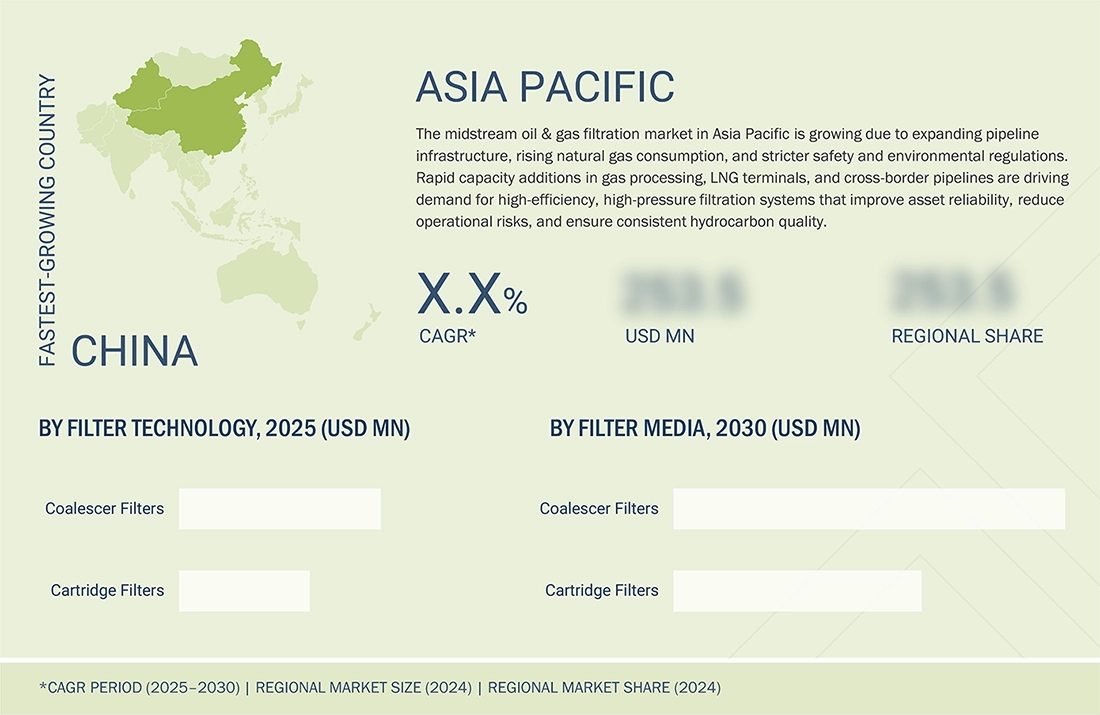
Asia Pacific to be fastest-growing region in global midstream oil & gas filtration market during forecast period
The Asia Pacific region is projected to be the largest market for midstream oil and gas filtration during the forecast period. This market includes key countries like China, Japan, India, South Korea, and other parts of the Asia Pacific. It is expected to experience the fastest growth due to significant industrialization, urbanization, and rising energy demand, particularly in China, India, and Southeast Asia. As a result, there is an increase in investments in midstream infrastructure, such as pipelines, LNG terminals, storage facilities, and gas processing plants, which will require advanced filtration solutions. Additionally, government policies in the region aim to enhance energy security and diversify energy sources. Consequently, there have been substantial investments in cross-border pipelines, the development of LNG import capacities, and the establishment of national gas grids to meet the rising demand of the growing population and reduce reliance on energy imports.
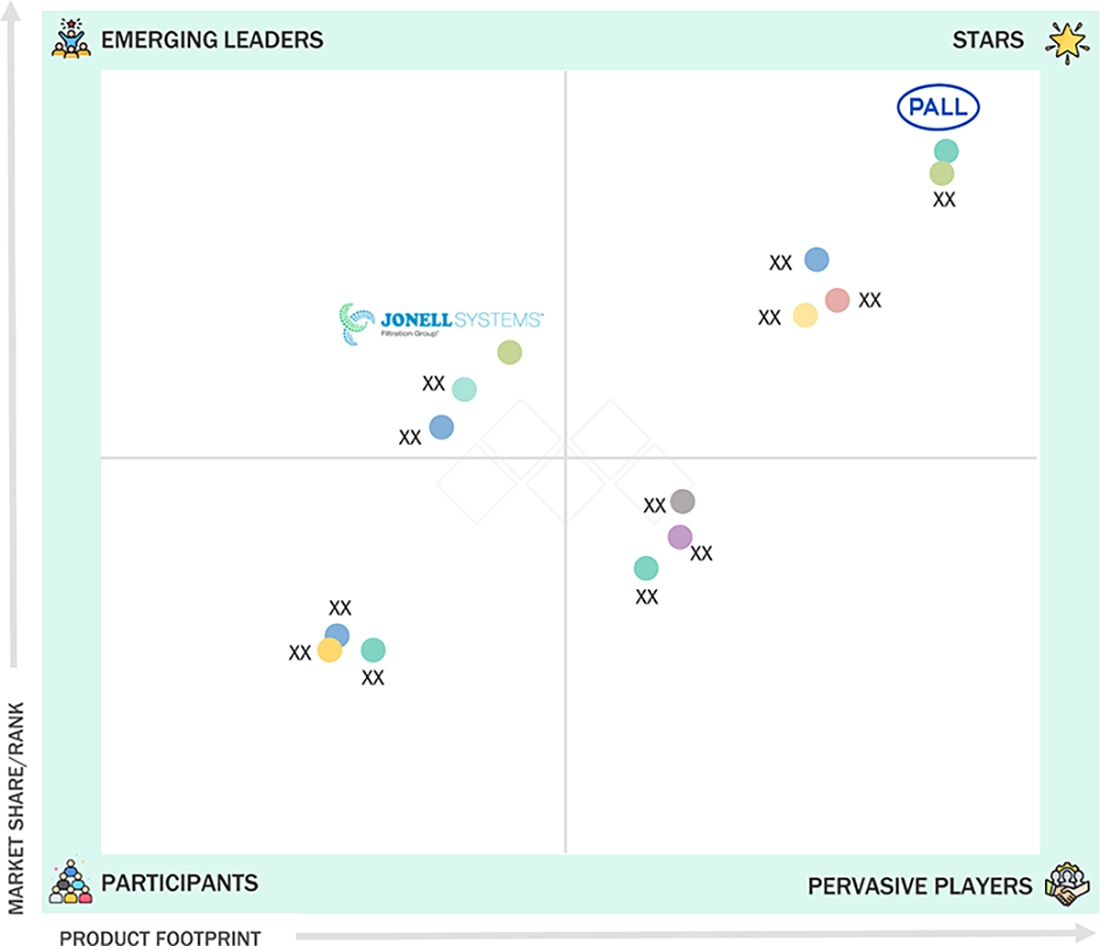
MIDSTREAM OIL & GAS FILTRATION MARKET: COMPANY EVALUATION MATRIX
In the midstream oil and gas filtration market, Pall Corporation (Star) stands out with its extensive global network and a wide range of filtration, separation, and coalescing solutions used across pipelines, gas processing, LNG, and storage facilities. The company's main strengths include advanced contaminant-control technologies, deep application engineering expertise, and robust aftermarket support, all of which ensure reliable regulatory compliance. Jonell Systems (Emerging Player) is gaining visibility with its filtration vessels, cartridges, and solutions specifically designed for gas and liquid streams. The company focuses on custom-made products that effectively remove even the rarest contaminants and maintains strong partnerships with midstream operators. This strategy enables Jonell to remain competitive in specialized, retrofit-driven applications.
Source: Secondary Research, Interviews with Experts, MarketsandMarkets Analysis
KEY MARKET PLAYERS
- Pall Corporation (US)
- Parker Hannifin (US)
- Eaton (Ireland)
- Pentair (US)
- 3M (US)
- CECO Environmental (US)
- FTC Filters (US)
- Hilliard Corporation (US)
- Jonell Systems (US)
- Graver Technologies (US)
MARKET SCOPE
| REPORT METRIC | DETAILS |
|---|---|
| Market Size in 2024 (Value) | USD 2.65 Billion |
| Market Forecast in 2030 (Value) | USD 3.73 Billion |
| Growth Rate | CAGR of 5.9% from 2025–2030 |
| Years Considered | 2021–2030 |
| Base Year | 2024 |
| Forecast Period | 2025–2030 |
| Units Considered | Value (USD Billion) |
| Report Coverage | Revenue Forecast, Company Ranking, Competitive Landscape, Growth Factors, and Trends |
| Segments Covered |
|
| Regions Covered | North America, Asia Pacific, Europe, South America, Middle East & Africa |
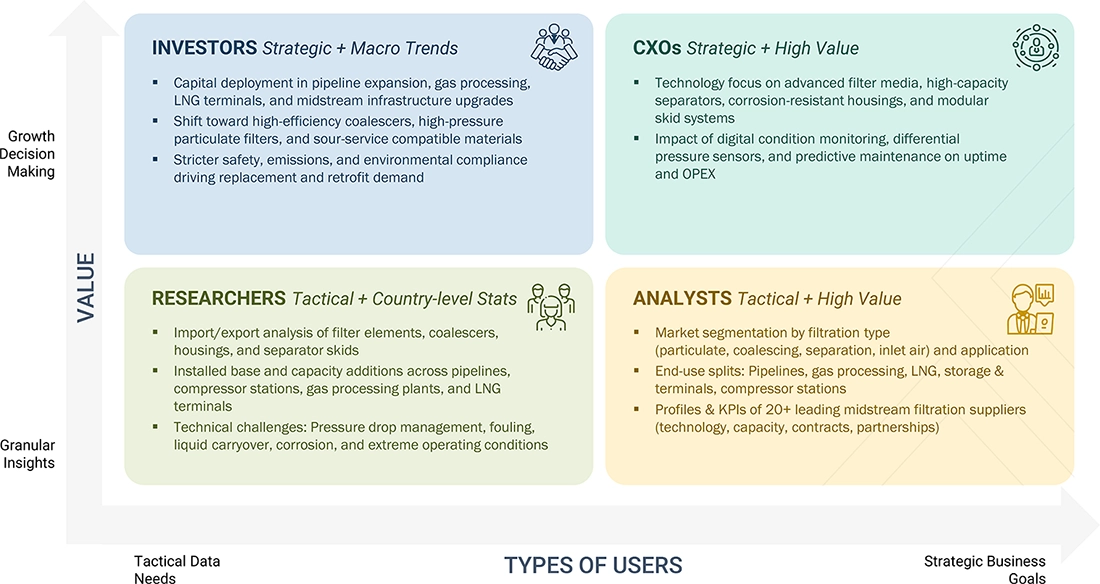
WHAT IS IN IT FOR YOU: MIDSTREAM OIL & GAS FILTRATION MARKET REPORT CONTENT GUIDE
DELIVERED CUSTOMIZATIONS
We have successfully delivered the following deep-dive customizations:
| CLIENT REQUEST | CUSTOMIZATION DELIVERED | VALUE ADDS |
|---|---|---|
| US-based Midstream Pipeline Operator |
|
|
| Gas Processing Plant Owner |
|
|
| LNG Terminal & Storage Operator |
|
|
| Midstream EPC Contractor |
|
|
| Regional Midstream Operator (Emerging Markets) |
|
|
RECENT DEVELOPMENTS
- November 2025 : Parker Hannifin has agreed to acquire Filtration Group Corp. for USD 9.25 billion on a cash-free, debt-free basis—valued at 19.6x Filtration Group’s 2025 estimated EBITDA, or 13.4x with expected synergies—financed through new debt and cash on hand.
- May 2025 : Eaton launched three high-performance hydraulic filter series: DUA, LWF, and DNR, which are designed for industrial and lubrication filtration. The DUA duplex filter supports continuous operation under pressures up to 320 psi. It is ideal for power plants and manufacturing. The LWF in-line pressure filters offer flexibility on suction, pressure, or return lines with pressures up to 232 psi. The DNR duplex filter features a three-way valve for uninterrupted filtration, which is suitable for lubrication in gearboxes and turbines. All provide durability, efficiency, and reliability for power generation, manufacturing, and petrochemical sites.
- April 2024 : Eaton launched SENTINEL MAXPO and DURAGAF MAXPOXL specialty filter bags designed for oil, chemical, and petrochemical filtration. These polypropylene needle felt bags feature a fully-welded construction with an additional internal meltblown polypropylene core that enhances dirt-holding capacity and oil absorption. The DURAGAF MAXPOXL range offers a two to five times longer lifespan than standard bags, reducing operational costs. Both ranges are available with nominal retention rates from 1 to 200 µm, optimizing filtration efficiency and durability in industrial applications.
- December 2023 : Pall Corporation opened a new filter production facility in Dammam, Saudi Arabia, in partnership with Tanajib, to better serve local and regional refinery and petrochemical customers, providing faster access to high-performance filtration products.
- April 2023 : CECO has completed its acquisition of Transcend Solutions, LLC, a Houston-based designer and manufacturer of process filtration solutions serving hydrocarbon and chemical processing markets.
Table of Contents
 Exclusive indicates content/data unique to MarketsandMarkets and not available with any competitors.
Methodology
The study involves two major activities in estimating the current market size for the midstream oil & gas filtration market. Exhaustive secondary research was done to collect information on the market, peer market, and parent market. The next step was to validate these findings, assumptions, and sizing with industry experts across the value chain through primary research. Both top-down and bottom-up approaches were employed to estimate the complete market size. After that, market breakdown and data triangulation were used to estimate the market size of segments and subsegments.
Secondary Research
Secondary sources referred to for this research study include financial statements of companies offering midstream oil & gas filtration and information from various trade, business, and professional associations. Secondary research has been used to obtain critical information about the industry’s value chain, the total pool of key players, market classification, and segmentation according to industry trends to the bottom-most level and regional markets. The secondary data was collected and analyzed to arrive at the overall size of the midstream oil & gas filtration market, which was validated by primary respondents.
Primary Research
Extensive primary research was conducted after obtaining information regarding the midstream oil & gas filtration market scenario through secondary research. Several primary interviews were conducted with market experts from both the demand and supply sides across major countries of North America, Europe, Asia Pacific, Middle East & Africa, and South America. Primary data was collected through questionnaires, emails, and telephonic interviews. The primary sources from the supply side included various industry experts, such as chief executive officers (CXOs), vice presidents (VPs), directors from business development, marketing, product development/innovation teams, and related key executives from the midstream oil & gas filtration industry, such as vendors, material providers, distributors, and key opinion leaders. Primary interviews were conducted to gather insights into market statistics, revenue from products and services, market breakdowns, market size estimates, market forecasting, and data triangulation. Primary research also helped in understanding the various trends related to membrane type, system configuration, capacity, application, and region. Stakeholders from the demand side, such as CIOs, CTOs, CSOs, and installation teams of the customer/end users who are seeking midstream oil & gas filtration services, were interviewed to understand the buyer’s perspective on the suppliers, products, component providers, and their current usage of midstream oil & gas filtration and future outlook of their business which will affect the overall market.
Breakdown of Primary Respondents:

To know about the assumptions considered for the study, download the pdf brochure
Market Size Estimation
The research methodology used to estimate the size of the midstream oil & gas filtration market includes the following details. The market sizing of the market was undertaken from the demand side. The market was upsized based on the demand for midstream oil & gas filtration in different end-use industries at the regional level. Such procurements provide information on the demand aspects of the midstream oil & gas filtration industry for each end-use industry. For each end-use, all possible segments of the midstream oil & gas filtration market were integrated and mapped.

Data Triangulation
After arriving at the overall size from the market size estimation process explained above, the total market was split into several segments. The data triangulation and market breakdown procedures explained below were implemented, wherever applicable, to complete the overall market engineering process and arrive at the exact statistics for various market segments. The data was triangulated by studying various factors and trends from the demand and supply sides. Along with this, the market size was validated using both the top-down and bottom-up approaches.
Market Definition
The midstream oil and gas filtration market is composed of all the systems and methods that are able to remove impurities and thus allow the seamless transfer, storage, and processing of oil, gas, and their refined products from upstream to downstream. To remove the unwanted materials of solids, liquids, and aerosols, the market includes the complete set of devices consisting of filters, separators, coalescers, and others, for application at pipelines, compressor stations, terminals, and gas processing facilities. The final product quality, equipment safety, corrosion management, and finally regulatory compliance all depend on the effectiveness of the filtration process. The major market drivers are the safe and productive operations of midstream infrastructure, the construction of pipelines, and the rising gas processing activities.
Stakeholders
- Midstream Oil & Gas Filtration Manufacturers
- Midstream Oil & Gas Filtration Distributors and Suppliers
- End-use Industries
- Universities, Governments, and Research Organizations
- Associations and Industrial Bodies
- R&D Institutes
- Environmental Support Agencies
- Investment Banks and Private Equity Firms
- Research and Consulting Firms
Report Objectives
- To define, describe, and forecast the midstream oil & gas filtration market size in terms of volume and value
- To provide detailed information regarding the key factors, such as drivers, restraints, opportunities, and challenges influencing market growth
- To analyze and forecast the market by filter technology, filter media, application, filtration phase, and region
- To forecast the market size concerning five main regions (along with country-level data), namely, North America, Europe, Asia Pacific, Middle East & Africa, and South America, and analyze the significant region-specific trends
- To strategically analyze micromarkets with respect to individual growth trends, prospects, and contributions of the submarkets to the overall market
- To analyze the market opportunities and the competitive landscape for stakeholders and market leaders
- To assess recent market developments and competitive strategies, such as agreements, contracts, acquisitions, partnerships, collaborations, and new product developments/new product launches, to draw the competitive landscape
- To strategically profile the key market players and comprehensively analyze their core competencies
Available Customizations
MarketsandMarkets offers the following customizations for this market report:
- Additional country-level analysis of the midstream oil & gas filtration market
Product Analysis
- Product matrix, which provides a detailed comparison of the product portfolio of each company
Key Questions Addressed by the Report
1. What is the current market size of the Midstream Oil & Gas Filtration Market and how is it expected to grow?
The global Midstream Oil & Gas Filtration Market is projected to grow from USD 2.80 billion in 2025 to USD 3.73 billion by 2030, at a CAGR of 5.9% during the forecast period.
2. What are the key factors driving the Midstream Oil & Gas Filtration Market?
The Midstream Oil & Gas Filtration Market growth is driven by expanding pipeline infrastructure, increasing natural gas processing and LNG capacity, and stricter environmental and safety regulations requiring advanced filtration systems.
3. Which filter technology segment leads the Midstream Oil & Gas Filtration Market?
Coalescer filters held the largest market share in 2024 due to their high efficiency in removing liquids and contaminants from hydrocarbon streams while protecting critical equipment.
4. Which application segment is expected to grow the fastest in the Midstream Oil & Gas Filtration Market?
LNG processing is expected to be the fastest-growing application segment, supported by rising investments in LNG infrastructure and gas processing facilities worldwide.
5. Which region is expected to dominate the Midstream Oil & Gas Filtration Market?
The Asia Pacific region is projected to lead the market during the forecast period, driven by rapid industrialization, rising energy demand, and expanding investments in pipelines, LNG terminals, and gas infrastructure.


Personalize This Research
- Triangulate with your Own Data
- Get Data as per your Format and Definition
- Gain a Deeper Dive on a Specific Application, Geography, Customer or Competitor
- Any level of Personalization
Let Us Help You
- What are the Known and Unknown Adjacencies Impacting the Midstream Oil & Gas Filtration Market
- What will your New Revenue Sources be?
- Who will be your Top Customer; what will make them switch?
- Defend your Market Share or Win Competitors
- Get a Scorecard for Target Partners

Custom Market Research Services
We Will Customise The Research For You, In Case The Report Listed Above Does Not Meet With Your Requirements
Get 10% Free CustomisationTESTIMONIALS

Kimberly Murphy
GLOBAL MARKETING DIRECTOR
Bently Nevada,
Leading Condition Monitoring & Asset Protectionwww.bakerhughesds.com/bently-nevada

MarketsandMarkets™ showed consistent rigor for success and relentlessly worked with Bently Nevada stakeholders to positively impact go-to-market strategy. Their proactiveness and flexibility has been instrumental in achieving the objectives to grow our sales pipeline in key industrial markets.

DARRICK HUEBER
Business Development Leader
Nexus Controls LLC,
Leading Manufacturer of Automation System & Electrical Panelswww.bakerhughesds.com/nexus-controls

We partnered with MarketsandMarkets to expand our business further by tapping into new industrial segments. It was critical for us to gather crucial business insights about specific markets to achieve this goal. MarketsandMarkets engagement model and client services helped us provide those insights, it was really impressive and valuable for my business. The team was extremely flexible and helpful.

Mike Schoff
Global Industrial Commercial Strategy Leader
Nexus Controls LLC
Leading Manufacturer of Automation System & Electrical Panelswww.bakerhughesds.com/nexus-controls
We consulted MarketsandMarkets for potential Partner Identification. Overall, it was a good experience. The insights provided through interviews conducted by the team helped us put together the questionnaire required for discussion with the selected partners. Their ability to provide insights through interviews with customers in a timely manner was quite impressive.
- South Africa Midstream Oil & Gas Filtration Market
- Brazil Midstream Oil & Gas Filtration Market
- Argentina Midstream Oil & Gas Filtration Market
- Rest Of Europe Midstream Oil & Gas Filtration Market
- Rest Of Asia Pacific Midstream Oil & Gas Filtration Market
- Rest Of South America Midstream Oil & Gas Filtration Market
- US Midstream Oil & Gas Filtration Market
- Canada Midstream Oil & Gas Filtration Market
- Mexico Midstream Oil & Gas Filtration Market
- Germany Midstream Oil & Gas Filtration Market
- UK Midstream Oil & Gas Filtration Market
- France Midstream Oil & Gas Filtration Market
- Italy Midstream Oil & Gas Filtration Market
- Russia Midstream Oil & Gas Filtration Market
- China Midstream Oil & Gas Filtration Market
- India Midstream Oil & Gas Filtration Market
- Japan Midstream Oil & Gas Filtration Market
- Australia Midstream Oil & Gas Filtration Market
- South Korea Midstream Oil & Gas Filtration Market
- Saudi Arabia Midstream Oil & Gas Filtration Market
- UAE Midstream Oil & Gas Filtration Market






Growth opportunities and latent adjacency in Midstream Oil & Gas Filtration Market