Military Kevlar Market

Military Kevlar Market By Type (Para-Aramid, Meta-Aramid), Application (Security & Protection, Frictional Materials, Optical Fibers, Rubber Reinforcement, Electrical Insulation), and Region – Global Forecast to 2030




OVERVIEW
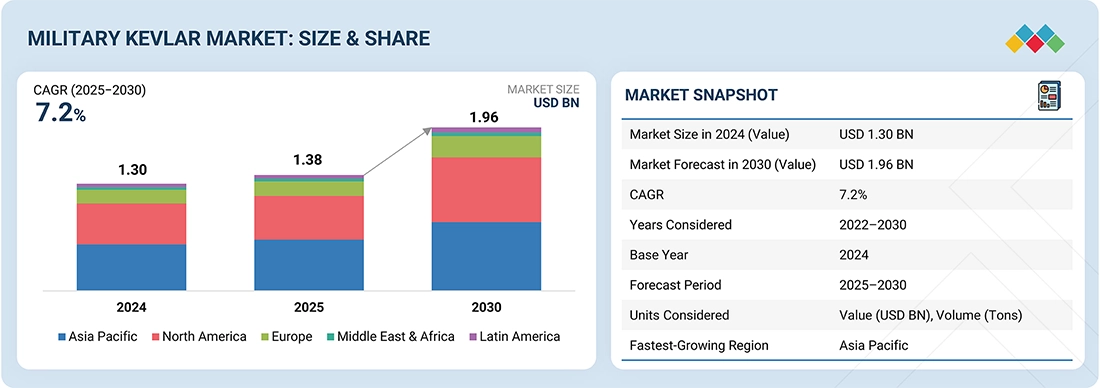
Source: Secondary Research, Interviews with Experts, MarketsandMarkets Analysis
The military kevlar market is projected to reach USD 1.96 billion by 2030 from USD 1.38 billion in 2025, at a CAGR of 7.2% during the forecast period. The military kevlar market is driven by an increase in global defense spending as countries strengthen their military capabilities to meet new challenges. Ongoing security risks, which also continue to evolve with time; have put pressure on governments to find new and improved protective solutions against terrorism and regional conflicts. For example, military modernization programs are adopting lightweight and durable materials such as aramid fibers, which further improves performance.
KEY TAKEAWAYS
-
BY REGIONThe Asia Pacific military kevlar market is expected to grow fastest, with a CAGR of 8.5%.
-
BY TYPEThe para-aramid segment accounted for the largest market share.
-
BY APPLIATIONBased on applicaton, security & protection aplication accounted for the largest share.
-
COMPETITIVE LANDSCAPEThe market is driven by strategic collaborations, capacity expansions, and technological innovations from leading players such as DuPont, Teijin Limited, Kolon Industries Inc., Yantai Tayho Advacned Materials Co., Ltd., and Toray Industries, Inc.
Soldier survivability, increasingly important to militaries around the world, has also led to greater demand for gear that will have improved ballistic resistance without sacrificing mobility. Therefore, the trends of increased spending, soldier survivability, and improved performance, are all leading to an increase in aramid fibers for defense applications including, but not limited to, body armor, helmets, and protection aboard a vehicle.
TRENDS & DISRUPTIONS IMPACTING CUSTOMERS' CUSTOMERS
The emerging trends and technologies in the industry are homeland security, ballistic protection, and fiber optic technologies, which increase the demand for raw materials. For example, in ballistic protection, companies are focusing on lightweight solutions that have bulletproof and heat-resistance properties. Advancements in the fiber optics industry are also encouraging the development of the military kevlar market. These new revenue sources are expected to drive the market as the need to increase operational efficiency and optimization is growing.
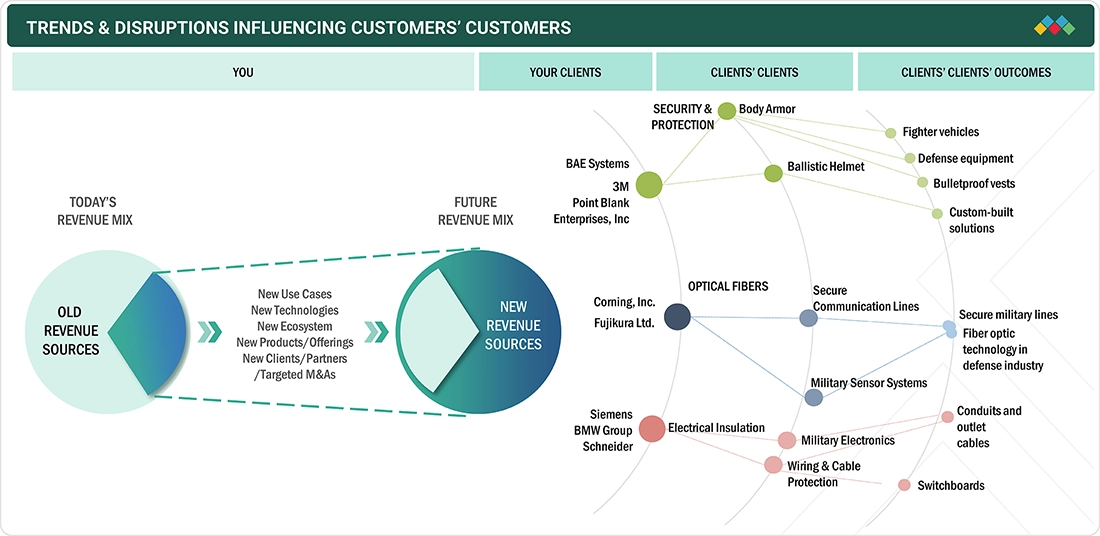
Source: Secondary Research, Interviews with Experts, MarketsandMarkets Analysis
MARKET DYNAMICS

Level
-
Rising demand for lightweight ballistic protection solutions

-
Growing geopolitical tensions driving protective gear adoption


Level
-
High Production costs

-
Competition from Alternative High-Performance Materials


Level
-
Strategic defense partnerships opening new global markets

-
Advanced material combinations and hybrid solutions


Level
-
Stringent military qualification requirements

-
Balance between protection and mobility

Source: Secondary Research, Interviews with Experts, MarketsandMarkets Analysis
Driver: Growing global defense expenditure
The increase in global defense expenditure is impacting the military kevlar market primarily from the increasing demand for advanced protective equipment and military equipment. As governments increase funding for defense to counter geopolitical tension, terrorism threats, and as well as modern warfare, there is now a greater demand for advanced materials in the form of aramid fibers to increase soldier safety, enhance equipment durability and state-of-the-art operational capacity. For ballistic protection applications, including bullet proof vests, helmets, and vehicle armor, and aramid fibers, are being utilized because of their excellent strength, heat resistance, and lightweight characteristics. Increased defense spending allows governments to spend funds on re-investing in state-of-the-art materials and advanced technology, including aramid fiber, to upgrade collective defense infrastructure. In addition, current warfare is becoming more reliant on mobility, survivability, and operational effectiveness, all driven by a demand for lighter, durable, and protective materials. Finally, as developing countries upgrade their military modernization programs, they are creating new defense-grade global product customers for military kevlar products. Aramid fiber performance is being enhanced by increased use in automotive and aerospace components in addition to military vehicle components where performance and fuel efficiency are major requirements. Defense procurement trends show a move towards purchasing multi-functional and high-performance products which improves the odds of military kevlar becoming a selectable material choice. Military customers on a global scale increasingly find current cases and every day a new instance of defense priority leads to continued investment.
Restraints: High production costs
The high cost of production is a restraint to the military kevlar market since the production processes are complex and require lots of energy. Aramid fibers like Kevlar and Twaron are polymerized and spun into fibers. Fiber processing requires specialized equipment, high temperatures, and expensive raw materials, such as para-phenylenediamine and terephthaloyl chloride. This fiber manufacturer must copiously invest in capital, and it also has high operating costs. Due to the volume of protective gear, armor, and aerospace products required by defense organizations, already exorbitant costs are costlier, which makes the final product expensive. Military kevlar must also comply with military specifications and quality requirements, resulting in extensive testing and certification costs. Such costs can limit the available procurement budgets for organizations while also limiting adoption more generally in countries or agencies with limited defense sector spending. Additionally, fluctuations in the prices of raw materials and supply chain disruptions outside of an organization's control create additional costs to consider as organizations attempt, with very limited knowledge, to plan production and pricing strategies. Aramid fibers are best known for their strength-to-weight ratio, heat resistance, and ballistic applications; however, their costs tend to drive defense sector organizations to other materials and/or blended composites, whilst frustrating market growth. Surmounting the cost component for broader organizational acceptance and adoption is paramount to even establish penetration volumes and affirmation that use of levels of aramid fibers within the offerings of material paths moving forward would not suffer from substantial increases in material costs per acquisition and adoption pathways.
Opportunity: Emerging defense applications
The new and emerging military kevlar could represent a significant opportunity for the fiber in light of its strength, heat resistance, and lightweight attributes. Warfare has become modernized, and there has been a significant increase in the need for protective solutions. Aramid fibers, including berve, made their way into the latest generation of body armor, helmets, and vehicle armor systems due to the ability to absorb impact and prevent penetration without added weight (which enhances the mobility of the soldier and survivability). The increasing demand for solutions to the asymmetric nature of warfare, the threat of drones, and lightweight ballistic protection in urban combat signal demand for innovative materials. Equally, the integrated use of aramid composites for aerospace and unmanned systems, while performance, weight savings, and durability are essential, suggests much wider opportunities. As defense forces increase global demand for modernization across a number of defense services and move to adopt new technologies and advanced materials, expect to see the focus on aramid fiber supply, as lightweight, reliable protection will increase. Aramid fibers can also be integrated into multi-functional composites and can be compatible with advances in smart textiles, which could incorporate or integrate communication and sensing systems. For these reasons, the defense market has a growing array of needs for aramid fiber, which will sustain continued growth and innovation opportunities across the global defense ecosystem.
Challenges: Stringent military qualification requirements
Military qualification requirements are a challenge for military kevlar because the military demands stringency in terms of performance, durability, and consistency for many applications. Ballistic protection, for example, uses aramid fibers (Kevlar, Twaron, etc.), and traditional military specifications involve strenuous specifications, including strength, thermal stability, and impact resistance. The qualification effort typically includes a barrage of testing under exaggerated conditions to ensure unfailing reliability in combat scenarios, which leads to increased time for development and increased costs. A slight variation in fiber properties and production methods can lead to disqualification, which makes aramid fiber production delicate and complex. Any design change, material change, or manufacturing change means the manufacturer must undergo the requalification process, which results in lost time and additional expense. The strict regulatory requirements diminish the potential for entrepreneurship and innovation for many smaller manufacturers and new entrants to the market.
military-kevlar-market: COMMERCIAL USE CASES ACROSS INDUSTRIES
| COMPANY | USE CASE DESCRIPTION | BENEFITS |
|---|---|---|
 |
Used aramid fiber composites for structural components of Apache helicopter | Provides high tensile strength, impact resistance, and reduced weight compared to metal alternatives |
 |
Used aramid fiber reinforced plastics in spacer structures of its fighter jet | Achieved a 23% weight reduction compared to titanium while offering 1.8 times higher ballistic impact resistance |
 |
Used aramid fiber composites for armor panels and hull reinforcements for US Navy’s Zumwalt-class stealth destroyers | The aramid fiber provided flexibility, high impact resistance, and lightweight protection against ballistic and blast threats |
 |
Used aramid fiber for hull section and protective zones of Nimitz-class supercarriers | Enhanced ballistic and impact resistance against threats like torpedoes or missiles |
Logos and trademarks shown above are the property of their respective owners. Their use here is for informational and illustrative purposes only.
MARKET ECOSYSTEM
The military kevlar market has a complex ecosystem, including manufacturers, raw material suppliers, distributors, governments, and end-user industries. Prominent companies in this market include well-established, financially stable manufacturers of military kevlar. These companies have been operating in the market for several years and possess diversified product portfolios and strong global sales and marketing networks.
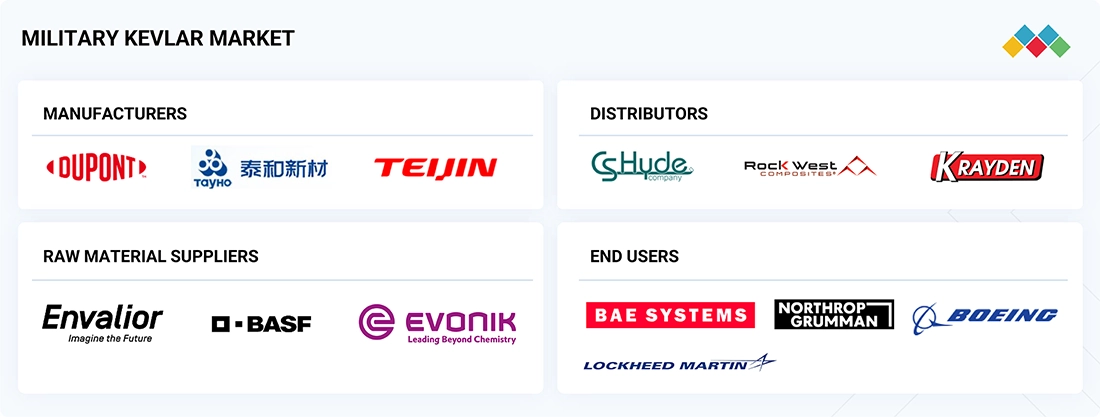
Logos and trademarks shown above are the property of their respective owners. Their use here is for informational and illustrative purposes only.
MARKET SEGMENTS
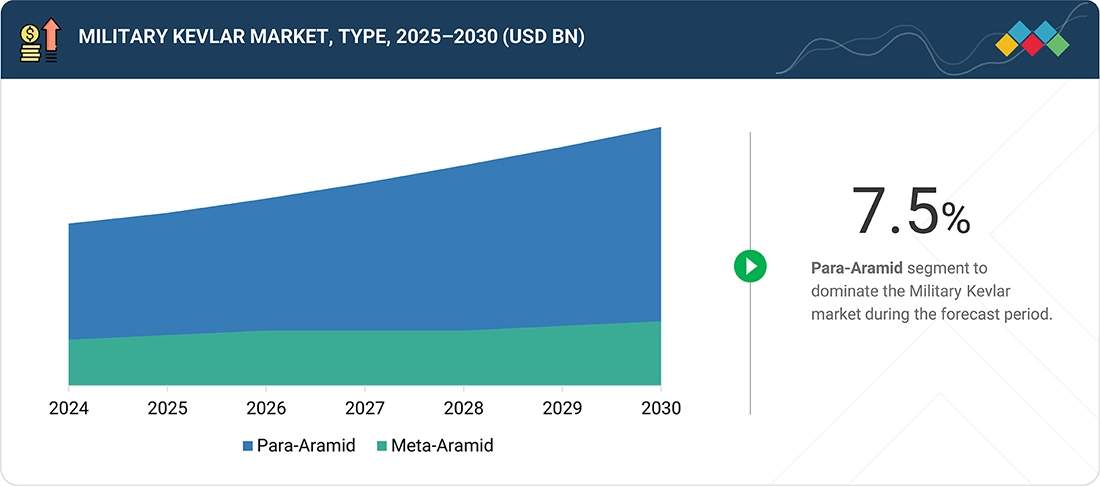
Source: Secondary Research, Interviews with Experts, MarketsandMarkets Analysis
Military Kevlar Market, by Type
The para-aramid fiber holds the majority share of the military kevlar market due to its unique thermal and mechanical properties that are often beneficial for military applications in military environments. Para-aramid stands out due to its superior weight-to-strength ratio and provides superior ballistic protection as a lightweight fiber, which is necessary when optimizing for mobility and comfort for the soldiers. Para-aramid fiber is inherently resistant to heat, flame, and chemical qualities, making it equally durable in some of the extreme combat environments. These attributes show that para-aramid is a preferred material that can be used to create combat helmets, body armor, ballistic vests, and vehicular armor systems.
Military Kevlar Market, by Application
Optical fibers is the fastest growing application for military kevlar applications because they help the end user achieve high-speed secure data transfer capabilities that may not exist in other options. Aramid fibers, like Kevlar, are used for protective sheathing of fiber-optic cables that are lightweight, flexible, and heat resistant, making them ideal for the military environment. Reliable communication systems are of utmost importance for mission success in defense; optical fibers allow for the highest bandwidth, lowest signal loss, and resistance to electromagnetic interference (EMI) compared to traditional copper wiring system elements. Expanded intelligence requirements for real-time data operations, advanced capabilities for surveillance, and more effective use of network-centric operations (warfare).
REGION
North America to be fastest-growing region in global military kevlar market during forecast period
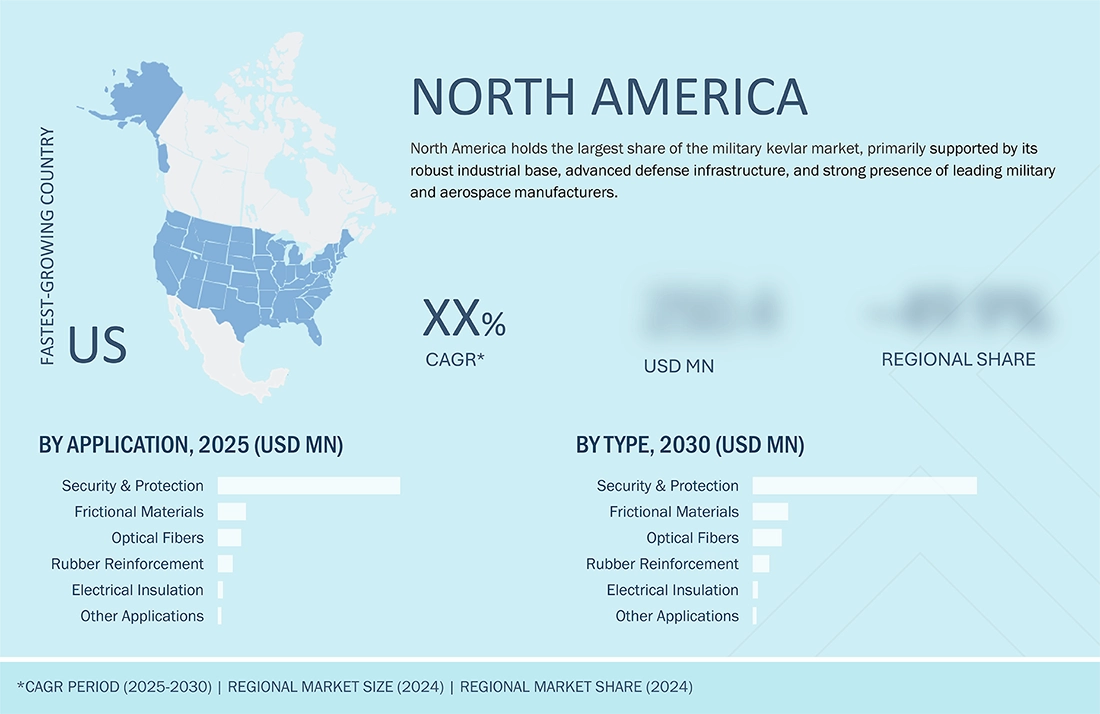
North America has the largest share of the military kevlar market, mainly due to significant military and defense technology expenditures in the region - largely due to the market dominance of the US as a military power. The US Department of Defense continues to spend billions of dollars on improved service, protective gear, armored vehicles, and aerospace applications that utilize a variety of aramid fibers, specifically Kevlar and Twaron, which value strength-to-weight ratio, heat-resistance, and ballistic protection. Major military kevlar contractors, like DuPont and Honeywell, support both a domestic supply chain and an innovation and development ecosystem. Moreover, there is strong alignment on soldier modernization programs, leading to consistent demand in modern military markets.
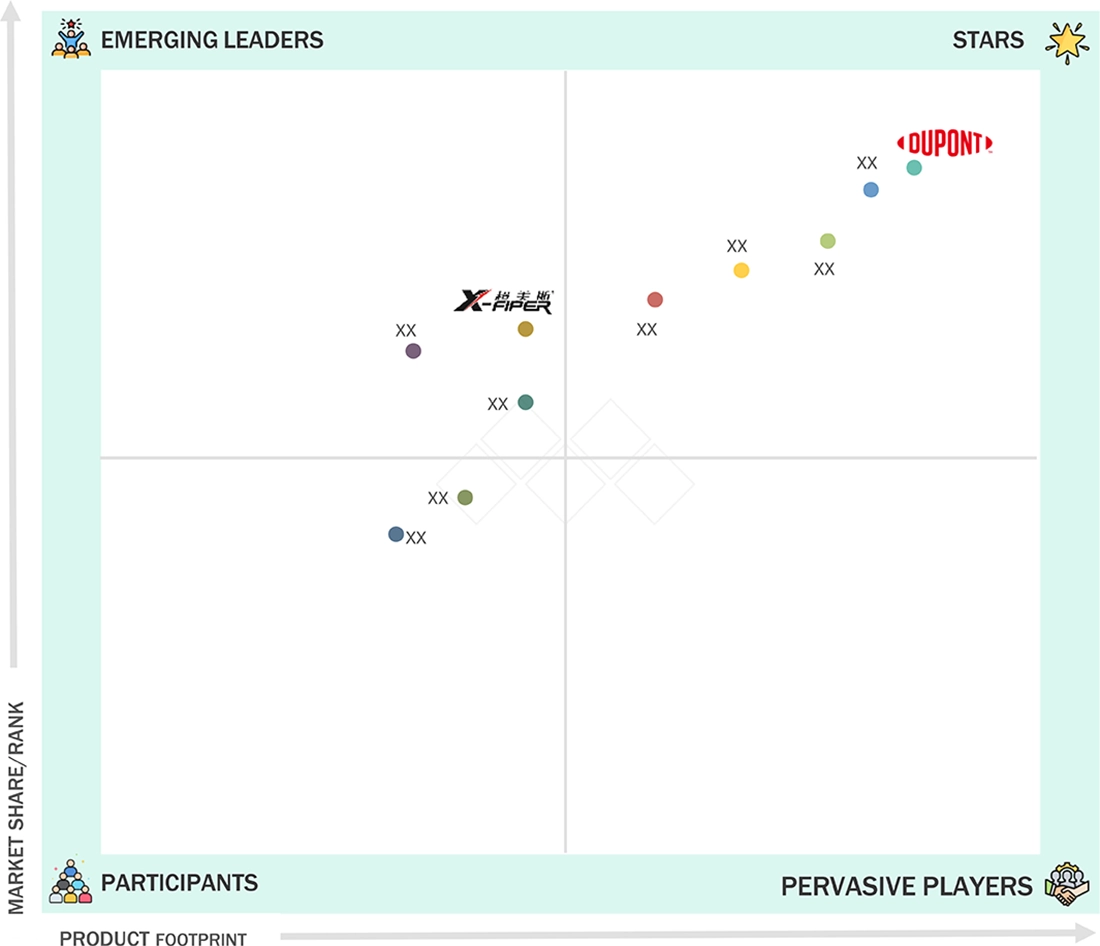
military-kevlar-market: COMPANY EVALUATION MATRIX
In the military kevlar market matrix, DuPont is one of the leading global suppliers of military kevlar, through a combination of strong product portfolio, and robust business strategies. DuPont holds a market leadership position and possesses a robust customer base. X-FIPER New Material Co., Ltd. is one of the emerging players in the military kevlar market, owing to its adaptability to market demands and strategic positioning in a rapidly expanding sector.
Source: Secondary Research, Interviews with Experts, MarketsandMarkets Analysis
KEY MARKET PLAYERS
- DuPont (US)
- Teijin Limited (Japan)
- Kolon Industries (South Korea)
- Yantai Tayho Advanced Materials (China)
- Hyosung Corporation (South Korea)
- SRF Limited (India)
- Kermel (France)
- JSC Kamenskvolokno (Russia)
- X-FIPER New Material (China)
- Guangdong Charming Co., Ltd. (China)
MARKET SCOPE
| REPORT METRIC | DETAILS |
|---|---|
| Market Size in 2024 (Value) | USD 1.30 Billion |
| Market Forecast in 2030 (value) | USD 1.96 Billion |
| Growth Rate | CAGR of 7.2% from 2025-2030 |
| Years Considered | 2022-2030 |
| Base Year | 2024 |
| Forecast Period | 2025-2030 |
| Units Considered | Value (USD Million/Billion), Volume (Tons) |
| Report Coverage | Revenue forecast, company ranking, competitive landscape, growth factors, and trends. |
| Segments Covered |
|
| Regions Covered | North America, Asia Pacific, Europe, South America, Middle East & Africa |
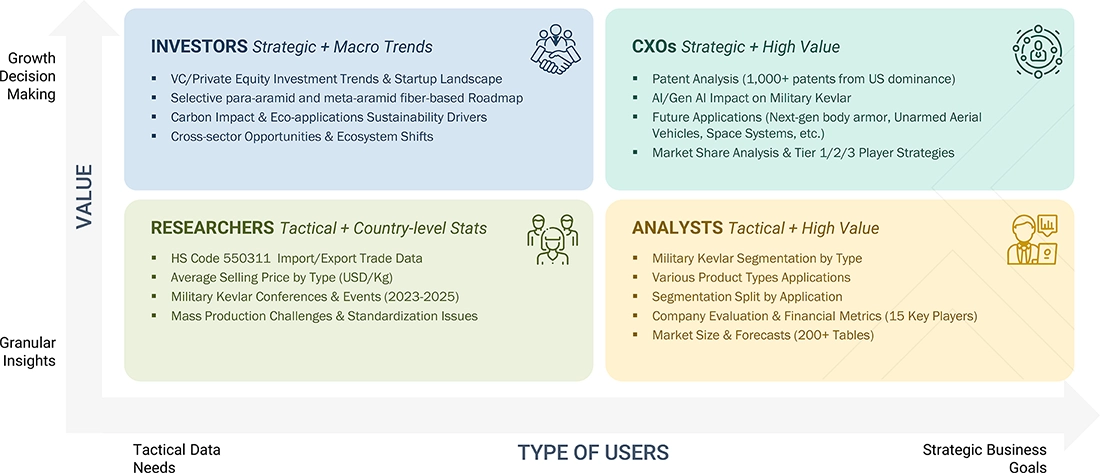
WHAT IS IN IT FOR YOU: military-kevlar-market REPORT CONTENT GUIDE
DELIVERED CUSTOMIZATIONS
We have successfully delivered the following deep-dive customizations:
| CLIENT REQUEST | CUSTOMIZATION DELIVERED | VALUE ADDS |
|---|---|---|
| US-based Military Kevlar Manufacturer |
|
|
| Aersopace & Defense Manufacturer |
|
|
| Military Kevlar Distributor |
|
|
| Raw Material Supplier |
|
|
RECENT DEVELOPMENTS
- February 2024 : Kolon Industries and Samyang Corporation collaborated their complementary fiber and materials technologies to create value in advanced defense applications. The combination of Kolon's aramid fiber technology and Samyang's state-of-the-art composites is developing lightweight and reliable protective solutions for current defense needs.
- January 2024 : Yantai Tayho and Vietnam Defence Industries formed a USD 120 million joint venture, Tayho Vietnam Defence Materials, to construct a facility to produce aramid fibers and ballistic materials at a defence facility in Vietnam. The joint venture is intended to supplement and provide materials for the defense requirements of Southeast Asia, combining Tayho's fiber technology with Vietnam's geo-strategic location to develop regional supply and mechanisms for military modernization.
- April 2024 : Hyosung Corporation initiated a production line for military aramid fibers with an investment of USD 110 million at a facility in Ulsan, South Korea. The new line produces 1,800 metric tons per year, and the expansion addressed the demand for advanced military kevlar from military markets globally while keeping Hyosung's leading supply status in aramid production.
- April 2023 : DuPont introduced Kevlar EXO aramid fiber, which offers an unmatched combination of protection, lightness, and flexibility. This product is applicable in security & protection for law enforcement officers and military personnel as soft body armor.
- November 2021 : Yantai Tayho Advanced Materials Co., Ltd. started industrial production of a new Newstar Meta-aramid project–High Performance Meta-aramid Efficient Industrialization Project for PPE. The initiative uses third-generation, top-tier worldwide Meta-aramid manufacturing technology. The strong inherent flame resistance and high-temperature resistance of Newstar Meta-aramid make it a crucial and fundamental material for personal protective equipment (PPE) and environmental protection.
Table of Contents
 Exclusive indicates content/data unique to MarketsandMarkets and not available with any competitors.
- 5.1 INTRODUCTION
- 5.2 AI IMPACT
-
5.3 MARKET DYNAMICSDRIVERSRESTRAINTSOPPORTUNITIESCHALLENGES
-
5.4 PORTER’S FIVE FORCES ANALYSISTHREAT OF NEW ENTRANTSTHREAT OF SUBSTITUTESBARGAINING POWER OF BUYERSBARGAINING POWER OF SUPPLIERSINTENSITY OF COMPETITIVE RIVALRY
- 5.5 MACROECONOMIC OUTLOOK
-
6.1 KEY STAKEHOLDERS AND BUYING CRITERIAKEY STAKEHOLDERS IN BUYING PROCESSBUYING CRITERIA
-
6.2 VALUE CHAIN ANALYSISRAW MATERIAL SUPPLIERSMANUFACTURERSDISTRIBUTORSEND-USERS
- 6.3 ECOSYSTEM ANALYSIS / MARKET MAP
- 6.4 CASE STUDIES
-
6.5 REGULATORY LANDSCAPEREGULATORY BODIES, GOVERNMENT AGENCIES & OTHER ORGANIZATIONSREGULATORY FRAMEWORKLIST OF KEY STARTUPS & RESEARCH INSTITUTES IN MILITARY KEVLAR MARKET
-
6.6 TECHNOLOGY ANALYSISKEY TECHNOLOGIES- Wet Spinning & Extrusion- Low-Temperature Solution Polycondensation- Liquid Crystalline SpinningCOMPLEMENTARY TECHNOLOGIES- Dry-jet Wet Spinning- Electrospinning
- 6.7 TRENDS DISRUPTIONS IMPACTING CUSTOMER’S BUSINESS
-
6.8 TRADE ANALYSISIMPORT DATAEXPORT DATA
- 6.9 KEY CONFERENCES & EVENTS IN 2025-2026
-
6.10 PRICING ANALYSISAVERAGE SELLING PRICE TREND, BY REGIONAVERAGE SELLING PRICE TREND OF KEY PLAYERS, BY TYPEAVERAGE SELLING PRICE TREND OF KEY PLAYERS, BY APPLICATION
- 6.11 INVESTMENT AND FUNDING SCENARIO
-
6.12 PATENT ANALYSISAPPROACHDOCUMENT TYPELEGAL STATUS OF THE PATENTSJURISDICTION ANALYSISTOP APPLICANTS
-
6.13 IMPACT OF 2025 US TARIFF – MILITARY KEVLAR MARKETINTRODUCTIONKEY TARIFF RATESPRICE IMPACT ANALYSISIMPACT ON COUNTRY/REGION- US- Europe- APACIMPACT ON END-USE INDUSTRIES
- 7.1 INTRODUCTION
-
7.2 PARA-ARAMIDSTANDARD MILITARY GRADEHIGH PERFORMANCE MILITARY GRADEULTRA HIGH MODULUS MILITARY GRADE
-
7.3 META-ARAMIDMILITARY SPECIFICATIONFLAME-RESISTANT MILITARY GRADE
- 8.1 INTRODUCTION
-
8.2 SECURITY & PROTECTIONBODY ARMORBALLISTIC HELMETSTACTICAL GEARPROTECTIVE APPAREL
-
8.3 FRICTIONAL MATERIALSMILITARY VEHICLE BRAKE SYSTEMSAIRCRAFT BRAKE COMPONENTS
-
8.4 OPTICAL FIBERSSECURE COMMUNICATION LINESMILITARY SENSOR SYSTEMS
-
8.5 RUBBER REINFORCEMENTMILITARY VEHICLE TIRESHOSES & BELTS
-
8.6 ELECTRICAL INSULATIONMILITARY ELECTRONICSWIRING & CABLE PROTECTION
- 8.7 OTHERS
- 9.1 INTRODUCTION
- 9.2 INTRODUCTION
-
9.3 NORTH AMERICAUSCANADAMEXICO
-
9.4 ASIA PACIFICCHINAJAPANINDIASOUTH KOREATAIWANREST OF ASIA PACIFIC
-
9.5 EUROPEGERMANYFRANCEUKITALYNETHERLANDSREST OF EUROPE
-
9.6 MIDDLE EAST & AFRICAGCC- Saudi Arabia- UAE- Rest of GCCSOUTH AFRICAREST OF MIDDLE EAST & AFRICA
-
9.7 SOUTH AMERICABRAZILARGENTINAREST OF SOUTH AMERICACOMPETITIVE LANDSCAPE
- 10.1 INTRODUCTION
- 10.2 KEY PLAYERS STRATEGIES
- 10.3 MARKET SHARE ANALYSIS
- 10.4 REVENUE ANALYSIS (2019-2024)
- 10.5 COMPANY VALUATION AND FINANCIAL METRICS
-
10.6 BRAND/PRODUCT COMPARISONCOMPANY EVALUATION MATRIX: KEY PLAYERS, 2024STARSEMERGING LEADERSPERVASIVE PLAYERSPARTICIPANTSCOMPANY FOOTPRINT: KEY PLAYERS, 2024- Company Footprint- Region Footprint- Type Footprint- Application Footprint
-
10.7 COMPANY EVALUATION MATRIX: STARTUPS/SMES, 2024PROGRESSIVE COMPANIESRESPONSIVE COMPANIESDYNAMIC COMPANIESSTARTING BLOCKSCOMPETITIVE BENCHMARKING: STARTUPS/SMES, 2024- Detailed List of Key Start-ups/SMEs- Competitive Benchmarking of Key Start-ups/SMEs
-
10.8 COMPETITIVE SCENARIONEW PRODUCT LAUNCHESDEALSOTHERS
-
11.1 DUPONT*BUSINESS OVERVIEWPRODUCTS OFFEREDRECENT DEVELOPMENTMNM VIEW
- 11.2 TEIJIN LIMITED
- 11.3 KOLON INDUSTRIES
- 11.4 YANTAI TAYHO ADVANCED MATERIALS
- 11.5 HYOSUNG CORPORATION
- 11.6 SRF LIMTIED
- 11.7 KERMEL
- 11.8 JSC KAMENSKVOLOKNO
- 11.9 X-FIPER NEW MATERIAL
- 11.10 GUANGDONG CHARMING
- 11.11 HUVIS CORPORATION
- 11.12 ARAMID HPM, LLC
- 11.13 JIANGSU TIANGONG TECHNOLOGY
- 11.14 CHINA NATIONAL BLUESTAR GROUP
- 11.15 TORAY INDUSTRIES
-
11.16 OTHER PLAYERSTAEKWANG INDUSTRIAL CO, LTD.SHANGHAI J&S NEW MATERIALS CO.,LTDYF INTERNATIONAL BVLYDALL, INC.SUZHOU ZHAODA SPECIALY FIBER TECHNICAL CO., LTD.SHEN MA INDUSTRY CO.,LTDYIZHENG CHEMICAL FIBERZHANGJIAGANG GANGYING INDUSTRY COMPANY LTD.VEPLAS GROUP- Barnet Europe W. Barnet GmbH & Co. KG
- 12.1 DISCUSSION GUIDE
- 12.2 KNOWLEDGE STORE: MARKETSANDMARKETS SUBSCRIPTION PORTAL
- 12.3 AVAILABLE CUSTOMIZATIONS
- 12.4 RELATED REPORTS
- 12.5 AUTHOR DETAILS
Methodology
The study involved four major activities in estimating the market size of the military kevlar market. Exhaustive secondary research was done to collect information on the market, the peer market, and the grandparent market. The next step was to validate these findings, assumptions, and sizing with industry experts across the value chain through primary research. Both top-down and bottom-up approaches were employed to estimate the complete market size. Thereafter, the market breakdown and data triangulation procedures were used to estimate the market size of the segments and subsegments.
Secondary Research
During the secondary research process, various secondary sources were consulted to identify and collect information for this study. These secondary sources include annual reports, press releases, investor presentations from companies, white papers, certified publications, trade directories, articles from recognized authors, and reputable websites, as well as databases. Secondary research has been used to obtain key information about the value chain of the industry, monetary chain of the market, the total pool of key players, market classification and segmentation according to industry trends to the bottom-most level, and regional markets. It was also used to obtain information about the key developments from a market-oriented perspective.
Primary Research
The military kevlar market comprises several stakeholders in the value chain, which include manufacturers and end users. Various primary sources from the supply and demand sides of the military kevlar market have been interviewed to obtain qualitative and quantitative information. The primary interviewees from the demand side include key opinion leaders in industrial sectors. The primary sources from the supply side include manufacturers, associations, and institutions involved in the military kevlar industry. Primary interviews were conducted to gather insights, including market statistics, revenue data collected from products and services, market breakdowns, market size estimations, market forecasting, and data triangulation. Primary research also helped in understanding the various trends related to type, application, and region. Stakeholders from the demand side, such as CIOs, CTOs, and CSOs were interviewed to understand the buyer’s perspective on the suppliers, products, and their current usage of military kevlar and outlook of their business, which will affect the overall market.
Market Size Estimation
The top-down and bottom-up approaches have been used to estimate and validate the size of the military kevlar market.
- The key players in the industry have been identified through extensive secondary research.
- The supply chain of the industry has been determined through primary and secondary research.
- All percentage shares, splits, and breakdowns have been determined using secondary sources and verified through primary sources.
- All possible parameters that affect the markets covered in this research study have been accounted for, viewed in extensive detail, verified through primary research, and analyzed to obtain the final quantitative and qualitative data.
- The research includes the study of reports, reviews, and newsletters of the key market players, along with extensive interviews for opinions with leaders such as directors and marketing executives.
Data Triangulation
After arriving at the total market size from the estimation process, the overall market has been split into several segments and sub-segments. To complete the overall market engineering process and arrive at the exact statistics for all the segments and sub-segments, the data triangulation and market breakdown procedures have been employed, wherever applicable. The data has been triangulated by studying various factors and trends from both the demand and supply sides. Along with this, the market size has been validated by using both the top-down and bottom-up approaches and primary interviews. Hence, for every data segment, there have been three sources—top-down approach, bottom-up approach, and expert interviews. The data was assumed correct when the values arrived from the three sources matched.
Market Definition
The military kevlar market is the segment of the marketplace that is concerned with the production, supply, and applying of military kevlar purposes. Aramid fibers refer to high-performance synthetic fibers with outstanding strength, heat resistance, and durability, useful in ballistic protection, such as ballistic helmets; military armor protection; such as for military vehicles; and protection clothing. The military kevlar market is growing as a direct result of the increase in demand for advanced lightweight materials, that enhance safety, reliability, and performance in military and security applications.
Key Stakeholders
- Senior Management
- End User
- Finance/Procurement Department
- R&D Department
- Manufacturers
- Raw Material Suppliers
Report Objectives
- To define, describe, and forecast the size of the military kevlar market, in terms of value and volume
- To provide detailed information regarding the major factors (drivers, opportunities, restraints, and challenges) influencing the growth of the market
- To estimate and forecast the market size based on type, application, and region.
- To forecast the size of the market with respect to major regions: Europe, North America, Asia Pacific, Middle East & Africa, and South America, along with their key countries
- To strategically analyze micro-markets with respect to individual growth trends, prospects, and their contribution to the overall market
- To analyze opportunities in the market for stakeholders and provide a competitive landscape of market leaders
- To track and analyze recent developments such as expansions, new product launches, partnerships & agreements, and acquisitions in the market
- To strategically profile key market players and comprehensively analyze their core competencies
Available Customizations:
Along with the given market data, MarketsandMarkets offers customizations according to the company’s specific needs. The following customization options are available for the report:
Regional Analysis
- Further breakdown of a region with respect to a particular country or additional application
Company Information
- Detailed analysis and profiles of additional market players
Tariff & Regulations
- Regulations and impact on the military kevlar market
Key Questions Addressed by the Report
What are the primary applications of Military Kevlar in defense?
Military Kevlar is mainly used in ballistic vests, helmets, vehicle armor, and protective clothing for personnel operating in combat zones.
Which companies dominate the Military Kevlar Market?
Key players include DuPont, Honeywell International Inc., Teijin Aramid, Kolon Industries, and Hyosung.
What factors are driving the demand for Military Kevlar?
Rising defense budgets, modernization of armed forces, increased geopolitical tensions, and focus on soldier safety are driving demand.
Which challenges are faced by manufacturers in the Military Kevlar Market?
High material costs, complex manufacturing processes, and competition from alternative high-performance fibers like UHMWPE and carbon composites are major challenges.
Which end-use segments are expected to grow the fastest in the Military Kevlar Market?
Infantry armor, military helmets, armored vehicles, and specialized protective gear for special forces are expected to see the highest growth rates.


Personalize This Research
- Triangulate with your Own Data
- Get Data as per your Format and Definition
- Gain a Deeper Dive on a Specific Application, Geography, Customer or Competitor
- Any level of Personalization
Let Us Help You
- What are the Known and Unknown Adjacencies Impacting the Military Kevlar Market
- What will your New Revenue Sources be?
- Who will be your Top Customer; what will make them switch?
- Defend your Market Share or Win Competitors
- Get a Scorecard for Target Partners

Custom Market Research Services
We Will Customise The Research For You, In Case The Report Listed Above Does Not Meet With Your Requirements
Get 10% Free CustomisationTESTIMONIALS

We at Nissan Chemicals Corporation have been clients of MarketsandMarkets for more than a year now. We recently consulted MarketsandMarkets for a study, the team at MarketsandMarkets was extremely professional and organized. The business insights were very detailed and aligned well with our expectations that really helped us formulate the Business Plans and device new strategies for development themes. MarketsandMarkets offers a unique combination of expertise and dedicated engagement model. Their research findings have helped us in designing our Pricing Strategy which will make it easier for us to predict the future sales and profits for the next ten years. We look forward to working with MarketsandMarkets in the future.
VP of Strategy & New Business Development
Leading Specialty Chemical Company
The MarketsandMarkets Engagement Model, composed of both the Knowledge Store and advisory custom research, has greatly helped us in understanding our markets and making strategic decisions. The Knowledge Store is a fast way to allow everyone in our organization to understand more about most any market they are interested in. The ability to then get custom research done and get answers to specific strategic questions and market insight has been spectacular. The Markets and Markets team feel more like colleagues than vendors and their services have helped us change our culture where statements of things like growth opportunities and competitive position are always backed by industry research.

Rich Gibson,
Director, Corporate Strategy
Milliken & Company,
Leading Industrial Manufacturer of specialty chemical, floor covering, performance and protective textile materials, and healthcaremilliken.com
MarketsandMarkets is a trusted resource that helps us to better understand markets that are near-adjacencies-whether its technology, value chain or geography. Their Knowledge Store platform provides a dashboard of markets and their characteristics which is easy to use and saves us time.
Adam Shaw,
Market Development and Strategy Manager
AdvanSix Inc. USA,
An American Leader in Chemicalswww.advansix.com
The Knowledge Store from MarketsandMarkets is a valuable tool which has helped my team acquire greater insight in to the end markets that our business serves. This has enabled us to help our company build stronger strategies throughout our planning process.
TOSHIO KINOSHITA
Senior Chif Consultion Research & Consulting Division
Mitsubishi Chemical Research Corporation,
Leading Manufacturer of Chemical Productswww.mitsubishichem-res.co.jp/en/

We recently engaged with MarketsandMarkets for a study, the team not only clearly understood our business objectives but was also extremely professional in the way they handled the entire project. The study was efficiently conducted in a phase-wise manner, and the engagement model furnished us with high-quality business insights that far exceeded our expectations at each phase. We were especially happy that MarketsandMarkets could provide us with both, an English as well as a Japanese version of the study. A special thanks to the Analyst Team and Client Services Team, whose fluency in Japanese enhanced our comfort level, as we could converse with them in our preferred language.
Independent entrepreneurs
Arrow Precision
We approached MarketsandMarkets for study on Proppants Market, and their work exceeded our expectations. The study conducted was comprehensive and enabled us to view the market through the various dimensions. In addition, the team was extraordinarily responsive throughout the process and resolved our queries on time. I strongly recommend MarketsandMarkets and will certainly consider them for additional market assessments we will need in the future.
Global engineering company, Japan
Deputy Manager,
Strategic Planning OfficeThe high-quality insights shared by the MarketsandMarkets team helped us understand the pharmaceutical plant designers in a specific geography. It also captured the risks that we may likely face in communicating with our potential partners. The study would enable us identify partners, which would impact our future growth.






Growth opportunities and latent adjacency in Military Kevlar Market