NFC Market Size, Share & Industry Trends

NFC Market Size, Share & Trends by Offering (NFC ICs, NFC Antennas, NFC Tags, NFC Readers), Operating Mode (Reader Emulation, Peer-to-Peer, Card Emulation), Use Case (Payment and Transactions, Product Identification, Ticketing, Access Control) - Global Forecast to 2032




NFC MARKET OVERVIEW
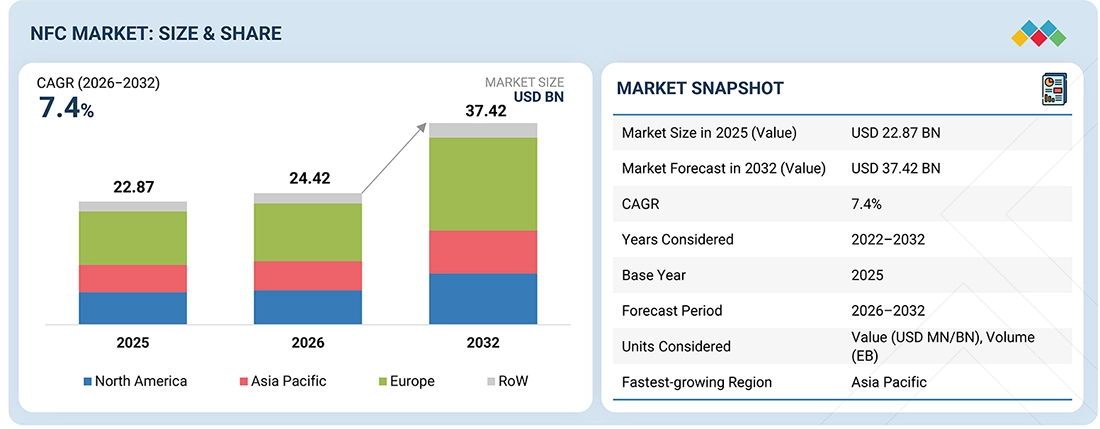
According to marketsandmarkets, The NFC market size was valued at USD 24.42 billion in 2026 and is projected to grow to USD 37.42 billion by 2032, at a CAGR of 7.4% during the forecast period of 2026-2032. The market is expected to grow steadily, driven by the increasing adoption of contactless payments, digital wallets, NFC-enabled smartphones, wearable devices, and connected consumer electronics. Rising demand for secure and convenient contactless communication, expanding deployment of digital payment infrastructure, and growing investments in smart retail, transportation, automotive, healthcare, and access control are further accelerating market adoption across consumer and commercial sectors. Additionally, advancements in NFC ICs & antennas, NFC tags, NFC readers, secure elements, and low-power NFC technologies are enabling scalable, secure, and reliable NFC deployments across diverse end-use industries.
Source: Secondary Research, Interviews with Experts, MarketsandMarkets Analysis
KEY TAKEAWAYS
-
By RegionAsia Pacific held the largest market share of approximately 46% in 2025, supported by rapid adoption of contactless payments, widespread penetration of NFC-enabled smartphones and wearable devices, expanding digital payment infrastructure, and the presence of leading NFC semiconductor and technology providers across China, Japan, South Korea, and India.
-
By Operating Mode TypeBy operating mode type, the card emulation segment is expected to account for the largest share in the NFC market size in 2026, driven by its widespread adoption in contactless payments, digital wallets, transit ticketing, access control, and digital identification applications. The increasing integration of NFC card emulation into smartphones, smartwatches, and other connected devices is accelerating deployment across banking & finance, transportation, retail, hospitality, and consumer electronics.
-
By VerticalBy vertical, the consumer electronics segment is expected to account for the largest market share in the NFC market size in 2032, driven by the widespread integration of NFC technology into smartphones, smartwatches, tablets, laptops, and other connected consumer devices. Growing adoption of NFC-enabled devices for contactless payments, digital wallets, device pairing, authentication, and access control is accelerating segment growth. In addition, rising smartphone and wearable penetration, advances in miniaturized NFC ICs and antennas, and growing demand for seamless device connectivity are supporting the integration of NFC functionality across consumer electronics.
-
By Energy SourceBy energy source, the light energy harvesting segment is projected to register the highest CAGR during the forecast period, supported by advancements in photovoltaic energy harvesting technologies and increasing deployment of indoor and outdoor battery-free IoT sensing applications.
-
By Hardware TypeBy hardware type, the NFC ICs & antennas segment is expected to account for the largest market share in 2032, driven by their widespread integration into smartphones, wearables, payment terminals, automotive systems, and other NFC-enabled devices. Growing adoption of contactless payments, digital wallets, and connected devices is further increasing demand for NFC ICs and antennas.
-
Competitive Landscape (Key Players)Key players in the NFC market growth include NXP Semiconductors; Broadcom; Qualcomm Technologies, Inc.; Texas Instruments; STMicroelectronics; Renesas Electronics; Infineon Technologies; and Thales, supported by continuous advancements in NFC ICs and antennas, secure elements, NFC readers, contactless payment technologies, and wireless connectivity solutions. These companies are strengthening their market positions through product innovation, strategic partnerships, R&D investments, and expansion of NFC applications across consumer electronics, banking & finance, retail, transportation, automotive, healthcare, and access control.
-
Competitive Landscape (SMEs/Startups)Key SMEs and startups in the NFC market trends include Flomio, Inc.; Premier Labels UK; Advanced Card Systems Ltd.; Cryptera; Identiv, Inc.; MagTek, Inc.; and HID Global. These companies are strengthening the market through innovations in NFC tags, readers, authentication, secure identification, contactless payment, and specialized NFC solutions. Their focus on application-specific products, secure NFC technologies, compact hardware, and flexible integration with digital payment, retail, access control, transportation, and identification ecosystems is expanding NFC adoption across emerging applications.
The NFC market analysis is experiencing strong growth, driven by the rising adoption of contactless payments, digital wallets, NFC-enabled smartphones, wearable devices, and connected consumer electronics. Growing demand for secure contactless transactions, seamless device connectivity, digital authentication, and convenient user experiences is accelerating the deployment of NFC across banking and finance, retail, consumer electronics, transportation, automotive, healthcare, hospitality, and access control applications. Additionally, advancements in NFC ICs and antennas, NFC tags, NFC readers, secure elements, and low-power NFC technologies are further strengthening global market expansion.
TRENDS & DISRUPTIONS IMPACTING CUSTOMERS' CUSTOMERS
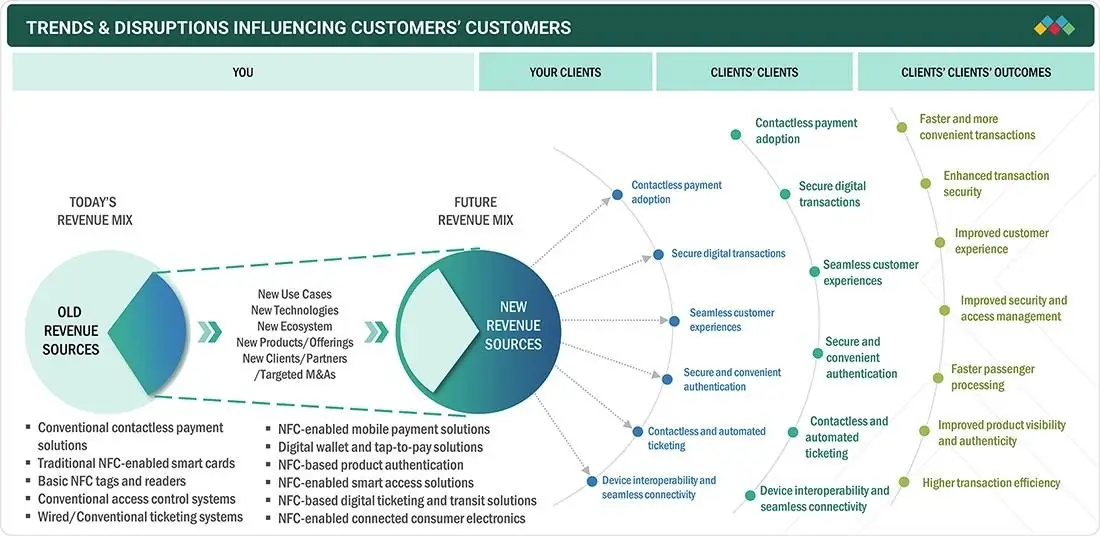
Trends in contactless payments, digital wallets, NFC-enabled smartphones and wearables, smart retail, and connected infrastructure are reshaping global demand for NFC technology. Banks, retailers, transportation operators, automotive companies, healthcare providers, and consumer electronics manufacturers are increasingly deploying NFC solutions to enable secure, convenient, and seamless contactless communication and transactions. These trends are accelerating demand for NFC ICs and antennas, NFC tags, NFC readers, secure elements, and NFC-enabled devices across banking and finance, consumer electronics, retail, transportation, automotive, healthcare, hospitality, and access control applications, enabling faster transactions, enhanced security, improved customer experiences, greater operational efficiency, and expanded digital connectivity.
Source: Secondary Research, Interviews with Experts, MarketsandMarkets Analysis
MARKET DYNAMICS

Level
-
Increasing adoption of contactless payments and digital wallets

-
NFC evolution beyond payments into digital access and authentication


Level
-
Limited device compatibility can create interoperability challenges across NFC ecosystems.

-
Dependence on NFC-enabled terminals can constrain contactless payment expansion.


Level
-
Expansion of NFC-enabled smart retail and product authentication applications

-
Growing integration of NFC into wearable and connected consumer devices.


Level
-
Ensuring secure communication against evolving threats to contactless security.

-
Ensuring reliable NFC performance across diverse operating environments.

Source: Secondary Research, Interviews with Experts, MarketsandMarkets Analysis
Driver: Increasing adoption of contactless payments and digital wallets
The rapid expansion of contactless payments, mobile wallets, and NFC-enabled smartphones is significantly increasing demand for NFC technology across banking, retail, transportation, and hospitality applications. Consumers and businesses are increasingly adopting tap-to-pay solutions due to their convenience, speed, and secure authentication capabilities. The growing deployment of NFC-enabled payment terminals and digital payment infrastructure further supports market expansion and accelerates the integration of NFC functionality into smartphones, wearables, cards, and connected devices.
Restraint: Limited device compatibility can create interoperability challenges across NFC ecosystems
NFC solutions require compatibility among smartphones, NFC readers, tags, payment terminals, secure elements, and software platforms, creating interoperability challenges across devices and ecosystems. Variations in NFC implementation, operating systems, hardware capabilities, and security requirements can increase integration complexity and development costs. These compatibility issues may slow deployment, particularly for businesses operating across multiple technology platforms and regions, thereby restraining NFC adoption in certain applications.
Opportunity: Expansion of NFC-enabled smart retail and product authentication applications
The growing adoption of NFC across smart retail, product authentication, smart packaging, and digital product identification is creating new growth opportunities for NFC technology providers. NFC tags embedded in products and packaging enable consumers to access product information, verify authenticity, engage with digital content, and interact directly with brands. As retailers and manufacturers invest in connected products, anti-counterfeiting solutions, and enhanced customer experiences, demand for NFC tags, readers, ICs, and supporting software is expected to rise.
Challenge: Ensuring secure communication against evolving contactless security threats
NFC systems must ensure secure communication and safeguard sensitive information against evolving threats, including unauthorized access, data interception, relay attacks, and credential theft. Security requirements are especially critical for payment, banking, access control, healthcare, and digital identification applications. NFC providers must continuously enhance encryption, secure elements, tokenization, authentication, and security protocols while preserving seamless user experiences. Meeting evolving security standards and regulatory requirements across countries remains a key technical and commercial challenge for market participants.
NFC MARKET SIZE, SHARE & INDUSTRY TRENDS: COMMERCIAL USE CASES ACROSS INDUSTRIES
| COMPANY | USE CASE DESCRIPTION | BENEFITS |
|---|---|---|
 |
Implemented NFC-based contactless fare collection for Argentina’s SUBE public transportation system across buses, trains, and metro networks. | Faster ticketing | Secure transactions | Convenient passenger access | Multimodal transportation support |
 |
Enabled NP Plastibell’s connected pre-filled syringe with an NFC tag for product authentication and access to medical information. | Improved patient safety | Product authentication | Better traceability | Easy information access |
 |
Powered Famoco’s NFC-enabled Soft POS device for contactless payments using smartphones and digital wallets. | Flexible payment acceptance | Faster transactions | Mobile POS deployment | Secure payments |
 |
Provided tamper-proof NFC tags for MintID gold and silver products to enable digital product authentication. | Counterfeit prevention | Product verification | Digital identity | Enhanced consumer confidence |
 |
Enabled NFC-based contactless payments on smart rings, watches, fitness trackers, and other wearable devices using secure-element technology. | Secure wearable payments | Card emulation | Tokenized transactions | Greater convenience |
Logos and trademarks shown above are the property of their respective owners. Their use here is for informational and illustrative purposes only.
MARKET ECOSYSTEM
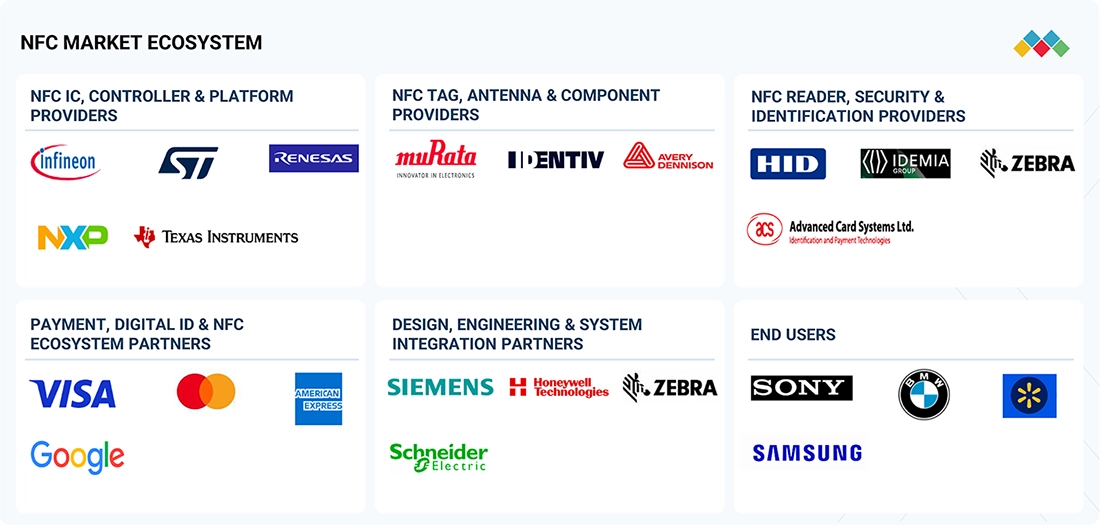
The NFC industry ecosystem comprises NFC semiconductor and IC providers, NFC tag and antenna manufacturers, NFC reader providers, secure element and security solution providers, payment and digital identity partners, system integrators, and end users. NFC semiconductor and IC providers develop NFC controllers, ICs, secure elements, and connectivity components that enable secure short-range wireless communication. NFC tag and antenna manufacturers supply tags, antennas, inlays, and related components for product identification, authentication, payments, and connected applications. NFC reader providers develop hardware and solutions for contactless payments, ticketing, access control, and device interaction. Payment networks, digital wallet providers, and technology partners support secure transactions and digital authentication across NFC ecosystems. System integrators and technology providers support NFC deployment, connectivity, software integration, and application development in enterprise environments. End users, including banks and financial institutions, consumer electronics manufacturers, retailers, transportation operators, automotive companies, healthcare providers, hospitality companies, and smart building operators, deploy NFC solutions across diverse applications.
Logos and trademarks shown above are the property of their respective owners. Their use here is for informational and illustrative purposes only.
MARKET SEGMENTS
Source: Secondary Research, Interviews with Experts, MarketsandMarkets Analysis
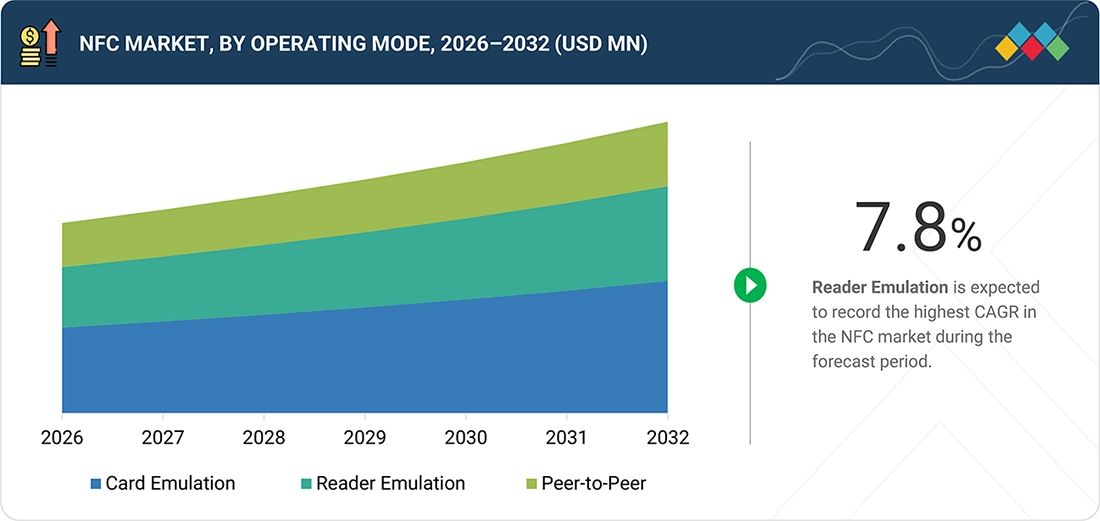
NFC Market, by Operating Mode
The card emulation segment is expected to account for the largest market share in the NFC market in 2026, driven by its widespread adoption in contactless payments, digital wallets, transit ticketing, access control, and digital identification applications. The increasing integration of NFC card emulation functionality into smartphones, smartwatches, and other connected devices is accelerating deployment across banking & finance, transportation, retail, hospitality, and consumer electronics applications.
NFC Market, by Vertical
The consumer electronics segment is expected to account for the largest market share in the NFC market in 2032, driven by the widespread integration of NFC technology into smartphones, smartwatches, tablets, laptops, and other connected consumer devices. Growing adoption of NFC-enabled devices for contactless payments, digital wallets, device pairing, authentication, and access control is accelerating segment growth. Increasing smartphone and wearable penetration, advances in miniaturized NFC ICs and antennas, and rising demand for seamless device connectivity further support NFC integration across consumer electronics.
NFC Market, by Hardware Type
The NFC ICs & antennas segment is expected to hold the largest market share in 2032, driven by widespread integration into smartphones, wearables, payment terminals, automotive systems, and other NFC-enabled devices. Growing adoption of contactless payments, digital wallets, and connected devices is increasing demand for NFC ICs and antennas. Advancements in miniaturized ICs, antenna design, power efficiency, and component integration are further supporting segment growth.
REGION
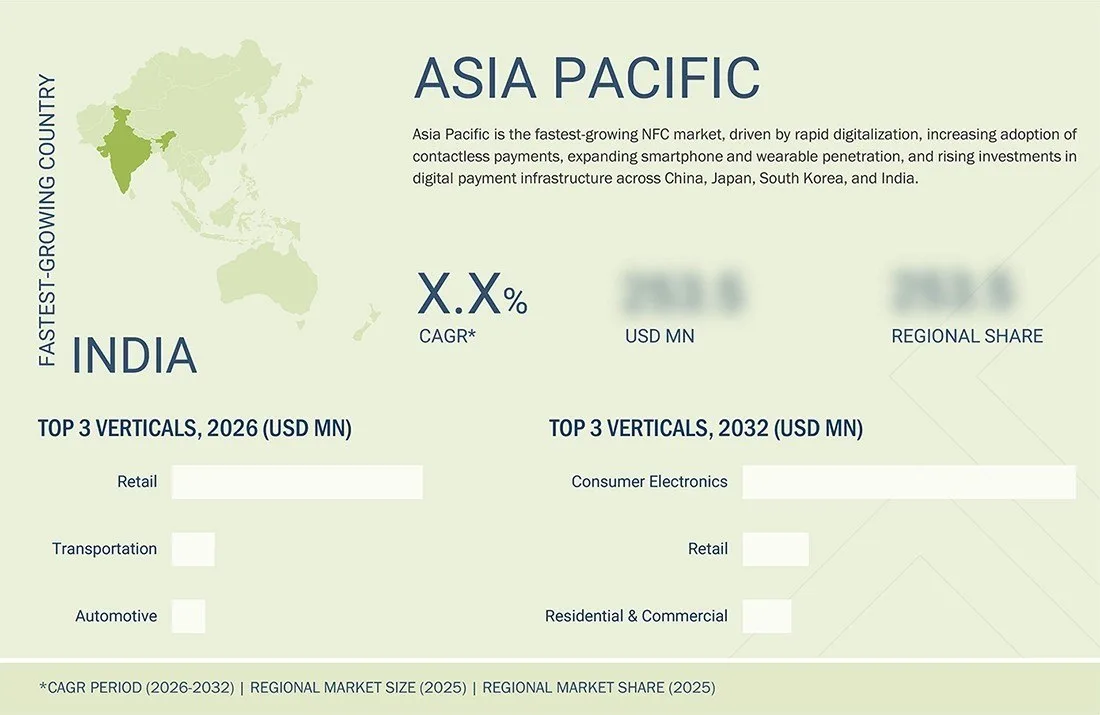
Asia Pacific is expected to record the fastest growth in the global NFC market during the forecast period
The Asia Pacific region accounted for the largest market share, approximately 46%, in 2025, supported by rapid adoption of contactless payments, widespread penetration of NFC-enabled smartphones and wearables, expanding digital payment infrastructure, and the presence of leading NFC semiconductor and technology providers across China, Japan, South Korea, and India. Growing investments in digital wallets, smart transportation, connected consumer electronics, and contactless payment infrastructure are further strengthening NFC adoption across the region.
NFC MARKET SIZE, SHARE & INDUSTRY TRENDS: COMPANY EVALUATION MATRIX
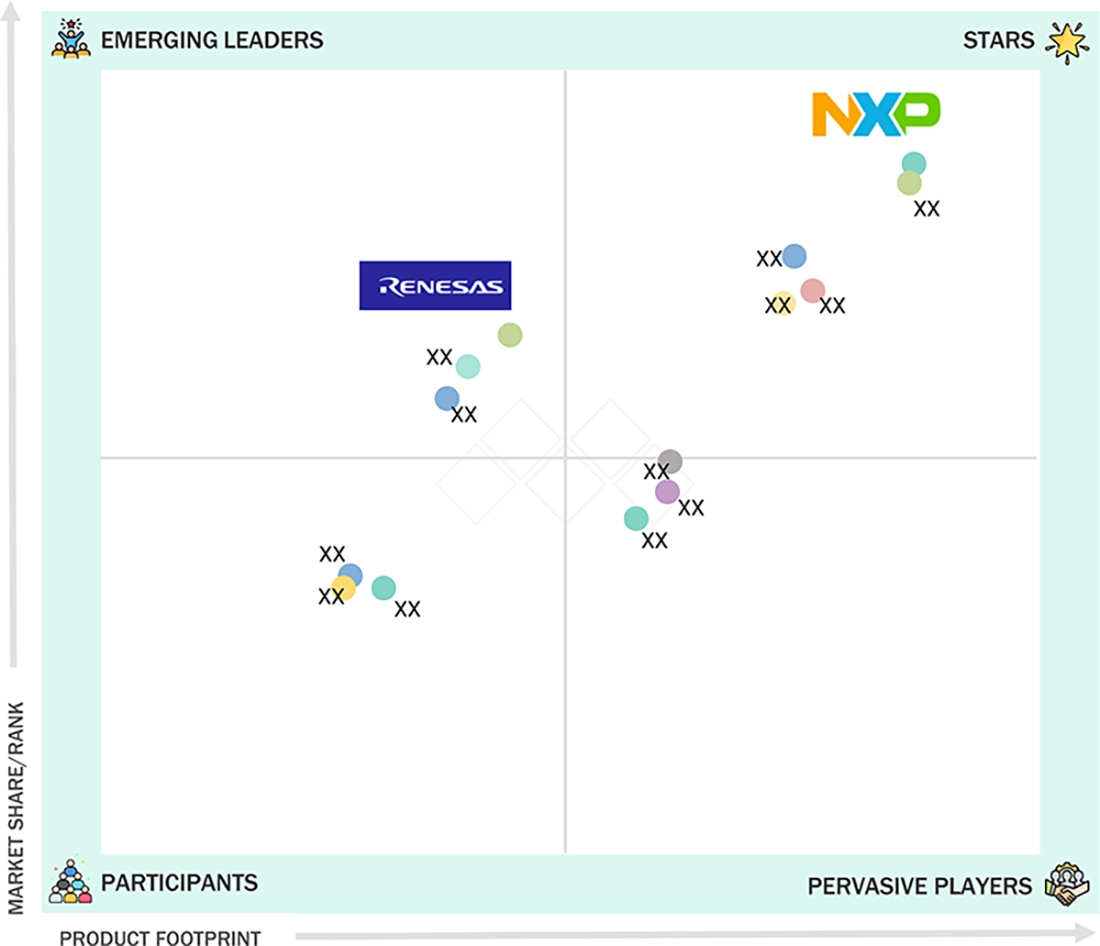
In the NFC companies matrix, NXP Semiconductors is positioned as a Star, supported by its strong portfolio of NFC semiconductors, advanced NFC ICs and controllers, secure-element technologies, and extensive capabilities across contactless payment, digital identity, automotive, and consumer electronics applications. Renesas Electronics Corporation is positioned as an Emerging Leader, driven by its expertise in secure digital identity, contactless payment technologies, NFC-enabled cards and solutions, and growing adoption across banking, transportation, access control, and identity applications.
Source: Secondary Research, Interviews with Experts, MarketsandMarkets Analysis
KEY MARKET PLAYERS
MARKET SCOPE
| REPORT METRIC | DETAILS |
|---|---|
| Market Size in 2025 (Value) | USD 22.87 Billion |
| Market Size in 2026 (Value) | USD 24.42 Billion |
| Market Forecast in 2032 (Value) | USD 37.42 Billion |
| Growth Rate | 7.4% |
| Years Considered | 2022-2032 |
| Base Year | 2025 |
| Forecast Period | 2026-2032 |
| Units Considered | Value (USD Million/Billion), Volume (Million Units) |
| Report Coverage | Revenue Forecast, Company Ranking, Competitive Landscape, Growth Factors, and Trends |
| Segments Covered |
|
| Regions Covered | North America, Europe, Asia Pacific, RoW |
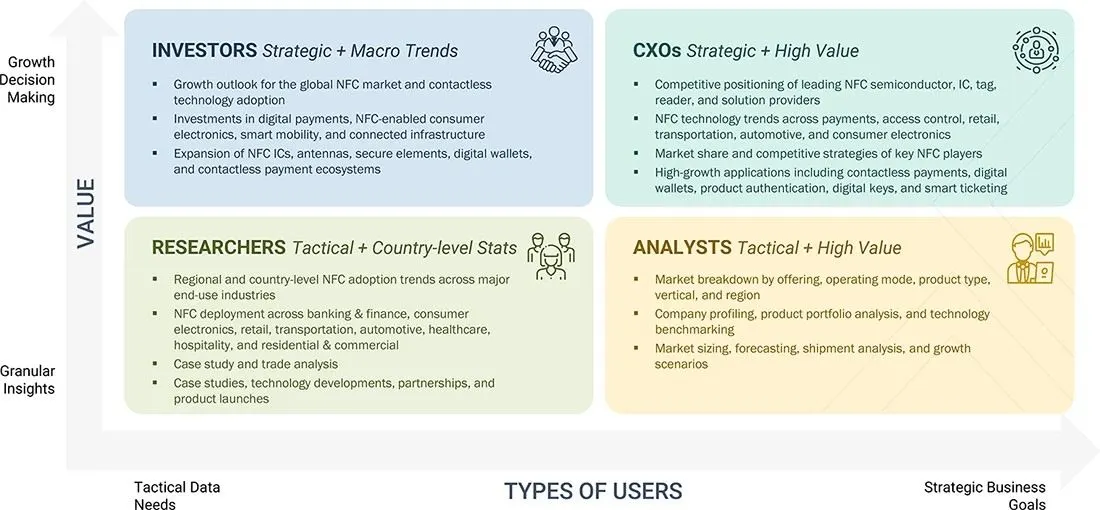
WHAT IS IN IT FOR YOU: NFC MARKET SIZE, SHARE & INDUSTRY TRENDS REPORT CONTENT GUIDE
DELIVERED CUSTOMIZATIONS
We have successfully delivered the following deep-dive customizations:
| CLIENT REQUEST | CUSTOMIZATION DELIVERED | VALUE ADDS |
|---|---|---|
| NFC IC, Controller & Semiconductor Manufacturer |
|
|
| NFC Tag & Antenna Manufacturer |
|
|
| NFC Reader & Hardware Manufacturer |
|
|
| NFC Technology & System Integration Provider |
|
|
| NFC Tag, Authentication & Identification Provider |
|
|
RECENT DEVELOPMENTS
- June 2026 : STMicroelectronics launched the ST25DA-C, a secure NFC device supporting Matter 1.6 NFC commissioning. The device enables secure, power-free onboarding of smart-home devices and integrates security capabilities to store keys and perform cryptographic operations.
- June 2026 : NXP introduced the EdgeLock SE051H, available from June 2026, for secure NFC commissioning of Matter-enabled devices. The solution enables onboarding without power, internet connectivity, or device unboxing, supporting secure and scalable smart-home deployments.
- April 2026 : Identiv expanded its ID-Safe NFC tag portfolio with tamper-evident and tamper-proof NFC tags for product authentication, tamper detection, and traceability. The solutions target pharmaceutical, healthcare, retail, food & beverage, electronics, and smart packaging applications.
- June 2026 : Infineon advanced its involvement in the Aliro 1.0 smart-access ecosystem, supporting interoperable mobile credentials using NFC, Bluetooth LE, and UWB. NFC provides secure tap-to-unlock functionality for buildings, hospitality, turnstiles, and other access-control applications.
- March 2026 : HID launched Converged Credentials, combining physical and digital identity management through a unified credential platform. The solution includes compact NFC-enabled readers, supporting secure access to workstations and environments where carrying a smartphone is impractical.
Table of Contents
 Exclusive indicates content/data unique to MarketsandMarkets and not available with any competitors.
Methodology
The study involved major activities to estimate the current size of the NFC market. Exhaustive secondary research was conducted to collect information on the NFC industry. The next step was to validate these findings, assumptions, and sizing with industry experts across the value chain through primary research. Different approaches, such as top-down and bottom-up, were employed to estimate the total market size. After that, the market breakup and data triangulation procedures were used to estimate the market size of the segments and subsegments of the NFC market.
Secondary Research
The market for companies offering NFC solutions was estimated using secondary data from paid and unpaid sources, analyzing the product portfolios of major companies in the ecosystem, and rating companies by their performance and quality. Secondary research drew on a range of sources to identify and collect information for this study. These included annual reports, press releases, investor presentations from companies, white papers, journals, certified publications, articles by recognized authors, directories, and databases. The secondary research was used to obtain critical information on the industry's value chain, the total pool of key players, market classification, and segmentation from both market and technology-oriented perspectives.
Primary Research
Extensive primary research has been conducted following secondary research that analyzed the current NFC market. Several primary interviews have been conducted with key opinion leaders from the demand and supply sides across four main regions—North America, Europe, Asia Pacific, and the Rest of Europe. Approximately 25% of the primary interviews were conducted with demand-side respondents, while approximately 75% were conducted with supply-side respondents. Primary data has been collected through questionnaires, emails, and telephone interviews.
After interacting with industry experts, brief sessions were held with highly experienced independent consultants to reinforce the findings from our primary. This, along with the opinions of in-house subject matter experts, has led us to the findings described in the remainder of this report. The breakdown of primary respondents is as follows:
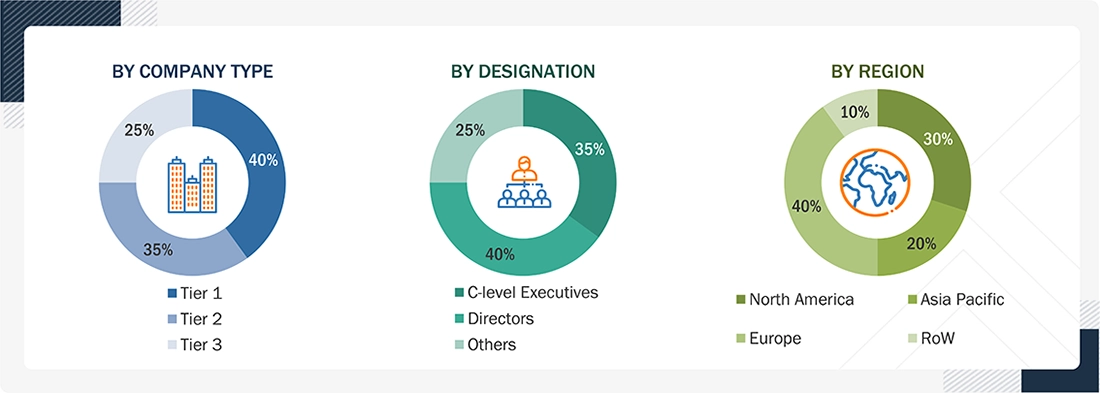
Note: Other designations include product, sales, and marketing managers.
Three tiers of companies have been defined based on their total revenue as of 2025: tier 3: revenue less than USD 50 million; tier 2: revenue between USD 50 million and USD 150 million; and tier 1: revenue more than USD 150 million.
To know about the assumptions considered for the study, download the pdf brochure
Market Size Estimation
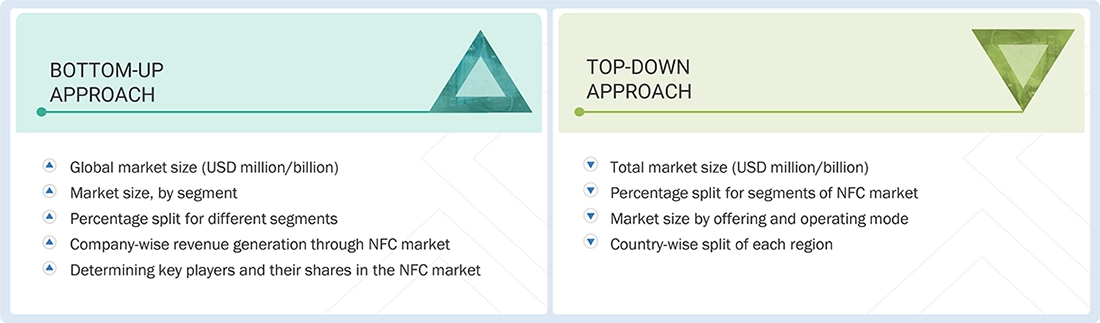
In the market engineering process, both top-down and bottom-up approaches, along with data triangulation methods, were used to estimate and validate the size of the NFC market and its dependent submarkets. The research methodology used to estimate market sizes includes the following:
- Identifying investments and spending across contactless payments, consumer electronics, automotive, retail, banking and finance, healthcare, transportation, access control, and IoT ecosystems, while considering segment-level splits and key market developments.
- Identifying the major stakeholders influencing the NFC market, including participants across the NFC IC, controller, secure element, antenna, tag, reader, semiconductor, smartphone, payment technology, and wireless communication value chain
- Analyzing leading companies in the NFC ecosystem and studying their product portfolios, NFC technologies, semiconductor capabilities, patents, partnerships, acquisitions, and research and development activities.
- Assessing the adoption of NFC technologies across key applications, including contactless payments, mobile payments, access control, ticketing, device pairing, digital identification, product authentication, smart packaging, and asset tracking.
- Evaluating the adoption of different NFC technologies and components, including NFC controllers, secure elements, NFC tags, readers, antennas, NFC ICs, and integrated NFC solutions.
- Estimating the market share and value contribution of various offering types, operating modes, product types, applications, verticals, and regional segments
- Aggregating revenues generated by NFC semiconductor manufacturers, NFC solution providers, and other relevant market participants to estimate the global NFC market size
- Segmenting the overall market into various categories, including offering, operating mode, product type, vertical, and region
- Analyzing regional- and country-level splits and validating NFC adoption patterns across major markets globally, with particular focus on North America, Europe, Asia Pacific, and the Rest of the World (ROW)
- Tracking recent and upcoming market developments, including investments, product launches, technology advancements, strategic partnerships, collaborations, acquisitions, expansions, and NFC infrastructure deployments, and forecasting the market size based on these developments and other critical parameters
- Conducting multiple discussions with key opinion leaders to understand NFC technology adoption trends, commercialization strategies, emerging applications, contactless payment developments, and future technology developments related to NFC
- Validating market estimates at every level through discussions with key opinion leaders, including chief executives (CXOs), vice presidents, business development managers, product managers, R&D heads, technology specialists, payment solution providers, system integrators, and independent industry experts
Data Triangulation
After determining the overall market size using the market estimation processes described above, the NFC market was segmented into categories and subcategories. To complete the market engineering process and derive accurate market estimates for each segment and subsegment, data triangulation and market breakdown methodologies were employed wherever applicable. Data were triangulated by analyzing multiple demand- and supply-side factors, including adoption of NFC technology across end-use verticals, contactless payment penetration, smartphone and wearable adoption, technological advancements in NFC ICs and antennas, product commercialization trends, NFC infrastructure deployment, company revenues, pricing analysis, and regional demand patterns. This comprehensive validation process ensured consistency and reliability in the market estimates, resulting in accurate sizing and forecasting of all market segments and subsegments.
Market Definition
NFC is a short-range wireless communication standard that enables the exchange of money and data and connects to various electronic devices. NFC operates using electromagnetic fields. Its high speed and convenience enable data sharing between devices such as smartphones, tablets, and laptops. For instance, NFC users can simply point their phone toward an enabled device to share information without manually establishing a connection.
Key Stakeholders
- NFC market chip manufacturers
- Micro SD card manufacturers
- Telecom operators for NFC market SIM cards
- System integrators
- Research organizations and patent holders
- Mobile manufacturers
- Trusted service managers
- Banks and credit card companies
- Assembly, testing, and packaging players
Report Objectives
- To describe and forecast the NFC market, in terms of value, based on offering, operating mode, and vertical
- To forecast the size of the NFC market in terms of volume
- To forecast the market size, in terms of value, for four main regions—North America, Europe, Asia Pacific, and the RoW (Rest of the World)
- To provide detailed information regarding drivers, restraints, opportunities, and challenges influencing market growth
- To provide a detailed overview of the value chain of the NFC ecosystem
- To strategically analyze micromarkets with respect to individual growth trends, prospects, and contributions to the total market
- To analyze the opportunities for stakeholders and details of the competitive landscape of the market
- To strategically profile the key players and comprehensively analyze their market positions in terms of ranking and core competencies2
- To analyze the major growth strategies implemented by key market players, such as agreements, acquisitions, product launches, expansions, and partnerships
- To study the impact of AI on the market under study, along with macroeconomic outlook for each region
Available customizations:
With the given market data, MarketsandMarkets offers customizations based on companies' specific requirements. The following customization options are available for the report:
- Detailed analysis and profiling of additional market players (up to 5)
Key Questions Addressed by the Report
What is the current value and projected growth of the NFC Market?
The NFC Market is projected to reach USD 37.42 billion by 2032 from an estimated USD 24.42 billion in 2026, growing at a CAGR of 7.4%.
Which region holds the largest share of the NFC Market?
Asia Pacific holds the largest share of the NFC Market, driven by the growing adoption of contactless payments, NFC-enabled smartphones and wearables, and digital payment infrastructure.
Which segment is expected to account for the largest share of the NFC Market?
The NFC ICs and antennas segment is expected to account for the largest share of the NFC Market by hardware type in 2032, supported by increasing integration across smartphones, wearables, payment terminals, and automotive systems.
Which application segment is expected to lead the NFC Market?
The card emulation segment is expected to hold the largest share by operating mode, while consumer electronics is expected to account for the largest share by vertical, supported by widespread NFC integration in connected devices.
Who are the key players in the NFC Market?
Key players in the NFC Market include NXP Semiconductors, Broadcom, Qualcomm Technologies, Texas Instruments, STMicroelectronics, Renesas Electronics, Infineon Technologies, Thales, ams-OSRAM, and Sony.


Personalize This Research
- Triangulate with your Own Data
- Get Data as per your Format and Definition
- Gain a Deeper Dive on a Specific Application, Geography, Customer or Competitor
- Any level of Personalization
Let Us Help You
- What are the Known and Unknown Adjacencies Impacting the NFC Market
- What will your New Revenue Sources be?
- Who will be your Top Customer; what will make them switch?
- Defend your Market Share or Win Competitors
- Get a Scorecard for Target Partners

Custom Market Research Services
We Will Customise The Research For You, In Case The Report Listed Above Does Not Meet With Your Requirements
Get 10% Free CustomisationTESTIMONIALS

Tetsuya Ohhira
Business Development Manager-Technology Business
Nikon Corporation,
Leading Japanese MNC specializing in optics and imaging productswww.nikon.com
MarketsandMarkets™ response
is quick. Their attitude is flexible and positive. Analyst Insights are globally considered and
significant. Client Services quickly respond to our inquiry and demand. Their wide range of global
surveys help us make our strategic plan.
We hope Knowledge Store will be easier to search
for a report.
VP - Marketing & Business Development
Leading Provider of Process Control Solutions
We engaged with MarketsandMarkets on a study to perform an analysis and recommend a Go-To-Market strategy for metrology and process control in the semiconductor market. The study was tailored to our targets and needs with well-defined milestones. Our overall experience with the MarketsandMarkets team was very good throughout the project in all aspects including the analysis methodologies used, the quality and depth of primary and secondary data sets, the professionalism and flexibility of the team and the ability to meet the target schedule and milestones. We want to thank MarketsandMarkets team for a job well done.
Growth opportunities and latent adjacency in NFC Market






Vincent
Apr, 2026
Which end-use sectors (retail, automotive, healthcare, banking) show the highest sensitivity to NFC adoption costs vs value generated, and which are most recession-resilient?.