Nitrogen Cryogenic Equipment Market

Nitrogen Cryogenic Equipment Market by Equipment (Tanks, Valves, Vaporizers, Pumps), End-use Industry (Energy & Power, Chemical, Metallurgy, Transportation), Region - Forecast to 2030




OVERVIEW
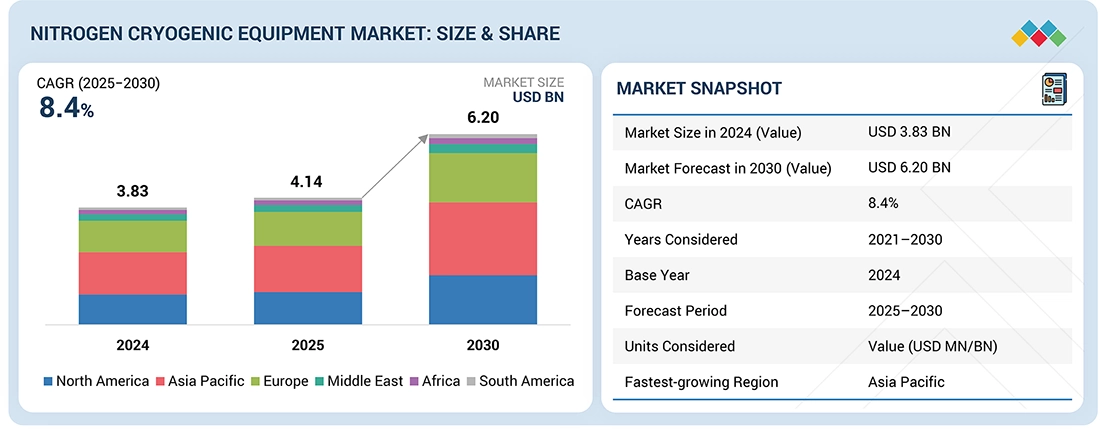
Source: Secondary Research, Interviews with Experts, MarketsandMarkets Analysis
The nitrogen cryogenic equipment market is projected to grow from USD 4.14 billion in 2025 to USD 6.20 billion by 2030, at a CAGR of 8.4% during the forecast period. The nitrogen cryogenic equipment market is growing due to rising demand for high-purity nitrogen across electronics, energy, chemicals, and metallurgy industries. Nitrogen is widely used for inerting, purging, cooling, and safety applications, which require reliable cryogenic storage and handling systems. Expansion of semiconductor manufacturing, LNG infrastructure, and industrial automation further supports demand. Additionally, nitrogen’s chemical stability, cost-effectiveness, and safety advantages make cryogenic nitrogen solutions increasingly preferred across diverse industrial applications.
KEY TAKEAWAYS
-
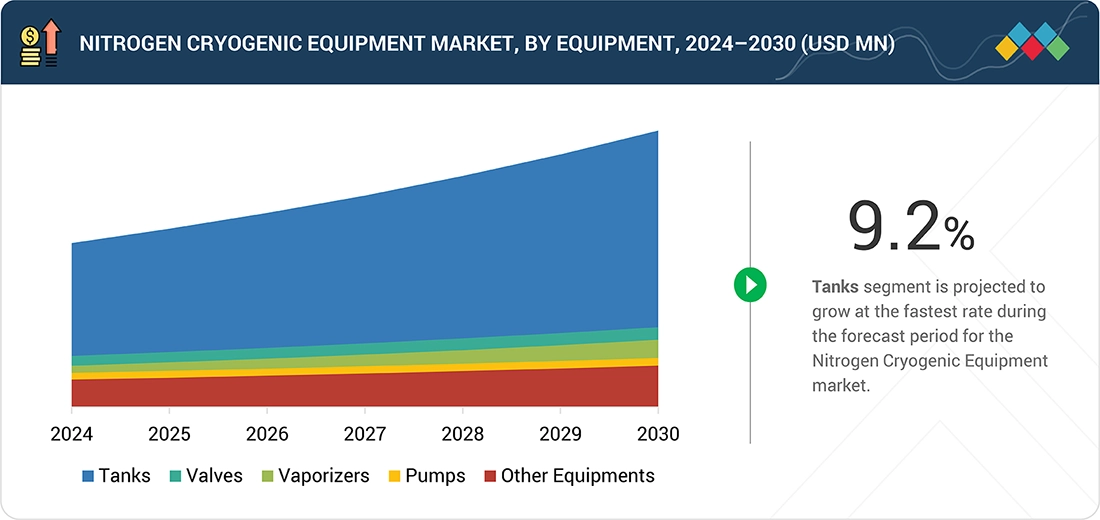
BY EQUIPMENTBy type, the tanks segment is projected to grow at the highest CAGR of 9.2% from 2025 to 2030.
-
BY END USERBy end user, the electronics industry is estimated to register a CAGR of 11.6% during the forecast period.
-
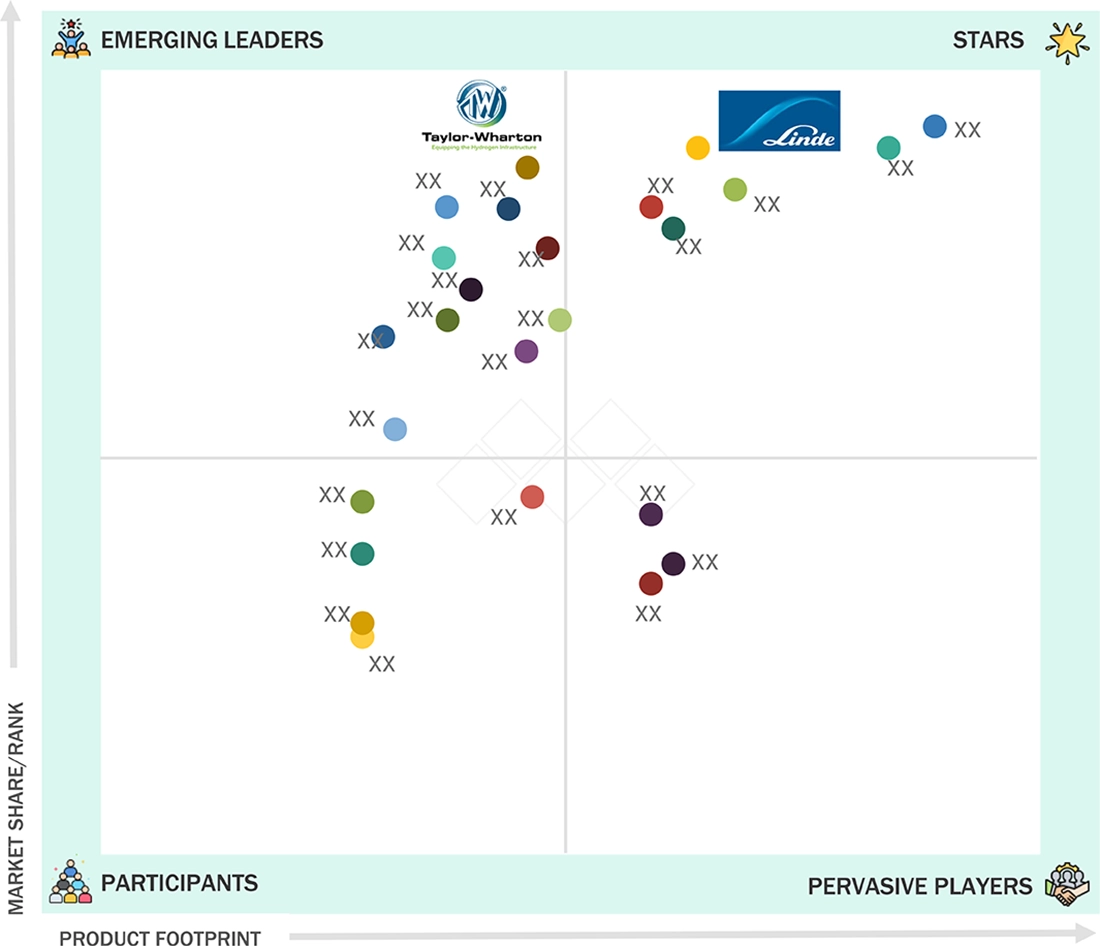
COMPETITIVE LANDSCAPELinde plc (Ireland), Chart Industries (US), Parker Hannifin Corp (US), Air Products and Chemicals, Inc. (US), and INOX India Limited (India) were identified as some of the star players in the market.
Demand for the nitrogen cryogenic equipment market is increasing due to the expanding use of nitrogen in critical industrial operations such as inerting, blanketing, purging, and controlled cooling. Rapid growth in electronics and semiconductor manufacturing requires ultra-high-purity nitrogen and reliable low-temperature storage systems. Rising LNG production and energy infrastructure projects depend on nitrogen for safety and maintenance operations. In metallurgy and chemical processing, nitrogen improves product quality and operational efficiency. Additionally, the increasing adoption of automation, stricter safety regulations, and the preference for nitrogen as a stable, non-reactive, and cost-effective gas are driving the sustained adoption of cryogenic nitrogen equipment globally.
TRENDS & DISRUPTIONS IMPACTING CUSTOMERS' CUSTOMERS
Key trends in the nitrogen cryogenic equipment market include the growing adoption of digital and IoT-enabled systems, which offer real-time monitoring, predictive maintenance, and remote diagnostics for improved uptime and safety. Energy-efficient and low-loss insulation technologies are emerging to reduce boil-off and operational costs. Demand for modular and standardized equipment accelerates faster deployment across industries. Expansion of hydrogen and LNG infrastructure increases integrated nitrogen usage. Additionally, customized solutions tailored to semiconductor, chemical, and advanced manufacturing processes are becoming more prevalent as end users seek higher purity and performance from cryogenic nitrogen systems.
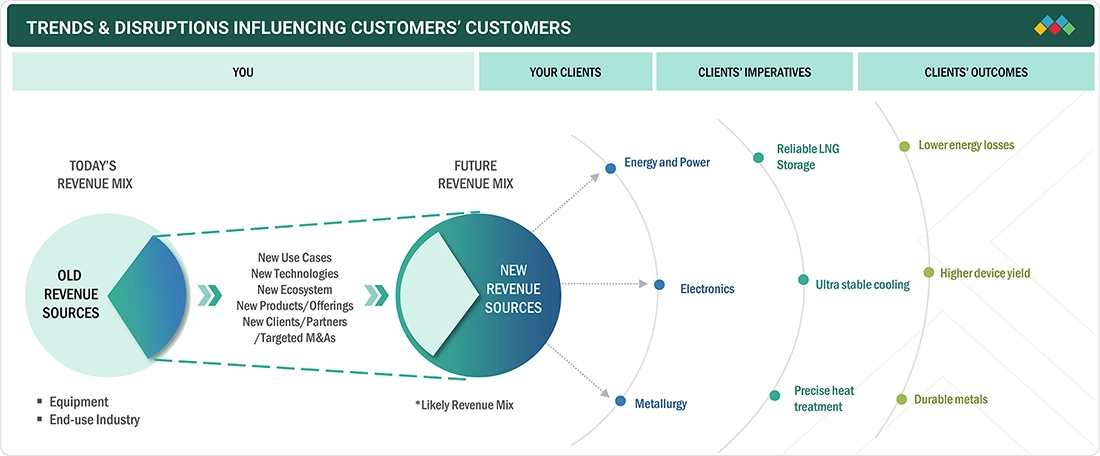
Source: Secondary Research, Interviews with Experts, MarketsandMarkets Analysis
MARKET DYNAMICS

Level
-
Rapid transition toward clean energy

-
Increasing utilization of industrial gases in metallurgy, oil & gas, and energy power industries


Level
-
Volatile raw material and metal prices

-
High CAPEX and OPEX costs associated with cryogenic plants


Level
-
Launch of new space and satellite missions

-
Evolving applications of cryogenic electronics


Level
-
Hazardous and greenhouse emissions resulting from the leakage of cryogenic fluids

Source: Secondary Research, Interviews with Experts, MarketsandMarkets Analysis
Driver: Rapid transition towards clean energy
The demand for liquid nitrogen equipment is increasing as industries transition to cleaner, more efficient processes that necessitate reliable cryogenic cooling. Liquid nitrogen enables low-emission food freezing, precision metallurgy, and environmentally friendly electronics testing without the use of ozone-depleting refrigerants. Its inert nature and relatively low cost make it attractive for replacing chemical coolants across manufacturing, healthcare, and research, supporting broader decarbonization and energy-efficiency goals.
Restraint: Volatile raw material and metal prices
Nitrogen cryogenic tanks, vaporizers, and transfer lines rely on stainless steel, aluminum, copper, and specialty insulation whose prices fluctuate with global commodity cycles. Rising metal and energy costs inflate manufacturing and installation expenses, making new systems less affordable for smaller food processors, labs, and machine shops. This volatility complicates long-term budgeting for gas suppliers and end users, slowing replacement of outdated equipment and extending payback periods for advanced nitrogen cryogenic systems.
Opportunity: Evolving applications of cryogenic electronics
Growth in semiconductors, quantum computing, and superconducting devices is opening up new applications for liquid nitrogen-based cryogenic electronics infrastructure. Nitrogen-cooled test chambers, cryostats, and cooling loops enable the low-temperature characterization of chips, sensors, and superconducting circuits at a comparatively low cost and with simple handling, compared to helium. As US investments in fabs and quantum research accelerate, demand increases for compact, high-reliability nitrogen cryogenic equipment tailored to electronics R&D and production environments.
Challenge: Hazardous and greenhouse emissions resulting from leakage of cryogenic fluids
Although nitrogen itself is inert and non-greenhouse, accidental releases of liquid nitrogen can rapidly displace oxygen, creating serious asphyxiation hazards in confined spaces. Spills and rapid vaporization also cause extreme cold burns, material embrittlement, and pressure buildup, necessitating robust ventilation, monitoring, and emergency vent systems. To meet strict occupational safety expectations, facilities must invest in oxygen sensors, fail-safe valves, and operator training, which increases lifecycle costs and complicates permitting for large nitrogen storage installations.
NITROGEN CRYOGENIC EQUIPMENT MARKET: COMMERCIAL USE CASES ACROSS INDUSTRIES
| COMPANY | USE CASE DESCRIPTION | BENEFITS |
|---|---|---|
 |
Designs and manufactures small to large liquid nitrogen dewars, supply tanks, and custom vacuum-insulated piping used in laboratories, hospitals, biobanks, and industrial facilities. ? The product range encompasses portable LN2 cylinders, static storage vessels ranging from several hundred liters to several thousand liters, and engineered transfer systems for nitrogen, oxygen, and argon. | In-house design and fabrication enable tailored nitrogen storage and transfer solutions that minimize boil-off losses and accommodate tight site constraints. Robust stainless-steel construction and long hold times reduce product loss and maintenance, lowering the total cost of ownership for gas distributors and end users. ? |
 |
Through its MVE-branded product line, distributed by Biomedical Solutions Inc., the company manufactures liquid nitrogen freezers and supply tanks for the cryogenic storage of biological samples in pharmaceutical, IVF, and research labs. Systems include LN2-freezers, supply reservoirs, and distribution manifolds designed for temperatures as low as −190 °C. | Integrated freezer-and-tank solutions provide stable ultra-low temperatures, enhancing sample viability and ensuring regulatory compliance in biomedical applications. High-efficiency insulation and level-monitoring options reduce nitrogen consumption and enable safer, automated operation for high-value sample inventories. |
 |
Manufactures handheld liquid nitrogen cryosurgery devices, spray units, and accessories used by dermatologists and veterinary clinics for lesion removal and tissue ablation. Equipment is designed around pressurized LN2 dewars and precision applicators that deliver controlled nitrogen jets to targeted tissue. | Purpose-built medical devices offer precise dose control and repeatable treatment temperatures, improving clinical outcomes versus improvised LN2 equipment. ?Durable construction, service support, and compatibility with standard nitrogen tanks help practices lower consumable waste and ensure reliable, clinic-ready cryogenic capability. |
Logos and trademarks shown above are the property of their respective owners. Their use here is for informational and illustrative purposes only.
MARKET ECOSYSTEM
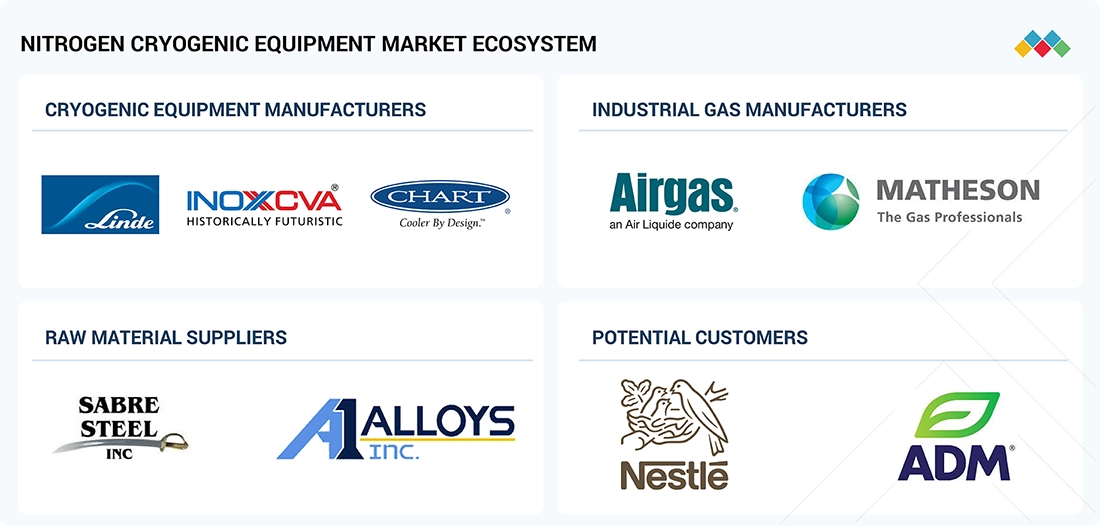
The nitrogen cryogenic equipment ecosystem links gas producers, equipment OEMs, distributors, and end users. Industrial-gas companies liquefy nitrogen and rely on OEMs for tanks, vaporizers, valves, and vacuum-insulated piping. Distributors and gas companies lease or sell this equipment to hospitals, food processors, metal treaters, and electronics manufacturers, often bundling supply contracts and maintenance. Upstream, metal and insulation suppliers supply OEMs, while regulators and safety solution vendors shape design standards and compliance services.
Logos and trademarks shown above are the property of their respective owners. Their use here is for informational and illustrative purposes only.
MARKET SEGMENTS
Source: Secondary Research, Interviews with Experts, MarketsandMarkets Analysis
NITROGEN CRYOGENIC EQUIPMENT MARKET, BY EQUIPMENT
The segment includes tanks, valves, vaporizers, pumps, etc. (pipes, regulators, freezers, dewars, strainers, samplers, and heat exchangers). The tanks segment is the fastest-growing equipment category because insulated liquid nitrogen tanks are essential at every stage of the value chain, from air-separation plants and bulk distribution to on-site storage at hospitals, food processors, and laboratories, creating frequent expansion and replacement demand across diverse industries.
NITROGEN CRYOGENIC EQUIPMENT MARKET, BY END USER
End-user industries are the metallurgy, energy and power, chemicals, electronics, transportation (shipping and rail and road transport), and other end-user industries. Energy and power is the largest end-user segment as utilities and oil and gas operators use liquid nitrogen extensively for pipeline purging, pressure testing, inerting, turbine and generator maintenance, and safe handling of flammable fuels, requiring substantial installed bases of storage tanks, vaporizers, and distribution systems at power plants and related facilities.
REGION
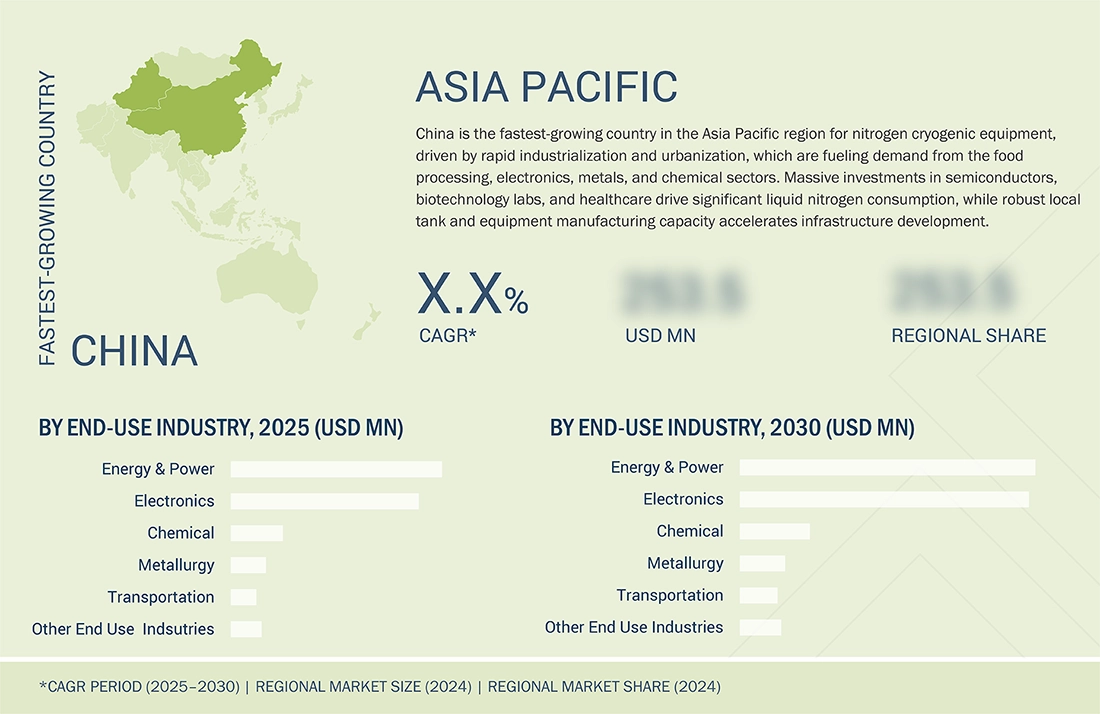
Asia Pacific to be fastest-growing region in nitrogen cryogenic equipment market during forecast period
Asia Pacific is the fastest-growing region because rapid industrialization in China, India, and Southeast Asia is driving strong demand for liquid nitrogen in food processing, electronics, chemicals, and healthcare. Massive investments in semiconductors, biopharma, and LNG infrastructure require extensive nitrogen storage and distribution equipment, while expanding middle-class consumption boosts frozen and packaged food demand.
NITROGEN CRYOGENIC EQUIPMENT MARKET: COMPANY EVALUATION MATRIX
Air Products and Chemicals, Inc. (US) and INOX India Limited (India) are positioned as stars in the market matrix, reflecting clear leadership in both market share and product breadth. The companies differentiate themselves through an extensive cryogenic equipment portfolio and strong reach across industries such as metallurgy, medical, and electronics.
Source: Secondary Research, Interviews with Experts, MarketsandMarkets Analysis
KEY MARKET PLAYERS
- Linde plc (Ireland)
- Chart Industries (US)
- Parker Hannifin (US)
- Air Products and Chemicals, Inc. (US)
- INOX India Limited (India)
- Taylor-Wharton (US)
- Wessington Cryogenics (UK)
- PHPK Technologies (US)
- Cryofab (US)
- Air Liquide (France)
MARKET SCOPE
| REPORT METRIC | DETAILS |
|---|---|
| Market Size in 2024 (Value) | USD 3.83 Billion |
| Market Forecast in 2030 (Value) | USD 6.20 Billion |
| Growth Rate | 8.4% |
| Years Considered | 2021–2030 |
| Base Year | 2024 |
| Forecast Period | 2025–2030 |
| Units Considered | Value (USD Million/Billion) |
| Report Coverage | Revenue forecast, company ranking, competitive landscape, growth factors, and trends |
| Segments Covered |
|
| Country Covered | Asia Pacific |
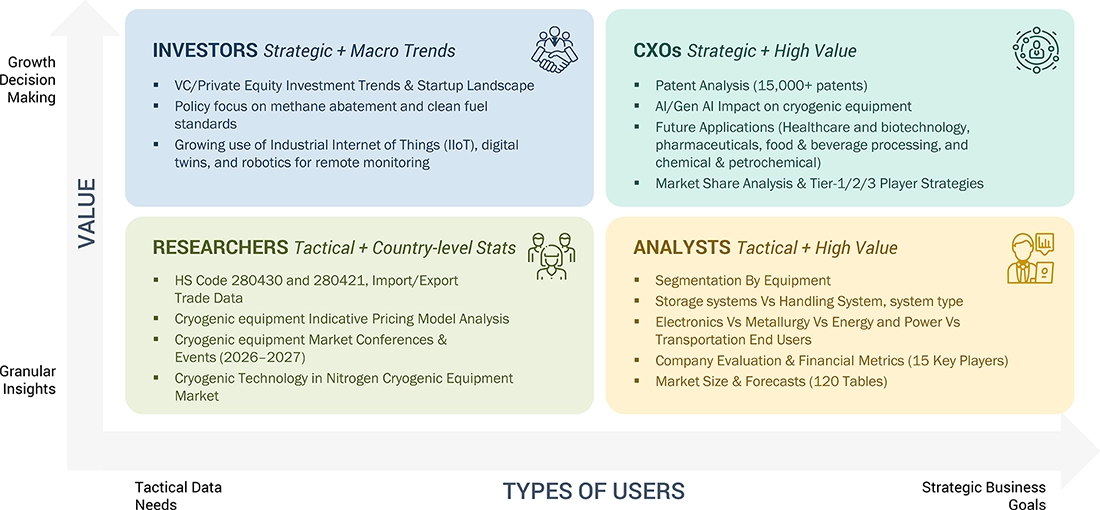
WHAT IS IN IT FOR YOU: NITROGEN CRYOGENIC EQUIPMENT MARKET REPORT CONTENT GUIDE
DELIVERED CUSTOMIZATIONS
We have successfully delivered the following deep-dive customizations:
| CLIENT REQUEST | CUSTOMIZATION DELIVERED | VALUE ADDS |
|---|---|---|
| Energy & power | Engineered liquid nitrogen storage and distribution skids with automated vaporizers, purge manifolds, and integration to DCS/SCADA for turbine, boiler, and pipeline inerting and cooldown cycles. | Higher plant uptime, safer handling of flammable fuels, faster turnaround during maintenance, and reduced outsourced nitrogen-purging costs. |
| Metallurgy | High-flow nitrogen storage tanks and headers with dedicated lines for ladle stirring, continuous casting, annealing furnaces, and powder-metal atomization, including flow-control skids and backup vaporizers. | Improved product quality, reduced oxidation and decarburization, longer refractory life, and lower defect and rework rates in steel and alloy production. |
| Transportation | Compact, skid-mounted nitrogen systems for pipeline and tank purging, truck and vessel loading terminals, and emergency inerting, designed for mobile deployment and quick connections. | Safer loading operations, minimized gas venting, faster commissioning of new lines, and compliance with hazardous-area regulations for LNG fuel and logistics networks. |
RECENT DEVELOPMENTS
- August 2023: Air Water Gas Solutions Inc. (as Taylor-Wharton was acquired by Air Water Gas Solutions Inc.) signed a 20-year agreement to supply RED with nitrogen for its Eastman Business Park (EBP) pipeline in Rochester, N.Y. The ASU will meet RED’s clients’ needs for nitrogen, oxygen, and argon.
- January 2021: Linde plc signed an agreement with BorsodChem Zrt., a member of Wanhua Chemical Groups, to supply oxygen, nitrogen, and compressed air to a chemical complex in Kazincbarcika.
Table of Contents
 Exclusive indicates content/data unique to MarketsandMarkets and not available with any competitors.
Methodology
The study involved major activities in estimating the current size of the Nitrogen Cryogenic Equipment Market. Exhaustive secondary research was done to collect information on the peer and parent markets. The next step was to validate these findings, assumptions, and sizing with industry experts across the value chain through primary research. Both top-down and bottom-up approaches were employed to estimate the total market size. Thereafter, market breakdown and data triangulation were used to estimate the market size of the segments and subsegments.
Secondary Research
This research study on the Nitrogen Cryogenic Equipment Market involved the use of extensive secondary sources, directories, and databases, such as Hoover’s, Bloomberg, Factiva, IRENA, International Energy Agency, and Statista Industry Journal, to collect and identify information useful for a technical, market-oriented, and commercial study of the Nitrogen Cryogenic Equipment Market. The other secondary sources included annual reports, press releases & investor presentations of companies, white papers, certified publications, articles by recognized authors, manufacturer associations, trade directories, and databases.
Primary Research
The Nitrogen Cryogenic Equipment Market comprises several stakeholders, such as cryogenic equipment manufacturers, technology providers, and technical support providers in the supply chain. The demand side of this market is characterized by the rising demand for types of cryogenic equipments such as rod lift systems, electric submersible pumps, progressive cavity pumps, and gas lift systems. The supply side is characterized by rising demand for contracts from the industrial sector and mergers & acquisitions among big players. Various primary sources from both the supply and demand sides of the market were interviewed to obtain qualitative and quantitative information. Following is the breakdown of primary respondents:
Market Size Estimation
Both top-down and bottom-up approaches were used to estimate and validate the total size of the Nitrogen Cryogenic Equipment Market. These methods were also used extensively to estimate the size of various subsegments in the market. The research methodology used to estimate the market size includes the following:
- The key players in the industry and market have been identified through extensive secondary research, and their market share has been determined through primary and secondary research.
- The industry’s value chain and market size, in terms of value, have been determined through both primary and secondary research processes.
- All percentage shares, splits, and breakdowns have been determined using secondary sources and verified through primary sources.
Data Triangulation
After arriving at the overall market size from the above estimation process, the total market has been split into several segments and subsegments. Data triangulation and market breakdown processes have been employed to complete the overall market engineering process and arrive at the exact statistics for all the segments and sub-segments, wherever applicable. The data has been triangulated by studying various factors and trends from both the demand- and supply sides. Along with this, the market has been validated using both the top-down and bottom-up approaches.
Market Definition
Cryogenic equipment comprises specialized machinery designed for use at extremely low temperatures, typically below -150 degrees Celsius. It enables the storage, transport, and handling of materials like gases and biological samples at these ultra-low temperatures. This technology finds application in various fields, from healthcare to aerospace, supporting scientific research and industrial processes.
The market for cryogenic equipment is the sum of revenues generated by global companies through the sales of cryogenic equipment.
Key Stakeholders
- Cryogenic equipment manufacturers and providers
- Industrial gas supplying companies
- Manufacturing industries
- R&D laboratories
- Consulting companies from energy & power sector
- Distributors of cryogenic equipment
- Government and research organizations
- State and national regulatory authorities
Objectives of the Study
- To define, describe, segment, and forecast the Nitrogen Cryogenic Equipment Market by equipment, cryogen, end-user industry, system type, application, and region, in terms of value
- To describe and forecast the market for six key regions: North America, Europe, Asia Pacific, South America, the Middle East, and Africa, along with their country-level market sizes, in terms of value
- To provide detailed information regarding key drivers, restraints, opportunities, and challenges influencing market growth
- To strategically analyze the micromarkets with respect to individual growth trends, prospects, and contributions to the overall market size
- To provide supply chain analysis, trends/disruptions impacting customer business, ecosystem/market map, pricing analysis, Porter’s five forces analysis, case study analysis, and regulatory standards pertaining to cryogenic equipment
- To analyze opportunities for stakeholders in the cryogenic equipment and draw a competitive landscape of the market
- To strategically analyze the ecosystem, tariffs and regulations, patents, and trading scenarios pertaining to cryogenic equipment
- To compare key market players based on product specifications and applications
- To strategically profile key players and comprehensively analyze their market rankings and core competencies
- To analyze competitive developments, such as contracts and agreements, investments and expansions, mergers and acquisitions, partnerships, joint ventures and collaborations, in the cryogenic equipment.
Available Customizations:
With the given market data, MarketsandMarkets offers customizations according to the specific requirements of companies. The following customization options are available for the report:
Product Analysis
- Product Matrix, which provides a detailed comparison of the product portfolio of each company
Company Information
- Detailed analyses and profiling of additional market players


Personalize This Research
- Triangulate with your Own Data
- Get Data as per your Format and Definition
- Gain a Deeper Dive on a Specific Application, Geography, Customer or Competitor
- Any level of Personalization
Let Us Help You
- What are the Known and Unknown Adjacencies Impacting the Nitrogen Cryogenic Equipment Market
- What will your New Revenue Sources be?
- Who will be your Top Customer; what will make them switch?
- Defend your Market Share or Win Competitors
- Get a Scorecard for Target Partners

Custom Market Research Services
We Will Customise The Research For You, In Case The Report Listed Above Does Not Meet With Your Requirements
Get 10% Free CustomisationTESTIMONIALS

Kimberly Murphy
GLOBAL MARKETING DIRECTOR
Bently Nevada,
Leading Condition Monitoring & Asset Protectionwww.bakerhughesds.com/bently-nevada

MarketsandMarkets™ showed consistent rigor for success and relentlessly worked with Bently Nevada stakeholders to positively impact go-to-market strategy. Their proactiveness and flexibility has been instrumental in achieving the objectives to grow our sales pipeline in key industrial markets.

DARRICK HUEBER
Business Development Leader
Nexus Controls LLC,
Leading Manufacturer of Automation System & Electrical Panelswww.bakerhughesds.com/nexus-controls

We partnered with MarketsandMarkets to expand our business further by tapping into new industrial segments. It was critical for us to gather crucial business insights about specific markets to achieve this goal. MarketsandMarkets engagement model and client services helped us provide those insights, it was really impressive and valuable for my business. The team was extremely flexible and helpful.

Mike Schoff
Global Industrial Commercial Strategy Leader
Nexus Controls LLC
Leading Manufacturer of Automation System & Electrical Panelswww.bakerhughesds.com/nexus-controls
We consulted MarketsandMarkets for potential Partner Identification. Overall, it was a good experience. The insights provided through interviews conducted by the team helped us put together the questionnaire required for discussion with the selected partners. Their ability to provide insights through interviews with customers in a timely manner was quite impressive.






Growth opportunities and latent adjacency in Nitrogen Cryogenic Equipment Market