North America 3D Printing Market

North America 3D Printing Market by Offering (Printers, Materials, Software, Services), Technology [Fused Deposition Modelling (FDM), Stereolithography (SLA), Selective Laser Sintering (SLS)], Process, Application, Vertical - Forecast to 2030




OVERVIEW
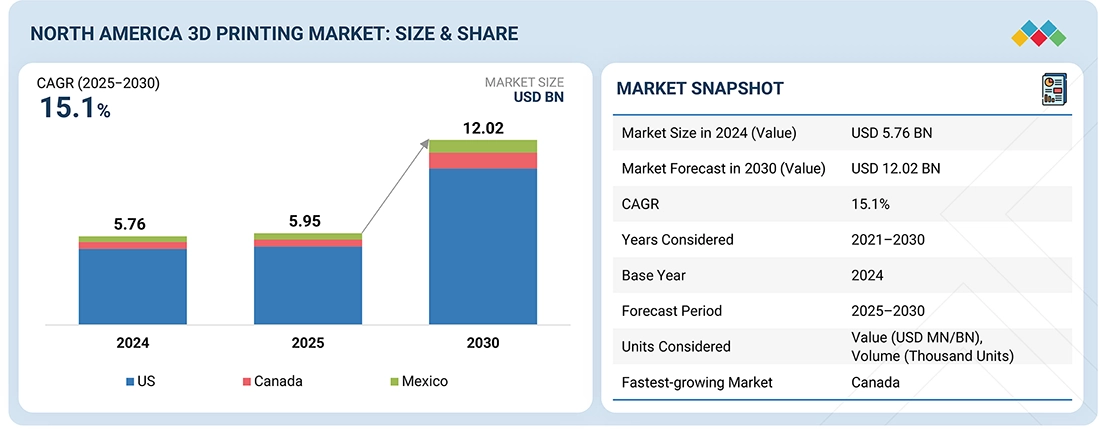
Source: Secondary Research, Interviews with Experts, MarketsandMarkets Analysis
The 3D printing market in North America is estimated at USD 5.95 billion in 2025 and is projected to reach USD 12.02 billion by 2030, growing at a CAGR of 15.1%. The market is experiencing strong expansion driven by high adoption of additive manufacturing in aerospace, automotive, healthcare, and industrial sectors, supported by advanced R&D infrastructure and strong government–industry collaboration. The increased use of metal and polymer AM for production-grade parts, along with rising investment in automation, materials innovation, and distributed manufacturing, is boosting market growth across the region.
Market Size & Forecast
KEY TAKEAWAYS
-
BY COUNTRYThe US is expected to dominate the 3D printing market in North America with an 85.6% share in 2025.
-
BY OFFERINGBy offering, the services segment is expected to hold a significant share of the North America 3D printing market in 2030.
-
BY APPLICATIONThe functional parts application segment is expected to have the highest CAGR of 19.1% during the forecast period.
-
BY VERTICALThe automotive segment is projected to grow the fastest in the 3D printing market in North America from 2025 to 2030.
-
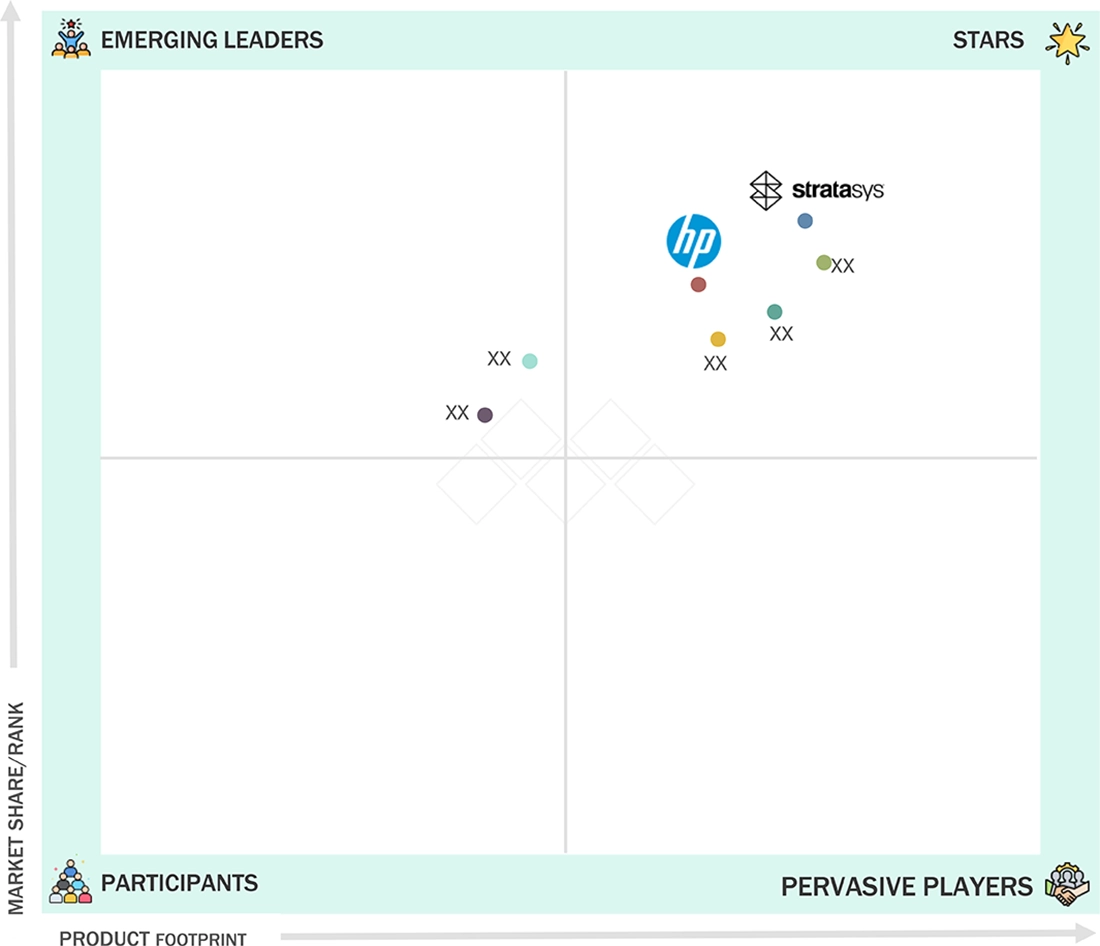
Competitive Landscape - KEY PLAYERSStratasys, HP Development Company, L.P., and 3D Systems, Inc. were identified as some of the star players in the 3D printing market, given their strong market share and product footprint.
-
Competitive Landscape - STARTUPS/SMESCarbon, Inc. and Formlabs, among others, have distinguished themselves among startups and SMEs by securing strong footholds in specialized niche areas, underscoring their potential as emerging market leaders
The 3D printing market in North America is experiencing significant growth due to advancements in additive manufacturing technologies and the increasing demand for customized products. Growing demand for mass customization, combined with widespread adoption of AM in medical implants, aerospace parts, and industrial tooling, is driving sustained market expansion across the region. Major industries, including healthcare, automotive, aerospace, and consumer goods, are utilizing 3D printing for rapid prototyping, personalized manufacturing, and mass customization.
TRENDS & DISRUPTIONS IMPACTING CUSTOMERS' CUSTOMERS
The 3D printing landscape in North America is experiencing a rapid transformation as industries transition from traditional printing technologies to disruptive additive manufacturing solutions. Emerging trends such as industrial metal 3D printing, bioprinting, automated additive manufacturing workflows, and AI-driven quality control are reshaping revenue models and opening new application frontiers across sectors including aerospace, healthcare, automotive, and consumer goods. Advances in materials, digital manufacturing, robotics, and cloud-based design platforms are further accelerating adoption, facilitating mass customization, complex geometries, faster prototyping, and distributed production.
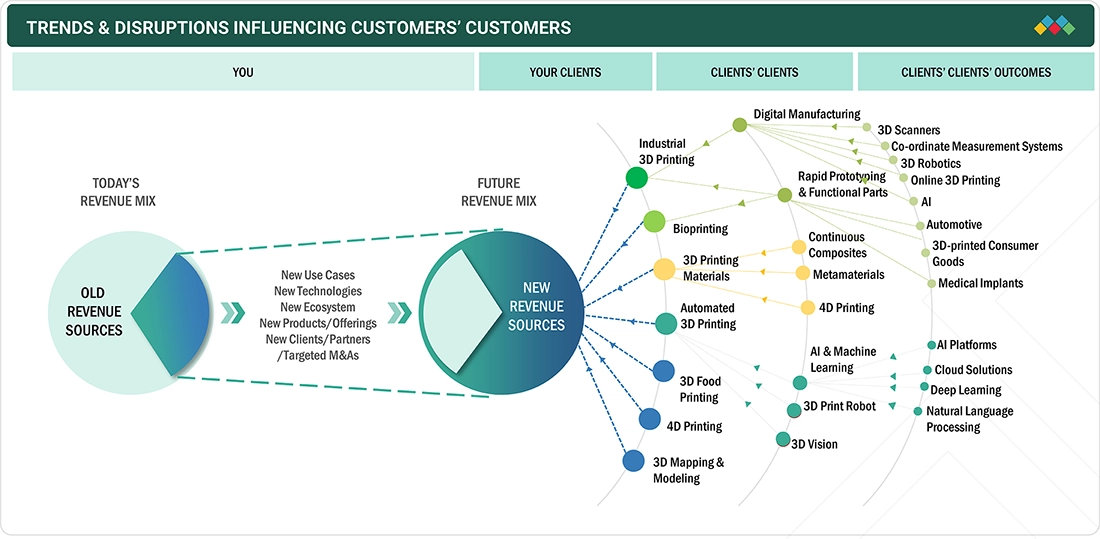
Source: Secondary Research, Interviews with Experts, MarketsandMarkets Analysis
MARKET DYNAMICS

Level
-
Ease in manufacturing of customized products

-
Reduction in manufacturing costs and process downtime


Level
-
Lack of standardized testing methods to verify mechanical properties of 3D printing materials and high raw material costs

-
Inadequate design and process control data due to lack of printing material specifications


Level
-
Increasing demand for medical products and supplies in post-pandemic scenario

-
Rapid advancements in printing technologies and materials and development of knowledge and skill progression frameworks


Level
-
Ensuring consistent quality of final 3D-printed product with repeatable and stable production processes

-
Threat of copyright infringement

Source: Secondary Research, Interviews with Experts, MarketsandMarkets Analysis
Driver: Ease in manufacturing of customized products
In North America, the demand for customization within the aerospace, medical devices, dental solutions, and automotive industries is increasing, thereby accelerating the adoption of 3D printing technologies. Manufacturers in the United States and Canada utilize additive manufacturing methods to facilitate swift prototyping and the production of complex, tailored components without the need for extensive tooling expenditure. This technological capability promotes more rapid innovation cycles and corresponds with regional tendencies toward on-demand manufacturing and individualized products.
Restraint: Lack of standardized testing methods to verify mechanical properties of 3D printing materials and high raw material costs
In North America, the lack of uniform standards for assessing AM material strength, durability, and consistency remains a barrier to scaling production, especially in regulated sectors. The high costs of advanced metal powders and engineered polymers further limit adoption among small and mid-sized manufacturers. These issues impede wider commercialization of AM technologies despite strong interest from defense, aerospace, and healthcare industries.
Opportunity: Increasing demand for medical products and supplies in post-pandemic scenario
The post-pandemic environment has increased demand for 3D-printed medical products, with hospitals and OEMs more frequently using AM for patient-specific implants, dental aligners, and surgical tools. The need for flexible, localized production is encouraging investment in additive manufacturing across the US and Canada. This trend is creating significant growth opportunities for AM providers to expand within healthcare networks and medical device manufacturing ecosystems.
Challenge: Ensuring consistent quality of final 3D-printed product with repeatable and stable production processes
Achieving stable and repeatable production quality remains a crucial challenge for manufacturers in North America as they expand beyond the prototyping stage. Variations in machine performance, material properties, and process workflows introduce risks, especially in aerospace and medical applications where qualification standards are rigorous. Addressing these issues necessitates substantial investments in process automation, real-time monitoring, and digital quality assurance systems to ensure consistent output at an industrial scale.
NORTH AMERICA 3D PRINTING MARKET: COMMERCIAL USE CASES ACROSS INDUSTRIES
| COMPANY | USE CASE DESCRIPTION | BENEFITS |
|---|---|---|
 |
3D printing of automotive fixtures for HVAC assemblies validation, consolidating multiple components into a single durable part using FDM technology and ASA material using Stratasys solution | Faster delivery in under a week vs. 4-5 weeks traditionally, significant cost savings through part consolidation, improved quality with high dimensional accuracy and stability, enhanced internal knowledge of 3D printing applications |
 |
Production of commercial-quality polymeric parts such as elastomer grommets for Focus Electric, damping bumpers for Transit Connect, and oil connectors using Digital Light Synthesis (DLS) technology | Reduced production time to less than a third of traditional methods, faster design iterations, broader material versatility including conductive materials, accelerated market entry with higher quality and cost-effective products |
 |
Manufacturing of structural titanium components for the 787 Dreamliner aircraft, replacing conventional forging and machining methods | Substantial cost reduction of approximately USD 2-3 million per aircraft, streamlined certification process with FAA approval for the material and technology, significant financial impact for high-volume production |
 |
Creation of customized orthopedic implants and other medical devices by building objects layer-by-layer from digital models using various materials for rapid prototyping and surgeon testing | Shortened innovation cycles and faster time-to-market, reduced production and delivery costs via just-in-time manufacturing, personalized solutions improving patient outcomes by reducing discomfort and healing time |
 |
Development and production of color-coded aircraft maintenance tools by HP, such as GAGS Tool Pads, Pintle Bearing Alignment Tools, and Flap Zero Locking Tools, using Multi Jet Fusion technology for Airbus services via Satair and Fast Radius | Enhanced safety through vibrant coloring to prevent tool retention, accelerated design iterations, durable and chemical-resistant parts for harsh environments, increased design freedom with integrated features like QR codes |
Logos and trademarks shown above are the property of their respective owners. Their use here is for informational and illustrative purposes only.
MARKET ECOSYSTEM
The 3D printing ecosystem in North America is characterized by a well-integrated value chain comprising advanced material innovators, robust software platforms, and a strong base of industrial and desktop printer manufacturers. This ecosystem is reinforced by high adoption across aerospace, healthcare, automotive, and industrial sectors, which are increasingly leveraging additive manufacturing for production-grade applications. Continuous advancements in materials, design automation, and digital manufacturing workflows are accelerating industrial scaling, while strong regional R&D capabilities and investment support further enhance innovation and commercialization across the additive manufacturing landscape.
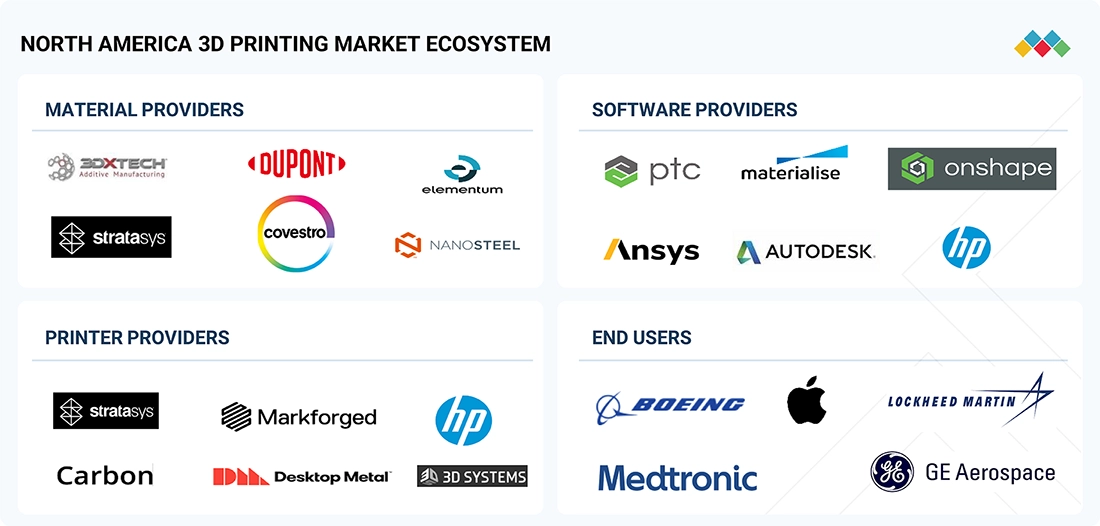
Logos and trademarks shown above are the property of their respective owners. Their use here is for informational and illustrative purposes only.
MARKET SEGMENTS

Source: Secondary Research, Interviews with Experts, MarketsandMarkets Analysis
North America 3D Printing Market, By Offering
The services segment is growing quickly as businesses increasingly outsource 3D printing for prototyping, tooling, and low-volume production to avoid high costs of industrial-grade printers. Service bureaus across North America are expanding capabilities in metal AM, advanced polymers, and on-demand manufacturing, enabling faster turnaround times and more design flexibility. The rising use of distributed manufacturing and customized production is further boosting demand for AM services in various industries.
North America 3D Printing Market, By Technology
Fused Deposition Modeling (FDM) remains dominant because of its affordability, wide material options, and strong presence in education, automotive, and industrial design sectors. Its simplicity, reliability, and extensive ecosystem of hardware and materials have made it the most accessible technology for both large companies and small businesses in North America. Ongoing innovation in engineering-grade polymers and high-performance filaments continues to reinforce FDM's leadership in the region.
North America 3D Printing Market, By Process
Vat photopolymerization is anticipated to experience significant growth in North America due to increasing demand for high-resolution components across dental, medical, consumer goods, and industrial sectors. Progress in resin formulation and accelerated production systems enhances the technology's suitability for end-use manufacturing. Its capability to produce precise details, smooth surfaces, and functional materials establishes it as a vital catalyst for growth within the additive manufacturing landscape of the region.
North America 3D Printing Market, By Application
Prototyping applications have dominated the 3D printing market in North American as enterprises increasingly depend on additive manufacturing to expedite product development, validate designs, and decrease iteration cycles. The extensive utilization of additive manufacturing within the automotive, aerospace, and electronics sectors facilitates rapid testing and refinement prior to production. Moreover, the robust adoption of digital design workflows and engineering software further reinforces prototyping as a fundamental use case for additive manufacturing in North America.
North America 3D Printing Market, By Vertical
The aerospace & defense sector is at the forefront of the market owing to the substantial demand for lightweight components, intricate geometries, and ready-for-production metal parts. A considerable investment in advanced manufacturing by prominent defense contractors and aerospace original equipment manufacturers has facilitated the widespread adoption of additive manufacturing for engines, structural components, and tooling. The sector’s rigorous performance standards and emphasis on supply chain resilience persist in driving the integration of additive manufacturing across design, testing, and production stages.
REGION
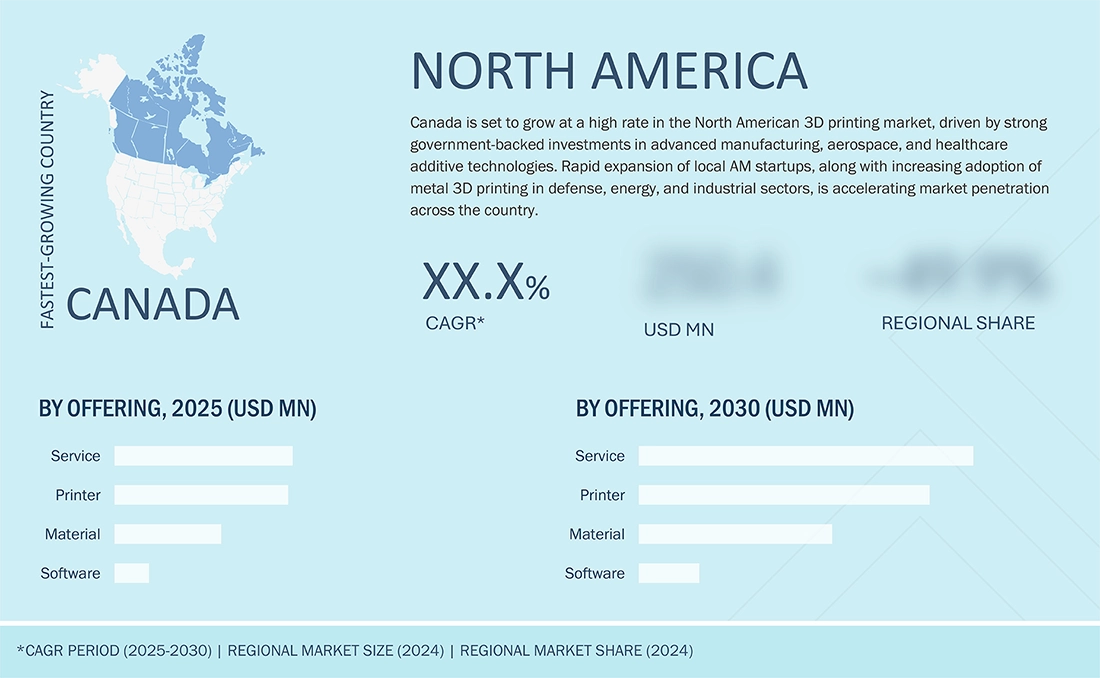
Canada to grow at a high rate in 3D printing market in North America during forecast period
Canada is anticipated to experience significant growth within the 3D printing market in North America owing to robust governmental support for advanced manufacturing, aerospace innovation, and digital industrialization. The nation is witnessing a rapid adoption of metal additive manufacturing, medical 3D printing, and industrial prototyping as enterprises seek to achieve localized, high-performance production capabilities. Moreover, burgeoning startup activities, increased investments in research centers, and escalating demand across the healthcare and energy sectors are further driving Canada’s rapid market expansion.
NORTH AMERICA 3D PRINTING MARKET: COMPANY EVALUATION MATRIX
Stratasys and HP Development Company, L.P. emerge as the leading entities in the 3D printing market landscape in North America, underpinned by their comprehensive product portfolios, widespread penetration within industrial and enterprise ecosystems, and leadership in both polymer and production-grade additive manufacturing technologies. Their robust customer base in aerospace, healthcare, and manufacturing sectors positions them at the forefront of advancing additive manufacturing adoption within the region.
Source: Secondary Research, Interviews with Experts, MarketsandMarkets Analysis
KEY MARKET PLAYERS
- Stratasys (US)
- EOS GmbH (Germany)
- HP Development Company, L.P. (US)
- 3D Systems, Inc. (US)
- General Electric Company (US)
- Materialise (Belgium)
- Nano Dimension (US)
- voxeljet AG (Germany)
- Renishaw plc. (UK)
- Proto Labs, Inc. (US)
- ONLY THE FIRST FIVE NEED TO BE HYPERLINKED!
MARKET SCOPE
| REPORT METRIC | DETAILS |
|---|---|
| Market Size in 2024 (Value) | USD 5.76 Billion |
| Market Forecast in 2030 (Value) | USD 12.02 Billion |
| Growth Rate | CAGR of 15.1% from 2025 to 2030 |
| Years Considered | 2021–2030 |
| Base Year | 2024 |
| Forecast Period | 2025–2030 |
| Units Considered | Value (USD Million/Billion), Volume (Thousand Units) |
| Report Coverage | Revenue Forecast, Company Ranking, Competitive Landscape, Growth Factors, and Trends |
| Segments Covered |
|
| Regional Scope | North America (US, Canada, Mexico) |
WHAT IS IN IT FOR YOU: NORTH AMERICA 3D PRINTING MARKET REPORT CONTENT GUIDE
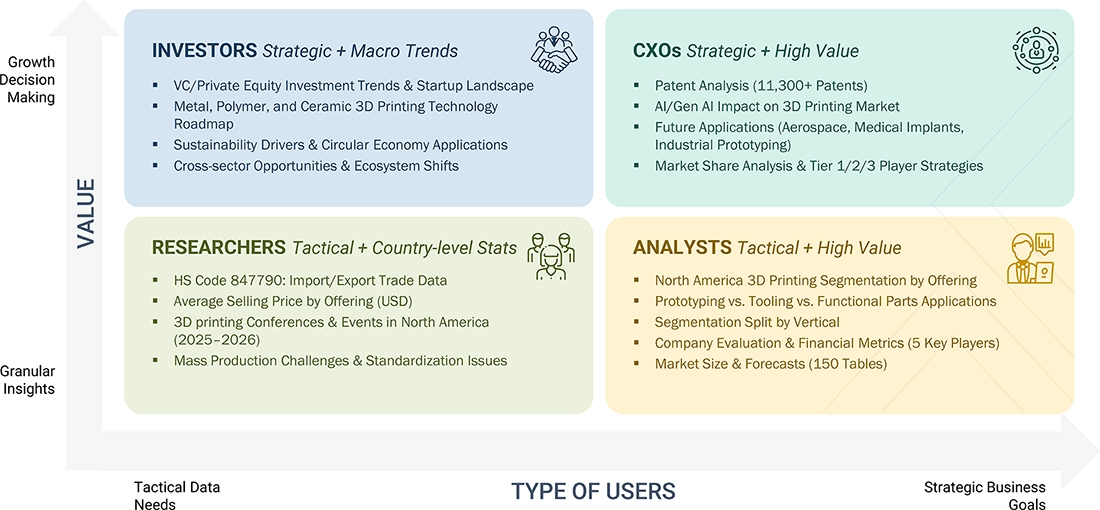
DELIVERED CUSTOMIZATIONS
We have successfully delivered the following deep-dive customizations:
| CLIENT REQUEST | CUSTOMIZATION DELIVERED | VALUE ADDS |
|---|---|---|
| Market Mapping of the 3D Printing Ecosystem | Profiled material, software, printer, and service segments; assessed technology adoption across key industries in the US and Canada | Delivers clarity on ecosystem structure and growth hotspots; supports targeted market-entry decisions |
| Benchmarking of Leading AM Vendors | Compared product capabilities, materials, industrial readiness, and customer penetration across major AM providers | Enhances competitive positioning and supports vendor/partner selection |
| Industry & Application Opportunity Assessment | Identified high-value applications across aerospace, healthcare, automotive, and industrial tooling; evaluated emerging AM use cases | Highlights ROI-driven opportunities and strengthens GTM focus |
| Pricing & Adoption Barrier Analysis | Benchmarked material and printer costs; analyzed certification challenges and production scalability issues | Supports pricing strategy and risk mitigation for regulated industries |
| Digital Manufacturing & AI Integration Impact | Assessed adoption of automation, AI, and cloud AM workflows; mapped their influence on production efficiency | Guides modernization strategies and supports future-ready AM investments |
RECENT DEVELOPMENTS
- December 2025 : Stratasys expanded the full commercial availability of its RadioMatrix radiopaque 3D printing material to the US, allowing healthcare providers and research institutions to create highly realistic, radiology-accurate anatomical models for CT imaging, training, and device testing. The material provides adjustable radiopacity and supports future medical imaging advancements.
- November 2025 : HP Development Company, L.P. launched the HP IF 600HT high-temperature filament 3D printer and previewed the larger IF 1000 XL system, marking its entry into filament-based additive manufacturing for aerospace, energy, automotive, and medical applications. The company also expanded its metal materials lineup with new nickel superalloys and introduced its Additive Manufacturing Network to cut part costs by 2026.
- November 2025 : Stratasys entered the metal 3D printing market through a strategic investment and a commercial partnership with Tritone Technologies, adding MoldJet metal and ceramic AM capabilities to its portfolio. This collaboration enhances Stratasys’ position as a full-spectrum AM provider and supports industrial-scale, production-grade metal part manufacturing.
- November 2025 : 3D Systems launched next-generation SLA solutions, including the high-productivity SLA 825 Dual printer with a larger build volume, the ArrayCast tool-less casting workflow, and new materials such as Accura SbF and Accura Xtreme Black. These advancements enhance performance for motorsports, aerospace, foundry applications, and prototyping, reinforcing the company’s leadership in photopolymer technologies.
Table of Contents
 Exclusive indicates content/data unique to MarketsandMarkets and not available with any competitors.
Methodology
The research process for this technical, market-oriented, and commercial study of the North America 3D Printing Market included the systematic gathering, recording, and analysis of data about companies operating in the market. It involved the extensive use of secondary sources, directories, and databases (Factiva, Oanda, and OneSource) to identify and collect relevant information. In-depth interviews were conducted with various primary respondents, including experts from core and related industries and preferred manufacturers, to obtain and verify critical qualitative and quantitative information as well as to assess the growth prospects of the market. Key players in the North America 3D Printing Market were identified through secondary research, and their market rankings were determined through primary and secondary research. This included studying annual reports of top players and interviewing key industry experts, such as CEOs, directors, and marketing executives.
Secondary Research
In the secondary research process, various secondary sources were used to identify and collect information for this study. These include annual reports, press releases, and investor presentations of companies, as well as whitepapers, certified publications, and articles from recognized associations and government publishing sources. Research reports from a few consortia and councils were also consulted to structure qualitative content. Secondary sources included corporate filings (such as annual reports, investor presentations, and financial statements); trade, business, and professional associations; white papers; Journals and certified publications; articles by recognized authors; gold-standard and silver-standard websites; directories; and databases. Data was also collected from secondary sources, such as the International Trade Centre (ITC) and the International Monetary Fund (IMF).
List of key secondary sources
|
Source |
Web Link |
|
NATIONAL INSTITUTE OF STANDARDS AND TECHNOLOGY |
https://www.nist.gov/additive-manufacturing |
|
US National Science Foundation |
https://new.nsf.gov/funding/opportunities/advanced-manufacturing-am |
|
US Government Accountability Office |
https://www.gao.gov/ |
|
The International Trade Administration, US Department of Commerce |
https://www.trade.gov/ |
|
US Department of Energy |
https://www.energy.gov/ |
|
US Department of Health & Human Services |
https://www.cdc.gov/niosh/index.htm |
|
European Commission |
https://commission.europa.eu/index_en |
|
National Institute of Advanced Industrial Science and Technology (AIST) |
https://www.aist.go.jp/index_en.html |
|
American Society for Testing and Materials (ASTM) |
https://www.astm.org/ |
|
CSA Group Testing & Certification Inc |
https://www.csagroup.org/ |
|
International Electrotechnical Commission (IEC) |
https://www.iec.ch/homepage |
|
The British Standards Institution |
https://www.bsigroup.com/en-IN/ |
|
Ministry of Economy, Trade and Industry |
https://www.meti.go.jp/english/ |
|
Additive Manufacturing Green Trade Association (AMGTA) |
https://amgta.org/ |
Primary Research
Extensive primary research was conducted after understanding and analyzing the North America 3D Printing Market scenario through secondary research. Approximately 30% of the primary interviews were conducted with the demand side, and 70% with the supply side. Primary data was collected through questionnaires, emails, and telephonic interviews. Various departments within organizations, such as sales, operations, and administration, were contacted to provide a holistic viewpoint in the report.
Market Size Estimation
In the complete market engineering process, top-down and bottom-up approaches and several data triangulation methods have been used to estimate and forecast the market size for the overall market segments and subsegments listed in this report. Extensive qualitative and quantitative analyses have been performed on the complete market engineering process to list the key information/insights throughout the report. The following table explains the process flow of the market size estimation.
The key players in the market were identified through secondary research, and their rankings in the respective regions were determined through primary and secondary research. This entire procedure involved the study of the annual and financial reports of top players, as well as interviews with industry experts such as chief executive officers, vice presidents, directors, and marketing executives, for quantitative and qualitative key insights. All percentage shares, splits, and breakdowns were determined using secondary sources and verified through primary sources. All parameters that affect the markets covered in this research study were accounted for, viewed in extensive detail, verified through primary research, and analyzed to obtain the final quantitative and qualitative data. This data was consolidated, supplemented with detailed inputs and analysis from MarketsandMarkets, and presented in this report.
Bottom-Up Approach
- Identifying the entities in the North America 3D Printing Market influencing the entire market, along with the related players, including material, printer, software, and service providers
- Analyzing major manufacturers of 3D printing systems, studying their portfolios, and understanding different types of printers, including desktop and industrial ones
- Analyzing the trends pertaining to the use of different types of 3D printers for different kinds of applications, technologies, and processes
- Tracking the ongoing and upcoming market developments, such as investments made, R&D activities, government support, product launches, collaborations, and partnerships, and forecasting the market based on these developments and other critical parameters
- Carrying out multiple discussions with key opinion leaders to understand the different types of printers and materials, services, verticals, technologies, and recent trends in the market, thereby analyzing the breakup of the scope of work carried out by major companies
- Arriving at the market estimates by analyzing revenues of the companies generated from each type of printer, material, software, and service, and then combining the same to get the market estimate
- Segmenting the overall market into various other market segments
- Verifying and cross-checking the estimate at every level from the discussion with key opinion leaders, such as CXOs, directors, and operations managers, and finally with the domain experts in MarketsandMarkets
- Studying various paid and unpaid sources of information, such as annual reports, press releases, white papers, and databases
Top-Down Approach
- Focusing initially on top-line investments and expenditures being made in the ecosystems of the North America 3D Printing Market
- Calculating the market size considering the revenues generated by players through the sales of 3D printers, materials, software, and services
- Further segmenting on the basis of R&D and key developments in key market areas
- Further segmenting on the basis of the mapping usage of 3D printing for different applications and verticals
- Building and developing the information related to the revenues generated by players through offerings
- Conducting multiple on-field discussions with key opinion leaders across major companies involved in the development of 3D printing technology
- Estimating the geographic split using secondary sources based on various factors such as the number of players in a specific country and region, the role of major players in the market for the development of innovative products, adoption and penetration rates in a particular country for various end-user applications, government support, investments, and others
Data Triangulation
After arriving at the overall size of the North America 3D Printing Market through the process explained above, the overall market has been split into several segments. Data triangulation procedures have been employed to complete the overall market engineering process and arrive at the exact statistics for all the segments, wherever applicable. The data has been triangulated by studying various factors and trends from both the demand and supply sides. The market has also been validated using both top-down and bottom-up approaches.
Market Definition
Three-dimensional (3D) printing is the process of building a real 3D object from a digital model by joining thin layers of materials (which might be in solid, powder, or liquid forms), usually layer upon layer in horizontal cross-section, unlike subtractive manufacturing methods. It is also known as additive manufacturing (AM) or freeform fabrication. 3D printing is the most common term in the consumer markets, while AM is mainly used in the industrial markets. 3D printing is used for prototyping, tooling, and functional part manufacturing. The manufactured functional parts are used in various verticals, such as automotive, aerospace, healthcare, jewelry, education, tooling, consumer goods, and art & architecture.
Key Stakeholders
- 3D printing product and solution providers
- 3D printing-related service providers
- 3D printing material and accessory providers
- 3D printing consulting companies
- 3D printing assembly companies
- 3D printing software providers
- 3D printing-related associations, organizations, forums, and alliances
- Government and corporate offices
- Venture capitalists, private equity firms, and start-up companies
- Distributors and traders
- End users willing to know more about 3D printing technologies and the latest technological developments in the North America 3D Printing Market
Report Objectives
- To define, describe, segment, and forecast the size of the North America 3D Printing Market , in terms of offering, technology, process, vertical, application, and region
- To give detailed information regarding drivers, restraints, opportunities, and challenges influencing the growth of the market
- To provide a value chain analysis, ecosystem analysis, case study analysis, patent analysis, Trade analysis, technology analysis, pricing analysis, key conferences and events, key stakeholders and buying criteria, Porter’s five forces analysis, investment and funding scenario, and regulations pertaining to the market
- To provide a detailed overview of the value chain analysis of the 3D printing ecosystem
- To strategically analyze micromarkets with regard to individual growth trends, prospects, and contributions to the total market
- To analyze opportunities for stakeholders by identifying high-growth segments of the market
- To strategically profile the key players, comprehensively analyze their market positions in terms of ranking and core competencies, and provide a competitive market landscape.
- To analyze strategic approaches such as product launches, acquisitions, agreements, and partnerships in the North America 3D Printing Market .
Available customizations:
With the given market data, MarketsandMarkets offers customizations according to the company’s specific needs. The following customization options are available for the report:
Company Information
- Detailed analysis and profiling of additional market players (up to seven)
Key Questions Addressed by the Report
What is the projected value of the North America 3D printing market?
The North America 3D printing market is projected to reach USD 12.02 billion by 2030 from USD 5.95 billion in 2025, growing at a CAGR of 15.1%
Which country dominates the North America 3D printing market?
The United States dominates the market, accounting for approximately 85.6% share in 2025.
Which segment leads the North America 3D printing market by offering?
The services segment is expected to hold a significant share of the North America 3D printing market by 2030.
Which application segment is expected to grow the fastest in the market?
The functional parts manufacturing segment is projected to grow at the highest CAGR of around 19.1% during the forecast period.
Who are the key players in the North America 3D printing market?
Key players in the market include Stratasys, HP Development Company, 3D Systems, EOS GmbH, General Electric, and Materialise.


Personalize This Research
- Triangulate with your Own Data
- Get Data as per your Format and Definition
- Gain a Deeper Dive on a Specific Application, Geography, Customer or Competitor
- Any level of Personalization
Let Us Help You
- What are the Known and Unknown Adjacencies Impacting the North America 3D Printing Market
- What will your New Revenue Sources be?
- Who will be your Top Customer; what will make them switch?
- Defend your Market Share or Win Competitors
- Get a Scorecard for Target Partners

Custom Market Research Services
We Will Customise The Research For You, In Case The Report Listed Above Does Not Meet With Your Requirements
Get 10% Free CustomisationTESTIMONIALS

Tetsuya Ohhira
Business Development Manager-Technology Business
Nikon Corporation,
Leading Japanese MNC specializing in optics and imaging productswww.nikon.com
MarketsandMarkets™ response
is quick. Their attitude is flexible and positive. Analyst Insights are globally considered and
significant. Client Services quickly respond to our inquiry and demand. Their wide range of global
surveys help us make our strategic plan.
We hope Knowledge Store will be easier to search
for a report.
VP - Marketing & Business Development
Leading Provider of Process Control Solutions
We engaged with MarketsandMarkets on a study to perform an analysis and recommend a Go-To-Market strategy for metrology and process control in the semiconductor market. The study was tailored to our targets and needs with well-defined milestones. Our overall experience with the MarketsandMarkets team was very good throughout the project in all aspects including the analysis methodologies used, the quality and depth of primary and secondary data sets, the professionalism and flexibility of the team and the ability to meet the target schedule and milestones. We want to thank MarketsandMarkets team for a job well done.






Growth opportunities and latent adjacency in North America 3D Printing Market