North America Crop Protection Chemicals Market

North America Crop Protection Chemicals Market by Type (Herbicides, Insecticides, Fungicides & Bactericides), Origin (Synthetic, Biopesticides), Formulation, Mode Of Application (Foliar, Seed Treatment, Soil Treatment), Crop Type - Forecast To 2030




OVERVIEW

Source: Secondary Research, Interviews with Experts, MarketsandMarkets Analysis
The North America crop protection chemicals market is projected to reach USD 22.26 billion by 2030 from USD 16.90 billion in 2025, at a CAGR of 5.7%. The North America market is under increasing pressure, with rising pests and diseases in major crops, together with intensive farming practice-adoption trends, which have driven the demand. Herbicides, insecticides, fungicides, and advances in formulation technologies, seed treatments, and precision application methods further sustain market growth across the region.
KEY TAKEAWAYS
-
BY COUNTRYThe US accounted for the dominant revenue share of around 80% in 2024 in the North America crop protection chemicals market.
-
BY TYPEBy type, the fungicides & bactericides segment is estimated to register the highest CAGR of 6.3% in 2025-2030.
-
BY MODE OF APPLICATIONBy mode of application type, the seed treatment segment is projected to register the highest CAGR of 6.2%.
-
BY FORMULATIONBy formulation type, the liquid segment is projected to grow at the fastest rate from 2025 to 2030.
-
BY CROP TYPEBy crop type segment, the cereals & grains segment is estimated to lead the market.
-
BY ORIGINSynthetic crop protection chemicals is projected to grow at the fastest rate from 2025 to 2030.
-
COMPETITIVE LANDSCAPE - KEY PLAYERSCompanies such as BASF SE, Bayer AG, FMC Corporation, and Syngenta Group were identified as some of the star players in the North America crop protection chemical market, given their strong market share and product footprint.
-
COMPETITIVE LANDSCAPE - STARTUPSMarrone Bio Innovations, Inc., Helena Agri-Enterprises, and American Vanguard Corporation have distinguished themselves among startups and SMEs by securing strong footholds in specialized niche areas, underscoring their potential as emerging market leaders.
The North America crop protection chemicals market is experiencing strong growth, driven by increasing pest and weed resistance, climate-induced disease pressure, and the need to protect yield across large-scale commercial farming systems. Continued innovation of herbicides, insecticides, and fungicides, along with rising adoption of precision agriculture, seed treatments, and integrated pest management practices, further supports market expansion across the region.
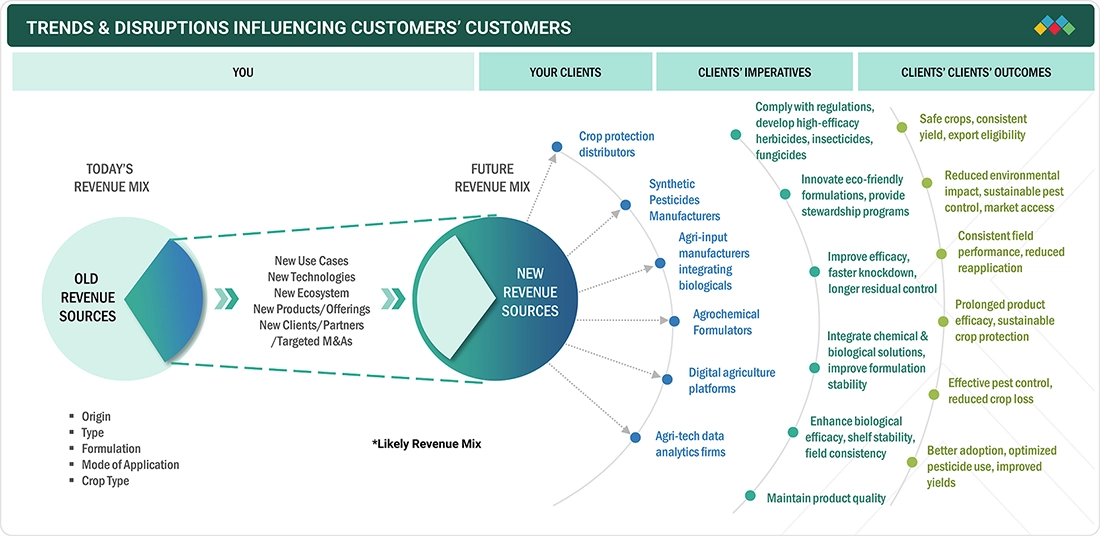
TRENDS & DISRUPTIONS IMPACTING CUSTOMERS' CUSTOMERS
A key trend in the North America market is the growing focus on the use of reduced-risk and integrated crop protection products. Farmers are increasingly resorting to the use of a combination of traditional insecticides, biologicals, seed treatments, and precision delivery systems to improve efficiency and align with regulatory and sustainability requirements. This has been driven by the need for resistance management, reduced concentrations of residues, and the increasing popularity of eco-friendly agriculture, which forced the industry to innovate, produce more precise products, and combine chemical and biological lines tailored to the requirements of crops in specific geographic locations.
Source: Secondary Research, Interviews with Experts, MarketsandMarkets Analysis
MARKET DYNAMICS

Level
-
Large-scale row-crop farming to sustain strong chemical protection demand

-
Integrated crop protection programs drive consistent chemical usage


Level
-
Stringent EPA and PMRA regulations restrict active ingredient availability

-
Input cost inflation and channel destocking pressure near-term sales


Level
-
Growing biological and seed-treatment adoption complements chemical portfolios

-
Precision agriculture enables optimized chemical application and premium products


Level
-
Rising weed and pest resistance reduces effectiveness of existing chemistries

-
Supply-chain disruptions impact formulation, distribution, and inventory stability

Source: Secondary Research, Interviews with Experts, MarketsandMarkets Analysis
Driver: Large-scale row-crop farming to sustain strong chemical protection demand
Heavy demand due to large-scale farming of crops to control weeds, pests, and diseases on a massive scale. Crops like corn, soybeans, wheat, and cotton need to be constantly protected with herbicides, insecticides, and fungicides to secure crop development. Factors like the need to increase the use of machinery and give utmost importance to crop output help to maintain public acceptance of crop protection on a large scale.
Restraint: Stringent EPA and PMRA regulations restrict active ingredient availability
Ongoing re-registration reviews, but also increasingly stricter residue limits coupled with advancing and developing environmental risk assessments, which can entail compliance costs as well as label restrictions or withdrawal of some chemistries. The above constraints further limit the available options for growers and would slow the introduction of new active ingredients throughout the United States and Canada.
Opportunity: Growing biological and seed-treatment adoption complements chemical portfolios
The growing acceptance of biologicals and seed treatment solutions creates the best potential for the North American crop protection chemicals market, coming as an add-on to conventional chemical portfolios. Producing biologicals and seed-applied chemistries enables early pest and disease control, reduced repetition in foliar applications, and more resistance management strategies. By combining these solutions, manufacturers can provide more complete, sustainable crop protection offerings that are compliant with regulatory expectations and evolving grower preferences.
Challenge: Rising weed and pest resistance reduces effectiveness of existing chemistries
Increasing resistance among weeds and pests, making traditional products and modes of action less effective, is one of the biggest challenges faced by the crop protection chemicals industry in the North American market. The over-reliance on the same modes of action has caused the weeds and insects to become resistant, thus increasing the costs involved in their control.
NORTH AMERICA CROP PROTECTION CHEMICALS MARKET: COMMERCIAL USE CASES ACROSS INDUSTRIES
| COMPANY | USE CASE DESCRIPTION | BENEFITS |
|---|---|---|
 |
Integrated use of chemical insecticides and biological solutions in corn and soybean systems | Enhances targeted pest control, supports resistance management, and sustains row-crop yields |
 |
Fungicides and complementary biological products in fruits and vegetables | Strengthens disease management, improves produce quality, and meets residue compliance standards |
 |
Advanced fungicides and seed-applied chemical treatments in cereals and grains | Improves early-stage protection, enhances plant vigor, and ensures consistent field performance |
 |
Selective insecticides and herbicides applied in row and specialty crops | Controls resistant pests effectively while supporting integrated pest management programs |
Logos and trademarks shown above are the property of their respective owners. Their use here is for informational and illustrative purposes only.
MARKET ECOSYSTEM
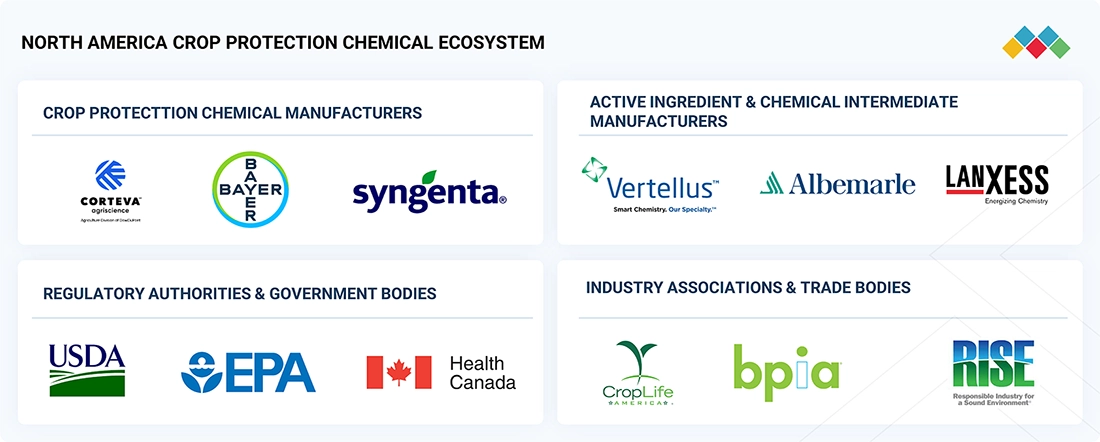
Some of the prominent companies in this market include well-established and financially sound manufacturers of crop protection chemical products. These companies have been operational in the market for over a decade and have diversified portfolios, latest technologies, and excellent global sales and marketing networks. The North American crop protection chemical ecosystem comprises manufacturers, regulatory bodies, and end users. Key manufacturers like Corteva Agriscience, UPL Limited, Certis Biologicals, and BASF have a strong presence in North America.
Logos and trademarks shown above are the property of their respective owners. Their use here is for informational and illustrative purposes only.
MARKET SEGMENTS
Source: Secondary Research, Interviews with Experts, MarketsandMarkets Analysis
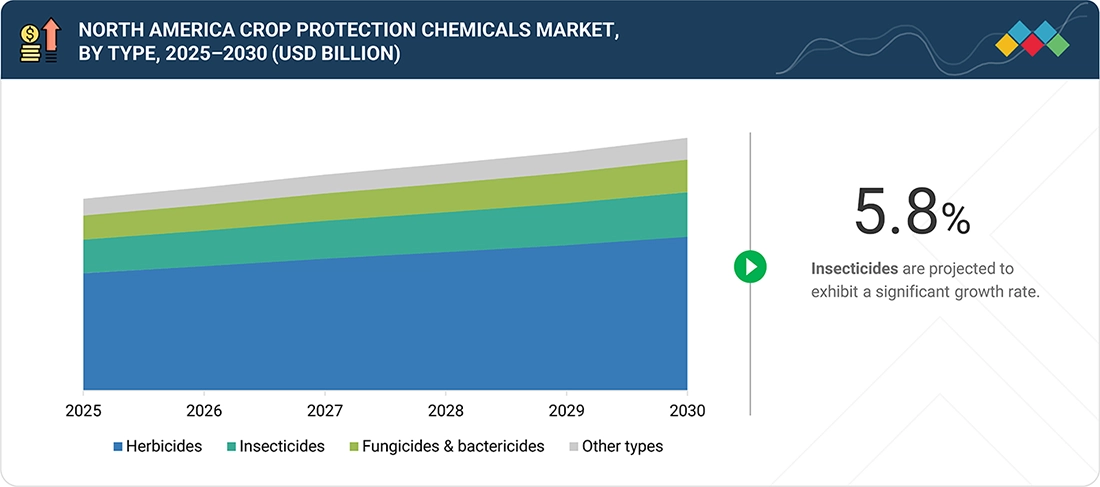
North America Crop Protection Chemicals Market, by Type
In North America, crop protection chemicals constitute four major segments: herbicides, insecticides, fungicides, and bactericides. Herbicides account for the largest share of the market, supported by prevalent cultivation of row crops and the need for control of resistant weed species across corn, soybean, and wheat acreage. Insecticides find a great extent of use in controlling increasing insect pressure arising from climate variability and intensive agricultural practices. Fungicides and bactericides are critical in preventing crop losses due to diseases, particularly in cereals, fruits, and vegetables. Current trends, including an emphasis on resistance management, sophisticated formulation technologies, and subsequent integration with biological solutions, are, therefore, continuing to mold demand across all product types.
North America Crop Protection Chemicals Market, by Mode of Application
The North America crop protection chemicals market is segmented by the mode of application: seed treatment, soil treatment, and foliar application. Foliar application dominates the market because of its flexibility and efficiency to manage in-season weed, pest, and disease outbreaks across row and specialty crops. Seed treatment is gaining popularity because of its early-stage protection, increase in crop establishment, and reduction in the need for multiple foliar sprays. Soil treatment is used to manage soil-borne pests, diseases, and nematodes, especially in high-value crops. Advancements in formulation technology and precision application tools are enhancing the efficacy of and adoption for all application modes on a continuous basis.
North America Crop Protection Chemicals Market, by Formulation
The North America crop protection chemicals market segment by formulation has been broadly categorized into liquid formulations and solid formulations. Liquid formulations backed up their larger proportion of ease of handling, uniform coverage, and compatibility with modern spraying equipment and precision application systems. These formulations are well-suited for foliar and soil applications among both row and specialty crops. On the other hand, solid formulations in the form of powders and granules would be preferred for seed treatments and certain particular applications in the soil where controlled release and stabilization were needed. Continuous advancements in formulation stability, dispersion, and safety put forward demand for both types.
North America Crop Protection Chemicals Market, by Origin
The North America crop protection chemicals market segment is dominated by synthetic chemicals. Synthetic crop protection chemicals tend to dominate the market for these reasons: proven efficacy, broad spectrum of activity, and reliability on a large scale in row crop farming. Biopesticides are gaining ground because of regulatory pressure to adopt microbial, biochemical, and botanical solutions; concern about resistance; and sustainability goals. The increasing integration of biopesticides in IPM programs with conventional chemistries has changed the composition of product portfolios as well as helped in achieving a balanced growth of the market.
North America Crop Protection Chemicals Market, by Crop Type
Cereals & grains, oilseeds & pulses, and fruits & vegetables are the categories found in the North America crop protection chemicals market. There is a high share for cereals and grains because a large area is being planted in corn, wheat, and barley, which in turn causes a high demand for herbicides and fungicides. Oilseeds and pulses, especially soybean and canola, benefit from integrated weed and pest management programs to safeguard the yield. Fruits and vegetables were the most lucrative category because they are usually associated with high insecticidal and fungicidal applications to meet quality and residue standards.
REGION
US to be the fastest-growing country in the North America crop protection chemicals market during the forecast period
The fastest-growing country in the North America market for crop protection chemicals is projected to be the US, since growing resistance in weeds, rising pests, pressure from diseases, and the need for yield protection in extensive row-cropping systems account for an increasing demand for the chemicals. The adoption of new active molecules of advanced herbicides, insecticides, and fungicides, alongside the rapid uptake of seed treatments and precision application technologies, is therefore pushing the market forward. Continuous innovation of products, strong investment into research and development, and increasingly wider use of integrated pest management practices are additionally strengthening the growth prospects across the major US agricultural regions.

NORTH AMERICA CROP PROTECTION CHEMICALS MARKET: COMPANY EVALUATION MATRIX
Star players such as Corteva Agriscience have expansive portfolios, significant brand visibility, and substantial market influence, while emerging leaders like Nufarm Limited are expanding rapidly in North America with innovative, eco-friendly crop protection solutions. Participants maintain steady operations, and pervasive players hold moderate market presence.

Source: Secondary Research, Interviews with Experts, MarketsandMarkets Analysis
KEY MARKET PLAYERS
- Bayer AG (Germany)
- BASF SE (Germany)
- Corteva Agriscience (US)
- Syngenta Group (Switzerland)
- FMC Corporation (US)
- UPL Limited (India)
- ADAMA Agricultural Solutions Ltd. (Israel)
- Nufarm Limited (Australia)
- Sumitomo Chemical Co., Ltd. (Japan)
- Albaugh LLC (US)
- Gowan Company (US)
- American Vanguard Corporation (US)
- Marrone Bio Innovations, Inc. (US)
- Helena Agri-Enterprises, LLC (US)
- AMVAC Chemical Corporation (US)
MARKET SCOPE
| REPORT METRIC | DETAILS |
|---|---|
| Market Size, 2024 (Value) | USD 15.98 Billion |
| Market Forecast, 2030 (Value) | USD 22.26 Billion |
| Growth Rate | CAGR of 5.7% during 2025 to 2030 |
| Years Considered | 2020–2030 |
| Base Year | 2024 |
| Forecast Period | 2025–2030 |
| Units Considered | Value (USD Million/Billion) |
| Report Coverage | Revenue Forecast, Company Ranking, Competitive Landscape, Growth Factors, and Trends |
| Segments Covered |
|
| Countries Covered | US, Mexico, Canada |
WHAT IS IN IT FOR YOU: NORTH AMERICA CROP PROTECTION CHEMICALS MARKET REPORT CONTENT GUIDE

DELIVERED CUSTOMIZATIONS
We have successfully delivered the following deep-dive customizations:
| CLIENT REQUEST | CUSTOMIZATION DELIVERED | VALUE ADDS |
|---|---|---|
| North America–based Crop Protection Manufacturer |
|
|
| Global Agrochemical Multinational |
|
|
| North America–based Agribusiness/Agritech Firm |
|
|
| Regional Distributor/Formulator |
|
|
| Investor/Private Equity Firm |
|
|
RECENT DEVELOPMENTS
- January 2025: Corteva Agriscience launched Enversa as a novel preemergent herbicide used prior to planting soybean crops; the product was designed to use a unique encapsulation technique to prolong the effectiveness of acetochlor on both broadleaf and grass weeds.
- March 2025: Corteva Agriscience also announced two new postemergence herbicides for use in soybean production: Kyber Pro and Sonic Boom, which have multiple modes of action and extended residual weed control; both products have been shown to control resistant weed populations.
- April 2025: Syngenta Group launched the CruiserMaxx Vibrance Elite seed treatment, which combined fungicides and insecticides to help enhance seedling development early in the growing season, as well as provide protection against soil-borne diseases and insect pests to cereals.
- December 2024: BASF SE continued the trend of innovation through product launches, focusing on crop health with their Zorina Fungicide, which provided a wide variety of disease control options for several key crops and supports producers in controlling disease more effectively over time.
Table of Contents
 Exclusive indicates content/data unique to MarketsandMarkets and not available with any competitors.
Methodology
The study involved four major activities in estimating the current size of the North America Crop Protection Chemicals market. Exhaustive secondary research was done to collect information on the market, peer, and parent markets. The next step was to validate these findings, assumptions, and sizing with industry experts across the value chain through primary research. Both top-down and bottom-up approaches were employed to estimate the complete market size. After that, market breakdown and data triangulation were used to estimate the market size of segments and subsegments.
Secondary Research
This research study involved the extensive use of secondary sources—directories and databases such as Bloomberg Businessweek and Factiva—to identify and collect information useful for a technical, market-oriented, and commercial study of the North America Crop Protection Chemicals market.
In the secondary research process, various sources such as annual reports, press releases & investor presentations of companies, white papers, certified publications, articles from recognized authors, gold & silver standard websites, directories, and databases were referred to identify and collect information. This research study involved the extensive use of secondary sources—directories and databases such as Bloomberg Businessweek and Factiva—to identify and collect information useful for a technical, market-oriented, and commercial study of the North America Crop Protection Chemicals market.
Secondary research was mainly used to obtain key information about the industry’s supply chain, the total pool of key players, and market classification and segmentation as per the industry trends to the bottom-most level, regional markets, and key developments from both market- and technology-oriented perspectives.
Primary Research
Extensive primary research was conducted after obtaining information regarding the North America Crop Protection Chemicals market scenario through secondary research. Several primary interviews were conducted with market experts from both the demand and supply sides across North America. Primary data was collected through questionnaires, emails, and telephonic interviews. The primary sources from the supply side included various industry experts, such as Chief X Officers (CXOs), Vice Presidents (VPs), Directors from business development, marketing, research, and development teams, and related key executives from distributors and key opinion leaders. Primary interviews were conducted to gather insights such as market statistics, data on revenue collected from the products and services, market breakdowns, market size estimations, market forecasting, and data triangulation. Primary research also helped in understanding the various trends related to mode of application, crop type, type, form, origin, and region.
North America Crop Protection Chemicals Market Size Estimation
Both the top-down and bottom-up approaches were used to estimate and validate the total size of the North America Crop Protection Chemicals Market. These approaches were also used extensively to estimate the size of various dependent submarkets. The research methodology used to estimate the market size includes the following:
- Key players were identified through extensive secondary research.
- Primary and secondary research determined the industry’s value chain and market size.
- All percentage share splits and breakdowns were determined using secondary sources and verified through primary sources.
- All the possible parameters that affect the markets covered in this research study were accounted for, viewed in extensive detail, verified through primary research, and analyzed to obtain the final quantitative and qualitative data.
- The following figure provides an illustrative representation of the complete market size estimation process implemented in this research study for an overall estimation of the North America Crop Protection Chemicals market in a consolidated format.
The following sections (bottom-up & top-down) depict the overall market size estimation process employed for the purpose of this study.
Data Triangulation
After arriving at the overall market size from the estimation process explained above, the total market was split into several segments and subsegments. Data triangulation and market breakdown procedures were employed, wherever applicable, to estimate the overall North America Crop Protection Chemicals market and arrive at the exact statistics for all segments and subsegments. The data was triangulated by studying various factors and trends from the demand and supply sides. The market size was also validated using both the top-down and bottom-up approaches.
Market Definition
According to FAO, a crop protection chemical means a pesticide product intended to prevent, destroy, or control any pest causing harm during or otherwise interfering with the production, processing, storage, transport /or marketing of food, agricultural commodities, and wood and wood products.
Crop Protection Chemicals are used to protect crops from diseases, pests, and unwanted weeds & grasses, ultimately resulting in better yield. These chemicals include fungicides, herbicides, insecticides, nematicides, and other such chemicals that can either be synthetically or naturally produced. Crop Protection Chemicals are preferred over seed treatment chemicals and genetically modified (GM) crops because of their high effectiveness and easy application. Crop Protection Chemicals can be used in liquid or solid form and are widely applied to cereals & oilseeds and fruits & vegetables. They are mainly applied through seed treatment, soil treatment, and foliar spray.
Key Stakeholders
- Crop protection chemical manufacturers
- Crop protection chemical importers and exporters
- Crop protection chemical traders, distributors and suppliers
- Pesticides manufacturers
- Research institutes and organizations
- Government bodies, venture capitalists, and private equity firms
-
Regulatory Bodies
- World Health Organization (WHO)
- European Crop Protection Agency (ECPA)
- Pesticides Manufacturers and Formulators Association (PMFAI)
- China Crop Protection Industry Association (CCPIA)
- Food and Agriculture Organization (FAO)
- US Department of Agriculture (USDA)
- Institute of Food and Agricultural Sciences (IFAS)
- US Environmental Protection Agency (US EPA)
- Organization for Economic Co-operation and Development (OECD)
- Federal Office of Consumer Protection and Food Safety
- European Food Safety Authority
- Ministry of Agriculture & Farmers Welfare
- Department Of Agriculture, Cooperation & Farmers Welfare
- Directorate Of Plant Protection, Quarantine & Storage
- Commercial Research & Development (R&D) Institutions and Financial Institutions
Report Objectives
Market Intelligence
- To determine and project the size of the North America Crop Protection Chemicals market with respect to the mode of application, type, form, origin, crop type, and region, over five years, ranging from 2024 to 2029.
- To identify the attractive opportunities in the market by determining the largest and fastest-growing segments across the key regions
-
To analyze the demand-side factors based on the following:
- Impact of macro-and micro-economic factors on the market
- Shifts in demand patterns across different subsegments and regions.
Competitive Intelligence
- Identifying and profiling the key players in the North America Crop Protection Chemicals market
-
Providing a comparative analysis of market leaders based on the following:
- Product offerings
- Business strategies
- Strengths and weaknesses
- Key financials
- Understanding the competitive landscape and identifying the major growth strategies players across the country adopt.
- Providing insights on key product innovations and investments in the North America Crop Protection Chemicals market.
Available Customizations:
With the given market data, MarketsandMarkets offers customizations according to company-specific scientific needs.
The following customization options are available for the report:
Product Analysis
- Product Matrix, which gives a detailed comparison of the product portfolio of each company.
Geographic Analysis
With the given market data, MarketsandMarkets offers customizations according to company-specific scientific needs.
- Further breakdown of the Rest of Europe into Belgium, Luxemburg, the Czech Republic, Denmark, Greece, Ireland, Hungary, the Netherlands, Austria, Portugal, Slovenia, Finland, and Sweden.
- Further breakdown of the Rest of Asia Pacific into New Zealand, Vietnam, Thailand, Oceania (tropical Pacific islands), and South Korea.
- Further breakdown of the Rest of South America into Paraguay, Ecuador, Peru, and Chile.
Company Information
- Detailed analyses and profiling of additional market players (up to five)


Personalize This Research
- Triangulate with your Own Data
- Get Data as per your Format and Definition
- Gain a Deeper Dive on a Specific Application, Geography, Customer or Competitor
- Any level of Personalization
Let Us Help You
- What are the Known and Unknown Adjacencies Impacting the North America Crop Protection Chemicals Market
- What will your New Revenue Sources be?
- Who will be your Top Customer; what will make them switch?
- Defend your Market Share or Win Competitors
- Get a Scorecard for Target Partners

Custom Market Research Services
We Will Customise The Research For You, In Case The Report Listed Above Does Not Meet With Your Requirements
Get 10% Free CustomisationTESTIMONIALS

Business Innovation Director
US Based Leading Agribusiness,
Food and Ingredients ManufacturerI highly appreciate the team's efficiency for a well conducted study that helped us clarify some blind spots in food and agricultural niche markets. Although compiling information for B2B markets is very difficult, the MnM team pulled out the task successfully. The quality of research, level of insights, and responsiveness of team were commendable.






Growth opportunities and latent adjacency in North America Crop Protection Chemicals Market