North America Food Encapsulation Market

North America Food Encapsulation Market by Shell Material (Lipids, Polysaccharides, Emulsifiers, Proteins), Technology (Microencapsulation, Nanoencapsulation, Hybrid Encapsulation), Application, Method, Core Phase, and Region - Forecast to 2030




OVERVIEW
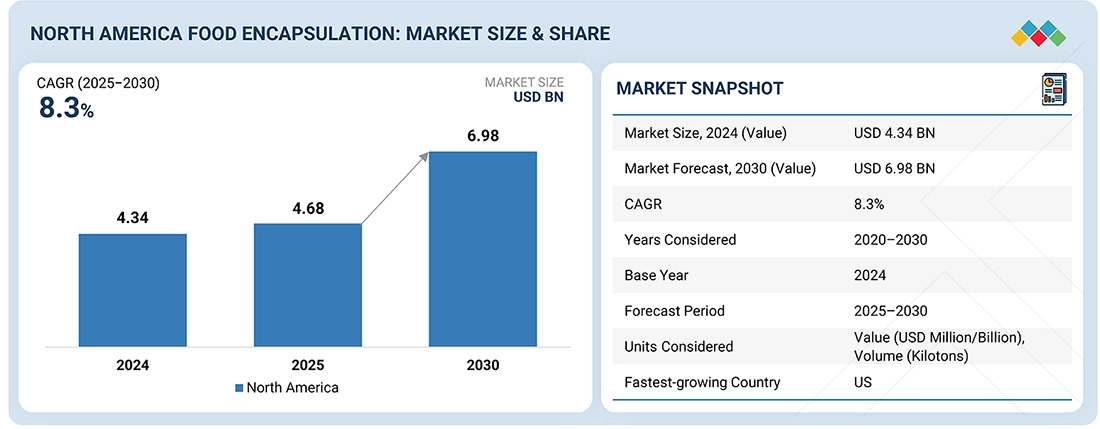
Source: Secondary Research, Interviews with Experts, MarketsandMarkets Analysis
The North America food encapsulation market is estimated to be valued at USD 4.68 billion in 2025 and is projected to reach USD 6.98 billion by 2030, growing at a CAGR of 8.3%. The market for food encapsulation is experiencing steady growth due to an increasing demand for systems designed to protect sensitive ingredients. These encapsulation technologies are employed by businesses to regulate the release of flavors, nutrients, and active compounds while also extending product shelf life. In North America, there is significant demand for functional foods, dietary supplements, beverages, baked goods, and dairy products. Food manufacturers implement encapsulation techniques to mitigate the presence of bitter or undesirable flavors and to enhance the stability of ingredients. Additionally, this technology enables them to comply with clean-label standards and improve overall product quality. As consumer interest in fortified and health-conscious foods continues to rise, the North American food industry is increasingly adopting advanced technologies, including spray drying, emulsification, and lipid-based systems.
KEY TAKEAWAYS
-
BY COUNTRYThe US dominated the North America food encapsulation market, with a substantial share of 71.22% in 2024.
-
BY CORE PHASEBy core phase, the vitamins & minerals segment is projected to lead the market during the forecast period.
-
BY TECHNOLOGYBy technology, the nanoencapsulation segment is projected to register the highest CAGR during the forecast period.
-
BY SHELL MATERIALBy shell material, polysaccharides dominated the market in 2024 with 47.19%
-
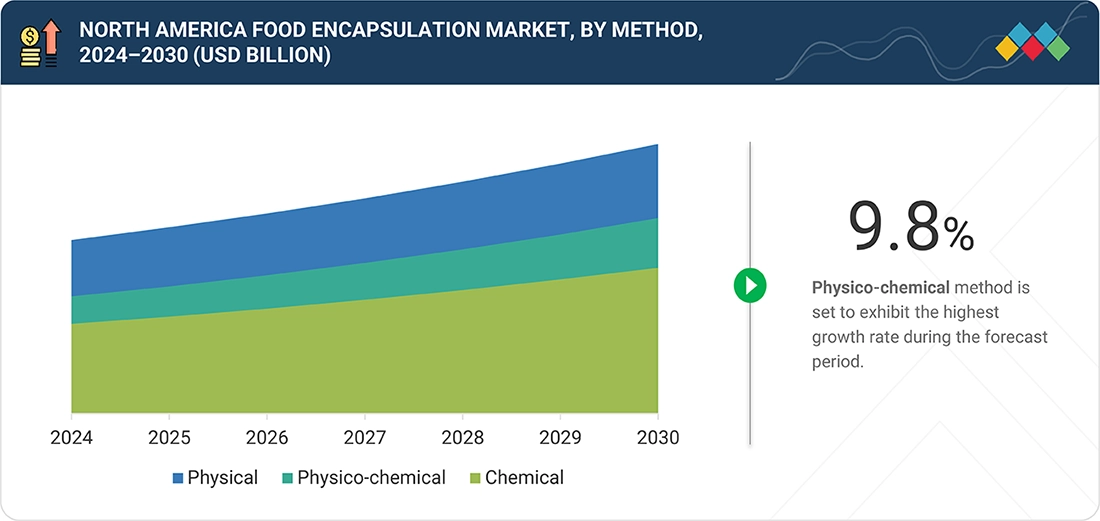
BY METHODBy method, the physico-chemical method segment is projected to lead the market at a CAGR of 9.8%.
-
BY APPLICATIONThe functional food products segment is projected to lead the market during the forecast period
-
COMPETITIVE LANDSCAPE - KEY PLAYERSKey players in the North America food encapsulation market include Cargill, Incorporated, Ingredion, Sensient Technologies Corporation, Balchem Corporation, and Encapsys LLC, supported by strong encapsulation expertise and established relationships with food & beverage manufacturers across North America.
-
COMPETITIVE LANDSCAPE - STARTUPS/SMESEmerging companies in the North America food encapsulation market include Aveka Group and Microtek Laboratories, Inc., which are strengthening their position through focused encapsulation expertise and growing engagement in food, nutrition, and functional ingredient applications.
The North America food encapsulation market is estimated to be valued at USD 4.68 billion in 2025 and is projected to reach USD 6.98 billion by 2030, growing at a CAGR of 8.3%. The market is poised for growth due to rising demand for stable, controlled-release food ingredients. Manufacturers are using encapsulation to improve shelf life, flavor, and nutrient delivery in functional foods, beverages, and supplements. An emphasis on clean labeling and quality is boosting market adoption, particularly in bakery products, dairy, and supplements. Ongoing investments in scalable encapsulation technologies will support long-term growth in North America.
TRENDS & DISRUPTIONS IMPACTING CUSTOMERS' CUSTOMERS
The current revenue model is focused on traditional food & beverage applications, but growth is expected to emerge from new use cases, advancements in encapsulation technologies, product enhancements, strategic partnerships, and targeted expansions. This shift will lead to emerging applications capturing a larger share of revenue, driven by innovations in encapsulation techniques and material selection. Customers across food, beverage, dietary supplements, animal nutrition, and wellness sectors are increasingly prioritizing clean labeling, food safety, ingredient protection, and sustainability. These trends are resulting in longer shelf life, reduced synthetic additives, improved product performance, and enhanced compatibility in various applications, thereby transforming the North American food encapsulation value chain.
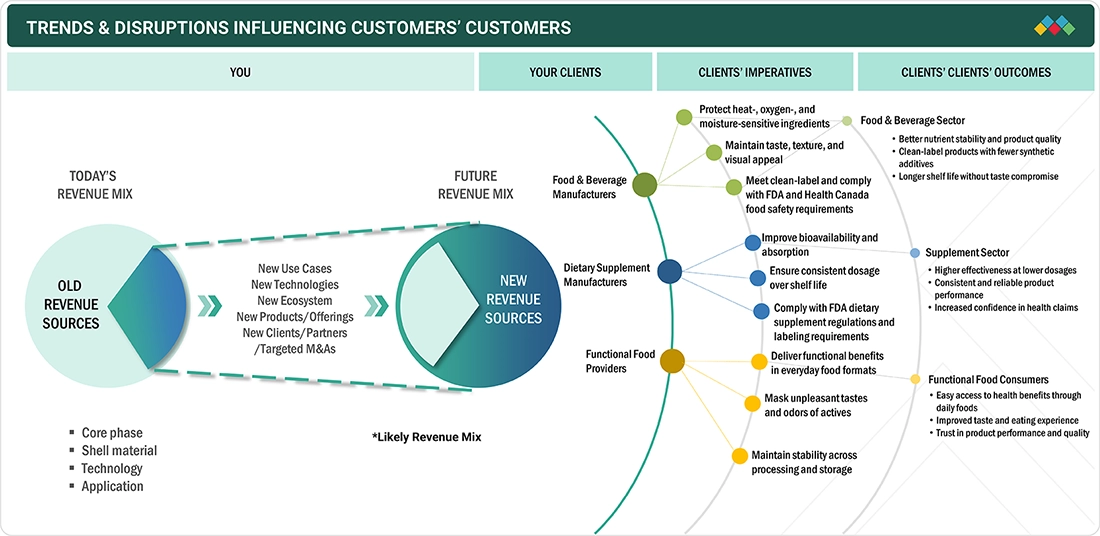
Source: Secondary Research, Interviews with Experts, MarketsandMarkets Analysis
MARKET DYNAMICS

Level
-
Rising demand for functional foods, dietary supplements, and fortified beverages

-
High use of encapsulation to improve ingredient stability, shelf life, and controlled release in processed foods


Level
-
High production and formulation costs associated with advanced encapsulation technologies

-
Limited awareness and adoption among small and mid-sized food producers due to cost and technical complexity


Level
-
Rising demand for clean-label, plant-based, and functional ingredients

-
Growth in personalized nutrition, sports nutrition, and nutraceutical-infused food products


Level
-
Balancing clean-label expectations with technical performance

-
Scaling production while keeping costs competitive

Source: Secondary Research, Interviews with Experts, MarketsandMarkets Analysis
Driver: Rising demand for functional foods, dietary supplements, and fortified beverages
The rising demand for functional and fortified foods in North America is fueling the growth of the food encapsulation market, as consumers look for products that enhance immunity, digestion, energy, and overall health. Manufacturers are incorporating active nutrients like probiotics, vitamins, and minerals, which can lose effectiveness when exposed to heat, light, oxygen, or moisture. Food encapsulation protects these nutrients during production and storage while also masking undesirable tastes, allowing for controlled nutrient release in the body. This trend is encouraging more food companies to adopt encapsulation technologies to ensure product consistency and meet health claims.
Restraint: High production and formulation costs associated with advanced encapsulation technologies
High production and formulation costs represent a significant constraint on the growth of the North American food encapsulation market. The implementation of advanced encapsulation techniques necessitates the use of expensive raw materials, specialized processing setups, and sophisticated equipment. Furthermore, companies incur substantial expenditures on formulation development, trials, and scale-up evaluations to ensure compliance with the stringent food safety regulations in North America. These requisite steps elevate both initial and ongoing expenses. As a result, numerous small and mid-sized food manufacturers are inclined to delay or forego the adoption of these technologies. This hesitation consequently limits broader utilization and impedes market growth across the region.
Opportunity: Rising demand for clean-label, plant-based, and functional ingredients
The North America food encapsulation market presents a significant opportunity driven by the rising demand for clean-label, plant-based, and functional ingredients. Consumers increasingly prefer products with fewer additives and transparent labels that deliver genuine health benefits. While companies are utilizing natural ingredients for vitamins and probiotics, these can negatively impact taste. Encapsulation effectively protects active ingredients, masks unpleasant flavors, and maintains clean labels, while also extending shelf life and enabling controlled release. As a result, encapsulation is a viable solution for brands developing health-oriented products such as beverages, snacks, dairy alternatives, and nutritional items.
Challenge: Scaling production while keeping costs competitive
The challenge of scaling production while maintaining competitive costs is a pertinent issue within the North American food encapsulation market. As demand continues to increase, it is imperative for suppliers to enhance production capabilities without elevating unit costs. The consistency and reliability of encapsulation processes must be upheld, even as production volumes rise. This often necessitates the acquisition of new equipment and modifications to existing processes. Concurrently, food companies anticipate a stable supply at competitive pricing. The delicate balance of fostering growth while safeguarding profit margins remains a significant barrier to broader market adoption.
NORTH AMERICA FOOD ENCAPSULATION MARKET: COMMERCIAL USE CASES ACROSS INDUSTRIES
| COMPANY | USE CASE DESCRIPTION | BENEFITS |
|---|---|---|
 |
Uses encapsulated probiotics, vitamins, and minerals in yogurts and fermented dairy products to protect active ingredients during processing and refrigerated shelf life | Maintains probiotic viability, improves nutrient stability, and supports functional health positioning |
 |
Uses encapsulated vitamins, minerals, and flavor systems in breakfast cereals and fortified food products | Prevents nutrient degradation during extrusion and baking and ensures consistent nutrient delivery |
 |
Applies encapsulated flavors, sweeteners, and functional ingredients in beverages and nutrition-focused drink brands | Improves flavor stability, masks bitterness, and enables controlled release in liquid formulations |
 |
Applies encapsulated flavors, sweeteners, and functional ingredients in beverages and nutrition-focused drink brands | Protects sensitive ingredients, improves shelf life, and supports targeted nutrition claims |
Logos and trademarks shown above are the property of their respective owners. Their use here is for informational and illustrative purposes only.
MARKET ECOSYSTEM
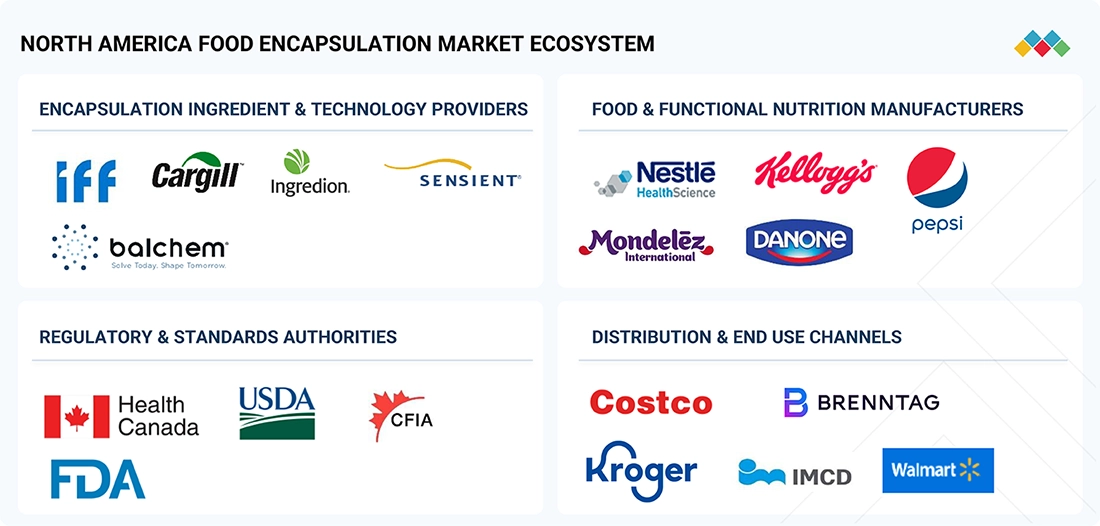
The food encapsulation market in North America functions as a dynamic ecosystem where various stakeholders, including ingredient suppliers, delivery system providers, manufacturers, regulatory bodies, and retailers, play critical roles in enhancing product quality and innovation. These stakeholders work collaboratively to protect delicate food ingredients and facilitate controlled release, which ultimately contributes to longer shelf life and improved taste stability. Through successful encapsulation techniques, they provide fortified foods, beverages, dietary supplements, and processed products that meet the evolving demands of consumers focused on health and wellness. At the core of this ecosystem are ingredient suppliers and delivery system providers, whose innovations enable food and functional nutrition manufacturers to create consistent and high-quality products. These manufacturers, in turn, rely on established relationships with distributors and retailers to effectively bring encapsulated ingredients and finalized food products to market. Regulatory bodies, such as the US Food and Drug Administration (FDA), the US Department of Agriculture (USDA), Health Canada, and the Canadian Food Inspection Agency (CFIA), establish a strict framework governing food safety, additives, labeling, and the approval of novel ingredients. Their oversight ensures that all stakeholders operate within a compliant environment that prioritizes consumer safety and trust. By working in tandem, these stakeholders not only drive advancements in encapsulation technology but also support a robust market where innovation can thrive, ultimately enhancing the consumer experience in North America's food landscape.
Logos and trademarks shown above are the property of their respective owners. Their use here is for informational and illustrative purposes only.
MARKET SEGMENTS
Source: Secondary Research, Interviews with Experts, MarketsandMarkets Analysis
North America Food Encapsulation Market, by Core Phase
Vitamins and minerals are vital core phase components in the North America food encapsulation market, due to their prevalence in functional foods, supplements, and fortified products. These nutrients are susceptible to degradation from heat, light, air, or moisture, making encapsulation essential for preserving their efficacy during manufacturing, storage, and transport. This process also enhances absorption and controlled release in the body, which is crucial for products that make nutritional claims. Given the stringent regulations on nutrient levels and the high demand for fortified foods, encapsulated vitamins and minerals are widely utilized across various sectors, including dairy, beverages, baked goods, infant nutrition, and meal replacements, ensuring even distribution and resolving taste challenges.
North America Food Encapsulation Market, by Technology
Microencapsulation technology is estimated to lead the North America food encapsulation market by safeguarding sensitive ingredients such as vitamins, minerals, and omega-3 fatty acids from heat, oxygen, moisture, and light during processing and storage, thereby enhancing stability and shelf life. This technology is primarily applied in functional foods, dietary supplements, bakery products, beverages, and dairy, allowing for the controlled release of active substances while maintaining the product's taste and texture. Additionally, it effectively masks undesirable flavors, benefiting producers of fortified and health-oriented foods. The ongoing demand for functional nutrition, clean-label formulations, and fortified products has further strengthened the adoption of microencapsulation technologies, solidifying its leadership in the industry.
North America Food Encapsulation Market, by Application
Dietary supplements are estimated to represent a substantial segment of the food encapsulation market in North America. Encapsulation serves a vital function in the formulation, storage, and consumption of these supplements. Many products in this category necessitate precise nutrient delivery in small doses, which encapsulation effectively facilitates. This technology is widely employed across various forms, including capsules, tablets, powders, and chewables, ensuring uniform mixing of ingredients and consistent performance of the final product. Furthermore, encapsulation enhances consumer acceptance by mitigating undesirable taste and odor in regularly used supplements. In North America, dietary supplements are extensively utilized for purposes such as routine wellness, immune support, and nutrition management. The rapid turnover of products and the ongoing reformulation of existing offerings contribute to the continuous application of encapsulation, underscoring its significance within the overall market.
REGION
US to be the fastest-growing country in the North America food encapsulation market during the forecast period
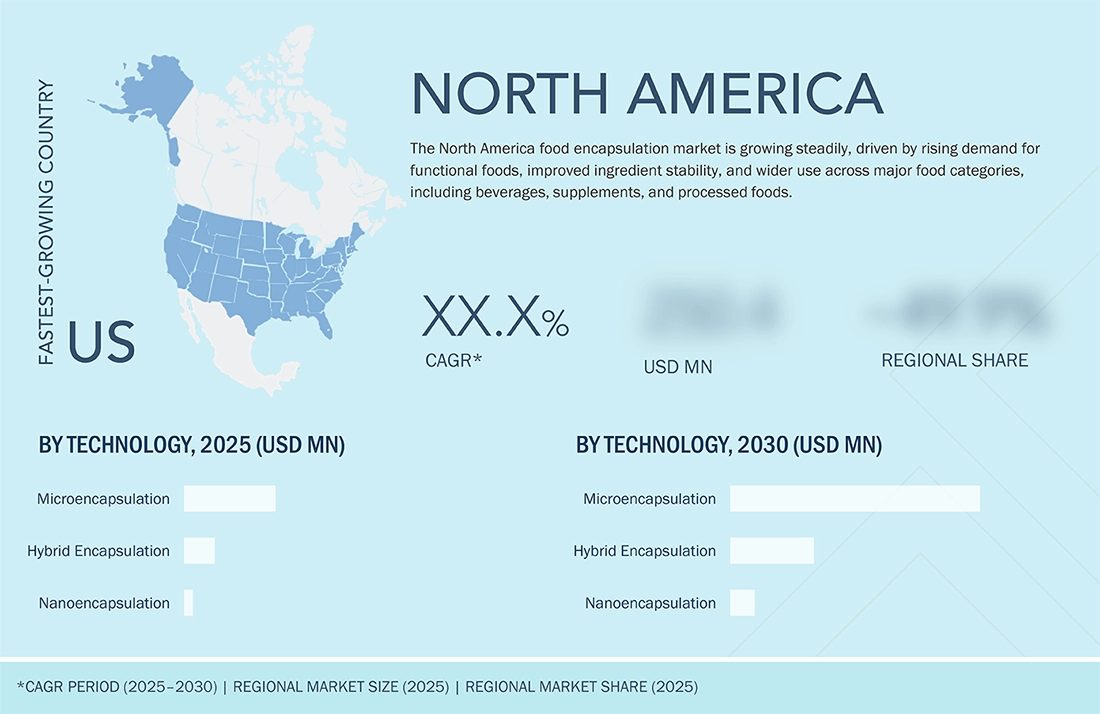
The US is expected to be the fastest-growing country in the North America food encapsulation market during the forecast period. The rising application of food encapsulation in packaged foods, beverages, and nutritional products is notable. The US has a strong network of food companies, ingredient suppliers, and supplement manufacturers that utilize encapsulation technologies in dietary supplements and fortified foods, helping to preserve the stability of vitamins, minerals, probiotics, and other active ingredients. Companies in the US prioritize food safety, product quality, and clean labels, all of which are supported by encapsulation methods. Moreover, most manufacturing facilities employ modern processing systems, facilitating the incorporation of encapsulated ingredients. Continuous product launches and steady investments further drive demand. Consequently, the US is projected to experience rapid growth compared to other countries in the North American food encapsulation market.
NORTH AMERICA FOOD ENCAPSULATION MARKET: COMPANY EVALUATION MATRIX
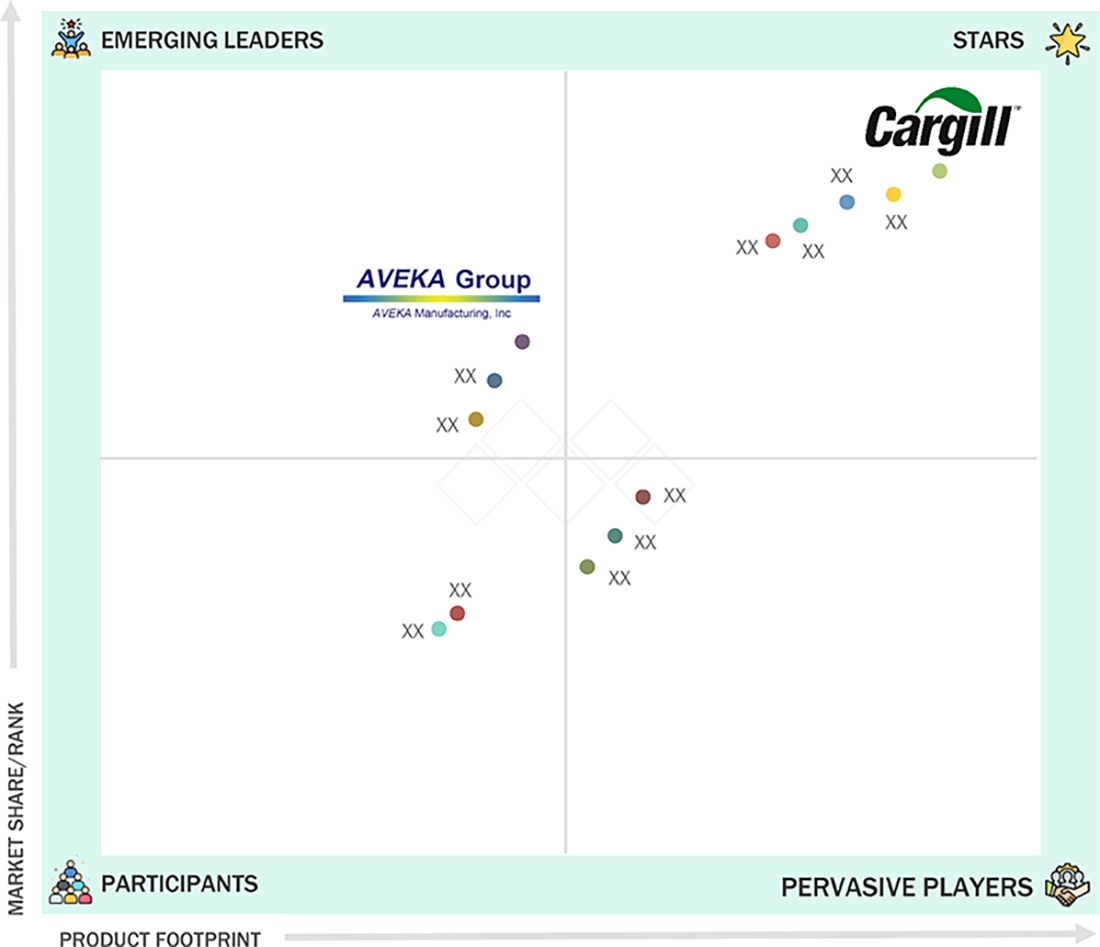
The North American food encapsulation market is divided into four categories: Stars, Emerging Players, Participants, and Pervasive Players, based on technology strength, market reach, and growth focus. Cargill, Incorporated, is recognized as a Star player due to its robust research and development capabilities, extensive range of encapsulated food and nutrition ingredients, and collaborative relationships with food and beverage manufacturers across North America. Aveka Group is classified as an Emerging Player, leveraging its role as a contract manufacturer of encapsulated food ingredients and the increasing demand for customized solutions from food and nutrition brands. Participants in this market primarily include smaller or regional firms with limited application focus or scalability, while Pervasive Players maintain a stable market presence but tend to show slower innovation in comparison to leading companies. This framework highlights the varied dynamics and competitive positioning within the food encapsulation sector in North America.
Source: Secondary Research, Interviews with Experts, MarketsandMarkets Analysis
KEY MARKET PLAYERS
- Cargill, Incorporated (US)
- Ingredion (US)
- Sensient Technologies Corporation (US)
- Balchem Corporation (US)
- Encapsys LLC (US)
- International Flavors & Fragrances Inc. (US)
- DuPont (US)
- Aveka Group (US)
- Microtek Laboratories, Inc. (US)
- Innophos Holdings, Inc. (US)
- Kemin Industries, Inc. (US)
- Blue California (US)
- Advanced BioNutrition Corp. (US)
- Kalsec Inc. (US)
- Ocean Nutrition (Canada)
MARKET SCOPE
| REPORT METRIC | DETAILS |
|---|---|
| Market Size, 2024 (Value) | USD 4.34 Billion |
| Market Forecast, 2030 (Value) | USD 6.98 Billion |
| Growth Rate | CAGR of 8.3% from 2025 to 2030 |
| Years Considered | 2020–2030 |
| Base Year | 2024 |
| Forecast Period | 2025–2030 |
| Units Considered | Value (USD Million/Billion), Volume (Kilotons) |
| Report Coverage | Revenue forecast, company ranking, competitive landscape, growth factors, and trends |
| Segments Covered |
|
| Countries Covered | US, Canada, Mexico |
WHAT IS IN IT FOR YOU: NORTH AMERICA FOOD ENCAPSULATION MARKET REPORT CONTENT GUIDE
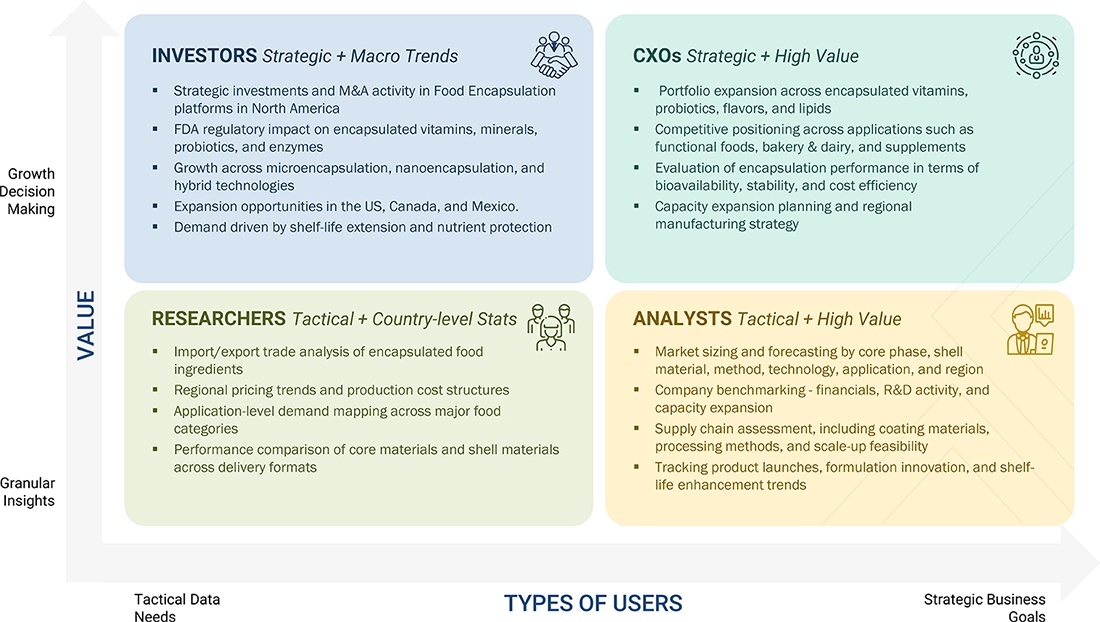
DELIVERED CUSTOMIZATIONS
We have successfully delivered the following deep-dive customizations:
| CLIENT REQUEST | CUSTOMIZATION DELIVERED | VALUE ADDS |
|---|---|---|
| Functional Food Ingredients Market |
|
|
| Flavors & Fragrances Market |
|
|
| Nutraceuticals & Dietary Supplements Market |
|
|
RECENT DEVELOPMENTS
- July 2024 : Sensient invested in expanding production capacity at its Kingston, Ontario, plant to increase automated output for natural colors and specialty ingredients used in encapsulated formats. The expansion was intended to support higher North American demand for encapsulation-ready natural ingredient solutions.
- April 2023 : IFF launched VERDIGEL SC, a pectin-based vegan softgel system enabling carrageenan-free encapsulation of high-viscosity and complex food actives. The technology supported plant-based softgel production and expanded encapsulation delivery options for North American formulators.
- May 2021 : Cargill announced planned to construct a new soybean processing plant in Pemiscot County, Missouri, near Hayti and Caruthersville, to meet rising local and worldwide demand for oilseeds in the food, feed, and fuel industries. This would help the company produce different encapsulated soy functional foods
Table of Contents
 Exclusive indicates content/data unique to MarketsandMarkets and not available with any competitors.
Methodology
This research study involved the extensive use of secondary sources—directories and databases such as the Food and Agriculture Organization and World Health Organization—to identify and collect information useful for a technical, market-oriented, and commercial study of the North America Food Encapsulation Market. In-depth interviews were conducted with various primary respondents—such as key industry participants, subject matter experts (SMEs), C-level executives of key market players, and industry consultants—to obtain and verify critical qualitative and quantitative information and assess prospects. The following figure depicts the research design applied in drafting this report on the North America Food Encapsulation Market.
Secondary Research
In the secondary research process, various sources such as website information, press releases & investor presentations of companies, white papers, food journals, certified publications, articles from recognized authors, gold & silver standard websites, directories, and databases, were referred to identify and collect information.
Secondary research was used to obtain key information about the industry’s supply chain, the total pool of key players, and market classification and segmentation as per the industry trends to the bottom-most level, regional markets, and key developments from both market- and technology-oriented perspectives.
Primary Research
In the primary research process, various sources from the supply and demand sides were interviewed to obtain qualitative and quantitative information. The primary sources from the supply side included industry experts such as CEOs, marketing directors, technology and innovation directors, and related key executives from various key companies and organizations operating in the North America Food Encapsulation Market.
Market Size Estimation
- Both the top-down and bottom-up approaches were used to estimate and validate the total size of the North America Food Encapsulation Market. These methods were also used extensively to estimate the size of the various subsegments in the market. The research methodology used to estimate the market size includes the following:
- The key players in the industry and market have been identified through extensive secondary research.
- All macroeconomic and microeconomic factors affecting the growth of the North America Food Encapsulation Market were considered while estimating the market size.
- All possible parameters that affect the market covered in this research study were accounted for, viewed in extensive detail, verified through primary research, and analyzed to obtain final quantitative and qualitative data.
Data Triangulation
After arriving at the overall market size from the estimation process explained above, the total market was split into several segments and subsegments. To complete the overall market engineering process and arrive at the exact statistics for all segments and subsegments, the data triangulation and market breakdown procedures were employed wherever applicable. The data was triangulated by studying various factors and trends from the demand and supply sides. Along with this, the market size was validated using the top-down and bottom-up approaches.
Report Objectives
- To define, segment, and project the global market for North America food encapsulation on the basis of core phase, application, shell material, method, technology and region
- To provide detailed information regarding the key factors influencing the growth of the market (drivers, restraints, opportunities, and industry-specific challenges)
- To strategically analyse the micro markets with respect to individual growth trends, future prospects, and their contribution to the total market
- To analyse the opportunities in the market for stakeholders and provide a competitive landscape of the market leaders
- To project the size of the market and its submarkets, in terms of value, with respect to the regions (along with the key countries)
- To strategically profile the key players and comprehensively analyse their market position and core competencies.
- To analyse the competitive developments such as joint ventures, mergers & acquisitions, new product developments, and research & developments in the North America Food Encapsulation Market
Available Customizations:
With the given market data, MarketsandMarkets offers customizations according to company-specific scientific needs.
The following customization options are available for the report:
Product Analysis
- Product Matrix, which gives a detailed comparison of the product portfolio of each company.
Geographic Analysis
With the given market data, MarketsandMarkets offers customizations according to the company-specific scientific needs.
- Further breakdown of the Rest of Europe Food Encapsulation Market includes the Sweden, Belgium, Greece, Switzerland, and other EU & Non-EU Countries
- Further breakdown of the Rest of South America Food Encapsulation Market includes Peru, Uruguay, and Venezuela.
- Further breakdown of the Rest of Asia Pacific Food Encapsulation Market includes Thailand, Indonesia, South Korea, Malaysia, Singapore, the Philippines, and Vietnam.
Company Information
- Detailed analyses and profiling of additional market players (up to five)


Personalize This Research
- Triangulate with your Own Data
- Get Data as per your Format and Definition
- Gain a Deeper Dive on a Specific Application, Geography, Customer or Competitor
- Any level of Personalization
Let Us Help You
- What are the Known and Unknown Adjacencies Impacting the North America Food Encapsulation Market
- What will your New Revenue Sources be?
- Who will be your Top Customer; what will make them switch?
- Defend your Market Share or Win Competitors
- Get a Scorecard for Target Partners

Custom Market Research Services
We Will Customise The Research For You, In Case The Report Listed Above Does Not Meet With Your Requirements
Get 10% Free CustomisationTESTIMONIALS

Business Innovation Director
US Based Leading Agribusiness,
Food and Ingredients ManufacturerI highly appreciate the team's efficiency for a well conducted study that helped us clarify some blind spots in food and agricultural niche markets. Although compiling information for B2B markets is very difficult, the MnM team pulled out the task successfully. The quality of research, level of insights, and responsiveness of team were commendable.






Growth opportunities and latent adjacency in North America Food Encapsulation Market