North America Gesture Recognition and Touchless Sensing Market

North America Gesture Recognition and Touchless Sensing Market by Technology (Touch-based, Touchless), Touchless Sensing Product (Touchless Biometric Equipment, Touchless Sanitary Equipment), Gesture Recognition, Industry and Region - Forecast to 2030




OVERVIEW
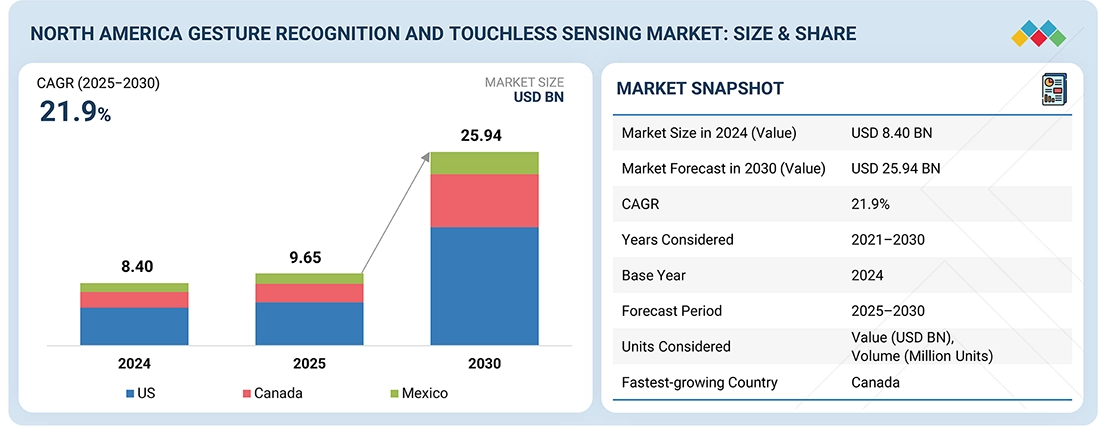
Source: Secondary Research, Interviews with Experts, MarketsandMarkets Analysis
The North America gesture recognition and touchless sensing market is projected to reach USD 25.94 billion by 2030 from USD 9.65 billion in 2025, at a CAGR of 21.9%. Market growth is supported by increasing use of natural user interfaces in connected vehicles, smart workplaces, and digital healthcare systems. Enterprises are adopting touchless technologies to improve operational efficiency and reduce dependency on physical interfaces. Additionally, strong regional innovation in sensing hardware and AI software is accelerating commercialization across various industries.
The US touchless sensing market is experiencing steady growth as industries increasingly adopt contact-free technologies to improve hygiene, automation, and user convenience, supported by rising demand for gesture recognition, biometric authentication, and touchless interfaces across healthcare, automotive, retail, and consumer electronics sectors.The adoption of smart home devices, AI-enabled sensors, and advanced human–machine interface technologies is further accelerating market expansion, while innovations in computer vision, proximity sensors, and voice-controlled systems are enabling seamless contact-free interactions across various digital environments in the United States.
KEY TAKEAWAYS
-
BY COUNTRYBy country, the US is expected to dominate the market, growing at a CAGR of 22.2% during the forecast period.
-
BY TECHNOLOGYBy technology, the touch-less technology segment is expected to lead the market throughout the forecast period.
-
GESTURE RECOGNITION TYPEBy gesture recognition type, online segment is expected to record the fastest growth rate during the forecast period.
-
GESTURE RECOGNITION INDUSTRYBy gester recognition industry, the consumer electronics segment is expected to dominate the market throughout the forecast period.
-
TOUCHLESS SENSING PRODUCTBy touchless sensing product, the touchless biometric segment is expected to dominate the market over the forecast period.
-
TOUCHLESS SENSING INDUSTRYBy touchless sensing industry, the automotive segment is expected to register the fastest CAGR from 2025 to 2030.
-
COMPETITIVE LANDSCAPE - KEY PLAYERSApple Inc. (US), Microsoft Corporation (US), Microchip Technology Inc. (US), Google LLC (US), Infineon Technologies (Germany) were identified as some of the star players in the North America gesture recognition and touchless sensing market, given their strong market share and product footprint.
-
COMPETITIVE LANDSCAPE - STARTUPS/SMESHID Global Corporation (US), among others, has distinguished itself among SMEs by securing strong footholds in specialized niche areas, underscoring its potential as an emerging market leader. This vendor has been marking its market presence by offering solutions according to end user requirements and adopting growth strategies to achieve its targets.
The North America gesture recognition and touchless sensing market is driven by rising demand for contactless and intuitive user interfaces across consumer electronics, automotive, and healthcare applications. Increased focus on hygiene, safety, and user convenience is accelerating adoption of touchless solutions across public and commercial spaces. Advancements in AI, 3D sensing, and edge processing are improving system accuracy and reliability. Strong investments in smart infrastructure and connected technologies across North America are further supporting market growth.
The Mexico gesture recognition market is experiencing strong growth as industries increasingly adopt touchless and AI-enabled interaction technologies.Rising adoption of gesture-based interfaces in consumer electronics, automotive infotainment systems, healthcare devices, and smart home technologies is driving demand across the country. In addition, Mexico’s expanding automotive manufacturing sector and increasing investments in digital technologies are accelerating the integration of gesture recognition systems in connected vehicles, industrial automation, and interactive digital platforms.
The U.S. gesture recognition market is experiencing strong growth as industries increasingly adopt touchless and AI-enabled human–machine interaction technologies.Gesture recognition systems use technologies such as computer vision, depth-sensing cameras, and machine learning algorithms to interpret human movements, enabling intuitive control of devices without physical contact. The growing adoption of smart consumer electronics, connected vehicles, healthcare technologies, and smart home automation solutions is significantly driving market expansion in the United States, while continuous advancements in artificial intelligence and 3D sensing are further enhancing the accuracy and functionality of gesture-based interfaces.
The Canada gesture recognition market is witnessing significant growth as industries adopt advanced human–machine interaction technologies across consumer electronics, automotive, healthcare, and smart home applications.Increasing adoption of touchless interfaces, AI-powered sensors, and IoT-enabled devices is driving market expansion across the country. In addition, Canada’s strong focus on innovation, research in artificial intelligence, and the rising use of gesture-based technologies in gaming, medical equipment, and smart environments are further accelerating the growth of the gesture recognition market.
TRENDS & DISRUPTIONS IMPACTING CUSTOMERS' CUSTOMERS
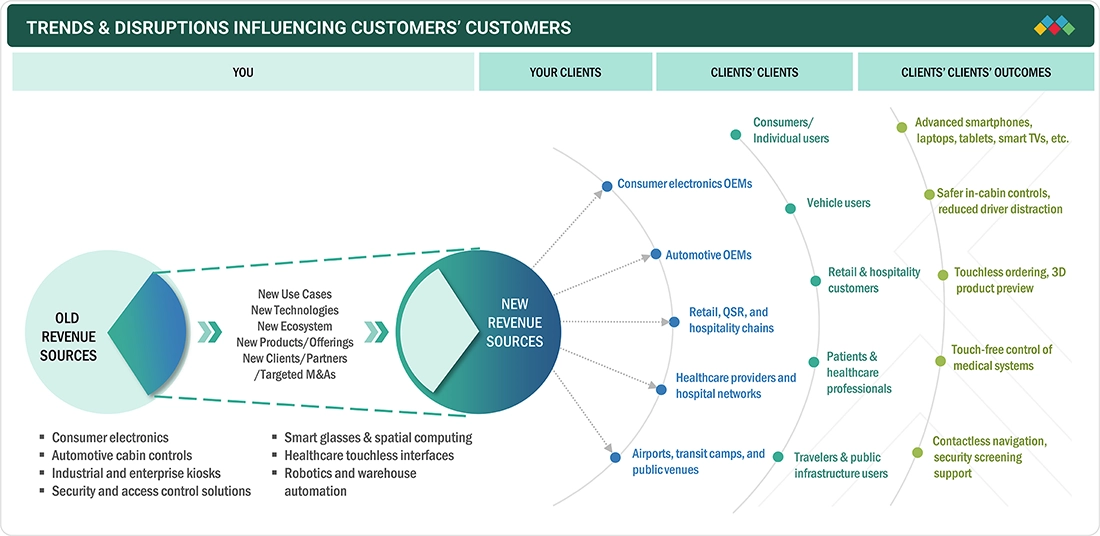
The North America Gesture Recognition and Touchless Sensing market is witnessing a shift from traditional consumer electronics and access control applications toward advanced use cases such as smart glasses, spatial computing, and touchless healthcare interfaces. Automotive OEMs are increasingly integrating in-cabin gesture controls to improve safety and reduce driver distraction. Retail, hospitality, and public infrastructure are adopting touchless ordering, navigation, and security screening solutions to enhance user experience and hygiene. These trends are expanding revenue opportunities through new customers, partnerships, and application-driven deployments across consumer, enterprise, and public-sector environments.
Source: Secondary Research, Interviews with Experts, MarketsandMarkets Analysis
MARKET DYNAMICS

Level
-
Rising demand for contactless retail and self-service solutions

-
Smart home and building automation adoption across urban areas


Level
-
Privacy and data security concerns around camera-based sensing

-
Lack of standardization across gesture recognition technologies and platforms


Level
-
Expansion of in-cabin gesture control across electric vehicles

-
Growing adoption of touchless kiosks in quick-service restaurants


Level
-
High implementation and integration costs for advanced sensing systems

-
Integrating touchless sensing with legacy hardware and software

Source: Secondary Research, Interviews with Experts, MarketsandMarkets Analysis
Driver: Rising demand for contactless retail and self-service solutions
Retailers and service providers in North America are increasingly adopting contactless and self-service solutions to improve customer convenience and operational efficiency. Gesture recognition and touchless sensing enable faster transactions and reduce physical interaction at kiosks and checkout points. This demand is further supported by the focus on hygiene, reduced wait times, and enhanced customer experience.
Restraint: Privacy and data security concerns around camera-based sensing
The use of camera-based gesture recognition raises concerns related to data privacy and security, particularly in public and commercial environments. Users and regulators are cautious about how visual data is collected, stored, and processed. These concerns can slow adoption, especially in applications involving sensitive personal information.
Opportunity: Expansion of in-cabin gesture control across electric vehicles
Electric vehicle manufacturers are increasingly integrating gesture-based controls to enhance in-cabin user experience and reduce driver distraction. Touchless sensing supports intuitive interaction with infotainment, climate, and navigation systems. This trend creates strong growth opportunities as EV adoption continues to increase across North America.
Challenge: High implementation and integration costs for advanced sensing systems
Deploying gesture recognition and touchless sensing solutions often requires advanced sensors, software, and system integration. These factors increase upfront investment for enterprises and OEMs. High costs can limit adoption, particularly among small and mid-sized organizations.
NORTH AMERICA GESTURE RECOGNITION AND TOUCHLESS SENSING MARKET: COMMERCIAL USE CASES ACROSS INDUSTRIES
| COMPANY | USE CASE DESCRIPTION | BENEFITS |
|---|---|---|
 |
Apple deployed gesture recognition and touchless sensing in its consumer electronics ecosystem, including Face ID facial recognition for iPhone and iPad devices, touchless gesture controls in watchOS, and spatial computing interactions in Vision Pro headset for immersive AR/VR experiences. | The technology enabled seamless biometric authentication, improved user privacy and security, enhanced accessibility for users with mobility limitations, reduced physical contact with devices, and created intuitive spatial computing experiences with natural hand tracking and eye-gaze interactions. |
 |
Microsoft implemented gesture recognition and touchless sensing through Azure Kinect DK and HoloLens mixed reality platform for enterprise applications including hands-free medical guidance in healthcare, touchless industrial equipment control in manufacturing, and gesture-based collaboration tools in corporate environments. | The deployment improved workplace hygiene and safety by eliminating physical touch requirements, enhanced productivity through natural gesture-based interactions, enabled innovative mixed reality training and simulation programs, and supported social distancing requirements in healthcare and manufacturing facilities. |
 |
Microchip Technology delivered integrated Gesture IC sensor acquisition controllers and touchless sensor solutions for automotive human-machine interfaces, smart home devices, and consumer electronics enabling mid-air gesture control for infotainment systems, touchless light switches, and proximity sensing for appliances. | The technology reduced driver distraction through intuitive gesture controls in vehicles, improved hygiene in public spaces and high-traffic environments, extended product lifespan by minimizing mechanical wear from physical buttons, and enhanced user convenience with contactless operation of everyday devices. |
 |
Google implemented gesture recognition and touchless sensing through Project Soli radar-based motion sensing technology in Pixel smartphones and Nest smart home devices, enabling touchless music control, call management, alarm snoozing, and presence detection for automated lighting and security systems. | The system enabled hands-free device control for improved accessibility and convenience, reduced unnecessary device interactions extending battery life, enhanced privacy through on-device processing without cameras, and created more intuitive smart home automation with presence and motion-based triggers. |
 |
OMNIVISION deployed 60 GHz radar sensors and time-of-flight (ToF) solutions for gesture recognition and touchless sensing in automotive cabin monitoring systems, smart retail displays with gesture-based navigation, and industrial robotics with touchless human-machine collaboration interfaces. | The deployment improved automotive safety through driver attention monitoring and child presence detection, enhanced retail customer engagement with interactive touchless displays, enabled safer human-robot collaboration in industrial settings, and provided reliable performance in challenging environmental conditions including varying lighting and temperature ranges. |
Logos and trademarks shown above are the property of their respective owners. Their use here is for informational and illustrative purposes only.
MARKET ECOSYSTEM
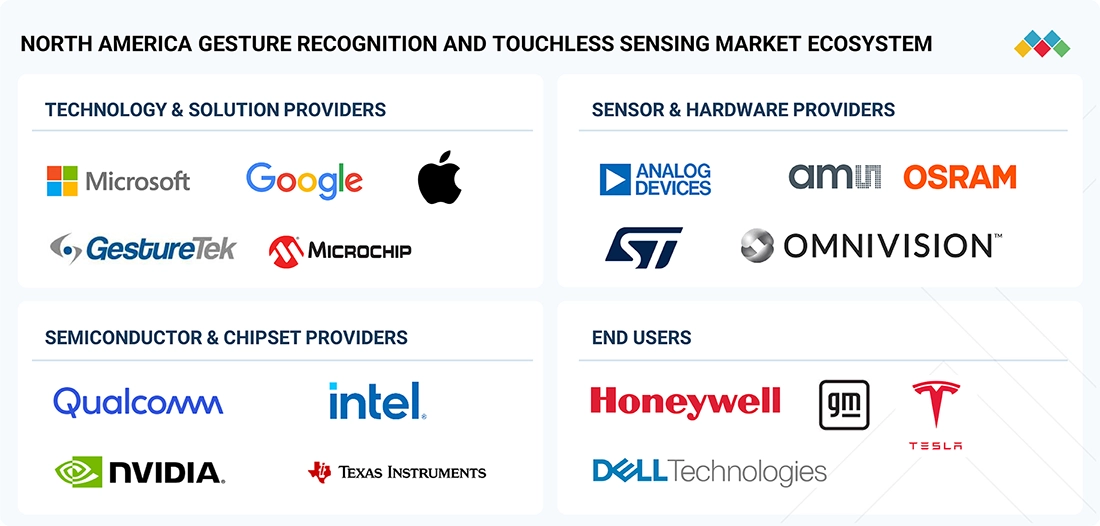
The North America gesture recognition and touchless sensing market ecosystem is structured around technology and solution development, sensor and hardware supply, semiconductor enablement, and end user adoption. Technology providers focus on software platforms, AI algorithms, and system integration to enable accurate touchless interactions. Sensor and hardware providers support the ecosystem with cameras, optical sensors, and proximity solutions required for reliable detection. Semiconductor and chipset providers ensure high processing performance and edge intelligence. End users across automotive, consumer electronics, industrial, and enterprise applications drive large-scale deployment and commercialization.
Logos and trademarks shown above are the property of their respective owners. Their use here is for informational and illustrative purposes only.
MARKET SEGMENTS
Source: Secondary Research, Interviews with Experts, MarketsandMarkets Analysis
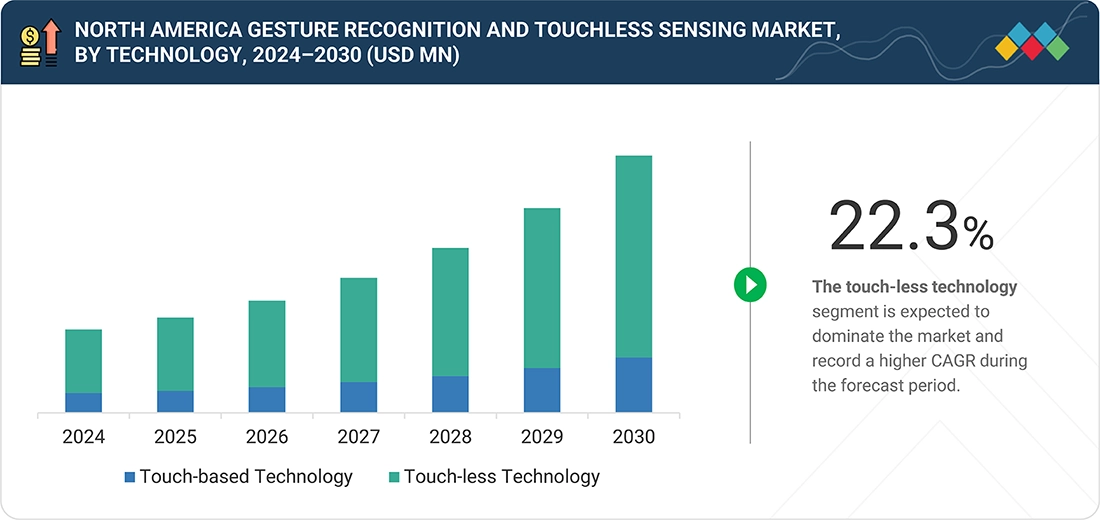
North America Gesture Recognition and Touchless Sensing Market, By Technology
Touchless technology is expected to dominate the North America market due to strong demand for contact-free user interfaces. Increased focus on hygiene and safety is driving adoption across public and commercial spaces. Industries are integrating touchless systems to improve user convenience. Early technology adoption in the region supports steady market growth.
North America Gesture Recognition Market, by Type
The online gesture recognition segment is expected to grow at the fastest rate in North America. Growth is supported by advancements in AI and real-time data processing. Connected devices and smart applications are increasing the use of online gesture systems. Strong digital infrastructure enables the smooth deployment of solutions across various industries.
North America Gesture Recognition Market, by Industry
The consumer electronics segment is expected to dominate the North America market. The increasing use of smartphones, smart TVs, and gaming devices is driving demand. Consumers prefer intuitive and hands-free interactions, further driving the market growth.
North America Touchless Sensing Market, by Product
Touchless biometric solutions are expected to dominate the market throughout the forecast period. The rising need for secure and contact-free authentication is a key driver. These solutions are increasingly adopted in offices, airports, and government facilities.
North America Touchless Sensing Market, by Industry
The automotive segment is expected to register the fastest growth in North America. Automakers are integrating gesture-based controls to improve safety and user experience. The surging demand for electric and connected vehicles supports adoption.
REGION
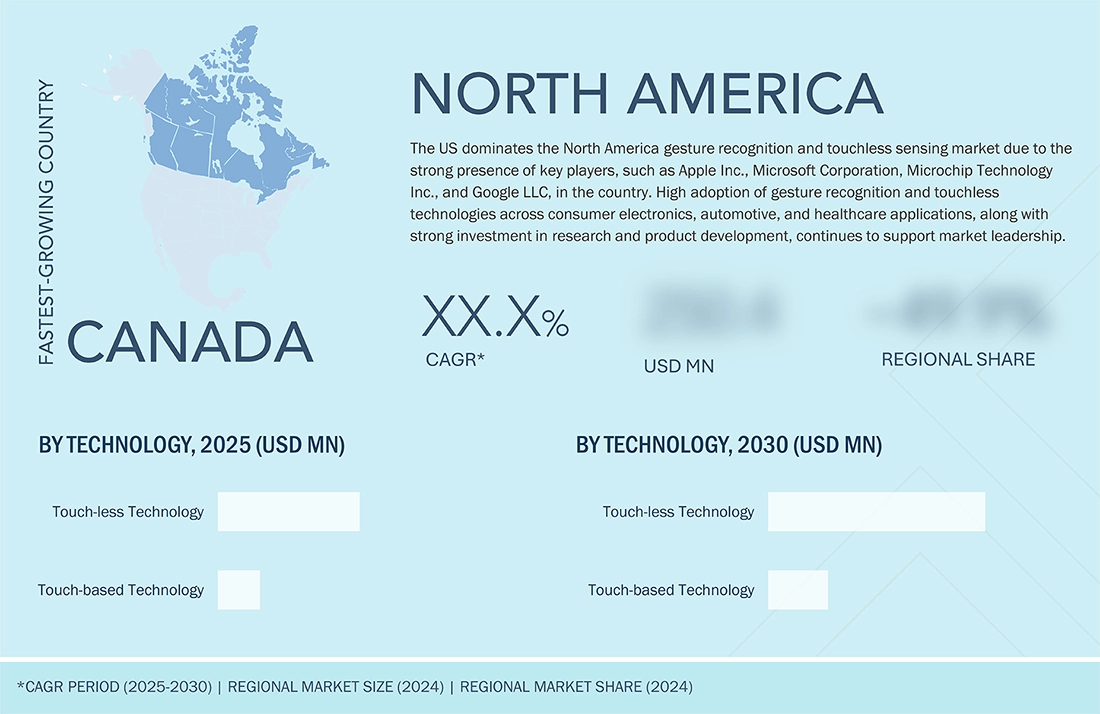
Canada is expected to be fastest-growing country across North America gesture recognition and touchless sensing market during forecast period
Canada is expected to record the fastest growth rate in the North America gesture recognition and touchless sensing market due to increasing adoption of touchless technologies across healthcare, smart buildings, and public infrastructure. Strong government support for digital transformation, along with the presence of emerging AI and sensing technology startups, is accelerating market expansion.
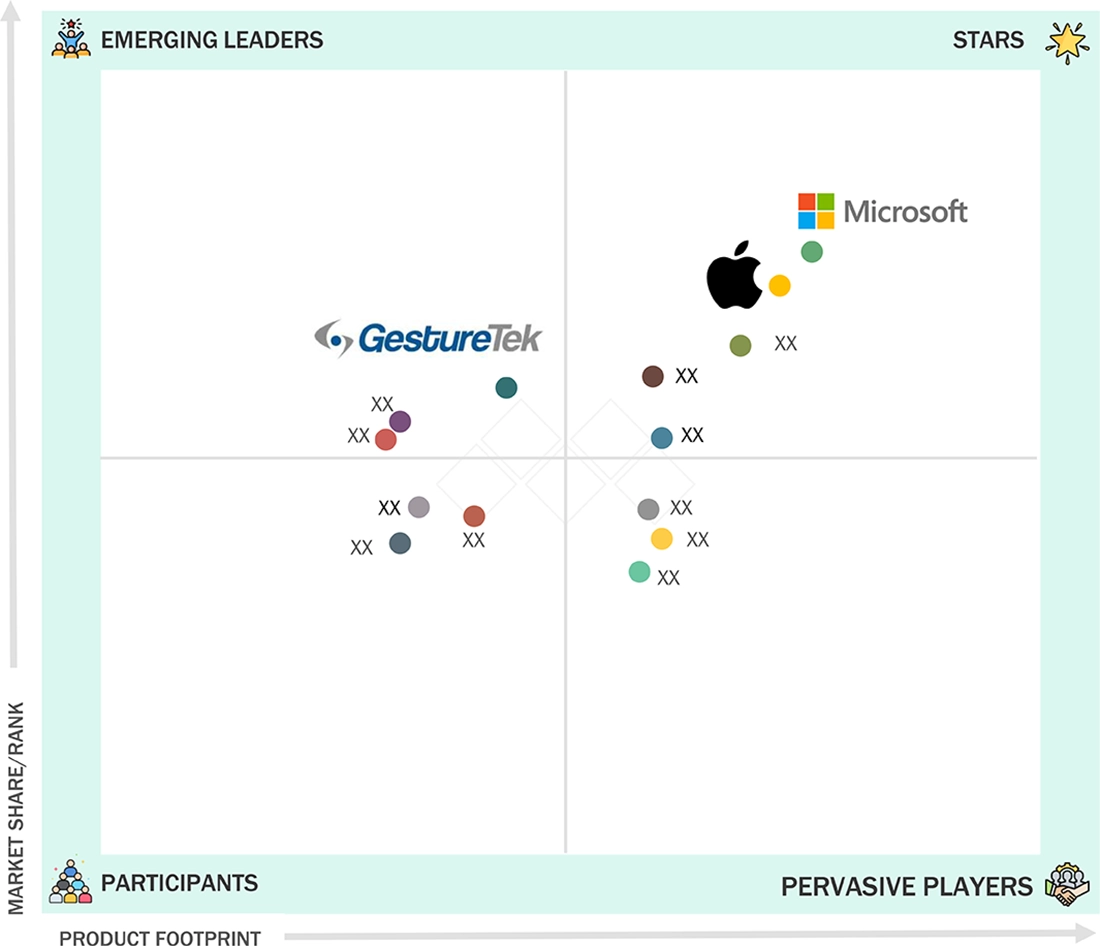
NORTH AMERICA GESTURE RECOGNITION AND TOUCHLESS SENSING MARKET: COMPANY EVALUATION MATRIX
In the North America gesture recognition and touchless sensing market, Microsoft Corporation (Star) leads with a strong market presence and a broad product portfolio, driving large scale adoption across consumer electronics, healthcare, and automotive sectors. GestureTek (Emerging Leader) is strengthening its position through specialized gesture based interaction solutions for smart spaces, healthcare environments, and interactive installations, supporting growing adoption in targeted applications.
Source: Secondary Research, Interviews with Experts, MarketsandMarkets Analysis
KEY MARKET PLAYERS
- Apple Inc. (US)
- Microsoft Corporation (US)
- Microchip Technology Inc. (US)
- Google LLC (US)
- OMNIVISION (US)
- GestureTek (Canada)
- Cisco Systems, Inc. (US)
- Sony Depthsensing Solutions (Belgium)
- Infineon Technologies (Germany)
- IrisGuard (UK)
MARKET SCOPE
| REPORT METRIC | DETAILS |
|---|---|
| Market Size in 2024 (Value) | USD 8.40 Billion |
| Market Forecast in 2030 (Value) | USD 25.94 Billion |
| Growth Rate | CAGR of 21.9% from 2025–2030 |
| Years Considered | 2021–2030 |
| Base Year | 2024 |
| Forecast Period | 2025–2030 |
| Units Considered | Value (USD Billion), Volume (Million Units) |
| Report Coverage | Revenue Forecast, Company Ranking, Competitive Landscape, Growth Factors, and Trends |
| Segments Covered |
|
| Country-level Scope | US, Canada, Mexico |
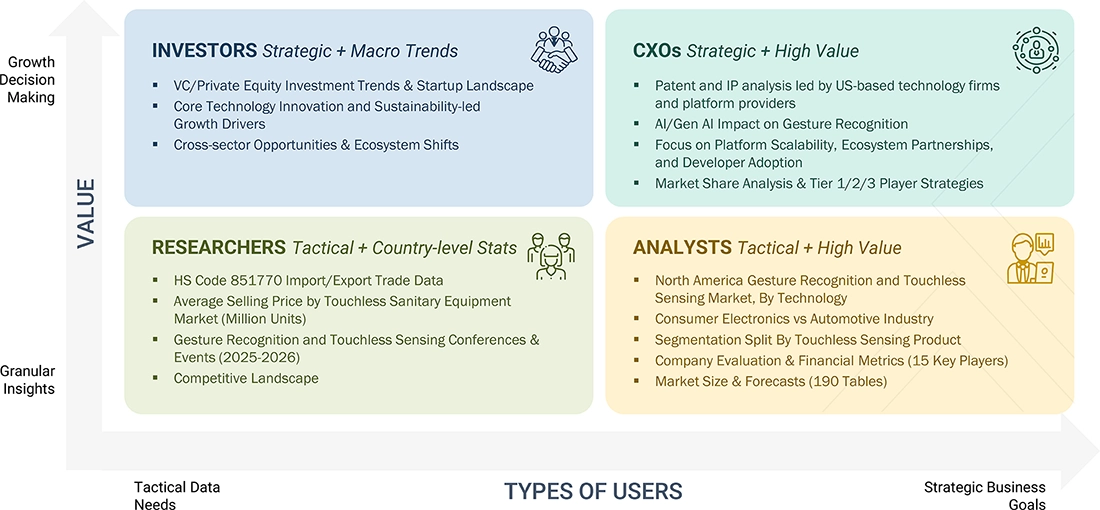
WHAT IS IN IT FOR YOU: NORTH AMERICA GESTURE RECOGNITION AND TOUCHLESS SENSING MARKET REPORT CONTENT GUIDE
DELIVERED CUSTOMIZATIONS
We have successfully delivered the following deep-dive customizations:
| CLIENT REQUEST | CUSTOMIZATION DELIVERED | VALUE ADDS |
|---|---|---|
| Quick Service Restaurant Chain Operator |
|
|
| Automotive OEM & Tier-1 Supplier |
|
|
| US Healthcare System & Digital Health Provider |
|
|
| Airport Security Solutions Integrator |
|
|
RECENT DEVELOPMENTS
- April 2024 : Microchip Technology Inc. acquired Seoul-based VSI Co. Ltd., a provider of high-speed asymmetric camera, sensor, and display connectivity technologies. The acquisition strengthened Microchip’s portfolio in Automotive SerDes Alliance (ASA)-based products, supporting advanced in-vehicle networking (IVN) applications.
- March 2024 : OMNIVISION launched its new OV50K40 smartphone image sensor based on TheiaCel technology. The OV50K40 is a 50-megapixel sensor with 1.2-micron pixel size and a 1/1.3-inch optical format, offering high gain and correlated multiple sampling (CMS) to improve performance in low-light conditions.
- September 2023 : Apple Inc. has introduced the Apple Watch Series 9, powered by watchOS 10, featuring redesigned apps, a new Smart Stack, updated watch faces, and enhanced capabilities for cycling and hiking. The launch also included support for double-tap gestures, improved performance, and expanded access to health data.
Table of Contents
 Exclusive indicates content/data unique to MarketsandMarkets and not available with any competitors.
Methodology
The research process for this study included systematic gathering, recording, and analysis of data about customers and companies operating in the North America Gesture Recognition and Touchless Sensing Market. This process involved the extensive use of secondary sources, directories, and databases (Factiva, Oanda, and OneSource) for identifying and collecting valuable information for the comprehensive, technical, market-oriented, and commercial study of the North America Gesture Recognition and Touchless Sensing Market. In-depth interviews were conducted with primary respondents, including experts from core and related industries and preferred manufacturers, to obtain and verify critical qualitative and quantitative information as well as to assess growth prospects. Key players in the North America Gesture Recognition and Touchless Sensing Market were identified through secondary research, and their market rankings were determined through primary and secondary research. This research included studying annual reports of top players and interviewing key industry experts such as CEOs, directors, and marketing executives.
Secondary Research
In the secondary research process, various secondary sources were referred to for identifying and collecting information important for this study. Secondary sources included corporate filings, such as annual reports, investor presentations, and financial statements; trade, business, and professional associations; white papers; North America Gesture Recognition and Touchless Sensing Market products-related journals; certified publications; articles by recognized authors; directories; and databases.
Secondary research was conducted to obtain key information about the industry supply chain, market value chain, key players, market classification and segmentation as per industry trends to the bottom-most level, geographic markets, and key developments from both market- and technology-oriented perspectives. Data from secondary research was collected and analyzed to determine the overall market size, which was further validated by primary research.
Primary Research
In the primary research process, various primary sources from the supply and demand sides were interviewed to obtain qualitative and quantitative information for this report. Primary sources from the supply side included industry experts such as CEOs, VPs, marketing directors, technology & innovation directors, and key executives from major companies in the North America Gesture Recognition and Touchless Sensing Market.
After going through market engineering (which includes calculations for market statistics, market breakdown, market size estimations, market forecasting, and data triangulation), extensive primary research was conducted to gather information and verify and validate the critical numbers obtained. Primary research was conducted to identify segmentation types, industry trends, key players, competitive landscape, and key market dynamics such as drivers, restraints, opportunities, and challenges, along with the key strategies adopted by players operating in the market.
Market Size Estimation
In the complete market engineering process, both top-down and bottom-up approaches were used, along with several data triangulation methods, to estimate and forecast the size of the market and its segments and subsegments listed in the report. Extensive qualitative and quantitative analyses were carried out on the complete market engineering process to list the key information/insights pertaining to the North America Gesture Recognition and Touchless Sensing Market.
The key players in the market were identified through secondary research, and their rankings in the respective regions were determined through primary and secondary research. This entire procedure involved the study of the annual and financial reports of top players, as well as interviews with industry experts such as chief executive officers, vice presidents, directors, and marketing executives for quantitative and qualitative key insights. All percentage shares, splits, and breakdowns were determined using secondary sources and verified through primary sources. All parameters that affect the markets covered in this research study were accounted for, viewed in extensive detail, verified through primary research, and analyzed to obtain the final quantitative and qualitative data. This data was consolidated and enhanced with detailed inputs and analysis from MarketsandMarkets and presented in this report.
Data Triangulation
After arriving at the overall size of the North America Gesture Recognition and Touchless Sensing Market from the market size estimation process explained above, the total market was split into several segments and subsegments. Where applicable, the market breakdown and data triangulation procedures were employed to complete the overall market engineering process and arrive at the exact statistics for all segments and subsegments. The data was triangulated by studying various factors and trends from both the demand and supply sides. Along with this, the market size was validated using top-down and bottom-up approaches.
Market Definition
Gesture recognition and touchless sensing are two radical technologies that facilitate users by getting rid of physical connections in order to operate any smart device. The idea of gesture recognition and touchless sensing underwent a sea change in the last decade. Intelligence in electronic devices is very technology-oriented, efficient, and assures high HMI. The growth in the market can be attributed to the easy adoption of gesture recognition and touchless sensing due to low technical complexity and increased digitalization. Gesture recognition and touchless sensing use various mathematical algorithms in computing devices to translate human gestures or movements. These systems help humans interact with machines without using any mechanical devices. Gesture recognition and touchless sensing technology use human gestures, such as the movement of the head, fingers, arms, hands, and the entire body. The gesture recognition market is segmented into technology, type, industry, and geography, whereas the touchless sensing market is segmented into technology, product, industry, and geography.
Key Stakeholders
- Gesture recognition and touchless sensing hardware and software providers
- Analysts and strategic business planners
- Venture capitalists and startups
- Research laboratories and intellectual property (IP) companies
- Technology standards organizations, forums, alliances, and associations
- Government bodies such as regulatory authorities and policymakers
- Raw material suppliers and manufacturers of gesture recognition and touchless sensing products
- Installation & maintenance service providers
- End customers from the consumer electronics, automotive, healthcare, and banking & finance sectors
Report Objectives
- To define, describe, and forecast the North America Gesture Recognition and Touchless Sensing Market based on technologies, product, type, industry, and region.
- To provide a detailed analysis of the North America Gesture Recognition and Touchless Sensing Market supply chain.
- To analyze the impact of the recession on North America Gesture Recognition and Touchless Sensing Market market
- To strategically analyze the micromarkets1 with respect to individual growth trends and prospects and their contributions to the total market
- To analyze competitive developments such as expansions, agreements, partnerships, acquisitions, product developments, and research and development (R&D) in the North America Gesture Recognition and Touchless Sensing Market
- To analyze the opportunities for market players and provide details of the competitive landscape of the market.
- To benchmark the market players using the proprietary company evaluation matrix framework, which analyzes the market players on various parameters within the broad categories of business strategy excellence and strength of product portfolios.
- To strategically profile the key players and comprehensively analyze their market positions in terms of ranking and core competencies, along with a detailed competitive landscape of the market.
Available customizations
With the given market data, MarketsandMarkets offers customizations according to the specific requirements of companies.
Product analysis
- Detailed analysis and profiling of additional market players
The following customization options are available for the report:
- Market sizing and forecast for additional countries
- Additional five companies profiling


Personalize This Research
- Triangulate with your Own Data
- Get Data as per your Format and Definition
- Gain a Deeper Dive on a Specific Application, Geography, Customer or Competitor
- Any level of Personalization
Let Us Help You
- What are the Known and Unknown Adjacencies Impacting the North America Gesture Recognition and Touchless Sensing Market
- What will your New Revenue Sources be?
- Who will be your Top Customer; what will make them switch?
- Defend your Market Share or Win Competitors
- Get a Scorecard for Target Partners

Custom Market Research Services
We Will Customise The Research For You, In Case The Report Listed Above Does Not Meet With Your Requirements
Get 10% Free CustomisationTESTIMONIALS

Tetsuya Ohhira
Business Development Manager-Technology Business
Nikon Corporation,
Leading Japanese MNC specializing in optics and imaging productswww.nikon.com
MarketsandMarkets™ response
is quick. Their attitude is flexible and positive. Analyst Insights are globally considered and
significant. Client Services quickly respond to our inquiry and demand. Their wide range of global
surveys help us make our strategic plan.
We hope Knowledge Store will be easier to search
for a report.
VP - Marketing & Business Development
Leading Provider of Process Control Solutions
We engaged with MarketsandMarkets on a study to perform an analysis and recommend a Go-To-Market strategy for metrology and process control in the semiconductor market. The study was tailored to our targets and needs with well-defined milestones. Our overall experience with the MarketsandMarkets team was very good throughout the project in all aspects including the analysis methodologies used, the quality and depth of primary and secondary data sets, the professionalism and flexibility of the team and the ability to meet the target schedule and milestones. We want to thank MarketsandMarkets team for a job well done.






Growth opportunities and latent adjacency in North America Gesture Recognition and Touchless Sensing Market