North America Industrial Control & Factory Automation Market

North America Industrial Control & Factory Automation Market by Component (Industrial Control Systems, Software, CNC Controllers, Industrial Robotics, Industrial 3D Printing, Process Analyzers, Industrial Communication, Flow Meters) - Forecast to 2030




OVERVIEW
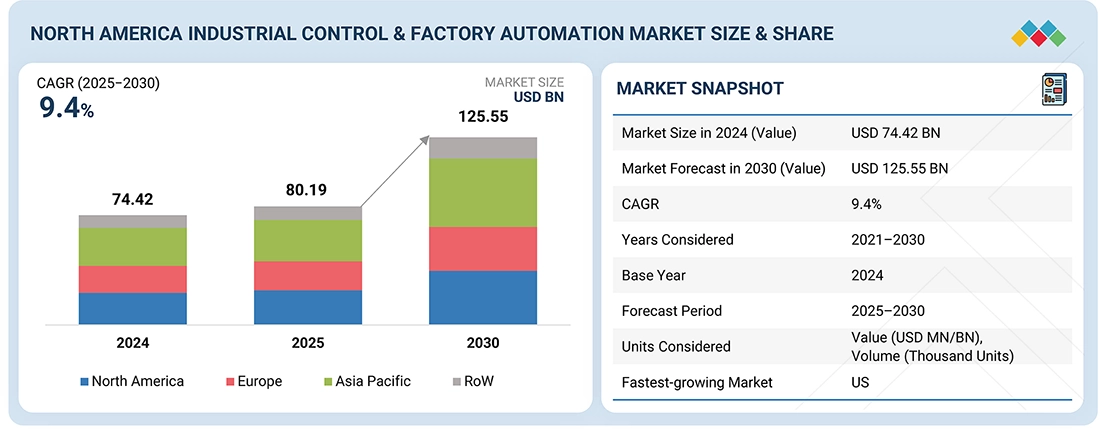
Source: Secondary Research, Interviews with Experts, MarketsandMarkets Analysis
The North America Industrial Control & Factory Automation Market is estimated to be valued at USD 80.19 billion in 2025 and USD 125.55 billion by 2030, growing at a CAGR of 9.4% during the forecast period. The regional market is expanding due to modernization of aging industrial infrastructure and increased focus on operational efficiency. Strong demand from automotive, aerospace, energy, and process industries for connected control systems and intelligent automation further boost the adoption of industrial control & factory automation in the region.
Market Size & Forecast
KEY TAKEAWAYS
-
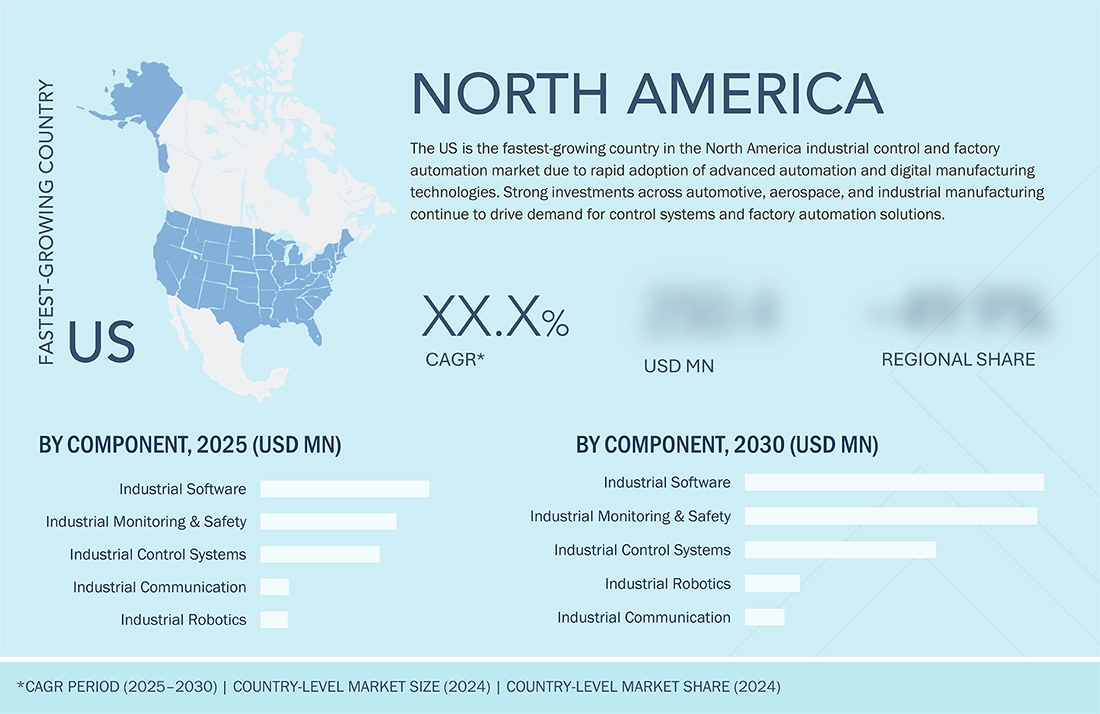
BY COUNTRYThe US is expected to dominate the North America industrial control & factory automation market with a 67.4% share in 2025.
-
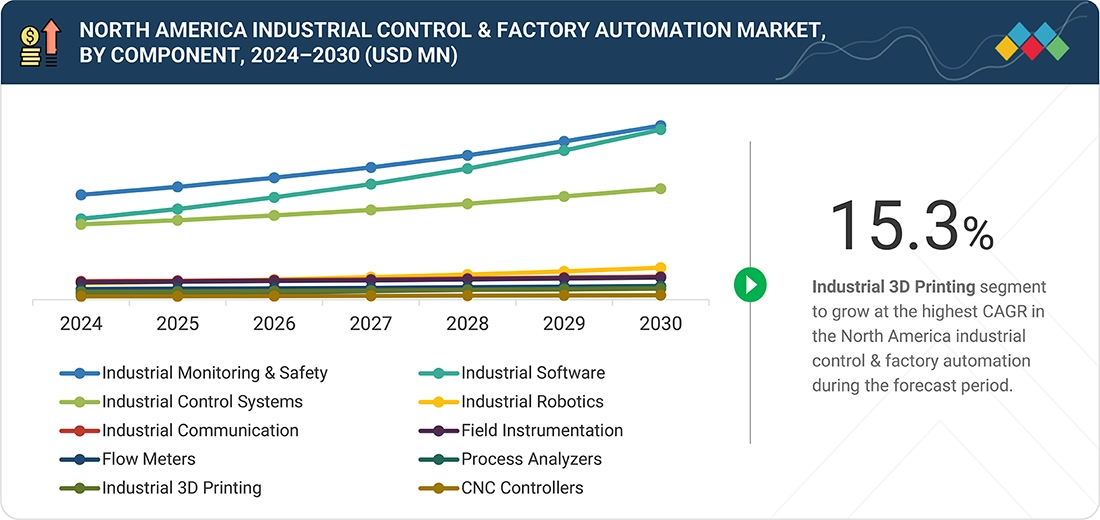
BY COMPONENTBy component, the industrial 3D printing segment is expected to grow at high CAGR of 15.3% between 2025 and 2030.
-
BY INDUSTRYThe automotive segment held the largest share of the North America industrial control & factory automation market in 2024.
-
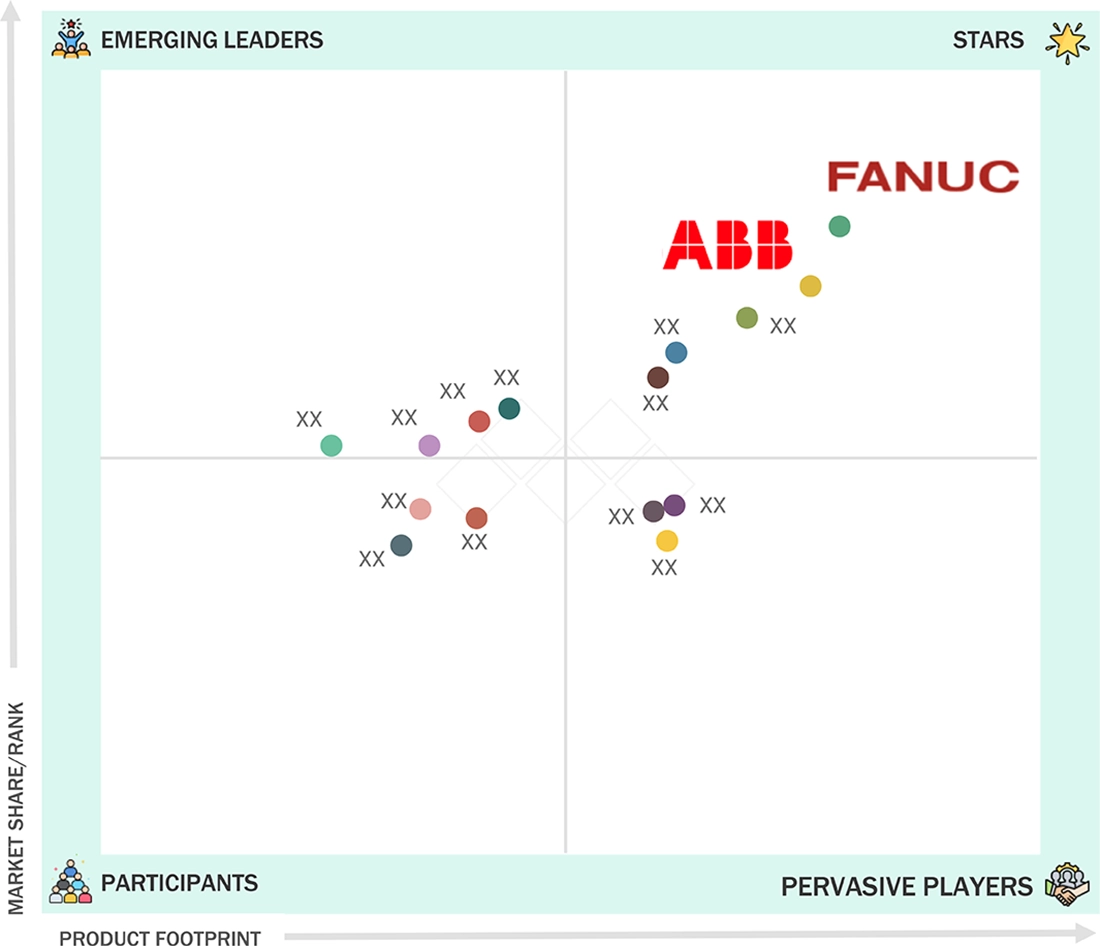
Competitive Landscape - KEY PLAYERSFANUC Corporation, ABB, and Yaskawa Electric Corporation were identified as some of the star players in the North America industrial control & factory automation market, given their strong market share and product footprint.
-
Competitive Landscape - STARTUPS/SMESDover Corporation, Stäubli International AG, and COMAU, among others, have distinguished themselves among startups and SMEs by securing strong footholds in specialized niche areas, underscoring their potential as emerging market leaders.
The North America industrial control & factory automation industry is growing steadily as manufacturers modernize production facilities to improve efficiency, quality, and operational resilience. Strong investments in smart factories, industrial robotics, and advanced control systems boost the adoption across automotive, aerospace, energy, and process industries. Rising labor shortages, reshoring initiatives, and increasing use of digital automation, IIoT, and predictive maintenance solutions further accelerate the market growth across the region.
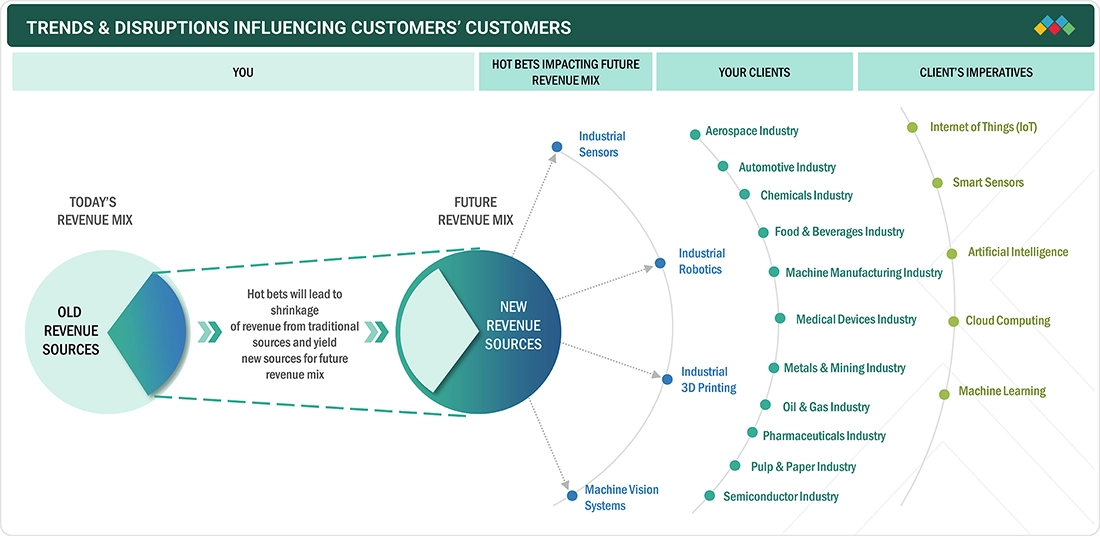
TRENDS & DISRUPTIONS IMPACTING CUSTOMERS' CUSTOMERS
The North America industrial control & factory automation market is undergoing a major shift as customers move away from traditional control hardware toward digitally connected and intelligent automation systems. Emerging trends, such as industrial IoT, industrial robotics, smart sensors, machine vision, and industrial 3D printing, are reshaping revenue models and expanding automation adoption across automotive, aerospace, chemicals, food & beverages, and semiconductor industries. Customer priorities are increasingly centered on IoT-enabled systems, artificial intelligence, cloud connectivity, and machine learning to improve visibility and decision-making. These disruptions are driving the transition toward flexible, data-driven, and scalable factory operations across the region.
Source: Secondary Research, Interviews with Experts, MarketsandMarkets Analysis
MARKET DYNAMICS

Level
-
High investment in smart factories

-
Mounting adoption of industrial robots and AI-driven automation technologies


Level
-
High costs of advanced automation systems

-
Complexity associated with upgrading legacy industrial infrastructure


Level
-
Rising demand for safety, monitoring, and compliance solutions

-
Increasing reliance on predictive maintenance and condition monitoring


Level
-
Lack of standardization across industrial communication protocols

-
Shortage of skilled workforce

Source: Secondary Research, Interviews with Experts, MarketsandMarkets Analysis
Driver: High investment in smart factories
Manufacturers across the US and Canada are investing heavily in smart factory initiatives to modernize production facilities. Adoption of industrial robots, advanced control systems, and connected technologies improve the productivity and operational efficiency. These investments augment the demand for industrial control & factory automation solutions across key industries.
Restraint: High costs of advanced automation systems
Advanced automation systems require significant upfront investment in hardware, software, and system integration. This creates adoption challenges for small- and mid-sized manufacturers in North America. Long payback periods further limit large-scale automation deployment in cost-sensitive industries.
Opportunity: Rising demand for safety, monitoring, and compliance solutions
Strict safety regulations and compliance requirements boost the demand for advanced monitoring and safety automation solutions. Manufacturers are increasingly deploying condition monitoring, safety systems, and real-time analytics to reduce risk. This trend is creating strong growth opportunities for automation vendors in North America.
Challenge: Lack of standardization across industrial communication protocols
The presence of multiple communication standards complicates system integration across industrial environments. Interoperability issues increase deployment time and integration costs. This challenge slows the adoption of fully connected and flexible automation systems in North America.
NORTH AMERICA INDUSTRIAL CONTROL & FACTORY AUTOMATION MARKET: COMMERCIAL USE CASES ACROSS INDUSTRIES
| COMPANY | USE CASE DESCRIPTION | BENEFITS |
|---|---|---|
 |
A major US utility modernized its black start natural gas-fueled turbine generators with Emerson's Ovation distributed control system, integrating condition monitoring and remote capabilities to ensure reliable power system restoration during outages. | Reduced unit startup time by 80%, eliminated obsolescence risks, improved reliability, and achieved annual operations and maintenance savings |
 |
A US steel mill with five million tons annual capacity addressed abnormal vibration in its steam turbine unit using GE Vernova's on-site inspection, repairs including new buckets, diaphragm repairs, bearings, and steam path alignment. | Eliminated six unplanned outage days, saved cost in production revenue, and prevented potential extensive equipment damage |
 |
Enabled digital transformation for North American manufacturers by integrating real-time monitoring, analytics, and connected enterprise solutions to optimize throughput, workforce efficiency, and predictive maintenance across operations. | Achieved significant improvements, such as higher labor efficiency, reduced training times, increased production output, and better asset utilization through advanced analytics and integrated control systems |
 |
Boulevard Brewing Company deployed Honeywell's Alvey palletizer systems for automated handling and palletizing of beer cases in its US production facility. | Improved palletizing efficiency, enhanced throughput in beverage production, reduced manual labor, and ensured consistent case handling in factory automation |
Logos and trademarks shown above are the property of their respective owners. Their use here is for informational and illustrative purposes only.
MARKET ECOSYSTEM
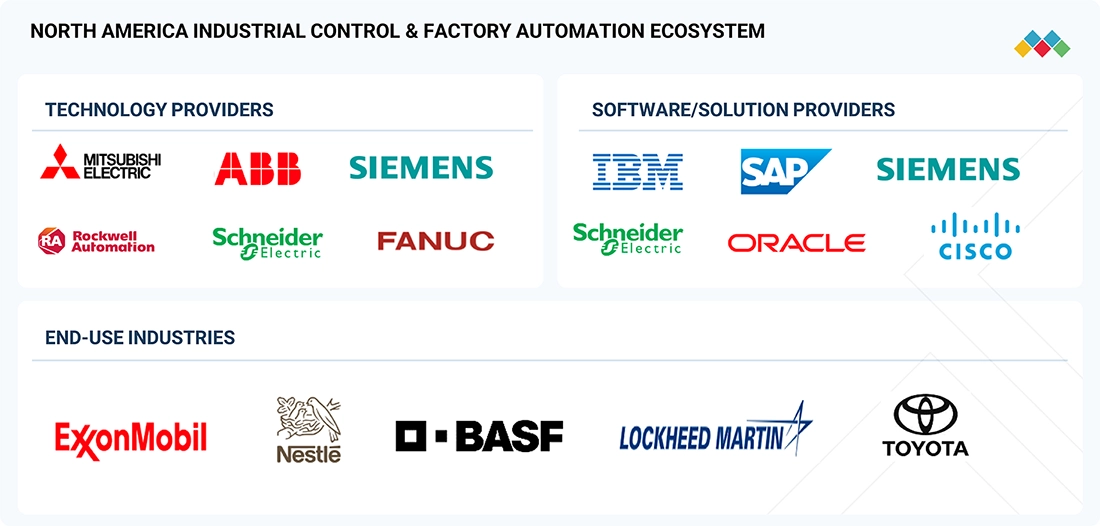
The North America industrial control & factory automation ecosystem is driven by strong interaction between hardware-focused technology providers, software/solution providers, and end-use industries. Technology providers deliver control systems, robotics, instrumentation, and communication infrastructure that form the foundation of factory operations. Software/solution providers add value through industrial platforms, connectivity, analytics, and system integration. End-use industries across manufacturing, energy, chemicals, and automotive drive demand by investing in automation to improve efficiency, reliability, and operational resilience.
Logos and trademarks shown above are the property of their respective owners. Their use here is for informational and illustrative purposes only.
MARKET SEGMENTS
Source: Secondary Research, Interviews with Experts, MarketsandMarkets Analysis
North America Industrial Control & Factory Automation Market, By Component
Industrial 3D printing in North America is expected to register a high CAGR during the forecast period as manufacturers use additive technologies to localize production and shorten supply chains. Strong demand from automotive and aerospace OEMs for rapid tooling, functional prototyping, and customized components accelerates the adoption. Increasing integration of additive manufacturing with automated production cells and digital design platforms further support the market growth. Supportive R&D ecosystems and advanced manufacturing initiatives in the US also contribute to market expansion.
North America Industrial Control & Factory Automation Market, By Industry
The automotive sector is projected to hold the largest share of the North America industrial control & factory automation market due to extensive automation across body-in-white, powertrain, and final assembly operations. US-based automakers are investing heavily in robotics, machine vision, and connected control systems to improve throughput and reduce labor dependency. The rapid transition toward electric and autonomous vehicles is driving upgrades to flexible and software-driven automation platforms. These factors continue to strengthen automotive’s dominant position in the regional market.
REGION
US to grow at fastest rate in North America industrial control & factory automation during forecast period
The US is expected to grow at the highest CAGR in the North America industrial control & factory automation market between 2025 and 2030, supported by large-scale modernization of manufacturing facilities and increased focus on operational efficiency. Strong investments in industrial robotics, advanced control systems, and industrial software also boost the adoption of automation technologies across automotive, aerospace, energy, and chemicals. In addition, reshoring initiatives and labor shortages encourage manufacturers to accelerate the deployment of smart factory and automation solutions.
NORTH AMERICA INDUSTRIAL CONTROL & FACTORY AUTOMATION MARKET: COMPANY EVALUATION MATRIX
ABB and FANUC emerge as the star players in the North America industrial control & factory automation market based on their strong positioning in industrial robotics. Their broad robot portfolios, deep integration with control systems, and extensive deployments across automotive, electronics, and general manufacturing give them high market share and a wide product footprint. Continuous innovation in high-speed, collaborative, and AI-enabled robots further reinforces their leadership in driving large-scale robot adoption across North American factories.
Source: Secondary Research, Interviews with Experts, MarketsandMarkets Analysis
KEY MARKET PLAYERS
- ABB (Switzerland)
- Emerson Electric Co. (US)
- Siemens (Germany)
- Schneider Electric (France)
- Mitsubishi Electric Corporation (Japan)
- GE Vernova (US)
- Rockwell Automation (US)
- Honeywell International Inc. (US)
- Yokogawa Electric Corporation (Japan)
- OMRON Corporation (Japan)
- FANUC Corporation (Japan)
MARKET SCOPE
| REPORT METRIC | DETAILS |
|---|---|
| Market Size in 2024 (Value) | USD 74.42 Billion |
| Market Forecast in 2030 (Value) | USD 125.55 Billion |
| Growth Rate | CAGR of 9.4% from 2025 to 2030 |
| Years Considered | 2021–2030 |
| Base Year | 2024 |
| Forecast Period | 2025–2030 |
| Units Considered | Value (USD Million/Billion), Volume (Thousand Units) |
| Report Coverage | Revenue Forecast, Company Ranking, Competitive Landscape, Growth Factors, and Trends |
| Segments Covered |
|
| Countries Covered | US, Canada, and Mexico |
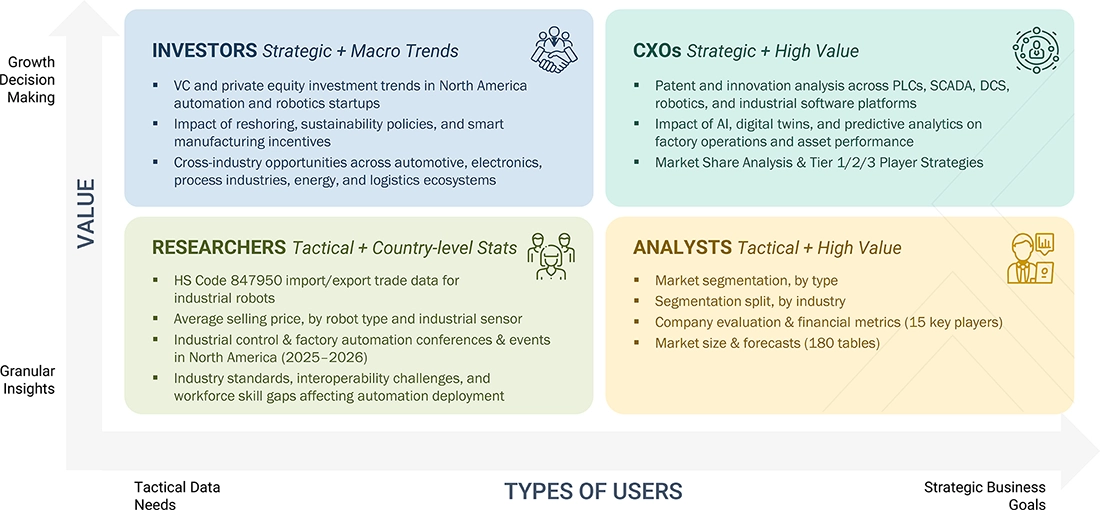
WHAT IS IN IT FOR YOU: NORTH AMERICA INDUSTRIAL CONTROL & FACTORY AUTOMATION MARKET REPORT CONTENT GUIDE
DELIVERED CUSTOMIZATIONS
We have successfully delivered the following deep-dive customizations:
| CLIENT REQUEST | CUSTOMIZATION DELIVERED | VALUE ADDS |
|---|---|---|
| North America Automation Value-Chain Mapping | Mapped the end-to-end automation value chain across hardware, software, robotics, control systems, and industrial connectivity, with a focus on US and Canada manufacturing ecosystems | Clarifies competitive positioning, identifies white spaces, and highlights high-potential growth nodes |
| Vendor Landscape and Capability Assessment | Assessed automation vendors based on control depth, robotics integration, software ecosystems, industry focus, and regional deployment strength | Improves vendor shortlisting, strengthens negotiation leverage, and supports partnership strategy |
| Vertical-Specific Automation Opportunity Analysis | Evaluated automation intensity and unmet needs across automotive, aerospace, energy, chemicals, food processing, and life sciences | Helps prioritize high-ROI verticals and align sales and solution strategies |
| Comprehensive Ecosystem Mapping of North America Industrial Control & Automation | Conducted in-depth mapping of the North America automation ecosystem covering control systems, industrial software, robotics, instrumentation, safety systems, and industrial communication technologies across key US and Canadian manufacturing hubs | Provides clear visibility into ecosystem structure, value-chain linkages, and high-growth automation segments, supporting regional market-entry and expansion strategies |
| Competitive Benchmarking of North America Automation Vendors | Evaluated leading automation providers based on product portfolios, control architectures, robotics capabilities, software integration, regional presence, and end-user adoption across North America | Strengthens competitive intelligence, enables objective vendor comparison, and supports partnership, sourcing, and acquisition decisions |
RECENT DEVELOPMENTS
- December 2025 : Rockwell Automation introduced its elastic Manufacturing Execution System (MES) offerings on a cloud-based, resilient platform. This unifies operational technology (OT) and information technology (IT), addressing integration challenges for manufacturers by providing a single platform for the full manufacturing lifecycle, from materials and inventory to production and tooling, enabling greater flexibility, scalability, and efficiency.
- November 2025 : Siemens expanded its SIPANEL industrial control panels offering in the US, with customizable panels now assembled in Wendell, North Carolina. These panels support protection, automation, and control applications, incorporating Digital Twin technology for enhanced efficiency in industrial systems, utilities, microgrids, and smart infrastructure projects.
- June 2025 : Honeywell launched TrackWise Manufacturing, an AI-assisted, cloud-native platform for life sciences companies to digitize operations, automate workflows, reduce errors from paper-based processes, and accelerate drug development and market delivery through advanced AI integration.
Table of Contents
 Exclusive indicates content/data unique to MarketsandMarkets and not available with any competitors.
Methodology
The study involved major activities in estimating the current market size for the North America Industrial Control & Factory Automation Market. Exhaustive secondary research was done to collect information on the industrial control & factory automation industry. The next step was to validate these findings, assumptions, and sizing with industry experts across the value chain using primary research. Different approaches, such as top-down and bottom-up, were employed to estimate the total market size. After that, the market breakup and data triangulation procedures were used to estimate the market size of the segments and subsegments of the North America Industrial Control & Factory Automation Market.
Secondary Research
The market for the companies offering industrial control & factory automation solutions is arrived at by secondary data available through paid and unpaid sources, analyzing the product portfolios of the major companies in the ecosystem, and rating the companies by their performance and quality. Various sources were referred to in the secondary research process to identify and collect information for this study. The secondary sources include annual reports, press releases, investor presentations of companies, white papers, journals, certified publications, and articles from recognized authors, directories, and databases. In the secondary research process, various secondary sources were referred to for identifying and collecting information related to the study. Secondary sources included annual reports, press releases, and investor presentations of blockchain vendors, forums, certified publications, and whitepapers. The secondary research was used to obtain critical information on the industry's value chain, the total pool of key players, market classification, and segmentation from the market and technology-oriented perspectives.
Primary Research
Extensive primary research has been conducted after understanding and analyzing the current scenario of the North America Industrial Control & Factory Automation Market through secondary research. Several primary interviews have been conducted with the key opinion leaders from the demand and supply sides across North America. Approximately 25% of the primary interviews were conducted with the demand-side respondents, while approximately 75% were conducted with the supply-side respondents. The primary data has been collected through questionnaires, emails, and telephone interviews.
After interacting with industry experts, brief sessions were conducted with highly experienced independent consultants to reinforce the findings from our primary. This, along with the in-house subject matter experts’ opinions, has led us to the findings as described in the remainder of this report. The breakdown of primary respondents is as follows:
Market Size Estimation
Both top-down and bottom-up approaches wete used to estimate and validate the total size of the North America Industrial Control & Factory Automation Market . These methods were also used extensively to estimate the size of various subsegments in the market. The research methodology used to estimate the market size includes the following:
Data Triangulation
After arriving at the overall market size using the market size estimation processes as explained above, the market was split into several segments and subsegments. The data triangulation and market breakdown procedures were employed, wherever applicable, to complete the overall market engineering process and arrive at the exact statistics of each market segment and subsegment. The data was triangulated by studying various factors and trends from the demand and supply sides.
Market Definition
Industrial control & factory automation is a highly digitalized and connected production system that can self-optimize performance across a broad network, self-adapt in various conditions in real time, and autonomously run an entire production process. The major advantage of industrial control & factory automation is its ability to evolve with the changing needs of organizations. Industrial control & factory automation uses a network to connect the virtual and physical elements of production processes to actual manufacturing operations. It helps to create an autonomous manufacturing environment that can handle any technical issues during real-time production, using fragmented information and communication structures to optimize production processes.
Key Stakeholders
- End users
- Government bodies, venture capitalists, and private equity firms
- Manufacturers of industrial control & factory automation components
- Distributors of industrial control & factory automation components and solutions
- Industrial control & factory automation industry associations
- Professional service/solution providers
- Research institutions and organizations
- Standards organizations and regulatory authorities related to the North America Industrial Control & Factory Automation Market
- System integrators
- Technology consultants
Report Objectives
- To describe and forecast the North America Industrial Control & Factory Automation Market, in terms of value, based on component , and industry
- To forecast the North America Industrial Control & Factory Automation Market, in terms of volume, by component
- To provide detailed information regarding drivers, restraints, opportunities, and challenges influencing the market growth
- To provide a detailed overview of the value chain of the industrial control and factory automation ecosystem
- To strategically analyze micromarkets with respect to individual growth trends, prospects, and contributions to the total market
- To provide a detailed overview of the industrial control and factory automation market value chain
- To provide an ecosystem analysis, case study analysis, key conferences, patent analysis, trade analysis, technology analysis, average selling price (ASP) analysis, Porter’s five forces analysis, buying criteria, and regulations pertaining to the market
- To track and analyze competitive developments undertaken by key players in the industrial control and factory automation market
- To profile key players and analyze their market share, core competencies, and detailed competitive landscape for market leaders
- To benchmark market players using the company evaluation matrix, analyzing players based on various parameters within broad business categories and product strategies.
- To analyze strategies, such as product launches, acquisitions, partnerships, and expansions, adopted by the players in the industrial control and factory automation market
- To study the impact of AI on the market under study, along with the macroeconomic outlook for each region
Available Customizations
With the given market data, MarketsandMarkets offers customizations according to the specific requirements of companies. The following customization options are available for the report:
- Detailed analysis and profiling of additional market players based on various blocks of the supply chain
Key Questions Addressed by the Report
What is the projected market value of the North America industrial control and factory automation market by 2030?
The North America industrial control and factory automation market is projected to reach approximately USD 220.4 billion by 2030, growing from about USD 157.8 billion in 2025 at a CAGR of around 7.5% during the forecast period.
Which countries drive growth in the North America industrial control and factory automation market?
The United States and Canada are the primary drivers of growth in the North America industrial control and factory automation market, supported by advanced manufacturing infrastructure and significant investments in automation technologies.
What are the key segments of the North America industrial control and factory automation market?
Key segments of the North America industrial control and factory automation market include control systems (PLCs, DCS, SCADA & HMI), industrial robots, sensors & actuators, machine vision systems, and components deployed across industries such as automotive, food & beverage, oil & gas, and electronics.
Which segment holds a significant share or is expected to grow fastest in the North America industrial control and factory automation market?
The PLC segment holds a significant share due to its extensive use across manufacturing automation, while industrial robotics and machine vision systems are expected to witness the fastest growth driven by smart manufacturing and Industry 4.0 adoption.
Who are the key players operating in the North America industrial control and factory automation market?
Key players operating in the North America industrial control and factory automation market include Siemens AG, Rockwell Automation, Inc., ABB Ltd., Schneider Electric SE, Mitsubishi Electric Corporation, Honeywell International Inc., and Emerson Electric Co., reflecting a competitive and innovation-driven ecosystem.


Personalize This Research
- Triangulate with your Own Data
- Get Data as per your Format and Definition
- Gain a Deeper Dive on a Specific Application, Geography, Customer or Competitor
- Any level of Personalization
Let Us Help You
- What are the Known and Unknown Adjacencies Impacting the North America Industrial Control & Factory Automation Market
- What will your New Revenue Sources be?
- Who will be your Top Customer; what will make them switch?
- Defend your Market Share or Win Competitors
- Get a Scorecard for Target Partners

Custom Market Research Services
We Will Customise The Research For You, In Case The Report Listed Above Does Not Meet With Your Requirements
Get 10% Free CustomisationTESTIMONIALS

Tetsuya Ohhira
Business Development Manager-Technology Business
Nikon Corporation,
Leading Japanese MNC specializing in optics and imaging productswww.nikon.com
MarketsandMarkets™ response
is quick. Their attitude is flexible and positive. Analyst Insights are globally considered and
significant. Client Services quickly respond to our inquiry and demand. Their wide range of global
surveys help us make our strategic plan.
We hope Knowledge Store will be easier to search
for a report.
VP - Marketing & Business Development
Leading Provider of Process Control Solutions
We engaged with MarketsandMarkets on a study to perform an analysis and recommend a Go-To-Market strategy for metrology and process control in the semiconductor market. The study was tailored to our targets and needs with well-defined milestones. Our overall experience with the MarketsandMarkets team was very good throughout the project in all aspects including the analysis methodologies used, the quality and depth of primary and secondary data sets, the professionalism and flexibility of the team and the ability to meet the target schedule and milestones. We want to thank MarketsandMarkets team for a job well done.






Growth opportunities and latent adjacency in North America Industrial Control & Factory Automation Market