North America Laser Processing Market

North America Laser Processing Market by Laser Type (Fiber, Ruby, YAG, Semiconductor, Thin-disk, CO2, Excimer, Helium-neon, Argon, Chemical, Liquid, X-ray, Photonic Crystal, Short-pulse), Configuration (Fixed, Moving, Hybrid) - Forecast to 2032




OVERVIEW
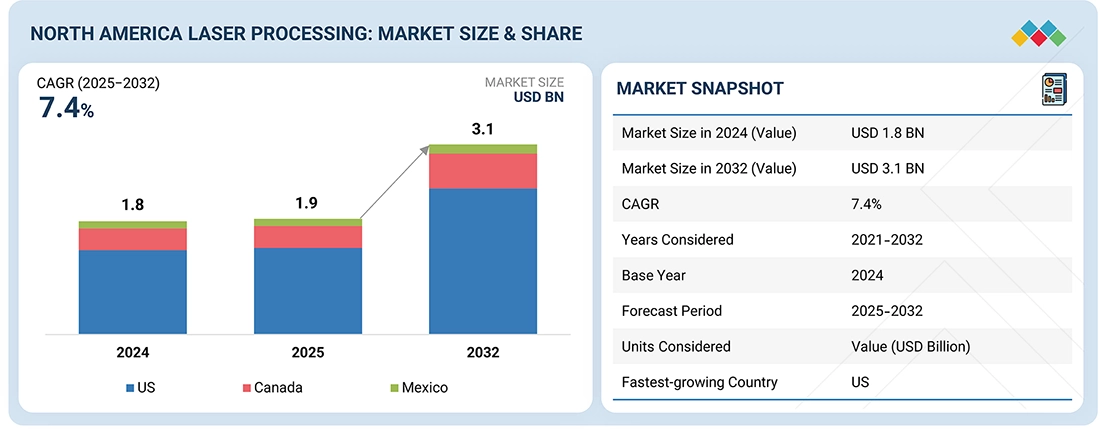
Source: Secondary Research, Interviews with Experts, MarketsandMarkets Analysis
The North American laser processing industry is anticipated to attain a valuation of USD 3.1 billion by 2032 from USD 1.9 billion in 2025, at a CAGR of 7.4% from 2025 to 2032. Laser processing constitutes a non-contact manufacturing technique that employs a concentrated, high-intensity laser beam as a tool to accurately cut, weld, drill, engrave, or alter the surface of diverse materials. This technology operates by focusing sufficient energy to swiftly heat, melt, or vaporize material within a localized area, thereby providing high precision, rapid processing speed, and automation capabilities without mechanical tool wear.
KEY TAKEAWAYS
-
BY COUNTRYBy country, the US market is expected to grow at the highest CAGR of 7.8% during the forecast period.
-
BY LASER TYPEBy laser type, the solid lasers segment is expected to register the fastest growth during the forecast period.
-
BY CONFIGURATIONBy 2032, the hybrid beams configuration segment is expected to dominate the North American laser processing market, with an approximate share of 40–45%.
-
BY APPLICATIONBy application, the cutting segment is expected to register the highest CAGR over the forecast period.
-
BY END USERBy end user, the microelectronics & semiconductors segment is expected to dominate with ~30% of the market in 2032.
-
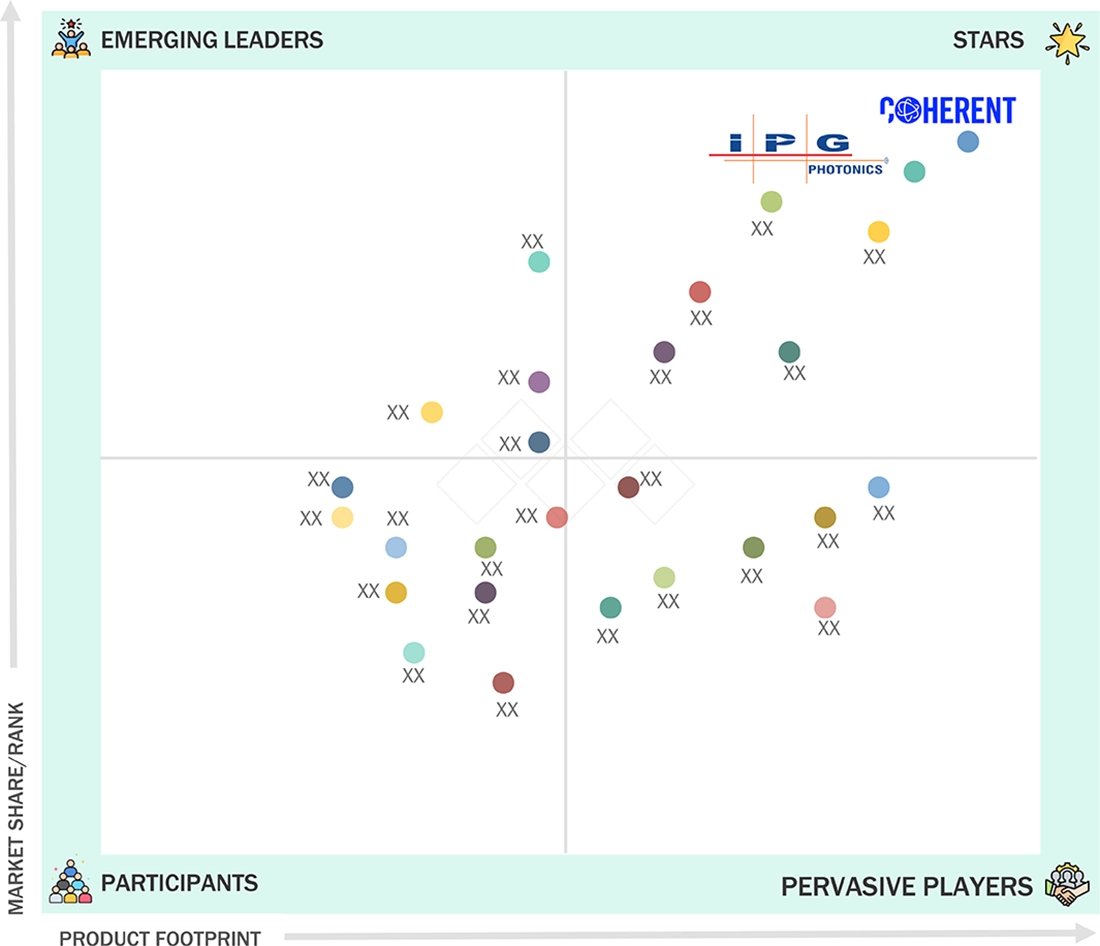
COMPETITIVE LANDSCAPE - KEY PLAYERSCoherent Corp. and IPG Photonics Corporation were identified as some of the star players in the North American laser processing companies, given their strong market share and product footprint.
-
COMPETITIVE LANDSCAPE - STARTUPS/SMESEpilog Laser, Laserax, and LaserStar Technologies Corporation, among others, have distinguished themselves among SMEs by securing strong footholds in specialized niche areas, underscoring their potential as emerging market leaders.
The North American laser processing market is expected to grow, driven by the increasing demand for precision in medical and aerospace manufacturing, as well as the integration of advanced industrial automation and AI. Additionally, strategic government investments, such as the CHIPS Act and the expanding electric vehicle (EV) sector, are speeding up the adoption of this technology for advanced production processes.
TRENDS & DISRUPTIONS IMPACTING CUSTOMERS' CUSTOMERS
In North America, the adoption of IIoT-enabled laser systems integrated with advanced sensors is increasing efficiency and precision in cutting, engraving, marking, and etching applications. The focus on automation and smart manufacturing is encouraging industries to replace traditional methods with laser-based solutions. Leading companies are making significant investments in R&D to develop next-generation laser technologies customized for evolving industrial needs. These advancements are creating new revenue opportunities in the region’s laser processing market.
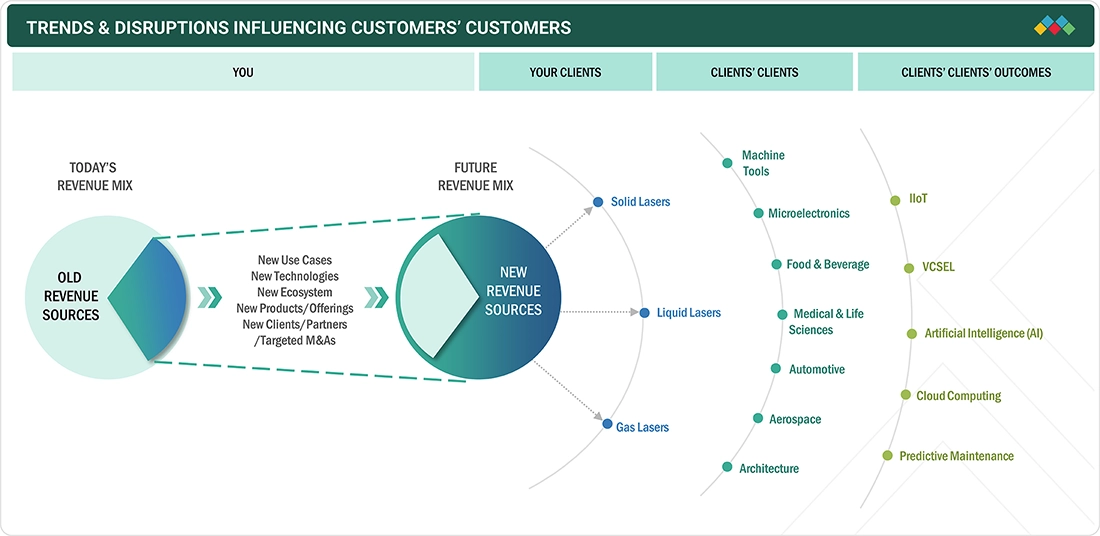
Source: Secondary Research, Interviews with Experts, MarketsandMarkets Analysis
MARKET DYNAMICS

Level
-
Significant investments in North American semiconductor manufacturing

-
Reshoring efforts aimed at creating secure supply chains driving adoption


Level
-
Influence of US tariffs on manufacturing costs of laser components

-
High initial investment for advanced laser systems


Level
-
AI-integration in laser systems in North America

-
High potential for using laser processing in modernizing physical infrastructure


Level
-
Rapid evolution of technology to outpace skilled worker availability

-
Fluctuating trade policies and environmental regulations

Source: Secondary Research, Interviews with Experts, MarketsandMarkets Analysis
Driver: Significant investments in North American semiconductor manufacturing
The US CHIPS and Science Act signifies a significant government commitment to strengthening the domestic semiconductor industry. This law offers essential financial incentives, grants, and subsidies designed to motivate companies to build and expand chip manufacturing plants within the US. The emphasis on regional self-sufficiency is fueling substantial investments in advanced manufacturing techniques, especially laser processing technology, which is crucial for the precision needed in modern chip production. The initiative aims to secure the supply chain and serves as a key driver for market growth in North America.
Restraint: Influence of US tariffs on manufacturing costs of laser components
A main limitation for the North American laser processing industry comes from current trade policies, especially US tariffs on imported parts. Tariffs, especially those placed on advanced components from major global suppliers like China, have significantly raised the costs of operations and materials for US manufacturers.
Opportunity: AI-integration in laser systems in North America
The advanced integration of artificial intelligence (AI) and machine learning into laser processing infrastructure enables North American manufacturers to reach unmatched levels of operational precision, predictive maintenance, and process efficiency. AI algorithms refine cutting paths, minimize material waste, and maintain consistency across high-volume production automatically. This provides a clear competitive edge, supporting complex and customized manufacturing solutions that meet strict industry standards in fields like aerospace and medical devices, unlocking new market opportunities.
Challenge: Rapid evolution of technology to outpace skilled worker availability
A major challenge hindering the growth of the North American laser processing market is a significant shortage of skilled labor. The fast pace of technological innovation, especially the move towards automated and AI-integrated systems, has created a large gap between the skills needed and the current workforce's abilities. Companies find it difficult to hire qualified technicians who can program complex machinery, align advanced optics, and perform specialized maintenance.
NORTH AMERICA LASER PROCESSING MARKET: COMMERCIAL USE CASES ACROSS INDUSTRIES
| COMPANY | USE CASE DESCRIPTION | BENEFITS |
|---|---|---|
 |
Coherent Inc. has deployed sophisticated fiber laser cutting and marking systems equipped with integrated IIoT sensors at a North American automotive supplier’s facility to monitor parameters such as laser power, material temperature, and cutting speed, thereby enabling automatic optimization. | The IIoT-enabled laser systems improve material utilization and energy efficiency while significantly reducing unplanned downtime and raising overall equipment effectiveness for automotive component production in North America. |
 |
IPG Photonics Corporation has deployed its YLR dual-beam fiber laser systems with embedded sensor arrays at a major aerospace manufacturer in the United States to perform precise welding of titanium and aluminum parts while enabling real-time quality monitoring and digital traceability. | Advanced fiber and dual-beam laser solutions increase welding throughput and ensure zero-defect quality with full traceability, which reduces rework and supports stringent aerospace regulatory compliance in the region. |
 |
TRUMPF Inc. has deployed TruLaser Cell cutting and marking systems integrated with cloud-based IIoT sensors across numerous contract manufacturing facilities in North America, which serve medical device OEMs. These systems transmit performance and quality data to the central manufacturing execution system. | Cloud-connected laser processing cells shorten batch cycle times, standardize cutting and marking quality across multiple facilities, lower maintenance incidents through predictive analytics, and help manufacturers achieve high on-time delivery performance in the North American medical device sector. |
 |
LaserStar Technologies has provided customized laser marking and welding platforms to a North American electronics manufacturer, where IIoT-enabled systems mark semiconductors, connectors, and circuit-board components while sending data on beam alignment, marking quality, and throughput to live production dashboards. | Customized laser marking and welding platforms deliver very high marking accuracy, reduce production errors, boost throughput, and extend optics lifespan, enabling electronics manufacturers in North America to meet serialization and quality standards more reliably. |
Logos and trademarks shown above are the property of their respective owners. Their use here is for informational and illustrative purposes only.
MARKET ECOSYSTEM
The North American laser processing ecosystem includes raw material suppliers, laser processing system manufacturers, distributors, and end-use industries. It identifies end-use sectors such as microelectronics & semiconductors, automotive, medical & life sciences, aerospace, and architecture & construction.
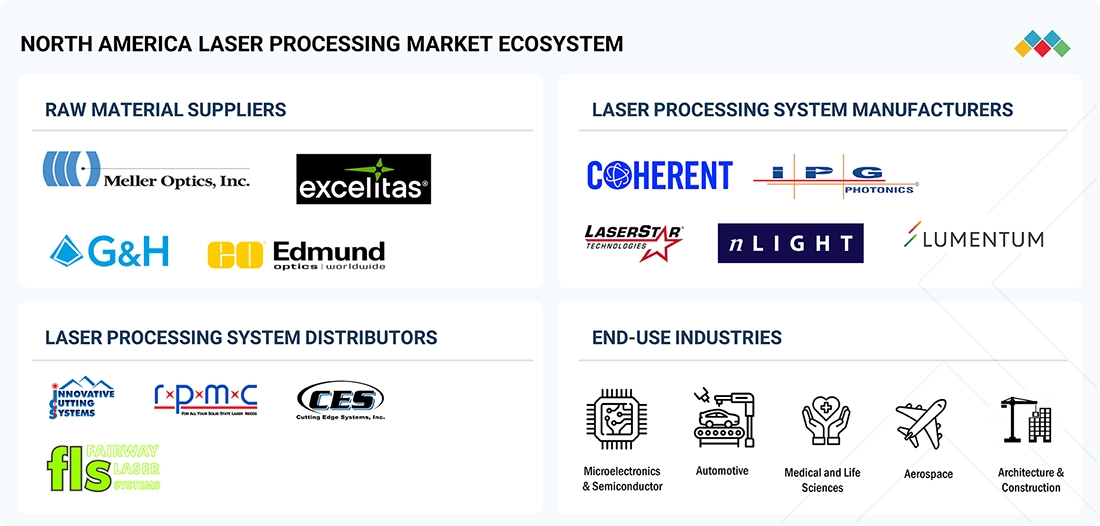
Logos and trademarks shown above are the property of their respective owners. Their use here is for informational and illustrative purposes only.
MARKET SEGMENTS

Source: Secondary Research, Interviews with Experts, MarketsandMarkets Analysis
North America Laser Processing Market, By Laser Type
Solid-state lasers lead the North American laser processing market because they provide an excellent balance of high beam quality, energy efficiency, and reliability for industrial applications. Their capacity to perform precise cutting, welding, drilling, and marking across metals, plastics, and composites makes them the top choice for automotive, aerospace, electronics, and medical manufacturing. Improvements in fiber and disk solid-state architectures have lowered operating costs and maintenance needs, while allowing for higher power outputs and faster processing speeds. Additionally, their compatibility with automation and IIoT-enabled control systems supports smart factory initiatives, strengthening their dominant position in the regional laser processing industry.
North America Laser Processing Market, By Configuration
Hybrid beam configurations lead the North American laser processing market because they combine the advantages of laser technology with complementary methods such as arc welding or traditional machining, providing better performance than single-source systems. By enabling deeper penetration, faster welding speeds, and improved gap-bridging ability, hybrid beams are especially useful for thick and hard-to-weld materials used in automotive, shipbuilding, and heavy machinery sectors. These systems also enhance energy efficiency and weld quality by focusing heat input while minimizing distortion and the heat-affected zone, which lowers post-processing needs. Additionally, their operational flexibility allows manufacturers to perform multiple processes on a single platform, supporting automation and smart-factory initiatives that are widely adopted across North American plants.
North America Laser Processing Market, By Application
Cutting accounts for the largest share of the North America laser processing market because it is a core requirement across automotive, aerospace, metal fabrication, electronics, and consumer goods manufacturing. Laser cutting delivers high precision, narrow kerf widths, and clean edges with minimal post-processing, which reduces scrap rates and overall production costs compared with mechanical cutting. The technology supports a wide range of materials and thicknesses from sheet metals to composites and advanced alloys, making it highly versatile for job shops and OEMs. Integration of automated loading systems, CNC controls, and IIoT monitoring further boosts throughput and uptime, reinforcing the dominance of laser cutting applications in regional demand.
North America Laser Processing Market, By End User
Microelectronics and semiconductors represent the largest share of laser processing demand in North America because the industry needs ultra-precise, high-speed techniques for wafer scribing, dicing, drilling, and micro-marking that conventional methods cannot provide. The ongoing growth of advanced packaging, 3D NAND, and logic node migration drives intense use of lasers for fine-feature patterning and high-density interconnect fabrication. Lasers enable non-contact, low-thermal-impact processing, which is essential for fragile substrates such as silicon, compound semiconductors, and advanced ceramics used in chips and packaging. Significant regional investments in fabs, semiconductor equipment, and electronics manufacturing further strengthen this segment’s dominant position in the North American laser processing market.
REGION
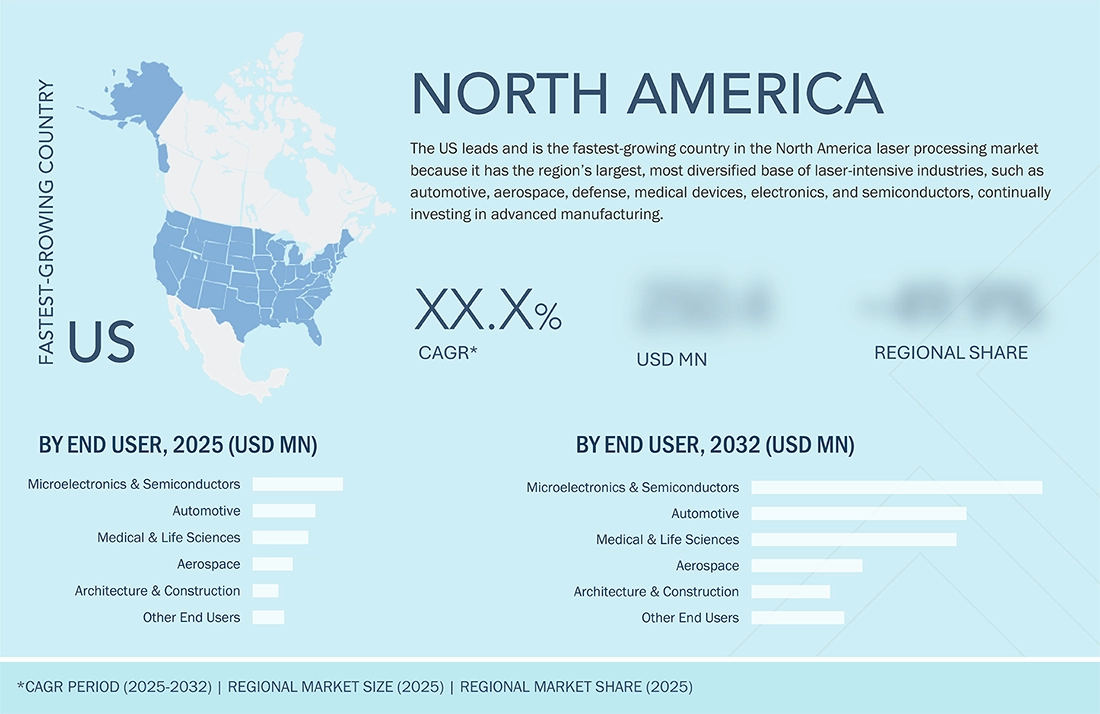
The US is expected to dominate across the North America laser processing market during the forecast period.
The US leads the North American laser processing market because of its large and diverse manufacturing industry spanning automotive, aerospace, defense, medical devices, and electronics, all of which heavily utilize laser technologies. Significant investments in factory automation, smart manufacturing, and IIoT integration drive the adoption of advanced laser cutting, welding, drilling, and marking systems in US facilities. The country is also home to many top laser OEMs, system integrators, and semiconductor/electronics fabs, fostering a strong domestic ecosystem for innovation and deployment.
NORTH AMERICA LASER PROCESSING MARKET: COMPANY EVALUATION MATRIX
Within the North American laser processing market matrix, Coherent Corp. and IPG Photonics Corporation (Star) are at the forefront, demonstrating a robust market presence and an extensive product portfolio. Their efforts significantly endorse adoption across diverse end-use sectors including Microelectronics & Semiconductors, Automotive, and Medical & Life Sciences.
Source: Secondary Research, Interviews with Experts, MarketsandMarkets Analysis
KEY MARKET PLAYERS
- Coherent Corp. (US)
- IPG Photonics Corporation (US)
- Lumentum Operations LLC (US)
- Laser Star Technologies (US)
- Epilog Laser (US)
- MKS Instruments (US)
- Novanta Inc. (US)
- Applied Laser Technology, Inc. (US)
- Photonics Industries International Inc. (US)
- Universal Laser Systems, Inc. (US)
- nLIGHT, Inc. (US)
MARKET SCOPE
| REPORT METRIC | DETAILS |
|---|---|
| Market Size in 2024 (Value) | USD 1.8 Billion |
| Market Forecast in 2032 (Value) | USD 3.1 Billion |
| Growth Rate | CAGR of 7.4% from 2025–2032 |
| Years Considered | 2021–2032 |
| Base Year | 2024 |
| Forecast Period | 2025–2032 |
| Units Considered | Value (USD Million/Billion) |
| Report Coverage | Revenue forecast, company ranking, competitive landscape, growth factors, and trends |
| Segments Covered |
|
| Regional Scope | North America (US, Canada, Mexico) |
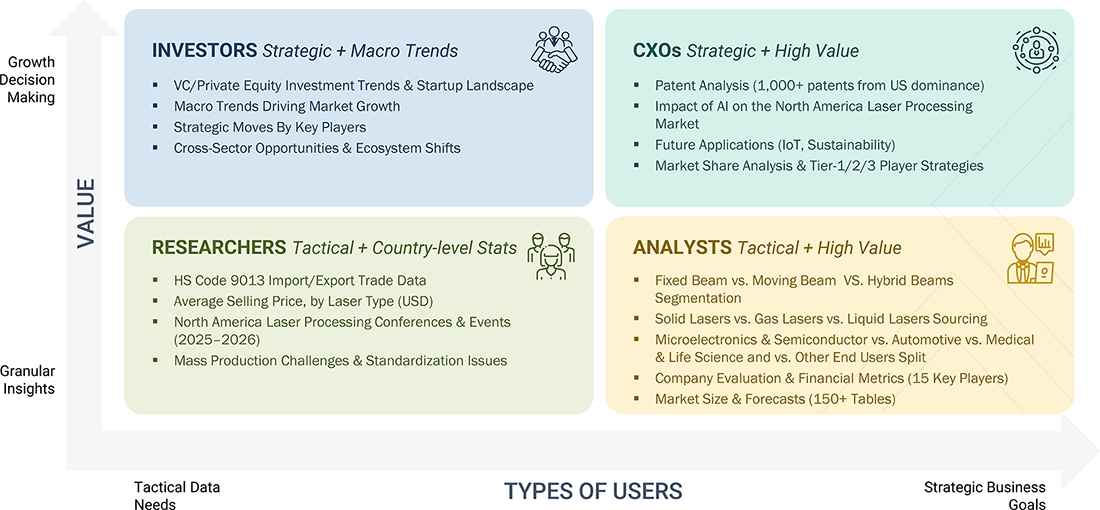
WHAT IS IN IT FOR YOU: NORTH AMERICA LASER PROCESSING MARKET REPORT CONTENT GUIDE
DELIVERED CUSTOMIZATIONS
We have successfully delivered the following deep-dive customizations:
| CLIENT REQUEST | CUSTOMIZATION DELIVERED | VALUE ADDS |
|---|---|---|
| US-based Automotive Tier-1 Supplier |
|
|
| North America Semiconductor & Microelectronics Manufacturer |
|
|
| US-based Medical Device OEM |
|
|
| Industrial Laser System Integrator in Canada |
|
|
| North America Aerospace & Defense Prime Contractor |
|
|
RECENT DEVELOPMENTS
- April 2025 : MKS Instruments (US) introduced the new Talon Mark UV15 and UV20 lasers for ultra-high-speed, precise marking and coding applications. These compact, high-power UV lasers feature advanced integration capabilities.
- March 2025 : Coherent Corp. (US) introduced the AIM FL Series, providing up to 3kW of power with excellent beam quality and stability for precision welding. Built for industrial applications, it allows easy integration with Coherent's processing heads and monitoring solutions.
- November 2024 : IPG Photonics Corporation (US) introduced the YLR-AMB dual-beam fiber lasers to improve precision, efficiency, and productivity in additive manufacturing. With independent control of core and ring beams, these lasers provide versatile processing options and optimized heat distribution for high-quality builds.
Table of Contents
 Exclusive indicates content/data unique to MarketsandMarkets and not available with any competitors.
Methodology
The study used four major activities to estimate the market size of North America laser processing market. Exhaustive secondary research was conducted to gather information on the market and its peer and parent markets. The next step was to validate these findings, assumptions, and sizing with industry experts across the value chain through primary research. Both top-down and bottom-up approaches were employed to estimate the total market size. Finally, market breakdown and data triangulation methods were utilized to estimate the market size for different segments and subsegments.
Secondary Research
The research methodology used to estimate and forecast the size of the North America Laser Processing Market began with the acquisition of data related to the revenues of key vendors in the market through secondary research. Various secondary sources have been referred to in the secondary research process to identify and collect information for this study. Secondary sources include annual reports, press releases, and investor presentations of companies; white papers, journals, certified publications, and articles by recognized authors; websites; directories; and databases. Secondary research has mainly been used to obtain key information about the value chain of the North America Laser Processing Market, key players, market classification, and segmentation according to the industry trends to the bottom-most level, geographic markets, and key developments from both market and technology-oriented perspectives. The secondary research referred to for this research study involves various journals like Springer Nature Limited, Laser Focus World, Spectrum Plastics Group, Journal of Laser Applications, and various other sources. Moreover, the study involved extensive use of secondary sources, directories, and databases, such as Hoovers, Bloomberg Businessweek, and Factiva, to identify and collect valuable information for a technical, market-oriented, and commercial study of the North America Laser Processing Market.
Primary Research
In the primary research process, various primary sources from both the supply and demand sides have been interviewed to obtain the qualitative and quantitative information relevant to this report. Primary sources from the supply side include key industry participants, subject-matter experts (SMEs), and C-level executives and consultants from various key companies and organizations in the North America laser processing ecosystem. After the complete market engineering (including calculations for the market statistics, the market breakdown, the market size estimations, the market forecasting, and the data triangulation), extensive primary research has been conducted to verify and validate the critical market numbers obtained. Several primary interviews have been conducted with market experts from the demand and supply-side players across North America.
Primary data has been collected through questionnaires, emails, and telephonic interviews. In the canvassing of primaries, various departments within organizations, such as sales, operations, and administration, were covered to provide a holistic viewpoint in our report. This and the in-house subject matter experts’ opinions have led us to the findings described in the remainder of this report.
Market Size Estimation
Both top-down and bottom-up approaches were utilized to estimate and validate the size of the North America Laser Processing Market and its submarkets. Secondary research was conducted to identify the key players in the market, and primary and secondary research was used to determine their market share in specific regions. The entire process involved studying top players' annual and financial reports and conducting extensive interviews with industry leaders such as CEOs, VPs, directors, and marketing executives. Secondary sources were used to determine all percentage shares and breakdowns, which were verified through primary sources. All parameters that could impact the markets covered in this research study were accounted for, analyzed in detail, verified through primary research, and consolidated to obtain the final quantitative and qualitative data.
Data Triangulation
Once the overall size of the North America Laser Processing Market was determined using the methods described above, it was divided into multiple segments and subsegments. Market engineering was performed for each segment and subsegment using market breakdown and data triangulation methods, as applicable, to obtain accurate statistics. To triangulate the data, various factors and trends from the demand and supply sides were studied. The market was validated using both the top-down and bottom-up approaches.
Market Definition
Laser Processing includes a wide range of systems used for precision cutting, welding, drilling, marking, and surface treatment. These systems are classified by laser type, such as solid lasers (fiber, ruby, YAG, semiconductor, thin-disk), gas lasers (CO2, excimer, helium-neon, argon, chemical), liquid lasers, and other laser types. Laser processing enables high-speed, contactless operations with superior accuracy and minimal material distortion, making it essential for applications requiring fine detail and high quality. It plays a critical role in industries like microelectronics and semiconductors, automotive, medical and life sciences, aerospace, and architecture & construction.
Key Stakeholders
- Microelectronics manufacturers
- Aerospace companies
- Medical & life sciences companies
- Automotive companies
- Architecture firms
- Machine tool manufacturers
- Lasers and systems manufacturers
- Laser processing solution providers
- Engineering and manufacturing companies
- Technology providers
Report Objectives
- To estimate and forecast the size of the North America Laser Processing Market, in terms of value, based on laser type, configuration, application, end user, and region
- To provide qualitative information about laser processing componenets in the North America Laser Processing Market
- To provide detailed information regarding major factors such as drivers, restraints, opportunities, and challenges influencing market growth in the of the North America Laser Processing Market
- To provide a detailed overview of the of the North America Laser Processing value chain
- To strategically analyze micromarkets regarding individual market trends, growth prospects, and contributions to the total of the North America Laser Processing market
- To strategically profile key players and comprehensively analyze their market position in terms of ranking and core competencies, along with a detailed competitive landscape for the market leaders in the North America Laser Processing Marketof the North America Laser Processing Market
- To analyze major growth strategies such as product launches/developments and acquisitions adopted by the key market players to enhance their market position in the North America Laser Processing Market
- To analyze the impact of the macroeconomic factors on the North America Laser Processing Market
Available Customizations:
With the given market data, MarketsandMarkets offers customizations according to the specific requirements of companies. The following customization options are available for the report:
- Detailed analysis and profiling of additional market players (up to 5)
- Additional country-level analysis of the North America Laser Processing Market
Product Analysis
- Product matrix, which provides a detailed comparison of the product portfolio of each company in the North America Laser Processing Market.
Key Questions Addressed by the Report
What is the projected market value of the North America Laser Processing market?
The North America Laser Processing market is projected to reach a significant market value by the forecast period, driven by increasing adoption of laser technologies in manufacturing and industrial applications.
Which region is expected to dominate the North America Laser Processing market?
The United States is expected to dominate the North America Laser Processing market due to strong industrial infrastructure and early adoption of advanced manufacturing technologies.
What are the key segments of the North America Laser Processing market?
The market is segmented by laser type, process, application, end-use industry, and country, with fiber lasers, cutting processes, and automotive and electronics industries accounting for a major share.
Who are the major key players in the North America Laser Processing market?
Major key players in the North America Laser Processing market include IPG Photonics Corporation, Coherent, Inc., TRUMPF Group, Lumentum Holdings Inc., and Han’s Laser Technology Industry Group Co., Ltd.
What factors are driving the growth of the North America Laser Processing market?
The growth of the North America Laser Processing market is driven by rising demand for precision manufacturing, increasing automation in industries, advancements in laser technology, and growing applications in automotive, aerospace, and electronics sectors.


Personalize This Research
- Triangulate with your Own Data
- Get Data as per your Format and Definition
- Gain a Deeper Dive on a Specific Application, Geography, Customer or Competitor
- Any level of Personalization
Let Us Help You
- What are the Known and Unknown Adjacencies Impacting the North America Laser Processing Market
- What will your New Revenue Sources be?
- Who will be your Top Customer; what will make them switch?
- Defend your Market Share or Win Competitors
- Get a Scorecard for Target Partners

Custom Market Research Services
We Will Customise The Research For You, In Case The Report Listed Above Does Not Meet With Your Requirements
Get 10% Free CustomisationTESTIMONIALS

Tetsuya Ohhira
Business Development Manager-Technology Business
Nikon Corporation,
Leading Japanese MNC specializing in optics and imaging productswww.nikon.com
MarketsandMarkets™ response
is quick. Their attitude is flexible and positive. Analyst Insights are globally considered and
significant. Client Services quickly respond to our inquiry and demand. Their wide range of global
surveys help us make our strategic plan.
We hope Knowledge Store will be easier to search
for a report.
VP - Marketing & Business Development
Leading Provider of Process Control Solutions
We engaged with MarketsandMarkets on a study to perform an analysis and recommend a Go-To-Market strategy for metrology and process control in the semiconductor market. The study was tailored to our targets and needs with well-defined milestones. Our overall experience with the MarketsandMarkets team was very good throughout the project in all aspects including the analysis methodologies used, the quality and depth of primary and secondary data sets, the professionalism and flexibility of the team and the ability to meet the target schedule and milestones. We want to thank MarketsandMarkets team for a job well done.
Growth opportunities and latent adjacency in North America Laser Processing Market






Justin
Apr, 2026
With the United States market growing steadily, how will this translate into revenue opportunities for manufacturers and solution providers?.
Edwin
Apr, 2026
SMEs such as Epilog Laser, Laserax, and LaserStar Technologies Corporation are gaining traction can niche specialization drive higher profit margins than scale?.