Asia Pacific eGRC Market

Asia Pacific eGRC Market by Solution (Risk Management, Compliance Management, Audit Management, Policy Management, Privacy Management), Service (Professional, Managed), Business Function (Legal, Finance, Operations), Vertical, & Country - Forecast to 2030




OVERVIEW
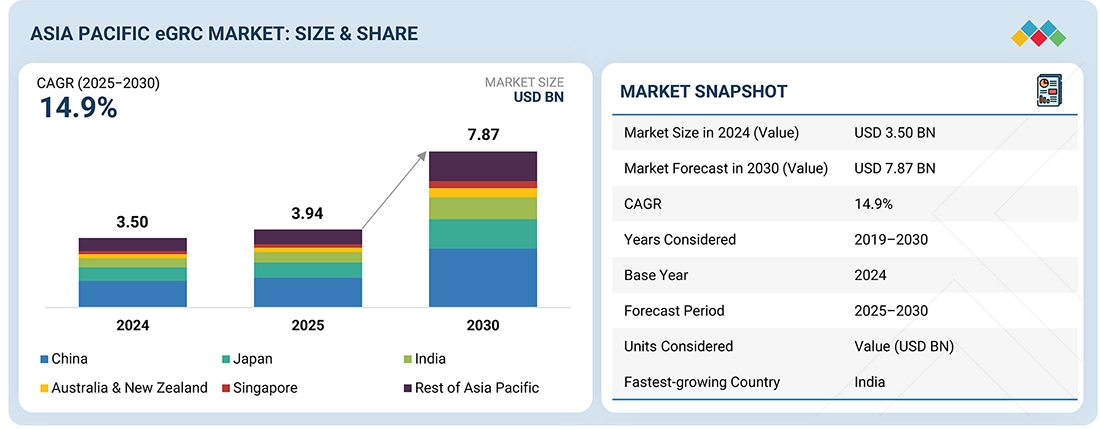
Source: Secondary Research, Interviews with Experts, MarketsandMarkets Analysis
The Asia Pacific eGRC market is expected to reach USD 7.87 billion by 2030 from USD 3.94 billion in 2025, at a CAGR of 14.9% from 2025 to 2030. In the Asia Pacific, many compliance regulations are being enacted, including Indonesia's DPDP Act, Singapore's MAS TRM Guidelines, and Australia's APRA CPS 234 and CPS 230. Regulatory pressures from various frameworks and sector-specific mandates in BFSI, healthcare, telecom, and infrastructure are two key drivers of the rapid growth of the eGRC market in the region. As a significant trend in the eGRC market, more companies are adopting cloud-based, AI-powered governance solutions to enhance visibility into their risk environment, improve and strengthen their compliance workflows, and automate the monitoring and management of their risks and compliance. As emerging use cases, AI-enabled continuous monitoring, SaaS deployed eGRC solutions, and third-party risk management will create new and continued growth opportunities for the eGRC market in the region.
KEY TAKEAWAYS
-
BY OFFERINGBy offering, the solutions segment is expected to dominate the market during the forecast period.
-
BY SOLUTIONBy solution, the risk management segment is expected to dominate the market in 2025.
-
BY SERVICEBy service, the professional services segment is expected to dominate the market during the forecast period.
-
BY ORGANIZATION SIZEBy organization size, the SMEs segment will grow at the highest CAGR of 15.5% during the forecast period.
-
BY BUSINESS FUNCTIONBy business function, the IT segment is projected to grow at the fastest rate of 15.0% from 2025 to 2030.
-
BY VERTICALBy vertical, the healthcare segment will grow at the highest CAGR of 17.5% during the forecast period.
-
COMPETITIVE LANDSCAPE - KEY PLAYERSIn the Asia Pacific region, the eGRC market is led by established players such as MetricStream, SAI360, Wolters Kluwer, Diligent, and Protecht Group, which offer mature, integrated governance platforms spanning risk, compliance, audit, policy, and third-party management.
-
COMPETITIVE LANDSCAPE - STARTUPSAsia Pacific also hosts a rapidly expanding ecosystem of innovative eGRC startups and emerging providers, including 6clicks, ReadiNow, ProGrec, Ascent Business Technology, Dynamic GRC, SafetyCulture, Sentrient, and Panacea Infosec. These companies deliver agile, cloud-native platforms focused on quick onboarding, automated control monitoring, integrated compliance workflows, and easy interoperability with existing enterprise systems.
A variety of regulatory and governance requirements will be imposed on businesses across the Asia Pacific as they grow their operations into multiple countries, including India, China, Japan, Australia. The complexity of these varied regulations is driving an increase in the use of e-GRC systems that offer centralized environmental visibility, allow for the continued monitoring of real-time risk, provide for controls that will be consistent across each regional operation as well as aid in the decision-making process.
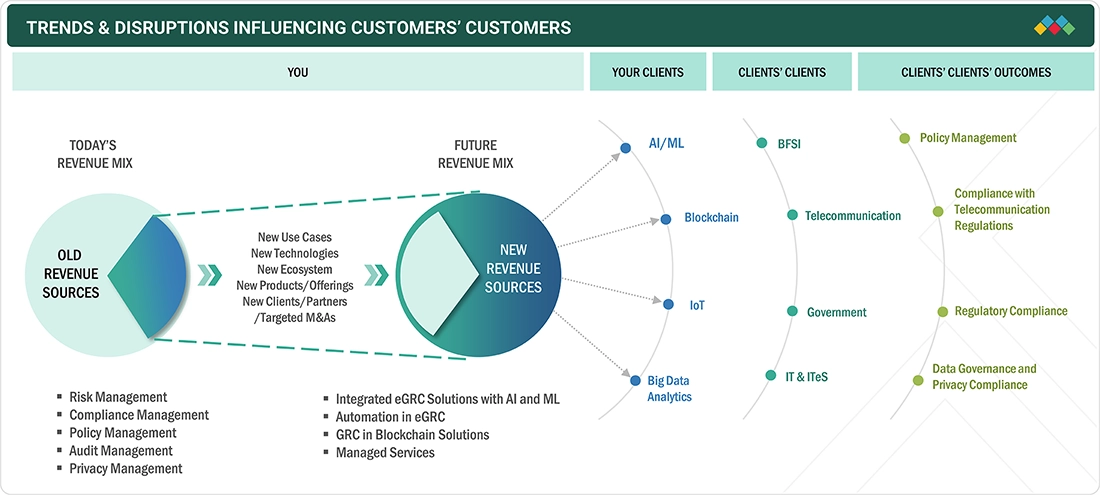
TRENDS & DISRUPTIONS IMPACTING CUSTOMERS' CUSTOMERS
The transformation of the eGRC from traditional governance technologies to AI-enabled, cloud solutions and integrated eGRC platforms is a result of the growing presence of regulatory mandates in many ASEAN countries. AI/ML-based risk analytics, blockchain-based audit trail, IoT-based operational monitoring, and compliance intelligence through big data are just a few examples. The rise of these new technologies is facilitating the region's rapid digital transformation and enabling eGRC vendors to expand their product offerings with AI-enabled eGRC suites and managed GRC services. Ultimately, these changes will allow enterprises to build long-term revenue opportunities as organizations evolve from legacy, disconnected systems to fully integrated and intelligent governance models.
Source: Secondary Research, Interviews with Experts, MarketsandMarkets Analysis
MARKET DYNAMICS

Level
-
Expansion of regulatory frameworks across Asia Pacific region

-
Growing digital transformation & cyber threats


Level
-
Shortage of skilled professionals

-
High deployment/integration costs


Level
-
Cloud & AI-enabled eGRC adoption

-
Growth in India, ASEAN, and Australia


Level
-
Data privacy/sovereignty constraints

-
Fragmented regulatory landscape

Source: Secondary Research, Interviews with Experts, MarketsandMarkets Analysis
Driver: Growing digital transformation & cyber threats
With the rapid growth of digital transformation, greater adoption of the cloud and digital services by businesses, and increased cyber threats and operational risks, the regulatory landscape for many companies in the Asia Pacific region is changing rapidly. In India, China, Australia, Japan, and other Southeast Asian countries, many companies are modernizing their technology infrastructure to comply with new data and privacy regulations. With new cyber threats arising in the form of phishing, ransomware, denial-of-service attacks, etc., organizations without established risk management and compliance processes face challenges in meeting their compliance obligations. Because of this, demand for eGRC platforms that will help organizations obtain and maintain a single view of all their risks, promote an ongoing process for monitoring and responding to regulatory issues, and increase their overall cyber governance is rapidly increasing.
Restraint: Shortage of skilled professionals
There is a severe shortage of skilled professionals who can assist organizations in developing and maintaining an organizational risk and compliance framework. This is especially true among many small and medium-sized companies throughout the Asia Pacific region. Especially within India and Southeast Asia, SMEs lack qualified risk professionals, which has hampered many eGRC installations and limited the maximum potential of eGRC systems and their ability to support organizations in meeting their risk management and compliance obligations.
Opportunity: Growth in India, ASEAN, and Australia
With the rapid development of digital maturity, regulatory mandates for cybersecurity, and the data privacy regulations in countries such as India, Indonesia, Singapore, Malaysia, Vietnam, and Australia, there are numerous business opportunities for eGRC vendors. An increasing number of mid-market organizations, digital-native companies, and regulated sectors are transitioning to SaaS, AI-driven, and automated eGRC solutions. This shift is creating significant long-term growth opportunities for eGRC vendors in this region.
Challenge: Data privacy & sovereignty constraints
The region is subject to diverse regulatory frameworks, and each country has implemented different laws on Data Security, Cybersecurity, and Compliance. There are also very strict Data Sovereignty Laws in India, Indonesia, China, and Australia, which hinder cross-border data storage (Cloud) and create barriers to global and unified governance frameworks. The increasing complexity of compliance issues is driving higher costs for organizations as they integrate and develop e-governance, risk, and compliance (eGRC) solutions across countries in the Asia Pacific region.
ASIA PACIFIC EGRC MARKET: COMMERCIAL USE CASES ACROSS INDUSTRIES
| COMPANY | USE CASE DESCRIPTION | BENEFITS |
|---|---|---|
 |
A leading Indian private-sector bank implemented MetricStream’s cloud-based eGRC platform to unify operational risk management, regulatory compliance tracking, and audit management across 2,000+ branches. | 40% reduction in manual compliance effort | Real-time visibility into risk events | Faster regulatory reporting aligned with RBI and DPDPA requirements |
 |
A major Southeast Asian bank adopted OneSumX to streamline regulatory reporting, manage complex risk models, and align data with evolving MAS and Bank Negara Malaysia (BNM) guidelines. | Improved accuracy and consistency of regulatory submissions | Centralized data governance | Reduced compliance costs and reporting turnaround time |
 |
An Indian IT services firm adopted 6clicks to automate compliance mapping across ISO, SOC 2, PCI DSS, and DPDPA using its AI engine (Hailey). | 70% faster policy-to-control mapping | Scalable compliance workflows for multiple standards | Reduced manual audit preparation time |
Logos and trademarks shown above are the property of their respective owners. Their use here is for informational and illustrative purposes only.
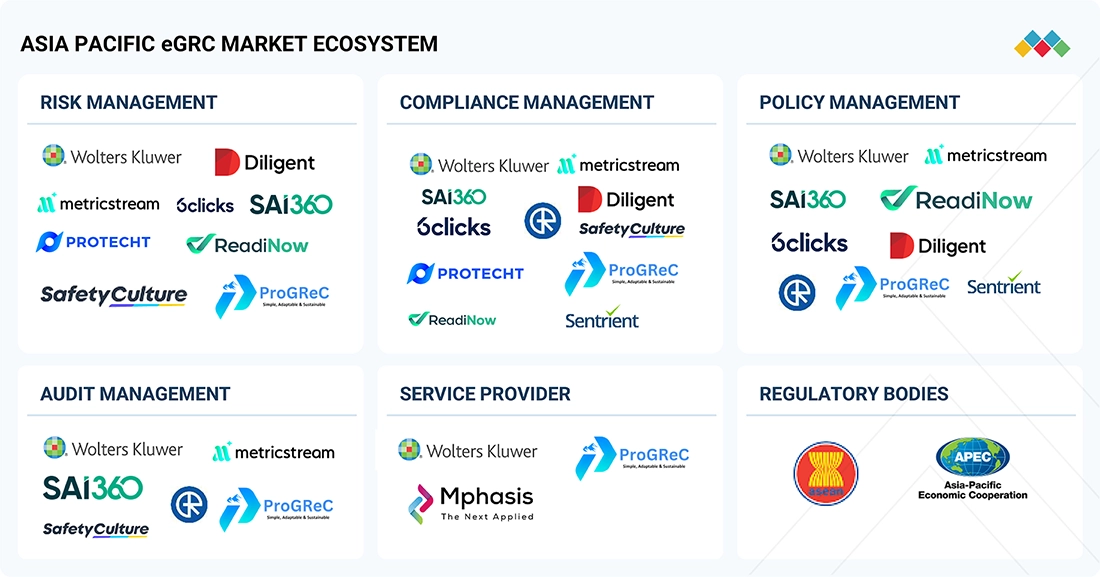
MARKET ECOSYSTEM
The eGRC ecosystem comprises established technology vendors delivering risk, compliance, policy, and audit management platforms, supported by consulting and managed service providers enabling implementation and operationalization. Regulatory bodies shape requirements, driving adoption across industries as organizations seek integrated governance solutions to meet data privacy, financial, and cybersecurity standards.
Logos and trademarks shown above are the property of their respective owners. Their use here is for informational and illustrative purposes only.
MARKET SEGMENTS
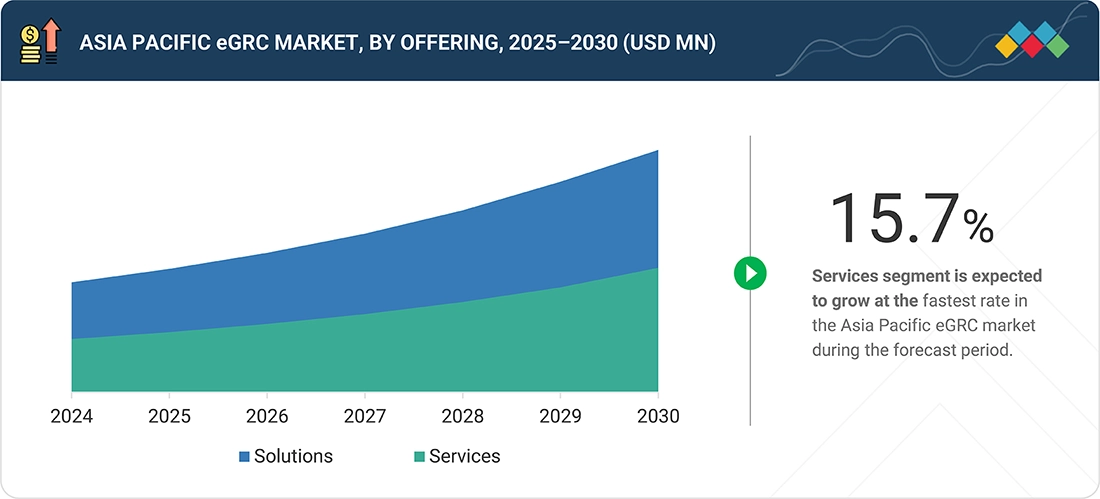
Source: Secondary Research, Interviews with Experts, MarketsandMarkets Analysis
eGRC, by Solution
A growing number of enterprises in the region have adopted an integrated eGRC approach for managing risk, compliance, audit, policy, and third-party governance using a single framework. Risk management solutions are experiencing the highest CAGR growth of all solutions due to regulatory and compliance requirements that require organizations to utilize a risk management solution, as it provides real-time insights into their risks and automates their compliance workflow. Additionally, consulting, implementation, and managed compliance support services are also gaining popularity with mid-market companies, as well as with governmental entities that need to quickly deploy their eGRC solutions and utilize domain expertise.
eGRC, by Deployment Mode
eGRC Tools built on the cloud are the fastest-growing segment across this region. India, Singapore, Australia, and Japan have begun to see rapid growth in the use of Cloud-Natively built eGRC solutions as a result of improved readiness to defend against cyber threats and the need to automate compliance. Despite the rapid adoption of Cloud-based eGRC solutions across this region, markets that are highly regulated in terms of critical data sovereignty rules (BFSI, Government and Telecommunication), are still pursuing a Hybrid Model for compliance-based solutions because they must comply with local hosting, data residency and security compliance requirements.
eGRC, by Organization Size
Both large corporations and small businesses are rapidly adopting eGRC solutions. Large corporations are primarily focused on meeting complicated regulations due to operating in different countries and having multiple governance structures. Industries such as BFSI, Telecom, Energy and Government sector have been quick to adopt complex eGRC suites that include data analytics, automated controls and continuous monitoring features. On the other hand, SMEs are now adopting lightweight cloud-based eGRC solutions from local vendors (i.e., 6clicks SafetyCulture, Ascent Business Technology, Sentrient), primarily driven by increasing cyber risks, insufficient understanding of the compliance required and growing digitalization.
eGRC Market, by Business Function
By business function, finance continues to be the largest adopter of eGRC solutions. This adoption continues to occur because of the need for organizations to be able to rely on the accuracy of their financial reporting, to be prepared for audits, and to monitor for fraud as well as continue to comply with changing accounting and taxation regulations. Risk management and information technology continue to be major solution adopted by finance departments. Similarly, eGRC platforms are increasingly being implemented by operations and HR departments to improve governance throughout the organization, ensuring compliance for their workforces, and standardizing processes between all departments.
eGRC Market, by Vertical
Ongoing regulatory scrutiny, the increasing demand for cybersecurity, and the rapid development of the digitalization of financial services including digital banks and fintech have been a significant contributing factor to BFSI being the largest adopters of eGRC solutions and services. In contrast, government/public-sector agencies are investing in eGRC frameworks at an increased pace to enable governance of data, the implementation of a National Cybersecurity Strategy, and Digital Public Infrastructure. Further, emerging industries such as IT & ITeS, manufacturing, healthcare, telecom, and energy & utilities are adopting eGRC solutions due to their own compliance requirements, e.g. laws governing data protection and privacy, operational resilience, supply chain governance, and various safety regulations.
REGION
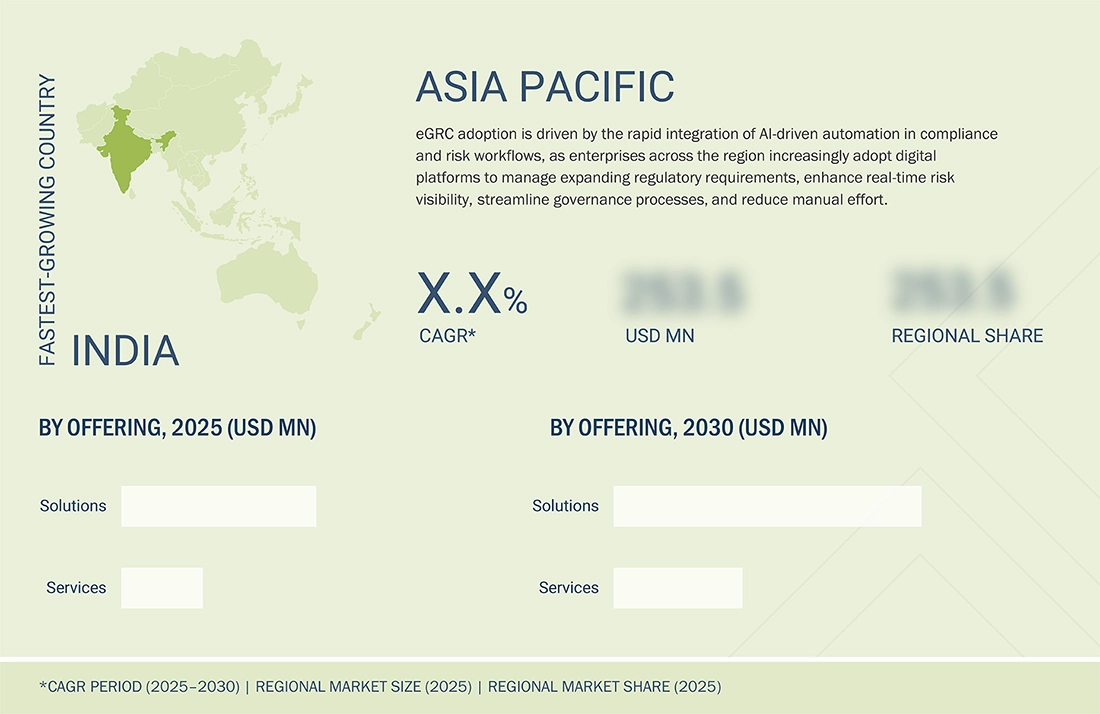
India to be the fastest-growing region in Asia Pacific eGRC market during the forecast period
The growing digitalization across sectors, including financial services (BFSI), IT/ITeS, telecommunications, and manufacturing, along with the implementation of stricter regulatory compliance requirements, is positioning India as the fastest-growing market for electronic governance, risk, and compliance (eGRC) in the Asia Pacific region. Furthermore, organizations are increasingly investing in automating risk management, compliance, and third-party risk management to enhance regulatory audits and cybersecurity measures, driving India's growth in this area. In addition, the government's ongoing commitment to protecting individuals' data and expanding access to prevent cyberattacks represents a significant opportunity for India to leverage eGRC in its digital transformation efforts.
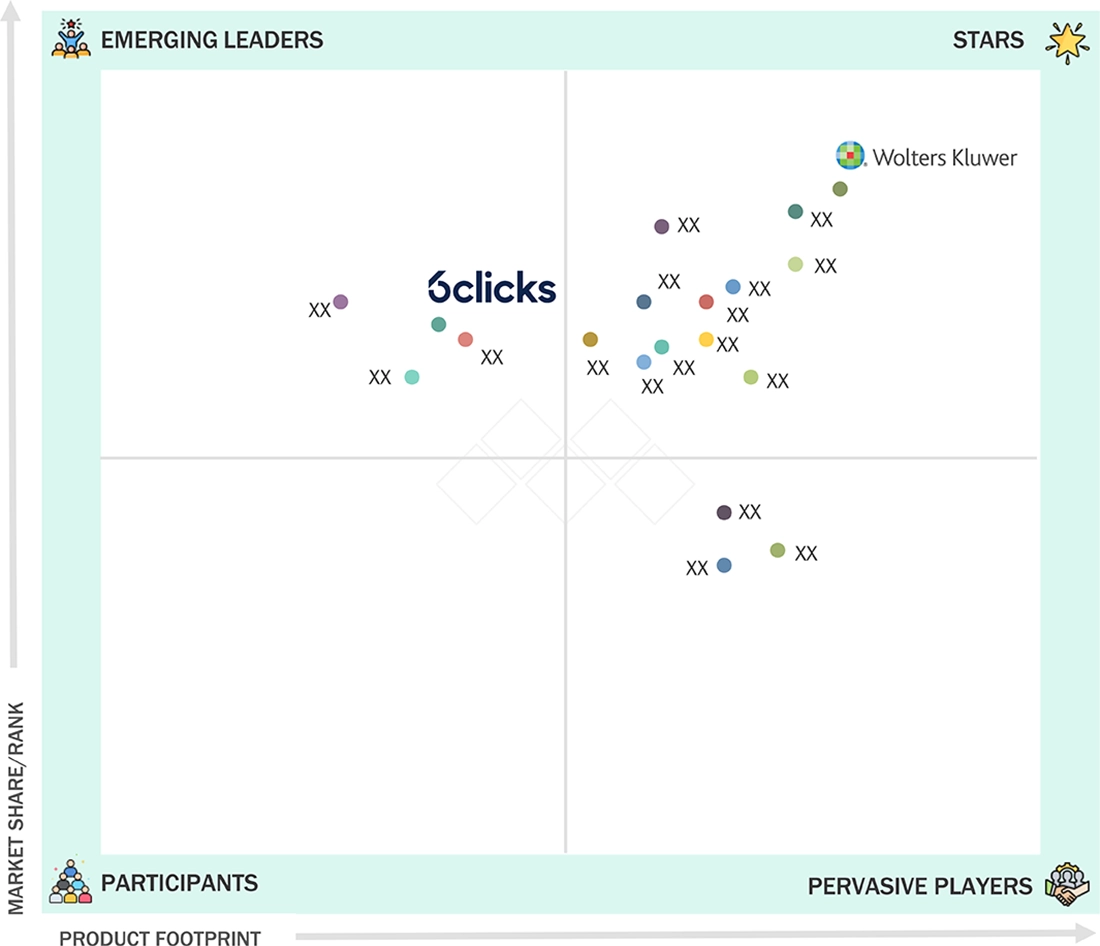
ASIA PACIFIC EGRC MARKET: COMPANY EVALUATION MATRIX
The market combines mature enterprise platforms with fast-growing cloud-native solutions. Wolters Kluwer leads with a comprehensive suite for risk, compliance, audit, and third-party management, while other vendors offer modular capabilities, analytics, and expanding integrations. Emerging players like 6clicks are gaining traction with intuitive interfaces, faster deployment, and flexible cloud models. Across the market, vendors focus on automation, simplified workflows, and integration with security, ESG, and data governance to meet evolving enterprise needs.
Source: Secondary Research, Interviews with Experts, MarketsandMarkets Analysis
KEY MARKET PLAYERS
- Mphasis (India)
- ReadiNow (Australia)
- Dynamic GRC (Singapore)
- ProGrec (India)
- 6clicks (Australia)
- Protecht Group (Australia)
- SafetyCulture (Australia)
- Ascent Business Technology (Singapore)
- Panacea Infosec (India)
- Sentrient (Australia)
- MetricStream (Singapore)
- SAI360 (Australia)
- Wolters Kluwer (Singapore)
- Diligent (Australia)
MARKET SCOPE
| REPORT METRIC | DETAILS |
|---|---|
| Market Size in 2024 (Value) | USD 3.50 Billion |
| Market Forecast in 2030 (Value) | USD 7.87 Billion |
| Growth Rate | CAGR of 14.9% from 2025–2030 |
| Years Considered | 2019–2030 |
| Base Year | 2024 |
| Forecast Period | 2025–2030 |
| Units Considered | Value (USD Billion) |
| Report Coverage | Revenue Forecast, Company Ranking, Competitive Landscape, Growth Factors, and Trends |
| Segments Covered |
|
| Countries Covered | China, Japan, India, Australia & New Zealand, Singapore, Rest of Asia Pacific |
WHAT IS IN IT FOR YOU: ASIA PACIFIC EGRC MARKET REPORT CONTENT GUIDE
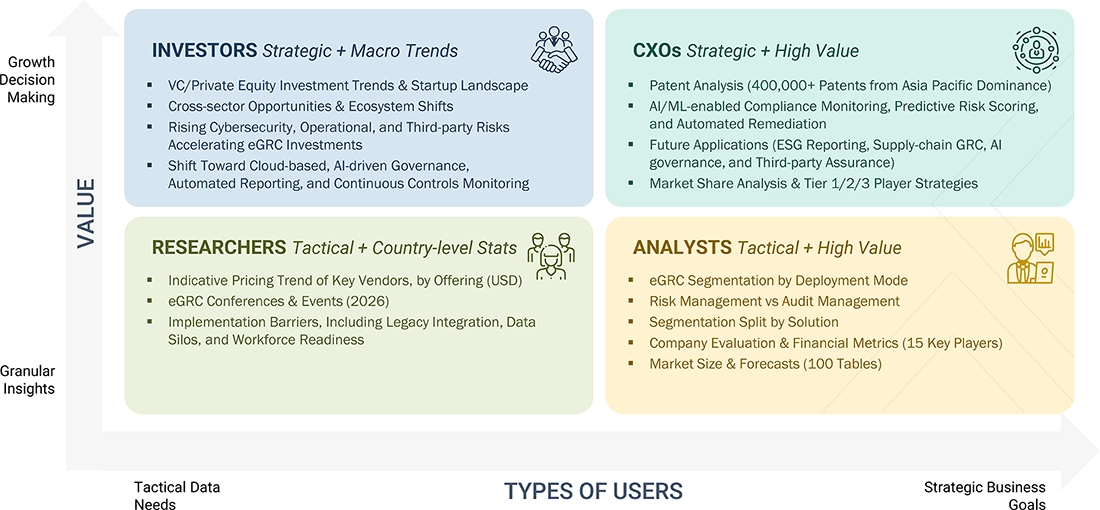
DELIVERED CUSTOMIZATIONS
We have successfully delivered the following deep-dive customizations:
| CLIENT REQUEST | CUSTOMIZATION DELIVERED | VALUE ADDS |
|---|---|---|
| Leading Solution Provider (Asia Pacific) | Solution Benchmarking: Comprehensive comparison of eGRC portfolios across top Asia Pacific vendors, including risk management, compliance management, audit management, and policy management solutions tailored to regional compliance needs. | Enhanced clarity on competitive positioning, technology differentiation, and investment priorities for stronger regional market expansion. |
| Leading Service Provider (Asia Pacific) | Company Profiles: Detailed profiling of top eGRC players (up to 5), covering capabilities across major Asia Pacific markets. | Actionable insights into partnership opportunities, capability gaps, and go-to-market strategies to strengthen presence in high-growth Asia Pacific industries. |
RECENT DEVELOPMENTS
- February 2024 : ReadiNow launched ReadiNow Nova, an enhancement to its digital transformation platform. Nova represents a revolution in user interface and user experience (UI/UX) design, meticulously crafted to meet the dynamic needs of modern businesses in the eGRC market.
- February 2024 : 6clicks launched a dedicated AI-powered GRC platform to enhance data sovereignty and cyber-compliance across South Asia. The platform offers public, private, and dedicated hosting for enterprises, government bodies, and critical infrastructure organizations. It helps clients comply with Indian regulations, such as the DPDP Act, as well as global cybersecurity standards. Using a “Hub & Spoke” architecture and AI-powered modules, it automates risk assessments, audits, and compliance tasks, providing central oversight with local autonomy.
Table of Contents
 Exclusive indicates content/data unique to MarketsandMarkets and not available with any competitors.
Methodology
This research study used extensive secondary sources, directories, and databases, such as D&B Hoovers and Bloomberg BusinessWeek, to identify and collect information useful for this technical, markett-oriented, and commercial study of the Asia Pacific eGRC market. The primary sources were mainly several industry experts from the core and related industries and preferred suppliers, manufacturers, distributors, service providers, technology developers, alliances, and organizations related to this industry's value chain segments. In-depth interviews were conducted with various primary respondents, including key industry participants, subject matter experts, C-level executives of key markett players, and industry consultants, to obtain and verify critical qualitative and quantitative information and assess prospects.
Secondary Research
In the secondary research process, various secondary sources were referred to to identify and collect information regarding the study. The secondary sources included annual reports, press releases, investor presentations of Asia Pacific eGRC market solution vendors; forums; certified publications, such as GRCI Publications, Compliance, and Regulatory Journal, GRC Professional Magazine, GRC Journal, From GRC 1.0 to GRC 5.0: A History of Technology for GRC; and whitepapers such as "Governance, Risk and Compliance (GRC) Framework" by MetricStream, "Governance, Risk, and Compliance Whitepaper" by Secure Digital Solutions. Secondary research was mainly used to obtain key information about the industry's value chain, the total pool of key players, markett classification, and segmentation from the markett- and technology-oriented perspectives.
Primary Research
In the primary research process, various primary sources from the supply and demand sides of the Asia Pacific eGRC market were interviewed to obtain qualitative and quantitative information for the study. The primary sources from the supply side included industry experts, such as Chief Executive Officers (CEOs), Vice Presidents (VPs), marketting directors, technology and innovation directors, and related key executives of various vendors providing eGRC solutions and services, associated service providers, and system integrators operating in the targeted regions. All possible parameters that affect the markett covered in this research study have been accounted for, viewed in extensive detail, verified through primary research, and analyzed to obtain the final quantitative and qualitative data.
After the complete markett engineering process (including calculations for markett statistics, markett breakups, markett size estimations, markett forecasting, and data triangulation), extensive primary research was conducted to gather information and verify and validate the critical numbers arrived at. The primary research helped identify and validate the segmentation types, industry trends, key players, a competitive landscape of eGRC solutions and services offered by several markett vendors, and fundamental markett dynamics, such as drivers, restraints, opportunities, challenges, industry trends, and key strategies.
In the complete markett engineering process, the bottom-up and top-down approaches and several data triangulation methods were extensively used to perform the markett estimation and forecasting for the overall markett segments and subsegments listed in this report. An extensive qualitative and quantitative analysis was performed on the complete markett engineering process to list the key information/insights throughout the report.
Following is the breakup of the primary study:
Market Size Estimation
Top-down and bottom-up approaches were used to estimate and validate the size of the Asia Pacific eGRC market and the size of various other dependent sub-segments in the overall Asia Pacific eGRC market. The research methodology used to estimate the markett size includes the following details: critical players in the markett were identified through secondary research, and their markett shares in the respective regions were determined through primary and secondary research. This entire procedure included the study of the annual and financial reports of the top markett players, and extensive interviews were conducted for key insights from the industry leaders, such as CEOs, VPs, directors, and marketting executives.
All percentage splits and breakdowns were determined using secondary sources and verified through primary sources. All possible parameters that affect the markett covered in this research study have been accounted for, viewed in extensive detail, verified through primary research, and analyzed to get the final quantitative and qualitative data. This data is consolidated and added to detailed inputs and analysis from markettsandmarketts.
Data Triangulation
After arriving at the overall markett size using the markett size estimation processes explained above, the markett was split into several segments and subsegments. The data triangulation and markett breakup procedures were employed, wherever applicable, to complete the overall markett engineering process and arrive at the exact statistics of each markett segment and subsegment. The data was triangulated by studying various factors and trends from both the demand and supply sides.
Market Definition
MarketsandMarkets defines eGRC as the umbrella term that covers an organization's approach across the areas of GRC. GRC typically encompasses corporate governance, enterprise risk management, and compliance with applicable laws and regulations. It allows organizations to achieve their goals by automating workflows while complying with policy guidelines and government regulations, reducing financial risks, and safeguarding the company's brand image. The latest development of artificial intelligence (AI)-)-enabled eGRC solutions would enhance the compliance process, making it more effective.
Key Stakeholders
- eGRC solution and service providers
- GRC staff
- IT governance directors/managers
- IT risk directors/managers
- IT compliance directors/managers
- IT audit directors/managers
- Information security directors/managers
- IT directors/consultants
- End-users/consumers/enterprise users
- Government organizations
- Consultants/advisory firms
- System integrators and resellers
- Training and education service providers
- Managed service providers
Report Objectives
- To describe and forecast the Asia Pacific eGRC market by offering, deployment mode, organization size, solution usage, business function, vertical, and region from 2024 to 2029, and analyze the various macroeconomic and microeconomic factors that affect markett growth
- To analyze the subsegments of the markett concerning individual growth trends, prospects, and contributions to the overall markett
- To provide detailed information regarding major factors (drivers, restraints, opportunities, and challenges) influencing the growth of the markett
- To analyze the opportunities in the markett for stakeholders and provide details of the competitive landscape for the major players
- To profile the key markett players; provide a comparative analysis based on the business overviews, regional presence, product offerings, business strategies, and critical financials; and illustrate the markett's competitive landscape.
- To track and analyze the competitive developments, such as mergers and acquisitions, product developments, partnerships and collaborations, and research development (R&D) activities, in the markett
Customization Options
With the given markett data, markettsandmarketts offers customizations based on company-specific needs. The following customization options are available for the report:
Company Information
- Detailed analysis and profiling of additional markett players (up to 5)
Key Questions Addressed by the Report
What is the current size of the Asia Pacific eGRC market?
The Asia Pacific enterprise governance, risk, and compliance (eGRC) market is valued at USD 3.94 billion in 2025 and is projected to reach USD 7.87 billion by 2030, growing at a CAGR of 14.9% during the forecast period. Growth is driven by increasing regulatory requirements, cybersecurity concerns, and rapid enterprise digital transformation.
What factors are driving the growth of the Asia Pacific eGRC market?
The market is expanding due to stricter regulatory compliance requirements, rising cyber threats, growing adoption of cloud-based governance platforms, and increasing demand for integrated risk and compliance management across industries such as BFSI, healthcare, telecom, manufacturing, and government.
Which solution segment leads the Asia Pacific eGRC market?
The risk management segment is expected to hold the largest share of the Asia Pacific eGRC market in 2025. Organizations are prioritizing risk management solutions to strengthen operational resilience, improve regulatory compliance, and gain real-time visibility into enterprise risks.
Which industries are adopting eGRC solutions the fastest in Asia Pacific?
The healthcare sector is projected to register the highest growth rate during the forecast period due to increasing data privacy regulations, cybersecurity requirements, and the need for effective governance and compliance frameworks. BFSI, telecom, and critical infrastructure also remain major adopters.
What are the major trends shaping the Asia Pacific eGRC market?
Key trends include the adoption of AI-powered eGRC platforms, cloud-based deployments, continuous compliance monitoring, third-party risk management, and automation of governance and audit processes. These technologies help organizations improve compliance efficiency and strengthen enterprise risk management.


Personalize This Research
- Triangulate with your Own Data
- Get Data as per your Format and Definition
- Gain a Deeper Dive on a Specific Application, Geography, Customer or Competitor
- Any level of Personalization
Let Us Help You
- What are the Known and Unknown Adjacencies Impacting the Asia Pacific eGRC Market
- What will your New Revenue Sources be?
- Who will be your Top Customer; what will make them switch?
- Defend your Market Share or Win Competitors
- Get a Scorecard for Target Partners

Custom Market Research Services
We Will Customise The Research For You, In Case The Report Listed Above Does Not Meet With Your Requirements
Get 10% Free CustomisationTESTIMONIALS






Growth opportunities and latent adjacency in Asia Pacific eGRC Market