North America Silicon Carbide (SiC) Market

North America Silicon Carbide (SiC) Market by SiC Discrete Devices, SiC Diodes, SiC MOSFETs, SiC Modules, Automotive, Energy & Power, Industrial, Transportation, Telecommunications, Up to 1200 V, 1200-1700 V, 1700-3300 V, and >3300 V - Forecast to 2030




OVERVIEW
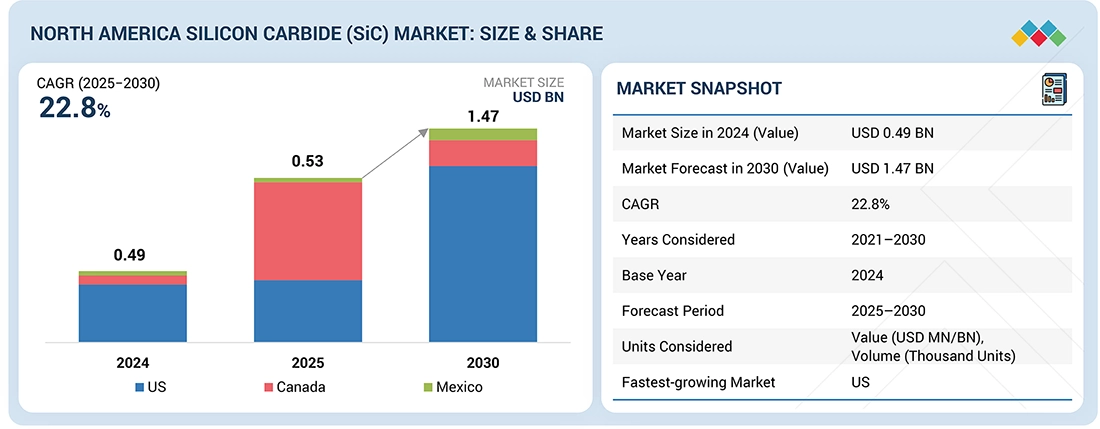
Source: Secondary Research, Interviews with Experts, MarketsandMarkets Analysis
The North America Silicon Carbide (SiC) market is projected to grow from around USD 0.53 billion in 2025 to approximately USD 1.47 billion by 2030, registering a strong CAGR of about 22.8%. Growth is driven by rising electric vehicle adoption, fast-charging infrastructure expansion, and renewable energy deployments. Increasing investments in domestic SiC manufacturing and high-efficiency power electronics further support market expansion across automotive, energy, and industrial applications.
Market Size & Forecast
• 2025 Market Size: USD 0.53 Billion
• 2030 Projected Market Size: USD 1.47 Billion
• CAGR (2025-2030): 22.8%
• SiC Module Segment : Register the Fastest Growth
• North America: Fast-Charging Network Expansion
KEY TAKEAWAYS
-
BY COUNTRYThe US is expected to dominate the North America SiC market, accounting for approximately 81.2% share in 2025, driven by large-scale EV manufacturing, fast-charging network expansion,
-
BY DEVICEBy device, the SiC module segment is expected to dominate the market and also register the fastest growth during the forecast period. Growth is driven by rising adoption of integrated, high-power modules in electric vehicles, fast-charging infrastructure, renewable energy systems, and industrial power electronics, where high efficiency and compact design are critical.
-
BY VOLTAGE RANGEBy voltage range, the 1,700–3,300 V segment is projected to account for the largest market share and witness the fastest growth, supported by strong demand from EV traction inverters, renewable energy inverters, energy storage systems, and high-power industrial applications across North America.
-
BY VERTICALThe industrial segment is expected to be the fastest growing, registering a strong CAGR of around 28.5%, driven by increasing adoption of SiC devices in motor drives, power supplies, factory automation, and energy-efficient industrial systems.
-
COMPETITIVE LANDSCAPE (KEY PLAYERS)STMicroelectronics, Semiconductor Components Industries, LLC, Infineon Technologies AG, and Wolfspeed, Inc. are among the leading players, supported by vertically integrated SiC capabilities, strong R&D, and long-term supply agreements in North America.
-
COMPETITIVE LANDSCAPE (STARTUPS/SMES)Notable North America–based SMEs and emerging players include GeneSiC Semiconductor, Solitron Devices Inc., and Microchip Technology Inc., which are strengthening their presence through niche SiC offerings, defense and industrial applications, and targeted power device innovation.
The North America Silicon Carbide (SiC) market is witnessing strong growth driven by accelerating electrification across automotive, energy, and industrial sectors. Increasing adoption of electric vehicles, fast-charging infrastructure, and renewable energy systems is boosting demand for high-efficiency SiC power devices. Rising investments in domestic semiconductor manufacturing further support market expansion.
TRENDS & DISRUPTIONS IMPACTING CUSTOMERS' CUSTOMERS
The North America Silicon Carbide (SiC) market is being reshaped by rapid advancements in EV powertrain technologies, renewable energy systems, data center electrification, and high-efficiency industrial power solutions. As industries shift toward higher-voltage, energy-efficient architectures, demand for SiC-based devices is accelerating. This transformation is strengthened by major end users such as Tesla, GM, and large utility providers driving next-generation power electronics adoption across the region.
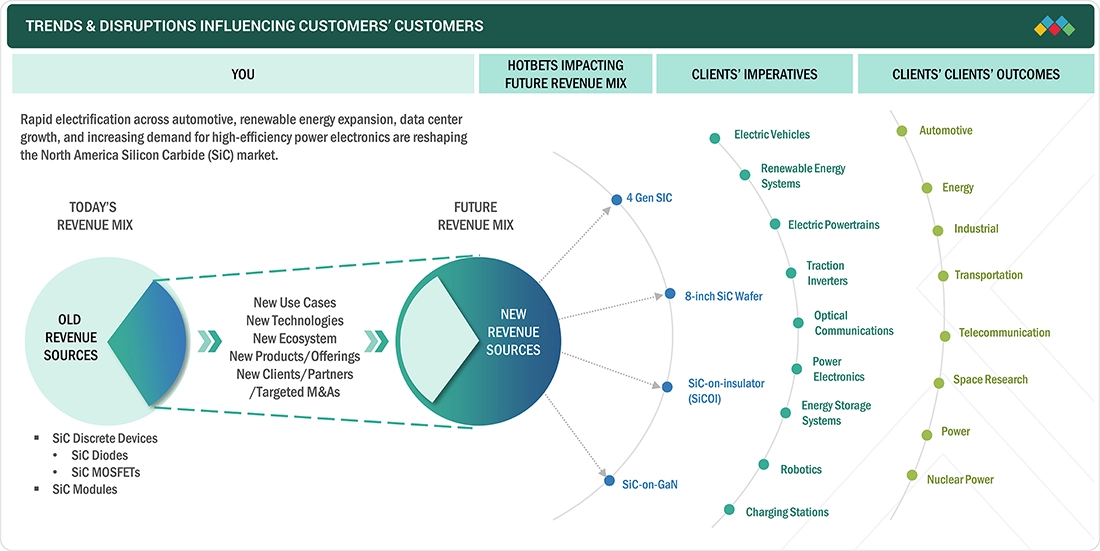
Source: Secondary Research, Interviews with Experts, MarketsandMarkets Analysis
MARKET DYNAMICS

Level
-
North America EV & Charging Network Expansion

-
Renewable Energy & Grid Modernization in North America


Level
-
High SiC Device & Manufacturing Costs in the North America

-
Skilled Semiconductor Workforce Gaps in North America


Level
-
Growth in US-Based SiC Manufacturing & CHIPS Act Incentives

-
Rising SiC Adoption in North America Data Centers & Utility Upgrades


Level
-
North America SiC Supply-Chain & Capacity Constraints

-
SiC Wafer Defect Rates & Yield Issues in North America Fabs

Source: Secondary Research, Interviews with Experts, MarketsandMarkets Analysis
Driver: North America EV & Charging Network Expansion
The rapid acceleration of electric vehicle manufacturing across the US and Canada is creating substantial demand for high-efficiency Silicon Carbide (SiC) power devices. As OEMs scale production of next-generation EV platforms, SiC MOSFETs and modules are becoming essential for achieving higher power density, improved thermal performance, and extended driving ranges. Simultaneously, the expansion of nationwide fast-charging infrastructure requires high-voltage, energy-efficient SiC devices to support faster charging speeds and grid stability. This shift toward widespread electrification—from passenger cars to commercial fleets—is driving large-scale SiC adoption across the region. As the market transitions from silicon-based power electronics to wide-bandgap SiC technologies, the automotive and charging ecosystem is emerging as one of the strongest growth engines for North America’s SiC market.
Restraint: High SiC Device & Manufacturing Costs in North America
The North America Silicon Carbide (SiC) market faces a significant restraint due to the high cost associated with SiC substrates, wafers, and advanced device fabrication. Producing high-quality SiC materials requires specialized equipment, complex processing steps, and strict quality control, all of which elevate manufacturing expenses. Compared with traditional silicon devices, SiC components remain considerably more expensive, limiting widespread adoption in cost-sensitive applications. Additionally, many North America manufacturers rely on imported SiC substrates, further increasing procurement costs and lead times. These factors collectively slow market penetration, particularly among smaller device makers and industries with tight budget constraints, reinforcing cost as a major barrier to scaling SiC technologies across the region.
Opportunity: Growth in US-Based SiC Manufacturing & CHIPS Act Incentives
The North America SiC market is benefiting from a significant opportunity driven by rising investments in domestic semiconductor manufacturing, accelerated by initiatives under the US CHIPS and Science Act. Federal incentives, tax credits, and grants are enabling major manufacturers to expand SiC wafer, substrate, and power device production within the US, reducing dependence on overseas supply. This localization effort strengthens supply-chain resilience, shortens lead times, and supports long-term capacity growth. As the demand for high-voltage SiC devices increases across electric vehicles, renewable energy, and industrial systems, expanded US-based manufacturing capabilities will create a robust ecosystem for innovation, workforce development, and next-generation power electronics commercialization.
Challenge: North America SiC Supply-Chain & Capacity Constraints
The North America SiC market faces a persistent challenge stemming from supply-chain limitations and restricted production capacity for SiC substrates and epitaxy. The region relies heavily on a small number of suppliers, resulting in long lead times, constrained material availability, and elevated procurement costs. These bottlenecks hinder the ability of device manufacturers to scale production and meet rising demand from the EV, energy, and industrial sectors. Additionally, shortages of specialized equipment and limited access to high-quality 150 mm and 200 mm SiC wafers further delay capacity expansion. These constraints slow innovation, delay customer deliveries, and pose a significant barrier to large-scale SiC adoption across North America.
NORTH AMERICA SILICON CARBIDE (SIC) MARKET: COMMERCIAL USE CASES ACROSS INDUSTRIES
| COMPANY | USE CASE DESCRIPTION | BENEFITS |
|---|---|---|
 |
Deployment of SiC MOSFETs in next-generation traction inverters for a leading US EV manufacturer | enabling higher switching speeds | compact inverter size | and improved thermal performance for long-range EVs. | Increased driving range | reduced inverter weight | enhanced power density | faster charging compatibility | improved drivetrain efficiency. |
 |
SiC module integration for DC fast-charging stations across major US charging networks | supporting 350 kW+ ultra-fast chargers used in nationwide EV infrastructure. | Faster charging times | higher system efficiency | reduced energy losses | lower operating costs | improved charger reliability. |
 |
Adoption of SiC MOSFETs in industrial motor drives across North America manufacturing plants | enabling energy-efficient and thermally stable operation for continuous-duty equipment. | Lower electricity consumption | reduced cooling needs | improved motor performance | extended equipment lifespan. |
 |
Use of SiC diodes and MOSFETs in US utility-scale solar inverters and energy storage systems | improving efficiency and grid stability under high-load conditions. | Higher renewable energy yield | lower conversion losses | enhanced grid support | reduced maintenance costs. |
 |
Integration of GaN+SiC hybrid power solutions in North America data center UPS systems | meeting high power density and efficiency needs for AI-driven workloads. | Reduced thermal load | higher energy efficiency | improved uptime | optimized rack density | lower operational costs. |
Logos and trademarks shown above are the property of their respective owners. Their use here is for informational and illustrative purposes only.
MARKET ECOSYSTEM
The North America Silicon Carbide (SiC) market ecosystem is driven by collaboration among raw material suppliers, SiC wafer and device manufacturers, system integrators, and major automotive and industrial end users. Growing investments in domestic SiC production, electrification, renewable energy, and high-efficiency power systems are strengthening ecosystem interdependencies, while technology providers accelerate innovation to meet rising demand for advanced power electronics across the region.
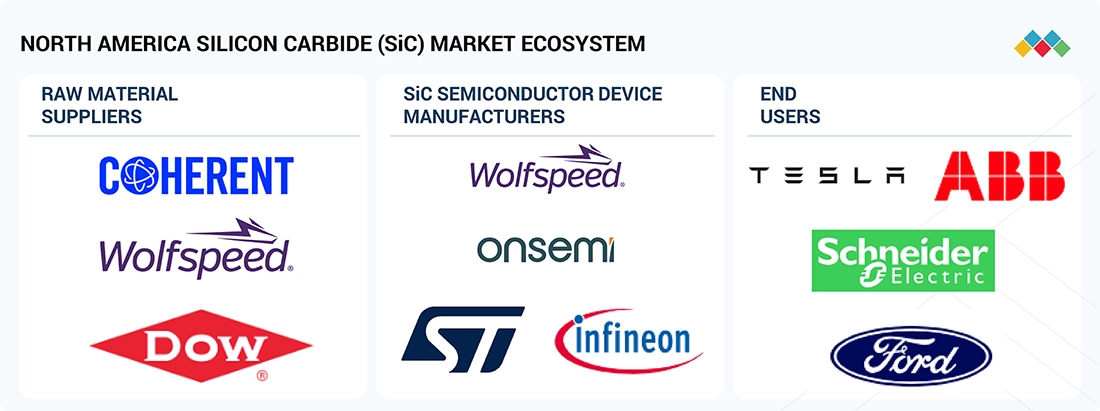
Logos and trademarks shown above are the property of their respective owners. Their use here is for informational and illustrative purposes only.
MARKET SEGMENTS
Source: Secondary Research, Interviews with Experts, MarketsandMarkets Analysis
North America Silicon Carbide (SiC) Market, By Device
The SiC module segment is expected to dominate the market and register the fastest growth, driven by its ability to deliver high power density, superior thermal performance, and reduced system complexity. As EV traction inverters, fast chargers, renewable energy inverters, and industrial power systems increasingly shift toward higher-voltage architectures, demand for integrated SiC modules is accelerating across the US, Canada, and Mexico.
North America Silicon Carbide (SiC) Market, By Voltage Range
The 1,700–3,300 V segment will hold the largest share and exhibit rapid growth due to its widespread use in EV powertrains, DC fast chargers, utility-scale solar inverters, and grid modernization projects. This voltage class enables high-efficiency conversion, reduced energy losses, and robust operation in demanding environments, supporting the region’s transition toward electrification and renewable energy integration.
North America Silicon Carbide (SiC) Market, By Vertical
The industrial segment is expected to witness the fastest growth as manufacturers adopt SiC-based power solutions for motor drives, automation equipment, high-efficiency power supplies, and advanced processing systems. Growing emphasis on energy optimization, electrification of industrial operations, and replacement of legacy silicon-based power devices is accelerating SiC adoption across North American factories, smart manufacturing environments, and large-scale industrial facilities.
REGION
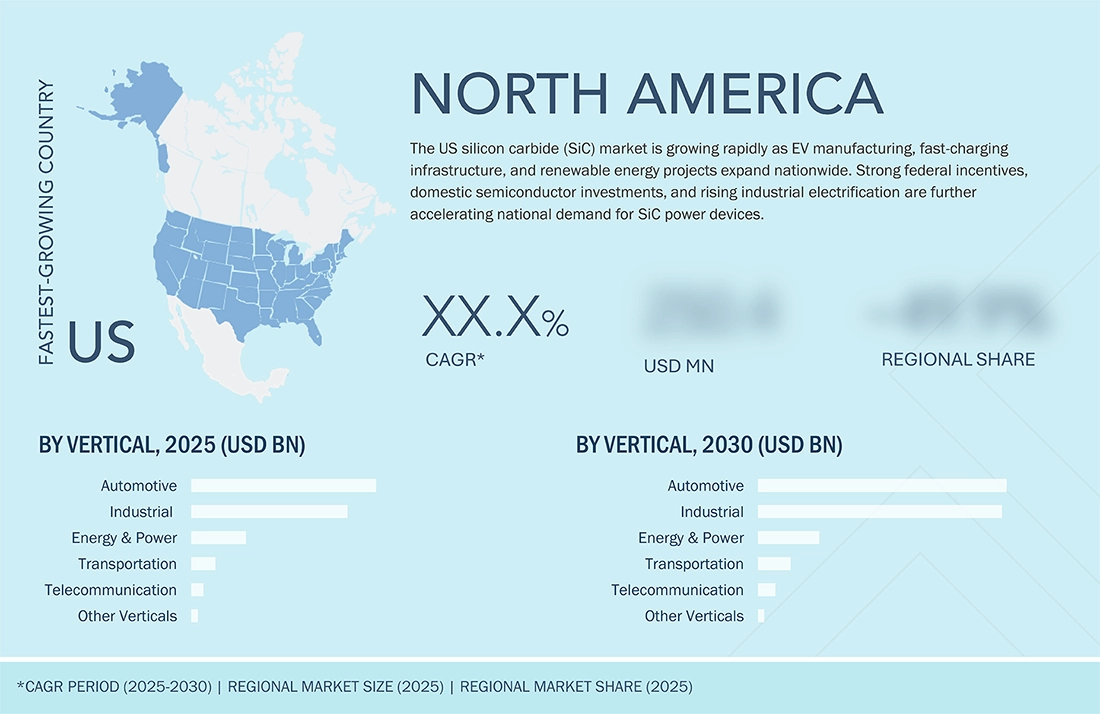
The US is projected to lead the North America Silicon Carbide (SiC) market during the forecast period
The US is expected to lead the North America Silicon Carbide (SiC) market due to its strong EV manufacturing base, rapid expansion of fast-charging infrastructure, and large-scale renewable energy deployments. Significant federal incentives and substantial investments in domestic SiC wafer and device production further strengthen market growth. Additionally, major automotive, industrial, and energy players drive widespread adoption of high-efficiency SiC power electronics across the country.
NORTH AMERICA SILICON CARBIDE (SIC) MARKET: COMPANY EVALUATION MATRIX
In the North America SiC market quadrant, STMicroelectronics stands out as a leading star with a strong product portfolio, advanced SiC technology capabilities, and deep partnerships in automotive and industrial sectors. Microchip Technology is emerging as a key contender, expanding its SiC offerings and strengthening its presence across power electronics applications. Their growing innovation focus supports the region’s accelerating transition toward high-efficiency SiC solutions.
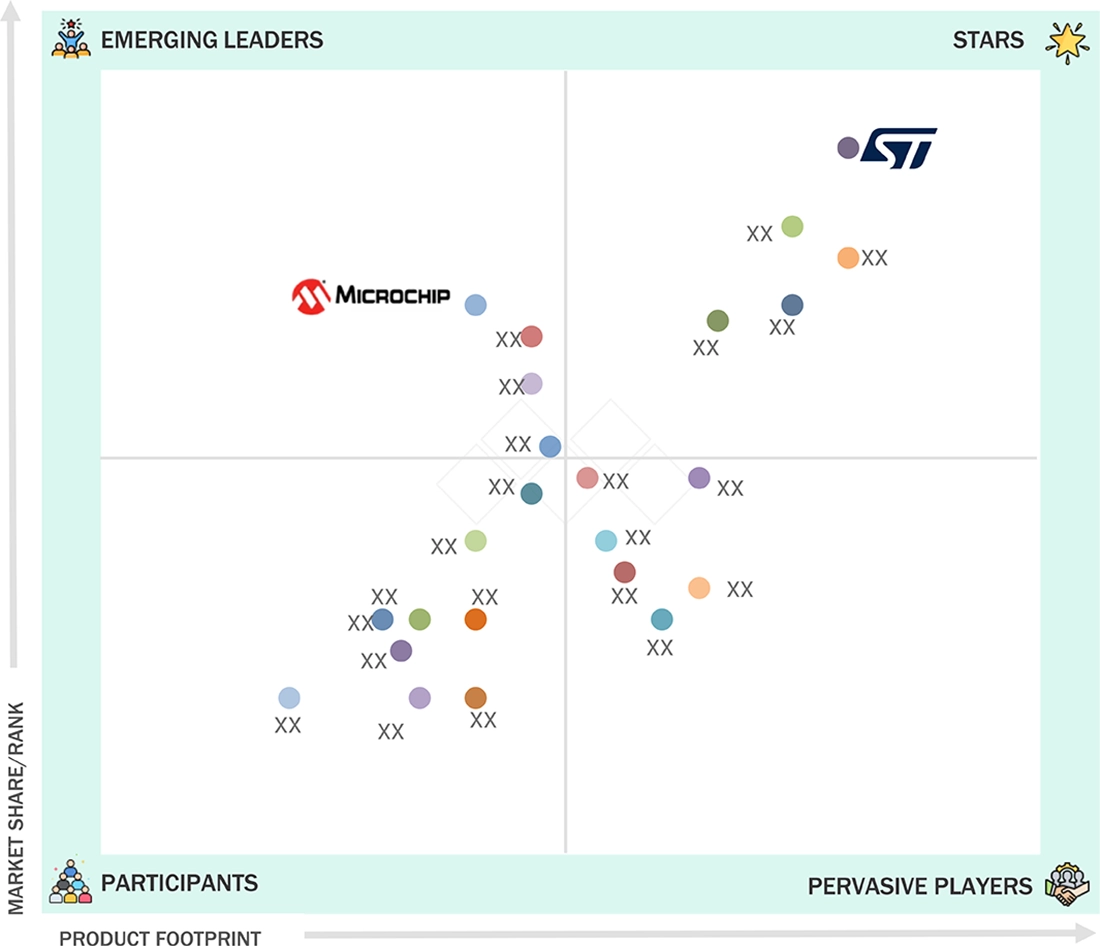
Source: Secondary Research, Interviews with Experts, MarketsandMarkets Analysis
KEY MARKET PLAYERS
- STMicroelectronics
- Semiconductor Components Industries, LLC
- Infineon Technologies AG
- WOLFSPEED, INC.
- ROHM CO., LTD.
- Fuji Electric Co., Ltd.
- TOSHIBA ELECTRONIC DEVICES & STORAGE CORPORATION
- Microchip Technology Inc.
- Mitsubishi Electric Corporation
- Robert Bosch GmbH
MARKET SCOPE
| REPORT METRIC | DETAILS |
|---|---|
| Market Size in 2024 (Value) | USD 0.49 Billion |
| Market Forecast in 2030 (Value) | USD 1.47 Billion |
| Growth Rate | CAGR of 22.8% from 2025-2030 |
| Years Considered | 2021-2030 |
| Base Year | 2024 |
| Forecast Period | 2025-2030 |
| Units Considered | Value (USD Million/Billion), Volume (Thousand Units) |
| Report Coverage | Revenue forecast, company ranking, competitive landscape, growth factors, and trends |
| Segments Covered |
|
| Regional Scope | North America |
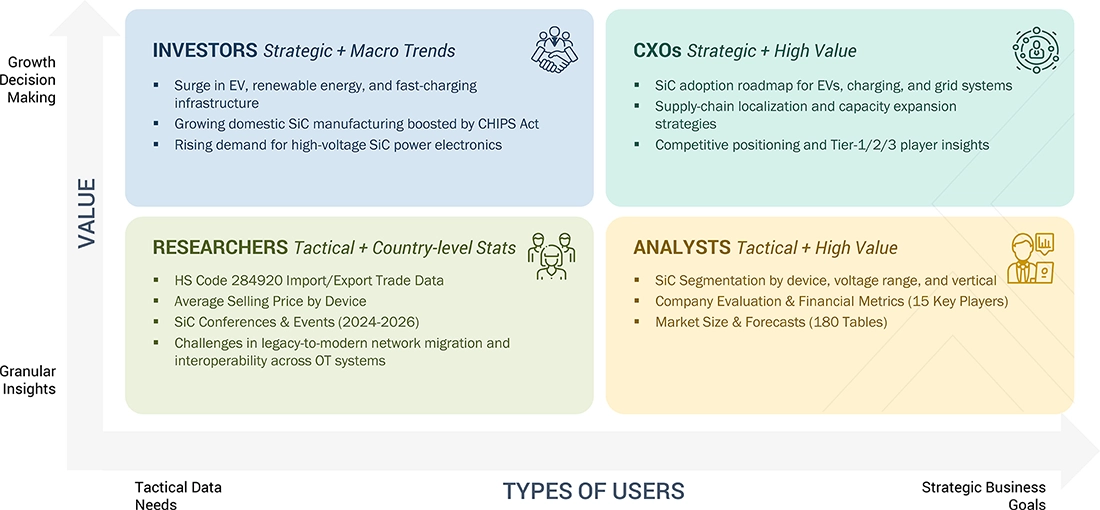
WHAT IS IN IT FOR YOU: NORTH AMERICA SILICON CARBIDE (SIC) MARKET REPORT CONTENT GUIDE
DELIVERED CUSTOMIZATIONS
We have successfully delivered the following deep-dive customizations:
| CLIENT REQUEST | CUSTOMIZATION DELIVERED | VALUE ADDS |
|---|---|---|
| SiC Market Mapping & Technology Adoption Study |
|
|
| Benchmarking of Leading SiC Manufacturers |
|
|
| Sector-Specific SiC Opportunity Assessment (Automotive, Energy, Industrial) |
|
|
| Supply Chain & Capacity Expansion Analysis |
|
|
| SiC Competitor & Pricing Intelligence |
|
|
RECENT DEVELOPMENTS
- September 2025 : Wolfspeed (US) announced the commercial launch of its 200 mm SiC materials portfolio, including bare wafers and epitaxy, to scale domestic production for EVs, renewable energy, and industrial applications, strengthening North America’s SiC supply-chain localization efforts.
- September 2024 : STMicroelectronics (US operations) unveiled its fourth-generation 750 V and 1200 V SiC MOSFETs and deepened partnerships with North American EV manufacturers for traction inverters and power modules, accelerating SiC adoption across US electric vehicle platforms.
- June 2025 : Infineon Technologies (US) completed the sale of its 200 mm Austin, Texas fab to SkyWater Technology, securing a long-term US-based supply agreement while maintaining SiC R&D and sales presence to support domestic power electronics applications.
- August 2024 : Wolfspeed (US) expanded multiple long-term SiC wafer supply agreements, including a USD 275 million deal with a major semiconductor company, to strengthen domestic EV and industrial power-device supply, reinforcing North America's electrification ecosystem.
Table of Contents
 Exclusive indicates content/data unique to MarketsandMarkets and not available with any competitors.
Methodology
The research study involved four major activities in estimating the size of the North America silicon carbide (SiC) market. Exhaustive secondary research has been conducted to gather key information about the market and its peer markets. The validation of these findings, assumptions, and sizing, with the help of primary research involving industry experts across the value chain, has been the next step. Both top-down and bottom-up approaches have been used to estimate the market size. The market breakdown and data triangulation have been adopted to estimate the market sizes of segments and subsegments.
Secondary Research
During the secondary research process, various secondary sources have been referred to for identifying and collecting information required for this study. The secondary sources include annual reports, press releases, investor presentations of companies, white papers, and articles from recognized authors. Secondary research has primarily been conducted to gather key information about the market’s value chain, the pool of key market players, market segmentation based on industry trends, regional outlook, and developments from both market and technology perspectives.
In the North America silicon carbide (SiC) market report, the global market size has been estimated using both the top-down and bottom-up approaches, along with several other dependent submarkets. The major players in the market have been identified through extensive secondary research, and their presence in the market has been determined through a combination of secondary and primary research. All the percentage shares, splits, and breakdowns have been determined using secondary sources and verified through primary sources.
Primary Research
Extensive primary research has been conducted following an understanding of the North America silicon carbide (SiC) market scenario through secondary research. Several primary interviews have been conducted with key opinion leaders from demand- and supply-side vendors across North America. Approximately 25% of the primary interviews have been conducted with demand-side vendors, while 75% have been conducted with supply-side vendors. Primary data has been collected mainly through telephonic interviews, which consist of 80% of the total primary interviews; questionnaires and emails have also been used to collect the data.
After successful interaction with industry experts, brief sessions have been conducted with highly experienced independent consultants to reinforce the findings of our primary research. This, along with the opinions of our in-house subject matter experts, has led us to the findings described in the report.
To know about the assumptions considered for the study, download the pdf brochure
Market Size Estimation
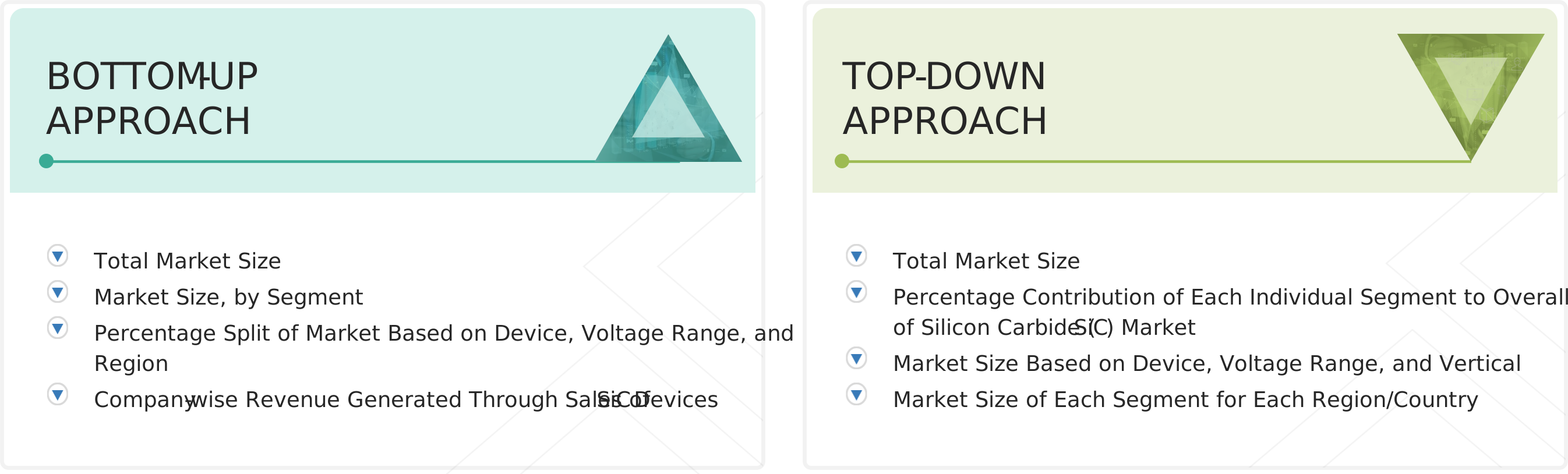
In the market engineering process, both top-down and bottom-up approaches, along with data triangulation methods, have been used to estimate and validate the size of the North America silicon carbide (SiC) market and other dependent submarkets. The research methodology used to estimate the market sizes includes the following:
- Identifying top-line investments and spending in the ecosystem and considering segment-level splits and significant market developments
- Identifying different stakeholders in the North America silicon carbide (SiC) market that influence the entire market, along with participants across the supply chain
- Analyzing major manufacturers in the North America silicon carbide (SiC) market and studying their product portfolio
- Analyzing trends related to the adoption of SiC devices
- Tracking recent and upcoming market developments, including investments, R&D activities, product launches, expansions, acquisitions, partnerships, collaborations, agreements, and investments, as well as forecasting the market size based on these developments and other critical parameters
- Carrying out multiple discussions with key opinion leaders to identify the adoption trends of North America silicon carbide (SiC)
- Segmenting the overall market into various other market segments
- Validating the estimates at every level through discussions with key opinion leaders, such as chief executives (CXOs), directors, and operations managers, and finally with the domain experts at MarketsandMarkets
North America Silicon Carbide (SiC) Market: Top-Down and Bottom-Up Approach
Data Triangulation
After determining the overall market size through the market size estimation process explained in the earlier section, the overall North America silicon carbide (SiC) market has been divided into several segments and subsegments. To complete the overall market engineering process and obtain the exact statistics for all segments, data triangulation and market breakdown procedures have been employed, where applicable. The data has been triangulated by studying various factors and trends from both the demand and supply sides. In addition to data triangulation and market breakdown, the market has been validated through both top-down and bottom-up approaches.
Market Definition
Silicon carbide (SiC) is known for its high thermal conductivity, electric field breakdown strength, and ability to withstand high currents. It significantly outperforms traditional silicon-based devices in high-temperature, high-power, and high-frequency applications. They play a crucial role in revolutionizing various industries by catering to sectors such as automotive, energy & power, industrial, transportation, and telecommunications, including space research and nuclear power applications. SiC is extensively used in EVs and hybrid systems, power supplies, motor drives, and UPS, and it is used to carry out harsh environment operations by offering higher efficiency, reliability, and thermal management. SiC technology enables high efficiency and durability. Additionally, it helps deliver compact systems in sectors ranging from renewable energy to aerospace.
Silicon carbide (SiC) market is broadly segmented by device type, voltage range, and vertical. By device type, the market encompasses SiC discrete devices and SiC modules, catering to a diverse range of applications that require high efficiency and thermal performance. By voltage range, SiC solutions are classified into four categories: up to 1,200 V, low (1,200 V to 1,700 V), medium (1,700 V to 3,300 V), and high (>3,300 V), enabling the selection of devices optimized for different power levels and system architectures. By vertical, the market spans automotive, energy & power, industrial, transportation, telecommunications, and other sectors. The automotive vertical is driving significant adoption due to the electrification of vehicles, while the energy and industrial sectors are increasingly utilizing SiC for renewable power systems, smart grids, and industrial automation. Telecommunications and transportation applications are leveraging SiC for high-efficiency power modules, charging infrastructure, and electric mobility systems, highlighting the technology’s versatility across multiple high-growth markets.
Key Stakeholders
- Raw material suppliers
- Original equipment manufacturers (OEMs)
- Original design manufacturers (ODMs)
- SiC semiconductor device manufacturers
- SiC wafer manufacturers
- Device integrators
- Distributors and resellers
- Research institutes and organizations
- Semiconductor manufacturing equipment forums, alliances, consortia, and associations
- Governments, financial institutions, and regulatory bodies
Report Objectives
- To define, analyze, and forecast the North America silicon carbide (SiC) market size by device, wafer size, vertical, and region, in terms of value
- To define, analyze, and forecast theNorth America silicon carbide (SiC) market size, by SiC discrete device type, in terms of volume
- To provide detailed information regarding the major drivers, restraints, opportunities, and challenges influencing the growth of the market
- To study the complete supply chain and related industry segments for the market
- To strategically study the micromarkets with respect to individual growth trends, prospects, and contributions to the total market
- To analyze the supply chain, market ecosystem, trends/disruptions impacting customers’ business, technology analysis, pricing analysis, Porter’s five forces model, key stakeholders and buying criteria, case study analysis, trade analysis, patent analysis, key conferences and events, regulations related to the North America silicon carbide (SiC) market, and investment and funding scenario.
- To understand opportunities in the market for various stakeholders by identifying the high-growth segments of the market.
- To strategically profile the key players and comprehensively analyze their market position in terms of ranking, core competencies, company valuation, and financial metrics, and product/brand comparison, along with detailing the competitive landscape for the market leaders
- To analyze competitive developments such as product launches, agreements, partnerships, collaborations, contracts, acquisitions, expansions, and research and development (R&D) activities carried out by players in the North America silicon carbide (SiC) market.
Available Customizations
With the given market data, MarketsandMarkets offers customizations according to the specific requirements of companies. The following customization options are available for the report:
Country-wise Information:
- Country-wise breakdown for North America, Europe, Asia Pacific, and Rest of the World
Company Information:
- Detailed analysis and profiling of additional market players (up to five)


Personalize This Research
- Triangulate with your Own Data
- Get Data as per your Format and Definition
- Gain a Deeper Dive on a Specific Application, Geography, Customer or Competitor
- Any level of Personalization
Let Us Help You
- What are the Known and Unknown Adjacencies Impacting the North America Silicon Carbide (SiC) Market
- What will your New Revenue Sources be?
- Who will be your Top Customer; what will make them switch?
- Defend your Market Share or Win Competitors
- Get a Scorecard for Target Partners

Custom Market Research Services
We Will Customise The Research For You, In Case The Report Listed Above Does Not Meet With Your Requirements
Get 10% Free CustomisationTESTIMONIALS

Tetsuya Ohhira
Business Development Manager-Technology Business
Nikon Corporation,
Leading Japanese MNC specializing in optics and imaging productswww.nikon.com
MarketsandMarkets™ response
is quick. Their attitude is flexible and positive. Analyst Insights are globally considered and
significant. Client Services quickly respond to our inquiry and demand. Their wide range of global
surveys help us make our strategic plan.
We hope Knowledge Store will be easier to search
for a report.
VP - Marketing & Business Development
Leading Provider of Process Control Solutions
We engaged with MarketsandMarkets on a study to perform an analysis and recommend a Go-To-Market strategy for metrology and process control in the semiconductor market. The study was tailored to our targets and needs with well-defined milestones. Our overall experience with the MarketsandMarkets team was very good throughout the project in all aspects including the analysis methodologies used, the quality and depth of primary and secondary data sets, the professionalism and flexibility of the team and the ability to meet the target schedule and milestones. We want to thank MarketsandMarkets team for a job well done.






Growth opportunities and latent adjacency in North America Silicon Carbide (SiC) Market