Pedestrian Protection System Market Size, Share & Analysis

Pedestrian Protection System Market by Technology (Passive, Active), Component (Camera, Radar, LiDAR, Ultrasonic, ECU, Actuator, Sensor), Vehicle Type (Passenger, Commercial), EV Type (BEV, HEV, PHEV), and Regio - Global Forecast to 2033



OVERVIEW
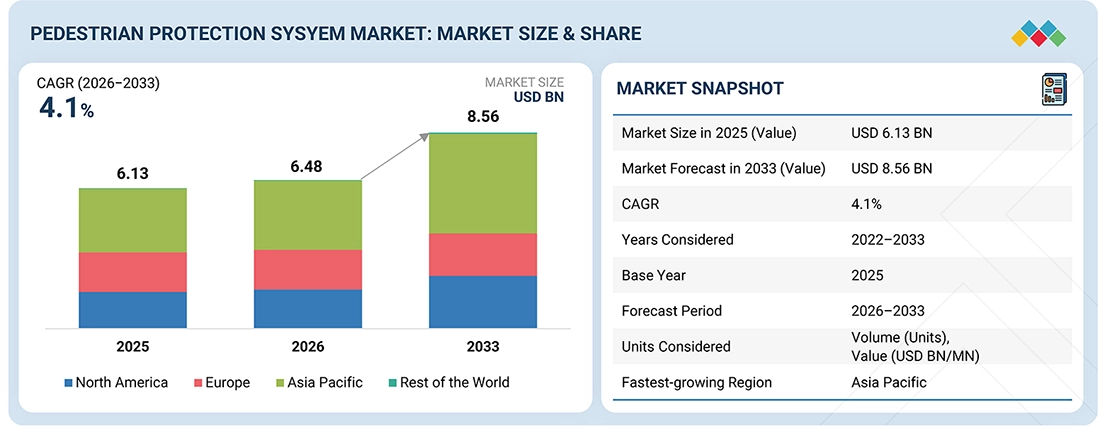
Source: Secondary Research, Interviews with Experts, MarketsandMarkets Analysis
The pedestrian protection system market is projected to grow from USD 6.48 billion in 2026 to USD 8.56 billion by 2033, with a CAGR of 4.1%. This growth is fueled by rising regulatory enforcement for pedestrian safety features, especially pedestrian automatic emergency braking and impact mitigation solutions. OEMs are expanding pedestrian protection system integration from premium models into high-volume segments, aided by cost decreases in radar and camera-based sensing technologies. Furthermore, improvements in detection accuracy and faster system responses are supporting wider adoption of pedestrian protection systems across passenger and light commercial vehicles.
Key Pedestrian Protection System Market Trends and Insights
- Pedestrian Protection System Market Growth: Growth is driven by stringent pedestrian safety regulations, increasing adoption of advanced driver assistance systems (ADAS), and rising vehicle safety awareness among consumers and automakers.
-
Safety Technology Impact: Pedestrian protection systems leverage sensors, cameras, radar, automatic emergency braking, and active hood lift technologies to reduce collision severity and improve road safety.
- Growing Trends: The Pedestrian Protection System market is witnessing increased adoption of AI-powered pedestrian detection, autonomous emergency braking systems, sensor fusion technologies, night vision systems, and integrated active safety solutions.
- Growth Opportunities: Opportunities are driven by expanding ADAS penetration, increasing vehicle electrification, evolving global safety regulations, and growing investments in autonomous and connected vehicle technologies.
KEY TAKEAWAYS
-
MARKET SNAPSHOT:
Market Size (2025): USD 6.13 Billion
Current Market Size (2026): USD 6.48 Billion
Projected Market Size (2033): USD 8.56 Billion
CAGR (2026–2033): 4.1% -
SEGMENT LEADERSHIP:
-
By RegionAsia Pacific is expected to be the largest and fastest-growing market for pedestrian protection systems during the forecast period.
-
By TechnologyThe mechatronic (active) segment is expected to record a CAGR of 6.3% between 2022 and 2033.
-
By ComponentThe ultrasonic segment is expected to lead the pedestrian protection system market during the forecast period.
-
By Vehicle TypePassenger cars are expected to surpass other segments during the forecast period.
-
By EV TypeBEVs are expected to grow at the fastest rate during the forecast period.
-
MARKET OUTLOOK & COMPETITIVE LANDSCAPE:
-
Competitive LandscapeThe pedestrian protection system market is dominated by global players such as Robert Bosch GmbH (Germany), Aumovio (Germany), Denso Corporation (Japan), ZF Group (Germany), and Aptiv (Ireland).
-
Competitive LandscapeNXP Semiconductors (Netherlands), Texas Instruments (US), ON Semiconductor (US), Infineon Technologies (Germany), and Hella GmbH (Germany) are the leading progressive companies in the pedestrian protection system market.
Rising safety standards for vehicles and stricter rules are boosting demand for advanced pedestrian protection systems. Real-time pedestrian detection in vehicles is achieved through radar, camera, and sensor fusion. AI-assisted perception further improves detection accuracy and reduces false alarms. Vehicle safety systems also incorporate pedestrian protection features, enabling quick responses to enhance overall safety.
TRENDS & DISRUPTIONS IMPACTING CUSTOMERS' CUSTOMERS
The pedestrian protection system market is evolving from a standalone safety solution to a data-driven ADAS ecosystem. Currently, it is fueled by a small share of revenue from traditional solutions such as camera-based pedestrian detection, radar-enabled automatic emergency braking, ultrasonic sensors, and passive components like energy-absorbing bumpers and hood systems. However, the future outlook indicates that a larger portion of revenue will come from advanced sensor fusion and AI-powered perception systems, along with real-time system integration across various vehicle types. This shift is enhancing the ability of OEMs and mobility providers to improve urban safety, increase system reliability, and enable faster, more accurate responses to pedestrians in complex driving scenarios.

Source: Secondary Research, Interviews with Experts, MarketsandMarkets Analysis
MARKET DYNAMICS

Level
-
Rising pedestrian fatalities and road safety concerns

-
Rapid integration of ADAS with pedestrian detection capability


Level
-
EV structural rigidity limiting passive pedestrian protection

-
High complexity in integrating and validating active hood and external airbag systems


Level
-
Expansion of pedestrian automatic emergency braking across vehicle segments

-
AI-based pedestrian intent prediction technologies


Level
-
Predicting pedestrian behavior and sudden road crossing events

-
Lack of regulatory harmonization in pedestrian protection testing increasing cost and complexity

Source: Secondary Research, Interviews with Experts, MarketsandMarkets Analysis
Driver: Rapid integration of ADAS with pedestrian detection capability
Pedestrian detection technologies are experiencing increased adoption in ADAS, which is fueling rapid market growth. OEMs are also integrating cameras and AI-based perception technologies into central vehicle platforms. This enhances performance and detection capabilities in real time. Sensor fusion, thermal imaging, and edge processing are further improving performance across various environments. Companies like Tesla, BMW, and Mercedes-Benz are advancing these technologies, while Bosch, Valeo, and Aptiv are contributing to their development, making pedestrian protection a key component of ADAS.
Restraint: EV structural rigidity limiting passive pedestrian protection
The shift in the automotive industry toward electric vehicles is creating a challenge for passive pedestrian protection solutions, especially regarding front-end packaging limitations. This is driven by larger battery packs, power electronics, and increased reinforcement, which reduce the space available for energy absorption during deformation. OEMs such as Volkswagen, Hyundai, BMW, and Mercedes-Benz are struggling to optimize hood clearance and crush space. Additionally, the lack of standardization between ICE and EV platforms is increasing design and development costs.
Opportunity: AI-based pedestrian intent prediction technologies
AI-based pedestrian intent prediction technologies are advancing quickly, allowing vehicles to anticipate pedestrian movements and improve collision prevention. These systems use machine learning, computer vision, and sensor fusion to analyze behavior patterns such as crossing intent, trajectory, and speed. The integration of radar, camera, and thermal sensors enhances detection accuracy across different lighting and weather conditions. Advanced perception algorithms and edge processing enable real-time decision-making with faster system responses. These technologies are boosting performance in complex urban settings, supporting predictive safety features like automatic braking and path tracking, and increasing the overall effectiveness and reliability of pedestrian protection systems.
Challenge: Lack of regulatory harmonization in pedestrian protection testing increasing cost and complexity
The lack of regulatory harmonization in testing methods for pedestrian protection increases development costs and complicates engineering efforts. Different regulations such as Euro NCAP, IIHS, JNCAP, CNCAP, AIS, and UNECE have varying impact speeds, test procedures, and rating criteria for head and leg protection. This influences region-specific design, sensor calibration, and system tuning, restricting the standardization of designs. Additionally, multiple validation efforts are necessary for active safety features like pedestrian AEB, which must account for various test scenarios and environmental conditions.
PEDESTRIAN PROTECTION SYSTEM MARKET: COMMERCIAL USE CASES ACROSS INDUSTRIES
| COMPANY | USE CASE DESCRIPTION | BENEFITS |
|---|---|---|
 |
Providing integrated pedestrian detection systems using radar and camera for real-time collision mitigation | Enabling automatic emergency braking, reducing collision severity, and improving safety outcomes |
 |
Providing radar and camera-based perception systems for pedestrian detection and situational awareness | Supporting accurate object detection, enabling automatic emergency braking, and reducing pedestrian collision risk |
 |
Delivering sensor fusion systems combining radar, camera, and ECU for pedestrian detection systems | Providing high detection accuracy, faster response time, and improved system reliability |
 |
Offering integrated braking and pedestrian detection systems for active safety | Improving response efficiency, enabling real time intervention, and reducing accident risks |
 |
Providing ADAS platforms with AI-based perception for pedestrian detection and tracking | Enhancing object recognition, enabling predictive safety features, and improving urban driving safety |
Logos and trademarks shown above are the property of their respective owners. Their use here is for informational and illustrative purposes only.
MARKET ECOSYSTEM
The pedestrian protection system market ecosystem includes raw material suppliers, sensor and semiconductor manufacturers, ADAS technology providers, safety system vendors, automakers, and software providers. Raw material suppliers, such as POSCO, ArcelorMittal, Nippon Steel, and Thyssenkrupp, supply high-strength steel and lightweight components that aid in energy absorption and structural design. Sensor and semiconductor manufacturers, including Bosch, Aumovio, Valeo, Infineon, and Onsemi, deliver sensor and semiconductor solutions like radar, cameras, and sensing technologies that enable accurate pedestrian detection. ADAS and semiconductor companies, such as NVIDIA, Mobileye, Ambarella, and Qualcomm, offer perception platforms and AI processors. Safety system providers like Autoliv, Denso, ZF, and Joyson supply active hoods, braking, and control systems adopted by automakers.

Logos and trademarks shown above are the property of their respective owners. Their use here is for informational and illustrative purposes only.
MARKET SEGMENTS

Source: Secondary Research, Interviews with Experts, MarketsandMarkets Analysis
Pedestrian Protection System Market, Technology
Mechatronic active systems are expected to be the fastest-growing segment because they enable real-time detection and prevention rather than post-impact mitigation. Integration with ADAS functions like automatic emergency braking and sensor fusion enhances safety ratings and regulatory compliance. Increasing urban traffic complexity and the need for proactive safety solutions are driving OEM focus toward active systems.
Pedestrian Protection System Market, Component
Ultrasonic sensors hold the largest market share because of their low cost, ease of integration, and effectiveness in short-range detection. They are commonly used in parking assistance and low-speed situations involving high pedestrian interaction. Their affordability allows for large-scale deployment in entry and mid-segment vehicles, promoting wider adoption of pedestrian safety features.
Pedestrian Protection System Market, Vehicle Type
Passenger cars dominate the market due to high production rates and tighter safety regulations. Strong consumer interest in safety features and frequent use in urban areas boost the need for pedestrian protection systems. This makes passenger cars the primary segment for technology integration.
Pedestrian Protection System Market, EV Type
BEVs are expected to be the fastest-growing segment, driven by increasing electrification and the integration of advanced safety systems at the platform level. Greater design flexibility allows for better sensor placement and system optimization. Regulatory pressure and focus on next-generation vehicle safety are further accelerating adoption.
REGION
Asia Pacific to be largest and fastest-growing region in global Pedestrian Protection System Market during forecast period
Asia Pacific dominates the pedestrian protection system market, driven by high vehicle production and greater integration of safety features in passenger and light commercial vehicles. China, India, Japan, and South Korea are at the forefront, fueled by increased adoption of pedestrian detection and automatic emergency braking systems aligned with evolving safety regulations. The region is shifting toward cost-effective sensor setups, allowing wider use across mid-range vehicles.

PEDESTRIAN PROTECTION SYSTEM MARKET: COMPANY EVALUATION MATRIX
Robert Bosch GmbH is classified as a Star player because the company demonstrates strong capabilities in integrated ADAS and pedestrian protection systems, supported by advanced radar, camera, and sensor fusion technologies. Its solutions enable real-time pedestrian detection, automatic emergency braking, and high system reliability across global vehicle platforms, strengthening its leadership position. Mobileye is classified as an Emerging Leader, driven by its expertise in AI-based vision systems and perception software. The company focuses on camera-centric pedestrian detection, object classification, and real-time decision making, supporting scalable ADAS deployment and enabling ongoing advancements in pedestrian safety technologies.

Source: Secondary Research, Interviews with Experts, MarketsandMarkets Analysis
KEY MARKET PLAYERS
- Robert Bosch GmbH
- Aumovio
- Denso Corporation
- ZF Group
- Aptiv
- Valeo
- Mobileye
- Hyundai Mobis
- Magna International
- Hitachi Astemo
- Autoliv
- Joyson Safety Systems
MARKET SCOPE
| REPORT METRIC | DETAILS |
|---|---|
| Market Size in 2025 (Value) | USD 6.13 BN |
| Market Forecast in 2033 (Value) | USD 8.56 BN |
| Growth Rate | CAGR of 4.1% from 2026 to 2033 |
| Years Considered | 2022–2033 |
| Base Year | 2025 |
| Forecast Period | 2026–2033 |
| Units Considered | Volume (Units), Value (USD BN/MN) |
| Report Coverage | Revenue Forecast, Competitive Landscape, Company Share, Growth Factors and Trends |
| Segments Covered |
|
| Regional Scope | Asia Pacific, North America, Europe, Rest of the World |
WHAT IS IN IT FOR YOU: PEDESTRIAN PROTECTION SYSTEM MARKET REPORT CONTENT GUIDE

DELIVERED CUSTOMIZATIONS
We have successfully delivered the following deep-dive customizations:
| CLIENT REQUEST | CUSTOMIZATION DELIVERED | VALUE ADDS |
|---|---|---|
| Coverage of advanced pedestrian detection capabilities across vehicle segments | Report incorporated analysis of radar, camera, and sensor fusion based pedestrian detection systems across passenger and commercial vehicles | Provides insight into scalable safety solutions improving detection accuracy and real time response |
| Deeper analysis on pedestrian intent prediction and collision avoidance | Report included evaluation of AI based perception, object classification, and predictive safety algorithms | Highlights advancements improving proactive safety and reducing collision risks |
| Integration with ADAS and vehicle electronic architectures | Report covered system integration with ECUs, ADAS platforms, and centralized vehicle computing systems | Demonstrates shift toward integrated safety architectures and enhanced system coordination |
| Insights on response time and system efficiency in real world conditions | Report analyzed sensor fusion latency, braking response, and system calibration across scenarios | Shows strategies for improving real time intervention and safety performance |
| Coverage of system reliability and validation requirements | Report included testing standards, validation processes, and compliance with global safety regulations | Emphasizes solutions ensuring consistent performance and regulatory compliance across markets |
RECENT DEVELOPMENTS
- January 2026 : Robert Bosch GmbH expanded its mobility R&D facility in Yokohama, Japan, focusing on automated driving, sensor systems, and AI-based perception technologies. The expansion supports the development of advanced pedestrian detection solutions, enhancing real-time response, system accuracy, and safety feature integration across global vehicle platforms and future mobility initiatives.
- January 2026 : Aptiv signed a multi-year agreement with Volkswagen to implement centralized ADAS platforms in their upcoming vehicles. These systems include pedestrian automatic emergency braking and advanced safety features, allowing for better detection, quicker responses, and easier integration of pedestrian protection technologies across various passenger vehicle platforms.
- December 2025 : Aumovio expanded its ADAS engineering capabilities in Germany to strengthen sensor fusion and perception software development. The expansion aims to improve pedestrian detection accuracy, boost algorithm performance, and support the integration of advanced safety systems across vehicle architectures, enabling better responses in complex urban driving conditions and environments.
- December 2025 : Denso Corporation collaborated with MediaTek to develop automotive system on chips for advanced driver assistance systems. These solutions improve pedestrian detection, support safety compliance, and allow efficient processing of sensor data, enhancing system reliability, faster decision-making, and the integration of safety features across modern vehicle platforms.
- November 2025 : Aptiv partnered with Mobileye to improve vision-based pedestrian detection and sensor fusion capabilities. The collaboration aims to enhance object recognition accuracy, enable better pedestrian tracking, and strengthen system performance in urban environments, supporting safer driving and advanced collision avoidance in next-generation vehicles.
Table of Contents
 Exclusive indicates content/data unique to MarketsandMarkets and not available with any competitors.
Methodology
The study involved four major activities in estimating the current size of the pedestrian protection system market. Exhaustive secondary research was done to collect information on the market, the peer market, and the parent market. The next step was to validate these findings, assumptions, and sizing with the industry experts across value chains through primary research. The top-down approach was employed to estimate the complete market size. Thereafter, market breakdown and data triangulation processes were used to estimate the market size of segments and subsegments.
Secondary Research
In the secondary research process, various secondary sources, such as company annual reports/presentations, industry association publications, magazine articles, directories, technical handbooks, World Economic Outlook reports, trade websites, technical articles, and databases, were referred to. The secondary data was collected and analyzed to arrive at the overall market size, which was further validated by primary research for an extensive commercial study of the pedestrian protection system market.
Primary Research
Extensive primary research has been conducted after acquiring an understanding of the pedestrian protection system market scenario through secondary research. Several primary interviews have been conducted with market experts from the demand and supply sides across Asia Pacific, Europe, North America, and the Rest of the World. Primary data was collected through questionnaires, emails, and telephonic interviews. In the canvassing of primaries, various departments within organizations, such as sales, operations, and marketing departments, have been covered to provide a holistic viewpoint in the report. After interacting with industry experts, brief sessions have been conducted with highly experienced independent consultants to reinforce the findings from primaries.
The following is a breakdown of the primary respondents:

Note: Others include purchase and sales managers, marketing managers, and product managers.
To know about the assumptions considered for the study, download the pdf brochure
Market Size Estimation
The bottom-up methodology was followed to estimate the size of the pedestrian protection system market in terms of volume (units) and value (USD million). The global market was derived by aggregating regional markets, which were further built using country-level data. At the country level, market volume was calculated by multiplying vehicle production across passenger cars, light commercial vehicles, and heavy commercial vehicles by the penetration rate of pedestrian protection systems. Vehicle production data was sourced from secondary databases such as OICA and MarkLines and validated through primary interviews with industry experts.

Data Triangulation
After arriving at the overall market size using the market size estimation processes explained above, the market was split into several segments and subsegments. To complete the overall market engineering process and arrive at the exact statistics of each market segment and subsegment, data triangulation and market breakdown procedures were employed, wherever applicable. The data was triangulated by studying various factors and trends from both the demand and supply sides.
Market Definition
Pedestrian protection systems refer to vehicle-integrated safety technologies such as automatic emergency braking, pedestrian detection systems, and pedestrian airbags designed to lessen pedestrian injuries during collisions. These systems utilize radar, cameras, sensors, and electronic control units to detect pedestrian presence and collision risks in real time.
Report Objectives
- To define, describe, segment, and forecast the pedestrian protection system market based on technology, component, vehicle type, EV type, and region
- To analyze regional markets for growth trends, prospects, and their contribution to the overall market
- To identify and analyze key drivers, restraints, opportunities, and challenges influencing market growth
- To strategically analyze markets with respect to individual growth trends, prospects, and contribution to the total market
- To analyze opportunities for stakeholders and the competitive landscape for market leaders
- To study the following with respect to the market -
- Value chain analysis
- Ecosystem analysis
- Technology analysis
- Trade analysis
- Case study analysis
- Patent analysis
- Regulatory landscape
- Key stakeholders and buying criteria
- Key conferences and events
- To strategically profile key players and comprehensively analyze their market share and core competencies
- To track and analyze competitive developments such as deals, product developments, and other activities carried out by key industry participants
Available customizations:
With the given market data, MarketsandMarkets offers customizations in line with company-specific needs.
- Pedestrian Protection System Market, by Level of Autonomy, at Regional Level (For regions covered in report)
- Pedestrian Protection System Market, by Price Segment, at Regional Level (For regions covered in report)
- Company Information
- Profiling of additional market players (up to five)
Key Questions Addressed by the Report
What is the current market size of the Pedestrian Protection System Market, and how is it expected to grow?
The Pedestrian Protection System Market is projected to grow from USD 6.48 billion in 2026 to USD 8.56 billion by 2033, at a CAGR of 4.1% during the forecast period.
What are the key factors driving the growth of the Pedestrian Protection System Market?
The market is driven by stringent pedestrian safety regulations, increasing adoption of ADAS, and growing integration of pedestrian automatic emergency braking and impact mitigation technologies.
Which region is expected to dominate the Pedestrian Protection System Market during the forecast period?
Asia Pacific is expected to dominate the Pedestrian Protection System Market due to rising vehicle production, increasing ADAS adoption, and expanding safety regulations across the region.
What are the latest trends shaping the Pedestrian Protection System Market?
Key trends include AI-powered pedestrian detection, sensor fusion technologies, advanced radar and camera systems, night vision, and integrated active safety solutions.
Who are the leading companies in the Pedestrian Protection System Market, and what strategies are they adopting?
Leading companies are focusing on product innovation, AI-enabled safety technologies, strategic partnerships, and expanding advanced pedestrian protection solutions to strengthen their market position.


Personalize This Research
- Triangulate with your Own Data
- Get Data as per your Format and Definition
- Gain a Deeper Dive on a Specific Application, Geography, Customer or Competitor
- Any level of Personalization
Let Us Help You
- What are the Known and Unknown Adjacencies Impacting the Pedestrian Protection System Market
- What will your New Revenue Sources be?
- Who will be your Top Customer; what will make them switch?
- Defend your Market Share or Win Competitors
- Get a Scorecard for Target Partners

Custom Market Research Services
We Will Customise The Research For You, In Case The Report Listed Above Does Not Meet With Your Requirements
Get 10% Free CustomisationTESTIMONIALS

JIM NAAS
PRODUCT DIRECTOR, WEASLER
Weasler Engineering, a CentroMotion organization
Global Provider of Industrial Actuation & Control Solutionswww.weasler.com
Our organization was interested in learning more about the attractiveness of a particular market space. We contacted MarketsandMarkets to help us based on previous positive experiences we had with them. The results did not disappoint! We discussed our objectives with them, and the team at MarketsandMarkets developed and executed a proposal that met our needs precisely. We were very impressed by their level of expertise, the quality of the analysis and their insightful recommendations. We would not hesitate in working with them again in the future.

Matt Kardel,
Vice President
Aptiv,
A global technology company that develops safer, greener and more connected solutions.www.aptiv.com
We contracted with
MarketsandMarkets to evaluate the value chain and potential go-to-market partners related to our
interest in the Fleet Management space. The team successfully completed the work on time and at the
pricing agreed. MarketsandMarkets listened and understood our objectives and collaborated well with
us to help us get the visibility we needed to make an investment.
We have subsequently used
MarketsandMarkets again related to Smart Cities to good results.
- India Pedestrian Protection System Market
- South Korea Pedestrian Protection System Market
- Germany Pedestrian Protection System Market
- France Pedestrian Protection System Market
- Spain Pedestrian Protection System Market
- UK Pedestrian Protection System Market
- Mexico Pedestrian Protection System Market
- Canada Pedestrian Protection System Market
- US Pedestrian Protection System Market
- Brazil Pedestrian Protection System Market
- South Africa Pedestrian Protection System Market
- Rest Of Europe Pedestrian Protection System Market
- China Pedestrian Protection System Market
- Japan Pedestrian Protection System Market






Growth opportunities and latent adjacency in Pedestrian Protection System Market