Pharmaceutical Plastic Packaging Market

Pharmaceutical Plastic Packaging Market by Type (Bottles, Blister Packs, Prefilled Syringes, Caps & Closures), Material (PP, PET, PE, PVC), Application (Solid Oral Dosage Forms, Injectable Medications), End User, and Region – Global Forecast to 2030




OVERVIEW

Source: Secondary Research, Interviews with Experts, MarketsandMarkets Analysis
The pharmaceutical plastic packaging market is expected to reach USD 55.32 billion by 2030, from USD 26.40 billion in 2025, with a CAGR of 16.0%. Pharmaceutical plastic packaging encompasses a wide range of materials and formats designed to protect, preserve, and deliver pharmaceutical products safely to end users. These solutions include plastic bottles, blister packs, prefilled syringes, caps & closures, and other specialized containers that ensure product integrity, extend shelf life, and comply with stringent regulatory requirements. The growth of this market is primarily driven by the increasing demand for pharmaceutical products worldwide, which require safe, lightweight, and cost-effective plastic packaging solutions.
KEY TAKEAWAYS
-
By RegionAsia Pacific is the fastest-growing region, driven by rapid growth in China and India.
-
By TypeBottles and blister packs led the market in 2024, constituting a combined 35.8% share by value.
-
By ApplicationInjectable medications are expected to be the fastest-growing segment during the forecast period.
-
By MaterialBio-based & recycled plastics are expected to grow at the fastest rate, driven by sustainability regulations and circular economy initiatives.
-
Competitive Landscape - Star PlayersAmcor plc, Gerresheimer AG, and AptarGroup were identified as leading players in the pharmaceutical plastic packaging market, given their strong market share, extensive product portfolios, and global manufacturing footprints.
-
Competitive Landscape - StartupsEmerging companies and specialized manufacturers have distinguished themselves by securing strong footholds in niche areas such as sustainable packaging solutions and smart connected packaging technologies, underscoring their potential as future market leaders.
The pharmaceutical plastic packaging market is experiencing robust growth driven by expanding pharmaceutical production, rising demand for biologics and biosimilar drugs, and increasing prevalence of chronic diseases requiring long-term medication management.
TRENDS & DISRUPTIONS IMPACTING CUSTOMERS' CUSTOMERS
The pharmaceutical plastic packaging market is undergoing rapid transformation driven by sustainability and technological advancements. Key developments in North America, Europe, and Asia Pacific focus on innovative materials and designs, including recyclable plastics and bio-based polymers. These trends enhance patient safety, improve medication adherence through tracking technologies, and support circular economy principles. Governments and regulatory bodies are promoting sustainable practices, tamper-evident closures, and partnerships to reduce waste, which accelerates the approval of innovative packaging formats tailored to diverse patient needs.

Source: Secondary Research, Interviews with Experts, MarketsandMarkets Analysis
MARKET DYNAMICS

Level
-
Surge in demand for biologic and biosimilar drugs

-
Prevalence of chronic diseases requiring long-term medication management


Level
-
Strict regulatory requirements and high costs associated with compliance


Level
-
Rise of sustainable materials and technology-driven solutions like smart and connected packaging


Level
-
Managing supply chain constraints and logistical complexities in global pharmaceutical distribution

Source: Secondary Research, Interviews with Experts, MarketsandMarkets Analysis
Driver: Surge in demand for biologic and biosimilar drugs
The growth of the pharmaceutical plastic packaging market is primarily driven by the rising demand for biologic and biosimilar drugs. As companies develop complex drug formulations, the need for advanced packaging solutions that provide superior barrier properties, stability, and sterility has increased. This is especially true for biologics, injectable medications, and temperature-sensitive therapies, leading to higher demand for prefilled syringes, vials, and other specialized packaging formats.
Restraint: Strict regulatory requirements and high costs associated with compliance
Strict regulatory requirements and high compliance costs significantly restrain the pharmaceutical plastic packaging market. Agencies impose stringent standards for materials, necessitating investment in testing, quality control, and validation. The threat of counterfeits has led to demands for serialization and tamper-evident features, further complicating packaging solutions. Manufacturers face varying regulations across markets, leading to delays in product launches and higher development costs.
Opportunity: Rise of sustainable materials and technology-driven solutions like smart and connected packaging
The increasing demand for sustainable materials and technology-driven solutions is creating growth opportunities in the pharmaceutical plastic packaging market. Regulatory pressures for eco-friendly and recyclable packaging are driving companies to explore alternatives. Innovations in smart packaging, featuring sensors and RFID tags, enable real-time tracking, enhance patient engagement, and help prevent counterfeit drugs. These advancements support the pharmaceutical industry's focus on safety, transparency, and environmental responsibility, opening new market segments for packaging manufacturers.
Challenge: Managing supply chain constraints and logistical complexities in global pharmaceutical distribution
Managing supply chain constraints in global pharmaceutical distribution is a major challenge for the pharmaceutical plastic packaging market. The COVID-19 pandemic exposed vulnerabilities in raw material availability, manufacturing capacity, and distribution networks. To address these issues, pharmaceutical packaging manufacturers need to ensure a reliable supply of materials, control costs, maintain quality, and meet just-in-time delivery requirements. The complexity is heightened by varying global regulatory standards and infrastructure. Companies must invest in supply chain resilience, diversified sourcing, and regional manufacturing to effectively support their pharmaceutical clients.
PHARMACEUTICAL PLASTIC PACKAGING MARKET: COMMERCIAL USE CASES ACROSS INDUSTRIES
| COMPANY | USE CASE DESCRIPTION | BENEFITS |
|---|---|---|
 |
Amcor supplies ready-to-recycle blister packaging systems and specialized plastic bottles to pharmaceutical manufacturers across North America, Europe, and Asia Pacific for solid oral dosage forms, OTC medications, and prescription drugs requiring moisture- and oxygen-barrier protection. | Provides enhanced product protection, supports sustainability goals through recyclable materials, ensures regulatory compliance, and enables efficient high-speed packaging operations for pharmaceutical production lines. |
 |
Gerresheimer provides glass and plastic primary packaging solutions, including prefilled syringes, vials, cartridges, and the innovative Gx Cap system, to pharmaceutical and biotech companies for injectable medications, biologics, and diagnostic applications that require sterile containment and enhanced medication traceability. | Ensures sterility and product integrity, enables precise dosing for injectable medications, supports cold chain management for biologics, and provides integrated smart features for improved patient safety and supply chain visibility. |
Logos and trademarks shown above are the property of their respective owners. Their use here is for informational and illustrative purposes only.
MARKET ECOSYSTEM
The pharmaceutical plastic packaging market is a collaborative ecosystem involving material suppliers, packaging manufacturers, pharmaceutical companies, and regulatory bodies. Raw material suppliers provide compliant resins, while packaging manufacturers produce bottles and blister packs using various processes. Contract packaging organizations offer services and regulatory expertise, ensuring packaging meets strict testing standards for safety and effectiveness. This collaboration enables pharmaceutical companies to deliver safe and effective medications worldwide, with an emphasis on sustainability, serialization, and patient safety.

Logos and trademarks shown above are the property of their respective owners. Their use here is for informational and illustrative purposes only.
MARKET SEGMENTS

Source: Secondary Research, Interviews with Experts, MarketsandMarkets Analysis
Pharmaceutical Plastic Packaging Market, by Type
In 2024, bottles dominated the pharmaceutical plastic packaging market due to their versatility and cost-effectiveness. Plastic bottles are used for both solid oral dosage forms and liquid medications, and are favored for their lightweight, shatter-resistant, and excellent barrier properties. Blister packs, vital for unit-dose packaging, also contributed significantly to the market by enhancing medication adherence. Together, bottles and blister packs accounted for 35.8% of the market value, highlighting their crucial role in pharmaceutical packaging.
Pharmaceutical Plastic Packaging Market, by Application
The pharmaceutical plastic packaging market is rapidly growing, particularly in the injectable medications segment, driven by the rise of biologics, biosimilars, and vaccine production. This segment requires specialized packaging that meets strict performance and sterility standards, utilizing advanced polymers like COP and COC. Growth is further fueled by the increasing use of self-administration devices such as prefilled syringes and auto-injectors, along with a rising incidence of chronic diseases needing injectable treatments. There is a strong demand for innovative packaging solutions to meet safety, sterility, and drug stability requirements.
REGION
Asia Pacific to be fastest-growing region during forecast period
Asia Pacific is expected to be the fastest-growing market for pharmaceutical plastic packaging during the forecast period. This growth is fueled by expanding pharmaceutical manufacturing in China and India, increasing healthcare spending, and rising demand for both generic and innovative drugs. Significant foreign investment, supportive government policies, and a large patient population contribute to this trend. As chronic diseases become more prevalent and health insurance coverage expands, the demand for pharmaceutical products and corresponding packaging rises. Efforts toward regulatory harmonization and international quality standards are also enhancing the region’s ability to meet global market needs.

PHARMACEUTICAL PLASTIC PACKAGING MARKET: COMPANY EVALUATION MATRIX
Amcor plc is a leading provider of pharmaceutical plastic packaging, offering products like plastic bottles, blister packaging, and specialty closures. With a strong global manufacturing presence, the company addresses sustainability demands through innovative solutions such as recycle-ready blister systems. Gerresheimer AG is another key player, known for advanced glass and plastic packaging, including prefilled syringes and the Gx Cap system, which enhances medication traceability.

Source: Secondary Research, Interviews with Experts, MarketsandMarkets Analysis
KEY MARKET PLAYERS
- Amcor plc (Switzerland)
- Gerresheimer AG (Germany)
- AptarGroup (US)
- ALPLA (Austria)
- Bormioli Pharma (Italy)
- Weener Plastics Group (Netherlands)
- Origin Pharma Packaging (UK)
- Tekni-Plex (US)
- CCL Industries (Canada)
- Nipro Corporation (Japan)
MARKET SCOPE
| REPORT METRIC | DETAILS |
|---|---|
| Market Size in 2025 (Value) | USD 26.40 BN |
| Market Forecast in 2030 (Value) | USD 55.32 BN |
| Growth Rate | CAGR of 16.0% from 2025 to 2030 |
| Years Considered | 2022–2030 |
| Base Year | 2024 |
| Forecast Period | 2025–2030 |
| Units Considered | Value (USD BN/MN) |
| Report Coverage | Revenue Forecast, Company Ranking, Competitive Landscape, Growth Factors, and Trends |
| Segments Covered |
|
| Regions Covered | North America, Europe, Asia Pacific, South America, Middle East & Africa |
WHAT IS IN IT FOR YOU: PHARMACEUTICAL PLASTIC PACKAGING MARKET REPORT CONTENT GUIDE

DELIVERED CUSTOMIZATIONS
We have successfully delivered the following deep-dive customizations:
| CLIENT REQUEST | CUSTOMIZATION DELIVERED | VALUE ADDS |
|---|---|---|
| Understanding demand patterns for pharmaceutical plastic packaging across global markets | Assessed pharmaceutical plastic packaging usage trends across key regions including North America, Europe, and Asia Pacific, highlighting differences in adoption of plastic bottles, blister packs, prefilled syringes, and specialty closures across solid oral dosage, injectable, and liquid medication applications | Helps clients align product portfolios with region-specific demand drivers, regulatory requirements, sustainability mandates, and pharmaceutical production volumes |
| Identifying sustainable packaging material suppliers and technology partners | Mapped suppliers of recyclable resins, bio-based polymers, and smart packaging technologies across North America, Europe, and Asia Pacific, with insights into material properties, regulatory compliance status, and commercial availability for pharmaceutical applications | Supports sustainability strategy development, reduces environmental impact, enables compliance with emerging regulations, and provides access to innovative packaging solutions that differentiate pharmaceutical products |
RECENT DEVELOPMENTS
- June 2024 : Gerresheimer AG introduced the Gx Cap system, an innovative closure solution that enhances medication traceability and patient safety through integrated smart features. The Gx Cap incorporates digital connectivity capabilities that enable real-time tracking of pharmaceutical products throughout the supply chain, support medication adherence programs, and help combat counterfeit drugs, representing a significant advancement in smart pharmaceutical packaging technology.
- April 2024 : Amcor plc launched a recycle-ready blister packaging system designed for pharmaceutical applications, addressing the growing demand for sustainable packaging solutions while maintaining the protective barrier properties and regulatory compliance required for pharmaceutical products. The new blister system enables pharmaceutical companies to meet their sustainability commitments without compromising product quality or patient safety.
Table of Contents
 Exclusive indicates content/data unique to MarketsandMarkets and not available with any competitors.
Methodology
The study involved four major activities to estimate the current size of the Pharmaceutical Plastic Packaging Market. Exhaustive secondary research was carried out to collect information on the market, the peer product market, and the parent product group market. The next step was to validate these findings, assumptions, and sizes with the industry experts across the value chain of pharmaceutical packaging through primary research. The top-down and bottom-up approaches were employed to estimate the overall size of the Pharmaceutical Plastic Packaging Market. After that, market breakdown and data triangulation procedures were used to determine the size of different segments and sub-segments of the market.
Secondary Research
The market for the companies offering pharmaceutical packaging is arrived at by secondary data available through paid and unpaid sources, analyzing the product portfolios of the major companies in the ecosystem, and rating the companies by their performance and quality. Various secondary sources, such as Business Standard, Bloomberg, World Bank, and Factiva, were referred to in order to identify and collect information for this study on the Pharmaceutical Plastic Packaging Market. In the secondary research process, various secondary sources were referred to identify and collect information related to the study. Secondary sources included annual reports, press releases, and investor presentations, forums, certified publications, and whitepapers. The secondary research was used to obtain critical information on the industry’s value chain, the total pool of key players, market classification, and segmentation from the market and technology-oriented perspectives.
Primary Research
In the primary research process, various primary sources from both the supply and demand sides were interviewed to obtain qualitative and quantitative information for this report. The primary sources from the supply side included industry experts, such as Chief Executive Officers (CEOs), Vice Presidents (VPs), marketing directors, technology and innovation directors, and related key executives from several key companies and organizations operating in the Pharmaceutical Plastic Packaging Market. After the complete market engineering (calculations for market statistics, market breakdown, market size estimations, market forecasting, and data triangulation), extensive primary research was conducted to gather information and verify and validate the critical numbers arrived at. Primary research was also conducted to identify the segmentation types, industry trends, competitive landscape of pharmaceutical packaging offered by various market players, and key market dynamics, such as drivers, restraints, opportunities, challenges, industry trends, and key player strategies. In the complete market engineering process, the top-down and bottom-up approaches and several data triangulation methods were extensively used to perform the market estimation and market forecasting for the overall market segments and subsegments listed in this report. Extensive qualitative and quantitative analysis was performed on the complete market engineering process to list the key information/insights throughout the report.
To know about the assumptions considered for the study, download the pdf brochure
Market Size Estimation
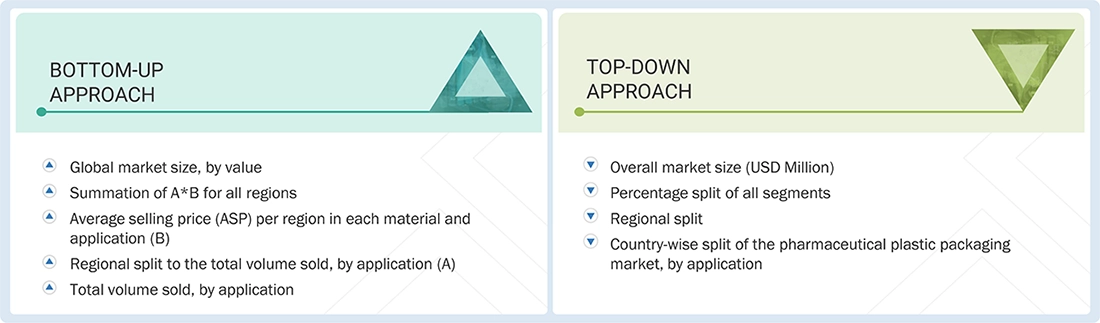
The top-down and bottom-up approaches were used to estimate and validate the size of the Pharmaceutical Plastic Packaging Market. These approaches were also used extensively to estimate the size of various dependent market segments. The research methodology used to estimate the market size included the following:
Pharmaceutical Plastic Packaging Market : Top-Down and Bottom-Up Approach
Data Triangulation
After arriving at the overall market size using the market size estimation processes, the market was split into several segments and subsegments. The data triangulation procedure was employed, wherever applicable, to complete the overall market engineering process and arrive at the exact statistics of each market segment and subsegment. The data was triangulated by studying various factors and trends from both the demand and supply sides.
Market Definition
Pharmaceutical packaging pertains to the materials and systems designed to protect, preserve, and deliver pharmaceutical products for oral, injectable, inhalation, and topical drug delivery modalities. It plays an important role in the stability and sterility of a drug, avoids contamination, and provides accurate dosing for the life of the product. Pharmaceutical packaging denotes the numerous varieties of available options, like plastic bottles, blister packs, vials, ampoules, prefillable syringes, tubes, pouches, and cartons to meet drug formulation requirements and regulatory obligations. Some of the significant functionalities of pharmaceutical packaging include moisture, oxygen, and light barrier protection, tamper evidence, patient convenience, and functionality with active pharmaceutical ingredients (APIs).
Areas of interest include ISO 15378 relating specifically to primary packaging materials, ISO 9001 regarding quality management systems, and GMP compliance. The DSCSA and the EU FMD identified serialized, tracking, and anti-counterfeiting programs, creating an opportunity for the packaging industry to help with drug quality and patient safety.
Stakeholders
- Pharmaceutical packaging manufacturers
- Raw material suppliers
- Converters & processors
- Distributors and traders
- Industry associations and regulatory bodies
- End users
Report Objectives
- To define, describe, and forecast the size of the Pharmaceutical Plastic Packaging Market, based on type, packaging type, drug delivery, raw material, and region in terms of value and volume
- To provide detailed information on the significant drivers, restraints, opportunities, and challenges influencing the market
- To strategically analyze micromarkets concerning individual growth trends, prospects, and their contribution to the market
- To assess the growth opportunities in the market for stakeholders and provide details on the competitive landscape for market leaders
- To forecast the market size of segments and subsegments for North America, Europe, Asia Pacific, South America, and the Middle East & Africa
- To strategically profile key players and comprehensively analyze their market shares and core competencies
- To analyze competitive developments such as acquisitions, product launches, expansions, partnerships, and agreements in the Pharmaceutical Plastic Packaging Market
- To provide the impact of AI/Gen AI on the market
Available Customizations
With the given market data, MarketsandMarkets offers customizations according to client-specific needs.
The following customization options are available for the Pharmaceutical Plastic Packaging Market report:
Product Analysis
- A product matrix that gives a detailed comparison of the product portfolio of each company
Geographic Analysis as per Feasibility
- A further breakdown of the Pharmaceutical Plastic Packaging Market for additional countries
Company Information
- Detailed analysis and profiling of additional market players (up to five)


Personalize This Research
- Triangulate with your Own Data
- Get Data as per your Format and Definition
- Gain a Deeper Dive on a Specific Application, Geography, Customer or Competitor
- Any level of Personalization
Let Us Help You
- What are the Known and Unknown Adjacencies Impacting the Pharmaceutical Plastic Packaging Market
- What will your New Revenue Sources be?
- Who will be your Top Customer; what will make them switch?
- Defend your Market Share or Win Competitors
- Get a Scorecard for Target Partners

Custom Market Research Services
We Will Customise The Research For You, In Case The Report Listed Above Does Not Meet With Your Requirements
Get 10% Free CustomisationTESTIMONIALS
We at Nissan Chemicals Corporation have been clients of MarketsandMarkets for more than a year now. We recently consulted MarketsandMarkets for a study, the team at MarketsandMarkets was extremely professional and organized. The business insights were very detailed and aligned well with our expectations that really helped us formulate the Business Plans and device new strategies for development themes. MarketsandMarkets offers a unique combination of expertise and dedicated engagement model. Their research findings have helped us in designing our Pricing Strategy which will make it easier for us to predict the future sales and profits for the next ten years. We look forward to working with MarketsandMarkets in the future.
VP of Strategy & New Business Development
Leading Specialty Chemical Company
The MarketsandMarkets Engagement Model, composed of both the Knowledge Store and advisory custom research, has greatly helped us in understanding our markets and making strategic decisions. The Knowledge Store is a fast way to allow everyone in our organization to understand more about most any market they are interested in. The ability to then get custom research done and get answers to specific strategic questions and market insight has been spectacular. The Markets and Markets team feel more like colleagues than vendors and their services have helped us change our culture where statements of things like growth opportunities and competitive position are always backed by industry research.

Rich Gibson,
Director, Corporate Strategy
Milliken & Company,
Leading Industrial Manufacturer of specialty chemical, floor covering, performance and protective textile materials, and healthcaremilliken.com
MarketsandMarkets is a trusted resource that helps us to better understand markets that are near-adjacencies-whether its technology, value chain or geography. Their Knowledge Store platform provides a dashboard of markets and their characteristics which is easy to use and saves us time.
Adam Shaw,
Market Development and Strategy Manager
AdvanSix Inc. USA,
An American Leader in Chemicalswww.advansix.com
The Knowledge Store from MarketsandMarkets is a valuable tool which has helped my team acquire greater insight in to the end markets that our business serves. This has enabled us to help our company build stronger strategies throughout our planning process.
TOSHIO KINOSHITA
Senior Chif Consultion Research & Consulting Division
Mitsubishi Chemical Research Corporation,
Leading Manufacturer of Chemical Productswww.mitsubishichem-res.co.jp/en/

We recently engaged with MarketsandMarkets for a study, the team not only clearly understood our business objectives but was also extremely professional in the way they handled the entire project. The study was efficiently conducted in a phase-wise manner, and the engagement model furnished us with high-quality business insights that far exceeded our expectations at each phase. We were especially happy that MarketsandMarkets could provide us with both, an English as well as a Japanese version of the study. A special thanks to the Analyst Team and Client Services Team, whose fluency in Japanese enhanced our comfort level, as we could converse with them in our preferred language.
Independent entrepreneurs
Arrow Precision
We approached MarketsandMarkets for study on Proppants Market, and their work exceeded our expectations. The study conducted was comprehensive and enabled us to view the market through the various dimensions. In addition, the team was extraordinarily responsive throughout the process and resolved our queries on time. I strongly recommend MarketsandMarkets and will certainly consider them for additional market assessments we will need in the future.
Global engineering company, Japan
Deputy Manager,
Strategic Planning OfficeThe high-quality insights shared by the MarketsandMarkets team helped us understand the pharmaceutical plant designers in a specific geography. It also captured the risks that we may likely face in communicating with our potential partners. The study would enable us identify partners, which would impact our future growth.






Growth opportunities and latent adjacency in Pharmaceutical Plastic Packaging Market