Pharmaceutical Washing Equipment Market by Type (Parts Washer, Glassware Washer, Bottle Washer, Vial, Ampoule, Syringe, Stopper, IBC), Technology (Ultrasonic, Spray), Mode (Batch, Inline), Application (Aseptic, Oral Solid Dosage) - Global Forecast to 2031

icon1
USD 1.30 BN
MARKET SIZE, 2031
icon2
CAGR 6.3%
(2026-2031)
icon3
380
REPORT PAGES
icon4
336
MARKET TABLES

OVERVIEW

pharmaceutical-washing-equipment-market Overview

Source: Secondary Research, Interviews with Experts, MarketsandMarkets Analysis

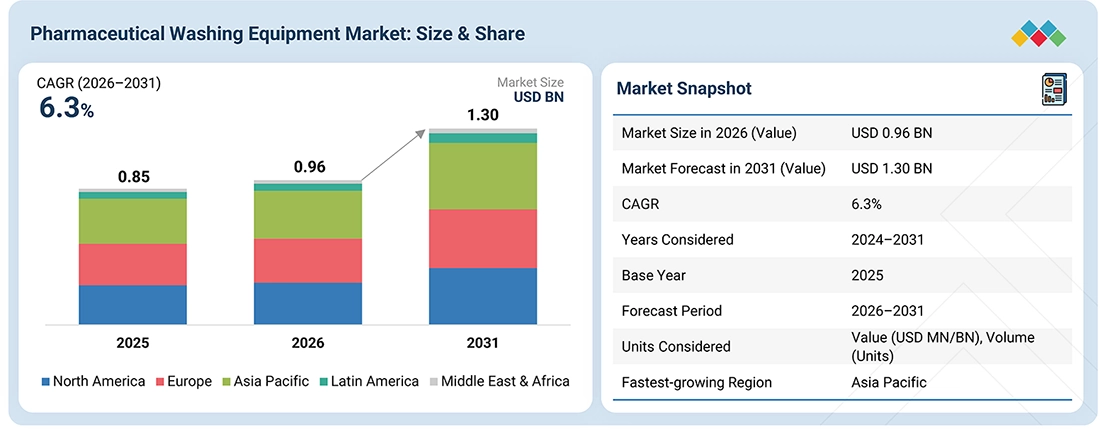
The global pharmaceutical washing equipment market is expected to grow to USD 1.30 billion by 2031 from USD 0.96 billion in 2026, at a CAGR of 6.3% during the forecast period. The market is driven by the global build-out of sterile fill-finish capacity for injectables, biologics, and vaccines, EU GMP Annex 1 and FDA data-integrity requirements that pull forward the replacement of older PLC-based washers, and the replacement cycle of the large installed base of GMP washers and rotary vial washers commissioned during the 2005–2012 investment wave. Growing contract manufacturing capacity in Asia and the onshoring of fill-finish lines in the US further boost demand. However, the shift to ready-to-use closures and nested containers and the 15–20-year service life of stainless-steel washers restrain unit growth. Single-chamber washer-sterilizer-dryers, external washers for lyophilized products, ultrasonic and hybrid washing on rotary lines, and digitally connected washers present significant opportunities for equipment suppliers.

KEY TAKEAWAYS

  • BY REGION
    Based on region, Asia Pacific accounted for the largest share, 32.3%, of the pharmaceutical washing equipment market in 2025.
  • BY EQUIPMENT TYPE
    Based on equipment type, the primary packaging container washing equipment segment accounted for the largest share of 29.6% in 2025.
  • BY WASHING TECHNOLOGY
    Based on washing technology, the steam-assisted washing segment is expected to grow at an 8.0% CAGR during the forecast period.
  • BY PROCESSING MODE
    Based on processing mode, the batch/chamber washing systems segment accounted for the largest share in 2025.
  • BY APPLICATION
    Based on application, the sterile/aseptic pharmaceutical manufacturing segment accounted for the largest market share in 2025.
  • COMPETITIVE LANDSCAPE - KEY PLAYERS
    SteelcoBelimed AG (Switzerland), Getinge AB (Sweden), and Syntegon Technology GmbH (Germany) are some key players in this market due to their validation support, Annex 1 compliance, integration with filling lines, service coverage, and price.
  • COMPETITIVE LANDSCAPE - STARTUPS
    Steriline S.r.l. (Italy) and LAST Technology S.r.l. (Italy) are notable companies in the startups/SMEs/emerging players category, competing in the areas of closure processing, external washers, laboratory-scale GMP washers, and competitively priced rotary washers.

The growth of the pharmaceutical washing equipment market is driven by several key factors, including the expansion of sterile injectable and biologics manufacturing capacity, stricter contamination-control and cleaning-validation expectations under EU GMP Annex 1, FDA data-integrity enforcement, and the replacement of GMP washers and in-line container washers installed more than 12–15 years ago. Ready-to-use component formats and the long life of stainless-steel washers limit unit growth, while combined washing-sterilization-drying systems, external container washers, and digitally connected washers raise value per installation and allow suppliers to grow revenue faster than volume.

TRENDS & DISRUPTIONS IMPACTING CUSTOMERS' CUSTOMERS

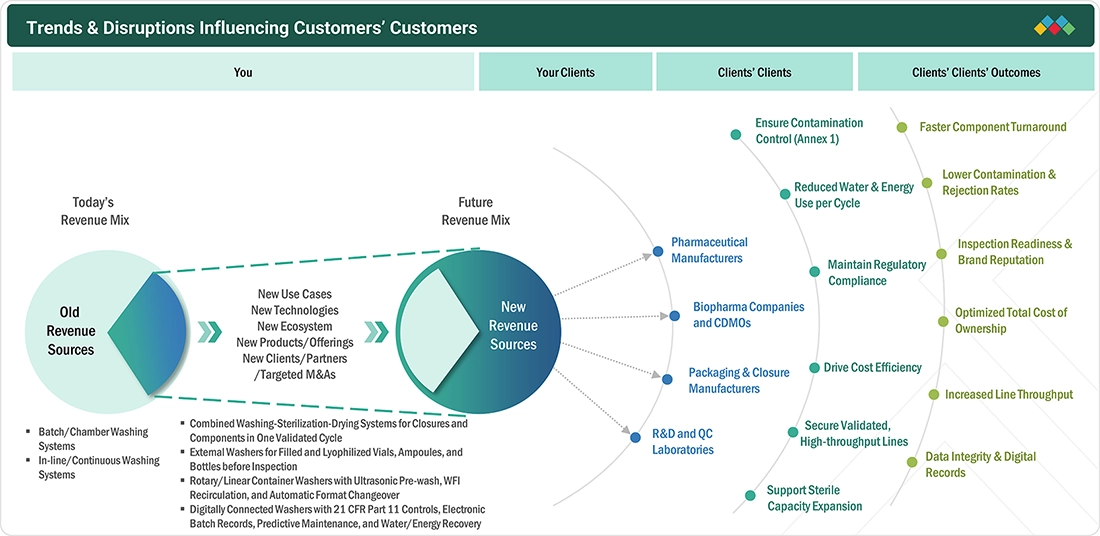
Revenue sources for pharmaceutical washing equipment manufacturers are shifting. Today's revenue mix is led by batch/chamber washers and in-line/continuous container washers; the future mix moves toward combined washing-sterilization-drying systems for closures and components, external washers for filled and lyophilized vials, rotary/linear container washers with ultrasonic pre-wash, WFI recirculation, and automatic format changeover, and digitally connected washers with 21 CFR Part 11 controls, electronic batch records, predictive maintenance, and water/energy recovery. Customers' imperatives—contamination control under Annex 1, regulatory compliance, validated high-throughput lines, sterile capacity expansion, data integrity, and cost efficiency—translate into outcomes such as lower contamination and rejection rates, faster component turnaround, inspection readiness, reduced water and energy use per cycle, and higher line throughput.

pharmaceutical-washing-equipment-market Disruptions

Source: Secondary Research, Interviews with Experts, MarketsandMarkets Analysis

MARKET DYNAMICS

Drivers
Impact
Level
  • Expansion of sterile injectable and biologics fill-finish capacity
  • Replacement of the 2005–2012 installed base of GMP and rotary washers
RESTRAINTS
Impact
Level
  • Shift to ready-to-use closures and nested containers
  • High capital cost and long qualification cycles
OPPORTUNITIES
Impact
Level
  • Combined washing-sterilization-drying systems and external container washers
  • Growth of CDMO and biologics capacity in Asia Pacific and the US
CHALLENGES
Impact
Level
  • Long equipment life (15–20 years) limits replacement volume
  • Price competition from Chinese and Indian OEMs

Source: Secondary Research, Interviews with Experts, MarketsandMarkets Analysis

Driver: Expansion of sterile injectable and biologics fill-finish capacity

The expansion of sterile injectable and biologics manufacturing capacity is the principal driver of the pharmaceutical washing equipment market. Every new aseptic filling line requires a rotary or linear container washer, and every sterile site adds GMP parts washers, closure washers, and laboratory glassware washers. Announced sterile injectable, biologics, and vaccine fill-finish projects in the US, Europe, China, and India, the onshoring of fill-finish lines in the US, and the growth of contract manufacturers translate directly into washer orders, because each line is specified with a validated washer and each new cleanroom suite adds cabinet washers; biologics sites also add bioreactor-part and vessel washing systems.

Restraint: Shift to ready-to-use closures and nested containers

The adoption of ready-to-use stoppers, caps, and nested vials and cartridges moves washing and sterilization from the drug manufacturer to the component supplier. Fewer, larger washing installations at closure and container manufacturers replace many small in-house lines, which reduces the number of closure washers and batch container washers sold to pharmaceutical companies, particularly in the US and Europe. Together with the 15–20-year service life of stainless-steel washers, this limits unit growth even as the value of each installation rises.

Opportunity: Combined washing-sterilization-drying systems and external container washers

Single-chamber systems that wash, sterilize, and dry closures and components in one validated cycle shorten processing time, reduce handling in the aseptic core and command two to three times the value of a washing-only unit; US fill-finish sites and closure manufacturers lead adoption. External washers for filled and lyophilized vials, ampoules, and bottles, which remove product residue before inspection and labeling, form a new line growing with lyophilization capacity. Ultrasonic and hybrid washing on rotary lines and water- and energy-recovery options add further value per installation.

Challenge: Price competition from Chinese and Indian OEMs

Domestic OEMs in China (Truking, Tofflon, Shinva, Chutian, Hualian) and India (Pharmalab, ACG, Harsiddh) supply rotary washers and GMP cabinet washers at roughly 25–40% of Western prices and account for the majority of in-line washer units installed worldwide. Their improving quality and references with WHO- and US-FDA-approved sites intensify price competition in Asia Pacific, Latin America, and the Middle East, which compresses the value growth of European and American OEMs outside their home regions and pushes them toward higher-specification, digitally connected systems.

PHARMACEUTICAL WASHING EQUIPMENT MARKET: COMMERCIAL USE CASES ACROSS INDUSTRIES

COMPANY USE CASE DESCRIPTION BENEFITS
company logo
Supplies GMP cabinet and pass-through washers, chamber washer/dryers, and large-component washers (PH, DS, LAB series) for parts, closures, bulk containers, and glassware at sterile and CDMO sites. Shortens component turnaround, reduces manual handling in the aseptic core, and supports Annex 1 contamination-control strategies.
company logo
Provides high-speed rotary (RRU/RRN) and linear vial, ampoule, cartridge, and syringe washers integrated with depyrogenation tunnels and filling lines. Enables validated continuous processing at up to 36,000–48,000 containers per hour with reduced particle and endotoxin load.
company logo
Offers FOW GMP washers and FOS combined washer-sterilizer-dryers for stoppers, plungers, and format parts, processed in one validated cycle. Delivers ready-to-use-quality closures in-house, cutting cycle time and consumable costs versus two-step washing and autoclaving.
company logo
Manufactures laboratory glassware washers (PLW/PG series) with GMP documentation and conductivity-monitored rinsing for QC, microbiology, and R&D laboratories. Ensures reproducible, documented cleaning of analytical glassware, supports data integrity, and frees analyst time.
company logo
Designs ultrasonic rotary and linear container washers and washing-sterilizing-filling lines, plus IBC and parts washers, for Chinese and export-approved sterile plants. Lowers capital cost per aseptic line, supports rapid capacity additions, and provides integrated line validation.

Logos and trademarks shown above are the property of their respective owners. Their use here is for informational and illustrative purposes only.

MARKET ECOSYSTEM

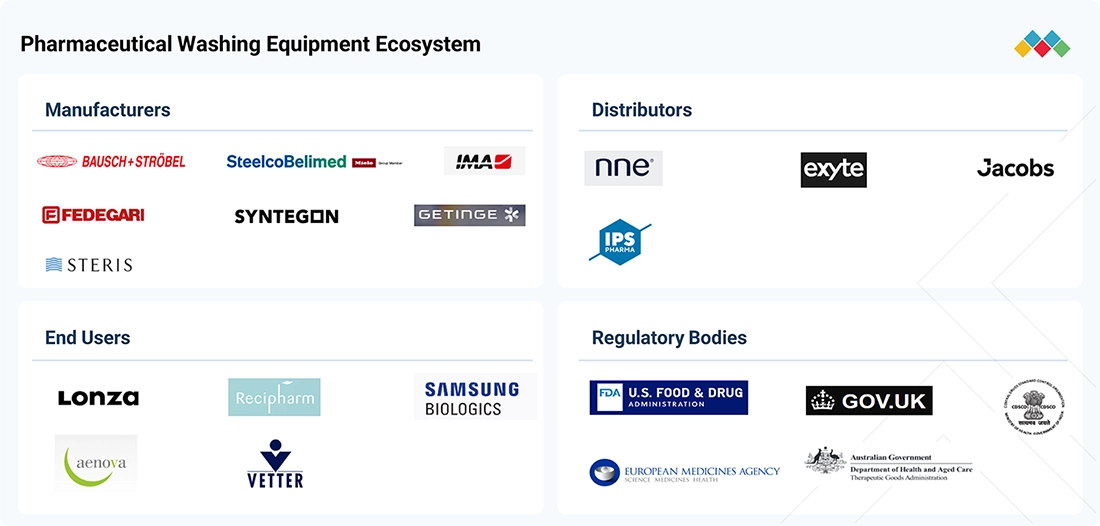
The pharmaceutical washing equipment market ecosystem consists of various elements that play a role in delivering validated cleaning capacity to drug manufacturers. Stainless-steel fabricators, pump, valve, and spray-nozzle makers; HEPA filter and drying-system suppliers; PLC and automation vendors (Siemens, Rockwell); and detergent manufacturers provide inputs to equipment manufacturers such as SteelcoBelimed, STERIS, Getinge, Fedegari, IWT, Syntegon, Bausch+Stroebel, IMA Life, and Truking, which develop GMP washers, rotary container washers, and combined washer-sterilizers. These systems reach the market directly and through engineering contractors, fill-finish line integrators (NNE, IPS, Exyte, Jacobs), and regional agents, who provide installation, qualification (IQ/OQ/PQ), and service. End users are pharmaceutical manufacturers, biopharmaceutical companies, and CDMOs such as Samsung Biologics, Lonza, Vetter, Recipharm, and Aenova, together with primary packaging and closure manufacturers such as West, Datwyler, Stevanato, and SCHOTT, operating under the oversight of regulators such as the FDA, EMA, MHRA, TGA, and CDSCO.

pharmaceutical-washing-equipment-market Ecosystem

Logos and trademarks shown above are the property of their respective owners. Their use here is for informational and illustrative purposes only.

MARKET SEGMENTS

pharmaceutical-washing-equipment-market Segments

Source: Secondary Research, Interviews with Experts, MarketsandMarkets Analysis

Pharmaceutical Washing Equipment Market, by Equipment Type

The primary packaging container washing equipment segment accounted for the largest share of the global pharmaceutical washing equipment market in 2025 because rotary and linear vial, ampoule, cartridge, and syringe washers are installed on every new aseptic filling line and carry the highest unit value; vial washing machines lead the segment, and cartridge and syringe washing machines grow fastest as bulk-glass cartridge and syringe lines are added at sterile sites.

Pharmaceutical Washing Equipment Market, by Washing Technology

Spray/jet washing holds the largest share due to its proven validation record and compatibility with all cabinet, chamber, and batch container washers, while steam-assisted washing grows fastest, as single-chamber washer-sterilizer-dryers replace two-step closure processing, followed by ultrasonic washing on rotary container lines.

Pharmaceutical Washing Equipment Market, by Processing Mode

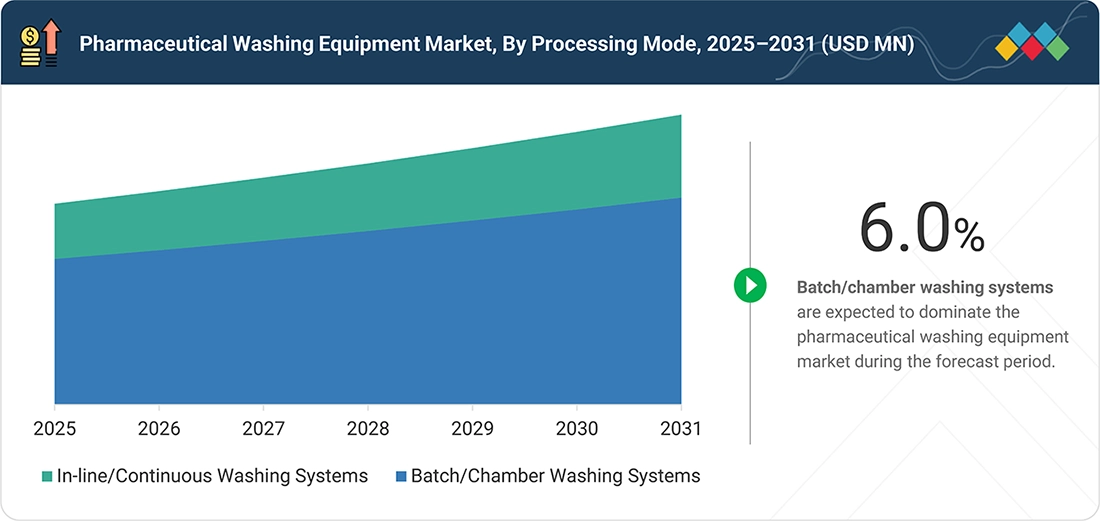
Batch/chamber washing systems hold the largest share, led by cabinet washers, followed by chamber washers/dryers and large-component chamber washers; in-line/continuous systems are growing faster, with rotary washers outperforming linear washers.

Pharmaceutical Washing Equipment Market, by Application

Sterile/aseptic pharmaceutical manufacturing holds the largest share as injectable, lyophilized, and vaccine capacity expands; oral solid dosage manufacturing follows, driven by tooling, change parts, and bin washing.

Pharmaceutical Washing Equipment Market, by End User

Pharmaceutical manufacturers hold the largest share because of the number of licensed sites they operate, while CDMOs/CMOs and biopharmaceutical manufacturers are expected to register higher growth rates, as contract fill-finish and biologics capacity carries the highest number of washers per site.

REGION

Asia Pacific to be fastest-growing region in global pharmaceutical washing equipment market

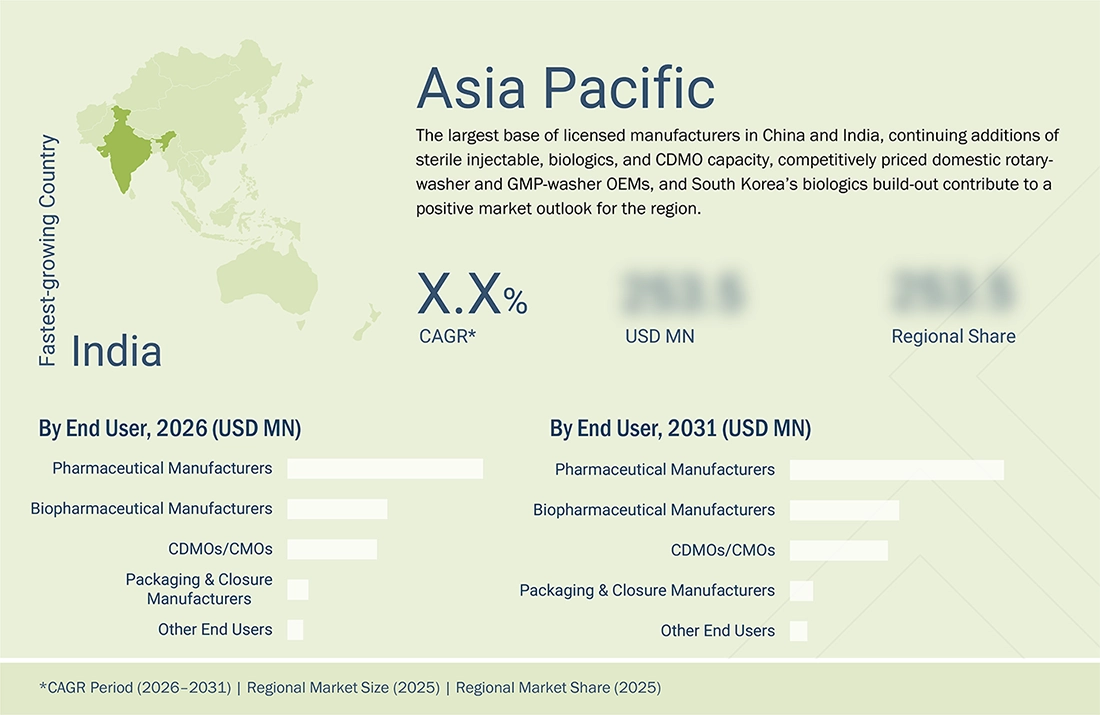
The Asia Pacific region is expected to experience the highest CAGR (6.8%) among the major regions in the pharmaceutical washing equipment market during the forecast period, driven by China's and India's continuing additions of sterile injectable, biologics, and CDMO capacity, US-FDA- and EU-driven upgrades of existing sites, and the large base of licensed manufacturers that buy rotary washers and GMP cabinet washers from domestic OEMs. South Korea's biologics CDMO build-out (Samsung Biologics, Celltrion, SK bioscience) adds demand for bioreactor part and large-component washers. India is the region's fastest-growing country (7.6% CAGR), followed by China (7.4%), while Japan sustains a mature, high-value replacement market.

pharmaceutical-washing-equipment-market Region

PHARMACEUTICAL WASHING EQUIPMENT MARKET: COMPANY EVALUATION MATRIX

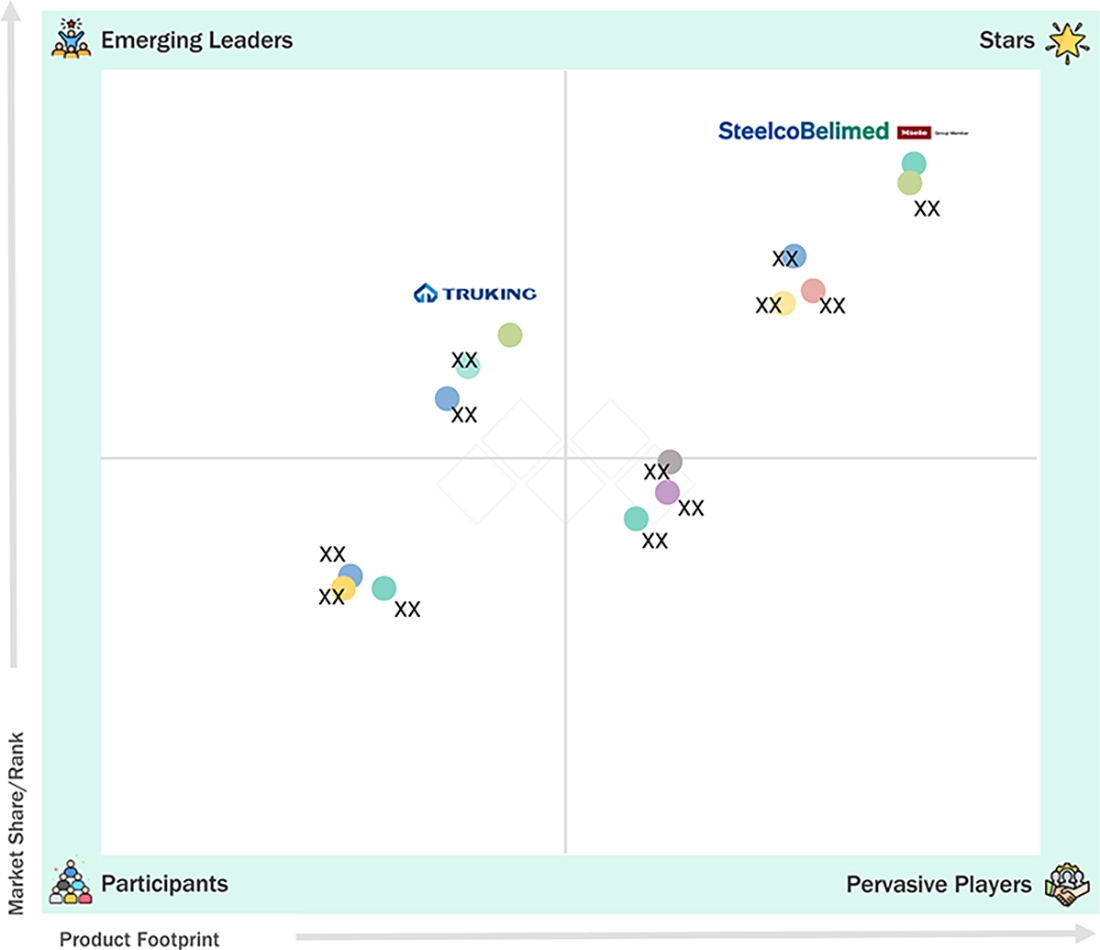
In the pharmaceutical washing equipment market, SteelcoBelimed AG (Star) has a strong and well-established position with the broadest GMP washer portfolio, the largest installed base in Europe and North America, and the combined Steelco and Belimed service network. Getinge AB, Syntegon Technology, and STERIS plc (Stars) hold leading positions through integrated aseptic-processing packages, rotary container washers, and the US Life Sciences installed base, respectively. Truking Technology (Emerging Leader) is gaining traction with high-speed rotary washers and integrated washing-sterilizing-filling lines at competitive prices and is positioned for growth beyond China, while Fedegari, IMA Life, and Bausch+Stroebel are pervasive players with strong niche positions in closure processing and in-line container washing.

pharmaceutical-washing-equipment-market Evaluation Metrics

Source: Secondary Research, Interviews with Experts, MarketsandMarkets Analysis

KEY MARKET PLAYERS

  • SteelcoBelimed AG (Switzerland)
  • STERIS plc (US)
  • Getinge AB (Sweden)
  • Fedegari Autoclavi S.p.A. (Italy)
  • Syntegon Technology GmbH (Germany)
  • Bausch+Stroebel SE & Co. KG (Germany)
  • IMA S.p.A. (Italy)
  • Marchesini Group S.p.A. (Italy)
  • Truking Technology Ltd. (China)
  • Tofflon Science and Technology Group Co., Ltd. (China)
  • Steriline S.r.l. (Italy)
  • Shinva Medical Instrument Co., Ltd. (China)
  • groninger & co. gmbh (Germany)
  • PennTech Machinery Corp. (US)
  • IWT S.r.l. (Italy)
  • Mueller AG (Switzerland)
  • Amsonic AG (Switzerland)
  • Brinox d.o.o. (Slovenia)
  • LAST Technology S.r.l. (Italy)
  • Glatt GmbH (Germany)
  • BSW-Anlagenbau GmbH/MBL (Germany)
  • De Lama S.p.A. (Italy)
  • ATEC Pharmatechnik GmbH (Germany)
  • Riebesam GmbH & Co. KG (Germany)
  • MMM Group (Germany)

MARKET SCOPE

REPORT METRIC DETAILS
Market Size in 2025 (Value) USD 0.85 Billion
Market Forecast in 2026 (Value) USD 0.96 Billion
Market Forecast in 2031 (Value) USD 1.3 Billion
Growth Rate CAGR of 6.3% from 2026 to 2031
Years Considered 2024–2031
Base Year 2025
Forecast Period 2026–2031
Units Considered Value (USD Million/Billion), Volume (Units)
Report Coverage Revenue Forecast, Company Ranking, Competitive Landscape, Growth Factors, and Trends
Segments Covered
  • By Equipment Type:
    • Primary Packaging Container
    • Closure
    • Parts & Components
    • Bulk Container & Process Equipment
    • External Container
    • Laboratory Glassware
    • Others
  • By Washing Technology:
    • Spray/Jet
    • Ultrasonic
    • Steam-assisted
    • Combination/Hybrid
    • Other
  • By Processing Mode:
    • In-line/Continuous (Linear
    • Rotary)
    • Batch/Chamber (Cabinet
    • Chamber Washer/Dryer
    • Large-component)
  • By Application:
    • Sterile/Aseptic
    • Oral Solid Dosage
    • Non-sterile Liquid & Semi-solid
    • API & Bulk
    • R&D & QC
    • Others
  • By End User:
    • Pharmaceutical Manufacturers
    • Biopharmaceutical Manufacturers
    • CDMOs/CMOs
    • Primary Packaging & Closure Manufacturers
    • Others
Regions Covered North America, Europe, Asia Pacific, Latin America, Middle East & Africa, and GCC Countries

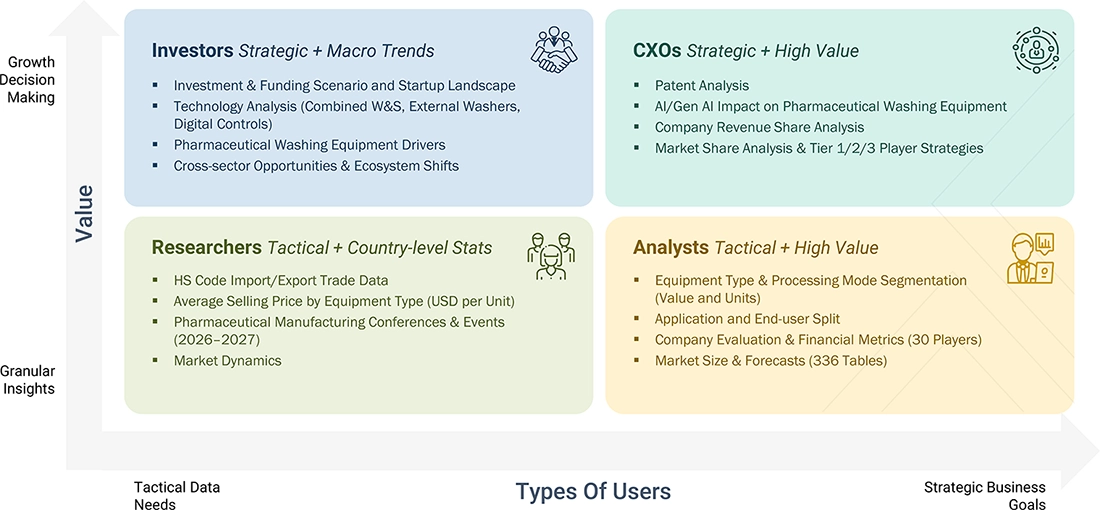
WHAT IS IN IT FOR YOU: PHARMACEUTICAL WASHING EQUIPMENT MARKET REPORT CONTENT GUIDE

pharmaceutical-washing-equipment-market Content Guide

DELIVERED CUSTOMIZATIONS

We have successfully delivered the following deep-dive customizations:

CLIENT REQUEST CUSTOMIZATION DELIVERED VALUE ADDS
Product Analysis Comparison of pharmaceutical washing equipment categories: batch GMP washers (parts & components, closure, bulk container & process equipment, laboratory glassware), in-line rotary and linear container washers, external container washers, and combined washing-sterilization-drying systems, with price bands by region and unit volumes by processing mode. Assessment of technological innovations such as single-chamber washer-sterilizer-dryers, ultrasonic and hybrid washing, data-integrity-compliant controls, and water/energy recovery, supporting product-roadmap and investment decisions.
Company Information Profiles of key manufacturers such as SteelcoBelimed AG (Switzerland), STERIS plc (US), Getinge AB (Sweden), Fedegari Autoclavi S.p.A. (Italy), Syntegon Technology GmbH (Germany), IMA S.p.A. (Italy), and Truking Technology Ltd. (China), covering washer portfolios, manufacturing footprint, service networks, partnerships, and M&A. Market share benchmarking and competitive landscape of leading players, including the SteelcoBelimed joint venture and the entry of Chinese fill-finish OEMs into export markets.
Geographic Analysis Detailed regional assessment of North America, Europe, Asia Pacific, Latin America, Middle East & Africa, and GCC countries, with country-level sizing by equipment type, washing technology, processing mode, application, and end user, and unit volumes by processing mode per region. Country-level sizing, CAGR forecasts and adoption analysis for major markets such as the US, Germany, Italy, China, India, South Korea, and Saudi Arabia, supporting market-entry, pricing, and service-network planning.

RECENT DEVELOPMENTS

  • November 2022 : AGIC Capital acquired a majority stake in ATEC Pharmatechnik GmbH (Germany), supporting the expansion of its stopper-processing, GMP washing, and combined washing-sterilization systems in the US and Asia.
  • June 2024 : In June 2024, Miele (67%) and Metall Zug (33%) completed the SteelcoBelimed joint venture, combining Steelco's GMP pharma washers and Belimed's Life Science washing and sterilization business into one supplier.
  • November 2024 : Syntegon Technology GmbH (Germany) announced the acquisition of Telstar from Azbil Corporation, adding sterilization, freeze-drying and aseptic-processing capabilities alongside its liquid-pharma lines, which include rotary and linear container washers.
  • August 2025 : Sani-Matic, Inc. (US) acquired Douglas Machines Corp., expanding its hygienic washing portfolio of clean-out-of-place parts washers and cabinet washers for pharmaceutical, biotech, and food manufacturers.
  • December 2025 : Metall Zug reported SteelcoBelimed's first full-year net sales of CHF 435.8 million (+5% comparable), confirming the joint venture's position as the largest dedicated supplier of GMP washers and pharma sterilizers in Europe.


Table of Contents

checkmarkExclusive indicates content/data unique to MarketsandMarkets and not available with any competitors.

TITLE
PAGE NO
1
INTRODUCTION


15
2
EXECUTIVE SUMMARY


3
PREMIUM INSIGHTS


4
MARKET OVERVIEW
Provides a snapshot of current market scenario, value chain context, and factors impacting competitive intensity.


4.1
INTRODUCTION


4.2
MARKET DYNAMICS


4.2.1
DRIVERS


4.2.2
RESTRAINTS


4.2.3
OPPORTUNITIES


4.2.4
CHALLENGES


4.3
UNMET NEEDS AND WHITE SPACES


4.4
INTERCONNECTED MARKETS AND CROSS-SECTOR OPPORTUNITIES


4.5
STRATEGIC MOVES BY TIER-1/2/3 PLAYERS


5
INDUSTRY TRENDS
Outlines emerging trends, technology impact, and regulatory signals affecting growth trajectory and stakeholder decisions.


5.1
PORTER’S FIVE FORCES ANALYSIS


5.2
MACROECONOMIC OUTLOOK


5.2.1
INTRODUCTION


5.2.2
GDP TRENDS AND FORECAST


5.2.3
TRENDS IN THE GLOBAL PHARMACEUTICAL EQUIPMENT INDUSTRY


5.3
SUPPLY CHAIN ANALYSIS


5.4
VALUE CHAIN ANALYSIS


5.5
ECOSYSTEM ANALYSIS


5.6
PRICING ANALYSIS


5.6.2
AVERAGE SELLING PRICE TREND, BY PRODUCT (2023–2025)


5.6.3
AVERAGE SELLING PRICE TREND, BY REGION (2023–2025)


5.7
TRADE ANALYSIS


5.8
KEY CONFERENCES AND EVENTS, 2026–2027


5.9
TRENDS/DISRUPTIONS IMPACTING CUSTOMER BUSINESS


5.10
INVESTMENT AND FUNDING SCENARIO


5.11
CASE STUDY ANALYSIS


5.12
IMPACT OF 2025 US TARIFFS – PHARMACEUTICAL WASHING EQUIPMENT MARKET


5.12.1
INTRODUCTION


5.12.2
KEY TARIFF RATES


5.12.3
PRICE IMPACT ANALYSIS


5.12.4
IMPACT ON COUNTRIES/REGIONS


5.12.4.1
US


5.12.4.2
EUROPE


5.12.4.3
APAC


5.12.5
IMPACT ON END-USE INDUSTRIES
 
 
6
TECHNOLOGICAL ADVANCEMENTS, AI-DRIVEN IMPACT, PATENTS, INNOVATIONS, AND FUTURE APPLICATIONS


6.1
KEY EMERGING TECHNOLOGIES


6.2
COMPLEMENTARY TECHNOLOGIES


6.3
TECHNOLOGY/PRODUCT ROADMAP


6.4
PATENT ANALYSIS


6.5
FUTURE APPLICATIONS


6.6
IMPACT OF AI/GEN AI ON PHARMACEUTICAL WASHING EQUIPMENT MARKET


6.6.1
TOP USE CASES AND MARKET POTENTIAL


6.6.2
BEST PRACTICES IN PHARMACEUTICAL WASHING EQUIPMENT PROCESSING


6.6.3
CASE STUDIES OF AI IMPLEMENTATION IN THE PHARMACEUTICAL WASHING EQUIPMENT MARKET


6.6.4
INTERCONNECTED ADJACENT ECOSYSTEM AND IMPACT ON MARKET PLAYERS


6.6.5
CLIENTS’ READINESS TO ADOPT GENERATIVE AI IN PHARMACEUTICAL WASHING EQUIPMENT MARKET
 
 
7
REGULATORY LANDSCAPE


7.1
REGIONAL REGULATIONS AND COMPLIANCE


7.1.1
REGULATORY BODIES, GOVERNMENT AGENCIES, AND OTHER ORGANIZATIONS
 
 
8
CUSTOMER LANDSCAPE & BUYER BEHAVIOR


8.1
DECISION-MAKING PROCESS


8.2
BUYER STAKEHOLDERS AND BUYING EVALUATION CRITERIA


8.3
ADOPTION BARRIERS & INTERNAL CHALLENGES


8.4
UNMET NEEDS FROM VARIOUS END-USE INDUSTRIES


9
PHARMACEUTICAL WASHING EQUIPMENT MARKET, BY EQUIPMENT TYPE (USD MILLION, 2024-2031)


9.1
INTRODUCTION


9.2
PRIMARY PACKAGING CONTAINER WASHING EQUIPMENT


9.2.1
VIAL WASHING MACHINES


9.2.2
AMPOULE WASHING MACHINES


9.2.3
CARTRIDGE WASHING MACHINES


9.2.4
SYRINGE WASHING MACHINES


9.2.5
OTHER PRIMARY PACKAGING CONTAINER WASHING EQUIPMENT


9.3
PHARMACEUTICAL CLOSURE WASHING EQUIPMENT


9.3.1
VIAL STOPPER WASHING EQUIPMENT


9.3.2
PLUNGER & NEEDLE SHIELD WASHING EQUIPMENT


9.3.3
CARTRIDGE CLOSURE & SEAL WASHING EQUIPMENT


9.3.4
CAP WASHING EQUIPMENT


9.3.5
OTHER CLOSURE WASHING EQUIPMENT


9.4
PARTS & COMPONENTS WASHING EQUIPMENT


9.4.1
FILLING-LINE COMPONENT WASHERS


9.4.2
MACHINE & CHANGE-PART WASHERS


9.4.3
PRODUCT-CONTACT PARTS WASHERS


9.4.4
OTHER PARTS & COMPONENT WASHERS


9.5
BULK CONTAINER & PROCESS EQUIPMENT WASHING SYSTEMS


9.5.1
IBC & BIN WASHING SYSTEMS


9.5.2
DRUM & CARBOY WASHING SYSTEMS


9.5.3
VESSEL & TANK WASHING SYSTEMS


9.5.4
BIOREACTOR WASHING SYSTEMS


9.5.5
OTHER BULK CONTAINER & PROCESS EQUIPMENT WASHING SYSTEMS


9.6
EXTERNAL CONTAINER WASHING EQUIPMENT


9.6.1
VIAL WASHERS


9.6.2
AMPOULE WASHERS


9.6.3
BOTTLE & OTHER CONTAINER WASHERS


9.7
PHARMACEUTICAL LABORATORY GLASSWARE WASHING EQUIPMENT


9.7.1
UNDERCOUNTER/BENCHTOP WASHERS


9.7.2
FREESTANDING WASHERS


9.7.3
LARGE-CAPACITY WASHERS


9.8
OTHER PHARMACEUTICAL WASHING EQUIPMENT


10
PHARMACEUTICAL WASHING EQUIPMENT MARKET, BY WASHING TECHNOLOGY (USD MILLION, 2024-2031)


10.1
INTRODUCTION


10.2
SPRAY/JET WASHING


10.3
ULTRASONIC WASHING


10.4
STEAM-ASSISTED WASHING


10.5
COMBINATION/HYBRID WASHING


10.6
OTHER WASHING TECHNOLOGIES


11
PHARMACEUTICAL WASHING EQUIPMENT MARKET, BY PROCESSING MODE (USD MILLION, 2024-2031)


11.1
INTRODUCTION


11.2
IN-LINE/CONTINUOUS WASHING SYSTEMS


11.2.1
LINEAR WASHING SYSTEMS


11.2.2
ROTARY WASHING SYSTEMS


11.3
BATCH/CHAMBER WASHING SYSTEMS


11.3.1
CABINET WASHERS


11.3.2
CHAMBER WASHER/DRYERS


11.3.3
LARGE-COMPONENT CHAMBER WASHERS
 
 
12
PHARMACEUTICAL WASHING EQUIPMENT MARKET, BY APPLICATION (USD MILLION, 2024-2031)


12.1
INTRODUCTION


12.2
STERILE/ASEPTIC PHARMACEUTICAL MANUFACTURING


12.2.1
INJECTABLE & PARENTERAL DRUGS


12.2.2
LYOPHILIZED DRUGS


12.2.3
VACCINES


12.2.4
OTHER STERILE PHARMACEUTICAL PRODUCTS


12.3
ORAL SOLID DOSAGE MANUFACTURING


12.3.1
TABLETS


12.3.2
CAPSULES


12.3.3
POWDERS & GRANULES


12.4
NON-STERILE LIQUID & SEMI-SOLID MANUFACTURING


12.4.1
ORAL LIQUIDS & SYRUPS


12.4.2
SUSPENSIONS


12.4.3
CREAMS, OINTMENTS & GELS


12.4.4
OTHER LIQUID & SEMI-SOLID PRODUCTS


12.5
API & BULK DRUG MANUFACTURING


12.6
PHARMACEUTICAL R&D & QUALITY CONTROL


12.7
OTHER APPLICATIONS


13
PHARMACEUTICAL WASHING EQUIPMENT MARKET, BY END USER (USD MILLION, 2024-2031)


13.1
INTRODUCTION


13.2
PHARMACEUTICAL MANUFACTURERS


13.3
BIOPHARMACEUTICAL MANUFACTURERS


13.4
CONTRACT DEVELOPMENT & MANUFACTURING ORGANIZATIONS/CONTRACT MANUFACTURING ORGANIZATIONS


13.5
PHARMACEUTICAL PRIMARY PACKAGING & CLOSURE MANUFACTURERS


13.6
OTHER END USERS


14
PHARMACEUTICAL WASHING EQUIPMENT MARKET, BY REGION (USD MILLION 2024-2031)


14.1
INTRODUCTION


14.2
NORTH AMERICA


14.2.1
US


14.2.2
CANADA


14.3
EUROPE


14.3.1
GERMANY


14.3.2
FRANCE


14.3.3
UK


14.3.4
ITALY


14.3.5
SPAIN


14.3.6
REST OF EUROPE


14.4
ASIA PACIFIC


14.4.1
CHINA


14.4.2
JAPAN


14.4.3
INDIA


14.4.4
SOUTH KOREA


14.4.5
AUSTRALIA


14.4.6
REST OF ASIA PACIFIC


14.5
LATIN AMERICA


14.5.1
BRAZIL


14.5.2
MEXICO


14.5.3
ARGENTINA


14.5.4
REST OF LATIN AMERICA


14.6
MIDDLE EAST & AFRICA


14.7
GCC COUNTRIES


15
COMPETITIVE LANDSCAPE


15.1
OVERVIEW


15.2
KEY PLAYER COMPETITIVE STRATEGIES/RIGHT TO WIN


15.3
REVENUE ANALYSIS


15.4
MARKET SHARE ANALYSIS


15.4.1
GLOBAL PHARMACEUTICAL WASHING EQUIPMENT MARKET SHARE ANALYSIS,


15.4.2
US PHARMACEUTICAL WASHING EQUIPMENT MARKET SHARE ANALYSIS,


15.5
BRAND COMPARISON


15.6
COMPANY EVALUATION MATRIX: KEY PLAYERS,


15.6.1
STARS


15.6.2
EMERGING LEADERS


15.6.3
PERVASIVE PLAYERS


15.6.4
PARTICIPANTS


15.6.5
COMPANY FOOTPRINT: KEY PLAYERS,


15.6.5.1
COMPANY FOOTPRINT


15.6.5.2
REGION FOOTPRINT


15.6.5.3
EQUIPMENT TYPE FOOTPRINT


15.6.5.4
PROCESSING MODE FOOTPRINT


15.6.5.5
WASHING MODE FOOTPRINT


15.6.5.6
APPLICATION FOOTPRINT


15.6.5.7
END USERS FOOTPRINT
 
 
15.7
COMPANY EVALUATION MATRIX: STARTUPS/SMES,


15.7.1
PROGRESSIVE COMPANIES


15.7.2
RESPONSIVE COMPANIES


15.7.3
DYNAMIC COMPANIES


15.7.4
STARTING BLOCKS


15.7.5
COMPETITIVE BENCHMARKING: STARTUPS/SMES,


15.7.5.1
DETAILED LIST OF KEY STARTUPS/SMES


15.7.5.2
COMPETITIVE BENCHMARKING OF KEY STARTUPS/SMES
 
 
15.8
COMPANY VALUATION AND FINANCIAL METRICS


15.9
COMPETITIVE SCENARIO


15.9.1
PRODUCT LAUNCHES


15.9.2
DEALS


15.9.3
EXPANSIONS
 
 
16
COMPANY PROFILES


16.1
KEY PLAYERS


16.1.1
IMA S.P.A.


16.1.2
SYNTEGON TECHNOLOGY GMBH


16.1.3
BAUSCH+STRÖBEL SE + CO. KG


16.1.4
STEELCOBELIMED


16.1.5
STERIS PLC


16.1.6
GETINGE AB


16.1.7
FEDEGARI AUTOCLAVI S.P.A.


16.1.8
MARCHESINI GROUP S.P.A.


16.1.9
TRUKING TECHNOLOGY LIMITED


16.1.10
IWT S.R.L. – IWT PHARMA


16.1.11
MIELE & CIE. KG


16.1.12
GEA GROUP AG


16.1.13
STERILINE SRL


16.2
OTHER PLAYERS


16.2.1
DARA PHARMACEUTICAL PACKAGING


16.2.2
ROTA VERPACKUNGSTECHNIK


16.2.3
GRONINGER & CO


16.2.4
COZZOLI MACHINE COMPANY


16.2.5
AUSTAR GROUP


16.2.6
SHINVA MEDICAL INSTRUMENT CO., LTD.


16.2.7
SANI-MATIC, INC.


16.2.8
SUNCOMBE LTD.


16.2.9
MÜLLER GROUP


16.2.10
NICOS GROUP


16.2.11
LUPERINI GROUP


16.2.12
SHANGHAI IVEN PHARMATECH ENGINEERING CO., LTD.


16.2.13
SHREE BHAGWATI MACHTECH (INDIA) PVT. LTD.
 
 
17
RESEARCH METHODOLOGY


17.1
RESEARCH DATA


17.1.1
SECONDARY DATA


17.1.1.1
KEY DATA FROM SECONDARY SOURCES


17.1.2
PRIMARY DATA


17.1.2.1
KEY DATA FROM PRIMARY SOURCES


17.1.2.2
KEY PRIMARY PARTICIPANTS


17.1.2.3
BREAKDOWN OF PRIMARY INTERVIEWS


17.1.2.4
KEY INDUSTRY INSIGHTS
 
 
17.2
MARKET SIZE ESTIMATION


17.2.1
BOTTOM-UP APPROACH


17.2.2
TOP-DOWN APPROACH


17.3
MARKET FORECAST APPROACH


17.3.1
SUPPLY SIDE


17.3.2
DEMAND SIDE


17.4
DATA TRIANGULATION


17.5
FACTOR ANALYSIS


17.6
RESEARCH ASSUMPTIONS


17.7
RESEARCH LIMITATIONS AND RISK ASSESSMENT


18
APPENDIX


18.1
DISCUSSION GUIDE


18.2
KNOWLEDGESTORE: MARKETSANDMARKETS’ SUBSCRIPTION PORTAL


18.3
CUSTOMIZATION OPTIONS



18.4
RELATED REPORTS



18.5
AUTHOR DETAILS


Methodology

This research study used both primary and secondary sources. It involved the study of various factors affecting the industry to identify the segmentation types, industry trends, key players, the competitive landscape of market players, and key market dynamics such as drivers, opportunities, challenges, restraints, and key player strategies.

Secondary Research

This research study involved the wide use of secondary sources such as directories, databases such as D&B Hoovers, Bloomberg Businessweek, and Factiva; white papers; annual reports and registry filings (Bundesanzeiger, Registro Imprese, CNINFO); regulator site registers (FDA, EudraGMDP, NMPA, CDSCO); and Companies House documents. Secondary research was undertaken to identify and collect information for this extensive, technical, market-oriented, and commercial study of the pharmaceutical washing equipment market. It was also used to obtain important information on top players, market classification and segmentation (down to the bottom-most level), geographic markets, and key market developments. A database of the key industry leaders was also prepared using secondary research.

Primary Research

In the primary research process, various supply-side and demand-side sources were interviewed to obtain qualitative and quantitative information for this report. Primary sources from the supply side included industry experts such as CEOs, vice presidents, marketing and sales directors, product managers, application engineers, and related key executives from various companies and organizations operating in the pharmaceutical washing equipment market. Primary sources on the demand side included engineering, validation, and quality personnel from pharmaceutical and biopharmaceutical manufacturers and CDMOs; procurement managers; laboratory managers; and stakeholders from engineering contractors and regulatory bodies.

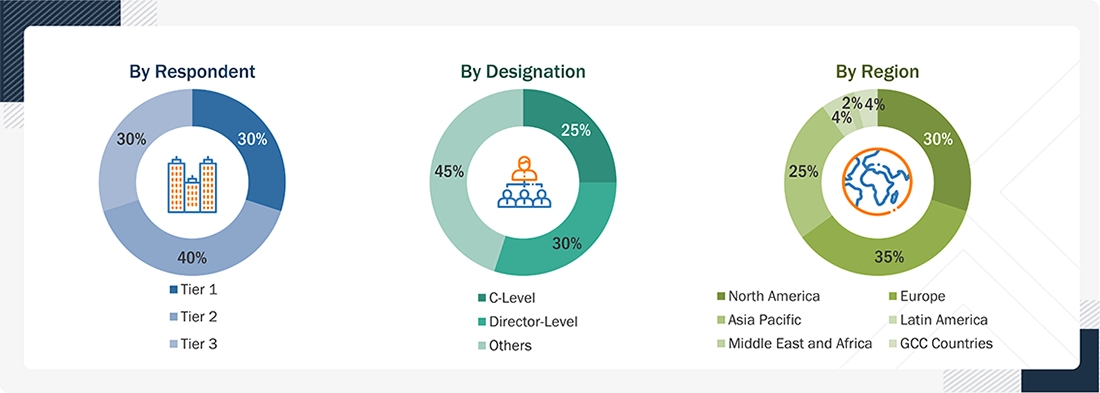
A breakdown of the primary respondents for the pharmaceutical washing equipment market (supply side) is provided below:

Pharmaceutical Washing Equipment Market 
 Size, and Share

Note 1: Companies are classified into tiers based on their total revenue. As of 2025: Tier 1 = >USD 1 billion, Tier 2 = USD 500 million–1 billion, and Tier 3 = <USD 500 million.
Note 2: C-level executives include CEOs, COOs, CTOs, and VPs.

Note 3: Other primaries include sales managers, marketing managers, and product managers

To know about the assumptions considered for the study, download the pdf brochure

Market Size Estimation

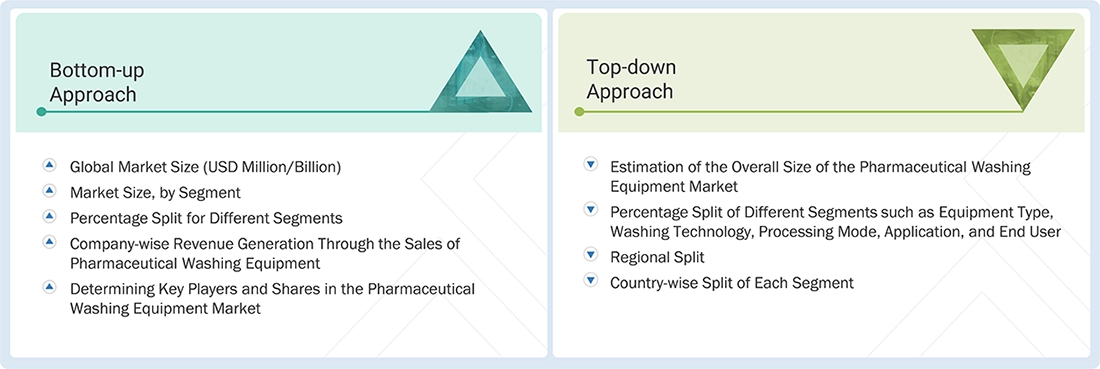
The market size for pharmaceutical washing equipment was determined using data from four sources, which are discussed below. Each method was evaluated, and a weighted average was calculated based on the number of assumptions made by each approach. The supply-side (bottom-up) estimate was built from the revenues of 30 profiled equipment manufacturers, their relevant business segments, and the share of each segment attributable to in-scope washing equipment, plus estimates for Tier 2/3 suppliers and the long tail; the demand-side estimate was built from an installed-base model of licensed pharmaceutical manufacturing sites by site type in 14 countries (washers per site, equipment life, capacity-addition uplift, and average selling price). The market size was ultimately derived from these distinct sources, as detailed in the following sections.

Pharmaceutical Washing Equipment Market: Bottom-up Approach & Top-down Approach

Pharmaceutical Washing Equipment Market Top Down and Bottom Up Approach

Data Triangulation

The entire market was divided into six segments to determine its size. Data triangulation and market breakdown processes were applied where necessary to complete the market engineering process and accurately arrive at the statistics for each segment.

To estimate the market size and forecast growth, secondary data from both paid and unpaid sources were utilized. A thorough analysis of sales data for pharmaceutical washing equipment from major players helped establish market rankings. Due to data limitations, the revenue share for certain companies was calculated based on an in-depth examination of their product portfolios (product mapping of in-scope washer lines) and individual sales performance. This information was verified at each stage through detailed interviews with industry professionals.

Market Definition

Pharmaceutical washing equipment comprises validated washing systems used in pharmaceutical, biopharmaceutical, and contract manufacturing and in pharmaceutical laboratories to clean primary packaging containers (vials, ampoules, cartridges, syringes), closures (stoppers, plungers, caps), machine parts and product-contact components, bulk containers and process equipment (IBCs, bins, drums, vessels, bioreactor parts), the exterior of filled containers, and laboratory glassware. It includes in-line/continuous rotary and linear washers integrated with filling lines, batch cabinet washers, chamber washer/dryers and large-component chamber washers, combined washer-sterilizer-dryers counted within closure washing, and the washing technologies (spray/jet, ultrasonic, steam-assisted, combination/hybrid) built into them. Sterilizers, depyrogenation tunnels, isolators, filling machines, clean-in-place/sterilize-in-place skids, hospital washer-disinfectors, consumables, and services are excluded.

Key Stakeholders

  • Manufacturers of pharmaceutical washing equipment, washer-sterilizers, and aseptic filling lines
  • Original equipment manufacturing companies and fill-finish line integrators
  • Suppliers and distributors of pharmaceutical washing equipment, spare parts, and racks
  • Pharmaceutical, biopharmaceutical, and contract manufacturing organizations (end users)
  • Primary packaging and closure manufacturers
  • Engineering, procurement, and construction (EPC) contractors and validation service providers
  • Suppliers of pumps, valves, automation, HEPA filtration, and detergents
  • Government bodies and regulatory agencies (FDA, EMA, MHRA, NMPA, CDSCO)
  • Industry associations (ISPE, PDA, A3P)
  • Business research and consulting service providers
  • Venture capitalists and private equity investors
  • Market research and consulting firms

Report Objectives

  • To define, describe, and forecast the pharmaceutical washing equipment market based on equipment type, washing technology, processing mode, application, end user, and region
  • To provide detailed information about the major factors influencing the market growth (such as drivers, restraints, challenges, and opportunities)
  • To strategically analyze micromarkets with respect to individual growth trends, prospects, and contributions to the overall pharmaceutical washing equipment market
  • To analyze market opportunities for stakeholders and provide details of the competitive landscape for key players
  • To forecast the size of the pharmaceutical washing equipment market in North America, Europe, Asia Pacific, Latin America, the Middle East & Africa, and GCC Countries
  • To profile the key players and comprehensively analyze their market shares and core competencies in the pharmaceutical washing equipment market
  • To track and analyze competitive developments such as joint ventures, partnerships, expansions, acquisitions, collaborations, product launches, agreements, and other developments in the pharmaceutical washing equipment market
  • To benchmark players within the pharmaceutical washing equipment market using the Company Evaluation Matrix framework, which analyzes market players on various parameters within the broad categories of business strategy, market share, and product offerings

Available customizations:

Based on the market data provided, MarketsandMarkets offers customizations to meet your company's specific needs. The following customization options are available for the report:

Company Information

  • Detailed analysis and profiling of additional market players (up to 5)

Geographic Analysis

  • Further breakdown of the Rest of Europe pharmaceutical washing equipment market into Switzerland, Ireland, Belgium, Denmark, and Poland, among others
  • Further breakdown of the Rest of Asia Pacific pharmaceutical washing equipment market into countries such as Singapore, Taiwan, Indonesia, and Vietnam


Personalize This Research

  • Triangulate with your Own Data
  • Get Data as per your Format and Definition
  • Gain a Deeper Dive on a Specific Application, Geography, Customer or Competitor
  • Any level of Personalization
Request A Free Customisation

Let Us Help You

  • What are the Known and Unknown Adjacencies Impacting the Pharmaceutical Washing Equipment Market
  • What will your New Revenue Sources be?
  • Who will be your Top Customer; what will make them switch?
  • Defend your Market Share or Win Competitors
  • Get a Scorecard for Target Partners
Customized Workshop Request

Custom Market Research Services

We Will Customise The Research For You, In Case The Report Listed Above Does Not Meet With Your Requirements

Get 10% Free Customisation

TESTIMONIALS

Growth opportunities and latent adjacency in Pharmaceutical Washing Equipment Market

THIS REPORT TELLS YOU

How big the Pharmaceutical Washing Equipment market is, and who leads it.

GROWTHIQ TELLS YOU NEW

Where your company should play next, and who is taking your share.

Get your company's view of this market. Free snapshot.

DMCA.com Protection Status
popup img