Automotive Filters Market Size, Share & Analysis

Report Code AT 2146
Published in Apr, 2024, By MarketsandMarkets™
Download PDF

Choose License Type

Buy Report Now Inquire Before Buying

Automotive Filters Market by Filters Type (Air, Fuel, Oil, Cabin, Coolant, Brake Dust, Oil Separator, Transmission, Steering, EMI/EMC, Coolant, DPF, GPF, Urea), Vehicle Type, Electric & Hybrid Type, Aftermarket & Region - Global Forecast to 2030

Overview

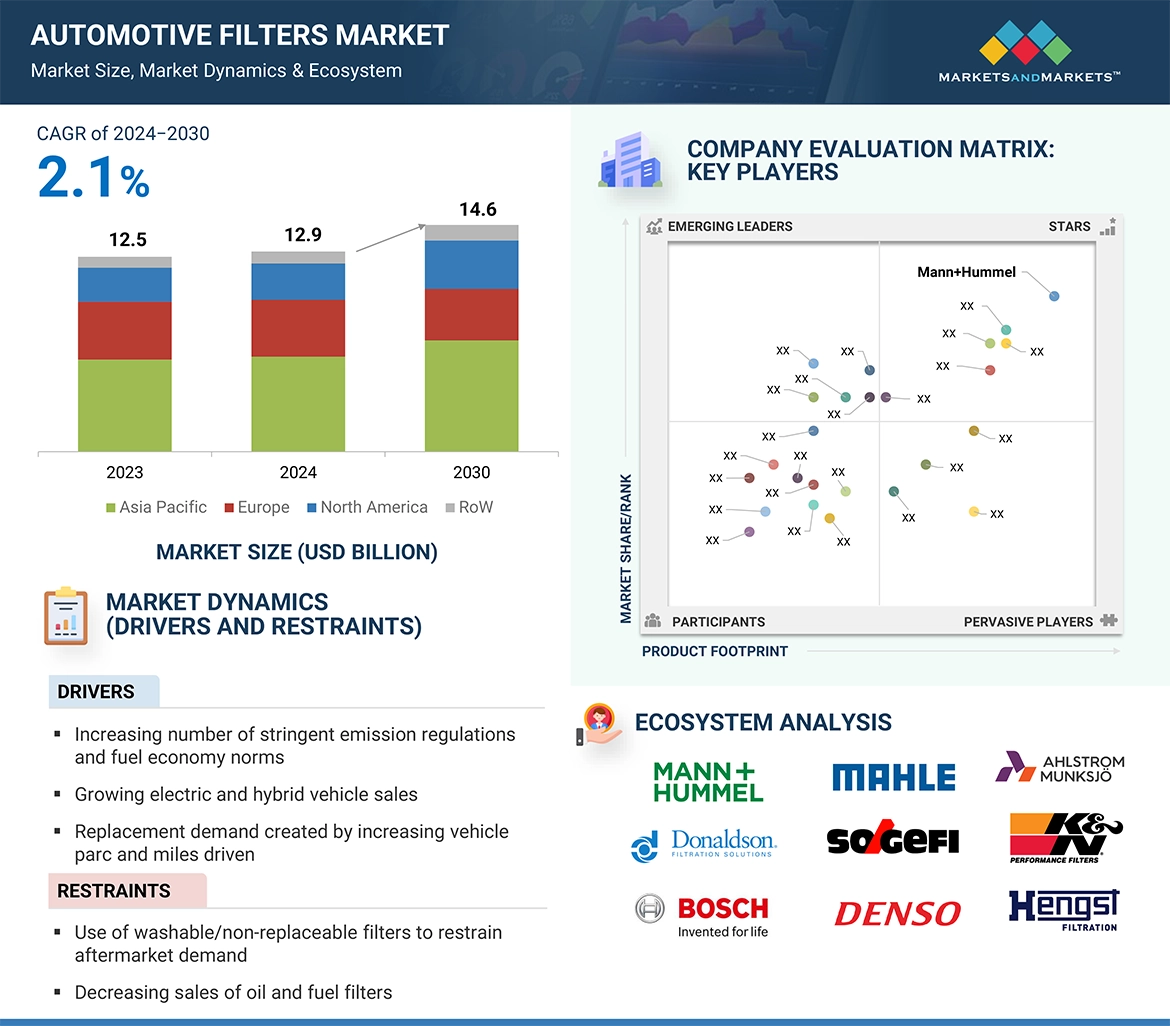
The global automotive filters market size is projected to grow from USD 12.9 billion in 2024 to USD 14.6 billion by 2030, at a CAGR of 2.1% during the forecast period. The automotive filter market's growth is primarily driven by technological advancements leading to more efficient filtration media and stringent emissions regulations necessitating adopting environmentally friendly solutions. Additionally, increasing vehicle production, rising demand for low-emission vehicles, and the expanding market for electric and hybrid vehicles contribute to the market's growth.

Attractive Opportunities in the Automotive Filters Market

ASIA-PACIFC

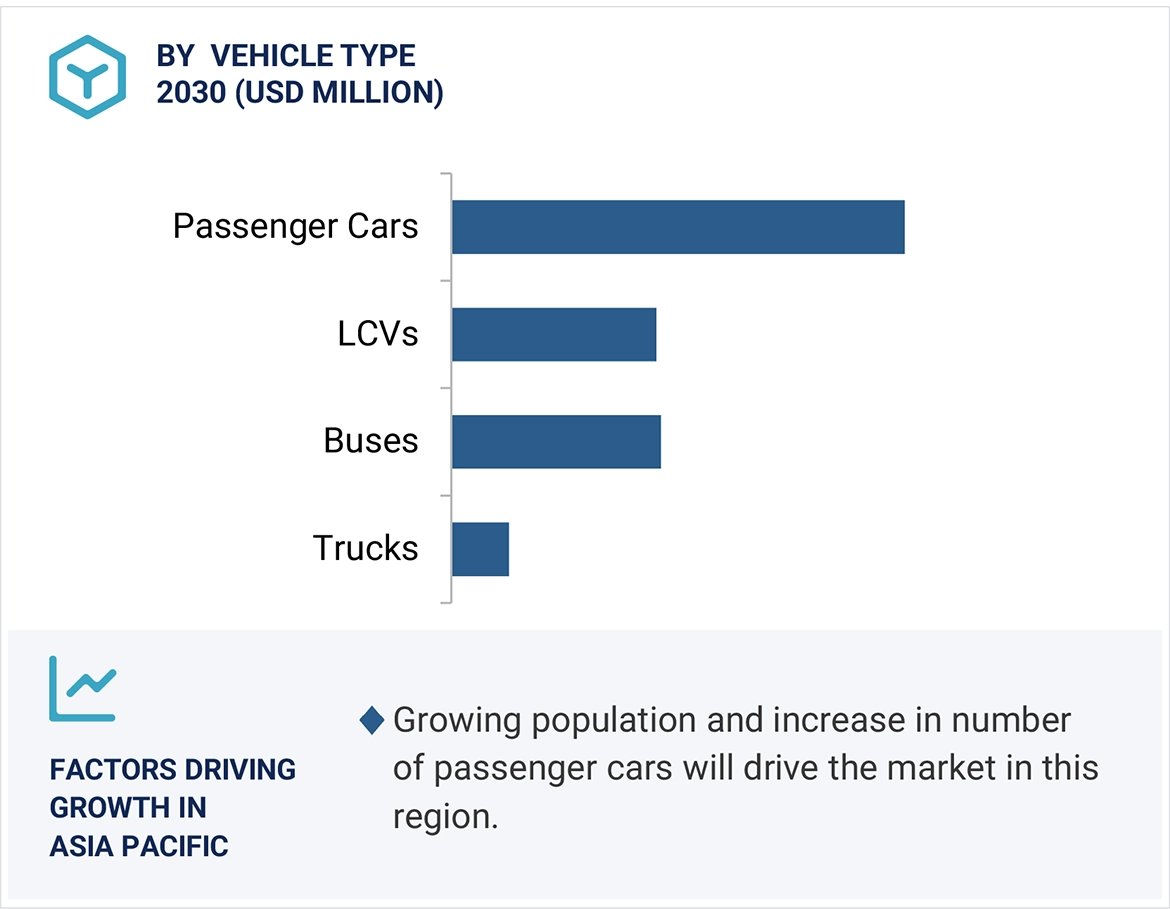
Market growth in the Asia Pacific can be attributed due to presence of major players of the global market, presence of leading automotive OEMS, demand for fuel efficient, increased vehicle production, higher vehicle sales, rising demand for luxury passenger cars, and a large customer base.

Passenger cars account for the maximum share of the automotive filters market. Rising sales of premium and luxury cars is expected to create the demand for synthetic air filters

The growth of this market can be attributed to the rise in advancement in filter media to vehicles optimize engine performance and efficiency.

Partnerships and innovative product launches would offer lucrative opportunities for market players in the next five years.

The growth of this market can be attributed to the rising demand for low emission vehicles, growing focus on electric vehicles.

Global Automotive Filters Market Dynamics

DRIVER: Replacement demand created by increasing vehicle parc and miles driven

The expansion of global vehicle fleets, propelled by improvements in road infrastructure and heightened vehicle sales, is set to increase the demand for automotive filters significantly. These essential components, including air, oil, and fuel filters, enhance engine performance and prolong vehicle lifespan. As vehicles accumulate mileage, these filters gradually accumulate contaminants, impairing their effectiveness and potentially jeopardizing engine functionality. Timely replacement of these filters is imperative, as failure to do so can lead to diminished vehicle performance and even mechanical breakdowns.In the passenger car segment, replacement intervals for essential filters typically align with OEM recommendations, necessitating annual replacement for air, oil, and fuel filters, with cabin filters requiring replacement biannually. Similarly, heavy commercial vehicles such as trucks and buses adhere to distinct replacement schedules, regularly replacing air filters. Given the projected growth in passenger and heavy commercial vehicle fleets, a robust aftermarket demand for automotive filters emerges. This escalating demand underscores the significance of filter manufacturers and suppliers in meeting the evolving needs of the automotive industry.

RESTRAINT: Surge in adoption of battery electric vehicles (BEVs)

The escalating adoption of Battery Electric Vehicles (BEVs), characterized by a 42% surge in sales in 2023 compared to 2022, is poised to significantly impact the automotive filter market. Unlike Internal Combustion Engine (ICE) vehicles, BEVs eliminate the necessity for oil and fuel filters due to the absence of an engine and combustion process. Furthermore, BEVs employ regenerative braking systems, reducing brake strain and potentially decreasing the demand for replacement air filters.The inherent design of BEVs, with fewer moving parts and the absence of combustion-generated contaminants, reduces maintenance requirements compared to ICE vehicles. Consequently, this translates into a diminished need for replacement filters. As BEVs continue to gain traction in the automotive market, their influence on reducing filter demand is anticipated to be a notable factor for businesses operating within the automotive filtration sector to consider.


OPPORTUNITY: Progress has occurred in filtration media technology.

A vehicle filter's media composition is crucial for ensuring optimal engine performance and reliability. Different types of media, such as cellulose, synthetic, glass fiber, and activated carbon, are utilized in automotive filters, with premium filters leveraging advanced media to gain a competitive edge. Technological innovations in filter media present significant opportunities for manufacturers in the automotive filtration sector.While cellulose media remains a cost-effective choice for most vehicle air intake filters, synthetic media is gaining traction due to its superior characteristics. Synthetic media offers advantages such as increased airflow, enhanced performance, and excellent water resistance, leading to improved combustion efficiency, fuel economy, and reduced emissions. Manufacturers like Mann+Hummel are developing synthetic ultra-fine fiber media to enhance filter lifespan and efficiency.Introducing innovative filter media solutions, such as Ahlstrom's Ahlstrom ECO, which incorporates renewable and sustainable materials like lignin-based impregnation, signifies a shift towards eco-friendly filtration technologies. These advancements maintain filter durability and contribute to environmental sustainability by reducing reliance on fossil-based resources. Such technological progressions are poised to drive growth within the automotive air filters market, presenting lucrative opportunities for manufacturers to capitalize on evolving consumer demands and regulatory requirements.

CHALLENGE: Fluctuating Raw Material Costs

Filters are manufactured using steel, aluminum, rubber, and synthetic fibers. These have experienced significant price fluctuations in recent years due to global economic conditions, geopolitical issues, and supply chain disruptions. When raw material costs surge, it becomes easier for filter manufacturers to maintain their profit margins. They are caught in a squeeze between rising input costs and the need to remain competitive in the global automotive filters market. To manage rising costs, some manufacturers might be tempted to reduce the quality of raw materials used in their filters.However, this can compromise the performance and durability of the filters, potentially leading to customer dissatisfaction and impacting brand reputation. The fluctuating costs of raw materials create a complex and challenging environment for automotive filter manufacturers. Manufacturers must adopt effective strategies, such as hedging, exploring alternative materials, and optimizing production processes.

Global Automotive Filters Market Ecosystem Analysis

The ecosystem analysis highlights various automotive filters market players, primarily representing OEMs, Tier 2 component suppliers, and Tier 1 integrators/su


“Diesel Particulate Filter (DPF) is expected to lead the Filter Type segment in ICE vehicles.

A significant reason for DPF growth is the increasing stringency of emission regulations worldwide. Governments are cracking down on harmful pollutants from vehicles and machinery, forcing manufacturers to adopt cleaner technologies like DPFs. The global brake dust particle filter market will grow from USD XX million in 2024 to USD XX million in 2030 at a CAGR of 5.4%. These filters capture and trap soot particles in diesel exhaust, significantly reducing air pollution. In the Asia Pacific region, DPF dominates the automotive diesel filters market. In 2022, China emerged as the leading market in the Asia-Pacific region for passenger car purchases, selling 23 million units.The Asia-Pacific region is experiencing significant economic growth, leading to a rise in commercial vehicle sales, including trucks and construction equipment. These vehicles often rely on diesel engines for their power and torque. DPFs become crucial for these vehicles to comply with emission standards. Euro 6 tightened emission regulations, including PM limits. It requires that DPF in most new diesel vehicles comply with the standards. Stricter PM limits in recent China standards, such as China 6, effectively push manufacturers towards using DPFs, especially for heavy-duty vehicles, to meet compliance. Rapid regional urbanization leads to increased traffic congestion and worsening air quality. Public awareness about the health impacts of air pollution is growing, making DPFs a desirable technology to reduce harmful particulate matter emissions from diesel vehicles. The surge in commercial vehicle sales in the Asia-Pacific region is poised to drive the growth of automotive filters due to the increasing demand for environmentally friendly filters.

Particle cabin filters are anticipated to dominate the cabin filter market in terms of material type.

Particle cabin filters are projected to emerge as the leading segment within the automotive cabin filter market, primarily due to their cost-effectiveness compared to activated carbon and electrostatic filters and their above-average performance. These filters feature a low-cost barrier made of entirely synthetic non-woven fabric, offering distinct advantages such as resistance to deformation caused by water due to the non-hygroscopic nature of synthetic fibers. Consequently, this is anticipated to fuel steady growth in the particle filter market in the foreseeable future.Furthermore, there is a burgeoning demand for air-conditioned cabins in heavy trucks in Europe and North America, primarily driven by government regulations. Notably, the European Commission has mandated the adoption of cabin air conditioning in all heavy commercial trucks, a directive echoed by the Indian government, albeit yet to be fully realized commercially. This regulatory push, coupled with major commercial vehicle manufacturers' installation of air conditioning systems in heavy trucks and buses, is expected to propel the particle automotive cabin air filter market within the heavy vehicles segment

ASIA-PACIFIC region holds the largest share of the Automotive Filters Market.

The Asia Pacific region holds the largest automotive filter market share. China accounts for the largest share owing to shifting consumer preferences, increasing per capita income of the middle-class population, and cost advantages that have led OEMs to increase vehicle production in the region. Thus, strong demand has been noticed in China, India, and Japan, accelerating the automotive filter market growth.


Recent Developments of Automotive Filters Market industry

  • In January 2024, Robert Bosch GmbH launched the FILTER+pro, a cabin filter that ensures the prevention of viruses and mold growth. Its antimicrobial filter layer is finely tuned to effectively combat bacteria, pollen, and allergens. The carbon layer eliminates odors and harmful gases like ozone or smog, while the ultrafine microfiber layer filters out over 98% of particulate matter sized 2.5 micrometers or more significantly. In August 2023, Donaldson partnered with NAPA Auto Parts stores (US). Donaldson Corporation will provide the NAPA United States network with a comprehensive range of heavy-duty air filtration products under the NAPA Gold product line. In April 2022, MANN+HUMMEL developed a cutting-edge filter medium named MULTIGRADE F-MB 2000, providing 99.95 percent separation efficiency for particles sized down to four micrometers. These particles are up to 18 times smaller than the width of a human hair. This filter medium is utilized in the MANN-FILTER WK 11 051 fuel filter, which retains 9,995 out of 10,000 flowing particles.
  • In October 2023, MANN+HUMMEL Group finalized its acquisition of a majority share in Suzhou U-Air Environmental Technology ("U-Air"), emphasizing its dedication to fulfilling the increasing worldwide need for cleaner air solutions. This strategic decision further solidifies MANN+HUMMEL's presence in China and Southeast Asia's expanding air filtration market. In August 2023, Donaldson partnered with NAPA Auto Parts stores (US). Donaldson Corporation will provide the NAPA United States network with a comprehensive range of heavy-duty air filtration products under the NAPA Gold product line In April 2023, Ahlstrom launched eco-friendly filtration solutions tailored for automotive use. This newly developed renewable and sustainable filter media, created by Ahlstrom, employs lignin-based impregnation, substituting fossil-based resin. The resin formula incorporates a notable portion of bio-based, renewable lignin, ensuring that the mechanical attributes and resilience of the filter media remain intact, even in demanding conditions.

Key Market Players

Scope of the Report

Report Attribute Details
Market size available for years 2019–2030
Base year considered 2023
Forecast period 2024–2030
Forecast units Volume (Units) and Value (USD Million)
Segments Covered By Filter Type (ICE), Vehicle Type (ICE), Fuel filters by fuel type (ICE), Air filter by Media type (ICE), Cabin filter by Material type (ICE), Electric & Hybrid vehicle filter by filter type, by Electric and Hybrid Vehicle Type, Aftermarket by filter type (ICE), off-highway by equipment type (ICE), Off-highway by filter type (ICE), and Region
Geographies covered Asia Pacific, North America, Europe, and RoW
Companies covered Mann+Hummel (Germany), Donaldson Company, Inc. (US), MAHLE GmbH (Germany), Robert Bosch GmbH (Germany), Sogefi S.p.A (Italy), Denso Corporation (Japan), Ahlstrom-Munksjö (Finland), Toyota Boshoku Corporation (Japan), Cummins Inc. (Indiana), and Parker Hannifin Corporation (US)


Key Questions Addressed by the Report

What is the current size of the global automotive filter market?
The global automotive filters market is projected to grow from USD 12.9 billion in 2024 to USD 14.6 billion by 2030, at a CAGR of 2.1% during the forecast period.
Which filter type is currently leading the global automotive filter market?
Diesel Particulate Filters are leading in the global automotive filters market.
Who are the key players in the global automotive filters market, and what strategies have they adopted?
Major companies include MANN+HUMMEL (Germany), Donaldson Corporation (US), Robert Bosch GmbH (Germany), Denso Corporation (Japan), Parker Hannifin (US), Sogefi S.p.A (Italy), Cummins Inc. (US), MAHLE GmbH (Germany), Toyota Boshoku (Japan), and AHLSTROM-MUNKSJO (Sweden). They have adopted strategies like new product launches, partnerships, and joint ventures.
Which cabin filter holds the largest market share?
Particle Cabin Filters hold the largest market share in the automotive filters market.
How does the demand for the global automotive filter market vary by region?
The Asia Pacific region is expected to lead the automotive filters market with a CAGR of 2.7%. The demand is driven by the need for low-emission vehicles and strict emission regulations, making this region the largest market, projected at USD 7.1 billion by 2030.


Personalize This Research

  • Triangulate with your Own Data
  • Get Data as per your Format and Definition
  • Gain a Deeper Dive on a Specific Application, Geography, Customer or Competitor
  • Any level of Personalization
Request A Free Customisation

Let Us Help You

  • What are the Known and Unknown Adjacencies Impacting the Automotive Filters Market
  • What will your New Revenue Sources be?
  • Who will be your Top Customer; what will make them switch?
  • Defend your Market Share or Win Competitors
  • Get a Scorecard for Target Partners
Customized Workshop Request

Table of Contents

Exclusive indicates content/data unique to MarketsandMarkets and not available with any competitors.

TITLE
PAGE NO
1
INTRODUCTION


15
2
EXECUTIVE SUMMARY


3
PREMIUM INSIGHTS


4
MARKET OVERVIEW
Provides a snapshot of current market scenario, value chain context, and factors impacting competitive intensity.


4.1
INTRODUCTION


4.2
MARKET DYNAMICS


4.2.1
DRIVERS


4.2.1.1
INCREASING NUMBER OF STRINGENT EMISSION REGULATIONS AND FUEL ECONOMY NORMS


4.2.1.2
GROWING ELECTRIC AND HYBRID VEHICLE SALES


4.2.1.3
REPLACEMENT DEMAND CREATED BY INCREASING VEHICLE PARC AND MILES DRIVEN


4.2.2
RESTRAINTS


4.2.2.1
USE OF WASHABLE/NON-REPLACEABLE FILTERS TO RESTRAIN AFTERMARKET DEMAND


4.2.2.2
DECREASING SALES OF OIL AND FUEL FILTERS


4.2.3
OPPORTUNITIES


4.2.3.1
ADVANCEMENTS IN FILTRATION MEDIA TECHNOLOGY


4.2.4
CHALLENGES


4.2.4.1
AVAILABILITY OF LOCAL PRODUCTS TO HINDER DEMAND FOR OE FILTERS


4.2.4.2
FLUCTUATING RAW MATERIAL COSTS


4.3
UNMET NEEDS AND WHITE SPACES


4.4
INTERCONNECTED MARKETS AND CROSS-SECTOR OPPORTUNITIES


4.5
STRATEGIC MOVES BY TIER-1/2/3 PLAYERS


5
INDUSTRY TRENDS
Outlines emerging trends, technology impact, and regulatory signals affecting growth trajectory and stakeholder decisions.


5.1
MACROECONOMIC OUTLOOK


5.1.1
INTRODUCTION


5.1.2
GDP TRENDS AND FORECAST


5.1.3
TRENDS IN THE GLOBAL AUTOMOTIVE & TRANSPORTATION INDUSTRY


5.2
SUPPLY CHAIN ANALYSIS


5.3
ECOSYSTEM ANALYSIS


5.4
PRICING ANALYSIS


5.4.1
AVERAGE SELLING PRICE TREND, BY FILTER TYPE (2022-2025)


5.4.2
AVERAGE SELLING PRICE TREND, BY REGION (2022-2025)


5.5
TRADE ANALYSIS


5.5.1
IMPORT SCENARIO (HS CODE 842123)


5.5.2
EXPORT SCENARIO (HS CODE 842123)


5.6
KEY CONFERENCES AND EVENTS, 2025–2026


5.7
TRENDS/DISRUPTIONS IMPACTING CUSTOMER BUSINESS


5.8
INVESTMENT AND FUNDING SCENARIO


5.9
FUNDING BY USE CASE APPLICATION


5.10
CASE STUDY ANALYSIS


5.11
BILL OF MATERIALS


5.12
TOTAL COST OF OWNERSHIP


5.13
IMPACT OF 2025 US TARIFF – AUTOMOTIVE FILTERS MARKET


5.13.1
INTRODUCTION


5.13.2
KEY TARIFF RATES


5.13.3
PRICE IMPACT ANALYSIS


5.13.4
IMPACT ON COUNTRIES/REGIONS


5.13.4.1
US


5.13.4.2
EUROPE


5.13.4.3
APAC


5.13.5
IMPACT ON THE AUTOMOTIVE INDUSTRY


6
TECHNOLOGICAL ADVANCEMENTS, AI-DRIVEN IMPACT, PATENTS, INNOVATIONS, AND FUTURE STRATEGIC APPLICATIONS


6.1
TECHNOLOGY ANALYSIS


6.1.1
KEY TECHNOLOGIES


6.1.2
COMPLEMENTARY TECHNOLOGIES


6.1.3
ADJACENT TECHNOLOGIES


6.2
TECHNOLOGY/PRODUCT ROADMAP


6.3
PATENT ANALYSIS


6.4
FUTURE APPLICATIONS


6.5
IMPACT OF AI/GEN AI ON THE AUTOMOTIVE FILTERS MARKET


6.5.1
TOP USE CASES AND MARKET POTENTIAL


6.5.2
BEST PRACTICES IN ELECTRIC VEHICLE DEVELOPMENT


6.5.3
CASE STUDIES OF AI IMPLEMENTATION IN THE AUTOMOTIVE FILTERS MARKET


6.5.4
INTERCONNECTED ADJACENT ECOSYSTEM AND IMPACT ON MARKET PLAYERS


6.5.5
CLIENTS’ READINESS TO ADOPT GENERATIVE AI IN THE AUTOMOTIVE FILTERS MARKET


6.5
SUCCESS STORIES AND REAL-WORLD APPLICATIONS


7
REGULATORY LANDSCAPE


7.1
REGIONAL REGULATIONS AND COMPLIANCE


7.1.1
REGULATORY BODIES, GOVERNMENT AGENCIES, AND OTHER ORGANIZATIONS


7.1.2
FILTRATION STANDARDS


7.1.3
EMISSION REGULATIONS


7.1.3.1
ON-ROAD VEHICLE EMISSION REGULATIONS


7.1.3.2
OFF-ROAD VEHICLE EMISSION REGULATIONS
 
 
8
CUSTOMER LANDSCAPE & BUYER BEHAVIOR


8.1
DECISION-MAKING PROCESS


8.2
BUYER STAKEHOLDERS AND BUYING EVALUATION CRITERIA


8.3
ADOPTION BARRIERS & INTERNAL CHALLENGES


8.4
UNMET NEEDS FROM VARIOUS END-USE INDUSTRIES


8.5
MARKET PROFITABILITY


9
AUTOMOTIVE FILTERS MARKET, BY FILTER TYPE (MARKET SIZE & FORECAST TO 2032 – IN VALUE, USD THOUSAND & VOLUME)


COMPARATIVE ASSESSMENT OF KEY AUTOMOTIVE FILTER TYPES, THEIR MARKET POTENTIAL, AND DEMAND PATTERNS BY VARIOUS SUPPLIER COMPANIES
Market Size, Volume & Forecast – USD Million


9.1
INTRODUCTION


9.2
AIR


9.2.1
INCREASING DEMAND FOR PASSENGER AND COMMERCIAL VEHICLES TO DRIVE THE MARKET


9.3
FUEL


9.3.1
INCREASING STRINGENT EMISSION NORMS AND ADVANCEMENT IN FILTRATION MEDIA TO DRIVE THE MARKET


9.4
OIL


9.4.1
INCREASING THE ENGINE SIZE OF HEAVY TRUCKS AND SUVS TO DRIVE THE MARKET


9.5
CABIN


9.5.1
RISING AWARENESS ABOUT IN-CABIN AIR QUALITY TO DRIVE THE MARKET


9.6
BRAKE DUST


9.6.1
GROWING AWARENESS ABOUT POLLUTION CAUSED BY DISC BRAKES TO DRIVE THE MARKET


9.7
TRANSMISSION OIL


9.7.1
RISING ADOPTION OF AUTOMATIC, CONTINUOUS VARIABLE, AND DUAL-CLUTCH TRANSMISSION SYSTEMS TO DRIVE THE MARKET


9.8
COOLANT


9.8.1
RISING NUMBER OF HEAVY-DUTY VEHICLES WITH LARGER ENGINE CAPACITY TO DRIVE THE MARKET


9.9
OIL SEPARATOR


9.9.1
INCREASING DEMAND FOR LUXURY AND PREMIUM CARS TO DRIVE THE MARKET


9.10
STEERING


9.10.1
INCREASING DEMAND FOR SUVS AND HEAVY-DUTY VEHICLES WITH HYDRAULIC POWER STEERING TO DRIVE THE MARKET


9.11
UREA


9.11.1
STRINGENT EMISSION NORMS RELATED TO CO2 AND NOX TO DRIVE MARKET


9.12
DIESEL PARTICULATE FILTER (DPF)


9.12.1
INSTALLATION OF DPF IN ALL DIESEL VEHICLES ACROSS EUROPE AND NORTH AMERICA TO DRIVE THE MARKET


9.13
GASOLINE PARTICULATE FILTER (GPF)


9.13.1
ENGINE DOWNSIZING TREND TO DRIVE MARKET


9.14
CRANKCASE VENTILATION


9.14.1
RISING DEMAND FOR HEAVY-DUTY TRUCKS AND BUSES TO DRIVE THE MARKET


9.15
KEY PRIMARY INSIGHTS


10
AUTOMOTIVE AIR FILTERS MARKET, BY MEDIA TYPE (MARKET SIZE & FORECAST TO 2032 – IN VALUE, USD THOUSAND & VOLUME)


VEHICLE-WISE DEMAND POTENTIAL AND GROWTH PATHWAYS SHAPING AUTOMOTIVE FILTERS ADOPTION IN DIVERSE INDUSTRIES


10.1
INTRODUCTION


10.2
CELLULOSE MEDIA


10.2.1
COST-EFFECTIVENESS TO DRIVE MARKET


10.3
SYNTHETIC MEDIA


10.3.1
INCREASING DEMAND FOR PREMIUM VEHICLES TO DRIVE THE MARKET


10.4
KEY PRIMARY INSIGHTS


11
AUTOMOTIVE CABIN FILTERS MARKET, BY MATERIAL TYPE (MARKET SIZE & FORECAST TO 2032 – IN VALUE, USD THOUSAND & VOLUME)


SYSTEM-WISE DEMAND POTENTIAL AND GROWTH PATHWAYS SHAPING AUTOMOTIVE FILTERS ADOPTION IN DIVERSE INDUSTRIES


11.1
INTRODUCTION


11.2
PARTICLE CABIN FILTERS


11.2.1
COST-EFFECTIVENESS AND BETTER PERFORMANCE TO DRIVE THE MARKET


11.3
ACTIVATED CARBON CABIN FILTERS


11.3.1
RISING DEMAND FOR MID-RANGE AND ECONOMY CARS IN EMERGING ECONOMIES TO DRIVE THE MARKET


11.4
ELECTROSTATIC CABIN FILTERS


11.4.1
GROWING SALES OF PREMIUM AND LUXURY VEHICLES TO DRIVE THE MARKET


11.5
KEY PRIMARY INSIGHTS


12
AUTOMOTIVE FUEL FILTERS MARKET, BY FUEL TYPE (MARKET SIZE & FORECAST TO 2032 – IN VALUE, USD THOUSAND & VOLUME)


SECTOR-SPECIFIC ADOPTION DRIVERS, DEMAND DYNAMICS, AND MARKET POTENTIAL ACROSS EACH ACTUATION


12.1
INTRODUCTION


12.2
GASOLINE


12.2.1
INCREASING SALES OF GASOLINE-FUELED VEHICLES COMPARED TO DIESEL-POWERED VEHICLES TO DRIVE THE MARKET


12.3
DIESEL


12.3.1
STRINGENT EMISSION NORMS ON DIESEL ENGINES TO REDUCE DEMAND


12.4
KEY PRIMARY INSIGHTS


13
OFF-HIGHWAY VEHICLE FILTERS MARKET, BY EQUIPMENT TYPE (MARKET SIZE & FORECAST TO 2032 – IN VALUE, USD THOUSAND & VOLUME)


SECTOR-SPECIFIC ADOPTION DRIVERS, DEMAND DYNAMICS, AND MARKET POTENTIAL ACROSS EACH COMPONENT


13.1
INTRODUCTION


13.2
AGRICULTURAL TRACTOR


13.2.1
ADOPTION OF MECHANIZED FARMING TO DRIVE THE MARKET


13.3
CONSTRUCTION EQUIPMENT


13.3.1
INCREASED CONSTRUCTION ACTIVITIES AND INDUSTRIAL DEVELOPMENTS TO DRIVE THE MARKET


13.4
KEY PRIMARY INSIGHTS


14
AUTOMOTIVE FILTERS MARKET (ICE), BY VEHICLE TYPE (MARKET SIZE & FORECAST TO 2032 – IN VALUE, USD THOUSAND & VOLUME)


SECTOR-SPECIFIC ADOPTION DRIVERS, DEMAND DYNAMICS, AND MARKET POTENTIAL ACROSS EACH COMPONENT


14.1
INTRODUCTION


14.2
PASSENGER CAR


14.2.1
NEED FOR FUEL EFFICIENCY TO DRIVE THE MARKET


14.3
LIGHT COMMERCIAL VEHICLE (LCV)


14.3.1
HIGH DEMAND IN NORTH AMERICA TO DRIVE THE MARKET


14.4
TRUCK


14.4.1
GROWTH OF LARGE-SCALE INDUSTRIES TO DRIVE THE MARKET


14.5
BUS


14.5.1
HIGH DEPENDENCY ON PUBLIC TRANSPORT TO DRIVE THE MARKET


14.6
KEY PRIMARY INSIGHTS


15
ELECTRIC & HYBRID VEHICLE FILTERS MARKET (OE),


BY VEHICLE TYPE (MARKET SIZE & FORECAST TO 2032 – IN VALUE, USD THOUSAND & VOLUME)


SECTOR-SPECIFIC ADOPTION DRIVERS, DEMAND DYNAMICS, AND MARKET POTENTIAL ACROSS EACH COMPONENT


15.1
INTRODUCTION


15.2
BATTERY ELECTRIC VEHICLE (BEV)


15.2.1
GOVERNMENT SUBSIDIES AND INVESTMENTS IN CHARGING INFRASTRUCTURE TO DRIVE THE MARKET


15.3
PLUG-IN HYBRID ELECTRIC VEHICLE (PHEV)


15.3.1
BENEFITS OF THE HIGHER RANGE TO DRIVE THE MARKET


15.4
KEY PRIMARY INSIGHTS


16
AUTOMOTIVE FILTERS AFTERMARKET (ICE), BY FILTER TYPE (MARKET SIZE & FORECAST TO 2032 – IN VALUE, USD THOUSAND & VOLUME)


COMPARATIVE ASSESSMENT OF KEY AUTOMOTIVE FILTER TYPES, THEIR MARKET POTENTIAL, AND DEMAND PATTERNS BY VARIOUS SUPPLIER COMPANIES


16.1
INTRODUCTION


16.2
OIL


16.2.1
INCREASING PROPORTION OF PASSENGER AND COMMERCIAL VEHICLES IN EMERGING ECONOMIES TO DRIVE THE MARKET


16.3
FUEL


16.3.1
INCREASING DEMAND FOR GASOLINE FUEL FILTERS TO DRIVE THE MARKET


16.4
AIR


16.4.1
RISING DEMAND FOR MID & FULL-SIZE VEHICLES TO DRIVE MARKET


16.5
CABIN


16.5.1
RISING DEMAND FOR IN-CABIN COMFORT TO DRIVE THE MARKET


16.6
TRANSMISSION OIL


16.6.1
GROWING PREMIUM VEHICLE PARC TO DRIVE MARKET


16.7
COOLANT


16.7.1
INCREASING CITY TRAFFIC AND LONG-DISTANCE TRAVEL TO DRIVE THE MARKET


16.8
KEY PRIMARY INSIGHTS


17
ELECTRIC & HYBRID VEHICLE FILTERS MARKET (OE),


BY FILTER TYPE (MARKET SIZE & FORECAST TO 2032 – IN VALUE, USD THOUSAND & VOLUME)


COMPARATIVE ASSESSMENT OF KEY AUTOMOTIVE FILTER TYPES, THEIR MARKET POTENTIAL, AND DEMAND PATTERNS BY VARIOUS SUPPLIER COMPANIES


17.1
INTRODUCTION


17.2
AIR


17.2.1
RISING SALES OF PHEVS TO DRIVE THE MARKET


17.3
FUEL


17.3.1
GROWING SALES OF PHEVS AND STRINGENT EMISSION NORMS TO DRIVE THE MARKET


17.4
OIL


17.4.1
EXCLUSIVE BLEND OF NATURAL AND SYNTHETIC MATERIALS IN ENGINE OIL FILTERS TO DRIVE THE MARKET


17.5
CABIN


17.5.1
RISING PREMIUM VEHICLE RANGE WITH ENHANCED IN-CABIN AMBIANCE TO DRIVE MARKET


17.6
BRAKE DUST


17.6.1
EXPECTED INTRODUCTION OF BRAKE DUST FILTERS BY AUDI AND BMW TO DRIVE THE MARKET


17.7
TRANSMISSION OIL


17.7.1
INCREASING DEMAND FOR ELECTRIC & HYBRID VEHICLES IN AUTOMATIC, CVT, AND DCT TRANSMISSIONS TO DRIVE THE MARKET


17.8
EMI/EMC


17.8.1
GROWING DEMAND FOR EFFICIENT PERFORMANCE OF POWER ELECTRONICS IN VEHICLES TO DRIVE THE MARKET


17.9
COOLING AIR PARTICLE


17.9.1
GROWING DEMAND FOR EFFICIENT BATTERY PERFORMANCE TO DRIVE THE MARKET


17.10
KEY PRIMARY INSIGHTS


18
OFF-HIGHWAY VEHICLE FILTERS MARKET (OE), BY FILTER TYPE (MARKET SIZE & FORECAST TO 2032 – IN VALUE, USD THOUSAND & VOLUME)


COMPARATIVE ASSESSMENT OF KEY FILTER TYPES, THEIR MARKET POTENTIAL, AND DEMAND PATTERNS BY VARIOUS SUPPLIER COMPANIES
Market Size, Volume & Forecast – USD Million


18.1
INTRODUCTION


18.2
AIR


18.2.1
R&D INVESTMENTS TO IMPROVE AIR FILTRATION TECHNOLOGY TO DRIVE THE MARKET


18.3
FUEL


18.3.1
GROWING RESIDENTIAL, COMMERCIAL, HIGHWAY, AND DAM CONSTRUCTION ACTIVITIES TO DRIVE THE MARKET


18.4
OIL


18.4.1
INCREASING DEMAND FOR HEAVY EQUIPMENT DUE TO RISING INFRASTRUCTURAL DEVELOPMENTS IN EMERGING ECONOMIES


TO DRIVE THE MARKET


18.5
CABIN


18.5.1
HIGH ADOPTION RATE OF SMALL-SIZED TRACTORS IN THE ASIA PACIFIC AND NORTH AMERICA TO DRIVE THE MARKET


18.6
TRANSMISSION OIL


18.6.1
GROWING TRACTION OF POWER-SHIFT AND AUTOMATIC TRANSMISSION TECHNOLOGY TO DRIVE THE MARKET


18.7
KEY PRIMARY INSIGHTS


19
AUTOMOTIVE FILTERS MARKET, BY REGION (MARKET SIZE & FORECAST TO 2032 – IN VALUE, USD THOUSAND & VOLUME)


ASSESSING GROWTH PATTERNS, INDUSTRY FORCES, REGULATORY LANDSCAPE, AND MARKET POTENTIAL ACROSS KEY GEOGRAPHIES AND COUNTRIES


19.1
INTRODUCTION


19.2
ASIA PACIFIC


19.2.1
CHINA


19.2.1.1
RISING PASSENGER VEHICLE DEMAND TO DRIVE THE MARKET


19.2.2
JAPAN


19.2.2.1
GROWING USE OF TECHNOLOGICALLY ADVANCED FILTRATION SOLUTIONS TO DRIVE THE MARKET


19.2.3
SOUTH KOREA


19.2.3.1
INCREASING DEMAND FOR LUXURY CARS TO DRIVE THE MARKET


19.2.4
INDIA


19.2.4.1
GROWTH IN VEHICLE SALES TO DRIVE THE MARKET


19.2.5
THAILAND


19.2.5.1
GROWING DEMAND FOR AUTOMOTIVE COMPONENTS TO DRIVE THE MARKET


19.2.6
REST OF ASIA PACIFIC


19.2.6.1
DEVELOPING COUNTRIES WITH RISING DISPOSABLE INCOME


19.3
EUROPE


19.3.1
GERMANY


19.3.1.1
HIGH DEMAND FOR PREMIUM CARS TO DRIVE THE MARKET


19.3.2
FRANCE


19.3.2.1
INCREASE IN PRODUCTION OF HIGH-END VEHICLES TO DRIVE THE MARKET


19.3.3
ITALY


19.3.3.1
PRESENCE OF A WELL-ESTABLISHED LUXURY CAR MARKET TO DRIVE THE MARKET


19.3.4
SPAIN


19.3.4.1
INCREASING PRODUCTION OF PASSENGER CARS TO DRIVE THE MARKET


19.3.5
UK


19.3.5.1
RISING SALES OF PREMIUM VEHICLES TO DRIVE THE MARKET


19.3.6
TURKEY


19.3.6.1
RISING FOCUS ON EXPORTS TO DRIVE MARKET


19.3.7
RUSSIA


19.3.7.1
INCREASING SALES OF PASSENGER CARS TO DRIVE THE MARKET


19.3.8
REST OF EUROPE


19.3.8.1
ROBUST GROWTH IN PRODUCTION CAPACITIES


19.4
NORTH AMERICA


19.4.1
US


19.4.1.1
INCREASING PRODUCTION OF SUVS TO DRIVE THE MARKET


19.4.2
CANADA


19.4.2.1
RISING GOVERNMENT REGULATIONS TO DRIVE THE MARKET


19.4.3
MEXICO


19.4.3.1
GROWING DEMAND FOR ADVANCED FILTRATION TECHNOLOGY TO DRIVE THE MARKET


19.5
REST OF THE WORLD


19.5.1
IRAN


19.5.1.1
HEAVY INVESTMENTS IN THE AUTOMOTIVE SECTOR TO DRIVE THE MARKET


19.5.2
BRAZIL


19.5.2.1
PRESENCE OF MAJOR AUTOMOTIVE COMPANIES TO DRIVE THE MARKET


19.5.3
OTHERS


19.5.3.1
GROWING DEMAND FOR ADVANCED FILTRATION TECHNOLOGY TO DRIVE THE MARKET
 
 
20
COMPETITIVE LANDSCAPE


STRATEGIC ASSESSMENT OF LEADING PLAYERS, MARKET RANKING/SHARE, REVENUE ANALYSIS, COMPANY POSITIONING, AND COMPETITIVE BENCHMARKS INFLUENCING MARKET POTENTIAL


20.1
OVERVIEW


20.2
KEY PLAYER COMPETITIVE STRATEGIES/ RIGHT TO WIN


20.3
REVENUE ANALYSIS (2022-2024)


20.4
MARKET SHARE ANALYSIS,


20.5
BRAND COMPARISON


20.6
COMPANY EVALUATION MATRIX: KEY PLAYERS,


20.6.1
STARS


20.6.2
EMERGING LEADERS


20.6.3
PERVASIVE PLAYERS


20.6.4
PARTICIPANTS


20.6.5
COMPANY FOOTPRINT: KEY PLAYERS,


20.6.5.1
COMPANY FOOTPRINT


20.6.5.2
REGION FOOTPRINT


20.6.5.3
TYPE FOOTPRINT


20.7
COMPANY EVALUATION MATRIX (ELECTRIC & HYBRID VEHICLE FILTER MANUFACTURERS): KEY PLAYERS,


20.7.1
STARS


20.7.2
EMERGING LEADERS


20.7.3
PERVASIVE PLAYERS


20.7.4
PARTICIPANTS


20.7.5
COMPANY FOOTPRINT: KEY PLAYERS,


20.8
COMPANY VALUATION AND FINANCIAL METRICS


20.9
SUPPLIER ANALYSIS


20.10
COMPETITIVE SCENARIO


20.10.1
PRODUCT LAUNCHES


20.10.2
DEALS


20.10.3
EXPANSION


21
COMPANY PROFILES


IN-DEPTH REVIEW OF COMPANIES, PRODUCTS, RECENT INITIATIVES, AND POSITIONING STRATEGIES IN THE AUTOMOTIVE FILTERS MARKET LANDSCAPE


21.1
KEY PLAYERS


21.1.1
MANN+HUMMEL


21.1.1.1
BUSINESS OVERVIEW


21.1.1.2
PRODUCTS/SOLUTIONS/SERVICES OFFERED


21.1.1.3
MNM VIEW


21.1.1.3.1
KEY STRENGTHS/RIGHT TO WIN


21.1.1.3.2
STRATEGIC CHOICES


21.1.1.3.3
WEAKNESSES/COMPETITIVE THREATS


21.1.2
DONALDSON COMPANY, INC.


21.1.2.1
BUSINESS OVERVIEW


21.1.2.2
PRODUCTS/SOLUTIONS/SERVICES OFFERED


21.1.2.3
RECENT DEVELOPMENTS


21.1.2.4
PRODUCT LAUNCHES


21.1.2.5
MNM VIEW


21.1.2.5.1
KEY STRENGTHS/RIGHT TO WIN


21.1.2.5.2
STRATEGIC CHOICES


21.1.2.5.3
WEAKNESSES/COMPETITIVE THREATS


21.1.3
ROBERT BOSCH GMBH


21.1.3.1
BUSINESS OVERVIEW


21.1.3.2
PRODUCTS/SOLUTIONS/SERVICES OFFERED


21.1.3.3
RECENT DEVELOPMENTS


21.1.3.3.1
PRODUCT LAUNCHES


21.1.3.4
MNM VIEW


21.1.3.4.1
KEY STRENGTHS/RIGHT TO WIN


21.1.3.4.2
STRATEGIC CHOICES


21.1.3.4.3
WEAKNESSES/COMPETITIVE THREATS


21.1.4
MAHLE GMBH


21.1.4.1
BUSINESS OVERVIEW


21.1.4.2
PRODUCTS/SOLUTIONS/SERVICES OFFERED


21.1.4.3
RECENT DEVELOPMENTS


21.1.4.3.1
PRODUCT LAUNCHES


21.1.4.4
MNM VIEW


21.1.4.4.1
KEY STRENGTHS/RIGHT TO WIN


21.1.4.4.2
STRATEGIC CHOICES


21.1.4.4.3
WEAKNESSES/COMPETITIVE THREATS


21.1.5
SOGEFI SPA


21.1.5.1
BUSINESS OVERVIEW


21.1.5.2
PRODUCTS/SOLUTIONS/SERVICES OFFERED


21.1.5.3
RECENT DEVELOPMENTS


21.1.5.3.1
PRODUCT LAUNCHES


21.1.5.4
MNM VIEW


21.1.5.4.1
KEY STRENGTHS/RIGHT TO WIN


21.1.5.4.2
STRATEGIC CHOICES


21.1.5.4.3
WEAKNESSES/COMPETITIVE THREATS


21.1.6
DENSO CORPORATION


21.1.6.1
BUSINESS OVERVIEW


21.1.6.2
PRODUCTS/SOLUTIONS/SERVICES OFFERED


21.1.6.3
RECENT DEVELOPMENTS


21.1.6.3.1
PRODUCT LAUNCHES


21.1.7
AHLSTROM


21.1.7.1
BUSINESS OVERVIEW


21.1.7.2
PRODUCTS/SOLUTIONS/SERVICES OFFERED


21.1.7.3
RECENT DEVELOPMENTS


21.1.7.3.1
PRODUCT LAUNCHES


21.1.8
TOYOTA BOSHOKU CORPORATION


21.1.8.1
BUSINESS OVERVIEW


21.1.8.2
PRODUCTS/SOLUTIONS/SERVICES OFFERED


21.1.8.3
RECENT DEVELOPMENTS


21.1.8.3.1
PRODUCT LAUNCHES


21.1.9
PARKER HANNIFIN


21.1.9.1
BUSINESS OVERVIEW


21.1.9.2
PRODUCTS/SOLUTIONS/SERVICES OFFERED


21.1.9.3
RECENT DEVELOPMENTS


21.1.9.3.1
PRODUCT LAUNCHES


21.1.10
CUMMINS INC.


21.1.10.1
BUSINESS OVERVIEW


21.1.10.2
PRODUCTS/SOLUTIONS/SERVICES OFFERED


21.1.10.3
RECENT DEVELOPMENTS


21.1.10.3.1
PRODUCT LAUNCHES


21.1.11
ADR GROUP


21.1.11.1
BUSINESS OVERVIEW


21.1.11.2
PRODUCTS/SOLUTIONS/SERVICES OFFERED


21.1.11.3
RECENT DEVELOPMENTS


21.1.11.3.1
PRODUCT LAUNCHES
 
 
21.2
OTHER KEY PLAYERS


21.2.1
LUCAS TVS LIMITED


21.2.2
HENGST SE


21.2.3
K&N ENGINEERING, INC.


21.2.4
ACDELCO


21.2.5
DALE FILTER SYSTEMS


21.2.6
FREUDENBERG GROUP


21.2.7
VALEO


21.2.8
FILTRAN LLC


21.2.9
FILDEX


21.2.10
APC FILTRATION


21.2.11
A.L. FILTER


21.2.12
IBIDEN CO., LTD.


21.2.13
UFI FILTERS


21.2.14
ALCO FILTERS


22
RESEARCH METHODOLOGY


22.1
RESEARCH DATA


22.1.1
SECONDARY DATA


22.1.1.1
KEY DATA FROM SECONDARY SOURCES


22.1.2
PRIMARY DATA


22.1.2.1
KEY DATA FROM PRIMARY SOURCES


22.1.2.2
KEY PRIMARY PARTICIPANTS


22.1.2.3
BREAKDOWN OF PRIMARY INTERVIEWS


22.1.2.4
KEY INDUSTRY INSIGHTS


22.2
MARKET SIZE ESTIMATION


22.2.1
BOTTOM-UP APPROACH


22.2.2
TOP-DOWN APPROACH


22.2.3
BASE NUMBER CALCULATION


22.3
MARKET FORECAST APPROACH


22.3.1
SUPPLY SIDE


22.3.2
DEMAND SIDE


22.4
DATA TRIANGULATION


22.5
FACTOR ANALYSIS


22.6
RESEARCH ASSUMPTIONS


22.7
RESEARCH LIMITATIONS AND RISK ASSESSMENT


23
APPENDIX


23.1
DISCUSSION GUIDE


23.2
KNOWLEDGESTORE: MARKETSANDMARKETS’ SUBSCRIPTION PORTAL


23.3
CUSTOMIZATION OPTIONS


23.4
RELATED REPORTS


23.5
AUTHOR DETAILS


The study involves four main activities to estimate the current size of the automotive filters market.

  • Exhaustive secondary research and country-wise model mapping to collect information on automotive filter type, vehicle type, filter media type, fuel type, and automotive filter materials.
  • The next step was to validate these findings, assumptions, and market analysis with industry experts across value chains through primary research.
  • Bottom-up and top-down approaches were employed to estimate the complete market size for different segments considered in this study.
  • After that, market breakdown and data triangulation processes were used to estimate the market size of segments and subsegments.

Secondary Research

In the secondary research process, various secondary sources were used to identify and collect information for this study. The secondary sources referred for this research study include automotive organizations such as the Organisation Internationale des Constructeurs d'Automobiles (OICA), the International Energy Agency (IEA), and the European Automobile Manufacturers' Association. The secondary sources included annual reports, press releases, and investor presentations of manufacturers; white papers, certified publications; articles from recognized authors, directories, and industry databases; and articles from recognized associations and government publishing sources.

Secondary research was used to obtain critical information about the industry's value chain, the overall pool of key players, market classification and segmentation according to industry trends to the bottom-most level, regional markets, and key developments from the market and technology-oriented perspectives.

Primary Research

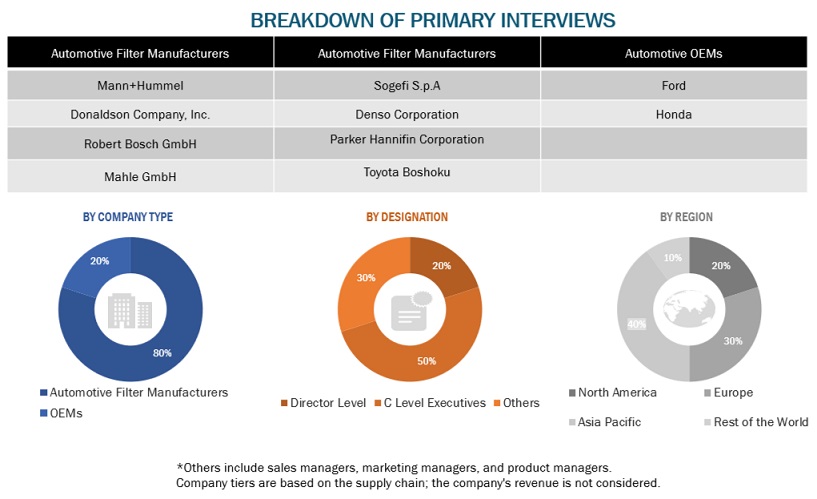
After understanding the automotive filters market scenario, extensive primary research was conducted. Several industry experts from automotive filter providers, component/system providers, and end-user organizations across four major regions, North America, Europe, Asia Pacific, and RoW, were contacted for the primary interviews. Most interviews were conducted from the supply side and some from OEMs. Primary data was collected through questionnaires, emails, and telephonic interviews. Various departments within organizations, including sales, operations, and administration, were contacted to provide a holistic viewpoint in the report while canvassing primaries. After interacting with industry participants, some brief sessions were conducted with experienced independent consultants to reinforce the findings from the primaries. This and the opinions of in-house subject matter experts led to the conclusions delineated in the rest of this report.

Automotive Filters  Market Size, and Share

To know about the assumptions considered for the study, download the pdf brochure

Market Size Estimation

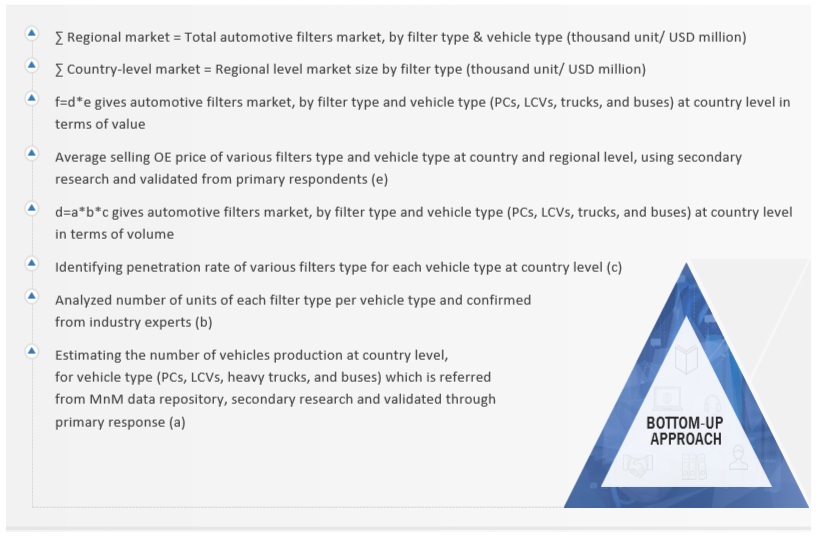
The bottom-up approach has been used to estimate and validate the size of the automotive filter market. The market size, by volume, of the automotive filters market has been derived by identifying the country-level vehicle production data (a) for each vehicle type (PCs, LCVs, trucks, and buses) and the number of units installed of different filter types per vehicle in all considered vehicle types (b) and penetration rate of each filter type in different vehicle types considered (c). Multiplying all three factors will provide the country-level market size by volume filter and vehicle type. The market size, by value, has been arrived at by multiplying the average selling OE price of filters for each vehicle type at the country level. The summation of the country-level market gives regional and global automotive filter markets by filter type and vehicle type. A similar approach is followed for the electric & hybrid vehicle filters market by vehicle type and filter types, off-highway by equipment type and filter type, and aftermarket by filter type in terms of volume and value.

Automotive Filters Market: Bottom-Up Approach

Automotive Filters  Market Bottom Up Approach

To know about the assumptions considered for the study, Request for Free Sample Report

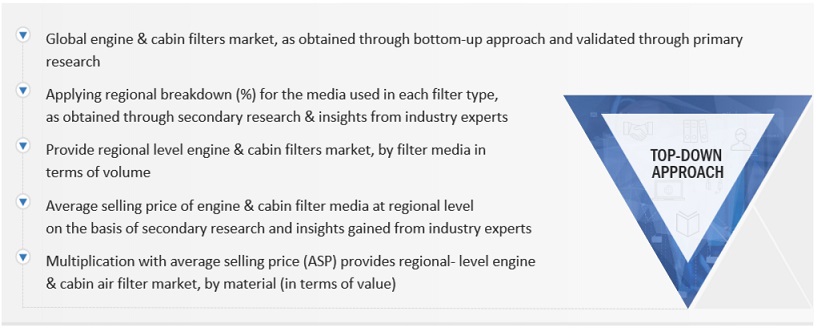
The market size of engine & cabin air filters, by material, was calculated using the top-down approach. Extensive secondary and primary research was carried out to understand the global market scenario for the types of material used in engine & cabin air filters. Several primary interviews were conducted with key opinion leaders concerning cabin air filter development, including key OEMs, Tier-I suppliers, and filter manufacturers. Qualitative aspects, such as market drivers, restraints, opportunities, and challenges, were considered while calculating and forecasting the market size.

Automotive Filters Market: Top-Down Approach

Automotive Filters  Market Top Down Approach

Market Definition:

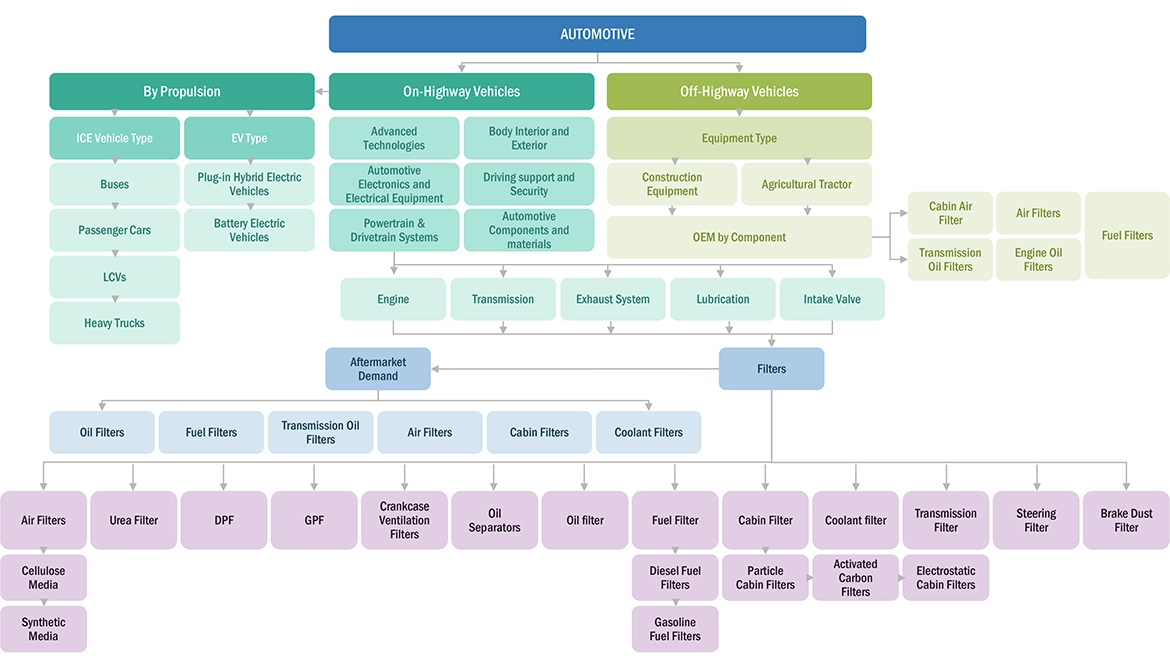
Filters in a vehicle remove foreign and unwanted substances/particles, which can cause severe damage to the vehicle system or human health. Some automotive filters include air filters, oil filters, brake dust filters, steering filters, cabin air filters, fuel filters, and coolant filters.

According to Mann+Hummel, a renowned automotive filter market player, combustion air always contains particles that should not be allowed to penetrate the inside of the engine. Therefore, applying air filters is essential to protect the engine and its components.

Stakeholders:

  • Automotive OEMs
  • Filters Manufacturers
  • Component and Raw Material Suppliers of Automotive Filters
  • On-highway and Off-highway Vehicle Manufacturers
  • Automotive Component Providers
  • Filters Design Companies
  • Automobile Organizations/Associations
  • Traders, Distributors, and Suppliers of Automotive Filters
  • Legal and Regulatory Authorities
  • Dealers, Distributors, and Retailers
  • Associations, Forums, and Alliances Related to ICE and Electric Vehicles
  • Government Agencies and Policymakers
  • Automobile Organizations/Associations

Report Objectives

  • To define, describe, and forecast the automotive filters market based on
    • Filter types (air filters, fuel filters, oil filters, oil separators, transmission oil filters, coolant filters, steering filters, brake dust filters, cabin filters, urea filters, DPF (Diesel Particulate Filters), GPF (Gasoline Particulate Filters), and crankcase ventilation filters)
    • Air filter by media type (cellulose and synthetic)
    • Cabin filter by material type (particle cabin filters, activated carbon filters, and electrostatic cabin filters)
    • Fuel filter by fuel type (gasoline filters and diesel filters)
    • Automotive Filter Aftermarket, by Filter Type (oil filters, fuel filters, air filters, cabin filters, coolant filters, and transmission oil filters)
    • Automotive Filters Market by vehicle type (passenger cars, light commercial vehicles, buses, and trucks)
    • Electric & hybrid vehicle filters market by vehicle type (BEV (battery electric vehicle) and PHEV (Plug-in hybrid electric vehicle)
    • Electric & hybrid vehicle filters market by filter type (air filters, fuel filters, oil filters, transmission oil filters, EMI/EMC filters, brake dust filters, cabin filters, cooling air particle filters)
    • Off-highway filters market by equipment type (agriculture tractors and construction equipment)
    • Off-highway filters market by filter type (fuel filters, engine oil filters, air filters, cabin air filters, and transmission oil filters)
    • By Region [Asia Pacific (China, India, Japan, South Korea, Thailand, and Rest of Asia Pacific), Europe (France, Germany, Russia, Spain, Turkey, the UK, and Rest of Europe), North America (Canada, Mexico, US) and RoW (Iran, Brazil, and Others in RoW)
  • To provide detailed information about significant factors influencing the growth of the market (drivers, restraints, opportunities, and industry-specific challenges)
  • To evaluate the opportunities in the market for stakeholders and provide details of the competitive landscape for market leaders
  • To strategically profile key players and comprehensively analyze their market shares and core competencies
  • To strategically analyze the key player strategies/right to win
  • To study the market with supply chain analysis, ecosystem analysis, trade analysis, case study analysis, pricing analysis, patent analysis, trends/disruptions impacting buyers, technology trends, regulatory analysis, and recession impact analysis
  • Analyzing the competitive leadership mapping of the global automotive filter manufacturers in the market and understanding their market position with the help of a company evaluation matrix.
  • To track and analyze competitive developments, such as joint ventures, collaborations, partnerships, mergers & acquisitions, new product developments, and expansions, in the automotive filters market

Available Customizations

With the given market data, MarketsandMarkets offers customizations based on the company’s needs.

Automotive Filters Market By Sales Channel (Region Level)

  • Aftermarket
  • OEM

Automotive Filters Market By Ice Vehicle Type (Country Level)

  • Passenger Cars
  • LCVs
  • Trucks
  • Buses

Electric And Hybrid Vehicle Filters Market, By Filter Type And Vehicle Type

  • Oil Filters
  • Fuel Filters
  • Air Filters
  • Cabin Filters
  • Transmission Oil Filters
  • Brake Dust Filters
  • EMI/EMC Filters
  • Cooling Air Particle Filters

Note: Asia Pacific (China, India, Japan, South Korea, Thailand, and others); Europe (France, Germany, Russia, Spain, Turkey, the UK, and others); North America (Canada, Mexico, the US) and RoW (Iran, Brazil, and others)

Previous Versions of this Report

Automotive Filters Market by Filters Type (Air, Fuel, Oil, Cabin, Coolant, Brake Dust, Oil Separator, Transmission, Steering, Dryer Cartridge, EMI/EMC, Coolant, DPF, GPF, Urea), Vehicle Type, Aftermarket & Region - Global Forecast to 2027

Report Code AT 2146
Published in Jan, 2023, By MarketsandMarkets™

Automotive Filters Market by Filter Type (Air, Fuel, Oil, Cabin, Coolant, Brake Dust, Oil Separator, Transmission, Steering, Dryer Cartridge, EMI/EMC, Coolant Particle), Air & Cabin Filter Media, Fuel & Vehicle Type, Aftermarket - Global Forecast to 2026

Report Code AT 2146
Published in Sep, 2021, By MarketsandMarkets™

Automotive Filters Market by Filter Type (Air, Fuel, Oil, Cabin, Coolant, Brake Dust, Oil Separator, Transmission, Steering, Dryer Cartridge, EMI/EMC, Coolant Particle), Air & Cabin Filter Media, Fuel & Vehicle Type, Aftermarket - Global Forecast to 2025

Report Code AT 2146
Published in Aug, 2020, By MarketsandMarkets™

Automotive Filters Market by Type (Air, Fuel, Oil, Cabin, Coolant, Brake Dust, Oil Separator, Transmission, Steering, Dryer Cartridge, EMI/EMC, Coolant Air Particle), Air & Cabin Filter Media, Fuel & Vehicle Type, Aftermarket - Global Forecast to 2025

Report Code AT 2146
Published in Apr, 2018, By MarketsandMarkets™

Air Filter Market by Type (Intake & Cabin), Filter Media (Intake-Cellulose & Synthetic, Cabin-Particle & Activated Carbon), Vehicle Type (Passenger Car, LCV, HCV, & Off- Highway), Market (OE & Aftermarket), & by Region - Global Forecast to 2020

Report Code AT 2146
Published in Aug, 2015, By MarketsandMarkets™

Automotive Air Filters Market by Vehicle Type (Passenger Car, Light & Heavy Commercial), by Filter Type (Intake & Cabin Air Filters), by Market Type (OE & Aftermarket), Two-Wheelers (OE & Aftermarket) & Geography - Global Trends & Forecast to 2018

Report Code AT 2146
Published in Oct, 2013, By MarketsandMarkets™
"Our USP is "providing game-changing business opportunities reports with free customization" - so please feel free to provide us with your specific areas of interest / business challenges in much greater detail !!"

We appreciate your interest in this report. Once you fill out the form, you'll be immediately directed to an exclusive solution tailored to your needs. This high-value offering can help boost your revenue by 30% - a must-see opportunity for anyone looking to maximize growth.


By clicking the "Submit" button, you are agreeing to the Terms of Use and Privacy Policy.

Custom Market Research Services

We Will Customise The Research For You, In Case The Report Listed Above Does Not Meet With Your Requirements

Get 10% Free Customisation

Growth opportunities and latent adjacency in Automotive Filters Market

Amey

Nov, 2019

Up to date (2017) Off highway filter marketplace Globally and by region for all types - Oil, Fuel, prefuel, hydraulic, transmission.

Amey

Nov, 2019

I would appreciate to have a sample of market research of the Brazilian Oil,Fuel,Air and HVAC market, production and market players split.

Amey

Nov, 2019

Air , Oil and Fuel filter Market at Canada , who is suppliers what size is it in aoutomotive including buses,trucks and business heavy equipments market .

Amey

Nov, 2019

Hello, I am interested in receiving reports for Aftermarket data for filters in the United States. Specifically, I would like to locate Vehicle in Operation information, or demands for Heavy Duty Filters. Any information provided would be much appreciated. Thank you.

Amey

Nov, 2019

What is the expected evolution of filter markets considering that the reliability of vehicles and quality of oils is continuously improving and enable to space out visits?.

Amey

Nov, 2019

yes Fuel Filters especially the Diesel Market size. I would like to see if you have info specifically units and dollars for the diesel fuel filter market in the u.s.

Amey

Nov, 2019

Interested to Know market potential for Fuel Filter Cum Water Separator for Ashok leyland Vehicles and current After market share held by various competetions in India.

Amey

Nov, 2019

we are conducting a final career project on filters for motorbikes. Your study migth help us. Regards.

Amey

Nov, 2019

I am seeking an air filter market report with a narrow focus. Specifically, the focus is medium and heavy vehicle in the North America markets (US and Canada data). May I please have a quote and a table of contents for a report with this focus? Thank you, Megan .

Amey

Nov, 2019

I'm specifically interested in automotive-filter manufacturers based in China and the markets/regions they supply to/support. .

Amey

Nov, 2019

I want to get a sense of how Mahle are doing in the UK and Europe within the Aftermarket compared to the leader. If I can get this, I will be able understand the full value of the report.

User

Jul, 2019

Hi, I am looking for specific information on Capacitive dividers for EVT, Testing, RC Dividers, Grading AIS, Grading GIS, TRV AIS, TRV GIS, Thyristor Valve, HVDC Bypass, Filter capacitor, EVT For the following countries and region - Europe. U.S., Canada, India, China, South America, and Middle East Can you please help me with a quote and timeline for the same?.

User

Jul, 2019

Diesel and Gasoline Particulate Filters, Catalysts for the automotive industry globally and all vehicle segments(i.e PC HCV). Thanks.

Swati

Jun, 2019

Hello, I am a consultant/investor in the North America Automotive Aftermarket space and would like a sample report to determine if it can add value for my filter manufacturer client. Regards, Frank.

Atul

May, 2019

We would be interested in purchasing the Report on automotive filters. Could you please provide us with some information prior to the purchase: Is there an extended table of content that you can share with us? Could you share with us the forecast model that is underlying the report? .

Atul

May, 2019

What is the source of the data used in the forecast? (Is it based on IHS data when it comes to volumes for instance?) .

Atul

May, 2019

Can you give us details regarding the methodology? We would need datapoints going back to 2013. Could you provide these? Many thanks in advance! .

Show More
DMCA.com Protection Status