Potassium Fluoride Market

Potassium Fluoride Market by Purity (95%-99%, >99%), By Form (Solid, Liquid), By Application (Fluorination & Analytical Reagent, Glass Etching, Flux), By End-use Industry (Agrochemical, Chemical, Glass & Metal) and Region - Global Forecast to 2032




OVERVIEW
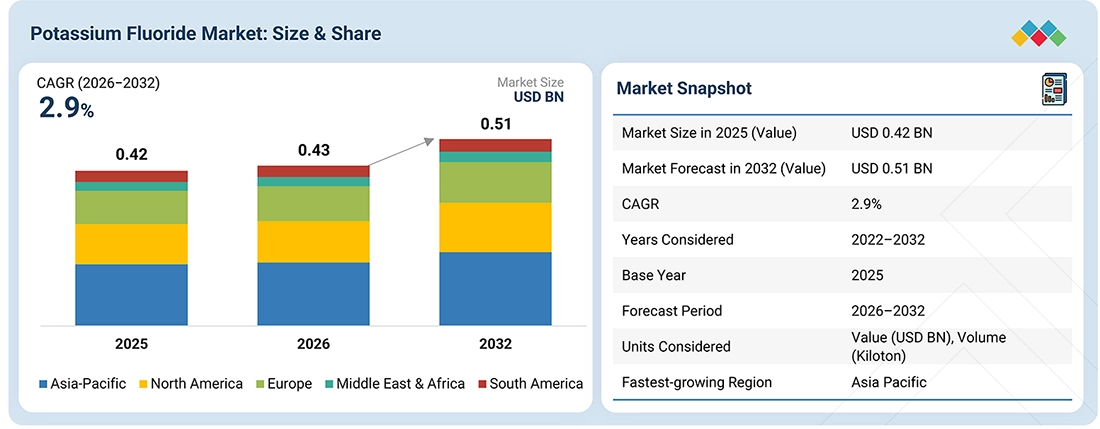
Source: Secondary Research, Interviews with Experts, MarketsandMarkets Analysis
The potassium fluoride market is projected to reach USD 0.51 billion by 2032 from USD 0.43 billion in 2026, at a CAGR of 2.9% from 2026 to 2032. The global potassium fluoride market is characterized by diversified demand across fluorochemical manufacturing, pharmaceuticals, agrochemicals, specialty chemicals, glass processing, metal treatment, and electronics-related applications. Potassium fluoride is primarily valued as a versatile fluoride source and fluorinating reagent, particularly in organic synthesis and halogen-exchange reactions, while its established use in glass etching, soldering fluxes, insecticides, and metal treatment provides additional demand. Market growth is being supported by increasing production of fluorinated pharmaceutical and agrochemical intermediates, expansion of specialty fluorochemical manufacturing, and growing requirements for high-purity fluoride materials. Asia Pacific remains the principal consumption and production hub, supported by China’s extensive chemical manufacturing base and expanding fluorine-chemistry capabilities in India, Japan, and South Korea. Meanwhile, suppliers are increasingly focusing on higher-purity grades, application-specific specifications, supply reliability, and integrated fluorine-chemical value chains to capture higher-value opportunities.
KEY TAKEAWAYS
-
BY REGIONAsia Pacific is anticipated to have the largest market share of 39.4% during the year 2025.
-
BY FORMSolid is expected to dominate the form segment, with a share of 92.0% in 2025.
-
BY PURITY95%-99% by purity is expected to register the highest CAGR of 3.0% during the forecast period.
-
BY APPLICATIONAgrochemical formulations by application is expected to register the highest CAGR of 3.5% during the forecast period.
-
BY END-USE INDUSTRYChemical by end-use industry is projected to experience the highest CAGR of 3.3% during the forecast period.
-
COMPETITIVE LANDSCAPE (KEY PLAYERS)Major players like Aarti Industries Ltd. (India), Gujarat Fluorochemicals Limited (India), Derivados del Flúor SAU (Spain) are sustaining growth by expanding production capacity, developing high-purity and application-specific KF grades, strengthening vertically integrated fluorine-chemical supply chains, and diversifying into higher-value pharmaceutical, agrochemical, electronics, and specialty-chemical applications.
-
COMPETITIVE LANDSCAPE (STARTUPS/SMES)Maruti Industries (India), Solstice Advanced Materials US, Inc.(US) and Stella Chemifa Corporation (Japan) among others, have distinguished themselves among startups and SMEs by securing strong footholds in specialized niche areas, underscoring their potential as emerging market leaders.
The potassium fluoride market is experiencing growth due to increasing demand for fluorination chemistry across pharmaceuticals, agrochemicals, specialty chemicals, fluorochemicals, and advanced materials. Potassium fluoride serves as an important fluoride source in organic synthesis, particularly halogen-exchange reactions, supporting the production of fluorinated pharmaceutical intermediates, active ingredients, and crop-protection chemicals. Expansion of fluorochemical manufacturing is further increasing consumption as producers develop fluorinated intermediates, specialty materials, and performance chemicals. Demand is also benefiting from the growing adoption of higher-purity fluoride reagents in pharmaceutical manufacturing, electronics, semiconductor-related processes, and other applications requiring controlled impurity levels. Asia Pacific is a particularly important growth engine because China and India are expanding fluorochemical, agrochemical, and pharmaceutical manufacturing, while Japan and South Korea provide additional demand from advanced electronics and specialty chemical industries. Additionally, increasing supplier investments in dedicated potassium fluoride capacity, high-purity grades, diversified product forms, and integrated fluorine-chemical supply chains are improving availability and supporting broader industrial adoption.
TRENDS & DISRUPTIONS IMPACTING CUSTOMERS' CUSTOMERS
The potassium fluoride market is witnessing a shift toward higher-purity and application-specific grades, alongside growing adoption in fluorination-intensive pharmaceutical, agrochemical, and specialty-chemical synthesis. Increasing semiconductor and advanced-material manufacturing is creating opportunities for electronic-grade KF, while producers are expanding anhydrous, granular, high-purity, and solution offerings to address differentiated customer requirements. At the same time, integrated fluorine-chemical supply chains and localized production are becoming increasingly important as customers prioritize supply reliability, consistent purity, and regulatory compliance. TANFAC's portfolio illustrates this diversification across agrochemicals, pharmaceuticals, fluoropolymers, solar cells, lithium batteries, and glass-related applications. A further disruption is the emergence of high-purity KF as a specialized product rather than a commodity, with electronic-grade material reaching ≥99.5% purity and targeting semiconductor and battery applications.
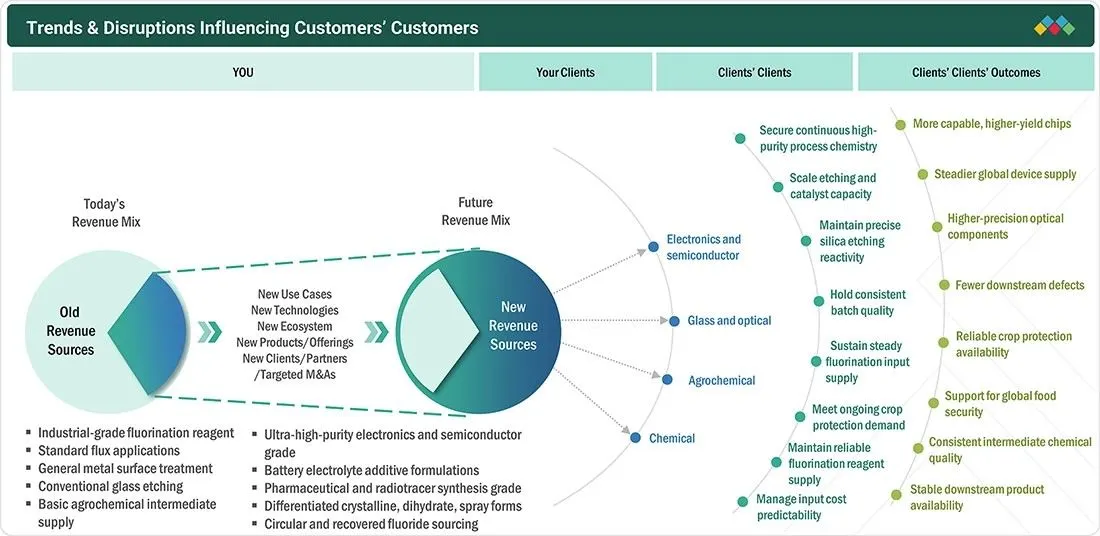
Source: Secondary Research, Interviews with Experts, MarketsandMarkets Analysis
MARKET DYNAMICS

Level
-
Semiconductor fluorination and etching chemistry is tightening electronic-grade Potassium Fluoride supply

-
Aluminum surface treatment is increasing fluoride consumption intensity per processing line


Level
-
Alternative fluorides are limiting Potassium Fluoride penetration in several bulk industrial applications

-
Fluoride discharge regulation is constraining growth in environmentally sensitive downstream sectors


Level
-
Electronic-grade Potassium Fluoride purification remains underdeveloped outside Northeast Asia

-
Battery-electrolyte fluorination intermediates offer a premium growth avenue for specialty producers


Level
-
Hygroscopicity and corrosivity are complicating storage, logistics, and customer handling economics

-
Achieving ultra-low impurity specifications requires expensive purification and analytical infrastructure

Source: Secondary Research, Interviews with Experts, MarketsandMarkets Analysis
Driver: Semiconductor fluorination and etching chemistry is tightening electronic-grade Potassium Fluoride supply
The escalating demand for ultra-high-purity (electronic-grade) potassium fluoride is acting as a massive driver within the semiconductor fabrication industry. In advanced logic device and microchip manufacturing, electronic-grade fluorinating agents and chelants are critical for selective wet etching, silicon wafer cleaning, and chemical mechanical planarization processes. As semiconductor nodes shrink, manufacturers require chemical agents with impurity profiles measured in parts-per-trillion to prevent catastrophic wafer defects. This exactitude has severely tightened the supply chain because producing electronic-grade potassium fluoride requires multi-stage distillation, aggressive cryogenic separation, and sophisticated crystallization to remove sub-ppm metallic and hydrogen fluoride impurities. Consequently, the limited number of high-purity processing facilities capable of meeting stringent SEMI (Semiconductor Equipment and Materials International) standards cannot scale production fast enough to meet the explosive demand generated by modern foundries. Because standard industrial-grade chemical precursors cannot simply be substituted in advanced deposition and etching systems without sacrificing chip yields, the dependency on true electronic-grade potassium fluoride ensures sustained upward pressure on its demand and secures its position as a highly leveraged driver for market expansion.
Restraint: Alternative fluorides are limiting Potassium Fluoride penetration in several bulk industrial applications
While potassium fluoride exhibits highly reactive properties suitable for nucleophilic fluorination, its market penetration in bulk industrial applications is heavily restrained by the availability and cost-effectiveness of alternative fluoride salts. In large-scale sectors such as metallurgy, industrial fluxes, wood preservation, and bulk agricultural pesticides, manufacturers frequently substitute potassium fluoride with sodium fluoride, calcium fluoride, or ammonium fluoride. Sodium fluoride, for example, shares a similar rock-salt crystalline structure and provides adequate fluorinating action for applications like municipal water treatment or basic fluxing, but at a significantly lower raw material cost due to the cheaper sodium hydroxide or sodium carbonate precursors used during neutralization. Furthermore, these alternative inorganic fluorides generally demonstrate lower degrees of hygroscopicity, making them less reactive to ambient moisture and easier to process in high-volume, lower-margin industrial environments. Because bulk applications do not require the elite solubility or exact reactivity profiles that potassium fluoride offers in fine organic synthesis or electronic chelation, industrial buyers naturally gravitate toward these cheaper, more stable alkaline earth and alkali metal fluorides. This aggressive substitution creates a hard ceiling for potassium fluoride volume growth outside specialized, high-margin chemical sectors.
Opportunity: Electronic-grade Potassium Fluoride purification remains underdeveloped outside Northeast Asia
A profound strategic opportunity lies in localizing the purification infrastructure for electronic-grade potassium fluoride, which is currently heavily concentrated in Northeast Asia. The majority of ultra-high-purity fluorine derivatives, essential for global semiconductor supply chains, are manufactured and refined in localized hubs across Japan, South Korea, and Taiwan, where legacy chemical expertise and close proximity to major semiconductor fabs exist. Expanding these complex purification capabilities, such as advanced metal adsorbent layer beds, low-temperature evaporation, and hydrogen peroxide oxidation systems, into North America and Europe represents a massive untapped market. As Western nations aggressively incentivize domestic semiconductor manufacturing through industrial policies and government subsidies, the localized supply of electronic-grade reagents becomes an absolute necessity to prevent supply chain bottlenecks. Developing regional production facilities capable of reaching ultra-high purity eliminates the intense logistical risks associated with importing highly specialized etching agents across regions. By establishing advanced neutralization, recrystallization, and automated distillation infrastructure in emerging tech hubs outside the traditional Northeast Asian corridor, specialized chemical manufacturers can capture premium margins and secure long-term contracts with regional semiconductor fabs striving for supply chain resilience
Challenges:Hygroscopicity and corrosivity are complicating storage, logistics, and customer handling economics
The inherent physical and chemical properties of potassium fluoride, specifically its extreme hygroscopicity and corrosivity, pose severe logistical and economic challenges for manufacturers and end-users. As an alkaline, inorganic fluoride salt, it rapidly absorbs atmospheric moisture, forming dihydrate or tetrahydrate complexes that can instantly degrade the high-purity baselines required for specialized synthesis. To prevent this moisture-induced degradation, manufacturers are forced to utilize highly specialized, rigid packaging solutions, such as high-density polyethylene (HDPE) drums or hermetically sealed polytetrafluoroethylene (PTFE) containers, which dramatically inflate overall packaging and freight costs. Furthermore, aqueous potassium fluoride is highly corrosive, actively attacking standard glass and porcelain processing equipment. This forces customer facilities to invest in expensive, fluorine-resistant handling infrastructure, including specialized polymeric piping, lined storage tanks, and robust ventilation systems. In addition to material degradation, potassium fluoride is classified as a severe toxic hazard, demanding stringent occupational safety protocols, specialized emergency response training for personnel, and complex regulatory compliance during transport. These compounded handling economics elevate the total cost of ownership, ultimately deterring smaller chemical facilities from adopting potassium fluoride and complicating the logistics for global supply chain distribution.
POTASSIUM FLUORIDE MARKET: COMMERCIAL USE CASES ACROSS INDUSTRIES
| COMPANY | USE CASE DESCRIPTION | BENEFITS |
|---|---|---|
 |
Potassium fluoride is used as a fluoridating agent in organic chemical synthesis, including conversion of chlorinated compounds to fluorinated compounds through Finkelstein and Halex reactions; it is also used in metallurgy for fluxing, metal finishing, coatings, and tin plating. | Enables efficient fluorine incorporation into organic molecules, supports production of fluorinated intermediates, and provides functional benefits in metal treatment and coating processes. |
 |
Potassium fluoride is manufactured as part of TANFAC's integrated fluorine-chemical portfolio and is positioned for fluorination chemistry, while the company's broader fluoride portfolio serves chemical, pharmaceutical, metallurgical, glass, and other industrial applications. | Supports reliable access to fluorine-based reagents from an integrated supplier, improving supply continuity and enabling applications requiring controlled fluoride chemistry. |
 |
Potassium fluoride is supplied in multiple grades and forms for chemical synthesis, fluorination, specialty materials, and high-purity applications, including applications requiring higher-grade fluoride materials. | Broad grade availability allows customers to match KF purity and physical form with process requirements, supporting chemical synthesis and purity-sensitive applications. |
 |
Potassium fluoride is positioned for pharmaceutical and agrochemical synthesis and specialty-material applications, alongside the company's broader portfolio of inorganic fluorides serving semiconductor, solar, battery, and other high-specification industries. | Provides a fluorine source for high-value synthesis while integrated manufacturing and application-specific grades support quality consistency and supply reliability. |
Logos and trademarks shown above are the property of their respective owners. Their use here is for informational and illustrative purposes only.
MARKET ECOSYSTEM
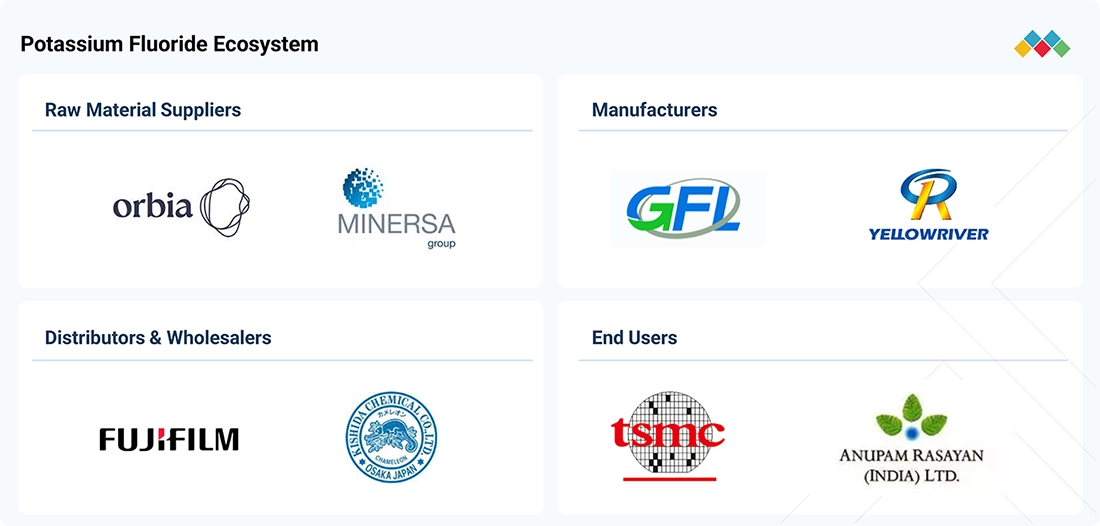
The potassium fluoride ecosystem comprises an integrated value chain extending from fluorspar and hydrofluoric acid (HF) producers to KF manufacturers, specialty chemical suppliers, distributors, and downstream users in pharmaceuticals, agrochemicals, fluorochemicals, metallurgy, glass, and advanced materials. Producers with integrated HF-based operations have an advantage in controlling raw-material availability, quality, and supply continuity; for example, TANFAC manufactures KF alongside anhydrous HF and other fluoride derivatives, while Gujarat Fluorochemicals Limited operates an integrated fluorine-chemistry value chain. Downstream demand is concentrated among chemical manufacturers using KF as a fluorinating agent and in pharmaceutical and agrochemical synthesis, with growing requirements for application-specific and high-purity grades. Chinese producers such as Henan Yellow River New Material Technology Co., Ltd. add significant dedicated KF capacity and supply multiple forms and grades, strengthening Asia Pacific's position in the ecosystem
Logos and trademarks shown above are the property of their respective owners. Their use here is for informational and illustrative purposes only.
MARKET SEGMENTS
Source: Secondary Research, Interviews with Experts, MarketsandMarkets Analysis
Potassium Fluoride Market, By Form
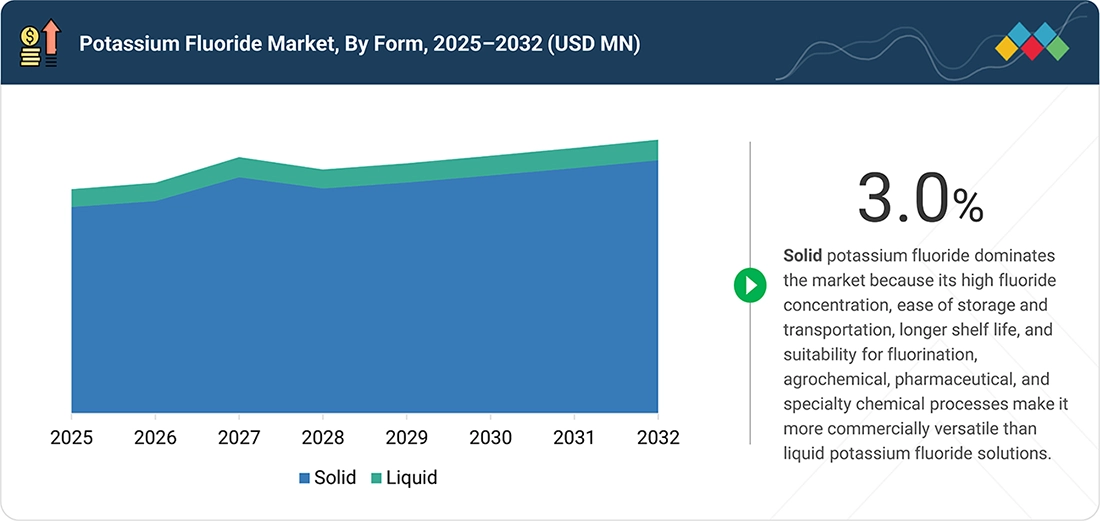
Solid forms, such as crystalline powder or micro-powder, dominate the potassium fluoride market primarily due to logistical stability, reactivity demands, and handling economics. Potassium fluoride is a highly deliquescent and corrosive inorganic salt, meaning aqueous solutions present severe challenges regarding specialized, anti-corrosive transportation infrastructure and reduced shelf life. Transporting it as a solid, typically packaged in robust HDPE bags with inner liners, drastically reduces freight weight and mitigates the immediate risks of liquid spills. More importantly, the solid anhydrous form is structurally necessary for advanced organic chemistry. Many industrial fluorination processes require strictly moisture-free environments to prevent the hydrolysis of sensitive intermediates. The finely milled solid powder provides maximum surface area for efficient reactivity while preserving the compound’s structural integrity during long-term storage under controlled, airtight conditions.
Potassium Fluoride Market, By Purity
The 95% - 99% purity tier, commonly designated as technical or industrial grade, represents the largest market segment because it aligns perfectly with the economic and chemical requirements of bulk manufacturing. While specialized sectors like semiconductor etching demand purities exceeding 99.9%, the overwhelming majority of heavy industrial processes do not justify the exponential refining costs required to eliminate trace impurities. For applications ranging from glass etching and metallurgical fluxing to water treatment and standard organic synthesis, a purity baseline of 95% - 99% provides optimal fluoride ion availability without disrupting chemical processes. This industrial grade offers a highly cost-effective nucleophilic reagent for converting chlorocarbons into fluorocarbons at scale. Utilizing this specific purity bracket allows chemical processors to maintain high reaction yields while protecting profit margins from unnecessary raw material over-specification.
Potassium Fluoride Market, By Application
Agrochemical formulations constitutes the leading application segment due to the vital role of fluorine atoms in modern pesticide, herbicide, and fungicide design. Introducing fluorine into agrochemical molecules significantly enhances their metabolic stability, lipophilicity, and overall biological efficacy against environmental pests. Potassium fluoride acts as the premier fluorinating agent for these mass-scale chemical conversions, heavily utilized in halogen exchange (Halex) reactions to efficiently convert chlorinated aromatic and aliphatic compounds into their fluorinated counterparts. Compared to other alkali metal fluorides, potassium fluoride offers an ideal balance of solubility, potent reactivity, and manageable industrial safety protocols. As global agricultural production demands intensify, the reliance on advanced fluorinated crop protection chemicals continues to surge. Consequently, agrochemical manufacturers consume immense volumes of bulk potassium fluoride to sustain the continuous, high-yield synthesis pipelines required for global agricultural supply chains.
Potassium Fluoride Market, By End use Industry
The chemical manufacturing sector is the definitive primary end-use industry for potassium fluoride due to the compound's foundational role as a versatile intermediate and catalytic agent. Beyond specialized niches, potassium fluoride is consumed in massive quantities for broad organic synthesis, functioning as an essential fluoride donor for creating specialty chemicals, complex fluoropolymers, and pharmaceutical active ingredients. Furthermore, it serves as a critical processing aid across various heavy industrial chemical processes, including its use as a base catalyst, an active soldering flux component to remove metal surface oxides, and a vital ingredient in specialized electroplating solutions. The sheer diversity of these chemical applications ensures that bulk demand remains exceptionally high. Because it is indispensable for converting standard chlorocarbons into high-value fluorinated derivatives, the broader chemical processing industry continuously absorbs the highest total tonnage of global production.
REGION
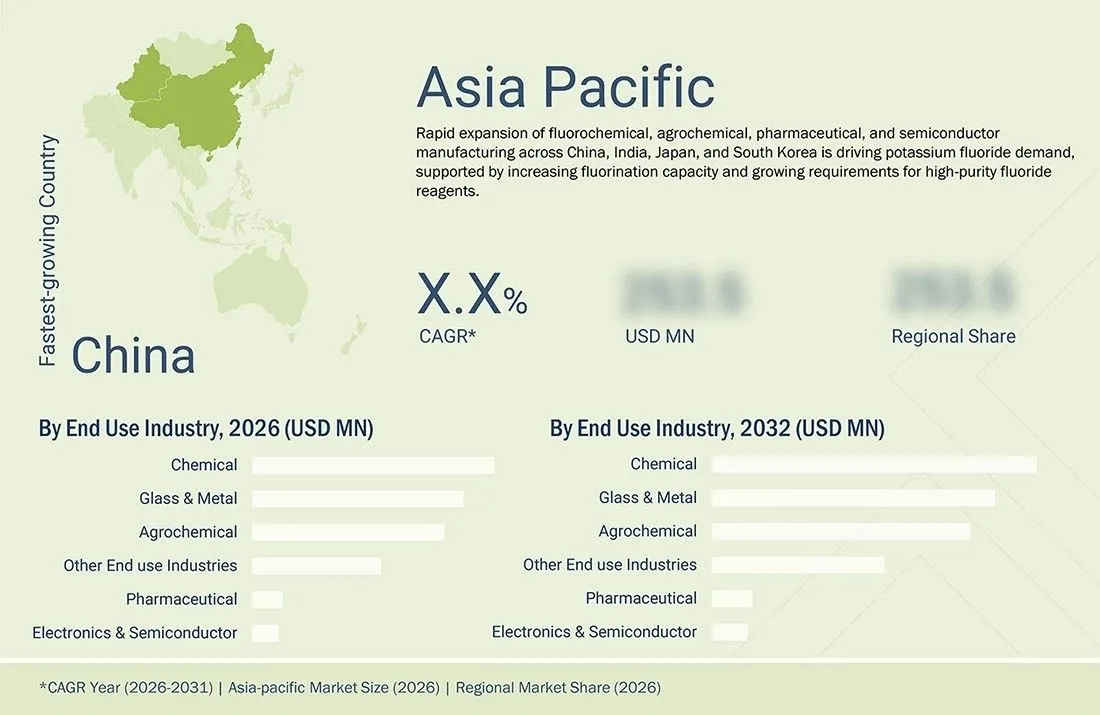
Asia Pacific to be fastest-growing region in the global potassium fluoride market during the forecast period
The Asia Pacific region commands the largest share of the global potassium fluoride market and is the fastest growing regional market due to its unparalleled integration across the entire fluorine value chain, from raw material extraction to high-volume end-use manufacturing. China possesses the world’s most extensive reserves of fluorspar, providing domestic chemical manufacturers with a secure, cost-effective baseline of anhydrous hydrogen fluoride required for large-scale potassium fluoride synthesis. Additionally, the region houses the absolute majority of global semiconductor foundries, specifically concentrated across Taiwan, South Korea, and Japan, which generate massive, continuous demand for electronic-grade potassium fluoride used in complex wafer etching and cleaning processes. Beyond electronics, China and India serve as the epicenter for global agrochemical and pharmaceutical active ingredient (API) production, heavily relying on industrial-grade potassium fluoride for critical nucleophilic fluorination and halogen exchange reactions. The combination of localized, abundant raw materials, vast chemical processing infrastructure, and immediate proximity to massive consumption hubs cements Asia Pacific’s dominance.
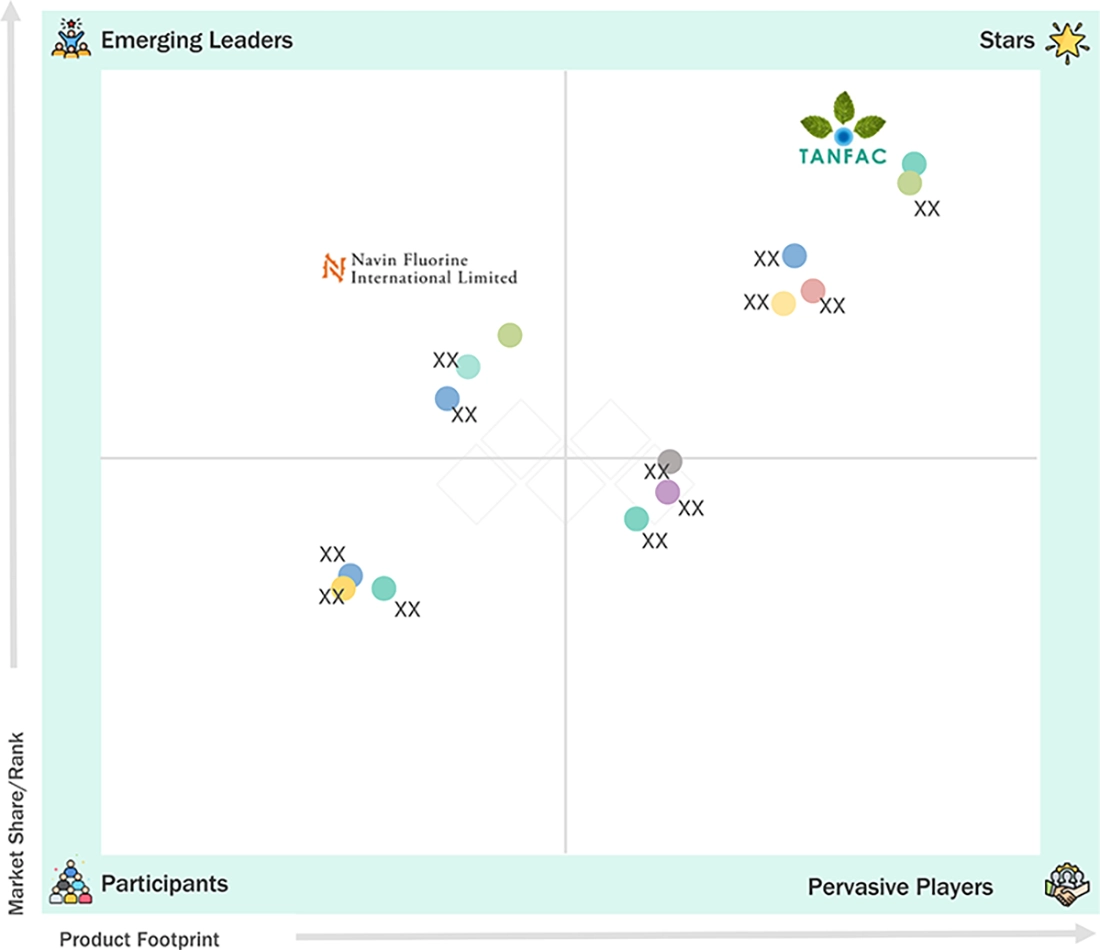
POTASSIUM FLUORIDE MARKET: COMPANY EVALUATION MATRIX
In the potassium fluoride market matrix, TANFAC Industries Ltd. (Star) leads with a dominant market share and an extensive product footprint, including high-purity (minimum 99.00%) deliquescent solid potassium fluoride. The company sees broad adoption across organic compound fluorination, solder flux manufacturing, and insecticide formulations. Navin Fluorine International Limited (Emerging Leader) is gaining strong visibility with its backward-integrated chemical manufacturing infrastructure and tailored, high-performance solutions for complex pharmaceutical synthesis, advanced agrochemical active ingredients, and specialty materials.
Source: Secondary Research, Interviews with Experts, MarketsandMarkets Analysis
KEY MARKET PLAYERS
- Aarti Industries Ltd. (India)
- Gujarat Fluorochemicals Limited (India)
- Derivados del Flúor SAU (Spain)
- TANFAC Industries Ltd. (India)
- Navin Fluorine International Limited (India)
- SB Chemicals (India)
- Henan Yellow River New Material Technology Co., Ltd. (China)
- Chengde Yingke Fine Chemical Co., Ltd. (China)
- Nantong Jinxing Fluorides Chemical Co., Ltd. (China)
- Fengyuan Group (China)
MARKET SCOPE
| REPORT METRIC | DETAILS |
|---|---|
| Market Size in 2025 (Value) | USD 0.42 Billion |
| Market Forecast in 2026 (Value) | USD 0.43 Billion |
| Market Forecast in 2032 (Value) | USD 0.51 Billion |
| Growth Rate | CAGR of 2.9% from 2026-2032 |
| Years Considered | 2022-2032 |
| Base Year | 2025 |
| Forecast Period | 2026-2032 |
| Units Considered | Value (USD Million/Billion), Volume (Kiloton) |
| Report Coverage | Revenue forecast, company ranking, competitive landscape, growth factors, and trends |
| Segments Covered |
|
| Regions Covered | North America, Asia Pacific, Europe, South America, Middle East & Africa |
WHAT IS IN IT FOR YOU: POTASSIUM FLUORIDE MARKET REPORT CONTENT GUIDE
DELIVERED CUSTOMIZATIONS
We have successfully delivered the following deep-dive customizations:
| CLIENT REQUEST | CUSTOMIZATION DELIVERED | VALUE ADDS |
|---|---|---|
| Leading Agrochemical Formulation Manufacturer |
|
|
| Advanced Semiconductor & Electronics Manufacturer |
|
|
| Pharmaceutical Intermediate & API Manufacturer |
|
|
| Metallurgical Flux & Welding Consumables Manufacturer |
|
|
| Specialty Chemical & Glass Processing Manufacturer |
|
|
RECENT DEVELOPMENTS
- May 2022 : Anupam Rasayan acquired a 24.96% stake from promoters and a 26.0% stake from public shareholders, achieving a 50.96% total stake and joint control (with TIDCO) over TANFAC, backward integrating its fluorination capabilities. For TANFAC’s potassium fluoride (KF) product offering, this partnership ensures a guaranteed, high-volume downstream off-take, drastically reducing exposure to merchant market volatility and aggressive pricing pressures. Consequently, TANFAC is incentivized to aggressively upgrade its potassium fluoride production capabilities, shifting focus toward the ultra-high purity specifications required for Anupam’s niche pharmaceutical and agrochemical intermediates. This symbiotic integration guarantees TANFAC sustained capacity utilization, higher margin realization, and a dominant position as a specialized potassium fluoride supplier.
Table of Contents
 Exclusive indicates content/data unique to MarketsandMarkets and not available with any competitors.
Methodology
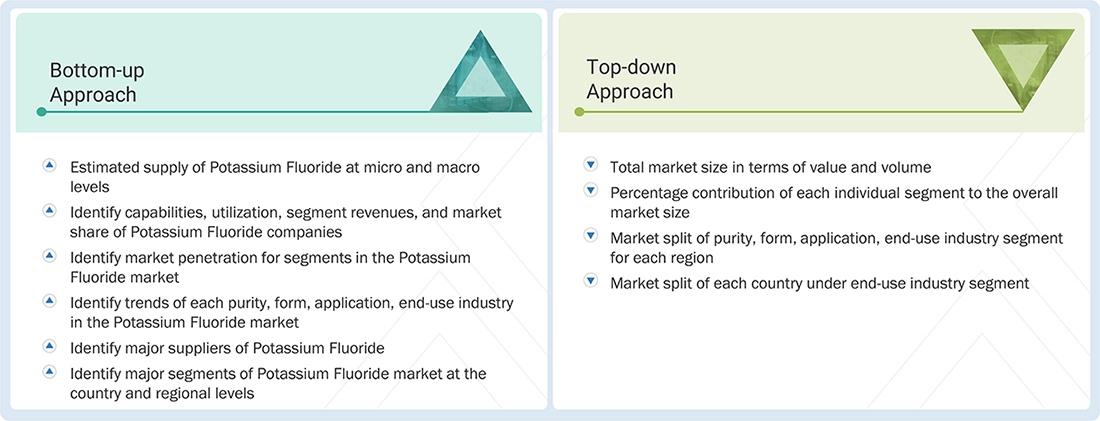
The study involved four major activities in estimating the size of the Potassium fluoride market. Exhaustive secondary research was done to collect information on the market, the peer market, and the parent market. The next step was to validate these findings, assumptions, and sizing with industry experts across the value chain through primary research. Both top-down and bottom-up approaches were employed to estimate the complete market size. Thereafter, the market breakdown and data triangulation procedures were used to estimate the market size of the segments and subsegments.
Secondary Research
In the secondary research process, various secondary sources have been referred to for identifying and collecting information for this study. These secondary sources include annual reports, press releases, investor presentations of companies, white papers, certified publications, trade directories, certified publications, articles from recognized authors, gold standard and silver standard websites, and databases.
Secondary research has been used to obtain key information about the value chain of the industry, the monetary chain of the market, the total pool of key Potassium fluoride players, market classification and segmentation according to industry trends to the bottom-most level, and country-level markets. It was also used to obtain information about the key developments from a market-oriented perspective.
Primary Research
The Potassium fluoride market comprises several stakeholders in the value chain, which include raw material suppliers, potassium fluoride manufacturers, distributors and wholesalers, and end users. Various primary sources from the supply and demand sides of the Potassium fluoride market have been interviewed to obtain qualitative and quantitative information. The primary interviewees from the demand side include key opinion leaders in application sectors. The primary sources from the supply side include manufacturers, associations, and institutions involved in the Potassium fluoride industry.
Primary interviews were conducted to gather insights such as market statistics, data on revenue collected from the products and services, market breakdowns, market size estimations, market forecasting, and data triangulation. Primary research also helped in understanding the various trends related to purity, form, application, end-use industry, and region. Stakeholders from the demand side, such as CIOs, CTOs, and CSOs, were interviewed to understand the buyer’s perspective on the suppliers, products, component providers, and their current usage of Potassium fluoride and future outlook of their business, which will affect the overall market.
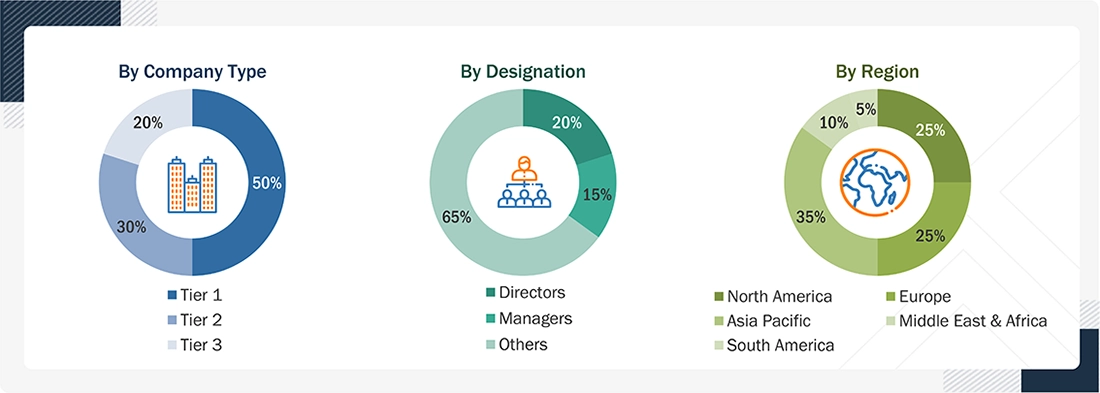
Note: Tier 1, Tier 2, and Tier 3 companies are classified based on their market revenue in 2025 available in the public domain, product portfolios, and geographical presence.
Other designations include sales representatives, production heads, and technicians.
To know about the assumptions considered for the study, download the pdf brochure
Market Size Estimation
- The top-down approach was used to estimate and validate the size of various submarkets for Potassium fluoride for each region. The research methodology used to estimate the market size included the following steps:
- The key players in the industry have been identified through extensive secondary research.
- The supply chain of the industry has been determined through primary and secondary research.
- The global market was then segmented into five regions and validated by industry experts.
- All percentage shares, splits, and breakdowns based on Purity, form, application, end use industry, and region were determined using secondary sources and verified through primary sources.
- All possible parameters that affect the markets covered in this research study were accounted for, viewed in extensive detail, verified through primary research, and analyzed to get the final quantitative and qualitative data. This data was consolidated and added with detailed inputs and analysis and presented in this report.
Data Triangulation
After arriving at the total market size from the estimation process for Potassium fluoride above, the overall market has been split into several segments and sub-segments. To complete the overall market engineering process and arrive at the exact statistics for all the segments and sub-segments, the data triangulation and market breakdown procedures have been employed, wherever applicable. The data has been triangulated by studying various factors and trends from both the demand and supply sides. Along with this, the market size has been validated by using both the top-down and bottom-up approaches and primary interviews. Hence, for every data segment, there have been three sources—top-down approach, bottom-up approach, and expert interviews. The data was assumed correct when the values from the three sources matched.
Market Definition
The potassium fluoride market comprises the production, distribution, and consumption of potassium fluoride, an inorganic fluoride salt primarily manufactured by neutralizing hydrofluoric acid with potassium-containing compounds. Potassium fluoride is commercially available mainly in solid, anhydrous, granular, crystalline, and aqueous forms across different purity levels. The market encompasses applications including fluorination and chemical synthesis, agrochemical manufacturing, pharmaceutical intermediates, glass etching, metal surface treatment, soldering and brazing fluxes, catalysts, electrolytes, and semiconductor-related processes. Demand is influenced by the increasing use of fluorinated molecules in pharmaceuticals and crop-protection products, expansion of specialty fluorochemical manufacturing, and growing requirements for high-purity fluoride materials. The market includes technical-grade and high-purity potassium fluoride supplied through direct contracts, distributors, and specialized chemical suppliers to industrial and research customers.
Key Stakeholders
- Raw material suppliers
- Potassium Fluoride manufacturers
- Potassium Fluoride exporters and importers
- Government and Private Research Organizations
- Associations and Industrial Bodies
- R&D Institutions
- Environmental Support Agencies
Report Objectives
- To define, describe, and forecast the size of the Potassium fluoride market, in terms of value and volume
- To provide detailed information regarding the major factors (drivers, opportunities, restraints, and challenges) influencing the growth of the market
- To estimate and forecast the market size based on purity, form, application, end-use industry, and region
- To forecast the size of the market with respect to regions, namely, Asia Pacific, Europe, North America, South America, Middle East & Africa.
- To strategically analyze micromarkets with respect to individual growth trends, prospects, and their contribution to the overall market
- To analyze opportunities in the market for stakeholders and provide a competitive landscape of market leaders
- To track and analyze recent developments such as product launches, collaborations, contracts, acquisitions, and expansion in the market
- To strategically profile key market players and comprehensively analyze their core competencies.
Available customizations:
Along with the given market data, MarketsandMarkets offers customizations according to the company’s specific needs. The following customization options are available for the report:
Country-level Analysis
- Further breakdown of a country with additional segmentation
Company Information
- Detailed analysis and profiles of additional market players
Tariff & Regulations
- Regulations and impact on the Potassium fluoride market


Personalize This Research
- Triangulate with your Own Data
- Get Data as per your Format and Definition
- Gain a Deeper Dive on a Specific Application, Geography, Customer or Competitor
- Any level of Personalization
Let Us Help You
- What are the Known and Unknown Adjacencies Impacting the Potassium Fluoride Market
- What will your New Revenue Sources be?
- Who will be your Top Customer; what will make them switch?
- Defend your Market Share or Win Competitors
- Get a Scorecard for Target Partners

Custom Market Research Services
We Will Customise The Research For You, In Case The Report Listed Above Does Not Meet With Your Requirements
Get 10% Free CustomisationTESTIMONIALS
We at Nissan Chemicals Corporation have been clients of MarketsandMarkets for more than a year now. We recently consulted MarketsandMarkets for a study, the team at MarketsandMarkets was extremely professional and organized. The business insights were very detailed and aligned well with our expectations that really helped us formulate the Business Plans and device new strategies for development themes. MarketsandMarkets offers a unique combination of expertise and dedicated engagement model. Their research findings have helped us in designing our Pricing Strategy which will make it easier for us to predict the future sales and profits for the next ten years. We look forward to working with MarketsandMarkets in the future.
VP of Strategy & New Business Development
Leading Specialty Chemical Company
The MarketsandMarkets Engagement Model, composed of both the Knowledge Store and advisory custom research, has greatly helped us in understanding our markets and making strategic decisions. The Knowledge Store is a fast way to allow everyone in our organization to understand more about most any market they are interested in. The ability to then get custom research done and get answers to specific strategic questions and market insight has been spectacular. The Markets and Markets team feel more like colleagues than vendors and their services have helped us change our culture where statements of things like growth opportunities and competitive position are always backed by industry research.

Rich Gibson,
Director, Corporate Strategy
Milliken & Company,
Leading Industrial Manufacturer of specialty chemical, floor covering, performance and protective textile materials, and healthcaremilliken.com
MarketsandMarkets is a trusted resource that helps us to better understand markets that are near-adjacencies-whether its technology, value chain or geography. Their Knowledge Store platform provides a dashboard of markets and their characteristics which is easy to use and saves us time.
Adam Shaw,
Market Development and Strategy Manager
AdvanSix Inc. USA,
An American Leader in Chemicalswww.advansix.com
The Knowledge Store from MarketsandMarkets is a valuable tool which has helped my team acquire greater insight in to the end markets that our business serves. This has enabled us to help our company build stronger strategies throughout our planning process.
TOSHIO KINOSHITA
Senior Chif Consultion Research & Consulting Division
Mitsubishi Chemical Research Corporation,
Leading Manufacturer of Chemical Productswww.mitsubishichem-res.co.jp/en/

We recently engaged with MarketsandMarkets for a study, the team not only clearly understood our business objectives but was also extremely professional in the way they handled the entire project. The study was efficiently conducted in a phase-wise manner, and the engagement model furnished us with high-quality business insights that far exceeded our expectations at each phase. We were especially happy that MarketsandMarkets could provide us with both, an English as well as a Japanese version of the study. A special thanks to the Analyst Team and Client Services Team, whose fluency in Japanese enhanced our comfort level, as we could converse with them in our preferred language.
Independent entrepreneurs
Arrow Precision
We approached MarketsandMarkets for study on Proppants Market, and their work exceeded our expectations. The study conducted was comprehensive and enabled us to view the market through the various dimensions. In addition, the team was extraordinarily responsive throughout the process and resolved our queries on time. I strongly recommend MarketsandMarkets and will certainly consider them for additional market assessments we will need in the future.
Global engineering company, Japan
Deputy Manager,
Strategic Planning OfficeThe high-quality insights shared by the MarketsandMarkets team helped us understand the pharmaceutical plant designers in a specific geography. It also captured the risks that we may likely face in communicating with our potential partners. The study would enable us identify partners, which would impact our future growth.






Growth opportunities and latent adjacency in Potassium Fluoride Market