Quantum Communication Market

Quantum Communication Market by Solution (Quantum Detectors, Quantum Key Distribution (QKD), Quantum Random Number Generator (QRNG), Quantum-safe Cryptography), QKD Transmission Type (Fiber-based and Free-space/Satellite-based) - Global Forecast to 2030




OVERVIEW
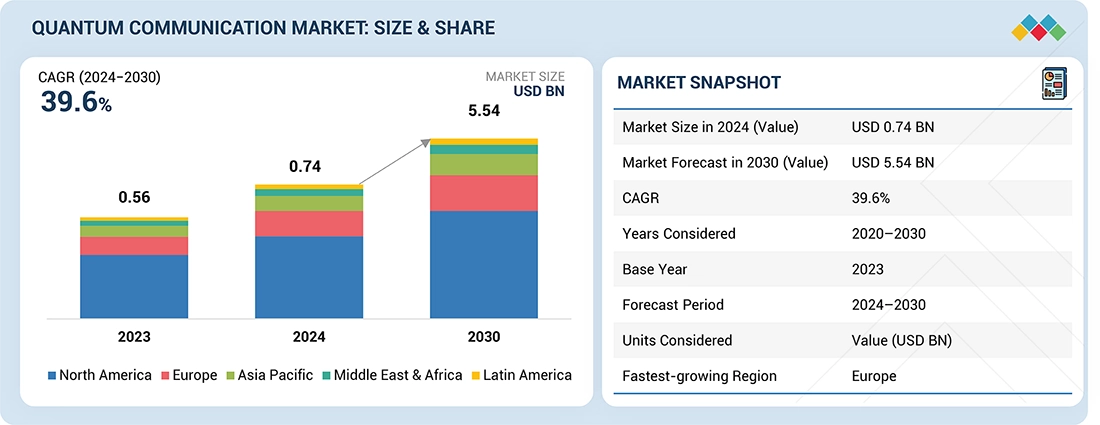
Source: Secondary Research, Interviews with Experts, MarketsandMarkets Analysis
The global quantum communication market size was estimated at USD 0.74 billion in 2024 and is projected to reach USD 5.54 billion by 2030, growing at a CAGR of 39.6% from 2024 to 2030. Quantum communications is an advanced security technology that uses quantum mechanics to enable ultra-secure data transmission and key exchanges. Market growth is driven by the threat of quantum computers compromising traditional encryption like RSA and ECC, and "harvest now, decrypt later" attacks. Across BFSI, government & defense, healthcare, aerospace, and IT & telecommunications, organizations are adopting QKD, satellite-based quantum links, and other quantum-secure solutions to protect sensitive data, ensure compliance, and strengthen cybersecurity.
Market Size and Forecast:
- Market Size in 2023: USD 0.56 Billion
- 2024 Market Size: USD 0.74 Billion
- 2030 Forecasted Market Size: USD 5.54 Billion
- Growth Rate (2024-2030): CAGR of 39.6%
- Forecast period: 2024–2030
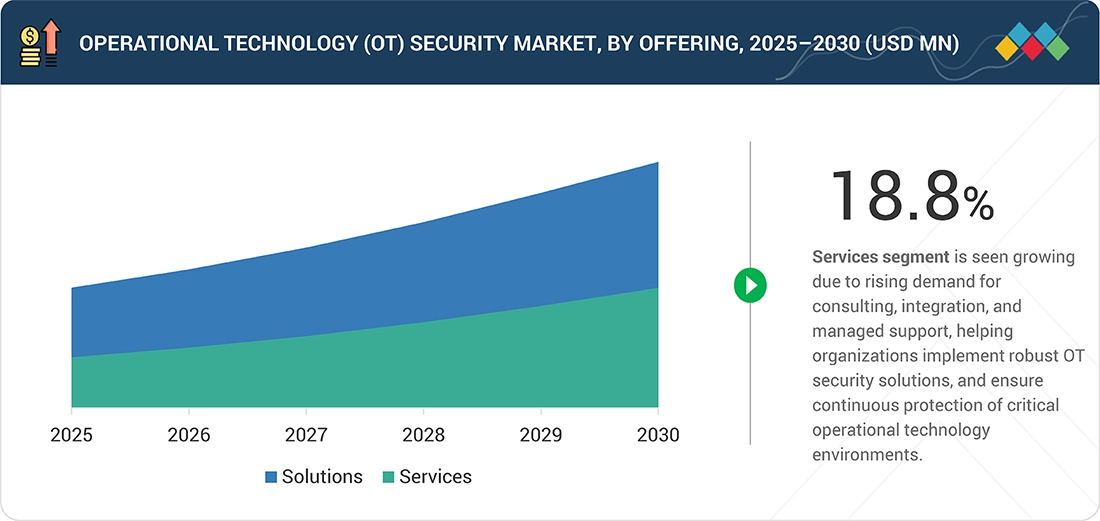
- Services segment is expected to register the highest CAGR of 18.8%.
Key Market Trends and Insights
- Future Outlook: Quantum market growth is driven by rising demand for secure communication and quantum network investments.
-
Growth Factors: Rising risks to conventional encryption and expanding infrastructure investments drive market growth.
- Key Trends: Secure data transmission trends include growing adoption of QKD, quantum-safe cryptography, and satellite networks.
- Growth Opportunities: Deployment is expanding across government, defense, BFSI, telecom, and critical infrastructure sectors.
KEY TAKEAWAYS
-
BY OFFERINGThe quantum communication market is divided into solutions and services. Solutions include quantum communication components (QCC), quantum key distribution (QKD) solutions, quantum random number generators (QRNG), and quantum-safe cryptographic (QSC) solutions for secure data transmission. Services cover professional and managed offerings that support deployment, integration, and maintenance, enabling organizations across various sectors to safeguard critical data and infrastructure.
-
BY TRANSMISSION MEDIUMThe quantum communication market, by transmission medium, includes fiber-based QKD for secure short-to-medium distances and free space/satellite-based QKD for long-distance global communication, enabling adoption across BFSI, government & defense, healthcare, aerospace, and IT & telecommunications.
-
BY DEPLOYMENT MODEBy deployment mode, the quantum communication market includes cloud for scalable, flexible access and on-premises for enhanced control and security, enabling organizations to optimize infrastructure, improve data management, and strengthen cybersecurity.
-
BY ORGANIZATION SIZEBy organization size, the quantum communication market includes SMEs for cost-effective security and large enterprises for robust cybersecurity and protection of critical data across complex networks.
-
BY VERTICALBy vertical, BFSI leads in demand due to the need for secure transactions and protection against cyber threats, followed by IT & Telecommunications for safeguarding critical networks and data, and Healthcare for securing sensitive patient information and complying with stringent data privacy regulations.
-
BY REGIONThe quantum communication market spans North America, Europe, Asia Pacific, Middle East & Africa, and Latin America. North America is the largest market, driven by advanced R&D initiatives, high adoption of cutting-edge technologies, strong government support, and significant investments in cybersecurity and quantum communication infrastructure.
-
COMPETITIVE LANDSCAPEMajor market players have pursued both organic and inorganic strategies, including partnerships and investments. For example, Toshiba (Japan), Thales (France), IDEMIA (France), and ID Quantique (Switzerland) have formed multiple agreements and collaborations to address the growing demand for quantum communication solutions and secure data transmission across various industries.
The quantum communication market is experiencing rapid growth, driven by the increasing need for ultra-secure data transmission and protection against emerging cyber threats, including attacks from quantum computers that can compromise traditional encryption methods. Adoption of technologies such as quantum key distribution (QKD), satellite-based quantum links, and quantum-secure communication solutions across BFSI, government & defense, healthcare, aerospace, and IT & telecommunications sectors is accelerating. Strategic partnerships, technological innovations, and rising investments in quantum security are reshaping the industry landscape.
TRENDS & DISRUPTIONS IMPACTING CUSTOMERS' CUSTOMERS
The figure highlights the evolving revenue landscape and client priorities in the quantum communication market. Currently, revenue is driven by traditional encryption and secure network solutions, while technologies like QKD, satellite-based quantum links, and quantum-safe cryptography are gaining traction. Over the next 4–5 years, growth is expected to shift toward integrated, scalable quantum communication platforms. Key sectors including Healthcare, BFSI, Government & Defense, IT & Telecommunications, and others are focusing on cybersecurity, secure data transmission, regulatory compliance, and protection of sensitive information.
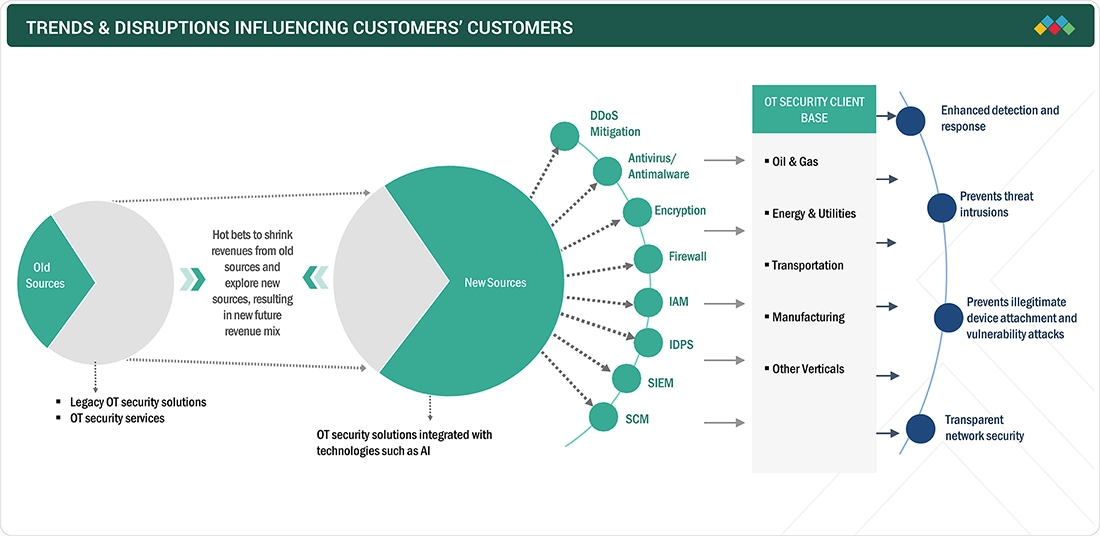
Source: Secondary Research, Interviews with Experts, MarketsandMarkets Analysis
MARKET DYNAMICS

Level
-
Increasing cyber threats boosting demand for robust quantum communication solutions

-
Increasing investment in quantum technology


Level
-
High implementation costs

-
Technological complexity


Level
-
Emphasis on data protection and privacy

-
Integration with emerging technologies


Level
-
Regulatory and standardization challenges

-
Integration complexity

Source: Secondary Research, Interviews with Experts, MarketsandMarkets Analysis
Driver: Increasing cyber threats boosting demand for robust quantum communication solutions
One of the major drivers of the quantum communication market is the growing threat of sophisticated cyberattacks and the vulnerabilities of traditional encryption methods like RSA and ECC against quantum computing. Quantum Key Distribution (QKD) provides a secure, tamper-proof key exchange mechanism, addressing rising cybersecurity concerns. With cybercrime costs projected to reach USD 10.5 trillion by 2025, organizations are increasingly investing in quantum communication to ensure future-ready data protection and resilience.
Restraint: High implementation costs
The high costs of developing and implementing quantum communication systems are a significant restraint in the quantum communication market. The advanced hardware, software, and infrastructure required, along with the need for skilled personnel, create substantial financial barriers. This limits adoption among SMEs, slowing overall market growth and concentrating deployment primarily within larger, resource-rich organizations.
Opportunity: Emphasis on data protection and privacy
The growing emphasis on data protection and privacy is a major opportunity in the quantum communication market. Increasing regulatory scrutiny and consumer awareness are driving demand for robust security solutions. Quantum communication, particularly QKD, enables secure key exchange and data transmission, helping organizations enhance compliance with regulations like GDPR and CCPA, build trust, and gain a competitive edge in industries such as finance, banking, and beyond.
Challenge: Regulatory and standardization challenges
The developing regulatory landscape is a major challenge in the quantum communication market. Unclear guidelines, inconsistent standards across regions like the US, EU, China, and Japan, and the absence of unified protocols can hinder investment and adoption. Establishing cohesive regulations and standardized frameworks is essential to build trust, ensure compliance, and enable the widespread deployment of quantum communication technologies.
Quantum Communication Market: COMMERCIAL USE CASES ACROSS INDUSTRIES
| COMPANY | USE CASE DESCRIPTION | BENEFITS |
|---|---|---|
 |
Hitachi Energy deployed ID Quantique’s SECU1 and SENC1 quantum encryption cards to secure mission-critical networks against cyber and quantum threats. | Delivered quantum-safe encryption, ultra-low latency, and high data reliability, ensuring long-term, secure, and resilient communication. |
 |
EPB, Qubitekk, and Aliro launched the EPB Quantum Network, the first commercial quantum network in the US, to enable secure, scalable communication and support testing of emerging quantum technologies. | Facilitated rapid development and validation of quantum solutions, promoted research collaboration, and advanced innovation through a robust, city-wide quantum infrastructure. |
 |
The Quantum Communications Hub implemented Quantum Key Distribution (QKD) across the UKQN and UKQNtel networks to establish secure quantum communication over existing fiber infrastructure. | Enabled quantum-secure key distribution across wide-area networks, ensured stable data transmission, and advanced the UK’s quantum communication capabilities through seamless integration of classical and quantum traffic. |
Logos and trademarks shown above are the property of their respective owners. Their use here is for informational and illustrative purposes only.
MARKET ECOSYSTEM
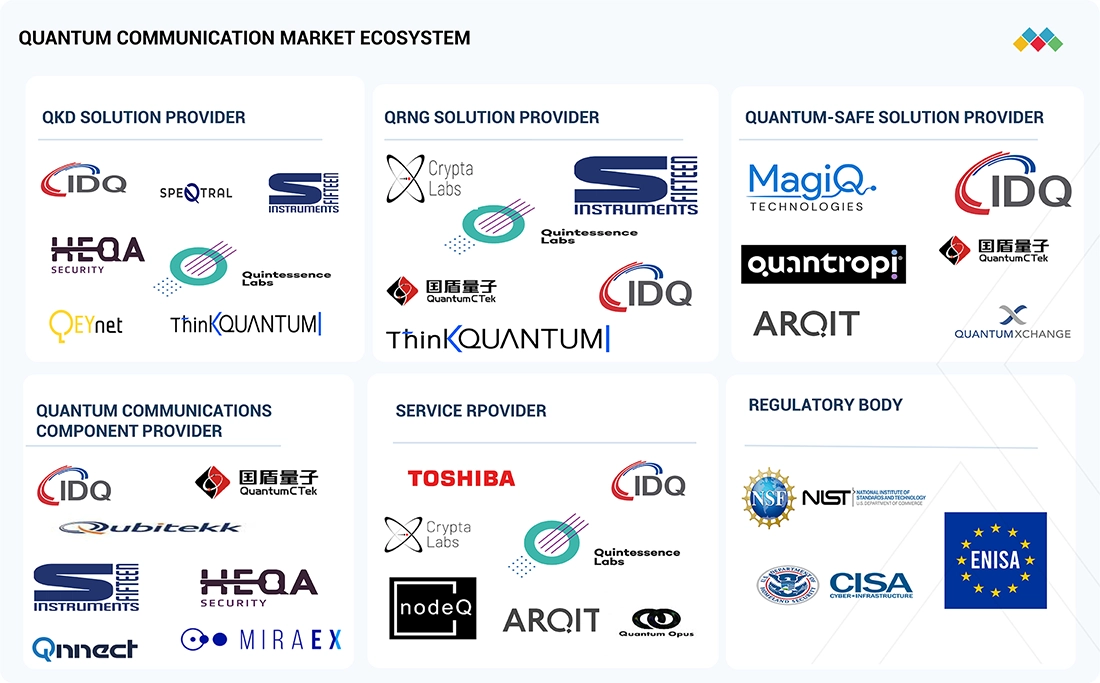
The quantum communication ecosystem involves interconnected components such as Quantum Key Distribution (QKD), Quantum Random Number Generators (QRNG), quantum-safe cryptography, photon detectors, quantum modulators, transceivers, and quantum repeaters. These solutions enable secure data transmission by leveraging quantum mechanics for advanced cryptographic protection. Service providers offer infrastructure, deployment, and integration expertise, while regulatory bodies set standards to ensure compliance and interoperability. End users span industries like BFSI, healthcare, government & defense, IT & telecommunications, and aerospace, adopting quantum communication to safeguard sensitive data, prevent cyber threats, and future-proof networks.
Logos and trademarks shown above are the property of their respective owners. Their use here is for informational and illustrative purposes only.
MARKET SEGMENTS
Source: Secondary Research, Interviews with Experts, MarketsandMarkets Analysis
Quantum Communication Market, By Offering
As of 2024, solutions held the largest share of the quantum communication market and are expected to maintain leadership through 2025 due to their role in enabling secure data transmission and key exchange. Widely adopted across BFSI, healthcare, government & defense, IT & telecommunications, and aerospace, solutions such as QKD, QRNG, quantum-safe cryptography, and quantum communication components provide robust security, scalability, and reliability. Advances in integrated quantum platforms further drive adoption, complementing professional and managed services to strengthen overall market growth.
Quantum Communication Market, By Transmission Medium
In 2024, fiber-based QKD dominated the quantum communication market, driven by demand for secure, short- to medium-distance data transmission in urban networks and enterprise applications. Fiber-based solutions offer high reliability, proven performance, and seamless integration with existing infrastructure. Meanwhile, free space and satellite-based QKD are gaining traction for long-distance, global communication. Advances in quantum repeaters and integrated photonic components further enhance performance, enabling scalable, secure, and future-proof quantum communication networks across industries.
Quantum Communication Market, By Deployment Mode
In 2024, on-premises deployment dominated the quantum communication market, driven by organizations’ need for enhanced control, data security, and compliance with internal policies. On-premises solutions offer robust protection for sensitive information and critical infrastructure, making them ideal for large enterprises and government institutions. Meanwhile, cloud-based deployment is gaining adoption due to its scalability, flexibility, and cost-effectiveness. Advances in integration services and secure hybrid architectures further support the growth of on-premises solutions across industries.
Quantum Communication Market, By Organization Size
As of 2024, large enterprises spearheaded growth in the quantum communication market, driven by their requirements for robust cybersecurity, protection of sensitive data, and compliance with strict regulations. These organizations invest in advanced solutions such as QKD, QRNG, and quantum-safe cryptography to build scalable and secure communication networks. While SMEs are slowly adopting cost-efficient alternatives, ongoing innovations in integration services, infrastructure, and quantum platforms continue to reinforce the dominance of large enterprises in deploying quantum communication technologies.
Quantum Communication Market, By Vertical
By vertical, BFSI is expected to hold the largest share of the quantum communication market, driven by the critical need for secure financial transactions, protection against cyber threats, and compliance with stringent regulations. Following BFSI, IT & telecommunications and healthcare are witnessing growing adoption for safeguarding sensitive data and ensuring secure communication. Advances in QKD, quantum-safe cryptography, and integrated quantum platforms are further fueling demand across these sectors.
REGION
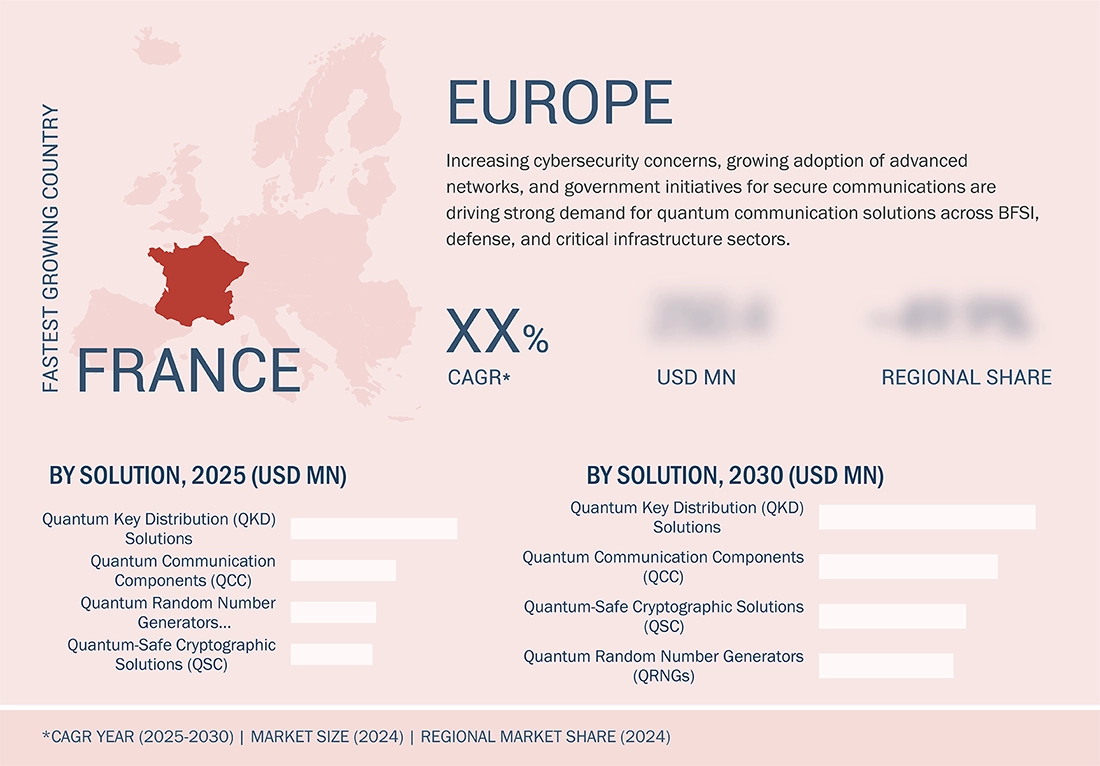
Europe to be fastest-growing region in global quantum communication market during forecast period
The European quantum communication market is expected to register the highest CAGR during the forecast period, driven by strong government initiatives, increased investments in cybersecurity infrastructure, and the rising adoption of advanced quantum technologies. Leading organizations and service providers across the region are deploying solutions such as QKD, QRNG, and quantum-safe cryptography to secure critical data and communication networks. Growing focus on digital sovereignty, regulatory compliance, and secure cross-border communication is further accelerating the adoption of quantum communication technologies in the region.
Quantum Communication Market: COMPANY EVALUATION MATRIX
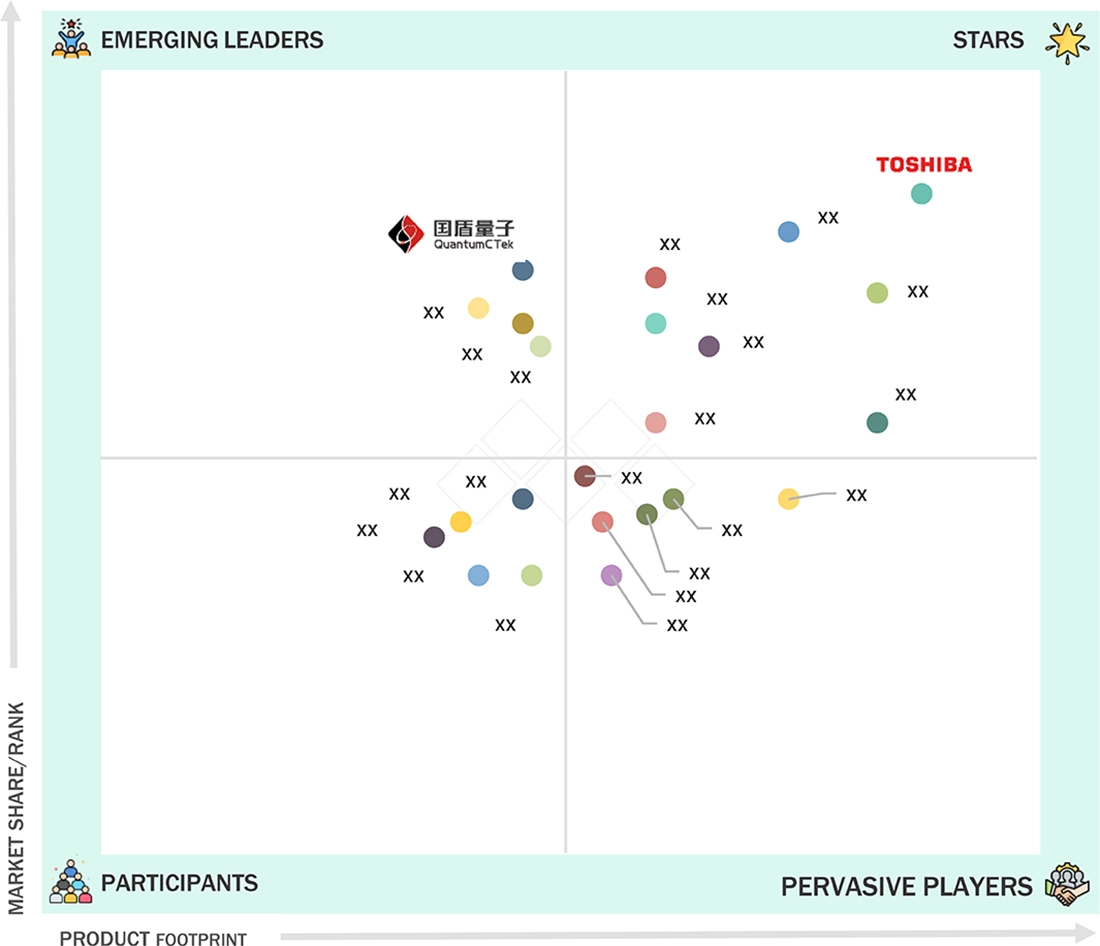
In the quantum communication market matrix, Toshiba (Star) leads with a strong market share and a comprehensive product portfolio, driven by its advanced QKD solutions, QRNGs, and quantum communication components widely adopted across BFSI, government, and defense sectors. QuantumCTek (Emerging Leader) is gaining visibility with its specialized quantum solutions and innovative offerings, strengthening its position through technology development and strategic partnerships. While Toshiba dominates through scale and an extensive portfolio, QuantumCTek shows significant potential to move toward the leaders' quadrant as demand for secure quantum communication continues to rise.
Source: Secondary Research, Interviews with Experts, MarketsandMarkets Analysis
KEY MARKET PLAYERS
MARKET SCOPE
| REPORT METRIC | DETAILS |
|---|---|
| Market Size in 2024 (Value) | USD 0.74 Billion |
| Market Forecast in 2030 (Value) | USD 5.54 Billion |
| Growth Rate | CAGR of 39.6% from 2024-2030 |
| Years Considered | 2020-2030 |
| Base Year | 2023 |
| Forecast Period | 2024-2030 |
| Units Considered | Value (USD Million/Billion) |
| Report Coverage | Revenue forecast, company ranking, competitive landscape, growth factors, and trends |
| Segments Covered |
|
| Regions Covered | North America, Europe, Asia Pacific, Middle East & Africa, and Latin America |
WHAT IS IN IT FOR YOU: Quantum Communication Market REPORT CONTENT GUIDE
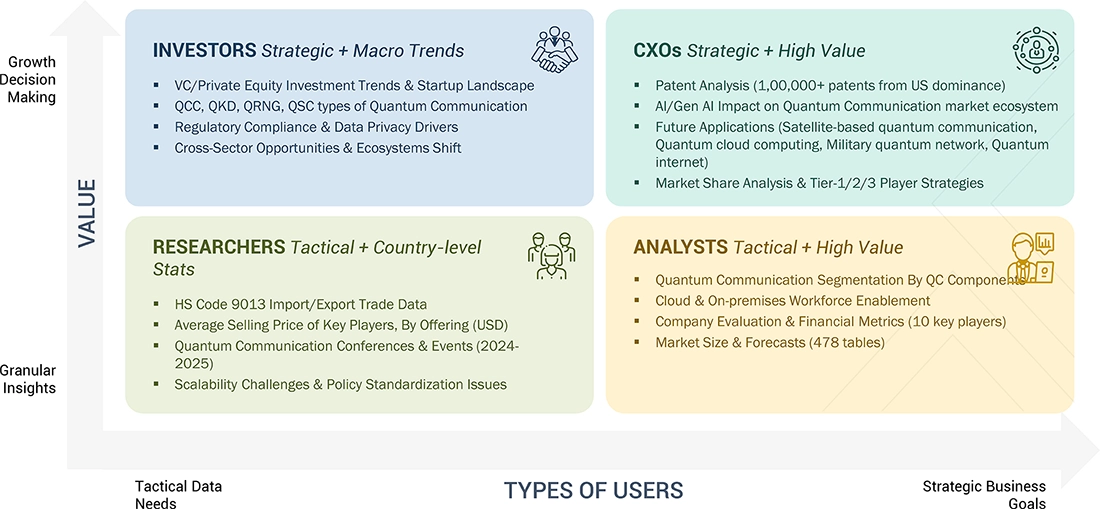
DELIVERED CUSTOMIZATIONS
We have successfully delivered the following deep-dive customizations:
| CLIENT REQUEST | CUSTOMIZATION DELIVERED | VALUE ADDS |
|---|---|---|
| Leading Solution Provider (US) | Product Analysis: Quantum Communication Product Matrix providing an in-depth comparison of each company’s portfolio, including QKD, QRNG, quantum-safe cryptography, and related components. | Deeper understanding of market positioning, product differentiation, and innovation strategies to support strategic decision-making. |
| Leading Service Provider (EU) | Company Information: Detailed profiling and evaluation of additional market participants (up to 5), covering capabilities, offerings, technological expertise, and strategic initiatives. | Comprehensive overview of the quantum communication landscape, highlighting growth opportunities, emerging trends, and potential areas for collaborations or strategic partnerships. |
RECENT DEVELOPMENTS
- April 2024 : Toshiba has partnered with KT Corporation to showcase how hybrid quantum secure communications, combining Quantum Key Distribution (QKD) and Post-Quantum Cryptography (PQC), can protect financial networks from quantum cyberattacks. This demonstration was conducted at Shinhan Bank in South Korea.
- March 2024 : IDQ has launched a quantum-safe communication ecosystem with partners HEQA Security, LuxQuanta, Quantum Optics Jena, and ThinkQuantum to drive the adoption of quantum networks. ID Quantique’s expanded ecosystem and open interfaces allow clients to utilize hybrid QKD networks, supporting continuous variables (CV), discrete variables (DV), and entanglement-based QKD.
- March 2024 : Quantum Xchange has partnered with Juniper Networks, a leader in AI-driven secure networking, to deliver quantum-resistant data and communication networks to Managed Service Providers (MSPs), government agencies, and global enterprises.
- October 2023 : 1touch.io and QuintessenceLabs formed a strategic partnership to bolster enterprise defenses against quantum computing threats. By combining 1touch.io’s cryptographic discovery capabilities with QuintessenceLabs’ quantum-resistant encryption, the collaboration enabled organizations to identify vulnerabilities and transition to post-quantum communication, ensuring long-term data protection and operational efficiency in the quantum era.
- June 2023 : Crypta Labs has partnered with, Blueshift Memory, a designer of high-speed memory architecture to create a cybersecurity memory solution designed to counter quantum computing threats.
Table of Contents
 Exclusive indicates content/data unique to MarketsandMarkets and not available with any competitors.
Methodology
The study involved estimating the current quantum communication market size significantly. Exhaustive secondary research was done to collect information on the quantum communication industry. The next step was to validate these findings, assumptions, and sizing with industry experts across the value chain using primary research. Different approaches, such as top-down and bottom-up, were employed to estimate the total market size. After that, the market breakup and data triangulation procedures were used to estimate the market size of the segments and subsegments of the quantum communication market.
Secondary Research
The market for the companies offering quantum communication solutions and services is arrived at by secondary data available through paid and unpaid sources, analyzing the product portfolios of the major companies in the ecosystem, and rating the companies by their performance and quality. Various sources were referred to in the secondary research process to identify and collect information for this study. The secondary sources include annual reports, press releases, investor presentations of companies, white papers, journals, certified publications, and articles from recognized authors, directories, and databases.
In the secondary research process, various secondary sources were referred to to identify and collect information related to the study. Secondary sources included annual reports, press releases, and investor presentations of quantum communication vendors, forums, certified publications, and whitepapers. The secondary research was used to obtain essential information on the industry’s value chain, the total pool of key players, market classification, and segmentation from the market and technology-oriented perspectives.
Primary Research
In the primary research process, various supply and demand sources were interviewed to obtain qualitative and quantitative information for this report. The primary sources from the supply side included industry experts, such as Chief Executive Officers (CEOs), Vice Presidents (VPs), marketing directors, technology and innovation directors, and related key executives from various key companies and organizations operating in the quantum communication market.
After the complete market engineering (calculations for market statistics, market breakdown, market size estimations, market forecasting, and data triangulation), extensive primary research was conducted to gather information and verify and validate the critical numbers arrived at. Primary research was also undertaken to identify the segmentation types, industry trends, competitive landscape of quantum communication solutions offered by various market players, and fundamental market dynamics, such as drivers, restraints, opportunities, challenges, industry trends, and key player strategies.
In the complete market engineering process, the top-down and bottom-up approaches and several data triangulation methods were extensively used to perform the market estimation and market forecasting for the overall market segments and subsegments listed in this report. Extensive qualitative and quantitative analysis was performed on the complete market engineering process to list the key information/insights throughout the report.
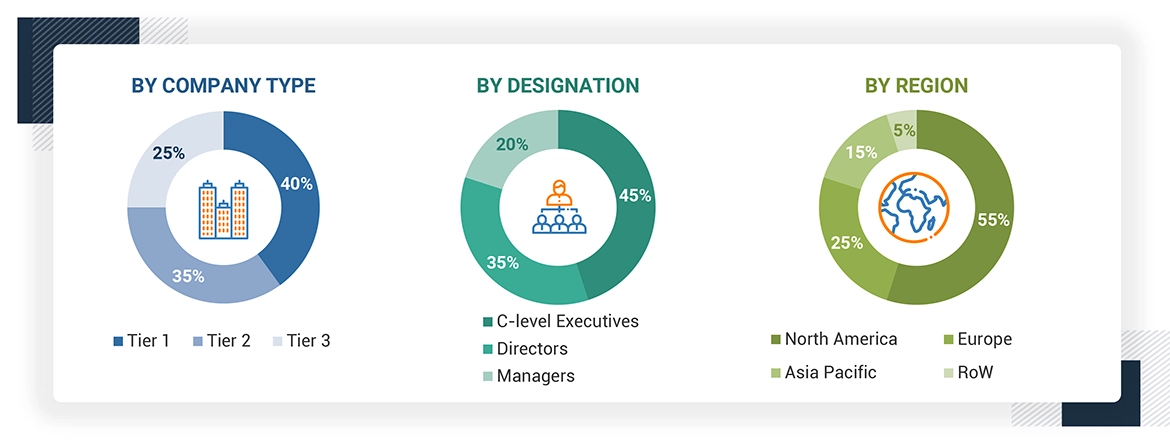
Note: The companies have been categorized based on their total annual revenue; tier 1 companies
= revenue greater than USD 10 billion; tier 2 companies = revenue between USD 1 billion and USD 10 billion;
tier 3 companies = revenue between USD 500 million and USD 1 billion.
Other levels include sales managers, marketing managers, and product managers.
Source: MarketsandMarkets Analysis
To know about the assumptions considered for the study, download the pdf brochure
Market Size Estimation
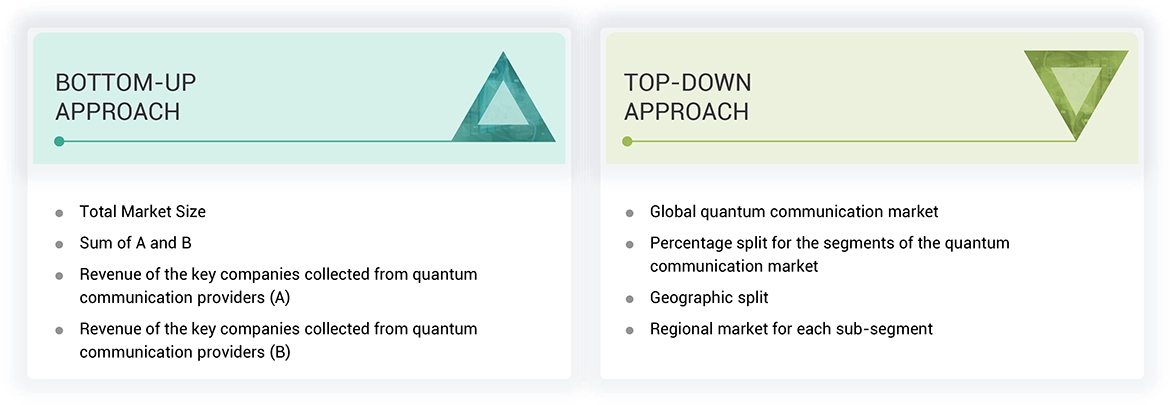
Top-down and bottom-up approaches were used to estimate and validate the size of the global quantum communication market and the size of various other dependent sub-segments in the overall market. The research methodology used to estimate the market size includes the following details: key players in the market were identified through secondary research, and their market shares in the respective regions were determined through primary and secondary research. This entire procedure included the study of the annual and financial reports of the top market players, and extensive interviews were conducted for key insights from the industry leaders, such as CEOs, VPs, directors, and marketing executives.
All percentage splits and breakdowns were determined using secondary sources and verified through primary sources. All possible parameters that affect the market covered in this research study have been accounted for, viewed in extensive detail, verified through primary research, and analyzed to get the final quantitative and qualitative data. This data is consolidated and added to detailed inputs and analysis from MarketsandMarkets.
Quantum Communication Market : Top-Down and Bottom-Up Approach
Data Triangulation
After arriving at the overall market size using the market size estimation processes explained above, the market was split into several segments and subsegments. The data triangulation and market breakup procedures were employed, wherever applicable, to complete the overall market engineering process and arrive at the exact statistics of each market segment and subsegment. The data was triangulated by studying various factors and trends from both the demand and supply sides.
Market Definition
According to MnM, “The Quantum Communications Market refers to the industry focused on developing, deploying, and commercializing technologies that leverage the principles of quantum mechanics to enable secure data transmission and communication. This market encompasses a range of products and services, including Quantum Key Distribution (QKD) systems, Quantum Random Number Generators (QRNG), and associated network infrastructure. The primary goal is to provide enhanced security features, such as quantum-resistant encryption, that protect against classical and quantum-based cyber threats.”
Stakeholders
- Government Agencies
- Quantum communication solution and service providers
- System Integrators
- Value-added Resellers (VARs)
- Distribution Partners
- Managed Service Providers
Report Objectives
- To define, describe, and forecast the quantum communication market based on - offering, QKD transmission type, deployment mode, organization size, vertical, and region.
- To define, describe, and forecast the market based on - offering, QKD transmission type, deployment mode, organization size, vertical, and region.
- To forecast the market size of five main regions: North America, Europe, Asia Pacific (APAC), Middle East & Africa (MEA), and Latin America
- To analyze the subsegments of the market concerning individual growth trends, prospects, and contributions to the overall market.
- To provide detailed information related to the primary factors (drivers, restraints, opportunities, and challenges) influencing the growth of the quantum communication market.
- To analyze opportunities in the market for stakeholders by identifying high-growth segments of the market.
- To profile the key players of the quantum communication market and comprehensively analyze their market size and core competencies.
- Track and analyze competitive developments, such as new product launches, mergers and acquisitions, partnerships, agreements, and collaborations in the global quantum communication market.
Available Customizations
With the given market data, MarketsandMarkets offers customizations based on company-specific needs. The following customization options are available for the report:
Geographic Analysis as per Feasibility
- Further breakup of the Asia Pacific market into countries contributing 75% to the regional market size
- Further breakup of the North American market into countries contributing 75% to the regional market size
- Further breakup of the Latin American market into countries contributing 75% to the regional market size
- Further breakup of the Middle Eastern and African market into countries contributing 75% to the regional market size
- Further breakup of the European market into countries contributing 75% to the regional market size
Company Information
- Detailed analysis and profiling of additional market players (up to 5)
Key Questions Addressed by the Report


Personalize This Research
- Triangulate with your Own Data
- Get Data as per your Format and Definition
- Gain a Deeper Dive on a Specific Application, Geography, Customer or Competitor
- Any level of Personalization
Let Us Help You
- What are the Known and Unknown Adjacencies Impacting the Quantum Communication Market
- What will your New Revenue Sources be?
- Who will be your Top Customer; what will make them switch?
- Defend your Market Share or Win Competitors
- Get a Scorecard for Target Partners

Custom Market Research Services
We Will Customise The Research For You, In Case The Report Listed Above Does Not Meet With Your Requirements
Get 10% Free CustomisationTESTIMONIALS
- Canada Quantum Communication Market
- US Quantum Communication Market
- UK Quantum Communication Market
- Germany Quantum Communication Market
- France Quantum Communication Market
- Italy Quantum Communication Market
- China Quantum Communication Market
- Japan Quantum Communication Market
- India Quantum Communication Market
- Singapore Quantum Communication Market
- Rest Of Europe Quantum Communication Market
- Rest Of Asia Pacific Quantum Communication Market
- GCC Quantum Communication Market
- South Africa Quantum Communication Market






Growth opportunities and latent adjacency in Quantum Communication Market