Residential Modular Construction Market

Residential Modular Construction Market by Type (Permanent, Relocatable), Material (Wood, Steel, Concrete), Module, and Region - Global Forecast to 2030




OVERVIEW
Source: Secondary Research, Interviews with Experts, MarketsandMarkets Analysis
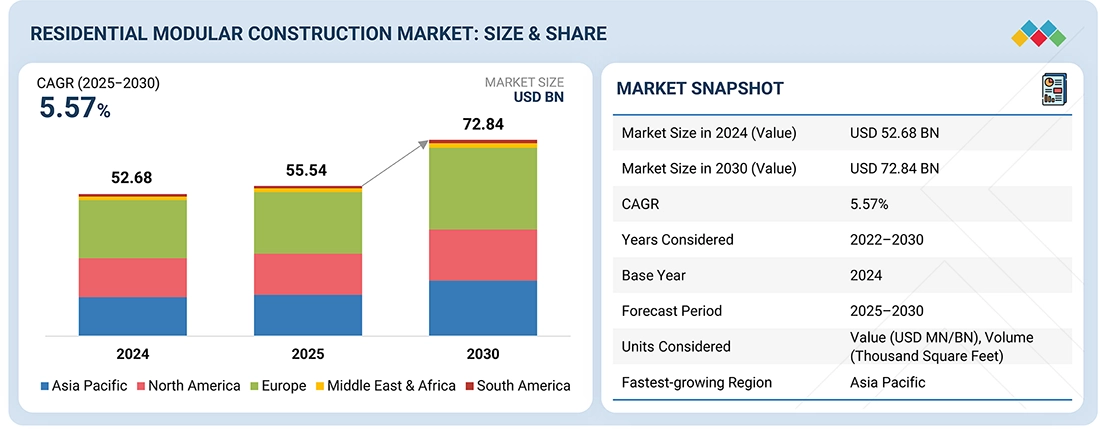
The Residential modular construction is expected to expand from USD 55.54 billion in 2025 to USD 72.84 billion by 2030, with a CAGR of 5.57% during the forecast period. The global residential modular construction market is growing gradually because of increasing need for faster, cheaper, and higher quality housing. The increase in urban population, the housing shortage that still exists in many countries, and the delays that are the consequence of traditional constructions have made governments and builers look for modular buildings as the solution. Modular houses help in pushing down costs, labor shortages, and delivery times. As per Modular Building Institute, modular constructions are able to reduce by 25 to 50 per cent the time periods for the project. This is resulting in its quick adoption in the construction of single-family homes, multifamily residential projects, student housing, and workforce accommodations. Modular homes provide greater design freedom, structural quality, and durability. Increasing land costs, supply-chain inefficiencies, and the need to hush on-site activities have all contributed to the acceleration of the factory-fabricated housing trend. With more money flowing into modular production facilities and more people recognizing modular construction as a viable, environmentally friendly housing method, the global residential modular construction market is gathering impressive speed.
KEY TAKEAWAYS
-
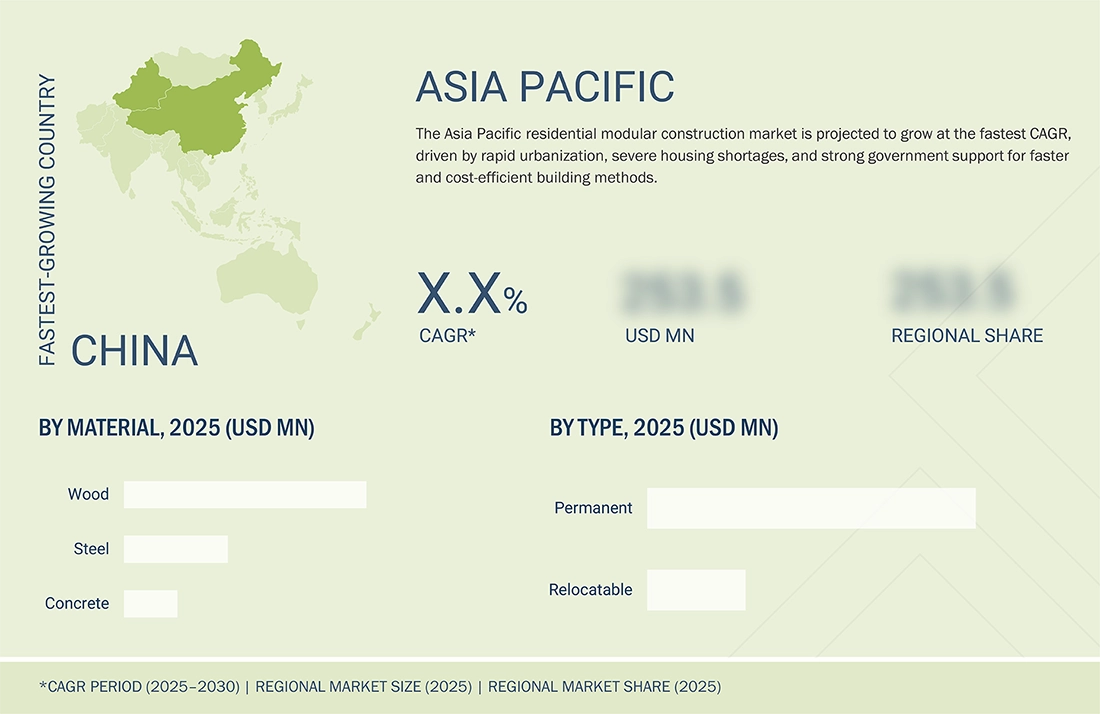
By RegionAsia Pacific Residential modular construction market to register the highest growth during the forecast period.
-
By MaterialBy material, the steelsegment is expected to register the highest CAGR of 6.90% from 2025 to 2030, in terms of value.
-
By TypeBy Type, the Relocatable structures segment is expected to register the highest CAGR of 7.5% from 2025 to 2030, in terms of value.
-
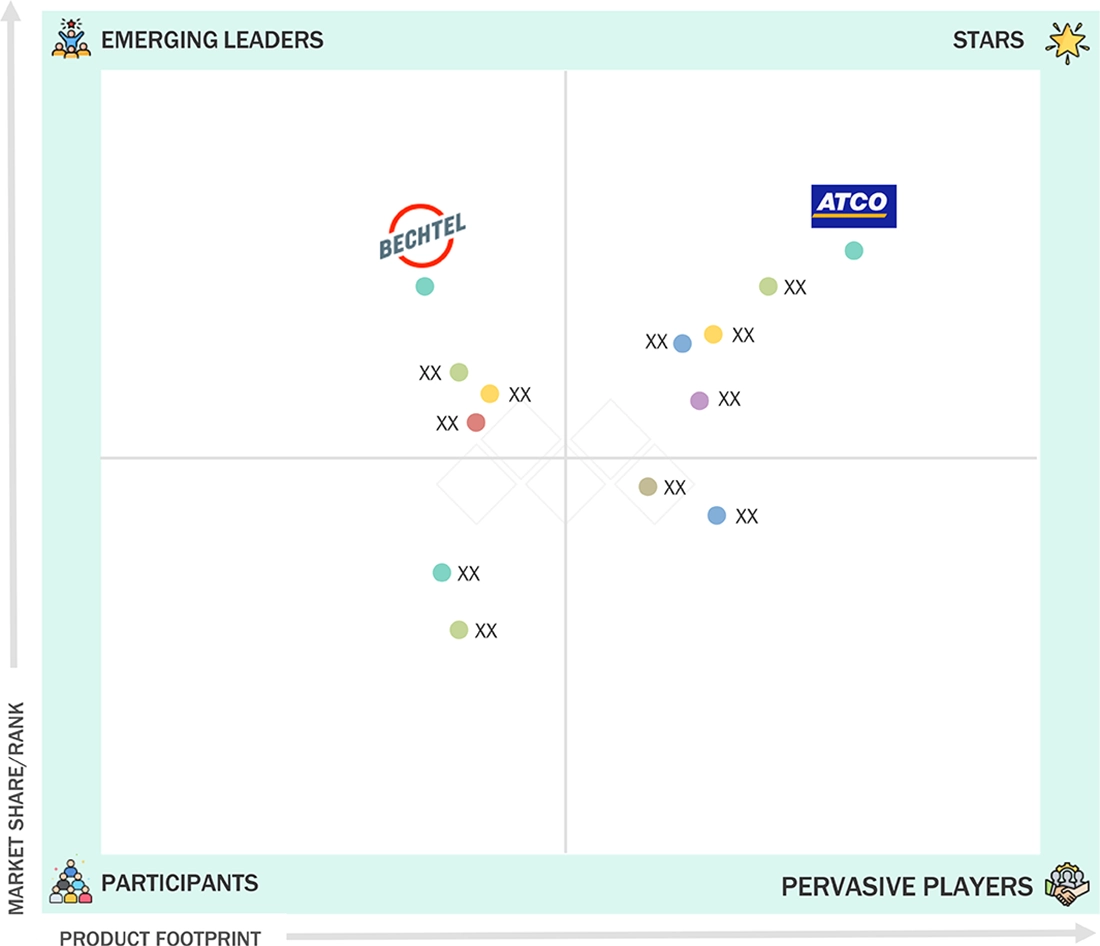
Competitive Landscape - Key PlayersLaing O’Rourke (UK), Red Sea Housing (Saudi Arabia), Atco Ltd. (Canada), Skanska AB (Sweden), and Bechtel Corporation (US) were identified as Star players in the residential modular construction market, as they have focused on innovation and have broad industry coverage, and strong operational & financial strength.
-
Competitive Landscape- StartupsBoxabl (USA), Veev (USA), Modulous (UK), KEF Infra (India), Champion Infratech (India) among others have distinguished themselves among startups and SMEs due to their strong product portfolio and business strategy.
The residential modular construction market is gaining momentum worldwide as governments, housing authorities, and research institutions highlight the growing pressure of housing shortages and the need for faster, more reliable building methods. In the United States, the US Census Bureau continues to report a housing deficit of more than 3.8 million units, intensifying demand for alternative homebuilding solutions that can accelerate delivery. The National Institute of Building Sciences notes that modular construction can cut project timelines by 25–50%, making it a practical tool for addressing affordability and speed concerns in stressed housing markets. Across Europe, the EU’s Housing Europe Observatory has documented chronic shortages in major cities, encouraging municipalities to pilot modular and prefabricated housing for social and emergency accommodation. In the Asia–Pacific region, governments in Japan and Singapore have expanded support for industrialized construction methods such as Singapore’s requirement for selected residential projects to use Prefabricated Prefinished Volumetric Construction (PPVC), to reduce labor dependence and improve quality consistency.
TRENDS & DISRUPTIONS IMPACTING CUSTOMERS' CUSTOMERS
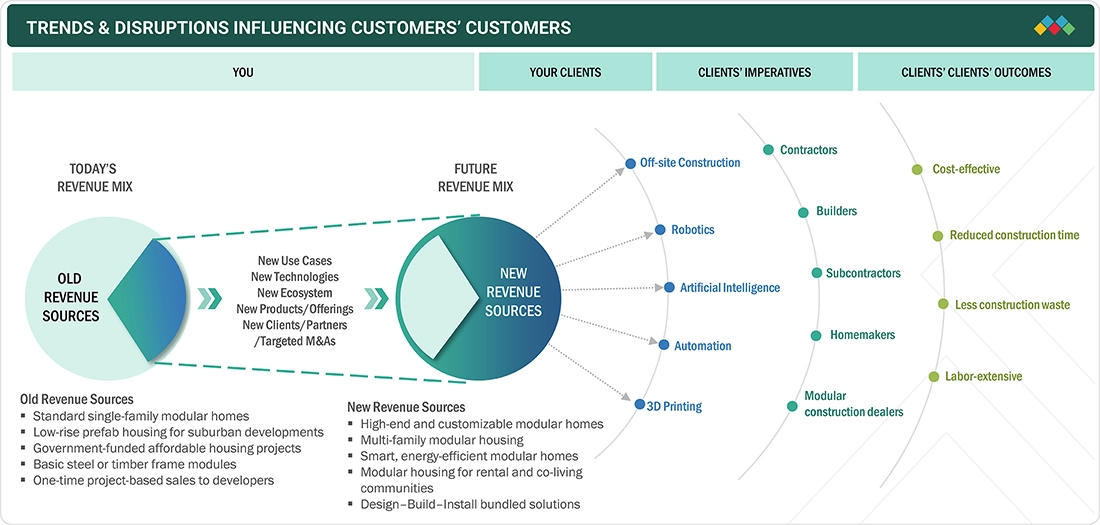
The residential modular construction market is gaining strong momentum as developers, homeowners, and governments increasingly seek faster and more cost-efficient housing solutions. A key trend is the growing shift toward factory-based manufacturing, which allows builders to achieve consistent quality, shorten construction timelines, and reduce dependence on skilled on-site labor. Another important trend is the rising use of modular methods in multifamily and urban housing projects, especially as cities face growing demand for affordable and high-density residential units. Sustainability is also becoming a major driver, with modular homes appealing to buyers due to lower material waste, higher energy efficiency, and better alignment with green-building standards. In addition, digital technologies such as Building Information Modeling, 3D design platforms, and automated production systems are improving precision and scalability. With many governments recognizing off-site construction as a way to ease housing shortages, these trends together are accelerating the adoption of modular construction across the residential sector.
Source: Secondary Research, Interviews with Experts, MarketsandMarkets Analysis
MARKET DYNAMICS

Level
-
Need for time-saving and cost-effective construction

-
Investments in infrastructure industry


Level
-
Risk of transportation and assembly issues in modular constructions

-
Lack of awareness in developing economies


Level
-
Population growth and urbanization translating to increased number of construction projects

-
Increasing demand for high-end residential and multi-story buildings


Level
-
Lack of experts in the market

-
Volatility in transportation charges

Source: Secondary Research, Interviews with Experts, MarketsandMarkets Analysis
Driver: Need for time saving and cost efficient construction
Residential modular construction is gaining momentum because it significantly reduces project timelines and overall costs compared to conventional building methods. Factory manufacturing enables parallel site preparation and module production, cutting construction time by 30 to 50 percent in many cases. This accelerated delivery lowers labor expenses, minimizes weather related delays, and reduces material wastage, making modular homes an attractive option for developers facing tight deadlines and rising building costs.
Restraint: Risk of transportation and assembly issues
Despite its advantages, modular construction faces logistical challenges that can slow adoption. Transporting large prefabricated modules requires specialized vehicles, route permits, and careful handling to avoid damage. In dense urban areas or regions with limited road access, moving modules from factory to site can be complex and costly. Additionally, improper on site assembly or misalignment may lead to delays or quality concerns, making some developers hesitant to adopt this method.
Opportunity: Urbanization driving demand for more housing projects
Rapid population growth and rising urbanization in many countries are creating a strong need for faster and scalable housing solutions. Governments and private developers are increasingly seeking construction methods that can address housing shortages without compromising quality. Modular construction offers a way to meet demand for multi family housing, affordable homes, and high density developments by delivering uniform quality, faster build cycles, and predictable project outcomes.
Challenge: Volatility in transportation charges
One of the major challenges for modular construction is fluctuating transportation costs, which can affect project budgets and profitability. Since modules are built off site and transported over long distances, rising fuel prices, variable freight rates, and regulatory fees can significantly increase total project expenses. These unpredictable logistics costs can make modular homes less appealing to developers working with strict financial constraints.
RESIDENTIAL MODULAR CONSTRUCTION MARKET: COMMERCIAL USE CASES ACROSS INDUSTRIES
| COMPANY | USE CASE DESCRIPTION | BENEFITS |
|---|---|---|
 |
Used modular and panelized components for single-family and multi-family housing to speed up construction in high-demand regions. | Faster project delivery Lower on-site labor needs Consistent factory-controlled quality Reduced material waste |
 |
Deployed fully prefabricated residential modules with integrated systems for rapid installation in urban and suburban areas. | High precision and durability Quicker occupancy timelines Better energy efficiency Less neighborhood disruption |
 |
Integrated modular home units into large mixed-use and residential developments to scale housing supply efficiently. | Predictable timelines and costs Supports large-scale housing delivery Lower environmental impact Phased construction with minimal disruption |
 |
Deployed fully prefabricated residential modules with integrated systems for rapid installation in urban and suburban areas. | -High precision and durability |
Logos and trademarks shown above are the property of their respective owners. Their use here is for informational and illustrative purposes only.
MARKET ECOSYSTEM
The ecosystem of the residential modular construction market is built around a coordinated network of material suppliers, modular manufacturers, distributors, builders, and final end users. Raw materials such as wood, steel, insulation panels, interior fittings, and mechanical systems are supplied by specialized vendors to modular manufacturers who use automated fabrication lines and standardized design processes to produce residential modules. Distributors and logistics partners then ensure smooth transportation and on-site delivery, where builders and installation contractors assemble the modules into completed homes or multi-unit structures. The ecosystem also includes architects, engineering firms, permitting authorities, and financing institutions that shape design standards, compliance requirements, and adoption decisions. Finally, end users ranging from real estate developers and community housing organizations to individual homebuyers drive demand for faster, cost-efficient, and sustainable residential construction solutions.
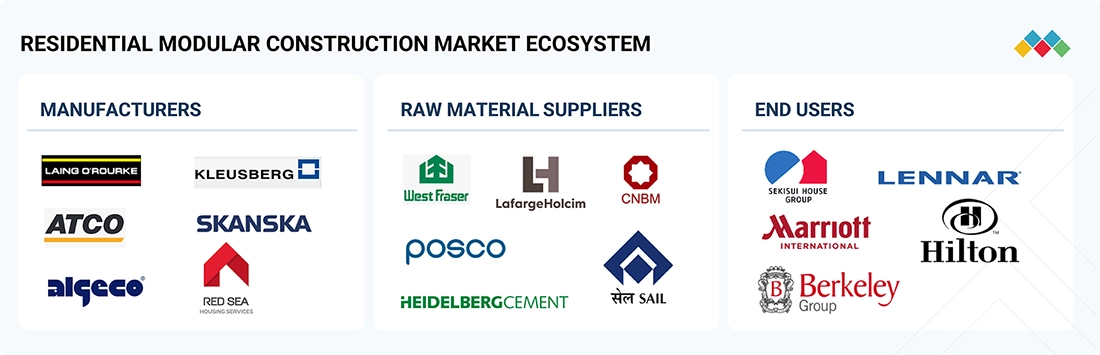
Logos and trademarks shown above are the property of their respective owners. Their use here is for informational and illustrative purposes only.
MARKET SEGMENTS
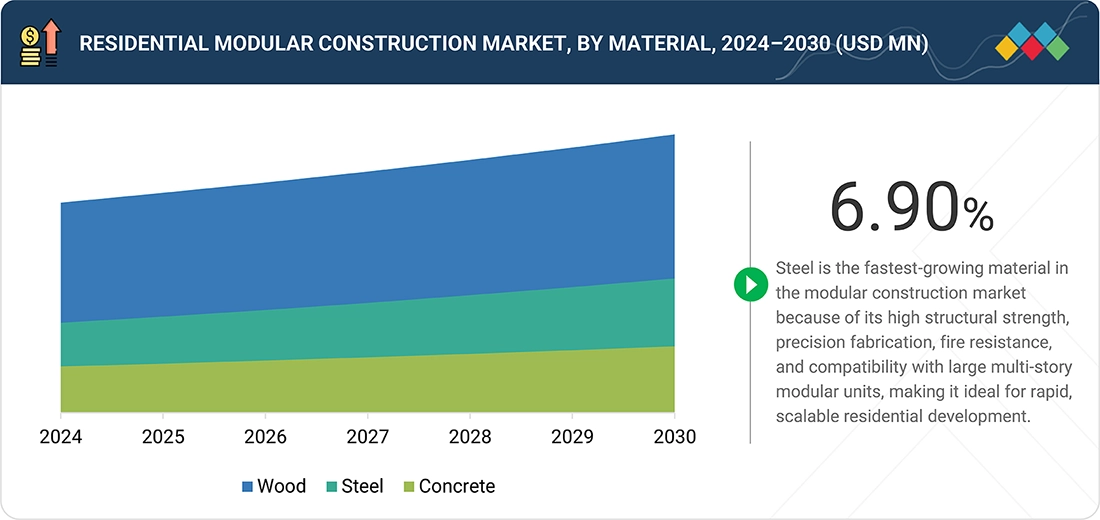
Source: Secondary Research, Interviews with Experts, MarketsandMarkets Analysis
Residential Modular Construction Market, By Type
Wood remains the largest material segment in residential modular construction because it is lightweight, cost-effective, and easier to fabricate into modular units compared to steel or concrete. Its strong thermal insulation properties, design flexibility, and lower carbon footprint make it the preferred choice for sustainable housing models. Wood-based modules can be manufactured faster, transported more efficiently, and installed with less on-site labor, which aligns perfectly with the speed-driven and affordability-driven nature of the residential modular sector.
Residential Modular Construction Market, By Material
Permanent modular construction dominates the residential market because homebuyers and developers increasingly prefer long-term, structurally sound housing solutions rather than temporary or relocatable units. Permanent modules allow full integration of utilities, advanced finishes, and multi-story configurations, providing the durability and performance of traditional construction with significantly shorter timelines. Developers also favor permanent modular designs because they enhance asset value, support large-scale community developments, and offer better financing and regulatory alignment compared to temporary structures.
REGION
Asia Pacific to be the fastest-growing region in the Residential modular construction market during the forecast period
APAC is the fastest-growing region due to rapid urbanization, severe housing shortages, and strong government backing for prefabricated and industrialized construction methods across countries like China, Japan, Australia, and Singapore. The region faces rising labor costs and productivity gaps in traditional construction, pushing developers toward modular solutions that reduce waste and accelerate delivery. In addition, increasing disaster-resilient housing needs and large-scale affordable housing programs are driving faster adoption of modular systems in the region’s residential segment.
RESIDENTIAL MODULAR CONSTRUCTION MARKET: COMPANY EVALUATION MATRIX
ATCO plays a strategic role in the market and leads the market through its long-standing expertise in modular infrastructure, standardized unit design, and large-scale deployment capabilities across housing and community projects. Alongside such established players, Bechtel Corporation is emerging as a significant leader, leveraging its advanced project-delivery systems, digital engineering tools, and expanding interest in modularized residential solutions to improve speed, cost efficiency, and construction precision across the value chain.
Source: Secondary Research, Interviews with Experts, MarketsandMarkets Analysis
KEY MARKET PLAYERS
MARKET SCOPE
| REPORT METRIC | DETAILS |
|---|---|
| Market Size in 2024 (Value) | USD 52.68 BN |
| Market Size in 2030 (Value) | USD 72.84 BN |
| CAGR | 5.57% |
| Years Considered | 2022–2030 |
| Base Year | 2024 |
| Forecast Period | 2025–2030 |
| Units Considered | Value (USD MN), Volume (Thousand square feet) |
| Report Coverage | Revenue forecast, company ranking, competitive landscape, growth factors, and trends |
| Segments Covered | By Material: Wood, Steel, Concrete By Type: Permanent, Relocatable |
| Regions Covered | Asia Pacific, North America, Europe, Middle East & Afrca, South America |
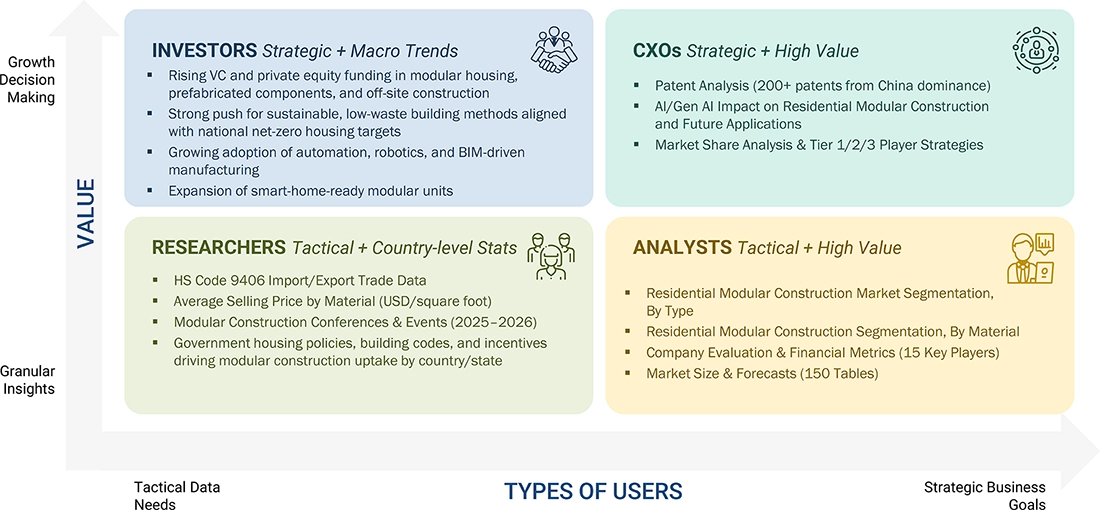
WHAT IS IN IT FOR YOU: RESIDENTIAL MODULAR CONSTRUCTION MARKET REPORT CONTENT GUIDE
DELIVERED CUSTOMIZATIONS
We have successfully delivered the following deep-dive customizations:
| CLIENT REQUEST | CUSTOMIZATION DELIVERED | VALUE ADDS |
|---|---|---|
| North America residential modular construction market assessment | Market sizing for US, Canada, Mexico and Rest of North America; Analysis of growth rates and demand by state/province | Provided latest market estimates ; Identified fastest-growing states; Highlighted expected CAGR and volume additions over the next 5 years |
| APAC modular housing opportunity sizing | Country-level demand sizing for volumetric modules and panelized systems; evaluation of government-driven housing programs; Analysis f 20 APAC countries | Delivered country-specific market numbers for more than 20 APAC countries |
| Benchmarking of leading modular home manufacturers | Comparative study of top 5 players | Provided detailed revenue analysis, competitor profiling, and benchmarking of pricing; identified companies with strongest market presence and fastest-growing portfolios |
RECENT DEVELOPMENTS
- December 2024 : Skanska AB announced an investment of SEK 220 million (USD 21 million) in a residential apartment building project in Uppsala, Sweden.
- October 2023 : Algeco Scotsman launched a range of modular Community Diagnostic Centres (CDCs) in standard sizes for the healthcare sector reflecting diversification of modular offerings beyond traditional housing.
- September 2024 : ATCO Structures acquired NRB Modular Solutions for USD 40 million strengthening its modular housing portfolio.
- February 2024 : Skanska signed a contract to build a residential block + commercial premises at Masthuggskajen in Gothenburg.
- March 2022 : Laing O’Rourke and Robotics Australia Group entered into a partnership to integrate robotic-related technologies in modular construction.
Table of Contents
 Exclusive indicates content/data unique to MarketsandMarkets and not available with any competitors.
Methodology
The study involved four major activities for estimating the current global size of the residential modular construction market. Exhaustive secondary research was conducted to gather information on the market, the peer market, and the parent market. The next step was to validate these findings, assumptions, and sizes with the industry experts across the value chain of residential modular construction through primary research. Both the top-down and bottom-up approaches were employed to estimate the overall size of the residential modular construction market. After that, market breakdown and data triangulation procedures were used to determine the size of different segments and sub-segments of the market.
Secondary Research
In the secondary research process, various secondary sources such as Hoovers, Factiva, Bloomberg BusinessWeek, and Dun & Bradstreet were referred to, to identify and collect information for this study on the residential modular construction market. These secondary sources included annual reports, press releases & investor presentations of companies, white papers, certified publications, articles by recognized authors, regulatory bodies, trade directories, and databases.
Primary Research
Various primary sources from both the supply and demand sides of the residential modular construction market were interviewed to obtain qualitative and quantitative information. The primary sources from the supply-side included industry experts, such as Chief Executive Officers (CEOs), vice presidents, marketing directors, sales professionals, and related key executives from various leading companies and organizations operating in the residential modular construction industry. The breakdown of the profiles of primary respondents is as follows:
To know about the assumptions considered for the study, download the pdf brochure
Market Size Estimation
Both the top-down and bottom-up approaches were used to estimate and validate the global size of the residential modular construction market. These approaches were also used extensively to estimate the size of various dependent segments of the market. The research methodology used to estimate the market size included the following details:
- The key players were identified through extensive secondary research.
- The industry’s supply chain and market size, in terms of value, were determined through primary and secondary research processes.
- All percentage shares, split, and breakdowns were determined using secondary sources and verified through primary sources.
- All possible parameters that affect the markets covered in this research study were accounted for, viewed in extensive detail, verified through primary research, and analysed to obtain the final quantitative and qualitative data.
- The research includes the study of reports, reviews, and newsletters of key industry players, along with extensive interviews with key officials, such as directors and marketing executives.
Data Triangulation
After arriving at the overall market size from the estimation process explained above, the total market was split into several segments and sub-segments. The data triangulation and market breakdown procedures were employed, wherever applicable, to complete the overall market engineering process and arrive at the exact statistics for all segments and sub-segments of the residential modular construction market. The data was triangulated by studying various factors and trends from both the demand- and supply-side. In addition, the market size was validated by using both the top-down and bottom-up approaches. Then, it was verified through primary interviews. Hence, for every data segment, there are three sources—top-down approach, bottom-up approach, and expert interviews. The data were assumed to be correct when the values arrived at from the three sources matched.
Market Definition
The residential modular construction market refers to the industry sector encompassing the design, fabrication, and assembly of building components in controlled factory environments for subsequent installation at construction sites. This approach to construction involves the prefabrication of standardized modules or components, which are then transported and assembled on-site to create structures ranging from residential homes and commercial buildings to industrial facilities and infrastructure projects.
Key Stakeholders
- Raw material suppliers
- Residential modular construction manufacturers
- Government & regulatory bodies
- Research organizations
- Associations and industry bodies
- Contractors, architects, and engineers
- End users
- Traders and distributors
Report Objectives
- To estimate and forecast the residential modular construction market, in terms of value and volume.
- To provide detailed information about the major factors (drivers, restraints, opportunities, and challenges) influencing the market growth.
- To define, describe, and forecast the market size, based on type, material, end-use industry, and region.
- To forecast the market size along with segments and submarkets, in key regions: North America, Europe, Asia Pacific (APAC), Middle East & Africa (MEA), and South America along with their key countries.
- To strategically analyze micromarkets, with respect to individual growth trends, prospects, and their contribution to the total market.
- To analyze growth opportunities in the market for stakeholders and provide details on the competitive landscape for market leaders.
- To strategically profile key players and comprehensively analyze their market shares and core competencies.
- To analyze competitive developments, such as merger & acquisition, expansion & investment, agreement, and new product development in the residential modular construction market.
Available Customizations
With the given market data, MarketsandMarkets offers customizations according to client-specific needs.
The following customization options are available for the residential modular construction report:
Product Analysis
- Product matrix, which offers a detailed comparison of the product portfolio of companies
Regional Analysis
- Further analysis of the residential modular construction market for additional countries
Company Information
- Detailed analysis and profiling of additional market players (up to five)


Personalize This Research
- Triangulate with your Own Data
- Get Data as per your Format and Definition
- Gain a Deeper Dive on a Specific Application, Geography, Customer or Competitor
- Any level of Personalization
Let Us Help You
- What are the Known and Unknown Adjacencies Impacting the Residential Modular Construction Market
- What will your New Revenue Sources be?
- Who will be your Top Customer; what will make them switch?
- Defend your Market Share or Win Competitors
- Get a Scorecard for Target Partners

Custom Market Research Services
We Will Customise The Research For You, In Case The Report Listed Above Does Not Meet With Your Requirements
Get 10% Free CustomisationTESTIMONIALS

We at Nissan Chemicals Corporation have been clients of MarketsandMarkets for more than a year now. We recently consulted MarketsandMarkets for a study, the team at MarketsandMarkets was extremely professional and organized. The business insights were very detailed and aligned well with our expectations that really helped us formulate the Business Plans and device new strategies for development themes. MarketsandMarkets offers a unique combination of expertise and dedicated engagement model. Their research findings have helped us in designing our Pricing Strategy which will make it easier for us to predict the future sales and profits for the next ten years. We look forward to working with MarketsandMarkets in the future.
VP of Strategy & New Business Development
Leading Specialty Chemical Company
The MarketsandMarkets Engagement Model, composed of both the Knowledge Store and advisory custom research, has greatly helped us in understanding our markets and making strategic decisions. The Knowledge Store is a fast way to allow everyone in our organization to understand more about most any market they are interested in. The ability to then get custom research done and get answers to specific strategic questions and market insight has been spectacular. The Markets and Markets team feel more like colleagues than vendors and their services have helped us change our culture where statements of things like growth opportunities and competitive position are always backed by industry research.

Rich Gibson,
Director, Corporate Strategy
Milliken & Company,
Leading Industrial Manufacturer of specialty chemical, floor covering, performance and protective textile materials, and healthcaremilliken.com
MarketsandMarkets is a trusted resource that helps us to better understand markets that are near-adjacencies-whether its technology, value chain or geography. Their Knowledge Store platform provides a dashboard of markets and their characteristics which is easy to use and saves us time.
Adam Shaw,
Market Development and Strategy Manager
AdvanSix Inc. USA,
An American Leader in Chemicalswww.advansix.com
The Knowledge Store from MarketsandMarkets is a valuable tool which has helped my team acquire greater insight in to the end markets that our business serves. This has enabled us to help our company build stronger strategies throughout our planning process.
TOSHIO KINOSHITA
Senior Chif Consultion Research & Consulting Division
Mitsubishi Chemical Research Corporation,
Leading Manufacturer of Chemical Productswww.mitsubishichem-res.co.jp/en/

We recently engaged with MarketsandMarkets for a study, the team not only clearly understood our business objectives but was also extremely professional in the way they handled the entire project. The study was efficiently conducted in a phase-wise manner, and the engagement model furnished us with high-quality business insights that far exceeded our expectations at each phase. We were especially happy that MarketsandMarkets could provide us with both, an English as well as a Japanese version of the study. A special thanks to the Analyst Team and Client Services Team, whose fluency in Japanese enhanced our comfort level, as we could converse with them in our preferred language.
Independent entrepreneurs
Arrow Precision
We approached MarketsandMarkets for study on Proppants Market, and their work exceeded our expectations. The study conducted was comprehensive and enabled us to view the market through the various dimensions. In addition, the team was extraordinarily responsive throughout the process and resolved our queries on time. I strongly recommend MarketsandMarkets and will certainly consider them for additional market assessments we will need in the future.
Global engineering company, Japan
Deputy Manager,
Strategic Planning OfficeThe high-quality insights shared by the MarketsandMarkets team helped us understand the pharmaceutical plant designers in a specific geography. It also captured the risks that we may likely face in communicating with our potential partners. The study would enable us identify partners, which would impact our future growth.






Growth opportunities and latent adjacency in Residential Modular Construction Market