
Kingdom of Saudi Arabia Cybersecurity Market

Kingdom of Saudi Arabia Cybersecurity Market by Solution (Cloud, Identity Security, GRC, Network, Endpoint, Application, Operations), Service (Professional, Technical Implementation, Managed Security, Training and Capability) - Forecast to 2031




OVERVIEW
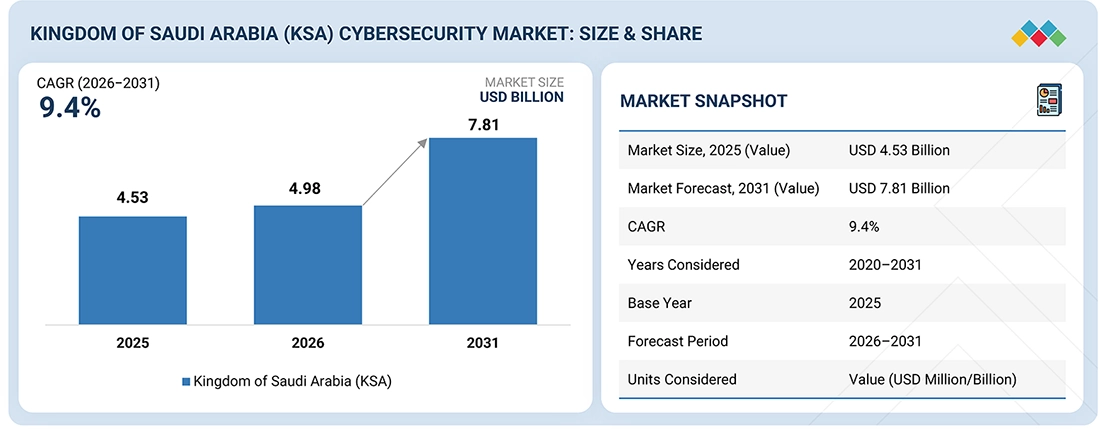
Source: Secondary Research, Interviews with Experts, MarketsandMarkets Analysis
The Kingdom of Saudi Arabia Cybersecurity Market is projected to grow from USD 4.98 billion in 2026 to USD 7.81 billion by 2031 at a Compound Annual Growth Rate (CAGR) of 9.4% during the forecast period. The accelerated digitalization of critical infrastructure is a primary motivator of the KSA cybersecurity economy. The Kingdom is increasing investment in smarter cities, industrial automation, energy modernization, fintech, and connected government platforms, which substantially enhances vulnerability to cyber threats both in operational technology (OT) and IT environments.
KEY TAKEAWAYS
-
BY OFFERINGCybersecurity services are projected to dominate the Kingdom of Saudi Arabia Cybersecurity market in 2026.
-
BY SOLUTIONThe identity security & management segment is projected to hold the largest market share.
-
BY SERVICEThe training and capability building segment will grow the fastest during the forecast period.
-
BY DEPLOYMENT MODECloud deployment is projected to grow at the highest rate.
-
BY ORGANIZATION SIZEThe large enterprises segment is projected to have the largest market size.
-
BY SECTORPublic sector entities are projected to grow the fastest, at the highest CAGR during the forecast period.
-
COMPETITIVE LANDSCAPE - KEY PLAYERSIBM, sirar by stc, Palo Alto Networks, Cisco, Fortinet, Trend Micro, and Check Point dominate KSA's cybersecurity sector, offering comprehensive cybersecurity solutions. They offer solutions that include network/cloud security, identity and access management, SOC automation, OT/ICS protection, and AI-driven threat detection. The companies' strong compliance with NCA regulations and PDPL requirements, along with extensive reach in government and critical infrastructure sectors, makes them a key partner for national programs and large enterprise projects in the Kingdom.
-
COMPETITIVE LANDSCAPE - STARTUPS/SMEsSITE, SAMI-AEC, Help AG, and Infratech are among the fastest-expanding cybersecurity players in KSA. These companies are supported by sovereign MSOC licensing, red-team and MDR services, OT security specialization, and GRC-led compliance offerings. The companies' local delivery models, NCA-aligned frameworks, Arabic-language support, and rapid deployment capabilities appeal strongly to government entities and mid-to-large enterprises adopting security-first and cloud-first resilience strategies.
KSA is improving its education system by incorporating an artificial intelligence and cybersecurity curriculum to strengthen its talent pool and workforce. Initiatives like Future Skills and university-led training programs are enhancing workforce readiness across the country. As a result, organizations are increasing their investments in security training, managed security operations center services, and automation-driven cybersecurity platforms. This overall strategy supports the sustained growth of the cybersecurity market in the Kingdom.
TRENDS & DISRUPTIONS IMPACTING CUSTOMERS' CUSTOMERS
The figure shows that the changing needs of clients are altering revenue models in the Kingdom of Saudi Arabia Cybersecurity market. Organizations are moving away from traditional offerings to sophisticated services like MDR, managed SOC, Zero Trust, and cloud security, as well as AI-driven threat intelligence. This change is caused by conformity and structures according to the NCA and Saudi Central Bank (SAMA), and digital development according to Saudi Vision 2030 and mega-projects such as NEOM, which will allow enhancing resilience, secure infrastructure, and stronger national cybersecurity outcomes.
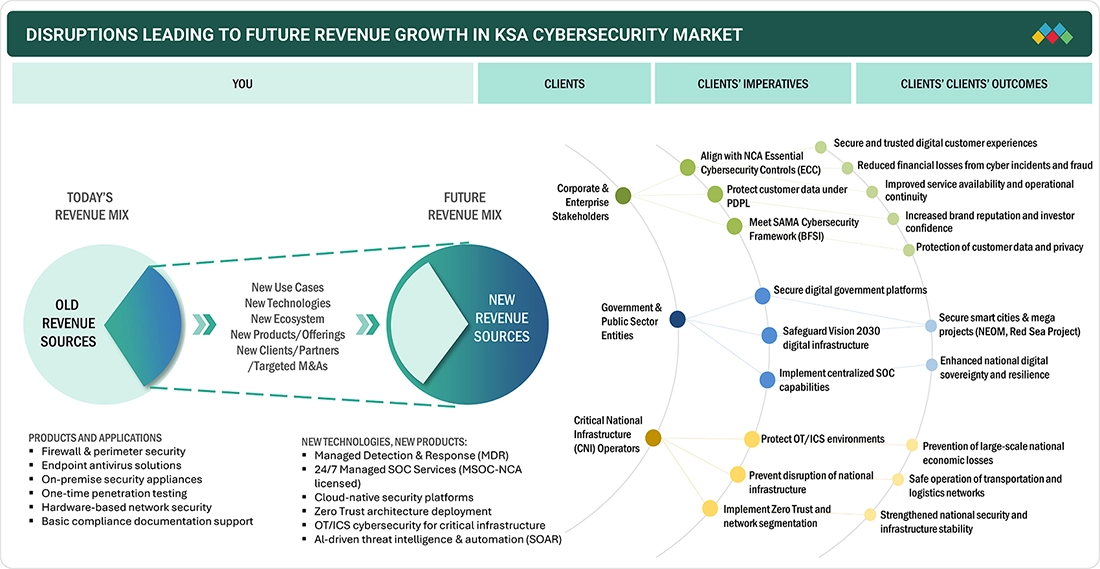
Source: Secondary Research, Interviews with Experts, MarketsandMarkets Analysis
MARKET DYNAMICS

Level
-
Government initiatives for digital transformation

-
Public-private collaboration and increased cybersecurity investment


Level
-
Limited cyber risk awareness at organizational levels

-
High cost of advanced cybersecurity solutions


Level
-
Cybersecurity as a foundational layer for autonomous and algorithm-driven cities

-
Lifecycle security for massive-scale connected and embedded systems


Level
-
Escalating ransomware and data extortion attacks

-
Lack of real-time threat intelligence and incident response capability

Source: Secondary Research, Interviews with Experts, MarketsandMarkets Analysis
Driver: Government initiatives for digital transformation
Government-led initiatives have become one of the key triggers of cybersecurity demand in KSA. The policies of the country, regulatory requirements, and massive digital development projects by Saudi Vision 2030 are driving the adoption of the cloud, smart government platforms, and connected infrastructure. Government bodies like the NCA have offered binding structures and measures, which force firms to enhance security potentials. It is a policy-based setting that is increasing the investments in sophisticated cybersecurity technologies in both the government and the private sectors.
Restraint: Limited cyber risk awareness at organizational levels
Despite regulatory developments, awareness of cyber risks remains disproportionate within organizations, especially in small and mid-sized businesses. Most organizations continue to consider cybersecurity as an IT operation and not a strategic business risk, thus remaining under-invested and with responsive security practices. Professional skills and executive knowledge of the changing threat environments are further limiting the adoption of advanced solutions. This gap slows down the process of market maturation and introduces points of vulnerability, particularly in markets that are increasingly digitizing without corresponding security preparedness.
Opportunity: Cybersecurity as a foundational layer for autonomous and algorithm-driven cities
The investments made by KSA in smart and autonomous urban ecosystems are generating major cybersecurity prospects. Mega-projects like NEOM have been developed around AI, IoT, and hyperconnected infrastructure, which need security to be incorporated in the design stage. Cybersecurity will become a foundational layer that will provide safe data transfer, autonomous mobility, and resilience of critical infrastructure. Security vendors with integrated, scalable, and AI-driven products will have an opportunity to leverage long-term demand associated with next-generation digital city implementations.
Challenge: Escalating ransomware and data extortion attacks
The cases of ransomware and data extortion are becoming more common and advanced in the region. Supply chains and identity vulnerabilities are being used by attackers who have been targeting critical infrastructure, government bodies, and large enterprises. Such attacks are causing financial and operational effects that are putting strain on organizations to implement proactive defense, incident response, and recovery capabilities. However, emerging attacker strategies, scant resources of skilled personnel, and sophisticated IT systems make it difficult for many organizations to sustain a robust counter-attack from sophisticated threats.
KINGDOM OF SAUDI ARABIA (KSA) CYBERSECURITY MARKET: COMMERCIAL USE CASES ACROSS INDUSTRIES
| COMPANY | USE CASE DESCRIPTION | BENEFITS |
|---|---|---|
 |
King Abdullah Financial District (KAFD) deployed AI-driven MDR from sirar by stc to secure its smart city infrastructure, enabling 24/7 monitoring across IoT systems and critical services. | Continuous real-time threat detection and response; stronger protection of smart infrastructure and IoT environments; enhanced security for tenants, visitors, and critical city services. |
 |
Saudi Aramco partnered with CrowdStrike to roll out Al-powered cybersecurity and enhance security in the enterprise, cloud, and operational environments. | Unified AI-driven security; enhanced endpoint and cloud protection; local data capabilities; improved threat intelligence and skills development. |
 |
In the case of Tabadul (a trade-exchange platform), IBM delivered cybersecurity, identity & access management, and compliance solutions to protect data, regulate access, and secure critical systems. | Strengthened governance and access controls; streamlined security operations; enhanced regulatory compliance and data protection. |
 |
A global non-profit organization chose SharkStriker’s cybersecurity solutions to secure its sensitive data and protect donor and beneficiary information from emerging threats. | Enhanced data security and privacy for sensitive global nonprofit operations; reduced exposure to cyber risk. |
 |
A GCC digital bank used Wattlecorp’s services (VAPT, security assessment, compliance, privacy) to rapidly achieve compliance and strengthen its security posture across cloud, network, and data layers. | Improved compliance readiness; reduced vulnerabilities; increased trust of customers; fortified infrastructure against cyber threats. |
Logos and trademarks shown above are the property of their respective owners. Their use here is for informational and illustrative purposes only.
MARKET ECOSYSTEM
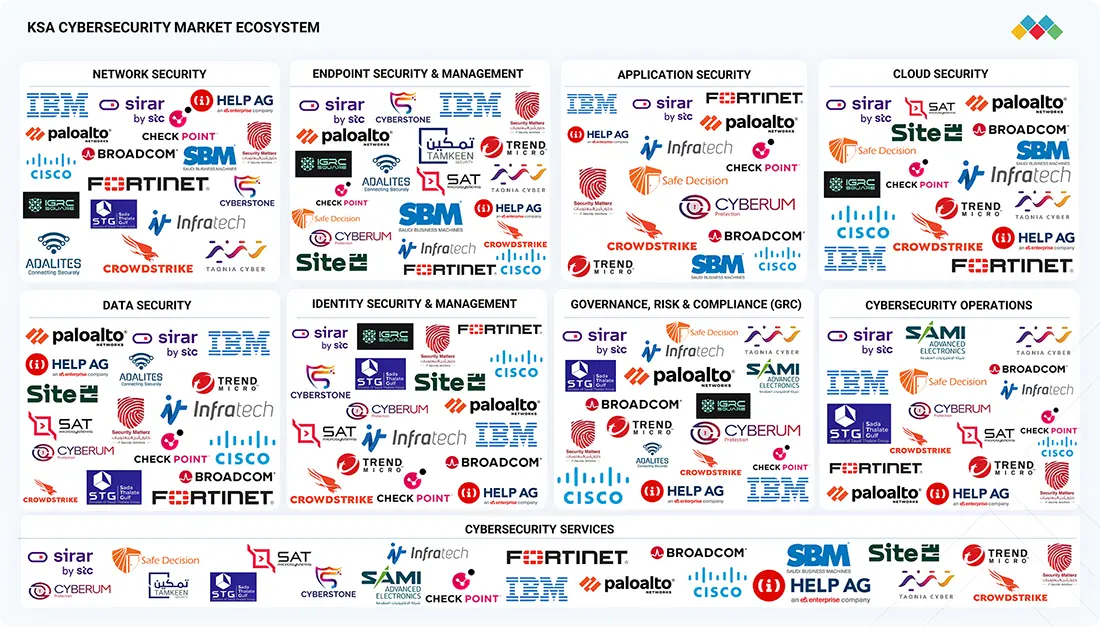
The figure demonstrates the Kingdom of Saudi Arabia Cybersecurity ecosystem, including global vendors, regional providers, system integrators, and regulatory stakeholders, providing end-to-end cyber protection. Market players operate across key cybersecurity solution segments, including network, endpoint, cloud, data, identity, GRC, and cybersecurity services. Global firms drive technology innovation while local companies focus on implementation, managed services, and compliance. System integrators & MSSPs are helpful in deployment, monitoring, and response to incidents. The ecosystem is strengthened by national regulations, sector oversight and investment in digital infrastructure aligning cybersecurity capabilities with developing threats and resilience priorities throughout the Kingdom.
Logos and trademarks shown above are the property of their respective owners. Their use here is for informational and illustrative purposes only.
MARKET SEGMENTS
Source: Secondary Research, Interviews with Experts, MarketsandMarkets Analysis
Kingdom of Saudi Arabia Cybersecurity Market, by Offering
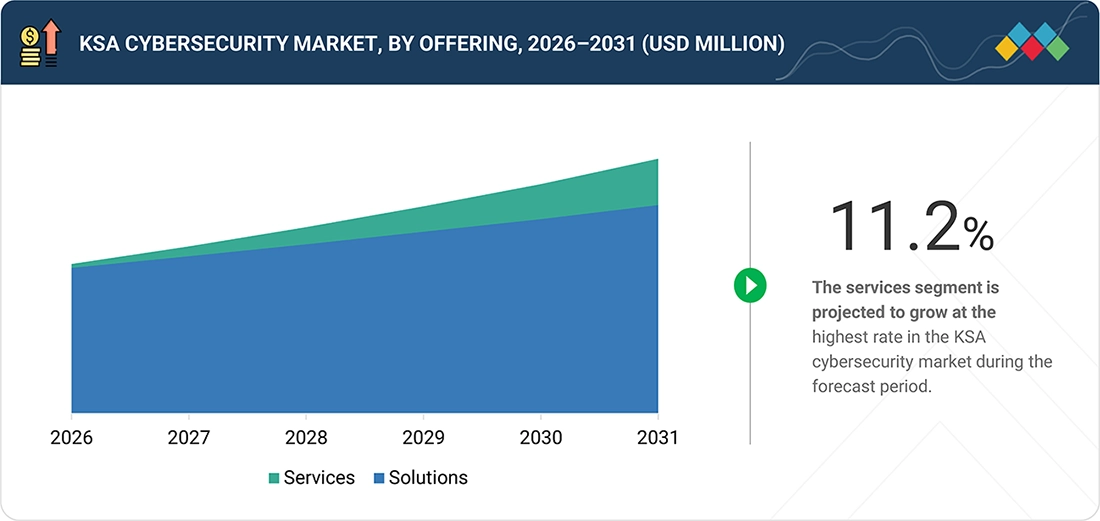
The Kingdom of Saudi Arabia Cybersecurity Market is dominated by the services segment as organizations are increasingly relying on external capabilities to deal with the emerging cyber risks and sophisticated regulatory needs. Demand is driven by consulting, integration, risk assessment, incident response, and managed security services across critical sectors. The shortages of talent and the necessity of constant observation are further encouraging outsourcing. With the increasing speed of digital transformation, cybersecurity services remain essential to be implemented, optimized, and for long-term security operations.
Kingdom of Saudi Arabia Cybersecurity Market, by Solution
Identity security and management occupies the largest market share in KSA as it is increasing in adoption of cloud solutions, remote access, and remote platforms. Companies are focusing on identity-dominated security to maintain the safety of users, applications, and sensitive data over distributed environments. Increasing credential-based attacks and compliance requirements are also contributing to the investments in government-wide authentication, access, and privileged access control solutions and enterprise sectors.
Kingdom of Saudi Arabia Cybersecurity Market, by Service
Managed services account for the largest share as organizations outsource cybersecurity functions to enhance security and contain talent gaps and budgets. Government entities and business organizations are embracing the use of managed SOC, MDR, and round-the-clock monitoring services to ensure threat identification and compliance preparedness. Growing cloud use and complicated hybrid environments are also strengthening the demand. Managed services further allow scalable, efficient, and unshaken security services in industries.
Kingdom of Saudi Arabia Cybersecurity Market, by Deployment Mode
On-premises deployment dominates the cybersecurity market in KSA as the country has robust data sovereignty requirements and compliance provisions over critical industries. Government, financial institutions, and energy companies are more inclined toward locally implemented solutions to have control over sensitive systems and data. The adoption is also supported by legacy infrastructure integration and customization requirements. As cyber risks targeting national infrastructure increase, organizations continue prioritizing on-premises environments for security and compliance assurance.
Kingdom of Saudi Arabia Cybersecurity Market, by Organization Size
Because of their vast value-added digital infrastructures and compliance risks, large enterprises represent a significant share of the total cybersecurity spend in KSA. For instance, corporations in the energy, telecom, finance, and government-owned enterprise sectors have a need for secure architectures, constant monitoring, and the ability to comply with all applicable regulations. With an abundance of financial resources and a higher exposure to cyber risk, large enterprises tend to consistently invest in cybersecurity solutions and service offerings, thus being the foremost contributors to the cybersecurity marketplace.
Kingdom of Saudi Arabia Cybersecurity Market, by Sector
Private sector entities account for the majority of the total cybersecurity marketplace in KSA. As digital-based services and cloud-based technologies are becoming ubiquitous, there is an increase in the level of cyber threats from these same types of services and technologies being offered to consumers. Due to the need to comply with all regulatory requirements, as well as keep customer information secure, and businesses operationally sound, the majority of organizations are significantly investing in cybersecurity. As the economy continues to diversify and grow in KSA, especially through private sector growth initiatives, there will be a continued increase in demand for organizations to invest in cybersecurity in the Kingdom.
KINGDOM OF SAUDI ARABIA CYBERSECURITY MARKET: COMPANY EVALUATION MATRIX
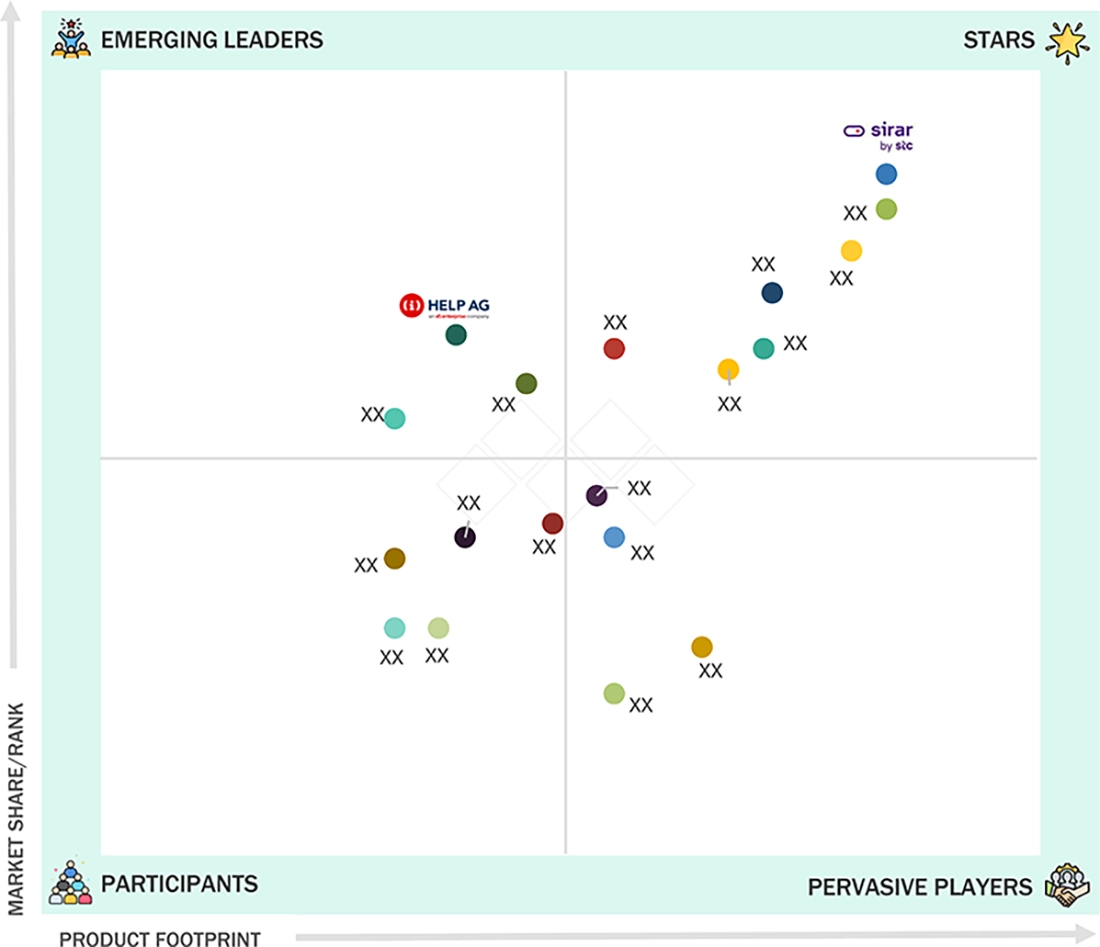
The Kingdom of Saudi Arabia Cybersecurity Market features a competitive mix of global technology leaders and rapidly growing national providers. Star players such as sirar by stc strengthen sovereign cybersecurity capabilities via managed SOC services and compliance-aligned offerings, while emerging leaders like Help AG expand its footprint through integrated cloud, AI-driven security, and threat-prevention platforms. Vendors across the Kingdom are enhancing identity, network, and automation-based defenses to support digital transformation and regulatory mandates in critical sectors.
Source: Secondary Research, Interviews with Experts, MarketsandMarkets Analysis
KEY MARKET PLAYERS
- IBM (US)
- sirar by stc (KSA)
- Palo Alto Networks (US)
- Fortinet (US)
- Cisco (US)
- Help AG (UAE)
- Check Point (Israel)
- Broadcom (US)
- CrowdStrike
- SAMI-AEC (KSA)
- Infratech (KSA)
- Security Matterz (KSA)
- Trend Micro (Japan)
- SBM (KSA)
- SITE (KSA)
- Cyberstone (KSA)
- SAT Microsystems (KSA)
- Safe Decision Co (KSA)
- Adalites (KSA)
- Cyberum (KSA)
- Tamkeen Security (KSA)
- Sada Thalate Gulf (KSA)
- IGRC Square (KSA)
MARKET SCOPE
| REPORT METRIC | DETAILS |
|---|---|
| Market Size, 2025 (Value) | USD 4.53 Billion |
| Market Forecast, 2031 (Value) | USD 7.81 Billion |
| Growth Rate | CAGR of 9.4% from 2026 to 2031 |
| Years Considered | 2020–2031 |
| Base Year | 2025 |
| Forecast Period | 2026–2031 |
| Units Considered | Value (USD Million/Billion) |
| Report Coverage | Revenue Forecast, Company Ranking, Competitive Landscape, Growth Factors, and Trends |
| Segments Covered |
|
WHAT IS IN IT FOR YOU: KINGDOM OF SAUDI ARABIA (KSA) CYBERSECURITY MARKET REPORT CONTENT GUIDE
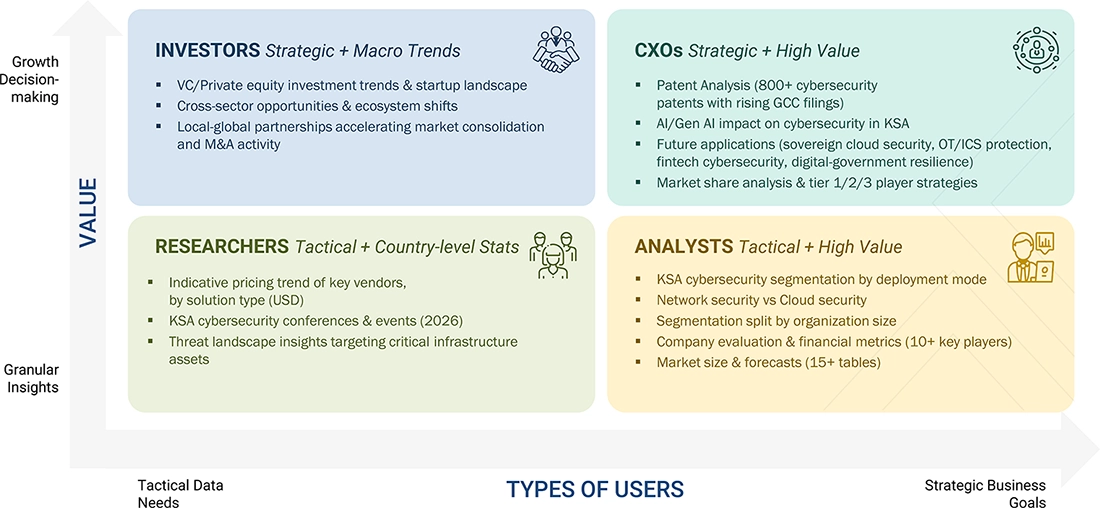
DELIVERED CUSTOMIZATIONS
We have successfully delivered the following deep-dive customizations:
| CLIENT REQUEST | CUSTOMIZATION DELIVERED | VALUE ADDS |
|---|---|---|
| Leading Solution Provider (KSA) | Product Benchmarking: Cybersecurity Solution Matrix offering detailed comparison of major vendors’ offerings in KSA across firewall, XDR, cloud security, IAM, OT/ICS protection and AI-driven threat detection, mapped against NCA compliance requirements and sector-specific deployment priorities. | Clear visibility into competitive positioning, technology differentiation and regional relevance, enabling stronger go-to-market development and investment decisions for the Saudi cybersecurity landscape. |
| Leading Service Provider (KSA) | Company Intelligence: In-depth profiling of key cybersecurity services players in KSA (up to 5), covering managed SOC, MDR, GRC, digital forensics, offensive security and cloud security services, along with partnership ecosystems and sovereign-cloud alignment. | Holistic understanding of service-provider strength and expansion opportunities in KSA, identifying white spaces for collaboration, partnership, and capability enhancement across government and enterprise segments. |
RECENT DEVELOPMENTS
- December 2025 : sirar by stc signed a Memorandum of Understanding with Microsoft during Black Hat MEA to co develop advanced cybersecurity services, integrated sector specific solutions, and joint training programs that strengthen Saudi Arabia's digital resilience across public and private entities.
- December 2025 : Qualys named Security Matterz as the first managed Risk Operations Center partner in Saudi Arabia, enabling the Riyadh based provider to deliver Qualys powered managed risk services that scale cyber risk visibility, prioritization, and response for enterprises across the Kingdom.
- July 2025 : Trend Micro collaborated with TechnoVal and Google Cloud to locally host the Trend Vision One Sovereign and Private Cloud platform in Saudi Arabia, providing sovereign XDR and threat detection capabilities while ensuring that sensitive security data remains within national borders.
- May 2025 : Cisco announced an expanded partnership with Saudi Arabia's HUMAIN AI enterprise to build secure, scalable AI infrastructure and data centers in the Kingdom, pairing Cisco's networking and security portfolio with major investments in AI research, digital skills, and cloud based AI services.
- February 2025 : Tributech and Tamkeen Security announced a strategic partnership to combine Tamkeen Security's cybersecurity GRC and risk expertise with Tributech's data integrity platform, delivering advanced protection against data manipulation for critical data operations across organizations in Saudi Arabia.
Table of Contents
 Exclusive indicates content/data unique to MarketsandMarkets and not available with any competitors.
Methodology
Secondary research was conducted to collect information useful for this technical, market-oriented, and commercial study of the Saudi Arabia cybersecurity market. The next step was to validate these findings, assumptions, and sizing with industry experts across the value chain using primary research. Different approaches, such as top-down and bottom-up, were employed to estimate the total market size. After that, the market breakup and data triangulation procedures were used to estimate the market size of the segments and subsegments of the Saudi Arabia cybersecurity market.
Secondary Research
In the secondary research process, various secondary sources were referred to for identifying and collecting information regarding the study. The secondary sources included annual reports, press releases, investor presentations of cybersecurity solution and service vendors, forums, certified publications, and whitepapers, in Saudi Arabia. The secondary research was mainly used to obtain key information about the industry’s supply chain, the total pool of key players, market classification and segmentation according to industry trends to the bottom-most level, regional markets, and key developments from both market- and technology-oriented perspectives, all of which were further validated by primary sources.
Primary Research
In the primary research process, various primary sources from both the supply and demand sides were interviewed to obtain qualitative and quantitative information for this report. The primary sources from the supply side included various industry experts, including Chief Executive Officers (CEOs), Vice Presidents (VPs, marketing directors, technology and innovation directors, and related key executives from various key companies and organizations operating in the Saudi Arabia cybersecurity market.
In the market engineering process, top-down and bottom-up approaches were extensively used, along with several data triangulation methods, to perform the market estimation and market forecasting for the overall market segments and subsegments listed in this report. Extensive qualitative and quantitative analysis was performed on the complete market engineering process to list key information/insights throughout the report.
After the complete market engineering process (including calculations for market statistics, market breakups, market size estimations, market forecasts, and data triangulation), extensive primary research was conducted to gather information and verify & validate the critical numbers arrived at. The primary research was also conducted to identify the segmentation, industry trends, competitive landscape of Saudi Arabia cybersecurity market players, and key market dynamics, such as drivers, restraints, opportunities, challenges, industry trends, and key strategies.
Market Size Estimation
Top-down and bottom-up approaches were used to estimate and validate the size of the Saudi Arabia cybersecurity market and the size of various dependent sub-segments in the Saudi Arabia cybersecurity market. The research methodology used to estimate the market size includes the following details: critical players in the market were identified through secondary research, and their market shares in the respective regions were determined through primary and secondary research. This entire procedure included the study of the annual and financial reports of the top market players, and extensive interviews were conducted for key insights from the industry leaders, such as CEOs, VPs, directors, and marketing executives.
All percentage splits and breakdowns were determined using secondary sources and verified through primary sources. All possible parameters that affect the market covered in this research study have been accounted for, viewed in extensive detail, verified through primary research, and analyzed to get the final quantitative and qualitative data. This data is consolidated and added to detailed input and analysis from MarketsandMarkets.
Data Triangulation
The market was split into several segments and subsegments after arriving at the overall market size using the market size estimation processes explained above. The data triangulation and market breakup procedures were employed, wherever applicable, to complete the overall market engineering process and arrive at the exact statistics of each market segment and subsegment. The data was triangulated by studying various factors and trends from both the demand and supply sides.
Market Definition
According to MarketsandMarkets, cybersecurity is a set of technologies, processes, and practices to fortify critical systems, such as networks, physical devices, programs, and information, from unauthorized access, insider threats, and malicious attacks. These cyberattacks can affect data transmission across the networks, cause operational disruptions, and result in money extortion/ransomware. Cybersecurity, or information security, can be provided through hardware, software, and services.
Stakeholders
- Chief Technology and Data Officers
- Consulting Service Providers
- Managed Security Services Professionals
- Business Analysts
- Information Technology (IT) Professionals
- Government Agencies
- Investors and Venture Capitalists
- Small and Medium-sized Enterprises (SMEs) and Large Enterprises
- Third-party Providers
- Consultants/Consultancies/Advisory Firms
- Managed and Professional Service Providers
Report Objectives
- To describe and forecast the Saudi Arabia cybersecurity market by offering, solution type, security type, deployment mode, organization size, vertical, and region from 2025 to 2030, and analyze the various macroeconomic and microeconomic factors that affect market growth
- To analyze the subsegments of the market with respect to individual growth trends, prospects, and contributions to the overall market
- To provide detailed information regarding major factors (drivers, restraints, opportunities, and challenges) influencing the growth of the market
- To analyze opportunities in the market for stakeholders and provide details of the competitive landscape of major players
- To profile key market players; provide a comparative analysis based on the business overviews, regional presence, product offerings, business strategies, and key financials; and illustrate the competitive landscape of the marketTo analyze competitive developments, such as mergers & acquisitions, product developments, partnerships and collaborations, and research & development (R&D) activities, in the market
Available Customizations
With the given market data, MarketsandMarkets offers customizations based on company-specific needs. The following customization options are available for the report:
Geographic Analysis as per Feasibility
- Further breakup of the Asia Pacific market into countries contributes to the rest of the regional market size
- Further breakup of the North America market into countries contributes to the rest of the regional market size
- Further breakup of the Latin America market into countries contributing to the rest of the regional market size
- Further breakup of the Middle East & Africa market into countries contributing to the rest of the regional market size
- Further breakup of the Europe market into countries contributes to the rest of the regional market size
Company Information
- Detailed analysis and profiling of additional market players (up to 5)
Need a Tailored Report?
Customize this report to your needs
Get 10% FREE Customization
Customize This ReportPersonalize This Research
- Triangulate with your Own Data
- Get Data as per your Format and Definition
- Gain a Deeper Dive on a Specific Application, Geography, Customer or Competitor
- Any level of Personalization
Let Us Help You
- What are the Known and Unknown Adjacencies Impacting the Kingdom of Saudi Arabia Cybersecurity Market
- What will your New Revenue Sources be?
- Who will be your Top Customer; what will make them switch?
- Defend your Market Share or Win Competitors
- Get a Scorecard for Target Partners

Custom Market Research Services
We Will Customise The Research For You, In Case The Report Listed Above Does Not Meet With Your Requirements
Get 10% Free CustomisationTESTIMONIALS






Growth opportunities and latent adjacency in Kingdom of Saudi Arabia Cybersecurity Market