Saudi Arabia Indoor Location Market

Saudi Arabia Indoor Location Market by Technology (BLE, UWB, Wi-Fi, RFID), Solution (Indoor Tracking [Asset & People Tracking, Indoor Location Analytics], Indoor Navigation, Database Management System) - Forecast to 2030




OVERVIEW
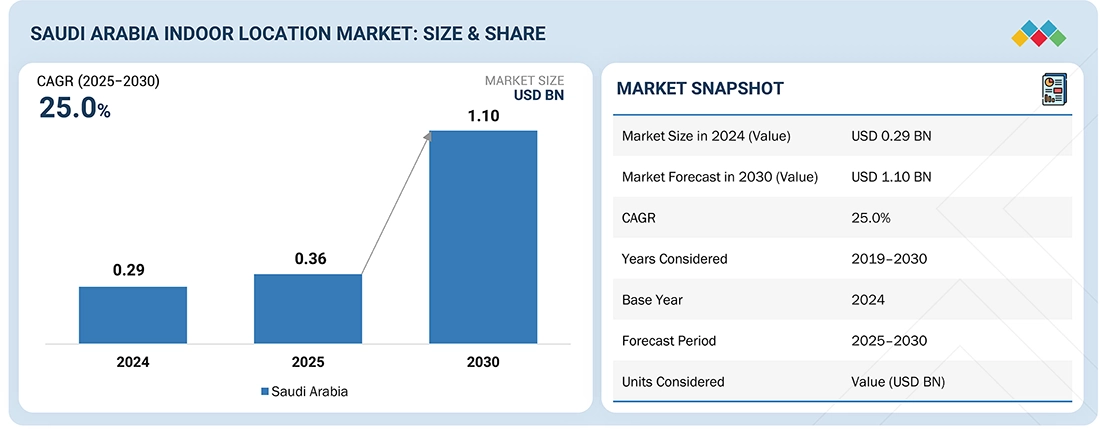
Source: Secondary Research, Interviews with Experts, MarketsandMarkets Analysis
KEY TAKEAWAYS
-
By OfferingBy offering, the services segment is expected to register the highest CAGR of 27.5% during the forecast period.
-
By TechnologyBy technology, the BLE segment is projected to hold the largest market share of 30.2% in 2025.
-
By ApplicationBy application, the remote monitoring segment is projected to register the fastest rate of 26.4% during the forecast period.
-
By VerticalBy vertical, the retail segment is projected to hold the largest market share of 23.9% in 2025.
-
Competitive LandscapeCisco, Zebra Technologies, Google, Microsoft, HPE, IoT Squared, and ABM were identified as some of the star players in the indoor location market (global), given their strong market share and product footprint.
-
Competitive LandscapeErshad Technologies, Makamat, CoreOneOffice, and NEARMOTION were identified as some of the SME/startup players in the Saudi Arabia indoor location market, securing strong footholds in specialized niche areas, underscoring their potential as emerging market leaders.
The Saudi Arabia Indoor Location Market is fueled by significant public and private investments in smart infrastructure, the growth of IoT platforms, and the decreasing costs of sensors and tags that facilitate accurate room-level positioning. Strong revenue growth is expected, along with an increasing adoption of software and services that expedite the implementation of these technologies across logistics, healthcare, and commercial real estate sectors.
TRENDS & DISRUPTIONS IMPACTING CUSTOMERS' CUSTOMERS
The impact on consumers in the Saudi Arabia indoor location market is driven by changing customer needs and industry disruptions. Key technologies such as UWB, BLE AoA, Wi-Fi RTT, computer vision, sensor fusion, and edge analytics are transforming indoor positioning from approximate tracking to centimeter-accurate, context-aware services and monetizable location platforms. Disruptions include dense sensor deployments, privacy concerns, and fragmented standards. As a result, end users benefit from improved asset utilization, personalized experiences, faster fulfillment, and reduced shrinkage.
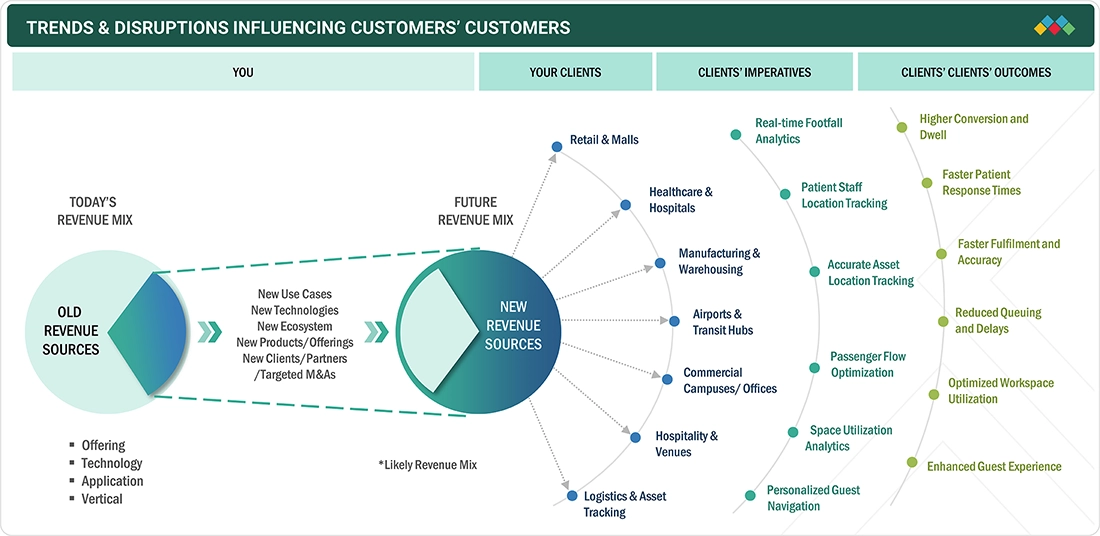
Source: Secondary Research, Interviews with Experts, MarketsandMarkets Analysis
MARKET DYNAMICS

Level
-
Vision 2030 and Giga-Project Infrastructure

-
Religious Tourism and Crowd Management


Level
-
High Dependence on Imported Technical Expertise

-
Data Sovereignty and Cybersecurity Regulations


Level
-
Smart Healthcare and Remote Patient Monitoring

-
Retail Analytics in Giga-Malls and Entertainment Centers


Level
-
Harsh Environmental Conditions for Hardware

-
Integration with Legacy Public Sector Systems

Source: Secondary Research, Interviews with Experts, MarketsandMarkets Analysis
Driver: Vision 2030 and Giga-Project Infrastructure
The Saudi Arabia indoor location market is driven by the government's Vision 2030 initiative, which includes various Giga projects such as NEOM (The Line), the Red Sea Project, and Qiddiya. These are smart cities designed from the ground up with digital infrastructure, creating a massive and immediate demand for embedded indoor positioning systems. These projects need indoor navigation and asset tracking to effectively manage autonomous logistics, visitor flows, and seamless security layers. Moreover, they aim to drive the adoption rate of indoor location technology in Saudi Arabia.
Restraint: High Dependence on Imported Technical Expertise
A significant restraint in this market is the shortage of local specialized talent required to deploy and maintain complex radiofrequency (RF)-based indoor location networks. Due to the rapid development of infrastructure, integration of technologies like ultra-wideband (UWB) and sensor fusion is dependent on the global vendors and consultants. This dependency can lead to higher implementation costs and project delays. This creates a knowledge transfer gap, slowing down the operational readiness of indoor location services in other sectors.
Opportunity: Smart Healthcare and Remote Patient Monitoring
The Health Sector Transformation Program is a key part of Vision 2030, which aims to digitize the Kingdom's healthcare system. It presents a great opportunity for indoor location in hospitals. There is a growing demand for RTLS to track high-value medical assets and monitor patient movements to prevent wandering and optimize patient flow. Integrating these systems with the unified "Seha" platform offers a very appealing opportunity for vendors to provide remote monitoring solutions.
Challenge: Harsh Environmental Conditions for Hardware
Extreme environmental conditions are a challenge for the indoor location market in Saudi Arabia. The high temperatures and dust storms can affect the performance and lifespan of indoor/outdoor hybrid hardware. Sensors and beacons deployed in semi-indoor spaces, like open-air concourses in stadiums or transport hubs, must be strengthened to withstand heat and fine dust intrusion. This requirement raises the hardware cost and complicates maintenance, as standard off-the-shelf indoor equipment often fails prematurely in the Saudi climate.
SAUDI ARABIA INDOOR LOCATION MARKET: COMMERCIAL USE CASES ACROSS INDUSTRIES
| COMPANY | USE CASE DESCRIPTION | BENEFITS |
|---|---|---|
 |
RTLS for hospitals and facilities to track equipment and staff | The integration of indoor location solutions with hospital workflows and patient-care systems enables automatic equipment check-in/out, caregiver location for rapid response, and location-based alerts. | Faster asset location, improved patient care, reduced equipment loss |
 |
BLE and Wi-Fi wayfinding and occupancy solutions for commercial buildings | Solutions provide indoor mapping and turn-by-turn navigation to occupants via mobile apps or kiosks | This is achieved by using BLE beacons and existing Wi-Fi infrastructure to compute position and guidance. | Optimized space use, better navigation, lower facility management costs |
 |
Indoor positioning for retail stores, enabling proximity offers and analytics | Beacons and smartphone-based SDKs detect shopper proximity to product displays and trigger contextually relevant promotions, coupons, or personalized messages | Collected insights feed marketing automation and loyalty platforms to measure campaign lift and refine targeting. | Targeted promotions, higher conversion, and improved footfall analytics and insights |
 |
Visitor flow analytics and navigation for malls and transit hubs | Location sensors and mobile-app signals track origin-destination flows, peak corridors, and pinch points to support crowd management | Turn-by-turn indoor navigation and dynamic routing reduce congestion by guiding visitors to less crowded entrances, platforms, or parking. | Reduced congestion, improved dwell time, and better retail conversions |
 |
Asset and personnel tracking for industrial and healthcare sites | The solution combines strengthened asset tags and wearable badges to locate tools, carts, and staff across complex facilities and hazardous zones | This enables faster task assignment and emergency evacuation. | Faster responses, reduced search times, and improved operational safety |
Logos and trademarks shown above are the property of their respective owners. Their use here is for informational and illustrative purposes only.
MARKET ECOSYSTEM
The Saudi Arabia indoor location market ecosystem includes both global and regional providers. Global companies such as Microsoft, HPE/Aruba, Cisco, Zebra, and Google supply essential infrastructure, cloud platforms, access point-based positioning, enterprise radios, tags, and mapping software development kits (SDKs). In contrast, regional providers like ABM, NEARMOTION, IoT Squared, Ershad Technologies, and Makamat offer localized real-time locating systems (RTLS), magnetic/Bluetooth Low Energy (BLE)/Angle of Arrival (AoA) positioning, indoor maps, and industrial solutions.
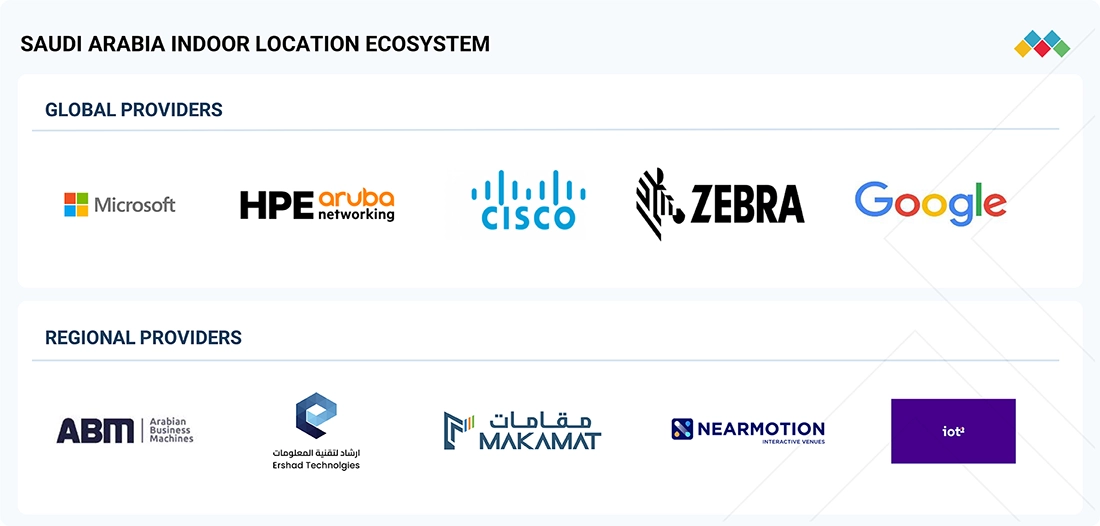
Logos and trademarks shown above are the property of their respective owners. Their use here is for informational and illustrative purposes only.
MARKET SEGMENTS
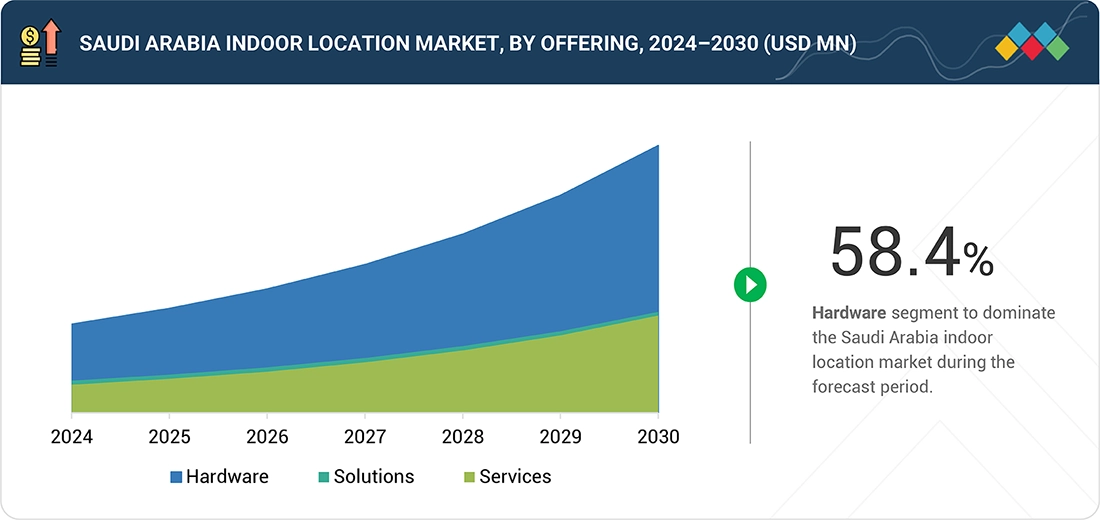
Source: Secondary Research, Interviews with Experts, MarketsandMarkets Analysis
Saudi Arabia Indoor Location Market, by Offering
In the Saudi Arabia indoor location market, the hardware segment is currently the largest source of revenue, primarily due to the extensive new construction underway. The initial phase of Vision 2030 requires procuring thousands of sensors, beacons, and gateways to equip the vast amounts of new real estate being developed in NEOM, Riyadh, and Jeddah. There is particularly high demand for premium hardware that can seamlessly integrate into luxury architectural designs, as well as robust industrial tags to support the expanding logistics hubs in King Abdullah Economic City (KAEC).
Saudi Arabia Indoor Location Market, by Technology
The BLE segment is experiencing rapid growth in the Saudi Arabia indoor location market. This growth is primarily due to the high smartphone penetration rate among both the Saudi population and pilgrims. BLE is the preferred technology for consumer-facing applications in malls and airports because it does not require visitors to carry any dedicated tags; instead, it utilizes their smartphones. Additionally, the cost-effectiveness of BLE beacons makes them an appealing option for large-scale deployment in Holy Sites, helping millions of pilgrims navigate efficiently without the burden of high infrastructure costs.
Saudi Arabia Indoor Location Market, by Application
Remote monitoring is a vital application sector in Saudi Arabia, especially within the energy and industrial industries. Given that many facilities are located in remote desert areas, companies like Aramco use indoor and outdoor location tracking to ensure the safety of lone workers and monitor the status of critical equipment in refineries and processing plants. This application is becoming a mandatory safety standard, driving significant growth in the adoption of indoor location solutions across Saudi Arabia.
Saudi Arabia Indoor Location Market, by Vertical
The retail segment is experiencing a digital transformation, transitioning from traditional open-air marketplaces to modern experiential complexes. This change is promoting the use of indoor location technology for better customer engagement. Retailers in upscale malls in Riyadh are leveraging location-based services to send personalized offers to VIP customers as they enter specific areas. Furthermore, the growing trend of click-and-collect is increasing the demand for back-end location tracking, which helps quickly locate inventory in large storerooms. This ensures a seamless and efficient omnichannel experience for customers.
SAUDI ARABIA INDOOR LOCATION MARKET: COMPANY EVALUATION MATRIX
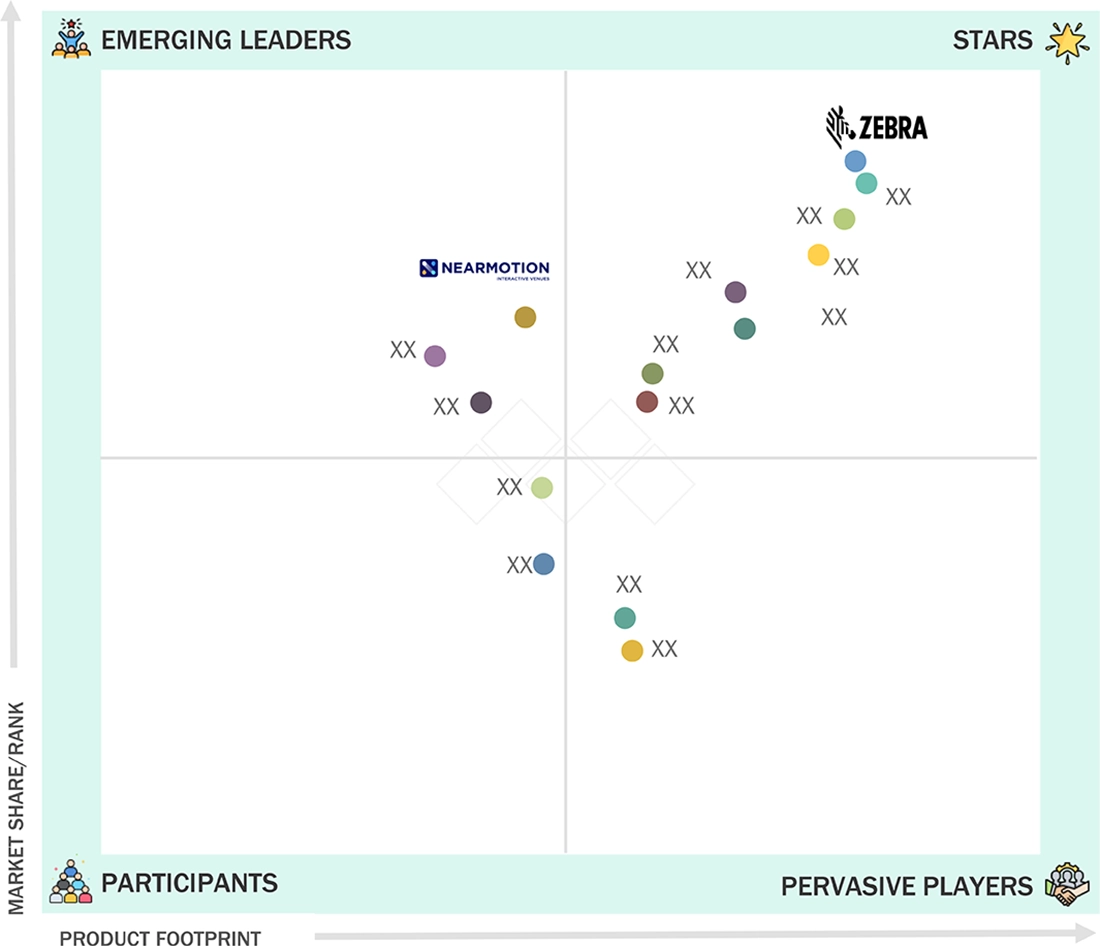
In the Saudi Arabia indoor location market matrix, Zebra (Star) leads with a strong market share and extensive product footprint, driven by high-accuracy RTLS and location-enabled workflows across healthcare, logistics, and industrial sites through its UWB, BLE, and RFID hardware integrated with regional partner ecosystems. NEARMOTION (Emerging Leader) is gaining visibility with its indoor navigation, wayfinding, and analytics platform tailored for malls, hospitals, and smart-city projects aligned with Saudi Arabia’s digital transformation and Vision 2030 initiatives.
Source: Secondary Research, Interviews with Experts, MarketsandMarkets Analysis
KEY MARKET PLAYERS
- Zebra Technologies (US)
- Cisco (US)
- Google (US)
- Microsoft (US)
- HPE (US)
- ESRI (US)
- ABM (Saudi Arabia)
- Ershad Technologies (Saudi Arabia)
- Makamat (Saudi Arabia)
- IoT Squared (Saudi Arabia)
- Coreoneoffice (Saudi Arabia)
- Qottuf Aljazeera (Saudi Arabia)
- NEARMOTION (Saudi Arabia)
- INNOSD (Saudi Arabia)
MARKET SCOPE
| REPORT METRIC | DETAILS |
|---|---|
| Market Size in 2024 (Value) | USD 0.29 Billion |
| Market Forecast in 2030 (Value) | USD 1.10 Billion |
| Growth Rate | CAGR of 25.0% from 2025–2030 |
| Years Considered | 2019–2030 |
| Base Year | 2024 |
| Forecast Period | 2025–2030 |
| Units Considered | Value (USD Billion) |
| Report Coverage | Revenue Forecast, Company Ranking, Competitive Landscape, Growth Factors, and Trends |
| Segments Covered |
|
WHAT IS IN IT FOR YOU: SAUDI ARABIA INDOOR LOCATION MARKET REPORT CONTENT GUIDE
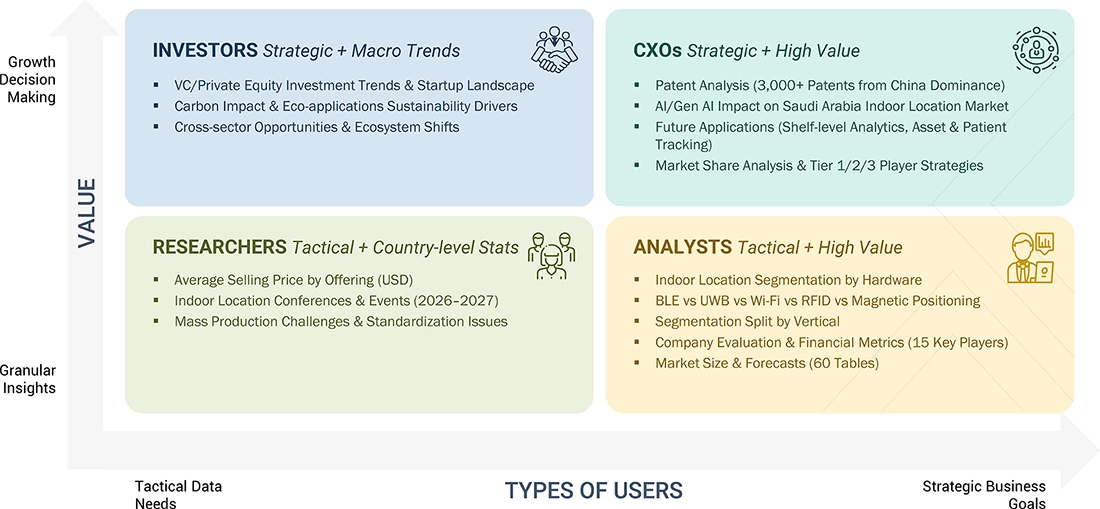
DELIVERED CUSTOMIZATIONS
We have successfully delivered the following deep-dive customizations:
| CLIENT REQUEST | CUSTOMIZATION DELIVERED | VALUE ADDS |
|---|---|---|
| Leading Solution Provider (Saudi Arabia) | Product Analysis: Product Matrix, which gives a detailed comparison of the product portfolio of each company | Enhanced understanding of competitive positioning and product offerings |
| Leading Service Provider (Saudi Arabia) | Company Information: Detailed analysis and profiling of additional market players (up to 5) | Deeper insights into market dynamics and potential strategic partnerships |
RECENT DEVELOPMENTS
- November 2025 : Mappedin (indoor mapping software) partnered with Cenomi Centers (a Saudi mall operator) to roll out interactive wayfinding across all 21 Cenomi malls. Under this deal, Mappedin’s platform provides up-to-date center maps and turn-by-turn routing in the new Cenomi Plus mobile app for iOS/Android. Shoppers can access real-time indoor maps and directions to stores, amenities, and exits both in-app and via on-site digital directories.
- February 2025 : Ericsson announced a framework deal with Tawal (a Saudi telecom tower company) to create a vendor-neutral indoor 5G neutral host ecosystem. This agreement enables Tawal and its customers to share Ericsson’s indoor Radio Dot units across multiple networks.
- February 2025 : Ericsson and ACES-NH announced they have implemented a shared indoor 5G network used by three major Saudi operators. This outcome stems from the neutral-host framework; ACES-NH now operates a multi-operator 5G infrastructure at key venues.
- December 2024 : Indoor-mapping firm Mapxus entered the Saudi market via a partnership with ABM, a Saudi systems integrator. The collaboration is expected to deliver Mapxus’s indoor mapping and wayfinding platform to businesses, malls, hospitals, and airports in Saudi Arabia. Through this partnership, ABM will resell Mapxus solutions to help businesses, institutions, and government entities optimize space use and guide visitors.
Table of Contents
 Exclusive indicates content/data unique to MarketsandMarkets and not available with any competitors.
Methodology
The study involved four major activities in estimating the current size of the Saudi Arabia indoor location market. Exhaustive secondary research was done to collect information on the market, peer, and parent markets. The next step was to validate these findings, assumptions, and sizing with industry experts across the value chain through primary research. Both top-down and bottom-up approaches were employed to estimate the total Saudi Arabia indoor location market size. After that, the market breakup and data triangulation techniques were used to estimate the market size of segments and subsegments.
Secondary Research
Various secondary sources, such as Bloomberg and BusinessWeek, were referred to in the secondary research process to identify and collect information for this study. The secondary sources included company annual reports, press releases, and investor presentations; white papers; journals, such as Linux Journal and Container Journal; and articles from recognized authors, directories, and databases.
Primary Research
In the primary research process, various sources from both the supply and demand sides were interviewed to obtain qualitative and quantitative information for the report. The primary sources from the supply side included industry experts, such as Chief Executive Officers (CEOs), Chief Technology Officers (CTOs), Chief Operating Officers (COOs), Vice Presidents (VPs), marketing directors, technology and innovation directors, and related key executives from various key companies and organizations operating in the Saudi Arabia indoor location market. The primary sources from the demand side included Indoor location end users, network administrators/consultants/specialists, Chief Information Officers (CIOs), and subject-matter experts from enterprises and government associations.
Market Size Estimation
The top-down and bottom-up approaches were used to make market estimates and forecast the Saudi Arabia indoor location market, as well as other dependent submarkets. The bottom-up procedure was used to arrive at the overall market size of the Saudi Arabia indoor location market using key companies’ revenue and their offerings in the market. The research methodology used to estimate the market size includes the following:
- The key players in the Saudi Arabia indoor location market have been identified through extensive secondary research.
- In terms of value, the market size has been determined through primary and secondary research processes.
- All percentage shares, splits, and breakups have been determined using secondary sources and verified through primary sources.
Data Triangulation
This study determined and confirmed the exact value of the overall parent market size through data triangulation and validation through primary interviews. The overall market size was then used in the top-down procedure to estimate the size of other individual markets via percentage splits of the market segmentation.
Market Definition
Indoor location or indoor positioning technology facilitates the navigation and tracking of objects and people in a building using sensory information captured by mobile devices. It includes hardware, software, and service components to provide indoor location services to various vertical organizations. Indoor location solutions may collect location data using Radio Frequency (RF), Visible Light Communication (VLC), Sound Navigation and Ranging (Sonar), Light Detection and Ranging (Lidar), or any technology or a combination of technologies.
Key Stakeholders
- Indoor location solution providers
- Independent Software Vendors (ISVs)
- Investors and Venture Capitalists (VCs)
- Support and maintenance service providers
- Value-added Resellers (VARs) and distributors
Report Objectives
- To determine and forecast the Saudi Arabia indoor location market by offering (hardware, solutions, and services), application, technology, vertical, and region from 2024 to 2029, and analyze the various macroeconomic and microeconomic factors that affect the market growth.
- To provide detailed information about the major factors (drivers, restraints, opportunities, and challenges) influencing the growth of the Saudi Arabia indoor location market.
- To analyze each submarket for individual growth trends, prospects, and contributions to the overall Saudi Arabia indoor location market.
- To analyze the opportunities in the market for stakeholders by identifying the high-growth segments of the Saudi Arabia indoor location market.
- To profile the key market players; provide a comparative analysis based on business overviews, product offerings, business strategies, and key financials; and illustrate the market's competitive landscape.
- Track and analyze competitive developments in the market, such as mergers and acquisitions, product developments, partnerships and collaborations, and Research and Development (R&D) activities.
Available Customizations
With the given market data, MarketsandMarkets offers customizations as per the company’s specific needs. The following customization options are available for the report:
Company Information
- Detailed analysis and profiling of two additional market players
Key Questions Addressed by the Report
What is the current size of the Saudi Arabia Indoor Location Market?
The Saudi Arabia indoor location market is valued at USD 0.36 billion in 2025 and is projected to reach USD 1.10 billion by 2030 at a CAGR of 25.0%.
What is driving growth in Saudi Arabia’s indoor location market?
Key growth are driven by Vision 2030, smart infrastructure development, IoT adoption, and increasing demand for asset visibility in industrial and retail sectors.
Which technology segment leads the Saudi Arabia indoor location market?
Bluetooth Low Energy (BLE) leads the market with a 30.2% share in 2025 due to its cost efficiency and scalability.
Which vertical dominates the Saudi Arabia indoor location market?
The Retail Technology segment holds the largest share at 23.9% in 2025, driven by mall digitization and personalized customer engagement.
Who are the leading players in Saudi Arabia’s indoor location market?
Some major players in the AI governance market include Microsoft (US), IBM (US), Google (US), Salesforce (US), SAP (Germany), AWS (US), SAS Institute (US), FICO (US), Accenture (Ireland), Qlik (US), H2O.AI (US), Alteryx (US), DataRobot (UK), Dataiku (US), Securiti (US), Domino Data Lab (US), SparkCognition (US), Collibra (US), OneTrust (US), Quest Software (US), Fiddler AI (US), Untangle AI (Singapore), 2021.AI (Denmark), Howso (US), Monitaur (US), Mind Foundry (UK), Credo AI (US), Holistic AI (UK), Fairly AI (Canada), Enzai (UK), ValidMind (US), FairNow (US), Mona Labs (US), Arthur AI (US), Trustible (US), Atlan (Singapore), ModelOp (US), Neptune AI (Poland), Patronus AI (US), Datatron (US), Modulos (Switzerland), Calvin Risk (Switzerland), Saidot (Finland), Censius (US), BreezeML (US), Anch.AI (Sweden), Prodago (Canada), QuantPi (Germany), and YOOI (France).
What opportunities exist for investors in the Saudi Arabia indoor location market?
Investors can target high-growth areas such as BLE, UWB, smart retail, logistics automation, and healthcare asset tracking.


Personalize This Research
- Triangulate with your Own Data
- Get Data as per your Format and Definition
- Gain a Deeper Dive on a Specific Application, Geography, Customer or Competitor
- Any level of Personalization
Let Us Help You
- What are the Known and Unknown Adjacencies Impacting the Saudi Arabia Indoor Location Market
- What will your New Revenue Sources be?
- Who will be your Top Customer; what will make them switch?
- Defend your Market Share or Win Competitors
- Get a Scorecard for Target Partners

Custom Market Research Services
We Will Customise The Research For You, In Case The Report Listed Above Does Not Meet With Your Requirements
Get 10% Free CustomisationTESTIMONIALS






Growth opportunities and latent adjacency in Saudi Arabia Indoor Location Market