Shadow AI Risk & Governance Market

Shadow AI Risk & Governance Market by Solution (Shadow AI Discovery & Visibility, AI Governance & Policy Management, AI Data Protection & Security Controls, AI Access & Agent Governance), Service (Professional, Managed) - Global Forecast to 2032




OVERVIEW
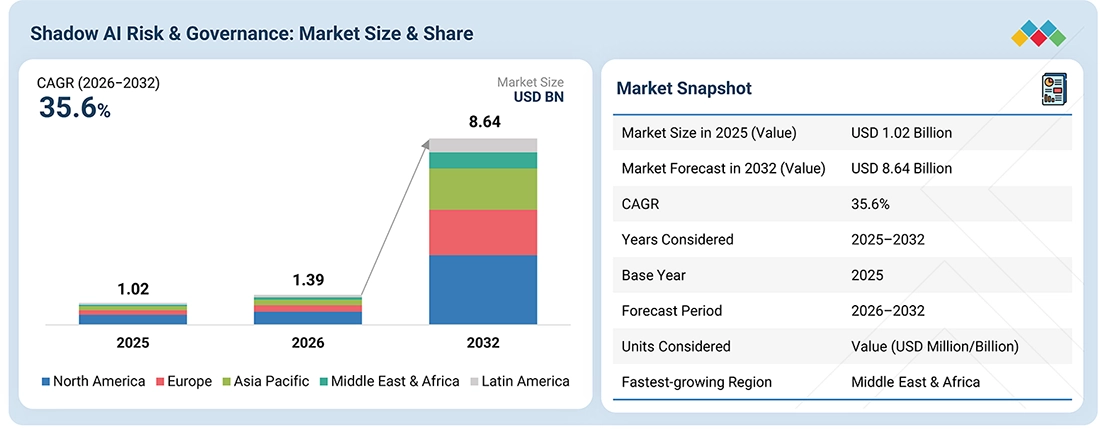
Source: Secondary Research, Interviews with Experts, MarketsandMarkets Analysis
The shadow AI risk & governance market is projected to reach USD 8.64 billion by 2032 from USD 1.39 billion in 2026, at a CAGR of 35.6%. A key growth driver is the rapid spread of AI tools beyond centrally managed enterprise environments. Microsoft and LinkedIn found that 75% of knowledge workers use AI at work, while 78% of AI users bring their own AI tools, showing how quickly employee-led AI use can outpace formal enterprise deployment. This creates a practical governance challenge, as organizations may have limited visibility into which tools employees use and what information is being processed. Cisco found that 63% of organizations restrict the data employees can enter into GenAI tools and 61% restrict which tools they can use, indicating that businesses are already introducing controls to address these risks. As this gap between AI use and centralized oversight widens, demand is increasing for solutions that can discover AI usage, protect data, enforce policies, and manage access and associated risks.
KEY TAKEAWAYS
-
BY REGIONNorth America is estimated to account for the highest share of 44.0% of the shadow AI risk & governance market in 2026.
-
BY OFFERINGBy offering, the solutions segment is estimated to dominate the market in 2026.
-
BY SOLUTION TYPEBy solution type, AI access & agent governance is set to grow at the fastest rate, registering a CAGR of 47.2%.
-
BY DEPLOYMENT MODEBy deployment mode, the cloud segment is projected to grow at a rapid pace, at the highest CAGR of 36.7%.
-
BY ORGANIZATION SIZEBy organization size, large enterprises are projected to dominate the shadow AI risk & governance market during the forecast period.
-
BY VERTICALBy vertical, the IT & ITeS segment is set to dominate the shadow AI risk & governance market.
-
COMPETITIVE LANDSCAPE - KEY PLAYERSKey players in the shadow AI risk & governance market include Palo Alto Networks, Microsoft, Zscaler, Cisco, IBM, and ServiceNow are offering capabilities across AI security, governance, data protection, access control, and risk management.
-
COMPETITIVE LANDSCAPE - STARTUPS/SMEsEmerging players such as Airia, Credo AI, Holistic AI, Mindgard, NeuralTrust, ModelOp, Relyance AI, HiddenLayer, Zenity, and Noma Security are developing specialized capabilities for AI governance, discovery, security testing, data protection, risk assessment, and AI access and agent governance.
The shadow AI risk & governance market is being driven by organizations formalizing AI oversight across business units and establishing clearer accountability for AI use. As responsibility for AI shifts from individual teams to enterprise-wide governance functions, organizations are adopting structured frameworks to define ownership, standardize policies, and maintain consistent oversight of AI applications.
TRENDS & DISRUPTIONS IMPACTING CUSTOMERS' CUSTOMERS
The shadow AI risk & governance market is shifting from basic AI discovery toward continuous governance, data protection, and agent controls. Organizations are increasingly deploying centralized AI inventories, policy enforcement, runtime monitoring, and access governance as AI usage expands across business functions. Emerging agentic AI adoption is further creating demand for identity, authorization, lifecycle management, and automated compliance capabilities.
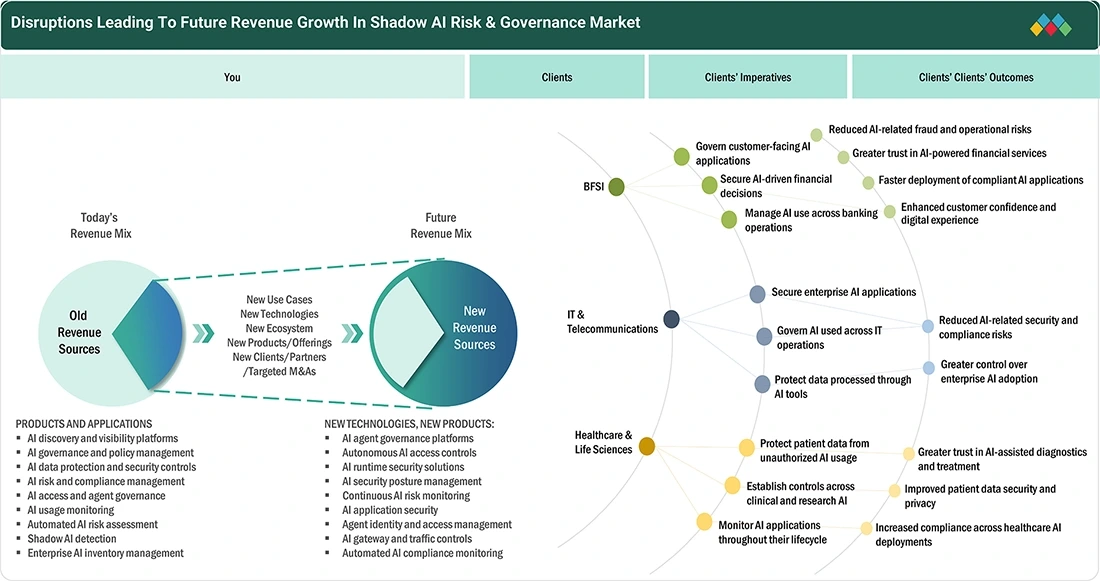
Source: Secondary Research, Interviews with Experts, MarketsandMarkets Analysis
MARKET DYNAMICS

Level
-
Growing gap between AI usage and enterprise oversight

-
Increasing organizational focus on AI accountability and risk ownership


Level
-
Fragmented AI environments hinder centralized governance

-
Shortage of skilled AI governance and security professionals


Level
-
Rising adoption of AI agents creates demand for access and agent governance

-
Integration of AI governance with existing security and data protection platforms


Level
-
Limited visibility into unauthorized AI usage

-
Balancing AI controls with business productivity

Source: Secondary Research, Interviews with Experts, MarketsandMarkets Analysis
Driver: Growing gap between AI usage and enterprise oversight
AI adoption is increasingly occurring outside formal enterprise processes, leaving organizations with limited visibility into the tools and applications being used. Cato found that 61% of IT leaders had identified unauthorized AI tools, while only 26% had solutions to monitor AI usage, creating a clear need for stronger discovery and governance capabilities.
Restraint: Fragmented AI environments hinder centralized governance
Organizations often operate AI applications across multiple models, platforms, business units, and data environments, making consistent governance difficult. Different ownership structures and technology stacks can complicate the application of common policies, access controls, monitoring, and risk assessments across the enterprise. Microsoft identifies agent inventory, ownership, lifecycle management, and centralized access governance as important requirements as AI environments expand.
Opportunity: Rising adoption of AI agents creates demand for access and agent governance
The shift toward autonomous AI agents is creating a new governance requirement around nonhuman identities, permissions, and accountability. Agents can access enterprise resources and execute actions with limited human intervention, increasing demand for dedicated controls covering identity, authorization, lifecycle management, and activity monitoring.
Challenge: Limited visibility into unauthorized AI usage
Organizations face difficulty identifying AI tools and agents operating outside approved environments, particularly when adoption occurs across decentralized teams and third-party applications. Cato's survey found that 69% of organizations lacked a formal system for tracking AI adoption, highlighting the challenge of maintaining an accurate view of AI usage and associated risks.
SHADOW AI RISK & GOVERNANCE MARKET: COMMERCIAL USE CASES ACROSS INDUSTRIES
| COMPANY | USE CASE DESCRIPTION | BENEFITS |
|---|---|---|
 |
A security audit identified nearly 200 shadow AI tools being used by employees. The organization adopted Microsoft 365 Copilot alongside Teams, SharePoint, Outlook, and Word to provide approved AI capabilities within its existing environment. | Reduced reliance on shadow AI tools while improving access to organizational information and strengthening control over how information is used |
 |
Mastercard faced hundreds of generative AI use cases and needed a scalable way to assess risks, review third-party AI vendors, and maintain visibility across AI applications. Credo AI provided an AI Registry, automated intake, risk categorization, and centralized review workflows. | Reduced manual governance effort, improved visibility across AI use cases and vendors, and enabled more scalable risk assessment and approval processes |
 |
Infosys used IBM watsonx.governance to manage AI governance across 2,700+ AI use cases, integrating cross-functional oversight, risk management, compliance monitoring, and AI lifecycle management. | 150% improvement in operational efficiency, with centralized governance and real-time compliance visibility across its AI portfolio |
|
|
Banco do Brasil implemented a unified AI governance model covering AI lifecycle oversight, model validation, monitoring, transparency, and risk and compliance management across its AI initiatives. | Automated governance reduced manual oversight and enabled real-time monitoring, explainability, and more consistent AI risk and compliance management |
Logos and trademarks shown above are the property of their respective owners. Their use here is for informational and illustrative purposes only.
MARKET ECOSYSTEM
The shadow AI risk & governance ecosystem is evolving from standalone AI discovery toward integrated platforms combining visibility, governance, data protection, risk management, and access controls. Increasing adoption of AI agents is expanding the ecosystem toward agent identity, runtime security, policy enforcement, and lifecycle management, while services support governance implementation, compliance assessments, integration, and continuous monitoring.
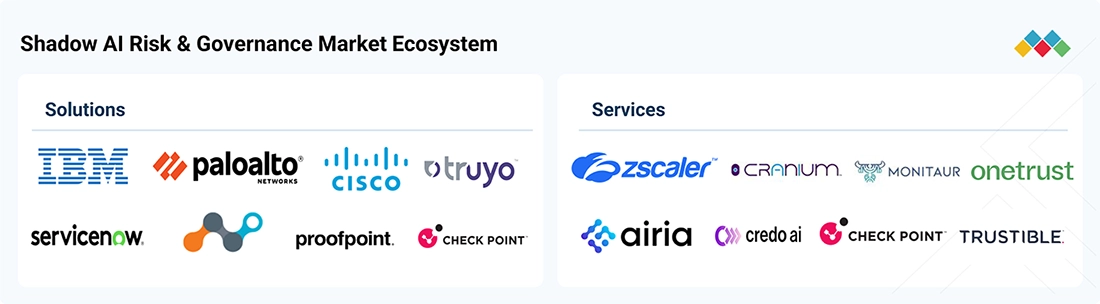
Logos and trademarks shown above are the property of their respective owners. Their use here is for informational and illustrative purposes only.
MARKET SEGMENTS
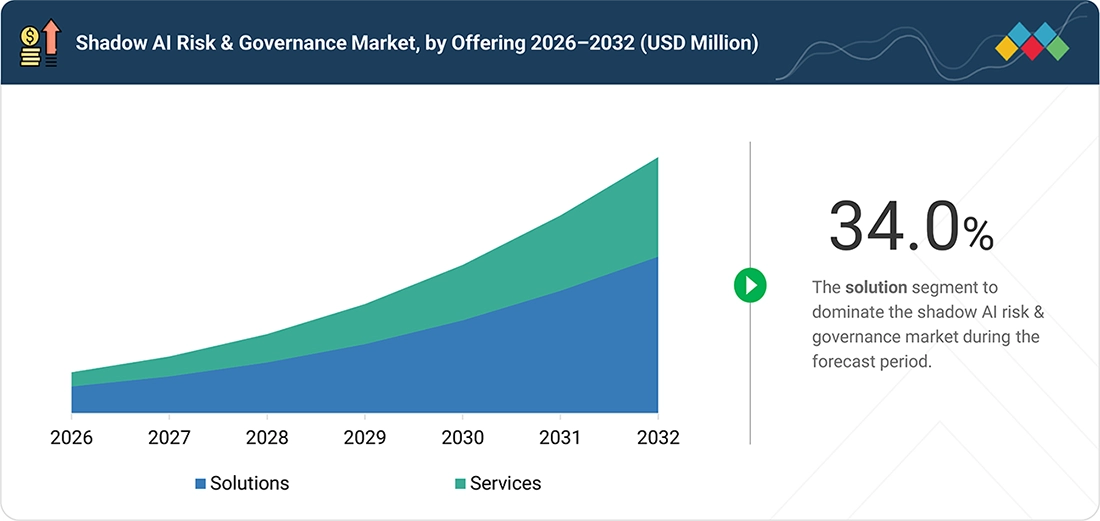
Source: Secondary Research, Interviews with Experts, MarketsandMarkets Analysis
Shadow AI Risk & Governance Market, by Offering
The solutions segment is projected to dominate the shadow AI risk & governance market, as organizations require dedicated technologies to identify, control, secure, and govern AI applications across enterprise environments. Solutions provide repeatable controls for AI discovery, policy enforcement, data protection, risk assessment, and access management as organizations scale their AI governance programs.
Shadow AI Risk & Governance Market, by Solution Type
AI data protection & security controls are projected to account for the largest share of the market, driven by organizations’ need to protect sensitive information processed through AI applications. These controls help monitor AI-related data flows, prevent unauthorized exposure, and apply security policies across AI tools and environments.
Shadow AI Risk & Governance Market, by Deployment Mode
The cloud segment is projected to dominate the shadow AI risk & governance market, supported by the growing use of cloud-hosted AI applications and enterprise AI platforms. Cloud deployment enables organizations to apply governance and security controls across distributed AI environments while simplifying scalability, centralized management, and integration with existing cloud security infrastructure.
Shadow AI Risk & Governance Market, by Organization Size
The large enterprises segment is projected to dominate the shadow AI risk & governance market, as larger organizations operate complex technology environments with multiple business units, applications, and data sources. Their broader AI footprint and formal risk management requirements create greater demand for centralized visibility, policy controls, and enterprise-wide AI governance.
Shadow AI Risk & Governance Market, by Vertical
The IT & telecommunications segment is projected to dominate the shadow AI risk & governance market, supported by its extensive use of AI across software development, infrastructure, customer operations, and data-intensive workloads. The healthcare & life sciences segment is expected to grow at the fastest rate as organizations place greater emphasis on controlling AI use across sensitive data, regulated processes, and clinical and research environments.
REGION
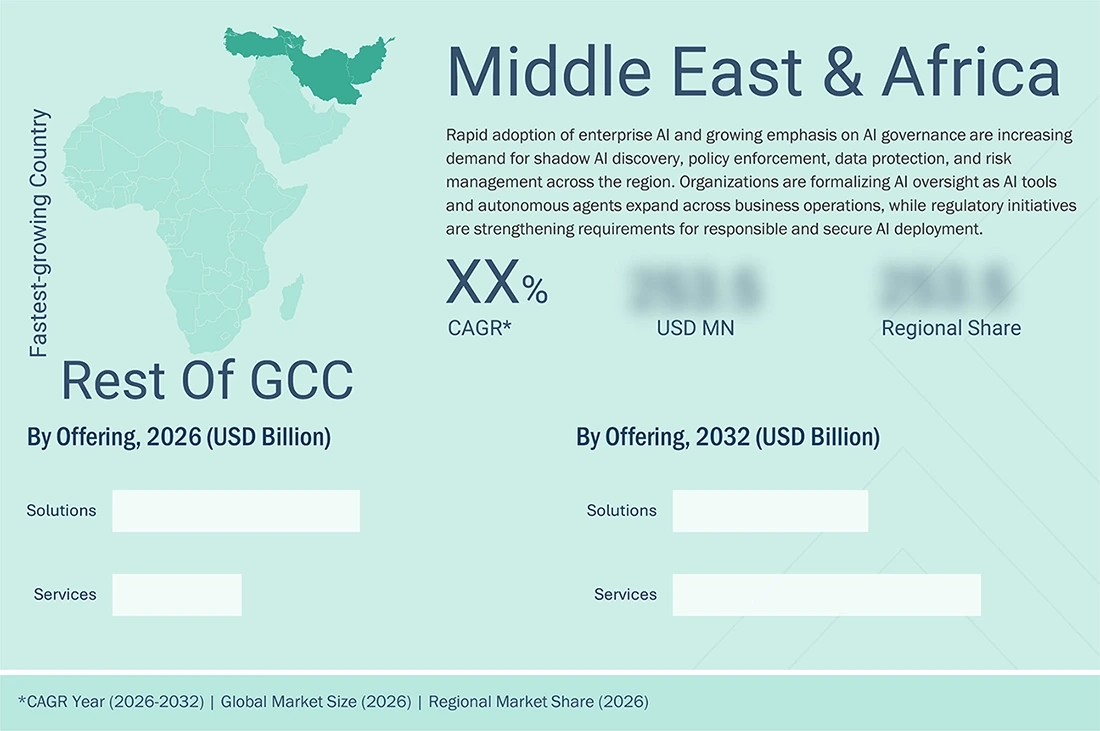
Middle East & Africa to be fastest-growing region in global shadow AI risk & governance market during forecast period
Middle East & Africa is expected to be the fastest-growing region in the shadow AI risk & governance market, supported by the rapid transition of organizations from AI experimentation toward enterprise-scale deployment. Deloitte reports that 66% of Middle East organizations are already seeing efficiency gains from AI, while only 21% have mature governance models for autonomous AI systems, highlighting a widening need for governance as AI deployment expands. Saudi Arabia is also strengthening the regional governance environment through SDAIA’s national AI risk management framework, which establishes processes for AI risk identification, assessment, treatment, and continuous monitoring across public and private entities. These developments are expected to support demand for AI discovery, governance, data protection, risk management, and access controls across the region.
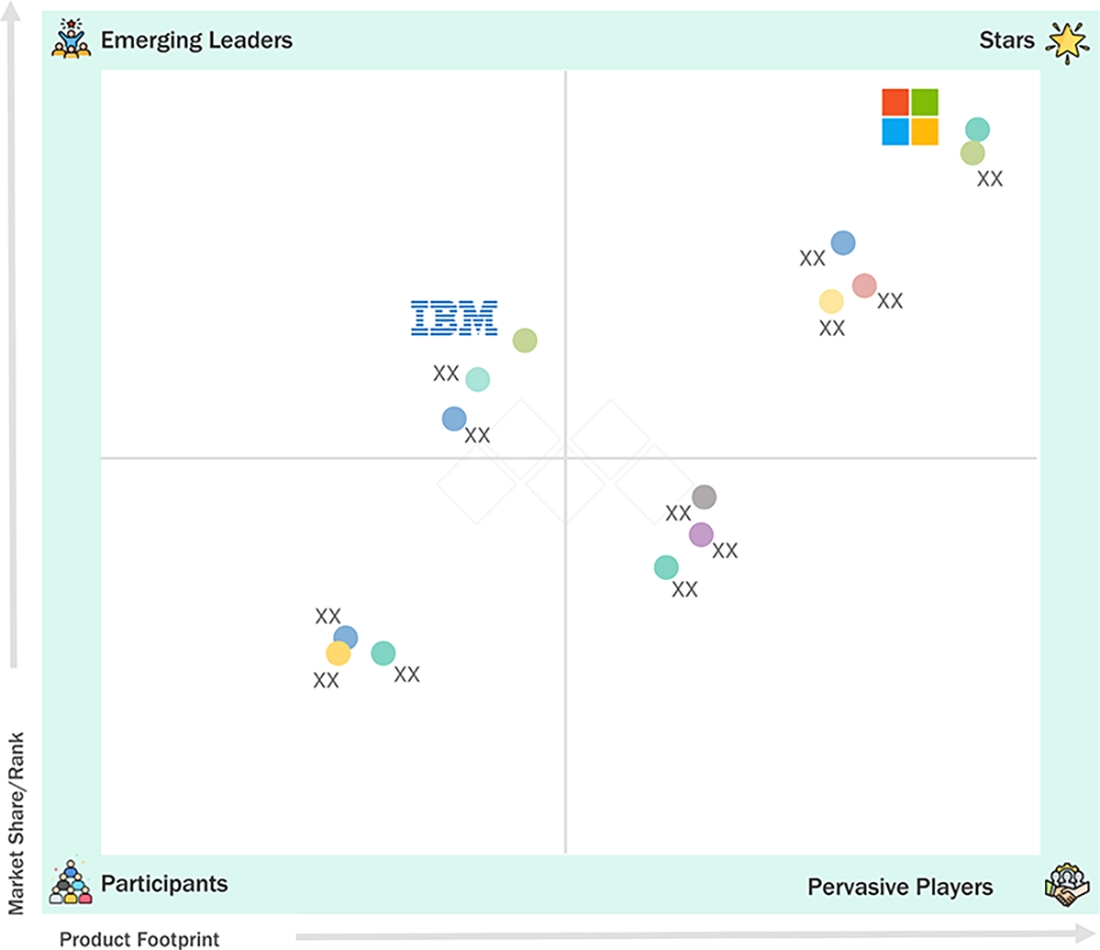
SHADOW AI RISK & GOVERNANCE MARKET: COMPANY EVALUATION MATRIX
Microsoft (Star) holds a strong position in the shadow AI risk & governance market through Microsoft Purview, Agent 365, and its broader security ecosystem, providing governance, identity, data protection, compliance, and security controls across AI applications and agents. IBM (Emerging) is expanding its position through watsonx.governance, offering AI governance, risk management, compliance, monitoring, and lifecycle controls across enterprise AI environments.
Source: Secondary Research, Interviews with Experts, MarketsandMarkets Analysis
KEY MARKET PLAYERS
- Microsoft (US)
- Palo Alto Networks (US)
- IBM (US)
- Cisco (US)
- ServiceNow (US)
- OneTrust (US)
- Zscaler (US)
- Netskope (US)
- Proofpoint (US)
- Airia (US)
MARKET SCOPE
| REPORT METRIC | DETAILS |
|---|---|
| Market Size in 2025 (Value) | USD 1.02 Billion |
| Market Forecast in 2026 (Value) | USD 1.39 Billion |
| Market Forecast in 2032 (Value) | USD 8.64 Billion |
| Growth Rate | CAGR of 35.6% |
| Years Considered | 2025–2032 |
| Base Year | 2025 |
| Forecast Period | 2026–2032 |
| Units Considered | Value (USD Million/Billion) |
| Report Coverage | Revenue forecast, company ranking, competitive landscape, growth factors, and trends |
| Segments Covered |
|
| Regions Covered | North America, Europe, Asia Pacific, Middle East & Africa, Latin America |
WHAT IS IN IT FOR YOU: SHADOW AI RISK & GOVERNANCE MARKET REPORT CONTENT GUIDE
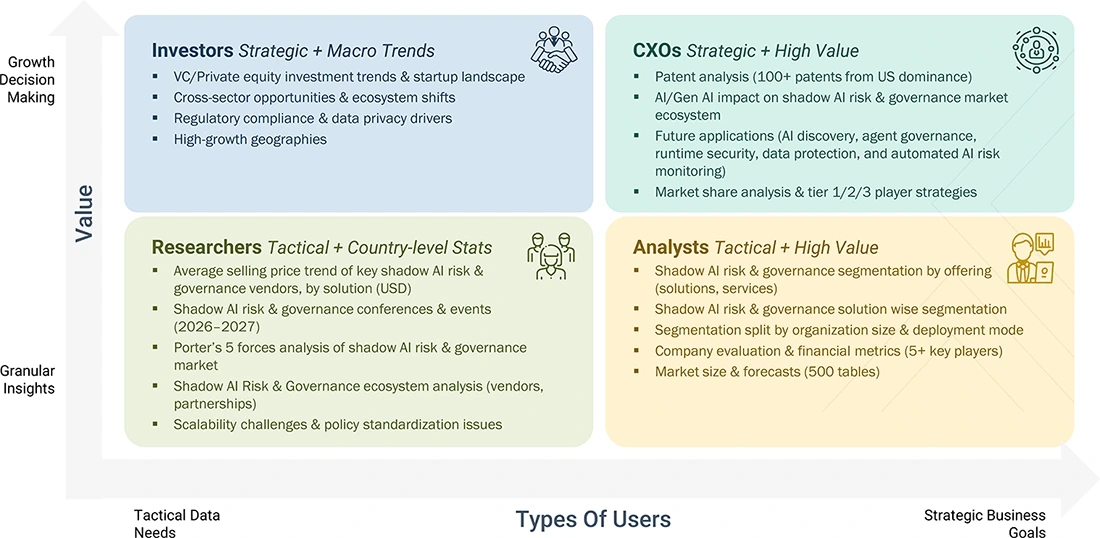
DELIVERED CUSTOMIZATIONS
We have successfully delivered the following deep-dive customizations:
| CLIENT REQUEST | CUSTOMIZATION DELIVERED | VALUE ADDS |
|---|---|---|
| Leading Solution Provider (US) | Product Analysis: Comprehensive comparison of leading shadow AI risk & governance vendors, covering AI discovery & visibility, governance and policy management, data protection, risk & compliance, access and agent governance, deployment models, and integration capabilities | Stronger understanding of vendor positioning, AI governance maturity, discovery capabilities, security controls, deployment flexibility, platform integration, and innovation strategies—supporting informed technology selection and AI risk management planning |
| Leading Service Provider (EU) | Company Information: Detailed profiling and evaluation of additional shadow AI risk & governance vendors (up to 5), covering AI discovery, governance, data protection, risk and compliance, access and agent controls, professional and managed services, regional presence, strategic partnerships, and competitive positioning | Comprehensive perspective of the evolving shadow AI risk & governance ecosystem, highlighting growing demand for AI visibility, policy enforcement, data protection, agent governance, regulatory compliance, and integrated risk management across enterprise AI environments |
RECENT DEVELOPMENTS
- September 2026 : Netskope introduced Agent Action Control, enabling organizations to classify AI-agent actions by risk and apply policies to block high-risk actions before execution, strengthening runtime governance and control.
- May 2026 : Zscaler announced the acquisition of Symmetry Systems to strengthen visibility into human and non-human identities, data access, and AI-agent communications, supporting governance and least-privilege controls for AI agents.
- May 2026 : ServiceNow expanded its partnership with NVIDIA to extend AI governance from desktops to data centers through AI Control Tower, while governing autonomous agents through policy, monitoring, and audit controls.
- March 2026 : Cisco introduced agent discovery, agentic identity and access management, model context protocol policy enforcement, and runtime guardrails to secure and govern AI agents across enterprise environments.
- February 2026 : Proofpoint acquired Acuvity to strengthen AI-native visibility, governance, and runtime protection across AI and agent-driven workflows, including controls addressing shadow AI and sensitive data exposure.
Table of Contents
 Exclusive indicates content/data unique to MarketsandMarkets and not available with any competitors.
Methodology
Secondary research was conducted to collect information useful for this technical, market-oriented, and commercial study of the shadow AI risk & governance market. The next step involved validating these findings, assumptions, and sizing with industry experts across the value chain using primary research. Different approaches, including top-down and bottom-up methods, were employed to estimate the total market size. After that, the market breakup and data triangulation procedures were used to estimate the market size of the segments and subsegments of the shadow AI risk & governance market.
Secondary Research
During the secondary research process, various secondary sources were consulted to identify and collect information relevant to the study. The secondary sources included annual reports, press releases, investor presentations of shadow AI risk & governance vendors, forums, certified publications, and whitepapers. The secondary research was mainly used to obtain key information about the industry’s supply chain, the total pool of key players, market classification and segmentation according to industry trends to the bottom-most level, regional markets, and key developments from both market- and technology-oriented perspectives, all of which were further validated by primary sources.
Primary Research
In the primary research process, various primary sources from both the supply and demand sides were interviewed to obtain qualitative and quantitative information for this report. The primary sources from the supply side included various industry experts, including chief executive officers (CEOs), vice presidents (VPs), marketing directors, technology and innovation directors, and related key executives from various key companies and organizations operating in the Shadow AI Risk & Governance market.
In the market engineering process, top-down and bottom-up approaches were extensively used, along with several data triangulation methods, to perform market estimation and forecasting for the overall market segments and subsegments listed in this report. Extensive qualitative and quantitative analysis was performed on the complete market engineering process to list key information/insights throughout the report.
After the complete market engineering process (including calculations for market statistics, market breakups, market size estimations, market forecasts, and data triangulation), extensive primary research was conducted to gather information and verify & validate the critical numbers arrived at. The primary research was also conducted to identify the segmentation types, industry trends, competitive landscape of Shadow AI Risk & Governance market players, and key market dynamics, such as drivers, restraints, opportunities, challenges, industry trends, and key strategies.
The following is the breakdown of the primary study:
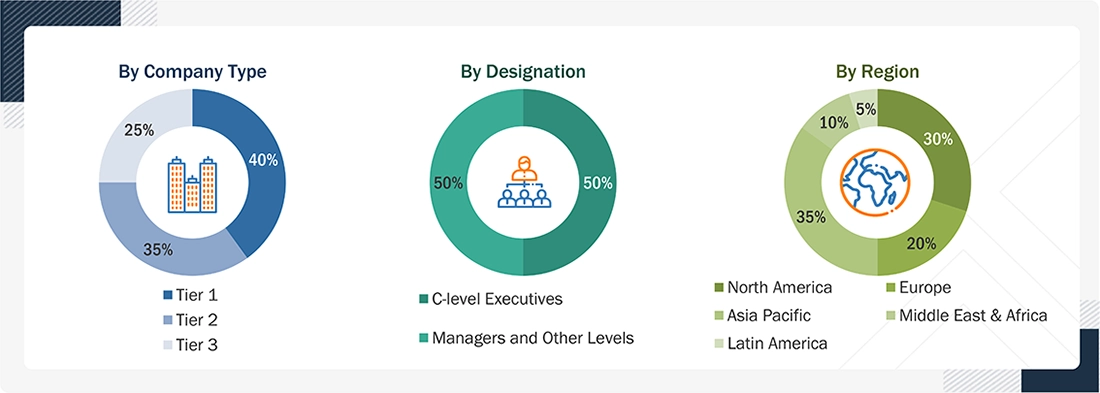
Note: Tier 1 companies receive revenues higher than USD 10 billion; Tier 2 companies' revenues range between USD 1 and 10 billion; and Tier 3 companies' revenues range between USD 500 million and USD 1 billion. Other designations include sales, marketing, and product managers.
Source: Industry Experts
To know about the assumptions considered for the study, download the pdf brochure
Market Size Estimation
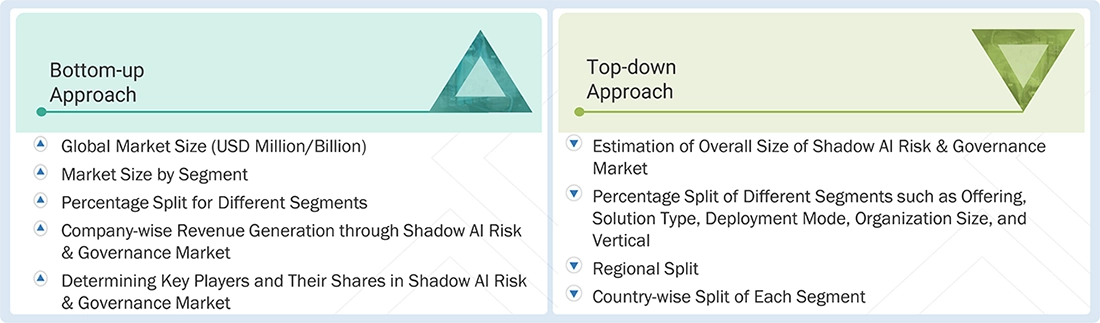
Top-down and bottom-up approaches were employed to estimate and validate the size of the shadow AI risk & governance market, as well as the size of various dependent sub-segments within the overall market. The research methodology used to estimate the market size includes the following details: critical players in the market were identified through secondary research, and their market shares in the respective regions were determined through primary and secondary research. This entire procedure involved studying the annual and financial reports of the top market players, and extensive interviews were conducted with key industry leaders, including CEOs, VPs, directors, and marketing executives, to gather valuable insights.
All percentage splits and breakdowns were determined using secondary sources and verified through primary sources. All possible parameters that affect the market covered in this research study were accounted for, viewed in extensive detail, verified through primary research, and analyzed to get the final quantitative and qualitative data. This data was consolidated and added to detailed inputs and analysis from MarketsandMarkets.
Shadow AI Risk & Governance Market : Top-Down and Bottom-Up Approach
Data Triangulation
The market was split into several segments and subsegments after arriving at the overall market size using the market size estimation processes explained above. The data triangulation and market breakup procedures were employed, wherever applicable, to complete the overall market engineering process and arrive at the exact statistics of each market segment and subsegment. The data was triangulated by studying various factors and trends from both the demand and supply sides.
Market Definition
The shadow AI risk & governance market comprises solutions and services designed to discover, monitor, assess, secure, and govern AI applications, tools, models, and agents used within organizations outside established IT, security, and governance processes. The market includes capabilities for AI discovery and visibility, AI governance and policy management, AI data protection and security controls, AI risk and compliance management, and AI access and agent governance, along with professional and managed services, supporting organizations in controlling AI usage, protecting sensitive data, managing access, assessing risks, and maintaining compliance across cloud and on-premises environments.
Key Stakeholders
- Chief Information Officers (CIOs), Chief Technology Officers (CTOs) & Chief AI Officers (CAIOs)
- Chief Information Security Officers (CISOs) & Cybersecurity Leaders
- AI Governance, Risk & Compliance (GRC) Professionals
- AI Security & Application Security Teams
- Data Protection Officers (DPOs), Privacy & Data Governance Professionals
- Legal, Regulatory & Compliance Professionals
- IT, Cloud & Enterprise Architecture Teams
- Security Operations & Identity and Access Management Teams
- Large Enterprises & Small and Medium-sized Enterprises (SMEs)
- Shadow AI Risk & Governance & AI Governance Platform Vendors
- AI Security, Runtime Protection & AI Application Security Providers
- Foundation Model, Generative AI & AI Application Providers
- Cloud Service & AI Infrastructure Providers
- System Integrators, AI Consultants & Managed AI Services Providers
- Government Agencies, Regulators, Standards Organizations & Industry Bodies
- Investors, Venture Capital Firms & Private Equity Firms
Report Objectives
- To define, describe, and forecast the shadow AI risk & governance market based on offering, solution type, deployment mode, organization size, vertical, and region
- To provide detailed information about the major factors, such as drivers, opportunities, restraints, and challenges, influencing the growth of the market
- To forecast the size of the market segments with respect to five main regions: North America, Europe, Asia Pacific, Middle East & Africa, and Latin America
- To analyze subsegments of the market with respect to individual growth trends, prospects, and contributions to the overall market
- To profile the key players of the market and comprehensively analyze their market shares and core competencies
- To map the competitive intelligence based on company profiles, key player strategies, and game-changing developments, such as product enhancements/launches, collaborations, and acquisitions
- To track and analyze the competitive developments, such as product enhancements/launches, acquisitions, partnerships, and collaborations, in the Shadow AI Risk & Governance market globally
Available customizations:
With the given market data, MarketsandMarkets offers customizations based on company-specific needs. The following customization options are available for the report:
Geographic Analysis
- Further breakdown of the Asia Pacific market into countries contributing to the rest of the regional market size
- Further breakdown of the North American market into countries contributing to the rest of the regional market size
- Further breakdown of the Latin American market into countries contributing to the rest of the regional market size
- Further breakdown of the Middle East & African market into countries contributing to the rest of the regional market size
- Further breakdown of the European market into countries contributing to the rest of the regional market size
Company Information
- Detailed analysis and profiling of additional market players (up to five)
Key Questions Addressed by the Report
What is the Shadow AI Risk & Governance Market size?
The Shadow AI Risk & Governance Market is projected to reach USD 8.64 billion by 2032, growing from USD 1.39 billion in 2026 at a CAGR of 35.6%.
What is driving the Shadow AI Risk & Governance Market?
The market is driven by the growing gap between AI usage and enterprise oversight and increasing focus on AI accountability and risk ownership.
Which region dominates the Shadow AI Risk & Governance Market?
North America is estimated to hold the largest market share, accounting for 44.0% of the Shadow AI Risk & Governance Market in 2026.
What are the key trends in the Shadow AI Risk & Governance Market?
Key trends include continuous AI governance, centralized AI inventories, policy enforcement, runtime monitoring, data protection, and AI agent governance.
Which segment dominates the Shadow AI Risk & Governance Market?
The solutions segment is projected to dominate the market, supported by demand for AI discovery, policy enforcement, data protection, risk assessment, and access controls.


Personalize This Research
- Triangulate with your Own Data
- Get Data as per your Format and Definition
- Gain a Deeper Dive on a Specific Application, Geography, Customer or Competitor
- Any level of Personalization
Let Us Help You
- What are the Known and Unknown Adjacencies Impacting the Shadow AI Risk & Governance Market
- What will your New Revenue Sources be?
- Who will be your Top Customer; what will make them switch?
- Defend your Market Share or Win Competitors
- Get a Scorecard for Target Partners

Custom Market Research Services
We Will Customise The Research For You, In Case The Report Listed Above Does Not Meet With Your Requirements
Get 10% Free CustomisationTESTIMONIALS






Growth opportunities and latent adjacency in Shadow AI Risk & Governance Market