Soft Gaskets Market

Soft Gaskets Market by Material Type, Product Type (Sheet Gaskets, Ring Gaskets, Envelope Gaskets, Molded Soft Gaskets), End-use Industry (Refineries, Power Generation, Automotive, Industrial Machinery), and Region - Global Forecast to 2030




OVERVIEW
Source: Secondary Research, Interviews with Experts, MarketsandMarkets Analysis
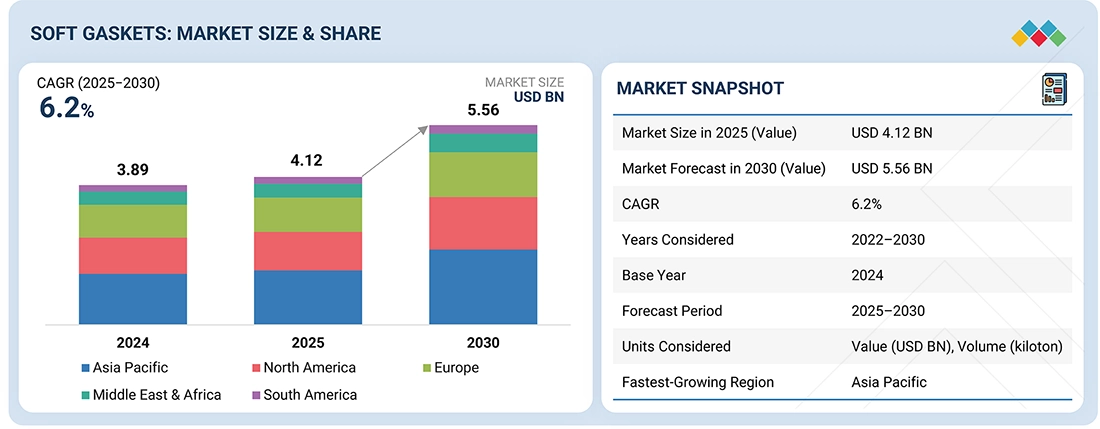
The soft gaskets market is projected to grow from USD 4.12 billion in 2025 to USD 5.56 billion by 2030, at a CAGR of 6.2% during the forecast period. The soft gaskets market is experiencing strong growth as industries, such as oil & gas, chemicals, power, water treatment, HVAC, automotive, and general manufacturing, continue to expand their networks of pipes, pumps, valves, and machinery that require reliable, low-cost sealing solutions.
KEY TAKEAWAYS
-
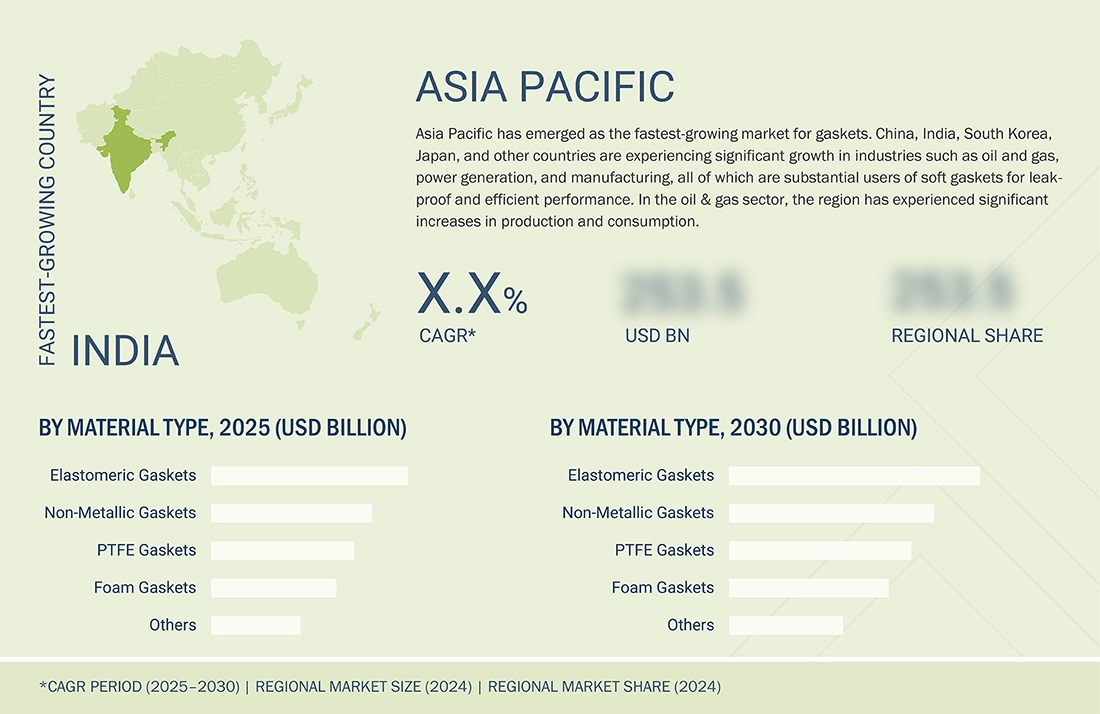
By RegionAsia Pacific is expected to be the fastest-growing market with a CAGR of 6.7% during the forecast period.
-
By Material TypeThe elastomeric material segment is projected to register the highest CAGR of 6.6% during the forecast period.
-
By Product TypeBy product type, the envelope gaskets segment is projected to witness the highest growth, registering a CAGR of 6.4% during the forecast period.
-
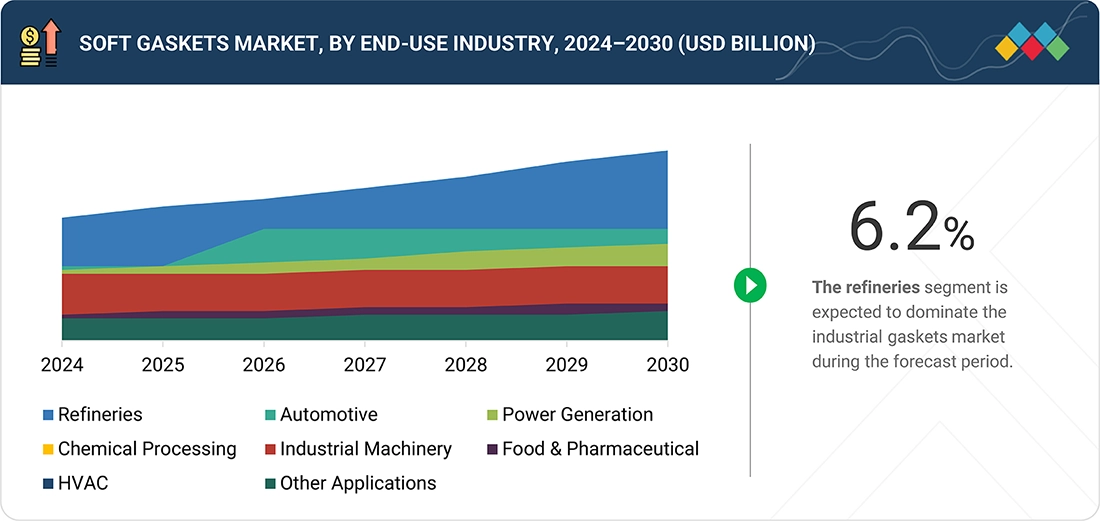
By End-Use IndustryThe refineries segment is estimated to account for the largest market share during the forecast period.
-
COMPETITIVE LANDSCAPE - KEY PLAYERSCompanies such as Freudenberg Sealing Technologies (Germany), KLINGER Group (Austria), and Garlock (US), among others, were identified as some of the star players in the Soft gasket market globally, given their strong market share and product footprint.
-
COMPETITIVE LANDSCAPE - STARTUPSSpira Power, PGE Industries, and Denver, among others, have distinguished themselves among startups and SMEs by securing strong footholds in specialized niche areas, underscoring their potential as emerging market leaders.
Soft gaskets, made from PTFE, rubber, CNAF, graphite composites, and elastomers, are preferred for the majority of low-to-medium pressure flange connections due to their versatility, chemical resistance, ease of installation, and low replacement cost.
TRENDS & DISRUPTIONS IMPACTING CUSTOMERS' CUSTOMERS
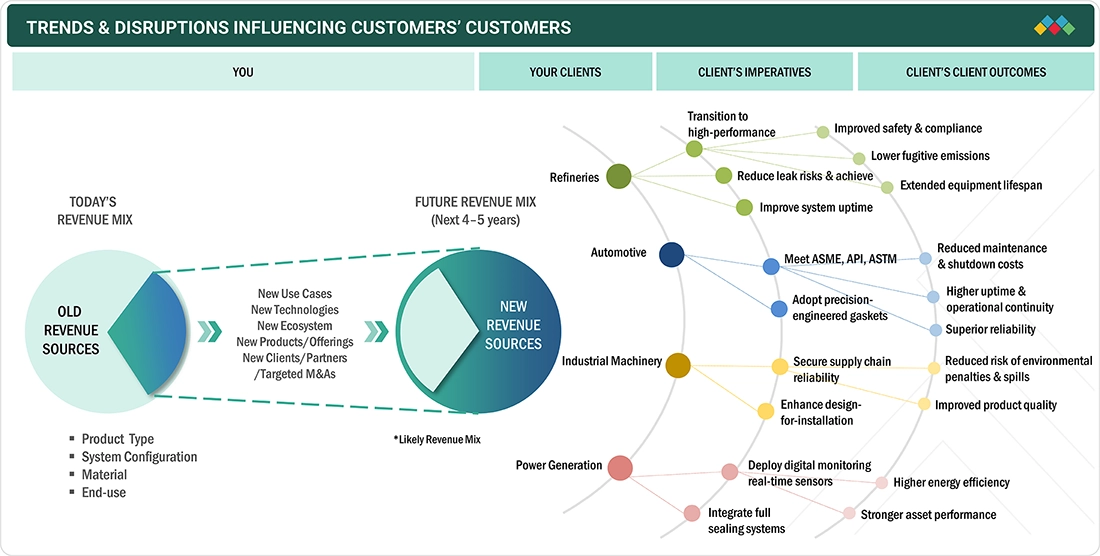
The soft gaskets market is witnessing significant trends and disruptions reshaping customer businesses across various industries. The automotive sector is undergoing disruption from vehicle electrification, which reduces the demand for traditional combustion engine gaskets while increasing the demand for new sealing materials for battery housings, thermal-management systems, and electronic enclosures. Meanwhile, global supply chain volatility in rubber, fillers, and PTFE resins is affecting various sectors, driving a shift toward localization, multi-sourcing, and new composite materials.
Source: Secondary Research, Interviews with Experts, MarketsandMarkets Analysis
MARKET DYNAMICS

Level
-
Material performance advantage

-
Growing demand from refineries


Level
-
Performance limits in high-pressure/high-temperature services

-
Availability of alternative sealing technologies


Level
-
Material innovation & high performance formulations

-
Regulatory shifts away from asbestos


Level
-
Competition from low-cost manufacturers

-
Supply chain disruptions

Source: Secondary Research, Interviews with Experts, MarketsandMarkets Analysis
Driver: Material performance advantage
Soft gaskets offer a combination of properties that allow for flexibility, chemical compatibility, and the ability to fit into uneven surfaces, unlike traditional metallic or hard seal solutions. PTFE, expanded PTFE, graphite, and newer elastomeric materials (EPDM, NBR, FKM, silicone) can be easily compressed and molded into the microscopic voids created by the imperfect surfaces found on flange surfaces to create a robust seal at lower bolt loads. Due to their universal compatibility with oil, steam, hydrocarbon, solvent, acid, and caustic chemicals, they can be used throughout the industrial sectors (i.e., refining, chemical, water treatment, and food/pharmaceutical). Newer formulations also offer improved creep resistance, higher temperature tolerance, and longer life, reducing leakage risk and compliance costs in LDAR-sensitive industries. As they are easier to install, safer to handle, and require simpler maintenance than metallic or spiral-wound gaskets, soft gaskets deliver a performance-for-cost ratio that makes them the preferred choice for the majority of low- to medium-pressure sealing applications.
Restraint: Performance limits in high-pressure/high-temperature services
The sealing market offers a wide range of gaskets to suit various operating conditions. Soft gaskets can offer limited service in extreme operating conditions (HPHT). This is due to their tendency to develop creep, cold flow, or relaxation when exposed to elevated temperatures for an extended time. Under high amounts of pressure, soft gaskets may extrude from the flange gap if they do not possess enough ability to compress and support the flange gap's weight. Most soft gasket materials will degrade or carbonize when exposed to temperatures above their thermal threshold and, therefore, will fail prematurely or leak. This presents an unacceptable risk in refinery reactors, steam pipeline systems, and boiler applications. Although PTFE is chemically resistant, it is susceptible to softening at elevated temperatures; therefore, PTFE does not provide reliable mechanical sealing performance at high temperatures. Consequently, metallic, spiral-wound, or kammprofile gaskets will typically be required for applications with HPHT because these types of gaskets can sustain extreme thermal and mechanical cycling activity. In conclusion, the limitations of the material types for soft gaskets act as a barrier to those products entering into the higher-severity segment of the sealing market.
Opportunity: Material innovations & high performance formulations
Soft gasket is being created as a result of material innovation and high-performance formulations, allowing for the development of new opportunities. Developments in expanded PTFE (ePTFE), filled PTFE, graphite-enhanced composite materials, and next-generation elastomers (such as peroxide-cured EPDM, low-permeation fluoroelastomers, and high-temperature silicone blends) have allowed for improved resistance to heat, chemicals, high pressure, and aging. These advanced materials provide improved dimensional stability, reduced creep, and increased service life. With these benefits, soft-gasket materials are increasingly used in applications that were considered to be too extreme to be sealed with metal or spiral-wound gaskets. In regulated industries, such as food, pharma, and chemicals, innovation in FDA-grade, USP-compliant, and low-extractables PTFE formulations is unlocking new adoption. Additive manufacturing, fiber-reinforcement technologies, and micro-textured sealing surfaces are also emerging, allowing improved compressibility and sealing performance even on imperfect flanges. Together, these advancements offer manufacturers the chance to differentiate through performance, move into higher-value segments, and capture demand driven by stricter leak-prevention and sustainability requirements across multiple end-use sectors.
Challenge: Competition from low-cost manufacturers
In the soft gasket industry, competition from low-cost manufacturers is a major challenge for some market players. This is especially true for standard sheet, ring, and elastomer gaskets. As companies located in low-cost countries have access to lower labor costs, as well as simpler production methods and inferior (lower-grade) raw materials, they can sell their gaskets for a fraction of the price offered by a major manufacturer. Many established and quality-conscious manufacturers cannot compete with low-cost manufacturers on price alone, creating downward pressure on prices, which impacts the bottom line of reputable manufacturers. As a result, reputable manufacturers can either absorb the cost increase or provide justification for their premium pricing through certification, material traceability, and enhanced technical performance. Many end users of soft gaskets in non-critical applications do not consider these factors when selecting a product. Conversely, low-cost manufacturers often lack the testing capabilities necessary to fully comply with ASME/API/EN standards, and they do not consistently maintain batch consistency. Despite this, they continue to gain market share in the industrial maintenance sector (maintenance-heavy sectors), where the primary buying focus is on getting immediate savings. This price-only competition results in a lack of differentiation, creating confusion in the procurement process for the customer. This forces premium manufacturers to invest more in product development, branding, and quality control to protect their market share.
SOFT GASKETS MARKET: COMMERCIAL USE CASES ACROSS INDUSTRIES
| COMPANY | USE CASE DESCRIPTION | BENEFITS |
|---|---|---|
 |
Soft gaskets are used in flange joints, valve bonnets, manways, tank nozzles, and piping systems for process lines and utility connections. They are installed during routine turnarounds and maintenance to restore pressure-bound seals on tanks, exchangers, valves, and piping. | Soft gaskets provide chemical compatibility, quick replacement during turnarounds, and good sealing for low-to-medium pressure hydrocarbon and utility lines, helping prevent vapor losses and enabling faster maintenance cycles. |
 |
Automakers use soft gaskets as engine head/valve-cover gaskets, intake-manifold seals, oil-pan gaskets, transmission/seal packings, and numerous body/assembly seals. These gaskets create fluid- and gas-tight joints between mating engine and drivetrain components and provide sealing across moving or thermally cycling surfaces. | Soft gaskets damp vibration, accommodate thermal expansion, prevent oil/coolant/exhaust leaks, and are inexpensive and easy to replace in scheduled service, lowering warranty leak issues and simplifying routine repairs. |
 |
Industrial OEMs and plants use soft gaskets in pump and compressor casings, flange connections, gearbox covers, hydraulic cylinders, and machine housings. Gaskets are used both as OEM parts and in service/repair kits during overhauls and routine maintenance to restore pressure and fluid integrity. | Soft gaskets simplify maintenance (available in pre-packed service kits), reduce downtime by enabling fast resealing during repairs, and provide vibration-tolerant, conformable seals for complex cast or machined mating surfaces. |
Logos and trademarks shown above are the property of their respective owners. Their use here is for informational and illustrative purposes only.
MARKET ECOSYSTEM
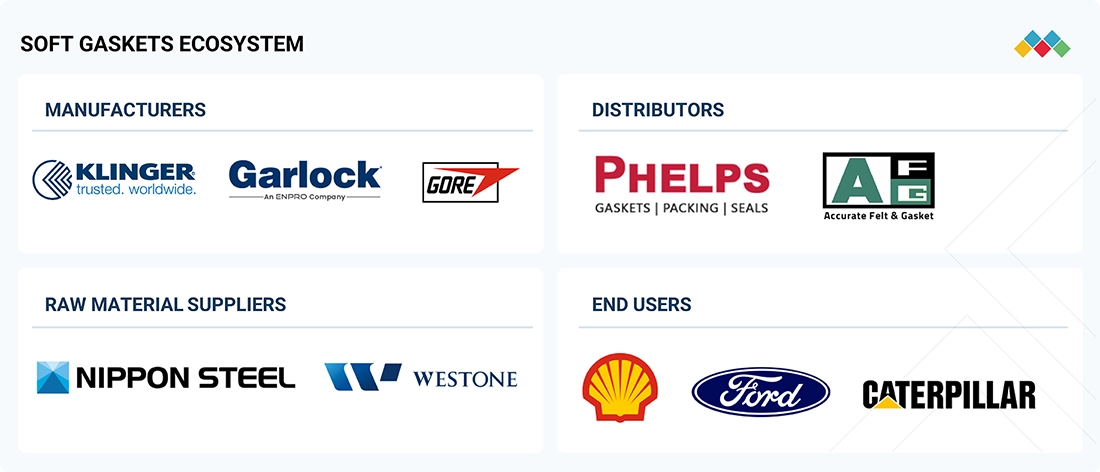
The soft gaskets market ecosystem comprises raw material suppliers, gasket manufacturers, distributors, and major end-use industries. Raw material providers supply elastomers, PTFE, and graphite to the manufacturers, who in turn use the raw materials for manufacturing gaskets. Distributors ensure timely delivery across various regions as per demand. Demand is driven by oil & gas, chemical processing, power generation, HVAC, automotive, and other industrial sectors that require reliable sealing for safety and compliance. Regulatory bodies, such as the EPA and ASME, are involved in drafting performance standards, creating a market that focuses on durability, safety, and continuous maintenance needs.
Logos and trademarks shown above are the property of their respective owners. Their use here is for informational and illustrative purposes only.
MARKET SEGMENTS
Source: Secondary Research, Interviews with Experts, MarketsandMarkets Analysis
Soft Gaskets Market, By Material Type
The elastomeric gasket segment is estimated to capture the largest share in the soft gaskets market during the forecast period. Flexible rubber materials, such as EPDM, nitrile (NBR), neoprene, and silicone, are used to produce elastomeric soft gaskets. Elastomeric soft gaskets offer great benefits due to their low-to-medium pressure applications, including those within pumps, valves, compressors, automotive engines, HVAC systems, and industrial machinery. In other words, elastomeric gaskets provide users with complete control over their seal by allowing the user to increase the compression to create a tight seal. Also, elastomers reduce the impact of vibration on equipment by absorbing the energy produced by the equipment, accommodating thermal changes during the operation of the equipment, and maintaining the seal's integrity under very dynamic conditions. Due to these benefits, elastomerics are the sealing products of choice in most industrial sectors, making them highly cost-effective and easy to install and maintain.
Soft Gaskets Market, By Product Type
The chemicals, refineries, food & beverage, biotech, and water treatment industries are increasingly focused on treating corrosive products, and are more strictly regulating their sanitary practices. As a result, PTFE-enveloped gaskets provide both a non-contaminating sealing surface and are compliant with FDA regulations. Additionally, they provide a chemically resistant sealing surface that is wider than what traditional elastomer or sheet gaskets can offer. Furthermore, as companies face increased regulatory pressures to replace CNF and asbestos-based gaskets, the use of PTFE envelope gaskets will continue to grow. Manufacturers are increasingly utilizing envelope gaskets in applications where product purity, low extractables, and ease of cleaning are essential. Furthermore, the reinforced core design of the envelope gasket overcomes some of the disadvantages associated with PTFE, such as its tendency to creep and cold flow.
REGION
Asia Pacific to be fastest-growing region in soft gaskets market during forecast period
Asia Pacific is the fastest-growing soft gaskets market as the region is undergoing rapid industrial expansion across chemicals, petrochemicals, automotive, pharmaceuticals, water treatment, and general manufacturing sectors. These industries rely heavily on low- to medium-pressure sealing solutions. China, India, Southeast Asia, and South Korea are seeing an increasing demand for soft gaskets due to the investment of billions of dollars into new refineries, power generation plants, and other industrial machinery in these markets. Additionally, there is a very extensive manufacturing ecosystem within this region supporting the production of rubber, elastomers, PTFE, and gasket sheet materials, which have reduced manufacturing costs and increased turnaround times compared to Western markets.
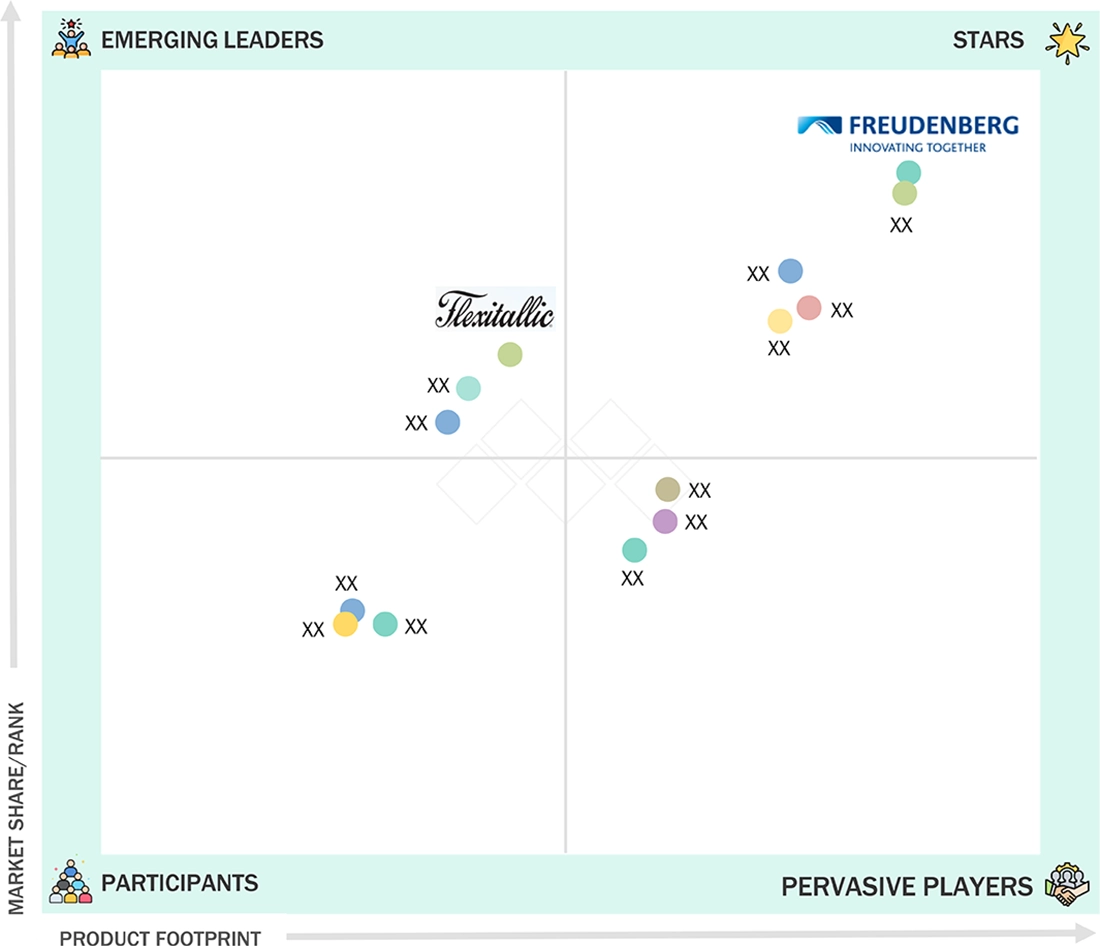
SOFT GASKETS MARKET: COMPANY EVALUATION MATRIX
In the soft gaskets market, Garlock (Leader) maintains a dominant position supported by its extensive installed base, wide-ranging gasket portfolio, and strong end-to-end sealing solutions. Its products are deeply embedded across refineries, chemical plants, power facilities, and high-demand sectors such as food & beverage, pharmaceuticals, and petrochemicals, reinforcing its leadership through scale, technical expertise, and proven execution across complex industrial environments. Flexitallic (Emerging Leader) is steadily expanding its presence with advanced gasket technologies, specialized high-temperature and high-pressure sealing solutions, and tailored offerings built for compact, high-efficiency operations across diverse industrial users. While Garlock continues to lead with its comprehensive capabilities and broad North American footprint, Flexitallic is well-positioned to move closer to the leaders’ quadrant as industries increasingly prioritize reliability, safety, and performance-driven gasket solutions.
Source: Secondary Research, Interviews with Experts, MarketsandMarkets Analysis
KEY MARKET PLAYERS
- W. L. Gore & Associates, Inc. (US)
- Garlock (US)
- Klinger Group (Austria)
- Freudenberg Sealing Technologies (Germany)
- James Walker Group (UK)
- Flexitallic (US)
- Datwyler Holding AG (Switzerland)
- Trelleborg (Sweden)
- Tenneco (US)
- IGP Group (India)
MARKET SCOPE
| REPORT METRIC | DETAILS |
|---|---|
| Market Size in 2025 (Value) | USD 4.12 Billion |
| Market Forecast in 2030 (value) | USD 5.56 Billion |
| Growth Rate | CAGR of 6.2% from 2025-2030 |
| Years Considered | 2022-2030 |
| Base Year | 2024 |
| Forecast Period | 2025-2030 |
| Units Considered | Value (USD Million/Billion), Volume (Kiloton) |
| Report Coverage | Revenue forecast, company ranking, competitive landscape, growth factors, and trends |
| Segments Covered |
|
| Regions Covered | Asia Pacific, Europe, North America, South America, Middle East & Africa |
WHAT IS IN IT FOR YOU: SOFT GASKETS MARKET REPORT CONTENT GUIDE
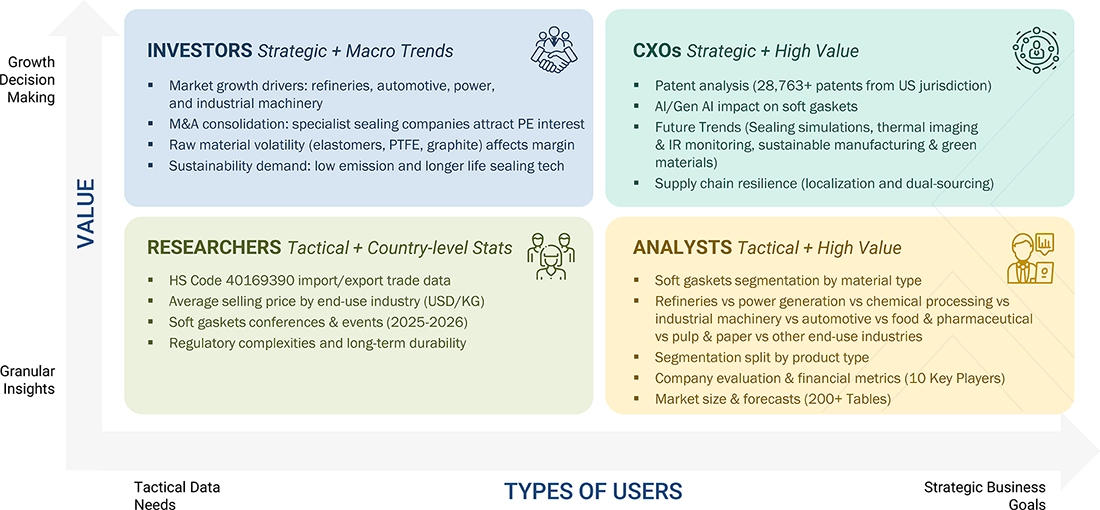
DELIVERED CUSTOMIZATIONS
We have successfully delivered the following deep-dive customizations:
| CLIENT REQUEST | CUSTOMIZATION DELIVERED | VALUE ADDS |
|---|---|---|
| Power Generation Organization |
|
|
| Distributor |
|
|
| Raw Material Supplier |
|
|
| Gasket Manufacturer |
|
|
RECENT DEVELOPMENTS
- September 2024 : Klinger announced two strategic acquisitions to expand its operations in Spain by acquiring Productos Salinas and Juntas Besma. By acquiring these two companies, KLINGER expanded its Spanish footprint and expanded its product portfolio. The acquisitions will allow KLINGER to offer an expanded product range and additional products such as industrial gaskets, sealing products, specialized rubbers, precision-engineered profiles, and Vulkollan products. KLINGER is now strategically positioned to provide more value to all industries through these acquisitions and enhanced capabilities.
- April 2024 : Klinger announced the acquisition of DIUNIS Wilhelm Gärtner GmbH Stanztechnik. DIUNIS is well-known for its high-quality production of smaller non-metallic gaskets, and this acquisition provides both companies with the opportunity to enhance their capabilities and better align themselves with the KLINGER strategic focus. In addition to enhancing KLINGER's current offerings, this acquisition represents a significant step towards expanding and diversifying the KLINGER product line within this sector.
- April 2024 : Freudenberg expanded its operations in Southeast Europe. It unveiled its new warehouse in Turkey, which ensures much faster deliveries of key products and parts to local customers. This expansion marks another step forward in enhancing sustainability, as transport routes to the customers will now be much more efficient.
Table of Contents
 Exclusive indicates content/data unique to MarketsandMarkets and not available with any competitors.
Methodology
The study involved four major activities to estimate the current size of the global Soft Gaskets Market . Exhaustive secondary research was conducted to collect information on the market, the peer product market, and the parent product group market. The next step was to validate these findings, assumptions, and sizes with the industry experts across the value chain of industrial gaskets through primary research. Both the top-down and bottom-up approaches were employed to estimate the overall size of the Soft Gaskets Market . After that, market breakdown and data triangulation procedures were used to determine the size of different segments and subsegments of the market.
Secondary Research
In the secondary research process, various secondary sources such as Hoovers, Factiva, Bloomberg BusinessWeek, and Dun & Bradstreet were referred to identify and collect information for this study on the Soft Gaskets Market . These secondary sources included annual reports, press releases & investor presentations of companies, white papers, certified publications, and articles by recognized authors, regulatory bodies, trade directories, and databases.
Primary Research
The Soft Gaskets Market comprises several stakeholders in the supply chain, which include raw material suppliers, equipment suppliers, distributors, end-product manufacturers, buyers, and regulatory organizations. Various primary sources from the supply and demand sides of the markets have been interviewed to obtain qualitative and quantitative information. The primary participants from the demand side include key opinion leaders, executives, vice presidents, and CEOs of companies in the Soft Gaskets Market . Primary sources from the supply side include associations and institutes involved in the Soft Gaskets Market , key opinion leaders, and processing players.
Market Size Estimation
The bottom-up and top-down approaches have been used to estimate the Soft Gaskets Market by material type, product type, end-use industry, and region. The research methodology used to calculate the market size includes the following steps:
- The key players in the industry and markets were identified through extensive secondary research.
- In terms of value, the industry’s supply chain and market size were determined through primary and secondary research processes.
- All percentage shares, splits, and breakdowns were determined using secondary sources and verified through primary sources.
- All possible parameters that affect the markets covered in this research study were accounted for, viewed in extensive detail, verified through primary research, and analyzed to obtain the final quantitative and qualitative data.
- The research included studying reports, reviews, and newsletters of top market players and extensive interviews with leaders, such as directors and marketing executives, to obtain opinions.
Data Triangulation
After arriving at the overall size of the Soft Gaskets Market from the estimation process explained above, the total market was split into several segments and subsegments. The data triangulation and market breakdown procedures were employed, wherever applicable, to complete the overall market engineering process and arrive at the exact statistics for all segments and subsegments. The data was triangulated by studying various factors and trends from both the demand and supply sides. Along with this, the market size was validated using both the top-down and bottom-up approaches.
Market Definition
Industrial gaskets are essential sealing components designed to fill the space between two mating surfaces, preventing the leakage of fluids or gases under compression. Used across a wide range of applications, from pipelines and pressure vessels to pumps, engines, and industrial machinery, these gaskets play a vital role in ensuring the integrity, efficiency, and safety of mechanical systems.
By creating a reliable seal, industrial gaskets help maintain pressure, prevent contamination, reduce emissions, and protect equipment from wear or failure. Depending on the application, industrial gaskets can be made from metallic, non-metallic, or composite materials, each selected for its ability to withstand specific temperature, pressure, and chemical conditions.
Stakeholders
- Industrial Gasket Manufacturers
- Raw Material Suppliers
- Equipment Suppliers
- Regulatory Bodies and Government Agencies
- Distributors and Suppliers
- End-use Industries
- Associations and Industrial Bodies
Report Objectives
- To define, describe, and forecast the size of the Soft Gaskets Market in terms of value and volume
- To provide detailed information regarding the key factors influencing the market growth (drivers, restraints, opportunities, and challenges)
- To forecast the market size based on material type, product type, end-use industry, and region
- To forecast the market size for the five main regions—North America, Europe, Asia Pacific (APAC), South America, and the Middle East & Africa (MEA), along with their key countries
- To strategically analyze micromarkets with respect to individual growth trends, prospects, and contributions to the total market
- To analyze the opportunities in the market for stakeholders and provide details of the competitive landscape for the market leaders
- To strategically profile leading players and comprehensively analyze their key developments, such as product launches, expansions, and deals in the industrial gasket market
- To strategically profile the key players and comprehensively analyze their market shares and core competencies
- To study the impact of AI/Gen AI on the market under study, along with the macroeconomic outlook
Key Questions Addressed by the Report
What are the key applications of the Soft Gaskets Market?
The Soft Gaskets Market is widely used across industries such as automotive, construction, electronics, packaging, and industrial manufacturing where high-performance materials and components are essential.
What factors are driving the growth of the Soft Gaskets Market?
The growth of the Soft Gaskets Market is driven by rising industrial demand, expanding end-use industries, technological advancements, and increasing global manufacturing activities.
Which regions dominate the Soft Gaskets Market?
Asia-Pacific, North America, and Europe are major regions in the Soft Gaskets Market due to strong manufacturing bases, growing industrial infrastructure, and increasing investments in advanced materials.
Who are the major end-users in the Soft Gaskets Market?
Key end-users in the Soft Gaskets Market include automotive, aerospace, construction, electronics, consumer goods, and energy industries that require reliable and high-quality materials.
What challenges are affecting the Soft Gaskets Market?
Major challenges in the Soft Gaskets Market include fluctuating raw material prices, environmental regulations, supply chain disruptions, and the need for continuous innovation to stay competitive.


Personalize This Research
- Triangulate with your Own Data
- Get Data as per your Format and Definition
- Gain a Deeper Dive on a Specific Application, Geography, Customer or Competitor
- Any level of Personalization
Let Us Help You
- What are the Known and Unknown Adjacencies Impacting the Soft Gaskets Market
- What will your New Revenue Sources be?
- Who will be your Top Customer; what will make them switch?
- Defend your Market Share or Win Competitors
- Get a Scorecard for Target Partners

Custom Market Research Services
We Will Customise The Research For You, In Case The Report Listed Above Does Not Meet With Your Requirements
Get 10% Free CustomisationTESTIMONIALS

We at Nissan Chemicals Corporation have been clients of MarketsandMarkets for more than a year now. We recently consulted MarketsandMarkets for a study, the team at MarketsandMarkets was extremely professional and organized. The business insights were very detailed and aligned well with our expectations that really helped us formulate the Business Plans and device new strategies for development themes. MarketsandMarkets offers a unique combination of expertise and dedicated engagement model. Their research findings have helped us in designing our Pricing Strategy which will make it easier for us to predict the future sales and profits for the next ten years. We look forward to working with MarketsandMarkets in the future.
VP of Strategy & New Business Development
Leading Specialty Chemical Company
The MarketsandMarkets Engagement Model, composed of both the Knowledge Store and advisory custom research, has greatly helped us in understanding our markets and making strategic decisions. The Knowledge Store is a fast way to allow everyone in our organization to understand more about most any market they are interested in. The ability to then get custom research done and get answers to specific strategic questions and market insight has been spectacular. The Markets and Markets team feel more like colleagues than vendors and their services have helped us change our culture where statements of things like growth opportunities and competitive position are always backed by industry research.

Rich Gibson,
Director, Corporate Strategy
Milliken & Company,
Leading Industrial Manufacturer of specialty chemical, floor covering, performance and protective textile materials, and healthcaremilliken.com
MarketsandMarkets is a trusted resource that helps us to better understand markets that are near-adjacencies-whether its technology, value chain or geography. Their Knowledge Store platform provides a dashboard of markets and their characteristics which is easy to use and saves us time.
Adam Shaw,
Market Development and Strategy Manager
AdvanSix Inc. USA,
An American Leader in Chemicalswww.advansix.com
The Knowledge Store from MarketsandMarkets is a valuable tool which has helped my team acquire greater insight in to the end markets that our business serves. This has enabled us to help our company build stronger strategies throughout our planning process.
TOSHIO KINOSHITA
Senior Chif Consultion Research & Consulting Division
Mitsubishi Chemical Research Corporation,
Leading Manufacturer of Chemical Productswww.mitsubishichem-res.co.jp/en/

We recently engaged with MarketsandMarkets for a study, the team not only clearly understood our business objectives but was also extremely professional in the way they handled the entire project. The study was efficiently conducted in a phase-wise manner, and the engagement model furnished us with high-quality business insights that far exceeded our expectations at each phase. We were especially happy that MarketsandMarkets could provide us with both, an English as well as a Japanese version of the study. A special thanks to the Analyst Team and Client Services Team, whose fluency in Japanese enhanced our comfort level, as we could converse with them in our preferred language.
Independent entrepreneurs
Arrow Precision
We approached MarketsandMarkets for study on Proppants Market, and their work exceeded our expectations. The study conducted was comprehensive and enabled us to view the market through the various dimensions. In addition, the team was extraordinarily responsive throughout the process and resolved our queries on time. I strongly recommend MarketsandMarkets and will certainly consider them for additional market assessments we will need in the future.
Global engineering company, Japan
Deputy Manager,
Strategic Planning OfficeThe high-quality insights shared by the MarketsandMarkets team helped us understand the pharmaceutical plant designers in a specific geography. It also captured the risks that we may likely face in communicating with our potential partners. The study would enable us identify partners, which would impact our future growth.






Growth opportunities and latent adjacency in Soft Gaskets Market