South Korea Interactive Kiosk Market

South Korea Interactive Kiosk Market by Information & Directory, Bitcoin, Ordering & Retail, Ticketing & Reservation, Hospitality & Travel, Public Sector, Restaurant & QSR, Financial Service, Floor-standing, Wall-mounted, and Region - Forecast to 2030




OVERVIEW

Source: Secondary Research, Interviews with Experts, MarketsandMarkets Analysis
The South Korea interactive kiosk market is projected to reach USD 807.8 million by 2030 from USD 509.8 million in 2025, at a CAGR of 9.6% from 2026 to 2030. Interactive kiosks are witnessing strong growth in South Korea, driven by the country’s highly digitalized infrastructure and widespread adoption of cashless payments. Increasing labor costs and workforce shortages are accelerating demand for self-service solutions across retail, quick service restaurant (QSR), and convenience stores. Additionally, high urban density and consumer preference for fast, contactless transactions are supporting kiosk deployment, while government initiatives promoting digital inclusion further strengthen adoption across public and service sectors.
KEY TAKEAWAYS
-
By TypeBy type, ordering & retail kiosks captured the largest market share between 20 and 23% in 2025.
-
By VerticalBy vertical, the retail segment dominated the market in 2025.
-
By OfferingBy offering, the software segment is projected to record the highest CAGR of ~17% during the forecast period.
-
By Mounting TypeBy mounting type, the floor-standing kiosks segment held the largest market share between 63 and 67% in 2025.
-
Display Panel SizeBy display panel size, the medium segment accounted for the largest market share of 50–53% in 2025.
-
Competitive Landscape - Star PlayersNCR Voyix Corporation (US), Diebold Nixdorf, Incorporated (US), Zebra Technologies Corporation (US), Advantech Co., Ltd. (Taiwan), and Glory Ltd. (Japan) were identified as star players in the South Korea interactive kiosk market, given their strong product portfolios and geographical presence.
-
Competitive Landscape - StartupsNCR Atleos Corporation (US) and Pyramid Computer GmbH (Germany) have distinguished themselves as emerging leaders, with KIOSK Information Systems (US) among the startups, underscoring their potential in specialized market segments.
The South Korea interactive kiosk market is experiencing robust growth driven by rising adoption of advanced digital solutions across retail, healthcare, and financial services sectors, driven by government initiatives to enhance digital education and support for senior citizens.
TRENDS & DISRUPTIONS IMPACTING CUSTOMERS' CUSTOMERS
The South Korea interactive kiosk market is experiencing strong innovation and rapid adoption across key sectors such as retail, healthcare, financial services, and transportation. Advancements in kiosk technology are aligned with trends in contactless payments, automated customer service, and broader digital transformation initiatives. The adoption of self-service kiosks is expanding across retail outlets, banks, hospitals, and transportation hubs, enabling automated transactions, streamlined information access, and efficient service delivery. These systems support faster customer processing and reduced operational costs while aligning with the growing preference for contactless interactions. Additionally, government and private sector initiatives promoting digital inclusion, particularly among senior citizens through education programs and user-friendly interfaces, are further accelerating adoption. Public-private collaborations are also supporting the deployment of secure, accessible, and efficient kiosk solutions across diverse user groups.

Source: Secondary Research, Interviews with Experts, MarketsandMarkets Analysis
MARKET DYNAMICS

Level
-
Strong penetration of contactless payment solutions (KakaoPay, Naver Pay) across retail and transit environments

-
Elevated demand for fast, self-service models due to high urban density in cities like Seoul


Level
-
Limited adoption by SMEs and independent retailers due to high upfront and recurring maintenance costs

-
Compliance burden due to stringent data privacy regulations under Korea’s Personal Information Protection Act


Level
-
Increasing kiosk deployment in public infrastructure with expansion of smart city initiatives and digital government services

-
Growing adoption in healthcare sector for patient check-in, registration, and teleconsultation services


Level
-
Continuous need for software upgrades and lifecycle management

-
Rising cybersecurity risks in financial and personal data handling

Source: Secondary Research, Interviews with Experts, MarketsandMarkets Analysis
Driver: Strong penetration of contactless payment solutions (KakaoPay, Naver Pay) across retail and transit environments
South Korea’s widespread adoption of contactless payment platforms, such as KakaoPay and Naver Pay, is accelerating the deployment of interactive kiosks across retail and transit environments. Consumers increasingly prefer fast, seamless, and cashless transactions, prompting businesses to integrate kiosk-based payment and service systems. This trend is further supported by high smartphone penetration and a digitally mature consumer base.
Restraint: Limited adoption by SMEs and independent retailers due to high upfront and recurring maintenance costs
High initial investment and recurring maintenance costs continue to limit kiosk adoption, particularly among SMEs and independent retailers in South Korea. Expenses related to hardware procurement, system integration, and ongoing technical support create cost pressures, making it challenging for smaller businesses to scale kiosk deployment.
Opportunity: Increasing kiosk deployment in public infrastructure with expansion of smart city initiatives and digital government services
The expansion of smart city initiatives and digital government services is creating strong opportunities for interactive kiosk deployment in public infrastructure across South Korea. Kiosks are increasingly used for public information access, administrative services, and transportation systems, supporting enhanced citizen engagement and efficient service delivery.
Challenge: Continuous need for software upgrades and lifecycle management
Frequent software upgrades and lifecycle management remain critical challenges due to rapid technological advancements and evolving user expectations. Operators must continuously invest in system updates, cybersecurity, and hardware maintenance to ensure reliable performance and consistent user experience.
SOUTH KOREA INTERACTIVE KIOSK MARKET: COMMERCIAL USE CASES ACROSS INDUSTRIES
| COMPANY | USE CASE DESCRIPTION | BENEFITS |
|---|---|---|
 |
Unmanned currency exchange kiosks deployed across CU convenience stores in key tourist locations such as Myeongdong and Yongsan, enabling foreign customers to exchange up to 15 currencies using passport authentication, multilingual interfaces, and automated transaction processing without visiting traditional exchange counters. | Provides 24/7 access to currency exchange services | Reduces dependency on staffed counters | Enhances convenience for foreign tourists | Iproves service efficiency in high-traffic retail locations |
 |
LG Electronics deployed self-order kiosks across QSR chains and cafés in South Korea, integrating touchscreen ordering, POS connectivity, and digital payment systems such as KakaoPay and card-based transactions. | Reduced wait times | Improved order accuracy | Minimized dependency on service staff | Enhanced customer throughput in high-density urban food service environments |
 |
Samsung Electronics deployed modular interactive kiosks across retail and hospitality sectors, integrating Samsung Knox security and multi-payment acceptance for seamless and secure transactions. | Enabled secure and reliable transactions| Improved operational efficiency | Supported scalable deployments | Enhanced overall customer experience across retail environments |
 |
NICE TCM deployed payment-enabled kiosks across convenience stores and unattended retail locations, supporting self-checkout, bill payments, and card-based transactions in high-footfall areas. | Improved checkout efficiency | Reduced queue congestion | Enabled seamless cashless payments | Enhanced transaction speed in convenience-driven retail ecosystems |
 |
LG CNS and Samsung SDS deployed smart service kiosks across public infrastructure and government service centers, enabling ticketing, information access, and digital administrative services. | Enabled 24/7 service accessibility | Reduced manual workload | Improved citizen service delivery efficiency| Supported large-scale digital transformation initiatives |
Logos and trademarks shown above are the property of their respective owners. Their use here is for informational and illustrative purposes only.
MARKET ECOSYSTEM
The South Korea interactive kiosk market is a collaborative ecosystem where R&d engineers, technology providers, hardware manufacturers, software developers, interactive kiosk manufacturers, system integrators, end users, and post-sales service providers work together to develop and implement advanced self-service solutions across various verticals. Companies in the region supply a variety of kiosk components, including touchscreen displays, payment terminals, printers, and specialized software applications. System integrators, technology consultants, and service providers assist with the design, installation, maintenance, as well as customization of these interactive kiosks. Ultimately, businesses and organizations across retail, healthcare, financial services, transportation, and government sectors in South Korea deploy kiosks, benefiting from supportive digital transformation policies and infrastructure development programs.

Logos and trademarks shown above are the property of their respective owners. Their use here is for informational and illustrative purposes only.
MARKET SEGMENTS

Source: Secondary Research, Interviews with Experts, MarketsandMarkets Analysis
South Korea Interactive Kiosks Market, by Type
Ordering & retail kiosks dominated the South Korea interactive kiosks market in 2025, supported by the strong adoption across QSR chains, convenience stores, and high-traffic urban locations. These kiosks play a critical role in enabling self-ordering and cashless transactions, aligning with the country’s advanced digital payment ecosystem. Their ability to reduce waiting times, improve service efficiency, and handle high customer volumes has made them a preferred solution across retail and food service environments.
South Korea Interactive Kiosks Market, by Offering
Hardware segment dominated the South Korea interactive kiosks market in 2025, supported by increasing demand for high performance kiosk components such as touch displays, processors, printers, and integrated payment terminals. The replacement cycle of legacy systems with advanced, durable, and modular hardware solutions, along with rising installations across retail and QSR chains, is driving segment growth. Additionally, the need for seamless system integration and long operational life is strengthening hardware adoption across high traffic environments.
South Korea Interactive Kiosks Market, by Vertical
Retail segment dominated the South Korea interactive kiosks market in 2025, driven by the rapid expansion of self ordering kiosks across QSR outlets, convenience stores, supermarkets, and shopping malls. Increasing focus on enhancing customer experience, reducing dependency on staff, and improving order accuracy is accelerating deployment. Moreover, high consumer acceptance of digital interfaces and cashless payments is supporting strong kiosk penetration across retail environments.
REGION
South Korea to experience significant growth in interactive kiosk market during forecast period
South Korea is experiencing rapid growth in the interactive kiosk market, driven by its advanced digital infrastructure, high smartphone penetration, and strong government support for digital transformation initiatives. The demand for self-service solutions in retail, banking, healthcare, and transportation is increasing, along with the production and deployment of interactive kiosks across the country. Additionally, significant investment in educational programs promoting digital device usage among senior citizens, combined with a tech-savvy population, is facilitating the swift adoption of kiosk technology from development to widespread implementation.

SOUTH KOREA INTERACTIVE KIOSK MARKET: COMPANY EVALUATION MATRIX
NCR Voyix is positioned as a star player in the South Korea interactive kiosk market, supported by its strong market share and extensive product footprint. The company offers a comprehensive portfolio, including ATM systems, self-checkout terminals, and POS-integrated kiosk solutions, widely deployed across retail and banking environments. Its focus on payment integration and retail automation aligns well with South Korea’s advanced digital and cashless ecosystem, reinforcing its leadership position. Pyramid Computer GmbH is identified as an emerging leader, with a growing presence driven by its specialized kiosk and industrial computing solutions. The company is expanding its footprint in self-service and retail kiosk applications, gradually strengthening its position in the South Korea market through targeted deployments and product innovations.

Source: Secondary Research, Interviews with Experts, MarketsandMarkets Analysis
KEY MARKET PLAYERS
- NCR Voyix Corporation (US)
- Diebold Nixdorf, Incorporated (US)
- Zebra Technologies Corporation (US)
- Advantech Co., Ltd. (Taiwan)
- Glory Ltd. (Japan)
- NCR Atleos Corporation (US)
- Pyramid Computer GmbH (Germany)
- KIOSK Information Systems (US)
MARKET SCOPE
| REPORT METRIC | DETAILS |
|---|---|
| Market Size in 2025 (Value) | USD 509.8 Million |
| Market Forecast in 2030 (Value) | USD 807.8 Million |
| Growth Rate | CAGR of 9.6% from 2026-2030 |
| Years Considered | 2021-2030 |
| Base Year | 2025 |
| Forecast Period | 2026-2030 |
| Units Considered | Value (USD Million), Volume (Million Units) |
| Report Coverage | Revenue Forecast, Company Ranking, Competitive Landscape, Growth Factors, and Trends |
| Segments Covered |
|
| Country Covered | South Korea |
WHAT IS IN IT FOR YOU: SOUTH KOREA INTERACTIVE KIOSK MARKET REPORT CONTENT GUIDE

DELIVERED CUSTOMIZATIONS
We have successfully delivered the following deep-dive customizations:
| CLIENT REQUEST | CUSTOMIZATION DELIVERED | VALUE ADDS |
|---|---|---|
| Understanding demand patterns for interactive kiosks across South Korea business sectors | Assessed kiosk deployment trends across key South Korean verticals, including retail, financial services, healthcare, transportation, and government, highlighting differences in adoption of payment kiosks, information terminals, ticketing systems, and self-service solutions across urban and suburban locations | Helps clients align product portfolios with sector-specific demand drivers, digital transformation maturity, and service automation priorities |
| Identifying local technology providers and integration partners | Mapped regional kiosk manufacturers, software developers, system integrators, and service providers across South Korea, with insights into hardware assembly, software customization, installation services, and maintenance support capabilities |
|
RECENT DEVELOPMENTS
- July 2025 : ASTA ALMEX and X Park Iskandar Puteri in Malaysia launched self-service ticketing kiosks at entertainment and recreational facilities, demonstrating the expansion of automated ticketing solutions in the Asia Pacific region and highlighting the growing adoption of self-service technologies in visitor management applications.
- November 2023 : CU, a major convenience store chain in South Korea, deployed unmanned currency exchange kiosks across its retail locations, enabling customers to exchange foreign currency through automated terminals without visiting traditional exchange counters, thereby enhancing service accessibility and operational efficiency.
- January 2026 : South Korea enforced mandatory barrier-free kiosk regulations across public and commercial spaces, requiring features such as voice guidance and accessible interfaces, thereby accelerating nationwide deployment of inclusive interactive kiosks.
- January 2026 : Over 80,000 restaurants and bars in South Korea adopted unmanned payment kiosks, highlighting rapid growth in self-service adoption driven by rising labor costs and demand for operational efficiency.
Table of Contents
 Exclusive indicates content/data unique to MarketsandMarkets and not available with any competitors.
Methodology
The study involved four major activities in estimating the current size of the south korea interactive kiosk market. Exhaustive secondary research was conducted to gather information on the market, adjacent markets, and the overall south korea interactive kiosk landscape. These findings, assumptions, and projections were validated through primary research involving interviews with industry experts and key stakeholders across the value chain. Both top-down and bottom-up approaches were utilized to estimate the overall market size. Subsequently, market breakdown and data triangulation techniques were applied to determine the sizes of various segments and subsegments. Two key sources, secondary and primary, were leveraged to conduct a comprehensive technical and commercial assessment of the south korea interactive kiosk market.
Secondary Research
The market for companies offering south korea interactive kiosk solutions is arrived at by secondary data available through paid and unpaid sources, analyzing the product portfolios of major companies in the ecosystem, and rating the companies by their performance and quality. The secondary sources included annual reports, press releases, and investor presentations of companies; white papers; journals and certified publications; and articles from recognized authors, websites, directories, and databases. Secondary research was conducted to obtain key information about the industry’s supply chain, the market’s value chain, the total pool of key players, market segmentation according to the industry trends (to the bottom-most level), regional markets, and key developments from market- and technology-oriented perspectives. The secondary data was collected and analyzed to determine the overall market size, which is further validated through primary research.
Primary Research
Extensive primary research was conducted after gaining knowledge about the current scenario of the south korea interactive kiosk market through secondary research. Several primary interviews were conducted with experts from the demand and supply sides across four major regions—North America, Europe, Asia Pacific, and RoW. This primary data was collected through questionnaires, emails, and telephonic interviews.
To know about the assumptions considered for the study, download the pdf brochure
Market Size Estimation
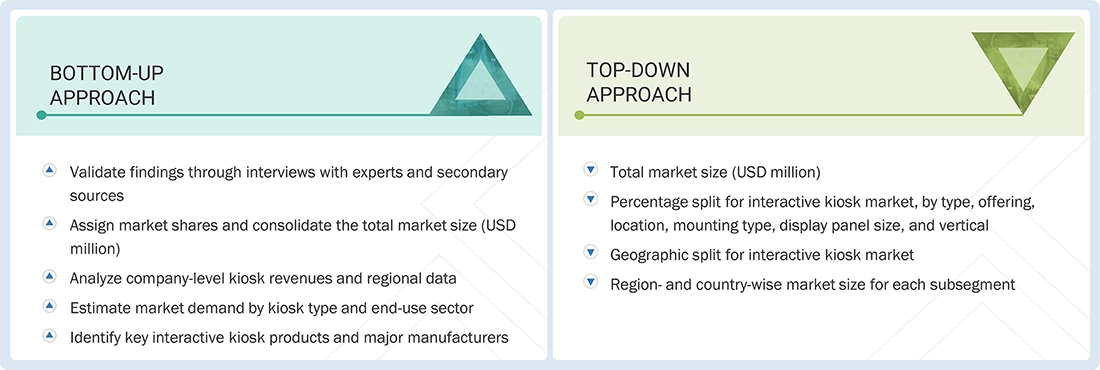
Both top-down and bottom-up approaches were used to estimate and validate the total size of the south korea interactive kiosk market. These methods have also been used to estimate the size of various subsegments in the market. The following research methodology was used to estimate the market size:
- Identifying products currently provided or expected to be offered by providers
- Tracking major south korea interactive kiosk manufacturers
- Estimating the size of the south korea interactive kiosk market based on demand, considering installation base expansion, replacement cycles, and end user adoption across verticals such as retail, hospitality, transportation, and healthcare
- Tracking ongoing and upcoming product launches by companies and forecasting the market based on these developments and other critical parameters
- Conducting multiple discussions with key opinion leaders to understand the demand for south korea interactive kiosks and analyzing the breakdown of the scope of work carried out by each major company
- Arriving at market estimates by analyzing revenues generated by manufacturers based on their locations (countries), and then combining country-based data to get a market estimate based on region
- Assigning a percentage to the overall revenue or, in a few cases, to segmental revenues of each company to derive their revenues from the sales of south korea interactive kiosks. This percentage for each company has been assigned based on its product portfolio and target application
- Verifying and cross-checking estimates at every level through discussions with key opinion leaders, including CXOs, directors, operation managers, and domain experts at MarketsandMarkets
US Interactive Kiosk Market: Top-Down and Bottom-Up Approach
Data Triangulation
After arriving at the overall size of the south korea interactive kiosk market using the market size estimation process explained above, the total market was split into several segments and subsegments. Data triangulation and market breakdown procedures were employed, wherever applicable, to complete the overall market engineering process and arrive at the exact statistics for all segments and subsegments of the market. The data was triangulated by studying various factors and trends from the demand and supply sides. The market size was also validated using the top-down and bottom-up approaches.
Market Definition
The south korea interactive kiosk refers to the ecosystem of self-service digital terminals that enable users to perform specific tasks or access information interactively without direct human assistance. These kiosks integrate hardware components, such as touchscreens, display panels, printers, scanners, sensors, and computing units, with software interfaces and connectivity features to deliver automated services across various public and commercial environments.
south korea interactive kiosks are deployed for diverse functions, including information dissemination, ticketing, payment transactions, product ordering, check-in/check-out, wayfinding, and other customer engagement applications. They are utilized across industries such as retail, banking & financial services, healthcare, transportation, hospitality, government, education, and entertainment.
An south korea interactive kiosk represents the growing convergence of automation, IoT, AI-driven interfaces, and digital payment technologies in self-service solutions aimed at improving accessibility, reducing operational costs, and increasing customer engagement across physical touchpoints.
Key Stakeholders
- Raw material and component suppliers
- Display and touchscreen manufacturers
- Hardware component suppliers (processors, sensors, printers, scanners, etc.)
- Software and platform developers
- Original equipment manufacturers (OEMs)
- Original design manufacturers (ODMs) and kiosk integrators
- System integrators and solution providers
- Payment solution providers
- Networking and connectivity providers
- Distributors and retailers
- Research and development organizations
- Technology standards organizations, forums, alliances, and associations
- Technology investors and venture capital firms
- End users (retail, hospitality, transportation, BFSI, healthcare, government, entertainment, etc.)
- Maintenance and service providers
- Value-added resellers (VARs)
Report Objectives
- To describe and forecast the size of the south korea interactive kiosk market, by offering, type, location, display panel size, mounting type, and vertical, in terms of value
- To describe and forecast the market size of various segments across four key regions—North America, Europe, Asia Pacific, and RoW, in terms of value
- To forecast the size of the south korea interactive kiosk market, in terms of volume
- To provide detailed information regarding the drivers, restraints, opportunities, and challenges influencing the growth of the south korea interactive kiosk market
- To analyze the south korea interactive kiosk value chain and ecosystem, along with the average selling price of south korea interactive kiosks
- To strategically analyze the regulatory landscape, standards, patents, Porter’s five forces, import and export scenarios, AI/Gen AI impact, trade values, the 2025 US tariff, and case studies pertaining to the market under study
- To strategically analyze micromarkets with regard to individual growth trends, prospects, and contributions to the overall market
- To analyze opportunities in the market for stakeholders by identifying high-growth segments
- To provide details of the competitive landscape for market leaders
- To provide details related to the macroeconomic outlook for regions covered under the study
- To analyze growth strategies, such as product launches, partnerships, contracts, collaborations, acquisitions, and expansions, adopted by players in the south korea interactive kiosk market
- To profile key players in the south korea interactive kiosk market and comprehensively analyze their market ranking based on their revenue, market share, and core competencies
Customization Options
With the given market data, MarketsandMarkets offers customizations according to the company’s specific needs. The following customization options are available for the report:
Company Information:
- Detailed analysis and profiling of additional market players (up to five)


Personalize This Research
- Triangulate with your Own Data
- Get Data as per your Format and Definition
- Gain a Deeper Dive on a Specific Application, Geography, Customer or Competitor
- Any level of Personalization
Let Us Help You
- What are the Known and Unknown Adjacencies Impacting the South Korea Interactive Kiosk Market
- What will your New Revenue Sources be?
- Who will be your Top Customer; what will make them switch?
- Defend your Market Share or Win Competitors
- Get a Scorecard for Target Partners

Custom Market Research Services
We Will Customise The Research For You, In Case The Report Listed Above Does Not Meet With Your Requirements
Get 10% Free CustomisationTESTIMONIALS

Tetsuya Ohhira
Business Development Manager-Technology Business
Nikon Corporation,
Leading Japanese MNC specializing in optics and imaging productswww.nikon.com
MarketsandMarkets™ response
is quick. Their attitude is flexible and positive. Analyst Insights are globally considered and
significant. Client Services quickly respond to our inquiry and demand. Their wide range of global
surveys help us make our strategic plan.
We hope Knowledge Store will be easier to search
for a report.
VP - Marketing & Business Development
Leading Provider of Process Control Solutions
We engaged with MarketsandMarkets on a study to perform an analysis and recommend a Go-To-Market strategy for metrology and process control in the semiconductor market. The study was tailored to our targets and needs with well-defined milestones. Our overall experience with the MarketsandMarkets team was very good throughout the project in all aspects including the analysis methodologies used, the quality and depth of primary and secondary data sets, the professionalism and flexibility of the team and the ability to meet the target schedule and milestones. We want to thank MarketsandMarkets team for a job well done.






Growth opportunities and latent adjacency in South Korea Interactive Kiosk Market