UK Agriculture Robots Market

UK Agricultural Robots Market by Robot Type (Automated Harvesting Systems, Milking Robots), Application (Harvest Management, Dairy & Livestock Management), Offering (Hardware, Software), End Use, Farming Environment, and Farm Size - Forecast to 2031


OVERVIEW
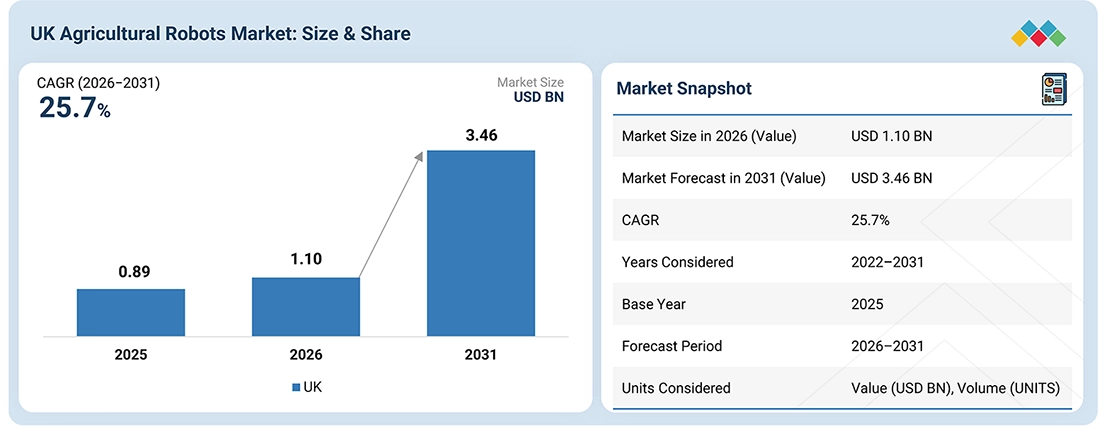
Source: Secondary Research, Interviews with Experts, MarketsandMarkets Analysis
The UK agricultural robots market is estimated to be USD 1.10 billion in 2026 and is projected to reach USD 3.46 billion by 2031, registering a CAGR of 25.7% during the forecast period. The market is witnessing a shift toward autonomous and multifunctional robotic systems that can perform multiple farm operations, including field monitoring, planting, crop management, material handling, and harvesting. The expansion of robotics into protected cultivation, nurseries, and horticulture is creating additional applications, while retrofit and autonomy-enabling technologies allow farmers to enhance existing machinery without completely replacing their equipment fleets.
KEY TAKEAWAYS
-
By Robot TypeBy robot type, the automated harvesting systems segment is estimated to account for the largest share (25.8%) of the UK agricultural robots market in 2026.
-
By ApplicationBy application, the dairy & livestock management segment is estimated to account for the largest market share of 31.6% in 20265.
-
By OfferingBy offering, the services segment is projected to register the highest CAGR of 27.8% during the forecast period.
-
By Farm SizeBy farm size, the large-sized farms segment is estimated to lead the UK agricultural robots market.
-
COMPETITIVE LANDSCAPE - KEY PLAYERSDeere & Company (US), CNH Industrial N.V. (UK), GEA Group (Germany), Kubota Corporation (Japan), and DJI (China) are some of the key companies identified in the UK agricultural robots market.
The UK agricultural robots market is expanding, driven by increasing adoption of automation, precision agriculture, and advanced farming technologies. Farmers are increasingly turning to robotic solutions to improve operational efficiency, address labor shortages, and enhance productivity across crop production and livestock management. Advances in artificial intelligence, machine vision, sensors, and autonomous navigation are enabling more precise and efficient agricultural operations. Growing investments in automated harvesting systems, driverless tractors, unmanned aerial vehicles, and robotic milking solutions are further supporting market adoption. This trend is expected to continue as the UK agricultural sector prioritizes farm modernization, efficient resource utilization, and sustainable farming practices.
TRENDS & DISRUPTIONS IMPACTING CUSTOMERS' CUSTOMERS
The UK agricultural robots market is witnessing a shift toward autonomous and multifunctional robotic systems that can perform multiple farm operations, including field monitoring, planting, crop management, material handling, and harvesting. The expansion of robotics into protected cultivation, nurseries, and horticulture is creating additional applications, while retrofit and autonomy-enabling technologies allow farmers to enhance existing machinery without completely replacing their equipment fleets.
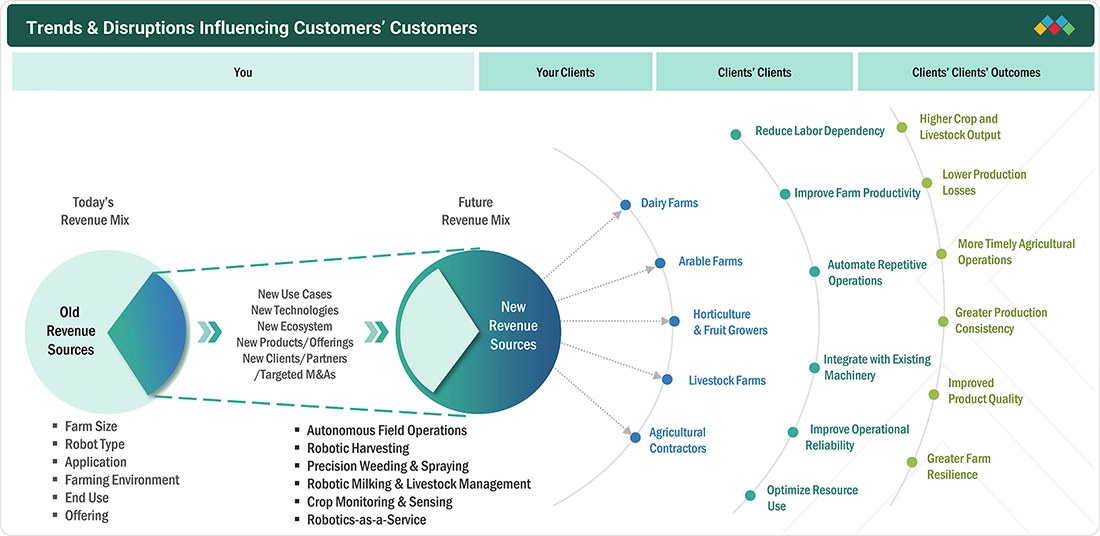
Source: Secondary Research, Interviews with Experts, MarketsandMarkets Analysis
MARKET DYNAMICS

Level
-
Agricultural labor shortages and rising labor costs

-
Increasing government support for agricultural automation and robotics


Level
-
High initial investment and uncertain return on investment

-
Technology integration and commercial deployment challenges


Level
-
Increasing adoption of robotics in controlled environment agriculture

-
Expansion of robotics across dairy and livestock operations


Level
-
Regulatory, liability, and standards uncertainty for agricultural robotics

-
Limited rural connectivity and digital infrastructure

Source: Secondary Research, Interviews with Experts, MarketsandMarkets Analysis
Agricultural labor shortages and rising labor costs
Labor shortages and rising labor costs are encouraging UK farmers to adopt agricultural robots. These technologies improve operational efficiency, reduce dependence on manual labor, and support timely farming activities across crop production and livestock management.
High initial investment and uncertain return on investment
High acquisition, installation, and maintenance costs can limit agricultural robot adoption, particularly among small- and mid-sized farms. Uncertainty regarding payback periods, technology integration, and the need for specialized training further constrains investment.
Increasing adoption of robotics in controlled environment agriculture
Growing interest in greenhouse automation and precision farming creates opportunities for agricultural robots in crop monitoring, harvesting, spraying, and other repetitive operations. Advances in AI, machine vision, and autonomous navigation can support more precise and efficient farming practices.
Regulatory, liability, and standards uncertainty for agricultural robotics
Differences in requirements governing drone operations, machinery safety, autonomous navigation, and data protection can complicate technology deployment. Ensuring reliable performance under varying field conditions, integrating robots with existing farm equipment, and addressing safety and liability concerns remain key challenges for wider adoption in the UK.
UK AGRICULTURE ROBOTS MARKET: COMMERCIAL USE CASES ACROSS INDUSTRIES
| COMPANY | USE CASE DESCRIPTION | BENEFITS |
|---|---|---|
 |
Develops agricultural drones, including the Agras series, for automated crop spraying, spreading, and other agricultural operations. | Improves field-operation efficiency, enables precise application of agricultural inputs, and reduces labor requirements across large farming areas. |
 |
Integrates AI-powered camera systems and image analysis into livestock management to monitor dairy-cow lameness and body condition. | Enables early identification of potential animal health issues, supports improved animal welfare, and strengthens herd-management efficiency. |
 |
Integrates machine vision and sensor-based technology into agricultural machinery to detect crop conditions and adjust input application in real time. | Reduces unnecessary fertilizer and chemical application, improves precision farming, and enhances operational efficiency through automated field decisions. |
Logos and trademarks shown above are the property of their respective owners. Their use here is for informational and illustrative purposes only.
MARKET ECOSYSTEM
The UK agricultural robots market operates within an ecosystem comprising agricultural robot manufacturers, technology and component providers, research institutions, industry associations, regulatory bodies, and farm operators. The ecosystem is shaped by interactions between technology developers and agricultural users, with robotic systems integrating sensing, positioning, artificial intelligence, machine vision, software, and autonomous control technologies. UK agricultural robotics spans applications including autonomous field operations, crop monitoring, targeted spraying, harvesting, and robotic milking.
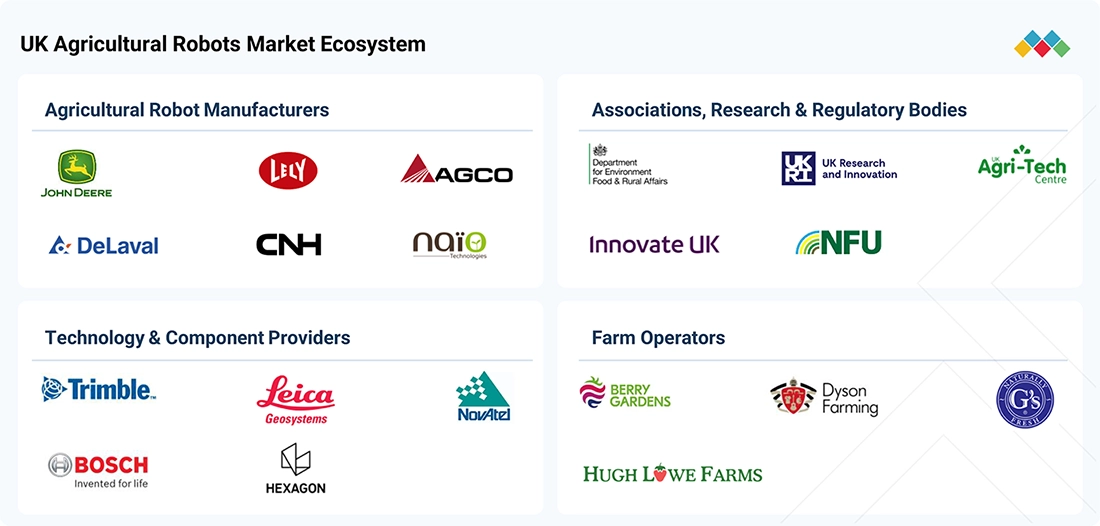
Logos and trademarks shown above are the property of their respective owners. Their use here is for informational and illustrative purposes only.
MARKET SEGMENTS
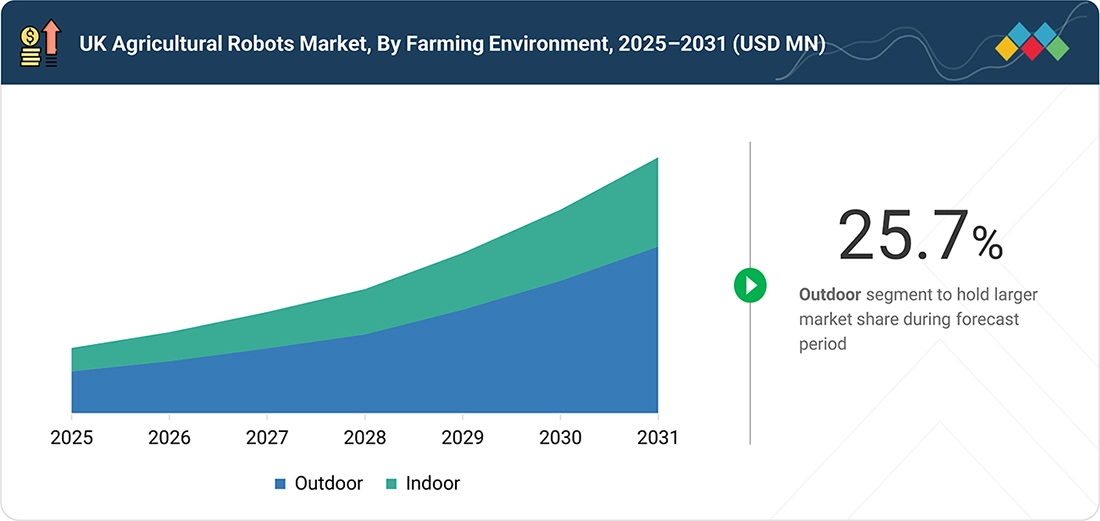
Source: Secondary Research, Interviews with Experts, MarketsandMarkets Analysis
By Robot Type
Automated harvesting systems are estimated to hold the largest share, driven by labor shortages and harvesting efficiency needs. UAVs are projected to grow fastest, supported by precision agriculture and crop monitoring.
By Application
Dairy & livestock management is estimated to hold the largest share, driven by robotic milking, automated feeding, and livestock monitoring.
By Offering
Hardware is estimated to hold the largest share, supported by demand for robotic equipment and components. Services are projected to grow fastest, driven by maintenance, integration, and technical support.
By Farm Size
Large-sized farms are estimated to hold the largest share, supported by higher investment capacity and greater opportunities to improve operational efficiency.
By Farming Environment
Outdoor farming is expected to hold the largest share, driven by the use of robots in field operations, crop monitoring, spraying, and harvesting.
By End Use
Farm produce is projected to grow fastest, driven by rising adoption of robotic harvesting, crop monitoring, precision spraying, and automated weeding.
REGION
UK Agricultural Robots Market
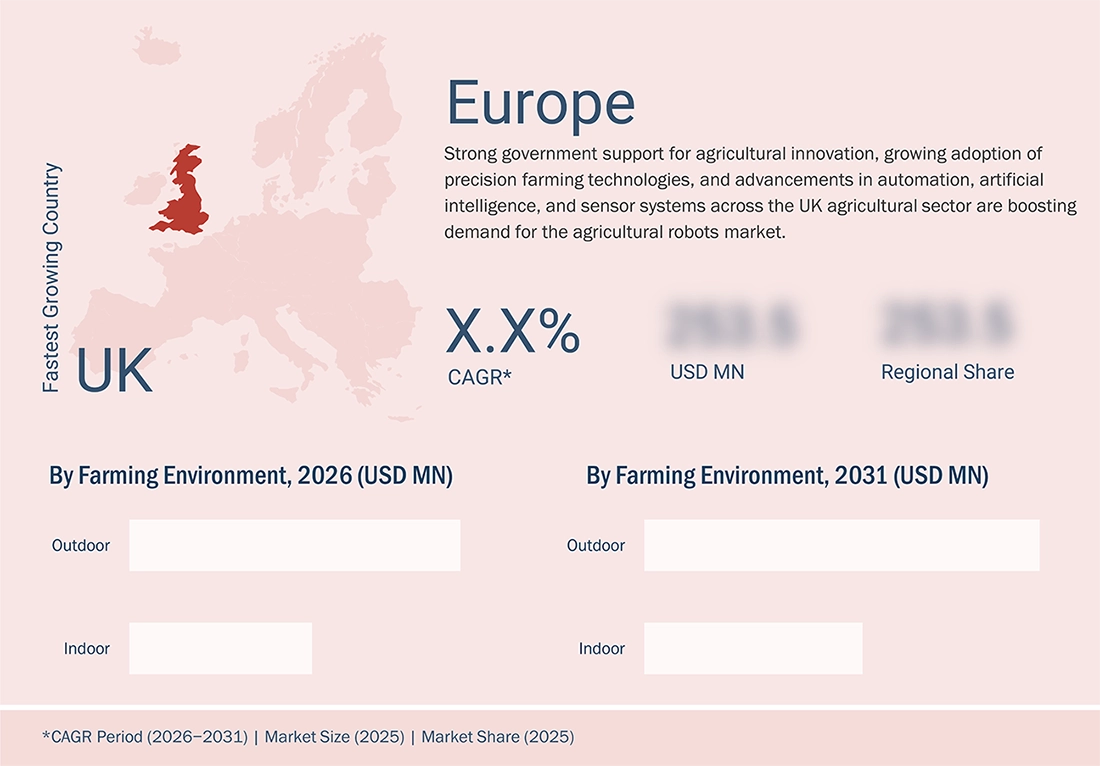
The UK agricultural robots market is driven by increasing labor shortages, rising labor costs, and growing adoption of precision farming technologies. Government support for agricultural innovation, alongside advances in AI, autonomous navigation, and machine vision, is encouraging farmers to adopt robotic solutions to improve productivity and operational efficiency.
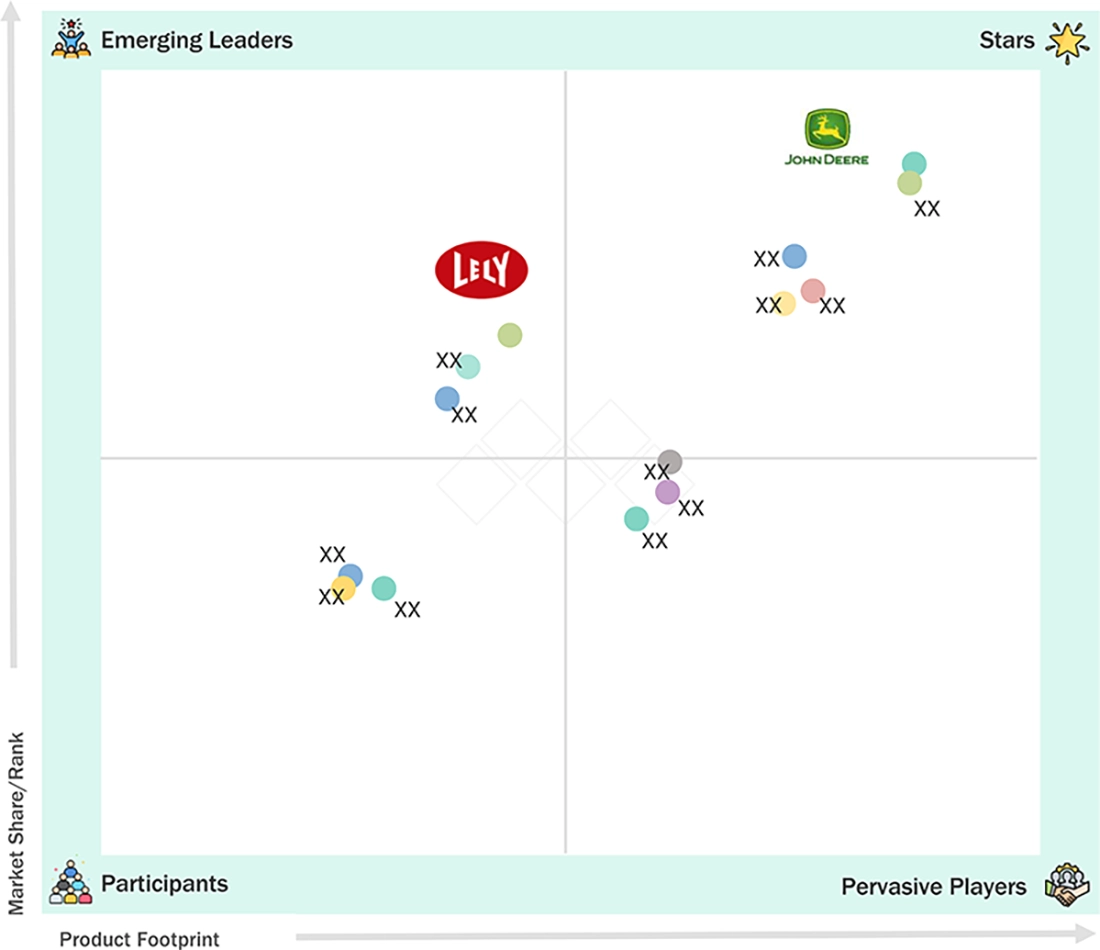
UK AGRICULTURE ROBOTS MARKET: COMPANY EVALUATION MATRIX
The UK agricultural robots market comprises global manufacturers and specialized technology providers competing through innovation, product performance, and distribution networks. Key players invest in AI, machine vision, and autonomous systems to improve farm productivity and reduce labor dependency. Meanwhile, emerging technology firms develop specialized solutions for precision weeding, crop monitoring, and automated harvesting, supporting wider adoption across the UK agricultural sector.
Source: Secondary Research, Interviews with Experts, MarketsandMarkets Analysis
KEY MARKET PLAYERS
- Deere & Company (US)
- CNH Industrial N.V. (UK)
- AGCO Corporation (US)
- DJI (China)
- Lely (Netherlands)
- Kubota Corporation (Japan)
- DeLaval (Sweden)
- Naïo Technologies (France)
- Ecorobotix (Switzerland)
- GEA Group (Germany)
MARKET SCOPE
| REPORT METRIC | DETAILS |
|---|---|
| Market Size in 2026 (Value) | USD 1.10 BN |
| Market Forecast in 2031 (Value) | USD 3.46 BN |
| Growth Rate | CAGR of 25.7% from 2026 to 2031 |
| Years Considered | 2022–2031 |
| Base Year | 2025 |
| Forecast Period | 2026–2031 |
| Units Considered | Value (USD Million/Billion), Volume (Units) |
| Report Coverage | Revenue Forecast, Company Ranking, Competitive Landscape, Growth Factors, and Trends |
| Segments Covered |
|
| Regions Covered | UK |
WHAT IS IN IT FOR YOU: UK AGRICULTURE ROBOTS MARKET REPORT CONTENT GUIDE
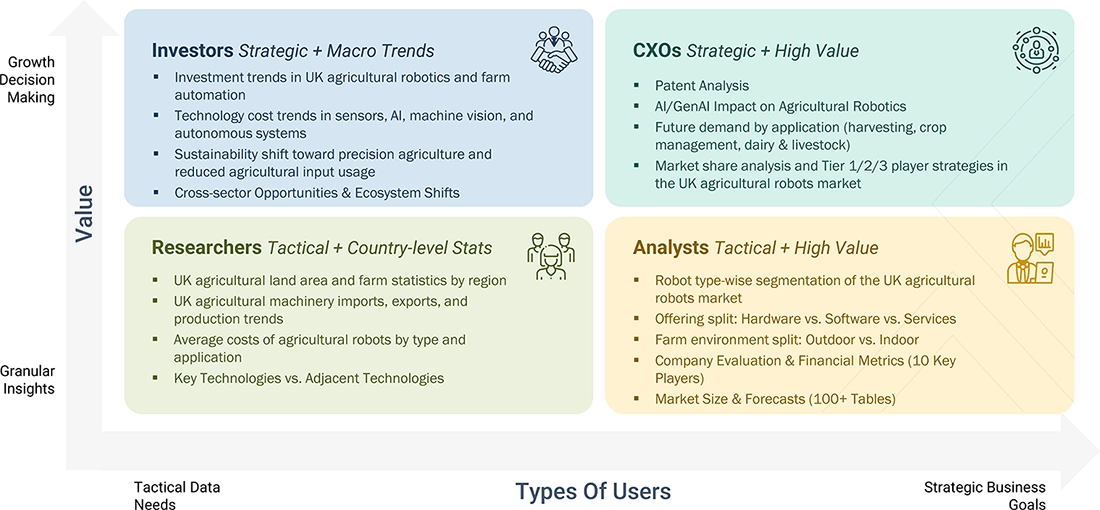
DELIVERED CUSTOMIZATIONS
We have successfully delivered the following deep-dive customizations:
| CLIENT REQUEST | CUSTOMIZATION DELIVERED | VALUE ADDS |
|---|---|---|
| UK Farmers & Agricultural Contractors |
|
|
| Agricultural Machinery Manufacturers & Technology Providers |
|
|
RECENT DEVELOPMENTS
- July 2026 : DJI launched the AGRAS T55 and T100 Dual Battery Spraying System globally. The AGRAS T55 supports spraying, spreading, and lifting operations, with capacities of 50 L for spraying, 55 kg for spreading, and 40 kg for lifting. The T100 Dual Battery Spraying System uses dual intelligent batteries and a 90 L spray tank to support large-scale agricultural spraying operations, with dual-atomized centrifugal sprinklers for wider spray coverage.
- June 2026 : CNH Industrial N.V. (UK) inaugurated an advanced virtual simulation ecosystem and automated logistics warehouse at its San Matteo R&D hub in Modena, Italy, following a €21 million investment (~USD 24.3 million). The R&D facility includes an advanced sensor test track designed to verify precision sensors and autonomous features. The expansion strengthens CNH’s European capabilities for developing and testing advanced agricultural technologies, including autonomous systems.
- February 2026 : Kubota led a EUR 6.5 million (~USD 7.6 million) pre-Series B financing round for Kilter and entered into a distribution partnership for the AX-1 autonomous precision-weeding robot. Kubota plans to offer the AX-1 through its dealer network in Germany and the Netherlands, while Kilter continues expanding the robot's European market presence.
Table of Contents
 Exclusive indicates content/data unique to MarketsandMarkets and not available with any competitors.
Methodology
This study involved two major approaches in estimating the current size of the UK agricultural robots market. Exhaustive secondary research was conducted to collect information on the market, peer, and parent markets. The next step involved validating these findings, assumptions, and sizing with industry experts across the value chain through primary research. Both top-down and bottom-up approaches were employed to estimate the complete market size. After that, market breakdown and data triangulation were used to estimate the market size of segments and subsegments.
Secondary Research
This research study involved the extensive use of secondary sources—directories and databases such as Bloomberg Businessweek and Factiva—to identify and collect information useful for a technical, market-oriented, and commercial study of the market.
In the secondary research process, various sources such as The International Society of Precision Agriculture, National Agricultural Aviation Association (NAAA), annual reports, investor presentations, and financial statements; trade, business, and professional associations; white papers; livestock-related journals; UAV-related journals; certified publications; articles from recognized authors; gold and silver standard websites; directories; and databases were referred to identify and collect information.
Secondary research was used to obtain key information about the industry’s supply chain, the total pool of key players, and market classification and segmentation as per the industry trends to the bottom-most level, regional markets, and key developments from the market- and technology-oriented perspectives.
Primary Research
The market comprises several stakeholders in the supply chain: suppliers, manufacturers, and end-use product manufacturers. Various primary sources from the supply and demand sides of the market were interviewed to obtain qualitative and quantitative information.
In the primary research process, various sources from the supply and demand sides were interviewed to obtain qualitative and quantitative information. The primary sources from the supply side included industry experts, such as CEOs, vice presidents, marketing directors, technology and innovation directors, and related key executives from various key companies and organizations operating in the UK agricultural robots market. The primary interviewees from the demand side comprised farm operators, including dairy farms, arable farms, horticulture and fruit growers, livestock farms, and agricultural contractors.
After the complete market engineering (which included calculations for market statistics, market breakdown, market size estimations, market forecasting, and data triangulation), extensive primary research was conducted to gather information and to verify and validate the critical numbers arrived at. Primary research was also conducted to identify the segmentation types, industry trends, key players, competitive landscape of agricultural robots supplied by different market players, and key market dynamics, such as drivers, restraints, opportunities, industry trends, and key player strategies.
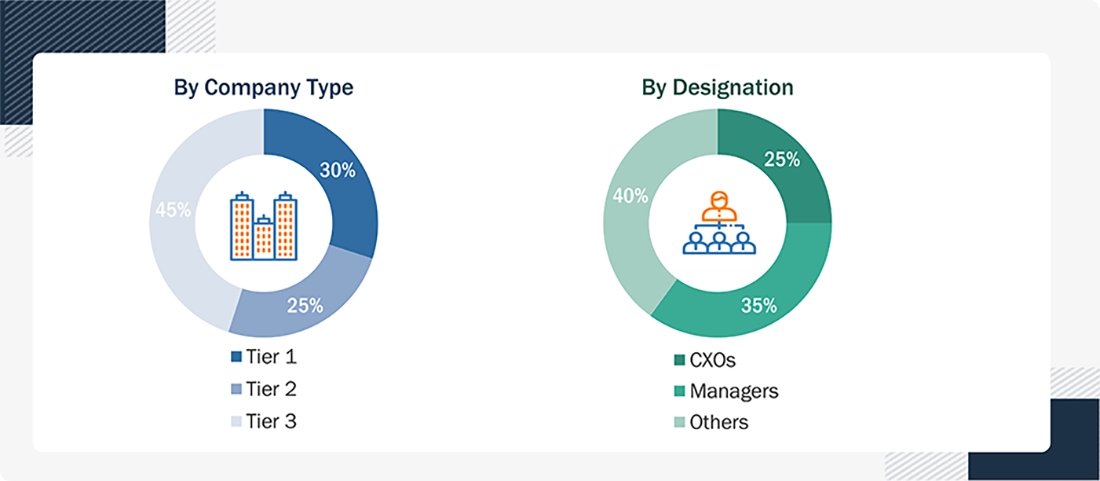
Note: The three tiers of the companies are defined based on their total revenues in 2024 or 2025, based on the availability of financial data: Tier 1: Revenue more than USD 5 billion, Tier 2: Revenue between USD 1 billion and USD 5 billion, and Tier 3: Revenue less than USD 1 billion.
|
COMPANY |
DESIGNATION |
|
Deere & Company (US) |
R&D Expert |
|
CNH Industrial N.V. (US) |
Sales Manager |
|
AGCO Corporation (US) |
Manager |
|
DJI (China) |
Sales Manager |
|
Lely International (Netherlands) |
Marketing Manager |
To know about the assumptions considered for the study, download the pdf brochure
Market Size Estimation
Both top-down and bottom-up approaches were used to estimate and validate the market's total size. These approaches were also used extensively to determine the size of various subsegments in the market. The research methodology used to estimate the market size includes the following details:
- The key players in the industry and the markets were identified through extensive secondary research.
- The UK agricultural robots market was determined through primary and secondary research.
- All percentage shares, splits, and breakdowns were determined using secondary sources and verified through primary sources.
- All macroeconomic and microeconomic factors affecting the growth of the UK agricultural robots market were considered while estimating the market size.
- All possible parameters that affect the market covered in this research study were accounted for, viewed in extensive detail, verified through primary research, and analyzed to obtain final quantitative and qualitative data.

Data Triangulation
After determining the overall market size through the previously described estimation process, the market was divided into multiple segments and subsegments. To accurately determine the statistics for all segments and subsegments in the UK agricultural robots market, data triangulation and market breakdown procedures were utilized when applicable. The data were triangulated by analyzing various factors and trends from both the demand and supply sides. Additionally, the market size was confirmed using both top-down and bottom-up approaches.
Market Definition
According to the Association for Advancing Automation (A3), agricultural robots are autonomous or semi-autonomous machines equipped with advanced technologies such as sensors, computer vision, and artificial intelligence, designed to assist farmers in various tasks, including planting, harvesting, monitoring crops, and managing livestock.
Agricultural robots automate slow, repetitive, and tedious tasks for farmers, enabling them to focus more on enhancing overall production yields. Agricultural robots include unmanned aerial vehicles (UAVs) or drones, milking robots, automated harvesting systems, driverless tractors, and other robots, such as unmanned ground vehicles (UGVs) used in nurseries or greenhouses, sorting and packing robots, and weed control robots. According to the International Federation of Robotics (IFR), agricultural robots, also known as agribots, are specialized machines used in agriculture to perform tasks such as seeding, spraying, harvesting, and monitoring crops. These robots are equipped with sensors, navigation systems, and robotic arms, enabling them to operate autonomously or with minimal human intervention.
Key Stakeholders
- Agriculture robot manufacturers
- Government and research organizations
- National and local government organizations
- Institutional investors
- Graphite suppliers
- End users
- Associations, regulatory bodies, and other industry-related bodies:
-
- Food and Agriculture Organization (FAO)
- CropLife International
- Association for Unmanned Vehicle Systems International
- Association of Remotely Piloted Aircraft Systems UK
- Commercial Drone Alliance
- International Society of Precision Agriculture
- National Agricultural Aviation Association (NAAA)
Report Objectives
- To determine and project the size of the market for agricultural robots, with respect to its robot type, application, offering, end use, farm size, and farming environment
- To identify the attractive opportunities in the market by determining the largest and fastest-growing segments across the UK
- To analyze demand-side factors based on the following:
- Impact of macro and microeconomic factors on market growth
- Shifts in demand patterns across subsegments
- To provide detailed information about the key factors influencing market growth (drivers, restraints, opportunities, and industry-specific challenges)
- To provide the regulatory framework for the UK related to the market for agricultural robots
- To analyze the micro-markets with respect to individual growth trends, prospects, and their contribution to the total market
Available customizations:
With the given market data, MarketsandMarkets offers customizations according to company-specific scientific needs.
The following customization options are available for the report:
SERVICE ANALYSIS
- Service Matrix, which gives a detailed comparison of the service portfolio of each company.
GEOGRAPHIC ANALYSIS
With the given market data, MarketsandMarkets offers customizations according to company-specific scientific needs.
- Further breakdown of the UK agricultural robots market by other robot types.
- Further breakdown of the UK agricultural robots market by other applications.
COMPANY INFORMATION
- Detailed analyses and profiling of additional market players (up to five)


Personalize This Research
- Triangulate with your Own Data
- Get Data as per your Format and Definition
- Gain a Deeper Dive on a Specific Application, Geography, Customer or Competitor
- Any level of Personalization
Let Us Help You
- What are the Known and Unknown Adjacencies Impacting the UK Agricultural Robots Market
- What will your New Revenue Sources be?
- Who will be your Top Customer; what will make them switch?
- Defend your Market Share or Win Competitors
- Get a Scorecard for Target Partners

Custom Market Research Services
We Will Customise The Research For You, In Case The Report Listed Above Does Not Meet With Your Requirements
Get 10% Free CustomisationTESTIMONIALS

Business Innovation Director
US Based Leading Agribusiness,
Food and Ingredients ManufacturerI highly appreciate the team's efficiency for a well conducted study that helped us clarify some blind spots in food and agricultural niche markets. Although compiling information for B2B markets is very difficult, the MnM team pulled out the task successfully. The quality of research, level of insights, and responsiveness of team were commendable.



Growth opportunities and latent adjacency in UK Agricultural Robots Market