Ultra-Wideband (UWB) Indoor Location Market Size, Share, Trends, Growth Opportunities & Latest Trends

Ultra-Wideband (UWB) Indoor Location Market By Application (Indoor Navigation, Asset Tracking, Workforce Management, Inventory Management), Offering, Vertical – Global Forecast to 2030




OVERVIEW
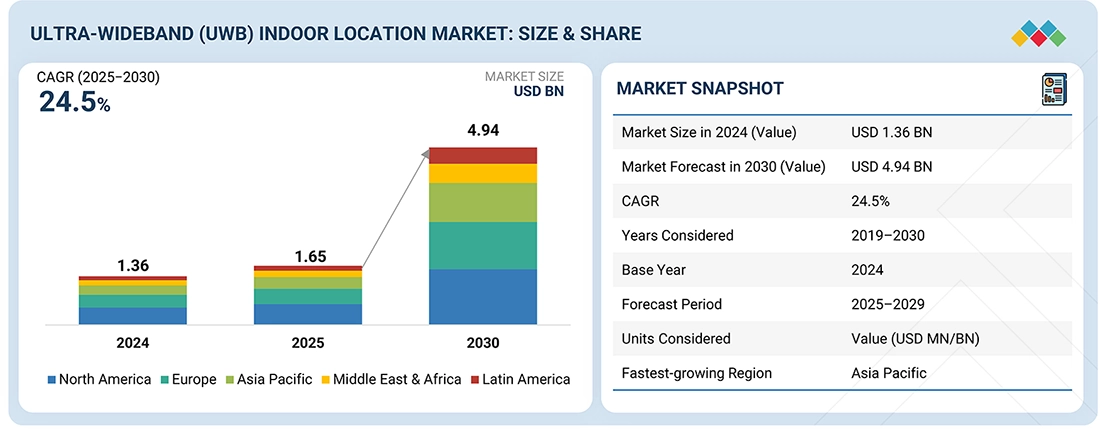
Source: Secondary Research, Interviews with Experts, MarketsandMarkets Analysis
The ultra-wideband (UWB) indoor location market is projected to reach USD 4.94 billion by 2030, from USD 1.65 billion in 2025, with a CAGR of 24.5%. Increasing demand for UWB is driven by industries needing high-precision solutions for collision avoidance to ensure worker safety and real-time asset tracking to quickly locate critical equipment. In addition to safety, the market is rapidly expanding into secure hands-free access and digital key applications.
KEY TAKEAWAYS
-
By RegionAsia Pacific is the fastest-growing regional market.
-
By OfferingThe services segment is expected to record the highest CAGR during the forecast period.
-
By ApplicationThe workforce management segment is expected to exhibit the fastest growth during the forecast period.
-
By VerticalRetail was the largest segment in 2025.
-
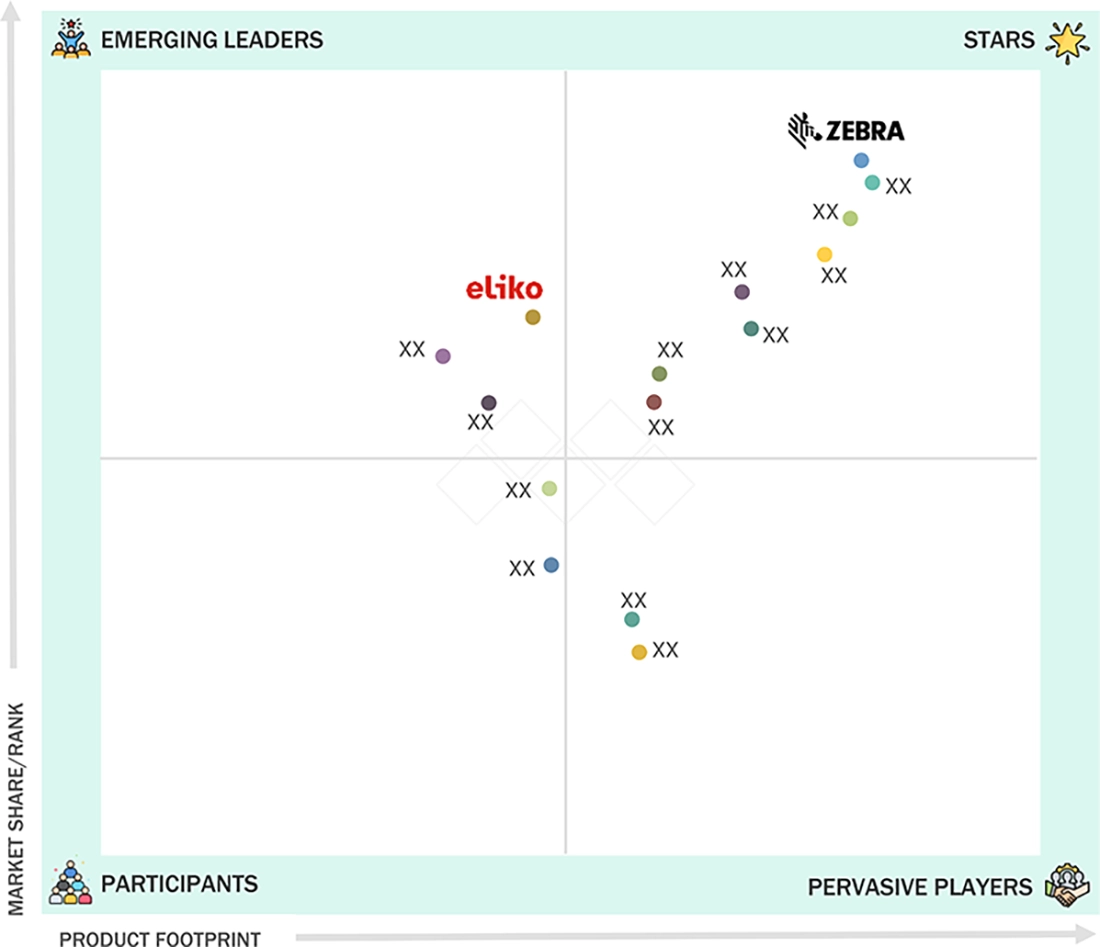
Competitive LandscapeZebra Technologies, Ubisense, Kinexon, and Pozyx were identified as the star players in the UWB indoor location market, given their strong market share and product footprint.
The UWB Indoor Location Market is expected to evolve from a niche industrial tool to a widely adopted standard driven by the mobile ecosystem and interoperability. The market will shift toward scalable solutions where precise location enables secure, hands-free access and seamless navigation.
TRENDS & DISRUPTIONS IMPACTING CUSTOMERS' CUSTOMERS
The impact on consumers' businesses in the UWB indoor location market results from changing customer needs and industry disruptions. Hot bets are UWB, sensor fusion, and edge analytics, which are shifting indoor positioning from rough tracking to centimeter-accurate solutions. Disruptions include dense sensor deployments, privacy concerns, and standards fragmentation. End users benefit from better asset utilization, personalized experiences, faster fulfillment, and reduced shrinkage.
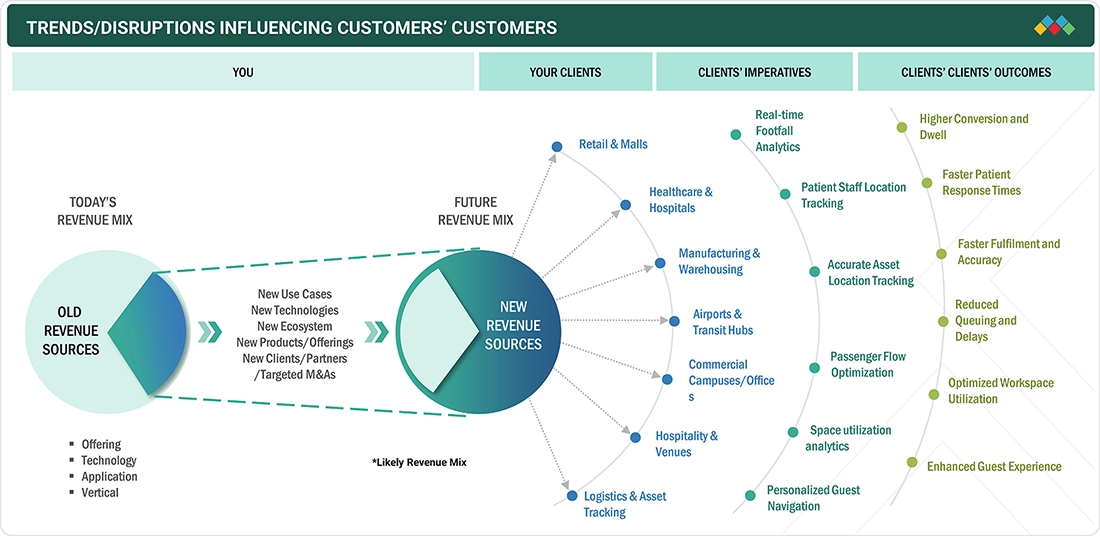
Source: Secondary Research, Interviews with Experts, MarketsandMarkets Analysis
MARKET DYNAMICS

Level
-
Demand for centimeter-level precision

-
Integration into consumer smartphones


Level
-
High infrastructure and deployment costs

-
Interference and spectrum regulations


Level
-
Augmented reality wayfinding

-
Secure hands-free access control


Level
-
Complexity of line-of-sight requirements

-
Standardization and interoperability issues

Source: Secondary Research, Interviews with Experts, MarketsandMarkets Analysis
Driver: Demand for centimeter-level precision
The UWB indoor location market is driven by the need for extremely precise positioning. Industries such as automotive manufacturing require data with an accuracy of 10 centimeters. This is different from Bluetooth or Wi-Fi, which can be off by meters. UWB uses Time of Flight calculations to locate a tool or worker in real time. This level of accuracy is essential for collision avoidance systems and automating high-speed production lines, where safety and efficiency depend on knowing the exact location of everything at all times.
Restraint: High infrastructure and deployment costs
The adoption of UWB is limited by its high cost, especially when compared to other technologies. Its implementation requires a dense network of receivers, called anchors, because signals have a shorter range. UWB also has difficulty penetrating thick walls compared to Wi-Fi. The total cost of ownership is high, including expensive hardware and complex cabling, making it challenging for budget-conscious projects to justify.
Opportunity: Augmented reality wayfinding
The exceptional precision of UWB enables reliable augmented reality experiences. There is an opportunity to combine UWB location data with phone cameras, overlaying digital information onto the real world. Examples include flashing arrows on a screen guiding a user in an airport or highlighting a specific product on a store shelf. This visual positioning creates engaging user experiences, as simpler technologies cannot support this without the digital objects moving around.
Challenge: Complexity of line-of-sight requirements
A technical challenge for UWB is its sensitivity to obstructions. The UWB tag requires a clear line of sight to the anchor for optimal accuracy. Cluttered environments, such as warehouses with metal shelving, can block signals. Signals may bounce off objects and cause tracking dead zones, known as the multipath effect. Addressing this involves using smart software algorithms and strategically placing additional anchors.
ULTRA-WIDEBAND (UWB) INDOOR LOCATION MARKET: COMMERCIAL USE CASES ACROSS INDUSTRIES
| COMPANY | USE CASE DESCRIPTION | BENEFITS |
|---|---|---|
 |
UWB RTLS for hospital equipment and personnel tracking at scale. | Centimetre accuracy, faster asset retrieval, improved patient safety, reduced loss. |
 |
UWB chipsets enabling high-precision positioning for industrial equipment. | Reliable time-of-flight measurements, lower power, certified interoperable UWB solutions. |
 |
UWB positioning for AGV and robotic guidance in factories. | Precise navigation, collision avoidance, higher automation throughput, fewer errors. |
 |
UWB RTLS for production line and tooling location management. | Centimetre tracking, reduced downtime, efficient tool allocation, better throughput. |
 |
UWB real-time location for complex manufacturing and assembly workflows. | Optimized processes, reduced cycle times, improved quality control and traceability. |
Logos and trademarks shown above are the property of their respective owners. Their use here is for informational and illustrative purposes only.
MARKET ECOSYSTEM
The UWB indoor location market ecosystem includes hardware providers like Zebra, Infineon, Pozyx, Sewio, and Eliko, which supply UWB chipsets, anchors, tags, and certified modules that achieve centimetre-level accuracy through time-of-flight. Solution and service providers such as Ubisense, Inpixon, Infsoft, Kinexon, and Redpoint Positioning offer RTLS platforms, middleware, analytics, and digital-twin solutions.
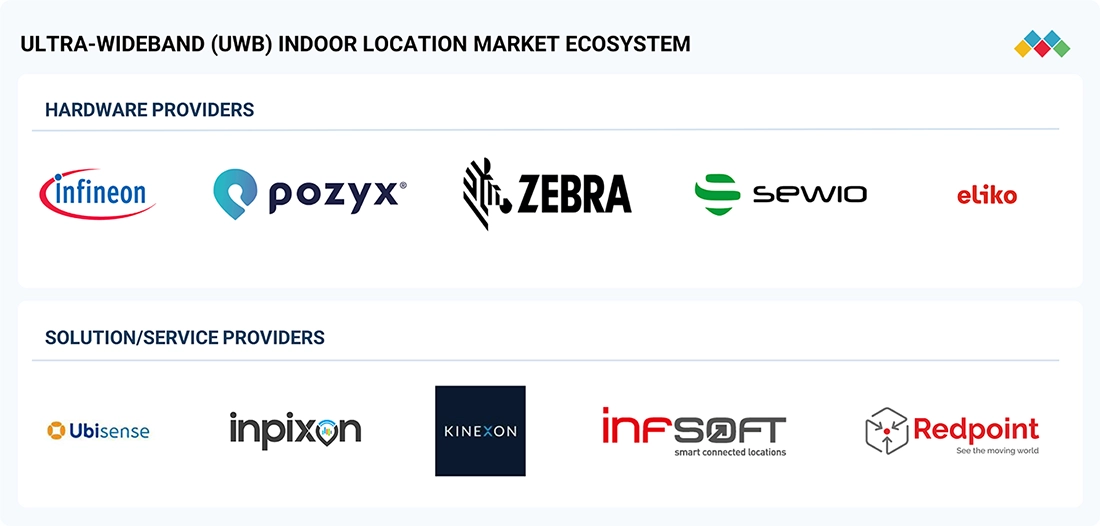
Logos and trademarks shown above are the property of their respective owners. Their use here is for informational and illustrative purposes only.
MARKET SEGMENTS
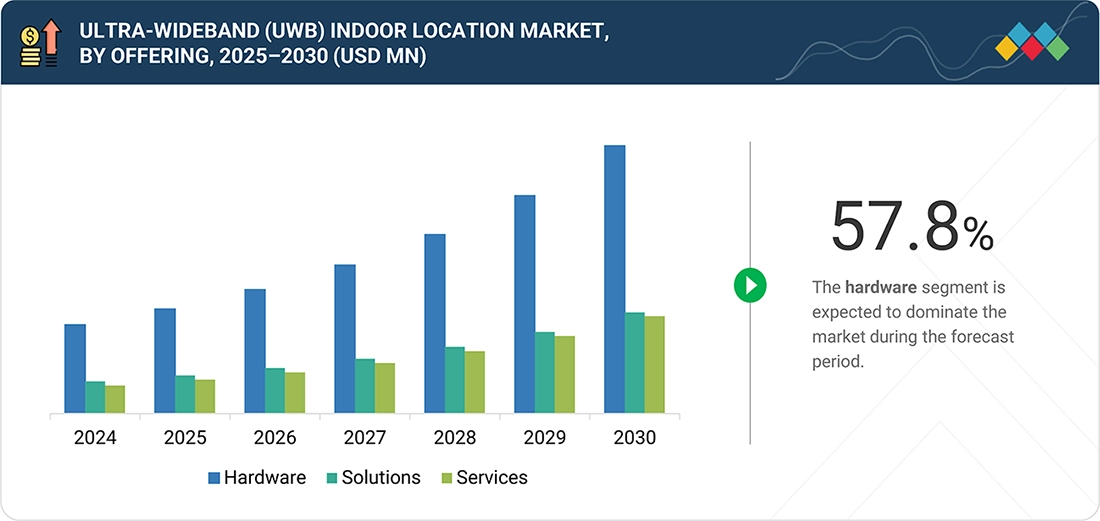
Source: Secondary Research, Interviews with Experts, MarketsandMarkets Analysis
Ultra-wideband (UWB) Indoor Location Market, By Offering
The adoption of hardware is driven by the ise of UWB chips in smartphones and wearables. Companies like Qorvo and NXP are making these chips smaller and more affordable. This means anchors and tags are becoming less costly. As a result, a growing number of compatible devices are emerging, pushing UWB from niche industrial uses into mainstream consumer applications.
Ultra-wideband (UWB) Indoor Location Market, By Application
Asset tracking adoption is driven by the need to locate high-value items instantly. Hospitals and factories cannot afford to lose costly machines or tools. They prefer UWB because it is significantly more accurate than Bluetooth. This dependence on precision boosts the global market for industrial safety and positions UWB as the top choice for critical tracking needs.
Ultra-wideband (UWB) Indoor Location Market, By Vertical
The retail sector is adopting UWB to create smoother shopping experiences. Stores aim to offer hands-free payments and personalized service. UWB enables them to determine exactly where a customer is located. This shifts the focus from warehouses to storefronts, demonstrating that UWB can boost sales and enhance customer loyalty on a large scale.
REGION
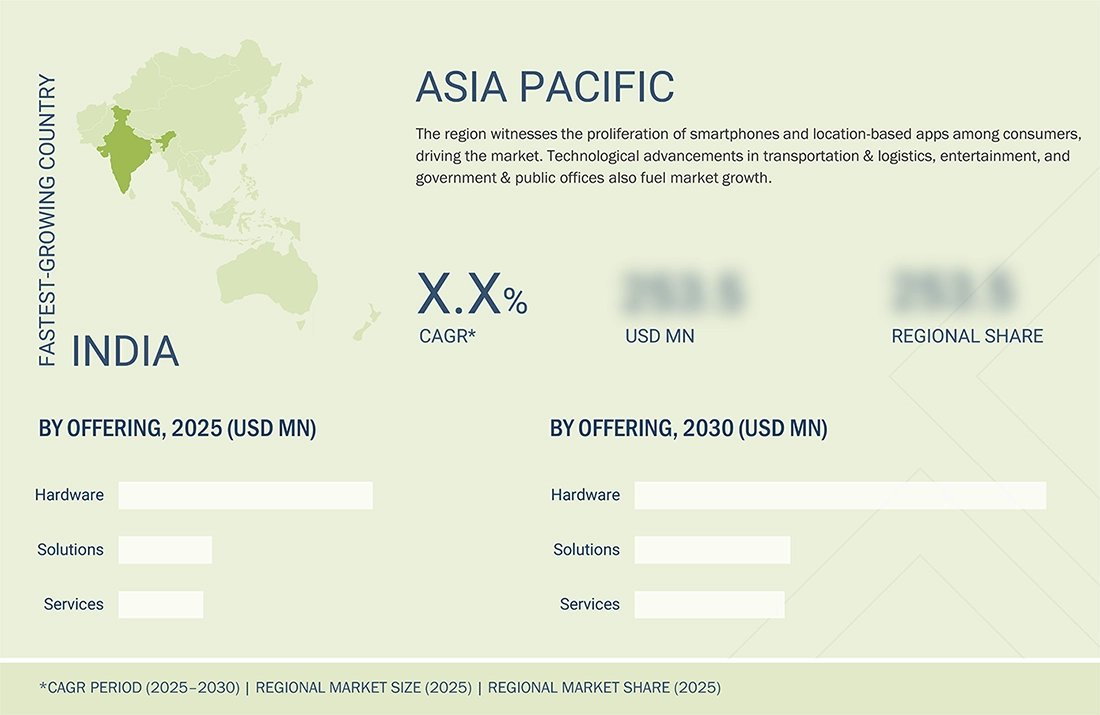
Asia Pacific to be fastest-growing region during forecast period
The adoption of UWB in the Asia Pacific region is driven by significant investments in smart city infrastructure and manufacturing. Countries like China, South Korea, and Japan are actively deploying UWB for precise digital twins in factories and secure, hands-free ticket gates in subway systems. This creates a vast testing ground for high-scale, public-facing UWB applications. These factors, along with a shift from niche industrial pilots to widespread urban use, make Asia Pacific the fastest-growing region in the global UWB indoor location market.
ULTRA-WIDEBAND (UWB) INDOOR LOCATION MARKET: COMPANY EVALUATION MATRIX
Zebra (Star) leads with a substantial market share and extensive product footprint, driven by enterprise-grade UWB tags/anchors integrated into its MotionWorks visibility platform, with deep vertical integrations. Eliko (Emerging Leader) is gaining visibility by providing compact, low-power UWB anchors and tag modules with open integrations and developer tooling, enabling fast pilot-to-scale RTLS deployments.
Source: Secondary Research, Interviews with Experts, MarketsandMarkets Analysis
KEY MARKET PLAYERS
- Zebra Technologies (US)
- Infineon (Germany)
- Inpixon (US)
- Pozyx (Belgium)
- Sewio (Czech Republic)
- Ubisense (UK)
- Redpoint Positioning (US)
- Kinexon (Germany)
- Eliko (Estonia)
- Infsoft (Germany)
- Ubitrack (Bulgaria)
- Wipelot IoT (Turkey)
- Marvelmind (Estonia)
- RealTrac International (Switzerland)
- Anantics (US)
MARKET SCOPE
| REPORT METRIC | DETAILS |
|---|---|
| Market Size in 2024 (Value) | USD 1.36 BN |
| Market Forecast in 2030 (Value) | USD 4.94 BN |
| Growth Rate | CAGR of 24.5% from 2025–2030 |
| Years Considered | 2019–2030 |
| Base Year | 2024 |
| Forecast Period | 2025–2030 |
| Units Considered | Value (USD MN/BN) |
| Report Coverage | Revenue forecast, company ranking, competitive landscape, growth factors, and trends |
| Segments Covered |
|
| Regions Covered | North America, Europe, Asia Pacific, Middle East & Africa, Latin America |
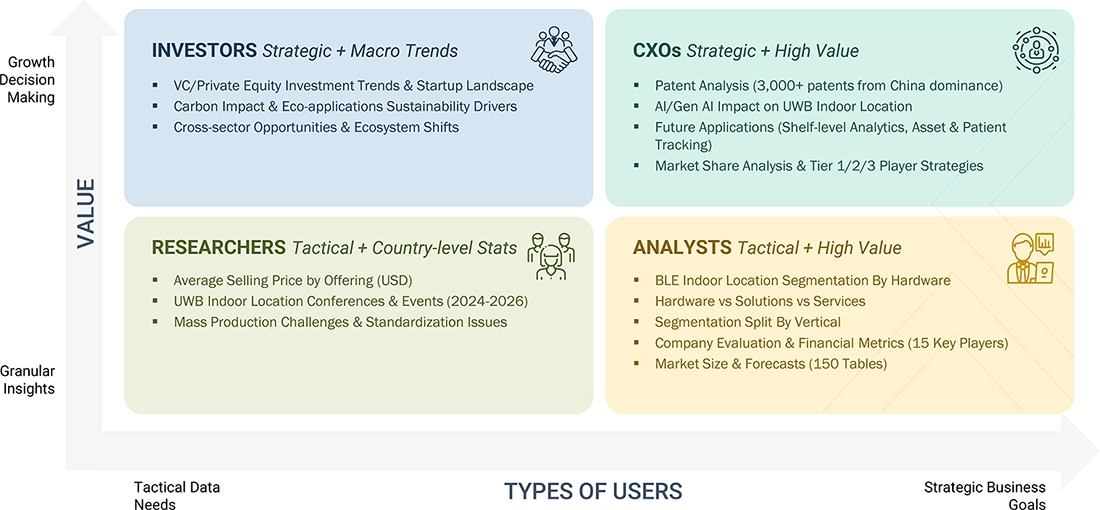
WHAT IS IN IT FOR YOU: ULTRA-WIDEBAND (UWB) INDOOR LOCATION MARKET REPORT CONTENT GUIDE
DELIVERED CUSTOMIZATIONS
We have successfully delivered the following deep-dive customizations:
| CLIENT REQUEST | CUSTOMIZATION DELIVERED | VALUE ADDS |
|---|---|---|
| Leading Solution Provider (US) | Product Analysis: Product Matrix, which gives a detailed comparison of the product portfolio of each company | Enhanced understanding of competitive positioning and product offerings |
| Leading Service Provider (Europe) | Company Information: Detailed analysis and profiling of additional market players (up to 5) | Deeper insights into market dynamics and potential strategic partnerships |
RECENT DEVELOPMENTS
- January 2025 : The FiRa Consortium officially released its Core 3.0 Specifications and Certification Program. This is a significant infrastructure development for the UWB ecosystem, introducing critical features like hybrid UWB scheduling (HUS) and dedicated data transfer.
- September 2024 : NXP Semiconductors launched the Trimension SR250. It is the industry's first single-chip solution that integrates both UWB secure ranging and short-range UWB radar processing. This development targets smart home and industrial safety applications where both proximity and presence detection are required.
- August 2024 : HID Global acquired Sewio Networks, a Czech-based provider of UWB real-time location systems (RTLS). By integrating Sewio's RTLS platform, the company expanded its ability to deliver precise, sub-meter accuracy for tracking tools, inventory, and personnel in harsh industrial environments.
- April 2024 : Inpixon launched the Inpixon Swarm UWB V3, a new generation of its compact RTLS tag module. The Swarm V3 module is designed to reduce the barrier to entry for integrators building custom location-aware products. It supports multiple UWB frequency bands and features an onboard microcontroller and sensors (accelerometer, temperature), allowing for integrator-ready deployment.
Table of Contents
 Exclusive indicates content/data unique to MarketsandMarkets and not available with any competitors.
Methodology
The study involved four major activities in estimating the current size of the europe indoor location market. Exhaustive secondary research was done to collect information on the market, peer, and parent markets. The next step was to validate these findings, assumptions, and sizing with industry experts across the value chain through primary research. Both top-down and bottom-up approaches were employed to estimate the total europe indoor location market size. After that, the market breakup and data triangulation techniques were used to estimate the market size of segments and subsegments.
Secondary Research
Various secondary sources, such as Bloomberg and BusinessWeek, were referred to in the secondary research process to identify and collect information for this study. The secondary sources included company annual reports, press releases, and investor presentations; white papers; journals, such as Linux Journal and Container Journal; and articles from recognized authors, directories, and databases.
Primary Research
In the primary research process, various sources from both the supply and demand sides were interviewed to obtain qualitative and quantitative information for the report. The primary sources from the supply side included industry experts, such as Chief Executive Officers (CEOs), Chief Technology Officers (CTOs), Chief Operating Officers (COOs), Vice Presidents (VPs), marketing directors, technology and innovation directors, and related key executives from various key companies and organizations operating in the europe indoor location market. The primary sources from the demand side included Indoor location end users, network administrators/consultants/specialists, Chief Information Officers (CIOs), and subject-matter experts from enterprises and government associations.
Market Size Estimation
The top-down and bottom-up approaches were used to make market estimates and forecast the europe indoor location market, as well as other dependent submarkets. The bottom-up procedure was used to arrive at the overall market size of the europe indoor location market using key companies’ revenue and their offerings in the market. The research methodology used to estimate the market size includes the following:
- The key players in the europe indoor location market have been identified through extensive secondary research.
- In terms of value, the market size has been determined through primary and secondary research processes.
- All percentage shares, splits, and breakups have been determined using secondary sources and verified through primary sources.
Data Triangulation
This study determined and confirmed the exact value of the overall parent market size through data triangulation and validation through primary interviews. The overall market size was then used in the top-down procedure to estimate the size of other individual markets via percentage splits of the market segmentation.
Market Definition
Indoor location or indoor positioning technology facilitates the navigation and tracking of objects and people in a building using sensory information captured by mobile devices. It includes hardware, software, and service components to provide indoor location services to various vertical organizations. Indoor location solutions may collect location data using Radio Frequency (RF), Visible Light Communication (VLC), Sound Navigation and Ranging (Sonar), Light Detection and Ranging (Lidar), or any technology or a combination of technologies.
Key Stakeholders
- Indoor location solution providers
- Independent Software Vendors (ISVs)
- Investors and Venture Capitalists (VCs)
- Support and maintenance service providers
- Value-added Resellers (VARs) and distributors
Report Objectives
- To determine and forecast the europe indoor location market by offering (hardware, solutions, and services), application, technology, vertical, and region from 2024 to 2029, and analyze the various macroeconomic and microeconomic factors that affect the market growth.
- To provide detailed information about the major factors (drivers, restraints, opportunities, and challenges) influencing the growth of the europe indoor location market.
- To analyze each submarket for individual growth trends, prospects, and contributions to the overall europe indoor location market.
- To analyze the opportunities in the market for stakeholders by identifying the high-growth segments of the europe indoor location market.
- To profile the key market players; provide a comparative analysis based on business overviews, regional presence, product offerings, business strategies, and key financials; and illustrate the market's competitive landscape.
- Track and analyze competitive developments in the market, such as mergers and acquisitions, product developments, partnerships and collaborations, and Research and Development (R&D) activities.
Available Customizations
With the given market data, MarketsandMarkets offers customizations as per the company’s specific needs. The following customization options are available for the report:
Company Information
- Detailed analysis and profiling of two additional market players
Key Questions Addressed by the Report
What is the projected size of the UWB indoor location market by 2030?
The UWB indoor location market is projected to grow from USD 1.65 billion in 2025 to USD 4.94 billion by 2030 at a CAGR of 24.5%.
Which application segment is growing fastest in the UWB indoor location market?
Workforce management is expected to register the fastest growth due to rising adoption in industrial safety and operational efficiency.
What are the major drivers of UWB indoor location market growth?
Key growth drivers include rising demand for precise indoor positioning, increased adoption in smartphones, and expansion of industrial IoT ecosystems.
Which vertical dominates the UWB indoor location market?
Retail led the market in 2025 due to increasing use of UWB for personalized shopping and frictionless payment systems.
Who are the leading players in the UWB indoor location market?
Major players include Zebra Technologies, Ubisense, Kinexon, and Pozyx.
What future trends will shape the UWB indoor location market?
Future trends include sensor fusion, edge analytics, digital keys, AR-enabled navigation, and seamless enterprise infrastructure integration.


Personalize This Research
- Triangulate with your Own Data
- Get Data as per your Format and Definition
- Gain a Deeper Dive on a Specific Application, Geography, Customer or Competitor
- Any level of Personalization
Let Us Help You
- What are the Known and Unknown Adjacencies Impacting the Ultra-Wideband (UWB) Indoor Location Market
- What will your New Revenue Sources be?
- Who will be your Top Customer; what will make them switch?
- Defend your Market Share or Win Competitors
- Get a Scorecard for Target Partners

Custom Market Research Services
We Will Customise The Research For You, In Case The Report Listed Above Does Not Meet With Your Requirements
Get 10% Free CustomisationTESTIMONIALS






Growth opportunities and latent adjacency in Ultra-Wideband (UWB) Indoor Location Market