Unmanned Systems (UxV) Market Size & Growth

Unmanned Systems (UxV) Market by Type [UGV (Legged, Wheeled, Tracked, Hybrid, Humanoid), UMV (USV, UUV), UAV (Small, Tactical, Strategic)], Application (Commercial, Military), Mode of Operation, and Region - Global Forecast to 2031




UNMANNED SYSTEMS (UxV) MARKET OVERVIEW
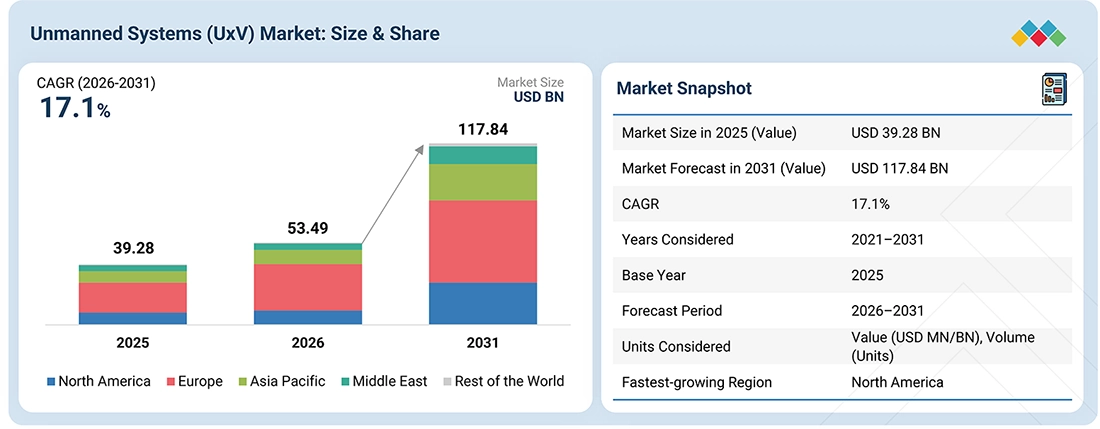
According to Marketsandmarkets, the Global Unmanned Systems (UxV) Market Size was valued at USD 53.49 billion in 2026 and is projected to reach USD 117.84 billion by 2031, growing at a CAGR of 17.1% from 2026-2031. In terms of volume, the market is projected to grow from 6,509,155 units in 2026 to 9,614,934 units by 2031. Demand for unmanned systems is increasing across commercial, military, government & public safety, and scientific & research applications. UxV systems are being used for logistics and delivery, infrastructure inspection, surveying and mapping, agriculture, environmental monitoring, ISR, combat support, explosive ordnance disposal, transportation, search & rescue, and other operational activities. Their use across ground, marine, and aerial operations is increasing as organizations adopt remotely operated and autonomous systems for a wider range of tasks.
REPORT SCOPE
| REPORT METRIC | DETAILS |
|---|---|
| Market Size in 2025 | USD 39.28 Billion |
| Market Forecast in 2031 | USD 117.84 Billion |
| CAGR | 17.1% |
| Years Considered | 2021–2031 |
| Base Year | 2025 |
| Forecast Period | 2026-2031 |
| Units Considered | Value (USD Million/Billion), Volume (Units) |
| Report Coverage | Revenue forecast, company ranking, competitive landscape, growth factors, and trends |
| Top Companies |
|
| Growth Drivers |
|
| Segments Covered |
|
| Regions Covered | North America, Asia Pacific, Europe, Middle East, Rest of the World |
KEY UNMANNED SYSTEMS (UxV) MARKET TAKEAWAYS
-
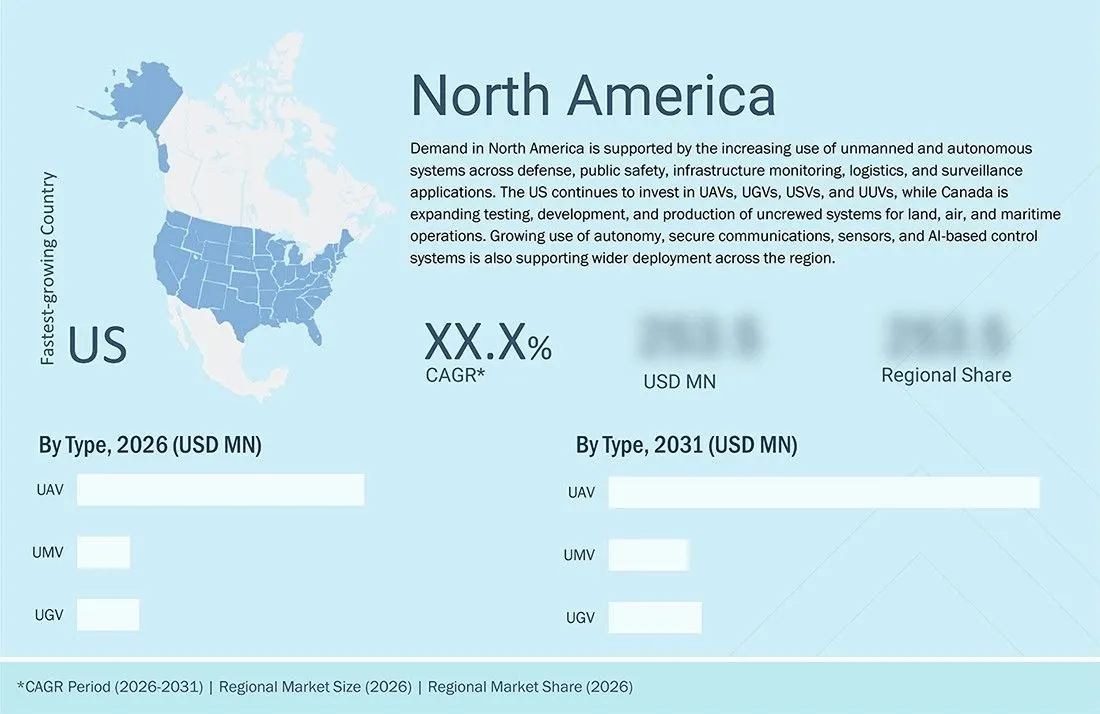
By RegionThe North America Unmanned Systems (UxV) market is expected to record the highest CAGR of 24.1% between 2026 and 2031.
-
By TypeThe UMV segment is expected to register the fastest CAGR of 22.6% between 2026 and 2031.
-
By ApplicationThe military segment is projected to be the most dominant in 2026.
-
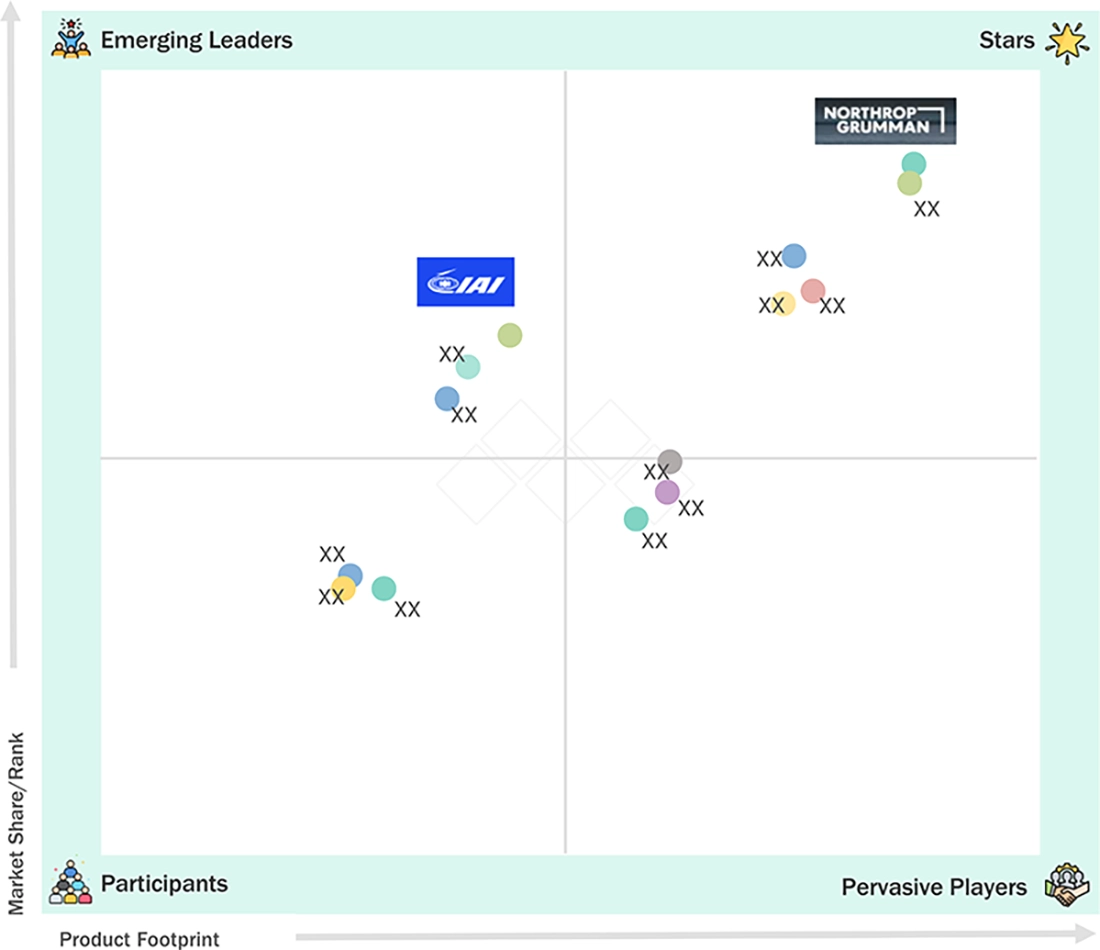
Competitive LandscapeNorthrop Grumman, Teledyne Technologies, and Lockheed Martin were identified as some of the key players in the unmanned systems (UxV) market (global), given their strong market share and product footprint.
The Unmanned Systems (UxV) Industry is developing as users require platforms that can operate for longer periods, cover larger areas, and complete tasks with fewer operator inputs. Improvements in sensors, navigation, communication links, onboard processing, and command and control systems are allowing ground, marine, and aerial unmanned systems to operate more reliably in complex environments. These developments are also supporting wider use of UxVs in applications where continuous monitoring, accurate data collection, long endurance, and operation in difficult or remote locations are required.
Source: Secondary Research, Interviews with Experts, MarketsandMarkets Analysis
TRENDS & DISRUPTIONS IMPACTING CUSTOMERS' CUSTOMERS
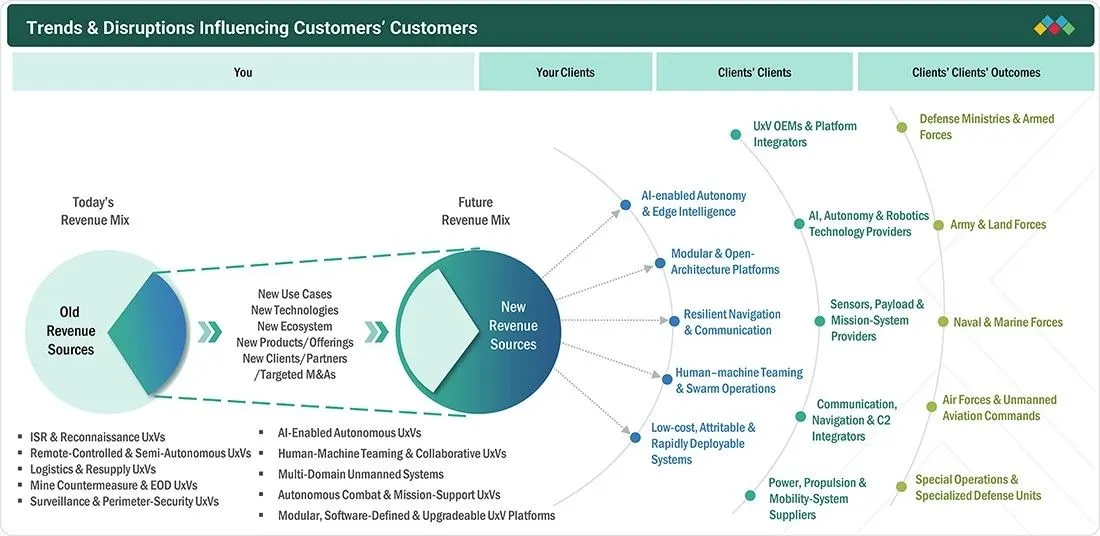
The impact on customers in the unmanned systems (UxV) market is increasingly linked to the need for flexible platforms that can support different tasks without requiring a separate system for each application. Modular designs, interchangeable payloads, common control interfaces, and software-based upgrades allow users to change sensors or mission equipment as requirements change. This can reduce integration effort, simplify operator training and maintenance, and make it easier to upgrade existing systems. As a result, commercial, government, and defense users can improve asset utilization while managing operating and lifecycle costs more effectively.
Source: Secondary Research, Interviews with Experts, MarketsandMarkets Analysis
UNMANNED SYSTEMS (UxV) MARKET DYNAMICS

Level
-
Surge in demand for autonomous systems

-
Need for improved ISR and target acquisition capabilities


Level
-
Information security risk and regulatory constraints

-
Lack of skilled operators and workflow training


Level
-
Growing global defense budgets

-
Rapid innovations and technological advancements


Level
-
Power supply issues and limited endurance

-
High operational costs

Source: Secondary Research, Interviews with Experts, MarketsandMarkets Analysis
Driver: Surge in demand for autonomous systems
Demand for autonomous systems is increasing as defense, commercial, and government users look to reduce direct human involvement in repetitive, hazardous, and long-duration tasks. Advances in onboard processing, sensors, navigation, and autonomy software are allowing unmanned aerial, ground, surface, and underwater systems to complete more tasks with limited operator input. Defense programs are also increasing investment in robotic and autonomous systems, supporting wider integration of UxVs into routine operations.
Restraint: Information security risk and regulatory constraints
Unmanned systems depend on communication networks, software, data links, and onboard computing, which creates exposure to cyberattacks, data interception, signal interference, and unauthorized access. At the same time, operators must comply with safety, airspace, export, cybersecurity, and operating regulations that vary by application and country. These requirements can increase certification, testing, and compliance needs and can slow deployment, particularly for autonomous and beyond-visual-line-of-sight operations.
Opportunity: Growing global defense budgets
Higher defense spending is creating additional funding for unmanned aircraft, autonomous ground platforms, unmanned surface vessels, underwater vehicles, sensors, communication systems, and related autonomy technologies. The US FY2026 defense budget, for example, includes continued investment in robotic autonomous systems, large unmanned surface vessels, extra-large unmanned underwater vehicles, MQ-4 Triton, MQ-25, and other enabling technologies. Similar procurement and modernization programs provide opportunities for UxV manufacturers, payload suppliers, and system integrators.
Challenge: Power supply issues and limited endurance
Endurance remains a major operating challenge for unmanned systems, particularly smaller battery-powered platforms. Power is required not only for propulsion but also for sensors, communication systems, navigation equipment, onboard processing, and mission payloads. Adding heavier or power-intensive equipment can reduce operating time and range. Longer missions may therefore require larger batteries, alternative power sources, recharging, refueling, or platform recovery, which can increase system weight and operating complexity.
UNMANNED SYSTEMS (UxV) MARKET SIZE & GROWTH: COMMERCIAL USE CASES ACROSS INDUSTRIES
| COMPANY | USE CASE DESCRIPTION | BENEFITS |
|---|---|---|
 |
Northrop Grumman’s MQ-4C Triton is used for long-endurance maritime intelligence, surveillance, reconnaissance, and targeting missions. The unmanned aircraft can operate above 50,000 ft for more than 24 hours and uses a 360-degree multi-intelligence sensor suite to detect, classify, and track targets across large ocean and coastal areas. It is operated by the US Navy and Royal Australian Air Force. | Provides persistent surveillance across large maritime areas without requiring an onboard crew. Its long endurance, wide-area sensor coverage, and high operating altitude allow fewer sorties while supporting continuous monitoring, targeting, and maritime situational awareness. |
 |
Teledyne FLIR Defense’s Centaur UGV is used by US Army, Navy, Air Force, and Marine Corps EOD teams to identify and handle improvised explosive devices, landmines, unexploded ordnance, and other hazards. Different sensors and payloads can also be fitted for CBRN detection, reconnaissance, route clearance, and other hazardous missions. | Allows personnel to detect and handle hazardous objects from a safer stand-off distance. Its modular payload design supports several mission types on a common platform, helping simplify training, maintenance, payload integration, and field support. |
 |
Lockheed Martin’s Indago 4 tactical UAS is used for reconnaissance and surveillance missions requiring a small, rapidly deployable aerial platform. The quadcopter provides 360-degree surveillance, high-resolution payload options, onboard edge computing, and GPS-denied navigation, and can be deployed from a backpack in about two minutes. | Gives operators a portable aerial surveillance capability that can be deployed quickly in areas that are difficult to access from the ground. Its low acoustic signature, modular payload interfaces, and GPS-denied navigation support reconnaissance and monitoring in complex operating environments. |
Logos and trademarks shown above are the property of their respective owners. Their use here is for informational and illustrative purposes only.
UNMANNED SYSTEMS (UxV) MARKET ECOSYSTEM
The unmanned systems (UxV) market includes unmanned platform manufacturers, sensor and payload suppliers, autonomy and control software developers, propulsion providers, communication system suppliers, and system integrators. Major companies such as Northrop Grumman Corporation, Teledyne Technologies Incorporated, Lockheed Martin Corporation, BAE Systems, DJI, Thales, Israel Aerospace Industries Ltd., The Boeing Company, General Dynamics Corporation, Textron Inc., L3Harris Technologies, Inc., Elbit Systems Ltd., Leonardo S.p.A., and EDGE Group PJSC provide unmanned and autonomous systems across aerial, ground, surface, and underwater applications. Their portfolios cover areas such as ISR, logistics, inspection, mapping, agriculture, surveillance, and other commercial and defense operations. Other players such as Shield AI, Autel Robotics, Delair, Microdrones GmbH, MSubs Ltd., Anduril Industries, International Submarine Engineering Ltd., Ocius Technology Limited, Clearpath Robotics Inc., and Maritime Robotics AS provide specialized unmanned platforms, autonomy technologies, mission software, and application-specific solutions across commercial, government, and defense use cases.
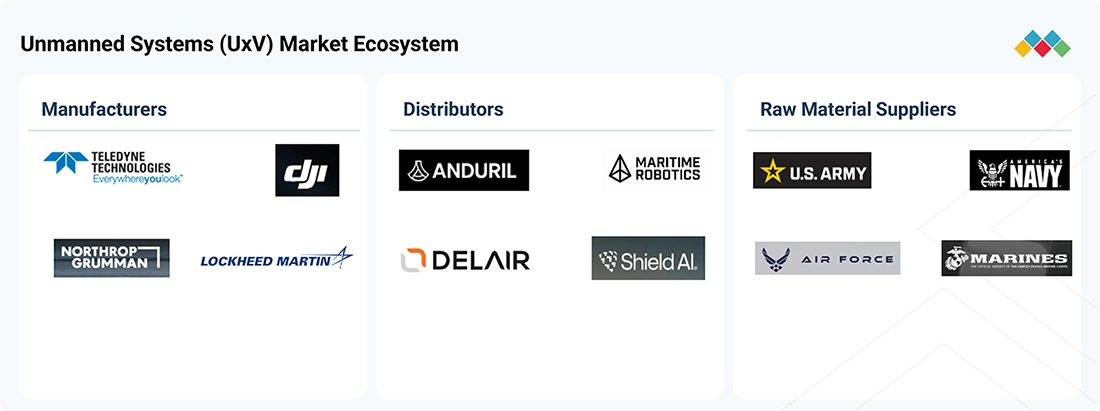
Logos and trademarks shown above are the property of their respective owners. Their use here is for informational and illustrative purposes only.
UNMANNED SYSTEMS (UxV) MARKET SEGMENTS
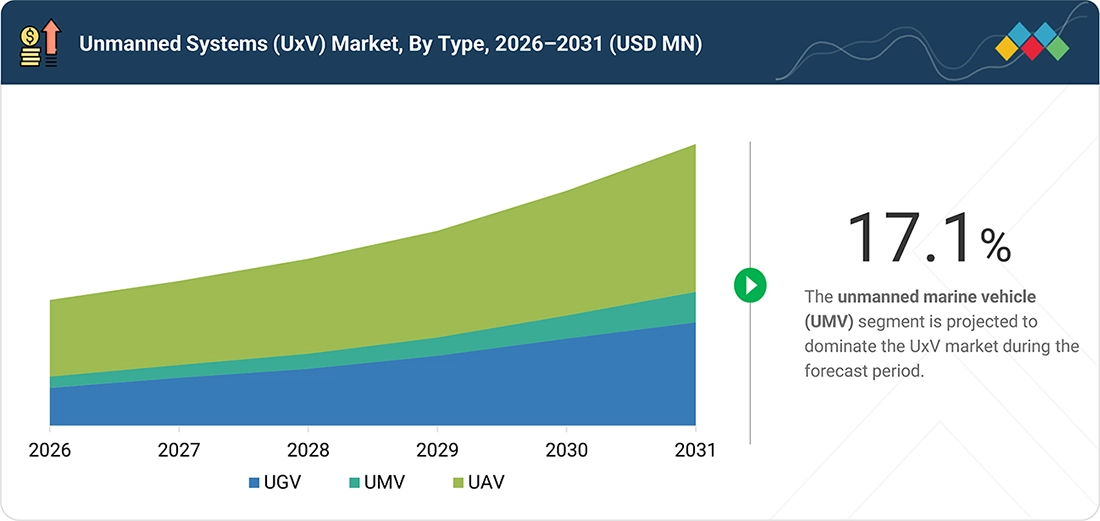
Source: Secondary Research, Interviews with Experts, MarketsandMarkets Analysis
Unmanned Systems (UxV) Market, By Type
The market covers unmanned ground vehicles (UGVs), unmanned marine vehicles (UMVs), and unmanned aerial vehicles (UAVs) designed for operations across land, water, and air. These platforms use combinations of propulsion systems, sensors, navigation equipment, communication links, onboard computing, and mission payloads based on their operating environment. UGVs are used for tasks such as logistics, inspection, EOD, and reconnaissance; marine systems support surveillance, hydrographic, mine-related, and underwater missions; while UAVs are widely used for mapping, monitoring, inspection, agriculture, logistics, and ISR.
Unmanned Systems (UxV) Market, By Application
UxVs are used across commercial, military, government & public safety, and scientific & research applications. Commercial uses include agriculture, infrastructure inspection, surveying, mapping, logistics, and environmental monitoring. Military applications include ISR, logistics, combat support, EOD, mine operations, and reconnaissance. Government and public safety sectors deploy unmanned systems for search & rescue, border monitoring, emergency response, and inspection, while research users apply them for data collection and operations in remote or difficult environments.
Unmanned Systems (UxV) Market, By Mode of Operation
Unmanned systems operate through different levels of remote control and autonomous operation depending on the platform, application, operating environment, and level of human oversight required. Remotely operated systems keep an operator directly involved in navigation or mission execution, while autonomous systems can perform functions such as route planning, obstacle avoidance, navigation, sensing, and mission tasks with lower levels of continuous operator input. Current development is increasingly focused on combining autonomous functions with secure communications, onboard processing, and human supervision.
UNMANNED SYSTEMS (UxV) MARKET REGION
North America to be fastest-growing region in global UxV market during forecast period
The North American unmanned systems (UxV) market is expected to grow at the fastest rate during the forecast period. Growth is supported by increasing use of unmanned and autonomous systems across defense, public safety, infrastructure inspection, logistics, mapping, and other commercial applications. In the US, the FAA is expanding programs that support advanced drone operations, including beyond-visual-line-of-sight applications, while additional UAS test sites are supporting development and integration of unmanned aircraft into national airspace. At the same time, US defense spending continues to support autonomous and unmanned capabilities, including long-endurance UAVs, AI-enabled unmanned systems, and navigation technologies for contested environments. These developments are supporting wider deployment of aerial, ground, and marine unmanned systems across North America.
UNMANNED SYSTEMS (UxV) MARKET SIZE & GROWTH: COMPANY EVALUATION MATRIX
The unmanned systems (UxV) market matrix includes Northrop Grumman Corporation (Star), supported by its strong position in autonomous and unmanned systems across air and underwater domains. Its portfolio includes MQ-4C Triton, Global Hawk, and Manta Ray, supporting ISR, maritime surveillance, long-endurance missions, and underwater operations. Northrop Grumman is also developing modular and open architecture autonomy capabilities for coordinated unmanned operations. Israel Aerospace Industries Ltd. (Emerging Leader) has built a strong position through its Heron family, KATANA USV, and BlueWhale autonomous underwater vehicle. These systems support ISR, maritime surveillance, border security, mine-related missions, and other defense applications, while IAI continues to expand autonomous capabilities across aerial and maritime platforms.
Source: Secondary Research, Interviews with Experts, MarketsandMarkets Analysis
KEY UNMANNED SYSTEMS (UxV) MARKET PLAYERS
List of Unmanned Systems (UxV) Market Companies
- Northrop Grumman (US)
- Teledyne Technologies Incorporated (US)
- Lockheed Martin Corporation (US)
- BAE Systems (UK)
- DJI (China)
- Thales (France)
- Israel Aerospace Industries Ltd. (Israel)
- The Boeing Company (US)
- General Dynamics Corporation (US)
- Textron Inc. (US)
- L3Harris Technologies, Inc. (US)
- Elbit Systems Ltd. (Israel)
- Leonardo S.p.A. (Italy)
- EDGE Group PJSC (UAE)
- ST Engineering (Singapore)
WHAT IS IN IT FOR YOU: UNMANNED SYSTEMS (UxV) MARKET SIZE & GROWTH REPORT CONTENT GUIDE
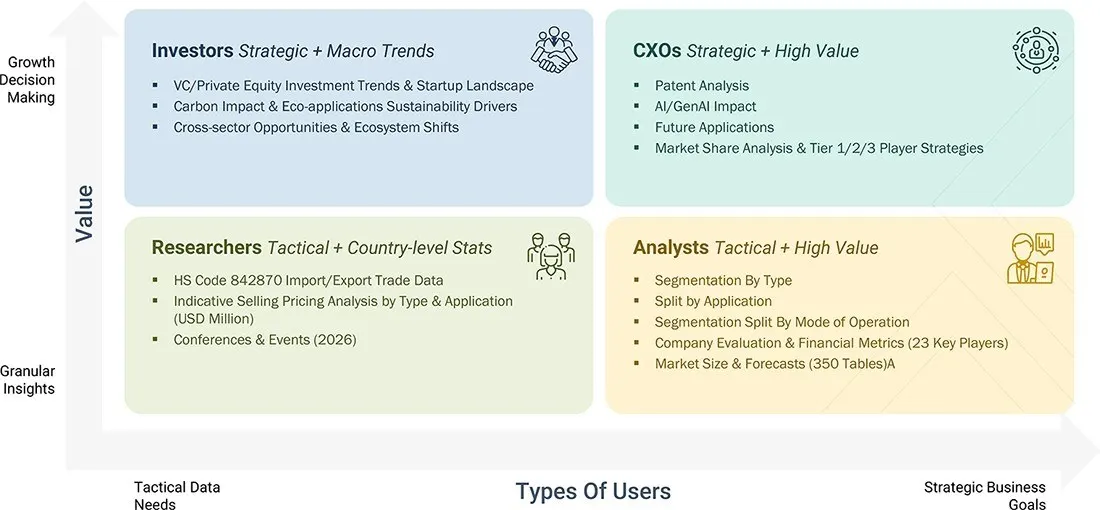
DELIVERED CUSTOMIZATIONS
We have successfully delivered the following deep-dive customizations:
| CLIENT REQUEST | CUSTOMIZATION DELIVERED | VALUE ADDS |
|---|---|---|
| Leading Manufacturer | Additional segment breakdown for countries | Additional country-level market sizing tables for segments/sub-segments covered at the regional/global level to gain an understanding of market potential by each country |
| Emerging Leader | Additional company profiles | Competitive information on targeted players to gain granular insights into direct competition |
| Regional Market Leader | Additional country market estimates | Additional country-level deep dive for a more targeted understanding of the total addressable market |
RECENT UNMANNED SYSTEMS (UxV) MARKET DEVELOPMENTS
- June 2026 : General Dynamics Corporation (US), through General Dynamics European Land Systems, and Alpha Robotics (Germany) signed a formal cooperation agreement covering manned-unmanned teaming. The companies are integrating the EAGLE 6×6 command vehicle with WOLF C1/G1 unmanned ground vehicles and HAWK and HUMMINGBIRD UAVs. The systems are intended for perimeter security, counter-UAS, transport, sensor and effector carriage, and decoy missions. The agreement directly supports coordinated UGV and UAV operations.
- March 2026 : Teledyne Technologies Incorporated (US), through Teledyne Marine and M Subs Ltd (UK), signed a Memorandum of Understanding to establish a strategic collaboration in maritime unmanned systems. The companies will combine unmanned underwater platforms, autonomy, sonar, acoustic communications, cameras, lighting, and related subsea technologies for Royal Navy and international programs. The agreement directly supports the development and integration of autonomous underwater and broader unmanned maritime systems.
- November 2025 : EDGE Group PJSC (UAE) and Anduril Industries, Inc. (US) agreed to establish the EDGE-Anduril Production Alliance, a jointly owned UAE-based vehicle for developing, producing, selling, and sustaining autonomous systems. The first platform is the Omen Group 3 autonomous air vehicle, with the UAE committing to acquire an initial 50 systems. EDGE is contributing nearly USD 200 million toward the program, alongside Anduril’s existing investment in mission autonomy and Group 3 VTOL development. The deal directly supports large-scale production of autonomous air systems and future multi-domain programs.
Table of Contents
 Exclusive indicates content/data unique to MarketsandMarkets and not available with any competitors.
Methodology
The study used four main activities to estimate the current size of the unmanned systems (UxV) market. First, detailed secondary research was conducted to collect information on UxV manufacturers, applications, defense programs, procurement contracts, deliveries, deployments, and ongoing development programs. The collected information and key assumptions were then checked through primary interviews with industry participants and experts across the value chain. Demand-side analysis was used to estimate spending on unmanned systems (UxV) by mode of operation, application, end user, and region. Finally, market breakdown and data triangulation were used to calculate the size of each segment and subsegment.
Secondary Research
Secondary research included information from government procurement portals, defense ministries, armed forces, defense agencies, company annual reports, regulatory filings, investor presentations, product documents, press releases, technical papers, journals, along with recognized defense databases. Sources such as SIPRI were used to review military spending, equipment transfers, and procurement activity, while government budget documents and procurement records were used to track UxV programs, contracts, orders, and deliveries. Company filings and official product information were used to study UxV portfolios, revenues, contracts, technologies, applications, customers, and geographical presence.
Primary Research
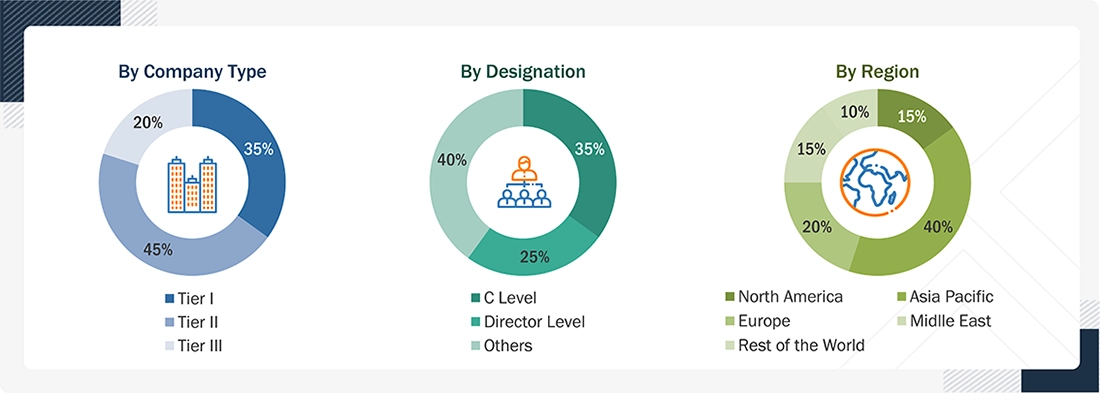
Primary research was conducted after completing the secondary research. Interviews were carried out with unmanned system manufacturers, component and payload suppliers, autonomy and software providers, system integrators, distributors, procurement officials, commercial operators, defense personnel, and other industry participants. The interviews covered major countries across North America, Europe, Asia Pacific, the Middle East, and the Rest of the world. Primary information was collected through questionnaires, emails, and telephone interviews and was used to check market estimates, procurement trends, platform demand, pricing, delivery patterns, applications, adoption rates, and segment-level assumptions.
To know about the assumptions considered for the study, download the pdf brochure
Market Size Estimation
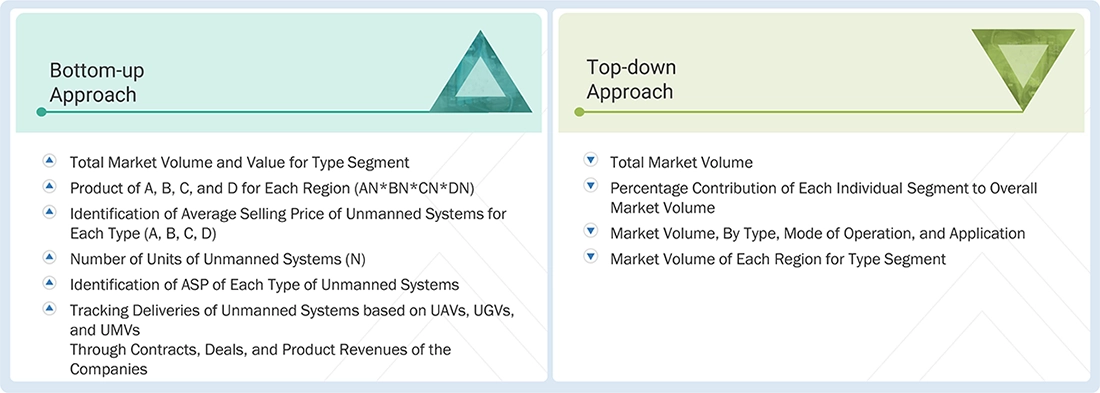
The top-down and bottom-up approaches were used to estimate and validate the size of the unmanned systems (UxV) market. The research methodology used to estimate the size of the market included the following details:
- Key UxV companies were identified through secondary research. Their market positions were estimated using company revenues, unmanned system portfolios, contract activity, delivery volumes, application presence, and regional presence. Annual reports, financial filings, product documents, procurement records, government sources, and interviews with company executives, engineers, system integrators, distributors, operators, and other industry participants were used for the analysis.
- Market shares, segment splits, regional shares, and growth rates were first estimated using secondary sources and then checked through primary interviews. The analysis covered type, application, and mode of operation, along with pricing, delivery volumes, installed/deployed platforms, procurement activity, and regional demand patterns.
- Demand for UxVs across commercial, military, government, and public safety applications was considered. The analysis included defense procurement programs, infrastructure inspection, agriculture, mapping, logistics, surveillance, maritime operations, public safety, regulatory requirements, autonomy adoption, payload integration, and platform replacement. For example, the US Department of Defense’s FY2026 budget separately identified USD 13.4 billion for autonomy and autonomous systems across aerial, ground, surface, underwater, and enabling capabilities. Commercial UAV demand was also assessed using operating and regulatory developments covering package delivery, agriculture, surveying, and BVLOS operations.
- The collected information was compared and combined through data triangulation. Final market values were calculated using company-level revenues, platform delivery volumes, average selling prices, contract values, procurement activity, commercial deployment patterns, regional demand, and primary interview validation.
Unmanned Systems (UxV) Market Size: Bottom-up and Top-down Approaches
Data Triangulation
After determining the overall market size, the unmanned systems (UxV) market was divided into its main segments and subsegments. Data triangulation and market breakdown were used to develop estimates for each segment and subsegment. The analysis considered factors from both the demand and supply sides, including UxV procurement, platform deliveries, commercial deployments, defense programs, applications, pricing, regulatory conditions, company participation, and regional demand. For aerial systems, factors such as routine commercial operations, BVLOS approvals, package delivery, and UAS traffic management development were also considered because they influence deployment levels and operating scale. The final market estimates were then checked using both top-down and bottom-up approaches to maintain consistency across the overall market, regions, segments, and subsegments.
Market Definition
Unmanned systems or unmanned vehicles refer to vehicles that operate without direct human intervention, often controlled remotely or autonomously through pre-programmed instructions or AI. These systems are commonly used in various sectors, including defense, agriculture, logistics, and transportation. They include different types of vehicles and platforms, as mentioned in the following:
Unmanned aerial vehicles (UAVs) are remotely piloted, optionally piloted, or fully autonomous aerial vehicles that play a significant role in the defense and commercial sectors. They are commonly termed drones and are mostly known for their wide use in various military missions, such as border surveillance and combat operations. These vehicles are also used for mapping, surveying, and determining the weather conditions of a specific area.
Unmanned ground vehicles (UGVs) operate on the ground without human presence onboard. These vehicles are used for protection or rescue duties in hazardous environments or for carrying out repetitive tasks. Unmanned ground vehicles are actively developed for both commercial and military use. They are typically deployed for reconnaissance, monitoring buildings and infrastructure, border surveillance, rescue missions, transportation of goods, explosive ordnance disposal, and mine clearance.
Unmanned marine vehicles (UMVs) are vehicles that operate on or below the water, including surface and underwater operations. These vehicles are used for surveillance, environmental monitoring, and naval missions. There are two types of UMVs: unmanned surface vehicles (USVs) and unmanned underwater vehicles (UUVs).
Unmanned surface vehicles (USVs) are marine vessels that operate on the water surface without human intervention. They have a complex system, including system integration, environment perception, and autonomous decision & control. USVs are powered by diesel/gasoline engines, rechargeable lithium-ion batteries, or solar energy. These vehicles are also equipped with various sensors, cameras, communications systems, and other payloads to collect data, perform tasks, and communicate information back to a control station or operator. They are primarily utilized for ocean exploration and various maritime applications.
Unmanned underwater vehicles (UUVs) are submersible marine vessels that operate under the water surface without human intervention. These vehicles are deployed to conduct tasks such as measuring oceanographic data, capturing bottom images, bathymetric imaging, collecting intelligence, obtaining intelligence, surveillance, and reconnaissance (ISR) data, cable laying, and mine detecting. The size of UUVs varies from small to large depending on various factors, such as their capabilities, dimensions, power, speed, and sensors.
Key Stakeholders
- Defense Ministries, Procurement Agencies & Government Buyers
- Armed Forces, Security Agencies & Other End Users
- UxV OEMs & Defense / Aerospace Prime Contractors
- Sensors, Payloads, Propulsion, Battery & Component Suppliers
- AI, Autonomy, Navigation, Communications & C2 Technology Providers
- System Integrators, Software Developers & Engineering Service Providers
- R&D, Testing, Certification & Regulatory Organizations
- Maintenance, Training, Repair & Lifecycle Support Providers
- Standards Bodies, Defense Alliances & Interoperability Organizations
Report Objectives
- To define, describe, segment, and forecast the size of the unmanned systems (UxV) market based on type, application, mode of operation, and region
- To forecast the size of market segments across five regions: North America, Europe, Asia Pacific, the Middle East, and the Rest of the World
- To identify and analyze key drivers, restraints, opportunities, and challenges influencing the growth of the market
- To identify industry trends, market trends, and technology trends in the market
- To analyze micro markets with respect to individual technology trends, growth prospects, and their contribution to the overall market
- To strategically profile key market players and analyze their market position and core capabilities
- To provide a detailed competitive landscape of the market and analyze competitive strategies such as product launches, partnerships, agreements, and collaborations adopted by key players
- To assess the financial position of key players along with their key products, unique offerings, and recent developments
Available customizations:
MarketsandMarkets offers the following customizations for this market report:
- Additional country-level analysis of the unmanned systems (UxV) market
- Profiling of other market players (up to five)
Product Analysis
- Product matrix, which provides a detailed comparison of the product portfolio of each company in the unmanned systems (UxV) market
Key Questions Addressed by the Report
What is the projected size of the global Unmanned Systems UxV Market by 2031?
The global Unmanned Systems UxV Market is projected to grow from USD 53.49 billion in 2026 to USD 117.84 billion by 2031, registering a CAGR of 17.1%. In terms of volume, the market is projected to increase from 6,509,155 units in 2026 to 9,614,934 units by 2031.
What are the major factors driving the Unmanned Systems UxV Market?
The surge in demand for autonomous systems and the need for improved ISR and target acquisition capabilities are major market drivers. Advances in sensors, navigation, communication links, onboard processing, and autonomy software are enabling unmanned systems to perform more tasks with limited operator input.
Which region is expected to grow the fastest in the Unmanned Systems UxV Market?
North America is expected to record the highest CAGR of 24.1% between 2026 and 2031. Growth is supported by increasing use of unmanned systems across defense, public safety, infrastructure inspection, logistics, mapping, and commercial applications, along with investments in autonomous capabilities and advanced drone operations.
Which UxV type segment is expected to register the fastest growth?
The Unmanned Marine Vehicles UMV segment is expected to register the fastest CAGR of 22.6% between 2026 and 2031. The market includes unmanned ground vehicles, unmanned marine vehicles, and unmanned aerial vehicles operating across land, water, and air.
Which application segment is expected to dominate the UxV Market?
The military segment is projected to be the most dominant application in 2026. Military applications include ISR, logistics, combat support, explosive ordnance disposal, mine operations, and reconnaissance.
What are the major technology trends shaping the Unmanned Systems UxV Market?
Key trends include autonomous operation, modular designs, interchangeable payloads, common control interfaces, software based upgrades, advanced sensors, onboard processing, navigation, and secure communications. These developments are enabling platforms to support multiple missions while reducing integration, training, and maintenance requirements.
What are the major opportunities in the Unmanned Systems UxV Market?
Growing global defense budgets represent a major opportunity for UxV manufacturers, payload suppliers, and system integrators. Investment is increasing across unmanned aircraft, autonomous ground platforms, unmanned surface vessels, underwater vehicles, sensors, communication systems, and autonomy technologies.
What are the major challenges facing the Unmanned Systems UxV Market?
Power supply issues and limited endurance remain significant challenges, particularly for smaller battery powered platforms. Adding sensors, communication systems, navigation equipment, onboard processing, or power intensive mission payloads can reduce operating time and range while increasing system weight and operational complexity.
What are the major restraints affecting the Unmanned Systems UxV Market?
Information security risks and regulatory constraints can slow market deployment. UxVs depend on communication networks, software, data links, and onboard computing, creating exposure to cyberattacks, data interception, signal interference, and unauthorized access, while operators must also comply with safety, airspace, export, cybersecurity, and operating regulations.
Which companies are the key players in the global Unmanned Systems UxV Market?
Key players include Northrop Grumman, Teledyne Technologies, Lockheed Martin, BAE Systems, and DJI. Northrop Grumman is identified as a Star player because of its strong position across autonomous and unmanned air and underwater systems, while Israel Aerospace Industries is identified as an Emerging Leader.


Personalize This Research
- Triangulate with your Own Data
- Get Data as per your Format and Definition
- Gain a Deeper Dive on a Specific Application, Geography, Customer or Competitor
- Any level of Personalization
Let Us Help You
- What are the Known and Unknown Adjacencies Impacting the Unmanned Systems (UxV) Market
- What will your New Revenue Sources be?
- Who will be your Top Customer; what will make them switch?
- Defend your Market Share or Win Competitors
- Get a Scorecard for Target Partners

Custom Market Research Services
We Will Customise The Research For You, In Case The Report Listed Above Does Not Meet With Your Requirements
Get 10% Free CustomisationTESTIMONIALS
- Canada Unmanned Systems Market
- US Unmanned Systems Market
- France Unmanned Systems Market
- Germany Unmanned Systems Market
- UK Unmanned Systems Market
- Australia Unmanned Systems Market
- India Unmanned Systems Market
- Japan Unmanned Systems Market
- South Korea Unmanned Systems Market
- Brazil Unmanned Systems Market
- Mexico Unmanned Systems Market
- Israel Unmanned Systems Market
- Saudi Arabia Unmanned Systems Market
- South Africa Unmanned Systems Market
- Turkey Unmanned Systems Market
- UAE Unmanned Systems Market






Growth opportunities and latent adjacency in Unmanned Systems (UxV) Market