US Artificial Intelligence in Manufacturing Market

US Artificial Intelligence in Manufacturing Market By Processor (MPUs, GPUs, FPGAs, ASICs), Software (On-premises, Cloud), Technology (Machine Learning, NLP, Context-aware Computing, Computer Vision, Generative AI), Application - Forecast to 2030




OVERVIEW
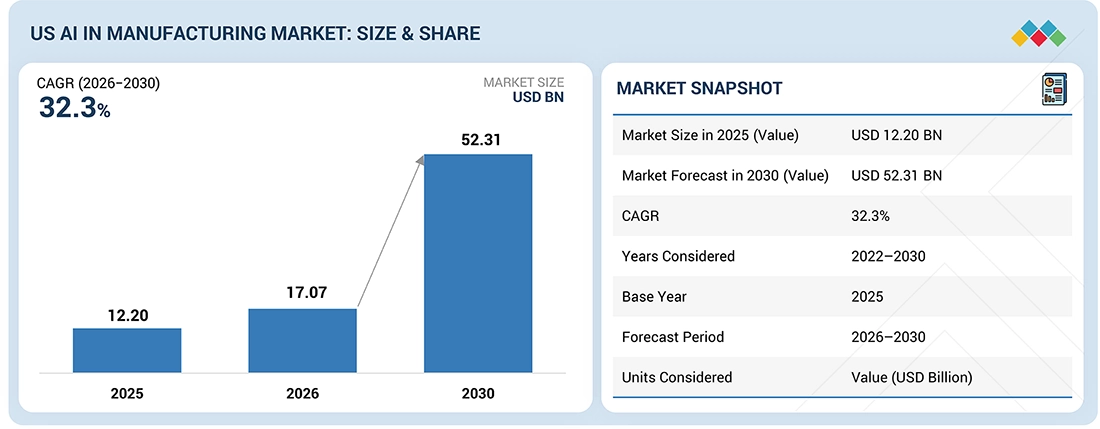
Source: Secondary Research, Interviews with Experts, MarketsandMarkets Analysis
The US artificial intelligence in manufacturing market is projected to reach USD 52.31 billion by 2030 from USD 12.20 billion in 2025, at a CAGR of 32.3% from 2026 to 2030. AI in manufacturing encompasses advanced technologies and solutions designed to enhance production efficiency, support real-time decision-making, and strengthen predictive maintenance capabilities. These AI-powered systems are designed to integrate with existing manufacturing infrastructures and can be used in various industrial applications, such as quality inspection, production planning, predictive maintenance, and supply chain optimization. The integration of AI is critical for enabling competitive advantages in the rapidly evolving manufacturing sector, helping reduce downtime and operational costs while improving overall product quality.
KEY TAKEAWAYS
-
By OfferingThe software segment is expected to witness a 35–40% of growth rate as it supports key manufacturing functions across the industry.
-
By TechnologyGenerative AI technology is expected to register the highest growth rate, enabling innovative design and process optimization across manufacturing operations.
-
By ApplicationPredictive maintenance is expected to witness a growth of 35–40% in the US artificial intelligence in manufacturing market, driven by increasing adoption of AI for equipment monitoring and downtime reduction.
-
By IndustryThe automotive industry registered a market share of 26% in 2025, leveraging AI for automation and quality control, constituting a large portion of market share in 2030.
-
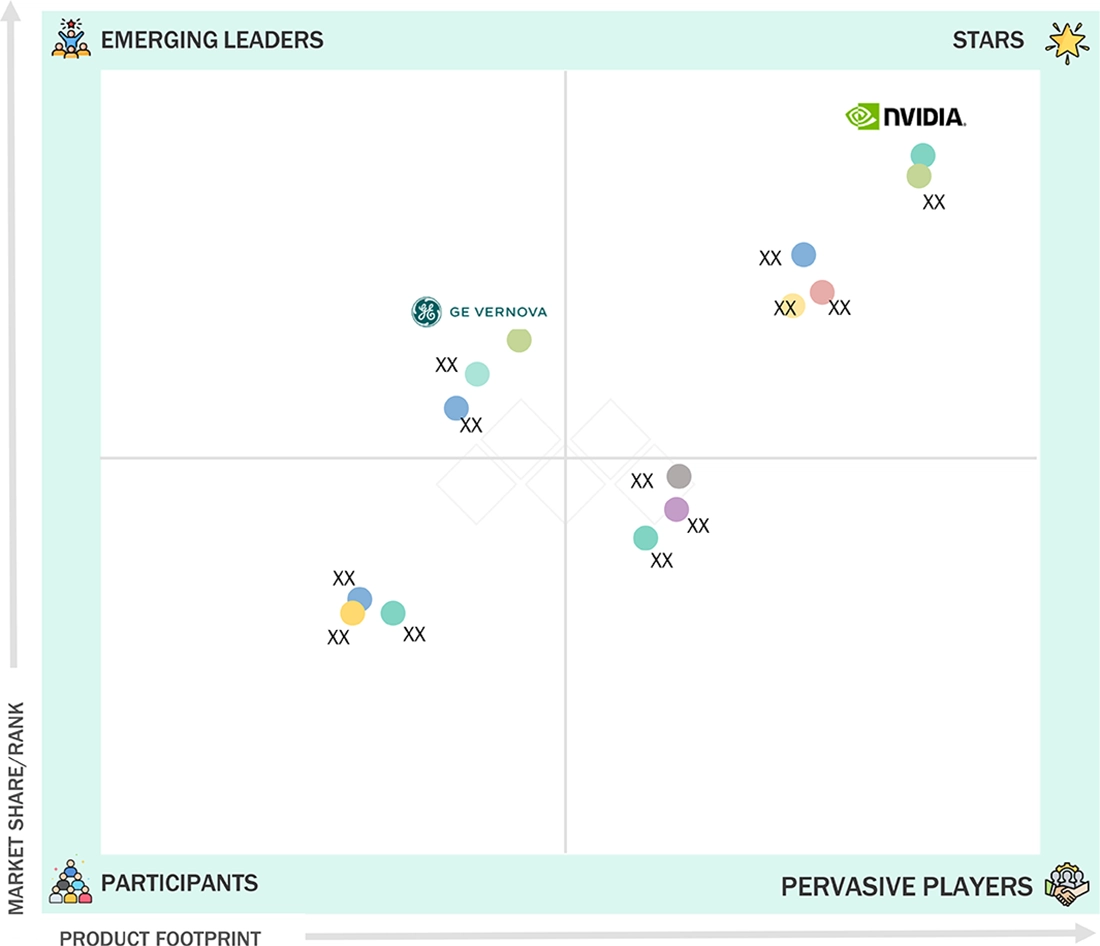
Competitive Landscape - Star PlayersNVIDIA Corporation, IBM, Siemens, ABB, Honeywell International Inc., GE Vernova, and Rockwell Automation were identified as leading players in the US artificial intelligence in manufacturing market, given their strong market share and extensive product footprint.
-
Competitive Landscape - StartupsUiPath (US) and Automation Anywhere, Inc. are emerging technology providers and specialized AI solution developers that have distinguished themselves among startups and SMEs by securing strong footholds in specialized niche areas, underscoring their potential as emerging market leaders.
The US artificial intelligence in manufacturing market is expanding rapidly, driven by increasing adoption of AI solutions that enhance production efficiency, support real-time decision-making, and strengthen predictive maintenance capabilities. The growing deployment of Industrial Internet of Things, expanding investments in machine learning and big data analytics, and increasing focus on automation and quality control are further accelerating demand for high-performance AI systems across the manufacturing sector.
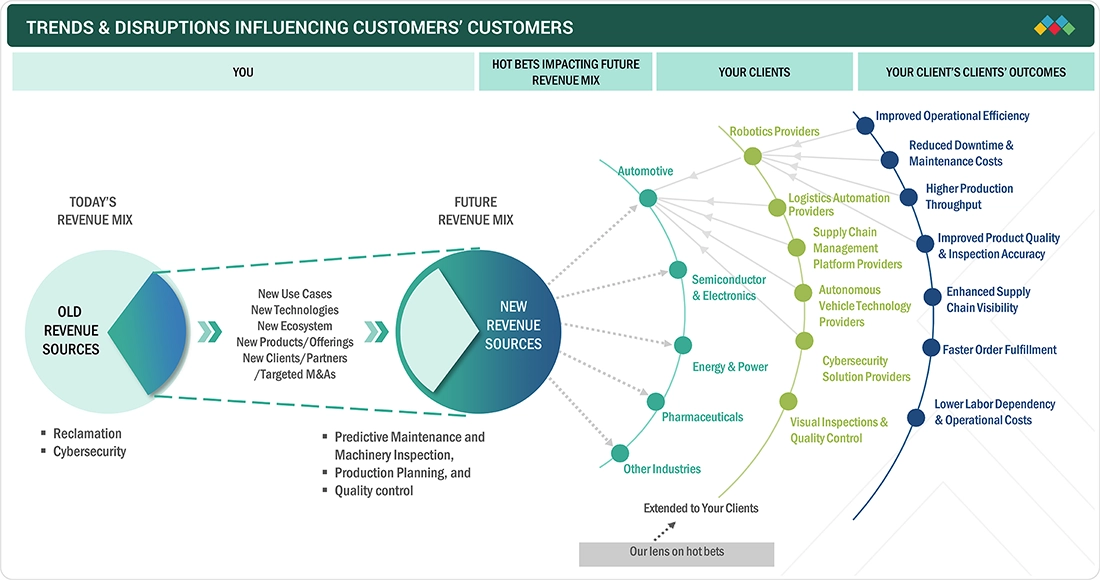
TRENDS & DISRUPTIONS IMPACTING CUSTOMERS' CUSTOMERS
The US artificial intelligence in manufacturing market is currently experiencing a phase of innovation and rapid adoption. Manufacturing facilities across automotive, electronics, aerospace, pharmaceuticals, and other industrial sectors are witnessing advancements in AI technology development and implementation. This progress aligns with emerging trends in predictive maintenance, quality inspection automation, and intelligent production planning. In the United States, the use of machine learning algorithms, computer vision systems, and advanced analytics platforms is increasing among manufacturing plants and industrial facilities. These technologies facilitate the deployment of AI-driven solutions that promote faster decision-making, reduce the need for manual intervention, and align with smart factory and Industry 4.0 approaches. Government agencies and industry organizations are encouraging domestic innovation, the development of AI-powered digital twins and personalized manufacturing solutions, and public-private research and development programs. These initiatives help accelerate technology adoption timelines and promote the implementation of automation-friendly, industrially validated AI platforms tailored to the needs of diverse manufacturing operations.
Source: Secondary Research, Interviews with Experts, MarketsandMarkets Analysis
MARKET DYNAMICS

Level
-
Advancements in machine learning and big data analytics driving manufacturing optimization

-
Increased deployment of Industrial Internet of Things enabling real-time production monitoring


Level
-
Significant cost of AI implementation and complexity of algorithm development


Level
-
Expansion of AI applications into predictive maintenance and high automation capabilities


Level
-
Ensuring cybersecurity and integrating AI systems with existing manufacturing infrastructures

Source: Secondary Research, Interviews with Experts, MarketsandMarkets Analysis
Driver: Advancements in machine learning and big data analytics driving manufacturing optimization
The rapid advancement of machine learning technologies and big data analytics capabilities across the United States is supporting greater adoption of AI in manufacturing. Industrial companies and technology providers are investing in advanced algorithms, data processing systems, and intelligent automation platforms, which is increasing the use of AI in production optimization, quality control, and operational efficiency improvements.
Restraint: Significant cost of AI implementation and complexity of algorithm development
The significant cost of implementing AI systems and the complexity of developing sophisticated algorithms in manufacturing environments restrict the adoption of advanced AI solutions. High initial investment requirements, integration challenges, and the need for specialized technical expertise create barriers for manufacturers trying to introduce comprehensive AI-powered systems across their production facilities.
Opportunity: Expansion of AI applications into predictive maintenance and high automation capabilities
The growing demand for predictive maintenance solutions and high automation capabilities presents significant growth opportunities in the US manufacturing sector. These AI applications are increasingly utilized in equipment monitoring, failure prediction, and autonomous production processes, aligning well with the focus on reducing downtime and improving operational efficiency.
Challenge: Ensuring cybersecurity and integrating AI systems with existing manufacturing infrastructures
Ensuring robust cybersecurity measures and seamless integration with existing manufacturing infrastructures remains a key challenge due to the complexity of industrial systems and the critical nature of production operations. Manufacturers must invest in security protocols, system compatibility testing, and operational validation to maintain reliability and acceptance of AI-powered manufacturing solutions.
US ARTIFICIAL INTELLIGENCE IN MANUFACTURING MARKET: COMMERCIAL USE CASES ACROSS INDUSTRIES
| COMPANY | USE CASE DESCRIPTION | BENEFITS |
|---|---|---|
 |
Advanced AI computing platforms and GPU-accelerated systems used in manufacturing for real-time quality inspection, predictive maintenance, and production optimization across automotive and electronics manufacturing facilities. | Provides powerful computational capabilities | Enables rapid data processing | Supports complex AI model training | Facilitates enhanced production efficiency and reduced operational costs |
 |
AI-driven digital twin solutions and industrial automation systems deployed in manufacturing plants for process simulation, production planning, and equipment performance monitoring across diverse industrial sectors. | Ensures accurate virtual modeling | Supports proactive maintenance scheduling | Enables optimized production workflows | Facilitates data-driven decision-making for improved manufacturing outcomes |
Logos and trademarks shown above are the property of their respective owners. Their use here is for informational and illustrative purposes only.
MARKET ECOSYSTEM
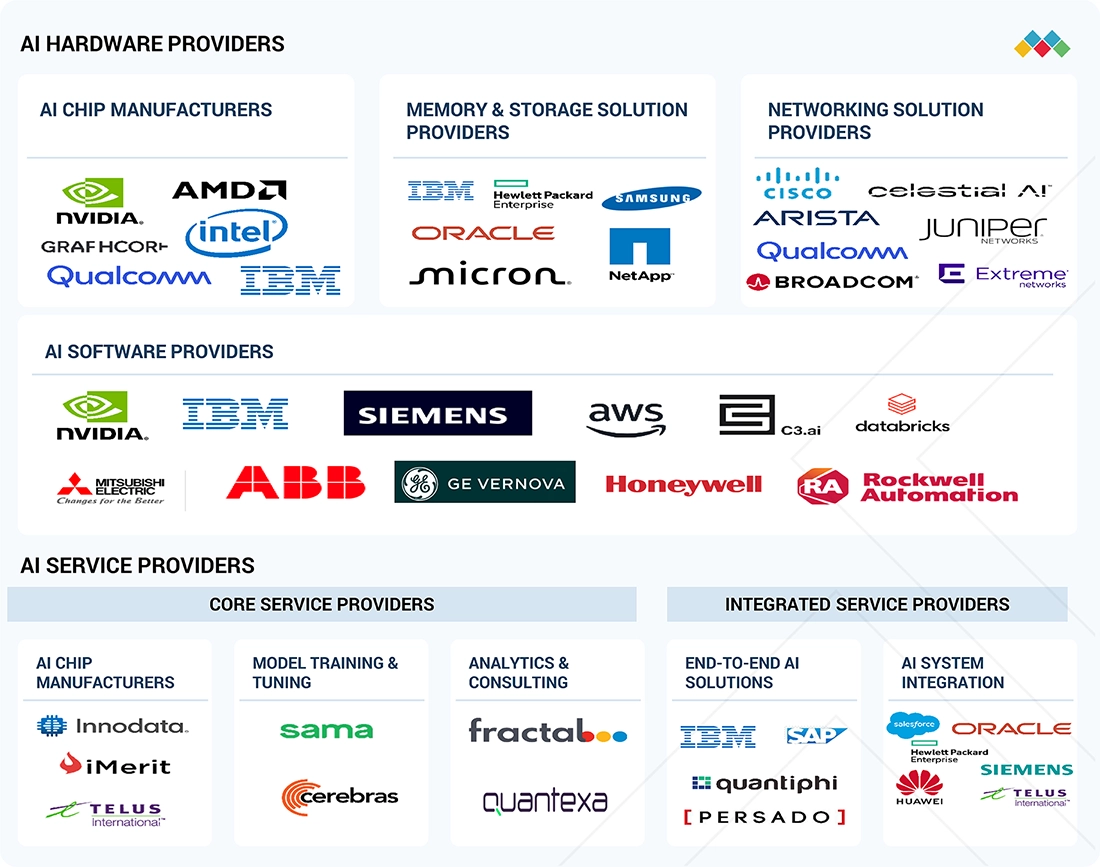
The US artificial intelligence in manufacturing involves a collaborative ecosystem where technology companies, industrial automation providers, software developers, research institutions, and manufacturing enterprises work together to develop and implement AI solutions in the industrial sector. Companies in the United States supply a variety of AI technologies, including machine learning platforms, computer vision systems, predictive analytics tools, and intelligent automation solutions. Research organizations, technology integrators, and consulting firms support the development, testing, and deployment stages, as well as the scale-up process for these AI systems. Ultimately, manufacturing facilities and industrial operators across the United States utilize the developed AI technologies, benefiting from supportive innovation policies and industry collaboration frameworks.
Logos and trademarks shown above are the property of their respective owners. Their use here is for informational and illustrative purposes only.
MARKET SEGMENTS
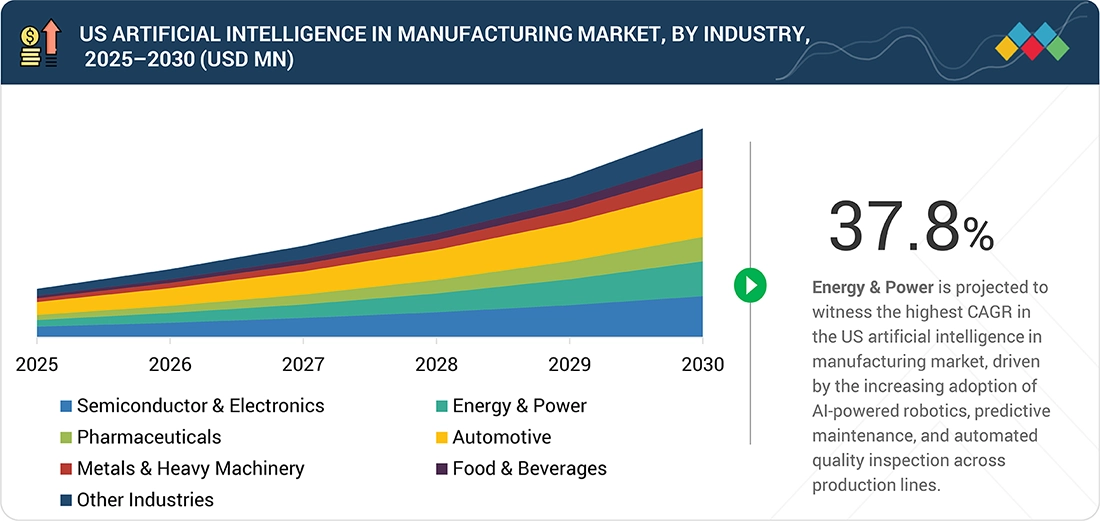
Source: Secondary Research, Interviews with Experts, MarketsandMarkets Analysis
US Artificial Intelligence in Manufacturing Market, by Offering
The software segment dominated the market in 2025, with AI software platforms being the backbone of most intelligent manufacturing systems deployed in industrial facilities. This is due to their flexibility, scalability, and proven performance in supporting key manufacturing functions, making them preferred for production optimization and quality control applications.
US Artificial Intelligence in Manufacturing Market, by Industry
The energy & power industry is projected to witness the highest CAGR in the US artificial intelligence in manufacturing market during the forecast period. The growing need for efficient energy generation, grid stability, and asset reliability is driving the adoption of AI technologies across the sector. Factors such as increasing automation in power plants, rising demand for predictive maintenance of critical infrastructure, and the deployment of AI-driven energy management and grid monitoring systems are accelerating the implementation of AI solutions across energy and power manufacturing operations.
REGION
United States market for artificial intelligence in manufacturing to be driven by country’s strong manufacturing base and rapid adoption of digital technologies
The United States market for artificial intelligence in manufacturing is driven by the country’s strong manufacturing base, rapid adoption of advanced digital technologies, and increasing investments in Industry 4.0 initiatives. The demand for production optimization, quality control, and predictive maintenance solutions is increasing as manufacturers across the US focus on improving operational efficiency and reducing downtime. Additionally, the presence of leading technology companies, strong government support for advanced manufacturing, and increasing investments in AI and machine learning are accelerating the deployment of AI-powered manufacturing solutions across the country.

US ARTIFICIAL INTELLIGENCE IN MANUFACTURING MARKET: COMPANY EVALUATION MATRIX
NVIDIA Corporation, recognized as a leading player in the AI computing segment of the US artificial intelligence in manufacturing market, offers a diverse portfolio that includes GPU-accelerated platforms, AI development tools, and specialized hardware for industrial applications. The company boasts a strong technology ecosystem in the United States and collaborates with manufacturing companies, automation providers, and industrial technology firms across automotive, electronics, and other manufacturing sectors. Another emerging player in the US market is GE Vernova, which is expanding its presence through AI-enabled industrial solutions. The company is strengthening its position by integrating artificial intelligence, machine learning, and advanced analytics into industrial and energy systems to enhance operational efficiency, predictive maintenance, and asset performance across manufacturing facilities.
Source: Secondary Research, Interviews with Experts, MarketsandMarkets Analysis
KEY MARKET PLAYERS
- NVIDIA Corporation (US)
- IBM (US)
- Siemens (Germany)
- ABB (Switzerland)
- Honeywell International Inc. (US)
- GE Vernova (US)
- Rockwell Automation (US)
- Cisco Systems, Inc. (US)
- Mitsubishi Electric Corporation (Japan)
- Schneider Electric (France)
- PTC (US)
- Oracle (US)
- SAP SE (Germany)
- Dassault Systemes (France)
- Microsoft (US)
- Micron Technology, Inc. (US)
- Intel Corporation (US)
- Amazon Web Services, Inc. (US)
- Google (US)
- Hewlett Packard Enterprise Development LP (US)
MARKET SCOPE
| REPORT METRIC | DETAILS |
|---|---|
| Market Size in 2025 (Value) | USD 12.20 Billion |
| Market Forecast in 2030 (Value) | USD 52.31 Billion |
| Growth Rate | CAGR of 32.3% from 2026-2030 |
| Years Considered | 2022-2030 |
| Base Year | 2025 |
| Forecast Period | 2026-2030 |
| Units Considered | Value (USD Billion) |
| Report Coverage | Revenue Forecast, Company Ranking, Competitive Landscape, Growth Factors, and Trends |
| Segments Covered |
|
| Countries Covered | United States |
WHAT IS IN IT FOR YOU: US ARTIFICIAL INTELLIGENCE IN MANUFACTURING MARKET REPORT CONTENT GUIDE
DELIVERED CUSTOMIZATIONS
We have successfully delivered the following deep-dive customizations:
| CLIENT REQUEST | CUSTOMIZATION DELIVERED | VALUE ADDS |
|---|---|---|
| Understanding demand patterns for AI solutions across US manufacturing sectors | Assessed AI technology adoption trends across key US manufacturing industries including automotive, electronics, aerospace, and pharmaceuticals, highlighting differences in implementation of machine learning, computer vision, predictive analytics, and automation solutions across production optimization, quality control, and maintenance applications | Helps clients align product portfolios with industry-specific demand drivers, technology maturity levels, and operational requirements |
| Identifying technology integration and partnership opportunities | Mapped regional AI solution providers, system integrators, and industrial automation companies across the United States, with insights into software development, hardware manufacturing, cloud platform services, and industrial AI deployment capabilities | Supports technology partnership strategies, reduces implementation complexity, accelerates deployment timelines, and improves solution effectiveness |
RECENT DEVELOPMENTS
- January 2026 : Siemens and NVIDIA expanded their strategic partnership to develop an Industrial AI operating system that integrates NVIDIA’s AI computing and simulation capabilities with Siemens’ industrial software and automation technologies. The collaboration enables manufacturers to create advanced digital twins, run AI-driven simulations, and optimize production processes by testing and validating manufacturing scenarios in virtual environments before real-world implementation.
- January 2025 : NEURA Robotics joined NVIDIA's Isaac GR00T program to develop cognitive AI robots, demonstrating enhanced capabilities for intelligent automation and advanced manufacturing applications with improved adaptability and decision-making functions for industrial robotics systems.
- December 2024 : NVIDIA announced major investments in AI server facilities, signaling contractual expansions and infrastructure development to support growing demand for AI computing capabilities in manufacturing and other industrial applications across the United States.
Table of Contents
 Exclusive indicates content/data unique to MarketsandMarkets and not available with any competitors.
Methodology
The study involved four major activities in estimating the current size of the AI in manufacturing market. Exhaustive secondary research has been conducted to gather information on the market, adjacent markets, and the overall AI in manufacturing landscape. These findings, assumptions, and projections were validated through primary research involving interviews with industry experts and key stakeholders across the value chain. Both top-down and bottom-up approaches were utilized to estimate the overall market size. Subsequently, market breakdown and data triangulation techniques were applied to determine the sizes of various segments and subsegments. Two key sources, secondary and primary, were leveraged to conduct a comprehensive technical and commercial assessment of the AI in manufacturing market.
Secondary Research
Various secondary sources have been referred to in the secondary research process to identify and collect important information for this study. The secondary sources include annual reports, press releases, and investor presentations of companies; white papers; journals and certified publications; and articles from recognized authors, websites, directories, and databases. Secondary research has been conducted to obtain key information about the industry’s supply chain, the market’s value chain, the total pool of key players, market segmentation according to the industry trends (to the bottom-most level), regional markets, and key developments from market- and technology-oriented perspectives. The secondary data has been collected and analyzed to determine the overall market size, and further validated by primary research.
Primary Research
Extensive primary research was conducted after gaining knowledge about the current scenario of the AI in manufacturing market through secondary research. Several primary interviews were conducted with experts from the demand and supply sides across four major regions—North America, Europe, Asia Pacific, and RoW. This primary data was collected through questionnaires, emails, and telephonic interviews.
Market Size Estimation
Both top-down and bottom-up approaches have been used to estimate and validate the total size of the AI in manufacturing market. These methods have also been used extensively to estimate the size of various subsegments on the market. The following research methodology has been used to estimate the market size:
- Major players in the industry and markets have been identified through extensive secondary research.
- The industry’s value chain and market size (in terms of value) have been determined through primary and secondary research processes.
- All percentage shares, splits, and breakdowns have been determined using secondary sources and verified through primary sources.
US Artificial Intelligence in Manufacturing Market : Top-Down and Bottom-Up Approach
Data Triangulation
After arriving at the overall size of the AI in manufacturing market from the market size estimation process explained above, the total market has been split into several segments and subsegments. Data triangulation and market breakdown procedures have been employed, wherever applicable, to complete the overall market engineering process and arrive at the exact statistics for all segments and subsegments of the market. The data has been triangulated by studying various factors and trends from both the demand and supply sides. Along with this, the market size has been validated using both top-down and bottom-up approaches.
Market Definition
Artificial Intelligence (AI) in manufacturing refers to the use of advanced technologies that simulate human intelligence to analyze data, interact with machines, and carry out key processes. It enables functions such as material handling, equipment monitoring, quality checks, and self-diagnostics, tasks that traditionally required human labor or operator-assisted robotics, to be performed faster, more accurately, and at lower cost. By minimizing manual intervention and optimizing resources, AI improves productivity, reduces downtime, and enhances operational efficiency. As a result, it serves as a strategic driver of digital transformation, strengthening competitiveness and resilience in the global manufacturing sector.
Key Stakeholders
- Semiconductor companies
- Technology providers
- Universities and research organizations
- System integrators
- AI solution providers
- AI platform providers
- Cloud service providers
- AI system providers
- AI service providers
- Energy and power companies
- Automobile companies
- Aircraft companies
- Textile companies
- Heavy metal companies
- Food & beverage companies
- Packaging companies
- Pharmaceutical companies
- Manufacturing consulting companies
- Investors and venture capitalists
- Manufacturers implementing AI technology
Report Objectives
- To define, describe, and forecast the artificial intelligence (AI) in manufacturing market, in terms of value, based on offering, technology, application, and industry
- To describe and forecast the artificial intelligence in manufacturing market, in terms of value, based on region—North America, Europe, Asia Pacific, and Rest of the World (RoW)
- To provide detailed information on drivers, restraints, opportunities, and challenges influencing market growth
- To strategically analyze micromarkets with respect to individual growth trends, prospects, and contributions to the total market
- To provide information on patent analysis, technology analysis, pricing analysis, Porter’s Five Forces analysis, key stakeholders and buying criteria, key conferences and events, regulatory bodies, government agencies, and regulations pertaining to the market under study
- To analyze the probable impact of the recession on the market in the near future
- To study the complete value chain of the artificial intelligence in manufacturing ecosystem, along with market trends and case studies
- To profile key players and comprehensively analyze their market positions in terms of ranking and core competencies, along with detailing the competitive landscape for market leaders
- To analyze the competitive developments such as joint ventures, collaborations, agreements, contracts, partnerships, mergers & acquisitions, product launches, and research & development (R&D) in the artificial intelligence in manufacturing market
Customization Options
With the market data given, MarketsandMarkets offers customizations according to the company’s specific needs. The following customization options are available for the report:
Company Information
- Detailed analysis and profiling of additional market players (up to 5)


Personalize This Research
- Triangulate with your Own Data
- Get Data as per your Format and Definition
- Gain a Deeper Dive on a Specific Application, Geography, Customer or Competitor
- Any level of Personalization
Let Us Help You
- What are the Known and Unknown Adjacencies Impacting the US Artificial Intelligence in Manufacturing Market
- What will your New Revenue Sources be?
- Who will be your Top Customer; what will make them switch?
- Defend your Market Share or Win Competitors
- Get a Scorecard for Target Partners

Custom Market Research Services
We Will Customise The Research For You, In Case The Report Listed Above Does Not Meet With Your Requirements
Get 10% Free CustomisationTESTIMONIALS

Tetsuya Ohhira
Business Development Manager-Technology Business
Nikon Corporation,
Leading Japanese MNC specializing in optics and imaging productswww.nikon.com
MarketsandMarkets™ response
is quick. Their attitude is flexible and positive. Analyst Insights are globally considered and
significant. Client Services quickly respond to our inquiry and demand. Their wide range of global
surveys help us make our strategic plan.
We hope Knowledge Store will be easier to search
for a report.
VP - Marketing & Business Development
Leading Provider of Process Control Solutions
We engaged with MarketsandMarkets on a study to perform an analysis and recommend a Go-To-Market strategy for metrology and process control in the semiconductor market. The study was tailored to our targets and needs with well-defined milestones. Our overall experience with the MarketsandMarkets team was very good throughout the project in all aspects including the analysis methodologies used, the quality and depth of primary and secondary data sets, the professionalism and flexibility of the team and the ability to meet the target schedule and milestones. We want to thank MarketsandMarkets team for a job well done.






Growth opportunities and latent adjacency in US Artificial Intelligence in Manufacturing Market