US Data Center BESS Market Size, Share & Trends

US Data Center BESS Market Size, Share & Trends by Battery Type (Li-ion Battery, Advanced Lead Acid Battery, Flow Battery, Sodium-ion Battery), Data Center Type (Hyperscale, Colocation, Enterprise & Edge), Deployment Architecture (BTM, FTM) - Forecast to 2030




US DATA CENTER BESS MARKET OVERVIEW
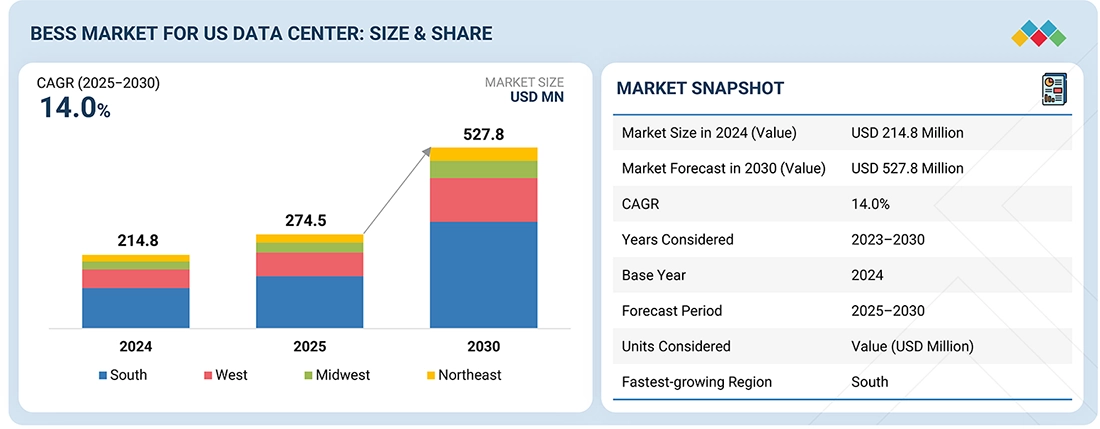
According to Marketsandmarkets, the BESS Market for US Data Center is valued at USD 274.5 million in 2025 and is projected to reach USD 527.8 million by 2030, at a CAGR of 14.0% during the forecast period. Growth is driven by rising deployment of battery energy storage systems across hyperscale and colocation data centers as operators focus on uninterrupted power supply, energy optimization, and grid resilience. Increasing demand for reliable backup power, renewable energy integration, and efficient energy management is accelerating BESS adoption. Advancements in lithium ion battery technologies, modular storage architectures, and intelligent energy management systems are enhancing operational reliability and power efficiency across modern US data center infrastructure.REPORT SCOPE
| REPORT METRIC | DETAILS |
|---|---|
| Market Size in 2024 (Value) | USD 214.8 Million |
| Market Size in 2025 (Value) | USD 274.5 Million |
| Market Forecast in 2030 (Value) | USD 527.8 Million |
| CAGR | CAGR of 14.0% from 2025-2030 |
| Years Considered | 2023–2030 |
| Base Year | 2024 |
| Forecast Period | 2025–2030 |
| Units Considered | Value (USD Million) |
| Report Coverage | Revenue Forecast, Company Ranking, Competitive Landscape, Growth Factors, and Trends |
| Top Companies |
|
| Growth Driver |
|
| Segments Covered |
|
| Regions Covered | South, West, Midwest, Northeast |
US DATA CENTER BESS MARKET KEY TAKEAWAYS
-
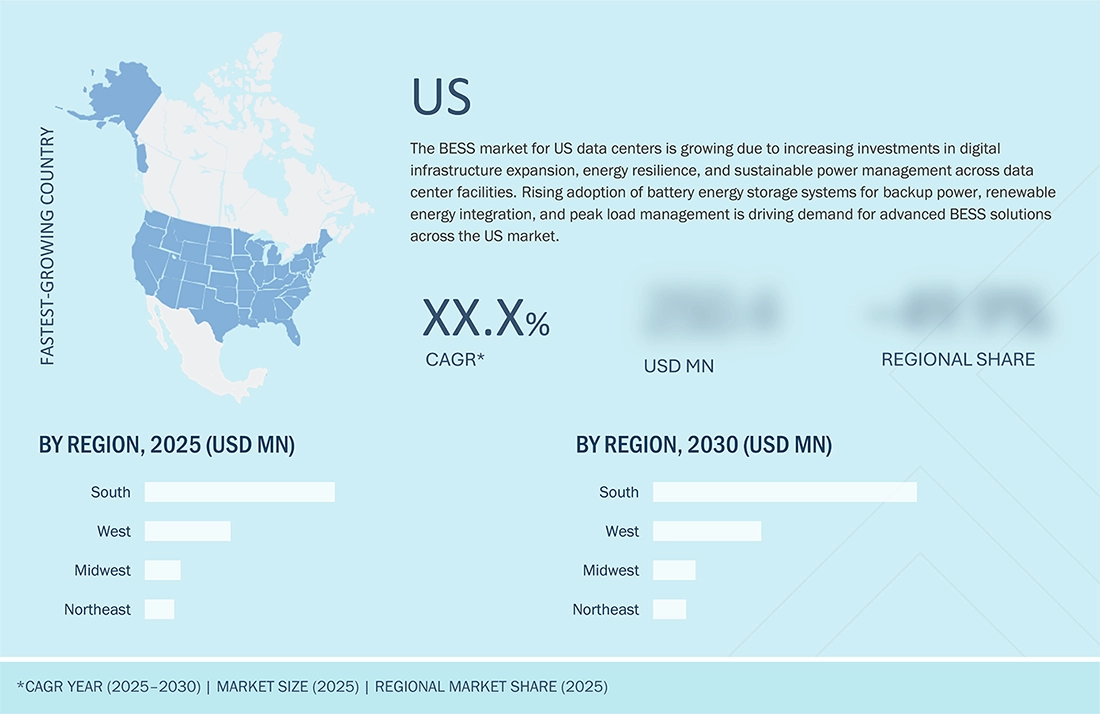
BY REGIONThe South US is expected to register the highest CAGR (15.3%) during the forecast period.
-
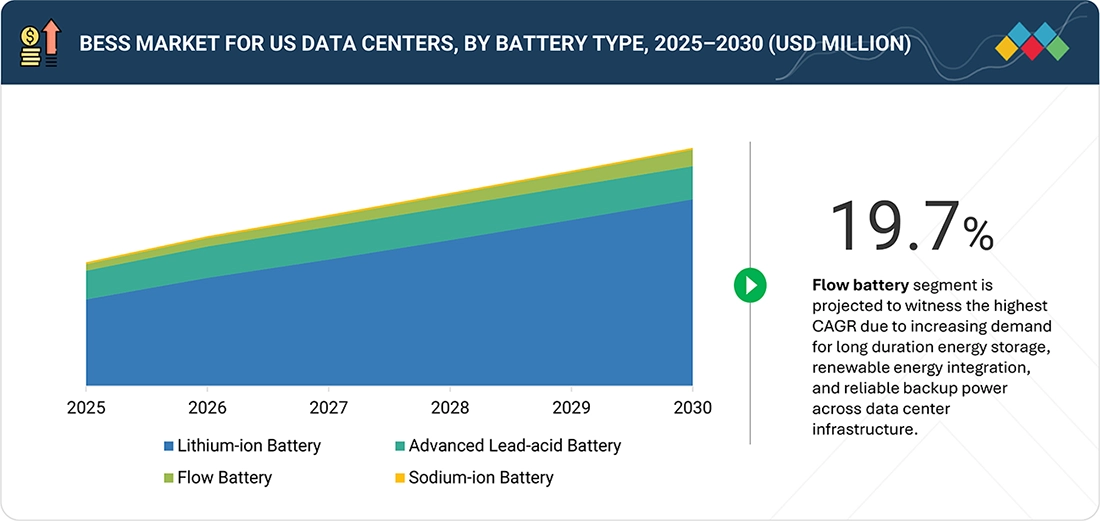
BY BATTERY TYPEBy battery type, the flow battery segment is expected to register the highest CAGR (19.7%) during the forecast period.
-
BY DATA CENTER TYPEBy data center type, the hyperscale segment is expected to register the highest CAGR (14.3%) during the forecast period.
-
BY STORAGE DURATIONBy storage duration, the 4–8 hours & above segment is expected to register the highest CAGR (24.8%) during the forecast period.
-
BY DEPLOYMENT ARCHITECTUREBy deployment architenture, the front-of-the-meter (FTM) segment is expected to register the highest CAGR (25.7%) during the forecast period.
-
BY APPLICATIONBy application, the renewable integration segment is expected to register the highest CAGR (29.6%) during the forecast period.
-
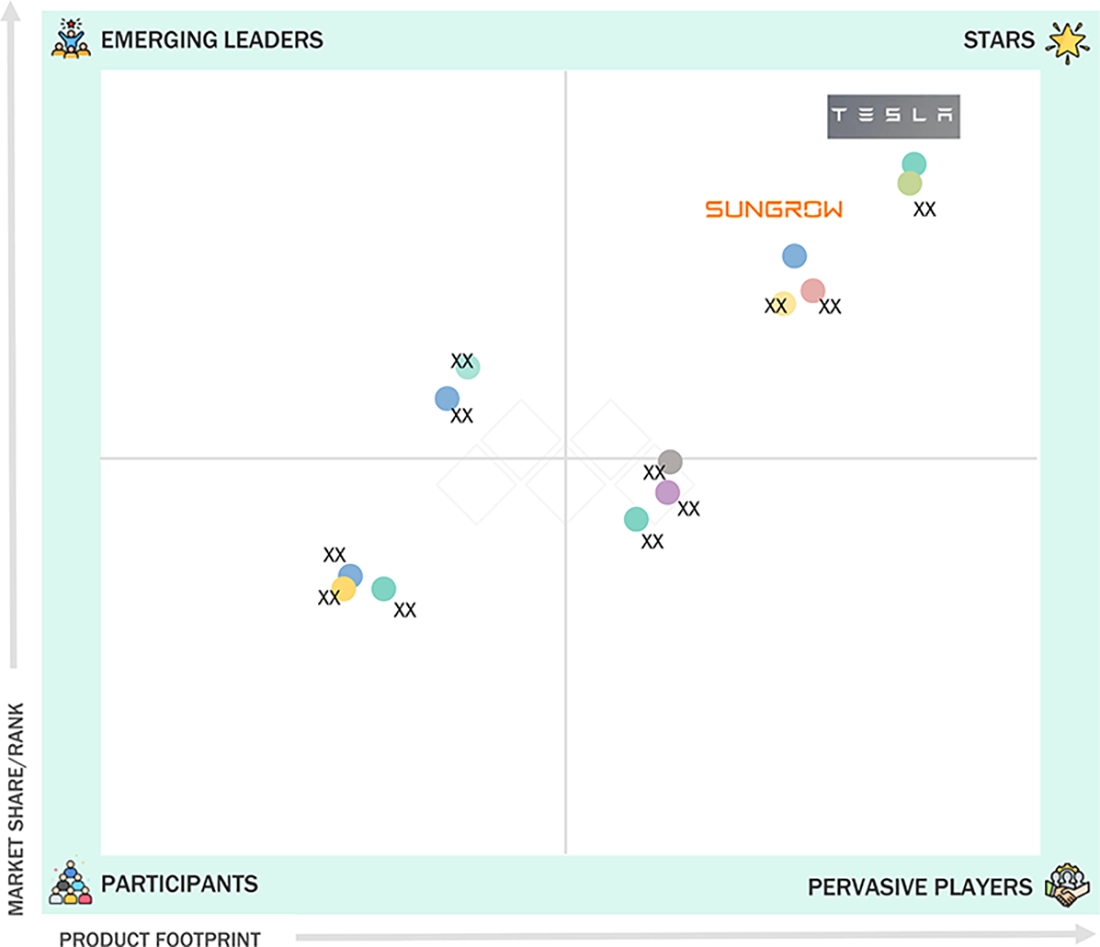
COMPETITIVE LANDSCAPE (KEY PLAYERS)Tesla (US) among others was identified as a star player in the BESS market for US data center due to its strong market presence and extensive battery energy storage solution portfolio.
The BESS market for US data centers is witnessing strong growth as data center operators deploy advanced battery energy storage systems to improve power reliability, operational continuity, and energy efficiency. The demand is driven by the growing need for uninterrupted backup power, peak-load management, and renewable energy integration across hyperscale and colocation facilities. Advancements in lithium-ion battery technologies, modular storage architectures, and intelligent energy management platforms are enhancing system responsiveness, scalability, and operational performance. Increasing expansion of AI workloads, cloud computing infrastructure, and high-density processing environments is further accelerating the adoption of battery energy storage systems across modern US data center operations.
Source: Secondary Research, Interviews with Experts, MarketsandMarkets Analysis
TRENDS & DISRUPTIONS IMPACTING CUSTOMERS' CUSTOMERS
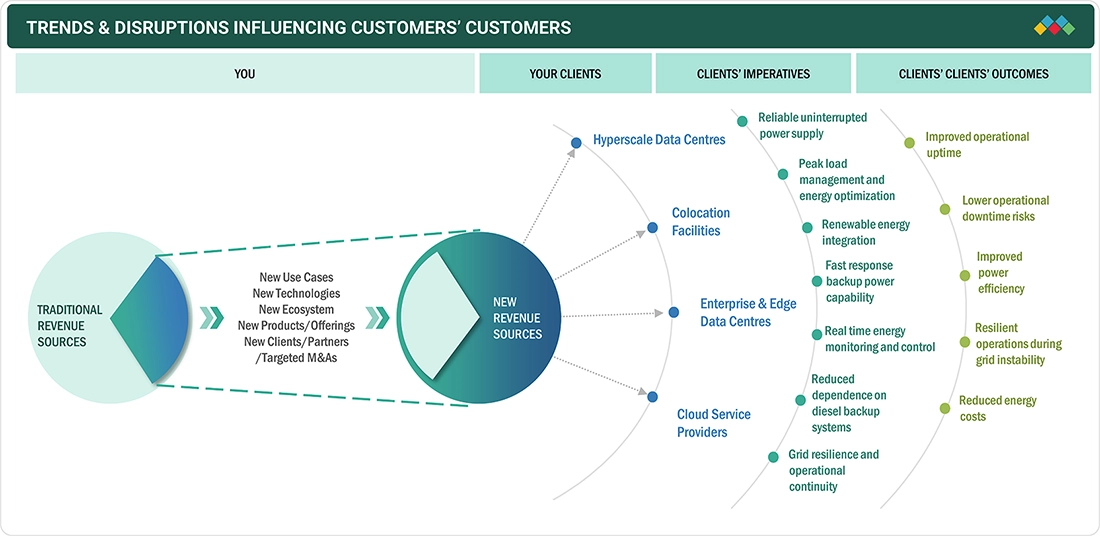
The figure highlights the transition in the BESS market for US data centers from conventional backup power systems toward advanced battery energy storage and intelligent power management solutions. Data center operators are deploying lithium-ion battery systems, modular storage architectures, and AI-enabled energy management platforms to improve power reliability, energy efficiency, and operational continuity across hyperscale and colocation facilities. Strong demand from cloud computing, AI workloads, and high-density data processing environments is driving adoption. This transition supports renewable energy integration, grid resilience, and optimized energy utilization, positioning battery energy storage systems as critical enablers of sustainable and resilient US data center infrastructure.
Source: Secondary Research, Interviews with Experts, MarketsandMarkets Analysis
US DATA CENTER BESS MARKET DYNAMICS

Level
-
Rising demand for uninterrupted power supply in hyperscale and colocation data centers

-
Growing adoption of AI workloads and high density computing infrastructure


Level
-
High initial investment and extended payback period

-
Space constraints and thermal management complexities


Level
-
Increasing integration of renewable energy in data center infrastructure

-
Expansion of modular and scalable energy storage deployments


Level
-
Complex battery lifecycle management and recycling requirements

-
Grid connectivity and power management integration challenges

Source: Secondary Research, Interviews with Experts, MarketsandMarkets Analysis
Driver: Rising demand for uninterrupted power supply in hyperscale and colocation data centers
Increasing deployment of AI workloads, cloud computing infrastructure, and high density processing environments is accelerating demand for reliable and continuous power management solutions. Battery energy storage systems help data center operators improve power resilience, reduce downtime risks, and optimize energy efficiency across mission critical operations.
Restraint: High initial investment and extended payback period
Deployment of battery energy storage systems requires significant investment in battery infrastructure, power management systems, cooling technologies, and system integration. Long payback timelines and high upfront costs can limit adoption, particularly for operators managing large scale infrastructure expansion projects.
Opportunity: Increasing integration of renewable energy in data center infrastructure
Growing adoption of renewable energy sources across US data center facilities is increasing demand for advanced battery energy storage systems capable of supporting stable and efficient power utilization. Integration of BESS with solar and renewable power systems enables improved energy optimization, grid flexibility, and sustainability performance.
Challenge: Complex battery lifecycle management and recycling requirements
Managing battery lifecycle performance, replacement schedules, thermal stability, and end of life recycling presents operational challenges for data center operators. Increasing regulatory focus on battery sustainability and safe disposal practices is further increasing the complexity of long term BESS management across large scale facilities.
US DATA CENTER BESS MARKET: COMMERCIAL USE CASES ACROSS INDUSTRIES
| COMPANY | USE CASE DESCRIPTION | BENEFITS |
|---|---|---|
 |
Deploys large scale battery energy storage systems for backup power support, peak load management, and renewable energy integration across hyperscale data center facilities. | Improves power resilience, reduces dependency on diesel backup systems, and enhances operational continuity. |
 |
Provides integrated BESS platforms and power conversion systems for efficient energy storage and grid stabilization in data center environments. | Supports energy optimization, improves power efficiency, and enables stable renewable energy integration. |
 |
Offers scalable battery energy storage and intelligent energy management solutions for mission critical digital infrastructure applications. | Enhances grid flexibility, improves uptime reliability, and supports efficient energy utilization. |
 |
Supplies software driven BESS and energy management platforms for fast response backup power and coordinated energy control across data center operations. | Strengthens energy management, enables real time monitoring, and reduces operational risk. |
 |
Delivers high performance lithium ion battery technologies for scalable and high availability energy storage deployments in data center facilities. | Improves battery efficiency, supports high density power requirements, and enhances system reliability. |
Logos and trademarks shown above are the property of their respective owners. Their use here is for informational and illustrative purposes only.
US DATA CENTER BESS MARKET ECOSYSTEM
The BESS market for US data centers ecosystem comprises battery manufacturers, BESS providers, component suppliers, system integrators, recycling companies, and data center operators working together to strengthen data center power infrastructure. These stakeholders support reliable backup power, renewable energy integration, energy optimization, and grid resilience across modern digital infrastructure environments. Growing investments in AI-driven computing, cloud platforms, and large-scale data center facilities are accelerating collaboration across the ecosystem to deliver scalable, efficient, and sustainable battery energy storage solutions across the US market.
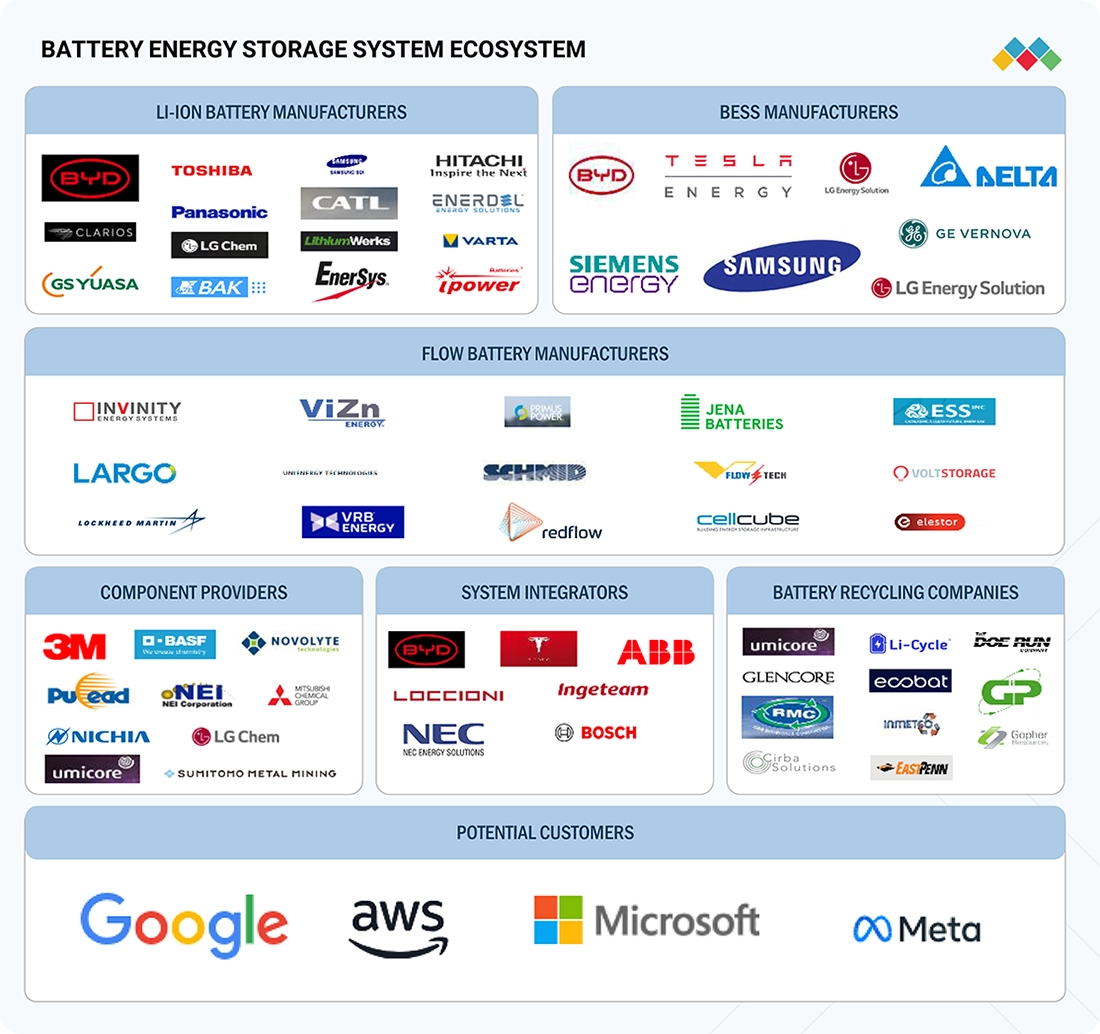
Logos and trademarks shown above are the property of their respective owners. Their use here is for informational and illustrative purposes only.
US DATA CENTER BESS MARKET SEGMENTS
Source: Secondary Research, Interviews with Experts, MarketsandMarkets Analysis
BESS Market for US Data Center, by Battery Type
Lithium ion batteries are expected to hold the largest share of the BESS Market for US Data Center due to their high energy density, fast response capability, long operational life, and strong deployment across modern data center infrastructure. These batteries support reliable backup power, peak load management, and renewable energy integration across large scale facilities.
BESS Market for US Data Center, by Data Center Type
Hyperscale data centers are expected to hold the largest share of the BESS Market for US Data Center due to rising investments in AI infrastructure, cloud computing, and high density digital operations. These facilities require scalable and reliable energy storage systems to support uninterrupted operations and efficient power management.
BESS Market for US Data Center, by Storage Duration
2–4 hours storage duration systems are expected to hold the largest share of the BESS Market for US Data Center due to their balanced capability to support backup power, energy optimization, and peak demand management. These systems are widely deployed across data center facilities for reliable short to medium duration power support.
BESS Market for US Data Center, by Deployment Architecture
Behind-the-meter (BTM) systems are expected to hold the largest share of the BESS market for US data centers, driven by the increasing deployment of on-site energy storage solutions for backup power reliability and energy cost optimization. These systems help data center operators improve operational continuity and manage electricity demand efficiently.
BESS Market for US Data Center, by Application
Backup power is expected to hold a significant share of the BESS market for US data centers, given the critical need for an uninterrupted power supply across data center operations. Battery energy storage systems help reduce downtime risks, improve power resilience, and support the continuous operation of mission-critical digital infrastructure.
BESS Market for US Data Center, by Region
The South US region is expected to hold the largest share of the BESS market for US data centers due to increasing investments in large-scale data center infrastructure, favorable energy availability, and expansion of cloud and AI-driven digital facilities. The growing deployment of energy storage systems across the region continues to strengthen market growth.
REGION
Asia Pacific to be fastest-growing region in autonomous mobile robots (AMR) market during forecast period
The South US is expected to register the highest CAGR in the BESS market for US data center during the forecast period due to increasing investments in hyperscale and colocation data center infrastructure across key states such as Texas and Virginia. The rising deployment of AI workloads, cloud computing platforms, and high-density digital infrastructure is accelerating demand for reliable, scalable battery energy storage systems. Expansion of renewable energy generation, favorable energy availability, and ongoing grid modernization initiatives are further supporting the adoption of advanced BESS solutions across the region. Data center operators are increasingly focusing on energy resilience, operational continuity, and sustainable power management, driving strong growth in battery energy storage deployments across the South US market.
US DATA CENTER BESS MARKET: COMPANY EVALUATION MATRIX
In the BESS market for US data center matrix, Tesla is positioned as a Star, supported by its strong portfolio of battery energy storage systems, energy management platforms, and scalable backup power solutions. The company’s strength lies in advanced battery technology capabilities, integrated energy optimization, and broad deployment across modern data center infrastructure. Sungrow is also positioned as a Star, driven by its expertise in power conversion systems, energy storage integration, and renewable energy technologies that support efficient and reliable data center power management. Continued investment in battery storage innovation, intelligent energy management, and large-scale infrastructure deployments is strengthening their presence within the evolving US data center BESS ecosystem.
Source: Secondary Research, Interviews with Experts, MarketsandMarkets Analysis
KEY MARKET PLAYERS
WHAT IS IN IT FOR YOU: US DATA CENTER BESS MARKET REPORT CONTENT GUIDE
DELIVERED CUSTOMIZATIONS
We have successfully delivered the following deep-dive customizations:
| CLIENT REQUEST | CUSTOMIZATION DELIVERED | VALUE ADDS |
|---|---|---|
| Data Center Infrastructure Provider |
|
|
| Battery Energy Storage System Manufacturer |
|
|
| Energy Management Software Provider |
|
|
RECENT DEVELOPMENTS
- August 2026: LG Energy Solution accelerated its shift toward energy-storage-system battery production in North America, with five of its eight regional factories expected to produce ESS batteries by the end of 2026. The company said demand is being driven substantially by the buildout of AI data centers, while its Lansing, Michigan facility is preparing to supply stationary-storage batteries for utilities and customers including Tesla. The expansion strengthens LG Energy Solution’s US ESS manufacturing capacity amid rising demand for BESS supporting data-center power infrastructure.
- July 2026: FlexGen Power Systems, LLC. advanced its data-center BESS offering by detailing how its HybridOS energy-management platform can coordinate batteries and other onsite energy assets to address transient power demands from AI data centers. The company highlighted BESS-based power-quality management, multi-asset orchestration, and faster interconnection as mechanisms for improving reliability and accelerating deployment of AI data-center capacity. This represents a direct application of FlexGen’s BESS and energy-management technology to US data-center power infrastructure.
- June 2026: Fluence collaborated with Siemens, NVIDIA, and nVent to develop a reference electrical and power architecture for NVIDIA AI data centers, integrating Fluence’s Smartstack battery energy storage system into the design. The BESS is intended to provide voltage and frequency ride-through, black-start capability, grid demand response, and AI-load smoothing for high-density AI workloads. The architecture is designed to help hyperscalers and other data-center operators deploy AI infrastructure faster and with greater power resilience, making it a direct US data-center BESS development.
- June 2026: SUNGROW highlighted its BESS technology for AI data centers, emphasizing capabilities including fault ride-through, short-circuit current support, rapid voltage recovery, seamless grid/off-grid switching, and black-start functionality. The company positioned these capabilities as solutions for maintaining reliable power as AI data centers experience increasingly demanding and variable electrical loads. The development directly connects Sungrow’s BESS technology with the power-reliability requirements of AI data centers.
- May 2026: Tesla supplied Megapack battery storage for a new solar-and-storage project supporting Meta’s AI data-center operations in Wyoming. The project, being developed by Meta and Enbridge, will use Tesla Megapacks as part of its power infrastructure for Meta’s growing data-center operations near Cheyenne. The deployment represents a direct application of Tesla’s utility-scale BESS technology to support power requirements for US AI data-center infrastructure.
Table of Contents
 Exclusive indicates content/data unique to MarketsandMarkets and not available with any competitors.
Methodology
The study involved four major activities in estimating the current size of the BESS market for US data centers. Exhaustive secondary research has been done to collect information on the market, peer market, and parent market. To validate these findings, assumptions, and sizing with industry experts across the value chain through primary research has been the next step. Both top-down and bottom-up approaches have been employed to estimate the complete market size. After that, market breakdown and data triangulation methods have been used to estimate the market size of segments and subsegments. Two sources of information, secondary and primary, have been used to identify and collect information for an extensive technical and commercial study of the BESS market for US data centers.
Secondary Research
Various secondary sources have been referred to in the secondary research process to identify and collect information important for this study. The secondary sources include annual reports, press releases, and investor presentations of companies; white papers; journals and certified publications; and articles from recognized authors, websites, directories, and databases. Secondary research has been conducted to obtain key information about the industry’s supply chain, the market’s value chain, the total pool of key players, market segmentation according to the industry trends (to the bottom-most level), regional markets, and key developments from market- and technology-oriented perspectives. The secondary data has been collected and analyzed to determine the overall market size, further validated by primary research.
Primary Research
Extensive primary research was conducted after gaining knowledge of the current BESS market for US data centers through secondary research. Several primary interviews were conducted with experts from the demand and supply sides across four major regions: North America, Europe, Asia Pacific, and RoW. This primary data was collected through questionnaires, emails, and telephonic interviews.
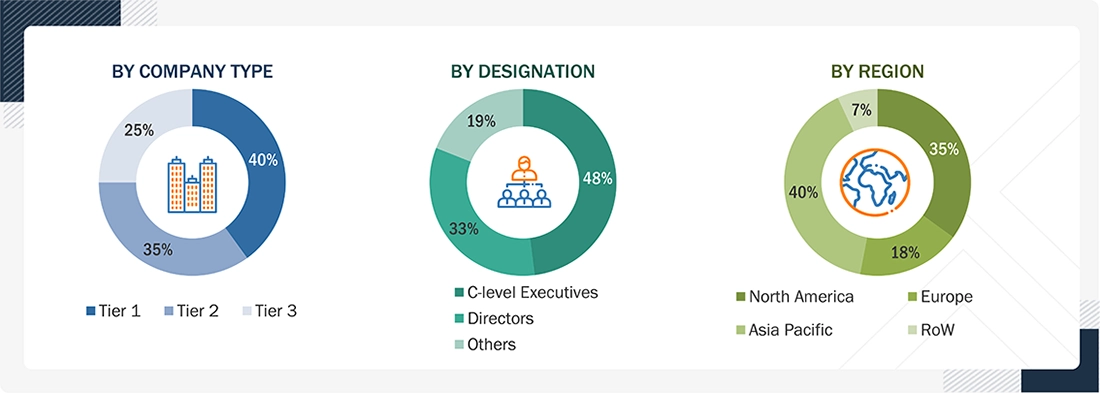
Note: Other designations include product managers, sales managers, and marketing managers.
Three tiers of companies have been defined based on their total revenue as of 2025: tier 3: revenue less than USD 500 million; tier 2: revenue between USD 500 million and USD 1 billion; and tier 1: revenue more than USD 1 billion.
RoW mainly includes South America, Africa, and the Middle East.
To know about the assumptions considered for the study, download the pdf brochure
Market Size Estimation
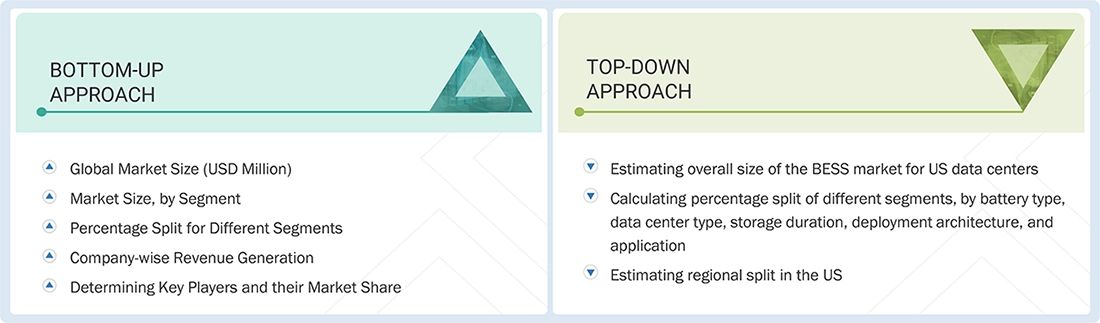
Both top-down and bottom-up approaches have been used to estimate and validate the total size of the BESS market for US data centers. These methods have also been used extensively to estimate the size of various subsegments in the market. The following research methodology has been used to estimate the market size:
- Major players in the industry and markets have been identified through extensive secondary research.
- The industry’s value chain and market size (in terms of value) have been determined through primary and secondary research processes.
- All percentage shares, splits, and breakdowns have been determined using secondary sources and verified through primary sources.
US Data Center BESS Market : Top-Down and Bottom-Up Approach
Data Triangulation
After arriving at the overall size of the BESS market for US data centers from the market size estimation process explained above, the total market has been split into several segments and subsegments. Data triangulation and market breakdown procedures have been employed, wherever applicable, to complete the overall market engineering process and arrive at the exact statistics for all segments and subsegments of the market. The data has been triangulated by studying various factors and trends from both the demand and supply sides. Along with this, the market size has been validated using both top-down and bottom-up approaches.
Market Definition
The BESS Market for US Data Center refers to the deployment of battery energy storage systems designed to support reliable, efficient, and uninterrupted power management across data center infrastructure in the United States. These systems are used for backup power, peak load management, renewable energy integration, and energy optimization in hyperscale, colocation, and enterprise data center facilities. BESS solutions help improve grid resilience, reduce dependency on conventional diesel backup systems, and support high-density computing environments with fast response power capabilities. Increasing digitalization, AI workloads, and cloud infrastructure expansion are driving the adoption of advanced battery energy storage technologies across the US data center ecosystem.
Key Stakeholders
- Battery Energy Storage System Providers
- Data Center Operators
- Hyperscale Cloud Service Providers
- Colocation Data Center Companies
- Lithium-ion Battery Manufacturers
- Flow Battery Technology Providers
- Energy Management Software Providers
- Power Electronics and Inverter Suppliers
- Grid Infrastructure and Utility Companies
- Renewable Energy Developers
- System Integrators and EPC Providers
- Government Bodies and Regulatory Authorities
- Research Institutes and Energy Storage Organizations
- Critical Power and Backup Power Solution Providers
- Data Center Infrastructure and Facility Management Companies
Report Objectives
- To define, describe, and forecast the BESS market for US data centers based on battery type, data center type, storage duration, deployment architecture, and application, in terms of value
- To describe and forecast the size of the BESS market for US data centers, by four regions: South, West, Midwest & Northeast, in terms of value
- To provide detailed information regarding drivers, restraints, opportunities, and challenges influencing market growth
- To strategically analyze micromarkets1 with respect to individual growth trends, prospects, and contributions to the overall market size
- To study the value chain of the BESS market for US data centers
- To analyze opportunities for stakeholders by identifying high-growth segments of the BESS market for US data centers
- To strategically profile the key players and comprehensively analyze their market positions in terms of their ranking and core competencies2
- To analyze competitive developments, such as product launches, acquisitions, collaborations, and partnerships, in the BESS market for US data centers
Available customizations:
With the given market data, MarketsandMarkets offers customizations according to the company’s specific needs. The following customization options are available for the report:
Company Information:
- Product matrix, which gives a detailed comparison of the product portfolio of each company
Key Questions Addressed by the Report
What is the current market size of the US Data Center BESS market?
The US Data Center BESS market is valued at USD 274.5 million in 2025 and was approximately USD 214.8 million in 2024.
What is the projected market size by 2030?
The market is projected to reach USD 527.8 million by 2030, indicating strong growth potential.
What is the expected CAGR of the market?
The market is expected to grow at a CAGR of 14.0% during the forecast period from 2025 to 2030.
What are the key growth drivers of the US Data Center BESS market?
Major drivers include rising demand for uninterrupted power supply, increasing AI and cloud workloads, renewable energy integration, and need for grid resilience and energy optimization.
What are the major industry trends in this market?
Key trends include adoption of lithium-ion and flow batteries, shift from diesel backup to battery systems, modular storage architectures, and AI-enabled energy management systems.
Which companies are leading in the US Data Center BESS market?
Leading companies include Tesla, Schneider Electric, Vertiv Group Corp., Eaton Corporation, ABB Ltd., Siemens AG, Fluence, FlexGen, and LG Energy Solution.
Which data center segment is growing the fastest?
The hyperscale data center segment is expected to grow at the highest CAGR due to rapid expansion of AI and cloud infrastructure.
Which battery type is witnessing the highest growth?
Flow batteries are expected to register the highest CAGR of around 19.7% during the forecast period.
Which regions dominate the US Data Center BESS market?
Key regions include the South (fastest growing at ~15.3% CAGR), along with major hubs like Texas, California, Northern Virginia, Arizona, and Illinois.
What does the report analysis methodology include?
The report uses primary and secondary research, along with top-down and bottom-up approaches, and data triangulation to accurately estimate market size and segment analysis.


Personalize This Research
- Triangulate with your Own Data
- Get Data as per your Format and Definition
- Gain a Deeper Dive on a Specific Application, Geography, Customer or Competitor
- Any level of Personalization
Let Us Help You
- What are the Known and Unknown Adjacencies Impacting the US Data Center BESS Market
- What will your New Revenue Sources be?
- Who will be your Top Customer; what will make them switch?
- Defend your Market Share or Win Competitors
- Get a Scorecard for Target Partners

Custom Market Research Services
We Will Customise The Research For You, In Case The Report Listed Above Does Not Meet With Your Requirements
Get 10% Free CustomisationTESTIMONIALS

Tetsuya Ohhira
Business Development Manager-Technology Business
Nikon Corporation,
Leading Japanese MNC specializing in optics and imaging productswww.nikon.com
MarketsandMarkets™ response
is quick. Their attitude is flexible and positive. Analyst Insights are globally considered and
significant. Client Services quickly respond to our inquiry and demand. Their wide range of global
surveys help us make our strategic plan.
We hope Knowledge Store will be easier to search
for a report.
VP - Marketing & Business Development
Leading Provider of Process Control Solutions
We engaged with MarketsandMarkets on a study to perform an analysis and recommend a Go-To-Market strategy for metrology and process control in the semiconductor market. The study was tailored to our targets and needs with well-defined milestones. Our overall experience with the MarketsandMarkets team was very good throughout the project in all aspects including the analysis methodologies used, the quality and depth of primary and secondary data sets, the professionalism and flexibility of the team and the ability to meet the target schedule and milestones. We want to thank MarketsandMarkets team for a job well done.






Growth opportunities and latent adjacency in US Data Center BESS Market