US eGRC Market

US eGRC Market by Solution (Risk Management, Compliance Management, Audit Management, Policy Management, Privacy Management), Service (Professional, Managed), Business Function (Legal, Finance, Operations), Vertical (BFSI, Healthcare) - Forecast to 2030




OVERVIEW
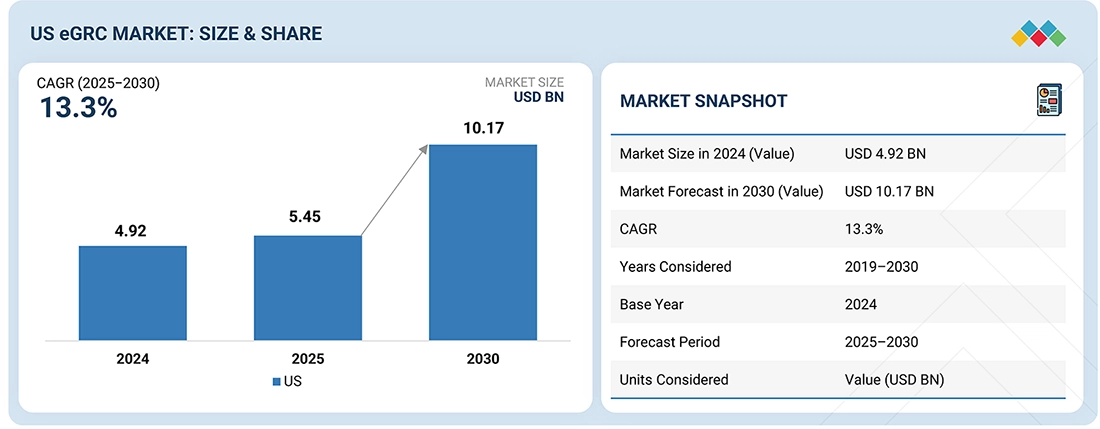
Source: Secondary Research, Interviews with Experts, MarketsandMarkets Analysis
The US eGRC market is projected to reach USD 10.17 billion by 2030 from USD 5.45 billion in 2025, at a CAGR of 13.3% from 2025 to 2030. Companies in the US eGRC market are now seeking tools that provide clearer risk insights and consolidate different governance activities into a single view. Increasing spending on compliance programs, third-party risk automation, and the growing pressure to meet privacy rules, such as CCPA and CPRA, are driving the growth of the eGRC market in the US. Organizations are now showing more interest in cloud-based eGRC platforms, managed compliance support, and data governance tools that help leaders make informed decisions using current company risk information. These changes are prompting vendors to adjust their product portfolios, as many US enterprises now expect solutions that can scale easily, automate manual tasks, and provide a more comprehensive view of risk across the business.
KEY TAKEAWAYS
-
BY OFFERINGBy offering, solutions segment is expected to dominate the market in terms of market share.
-
BY SOLUTIONBy solution, the risk management segment is expected to dominate the market in terms of market share.
-
BY SERVICEBy service, the professional services segment is expected to dominate the market in terms of market share.
-
BY ORGANIZATION SIZEBy organization size, SMEs are expected to grow at a CAGR of 14.8%.
-
BY BUSINESS FUNCTIONBy business function, the IT segment is projected to grow at the fastest rate, with a CAGR of 14.2% from 2025 to 2030.
-
BY VERTICALBy vertical, the healthcare segment will grow the fastest during the forecast period, at the highest CAGR of 17.3%.
-
COMPETITIVE LANDSCAPE - KEY PLAYERSLeading US-based eGRC vendors, including FIS, RSA Security, NAVEX, IBM OpenPages, MetricStream, ServiceNow, and OneTrust, dominate the market with mature, integrated platforms that cover risk, compliance, audit, policy, and third-party management. Their strong automation, regulatory alignment, and enterprise-grade scalability make them preferred choices for large US financial, healthcare, government, and Fortune 500 organizations.
-
COMPETITIVE LANDSCAPE - STARTUPSEmerging US players, such as LogicGate, Hyperproof, Drata, Vanta, and Secureframe, offer agile, cloud-native eGRC solutions that focus on rapid deployment, automated compliance, continuous control monitoring, and seamless integrations. Their modern SaaS-first approach appeals to mid-market firms, SaaS companies, and fast-growing digital businesses seeking simpler, scalable governance solutions.
As US enterprises expand across states, business units, and complex supply chains, fragmented risk and compliance processes create visibility gaps. Organizations face overlapping federal and state regulations, as well as rising cybersecurity threats. This is driving demand for centralized eGRC platforms that deliver real-time risk visibility, consistent control enforcement, informed decision-making, and continuous compliance across U.S. operations.
TRENDS & DISRUPTIONS IMPACTING CUSTOMERS' CUSTOMERS
The companies in the eGRC market in the US are now looking for tools that can give them clearer risk insights, automate more of the control testing, and tie different governance activities together in a single view. New revenue sources are emerging from continuous compliance, third-party risk automation, privacy compliance (CCPA/CPRA), and industry-specific regulatory needs across BFSI, healthcare, government, and tech sectors. As organizations modernize risk and compliance functions, demand is rising for cloud-native eGRC solutions, managed compliance services, and data governance tools that support real-time decision-making. This transition is reshaping vendor portfolios as US enterprises prioritize scalability, automation, and unified risk visibility.
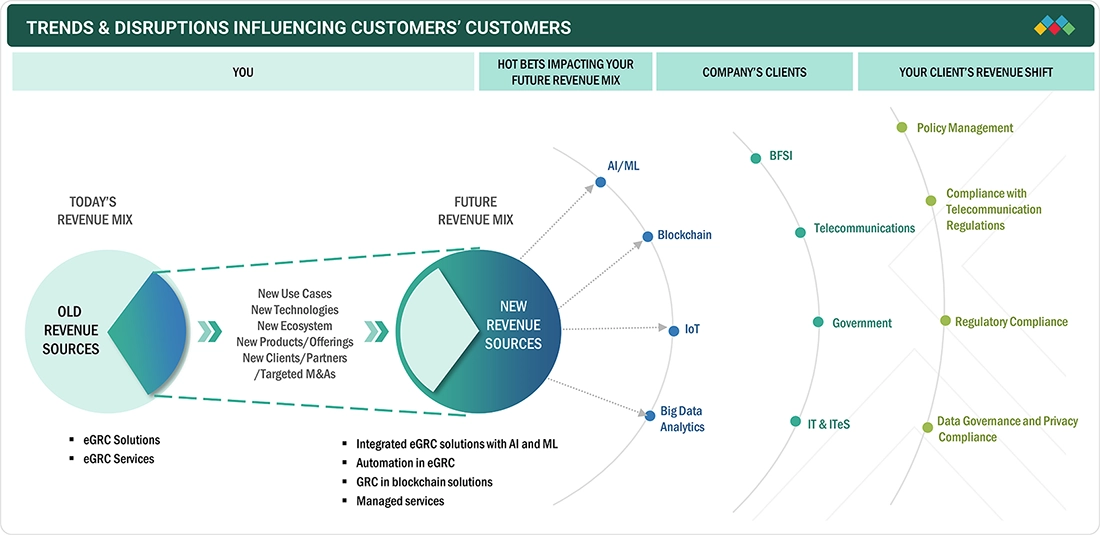
Source: Secondary Research, Interviews with Experts, MarketsandMarkets Analysis
MARKET DYNAMICS

Level
-
Regulatory & compliance pressure

-
Digital transformation & cloud adoption


Level
-
Legacy systems & high integration/implementation costs

-
Fragmented US privacy & regulatory landscape


Level
-
Cloud-native SaaS eGRC for mid-market & SMBs

-
Managed eGRC/GRC-as-a-Service


Level
-
Aligning cross-functional stakeholders (risk, IT, legal, business)

-
Provision of comprehensive eGRC solutions

Source: Secondary Research, Interviews with Experts, MarketsandMarkets Analysis
Driver: Regulatory & compliance pressure
US organizations are facing an expanding mix of regulatory expectations, whether it’s around financial reporting, privacy requirements, cybersecurity rules or sector-specific mandates. To keep up, many have started leaning on eGRC platforms that pull their controls into one place and cut down the amount of manual effort needed to gather evidence. The goal for most companies now is to stay compliant on an ongoing basis rather than scrambling during periodic audits.
Restraint: Legacy systems & high integration/implementation costs
Many firms are still working with older risk and compliance tools that weren’t built for today’s demands. Replacing these systems can be expensive and complex, and many of them face difficulties in connecting with modern eGRC platforms. The issues associated with legacy systems and high implementation costs are hindering the smooth deployment of eGRC solutions and services on the organization's systems.
Opportunity: Cloud-native SaaS eGRC for mid-market & SMBs
Small and mid-sized enterprises (SMEs) in the US are showing more interest in cloud-based eGRC options. They are increasingly seeking affordable, easy-to-deploy, cloud-based eGRC tools that offer automated compliance, real-time monitoring, and scalable workflows, creating a fast-growing opportunity for SaaS-driven eGRC vendors. This has created an opportunity for vendors that specialize in SaaS-based eGRC solutions or services delivery.
Challenge: Aligning cross-functional stakeholders (risk, IT, legal, business)
Risk teams, IT, legal, compliance and business units often still operate separately in an organization, each with its own view of processes and data. When information doesn’t move easily across these individual groups, it becomes much harder to streamline the operations. Such disconnect slows down eGRC initiatives and makes it difficult for companies to build more mature, enterprise-wide governance and risk programs.
US EGRC MARKET: COMMERCIAL USE CASES ACROSS INDUSTRIES
| COMPANY | USE CASE DESCRIPTION | BENEFITS |
|---|---|---|
 |
A global food and beverage giant opted for MetricStream to deploy a solution to ensure compliance with all relevant regulations, effectively managing associated risks and maintaining adherence to rigorous corporate governance standards. MetricStream GRC Solution provides the client with capabilities that include internal audit management, SOX compliance, and internal controls management | The client can effectively manage multiple operational and compliance controls in an integrated manner. The client also gains the following benefits: Proficient management of controls Improved visibility and collaboration Enhanced reporting Costs and efforts redirected towards value-added activities Adherence to strict corporate governance standards |
 |
Mid-sized US financial institutions leverage FIS enterprise risk and compliance platforms to automate KYC, vendor risk, and operational risk assessments, especially for monitoring fintech partners, payment processors, and outsourced service providers. The platform centralizes risk scoring, workflows, and documentation across lines of business. | Lower compliance workload, real-time risk visibility, better vendor governance, fewer manual review bottlenecks, and improved audit readiness. |
 |
US retail and e-commerce enterprises deploy ServiceNow GRC to automate policy lifecycle management, map controls to multiple frameworks (PCI DSS, SOC, ISO), and connect risk events from ITSM, SecOps, and HR systems. | Real-time control monitoring, reduced audit cycle times, improved IT-business alignment, and higher policy adoption rates. |
Logos and trademarks shown above are the property of their respective owners. Their use here is for informational and illustrative purposes only.
MARKET ECOSYSTEM
The eGRC market ecosystem includes a mix of established technology providers that offer platforms for managing risk, compliance, policies, and audits. It also includes consulting firms and managed service providers that utilize eGRC tools operationally. Regulatory bodies continue to set the direction by introducing new requirements, which prompt organizations to seek more integrated governance solutions. Most of the demand now comes from the need to meet expectations around data privacy, financial reporting, and cybersecurity, and companies are trying to bring these efforts together instead of treating them as separate projects.
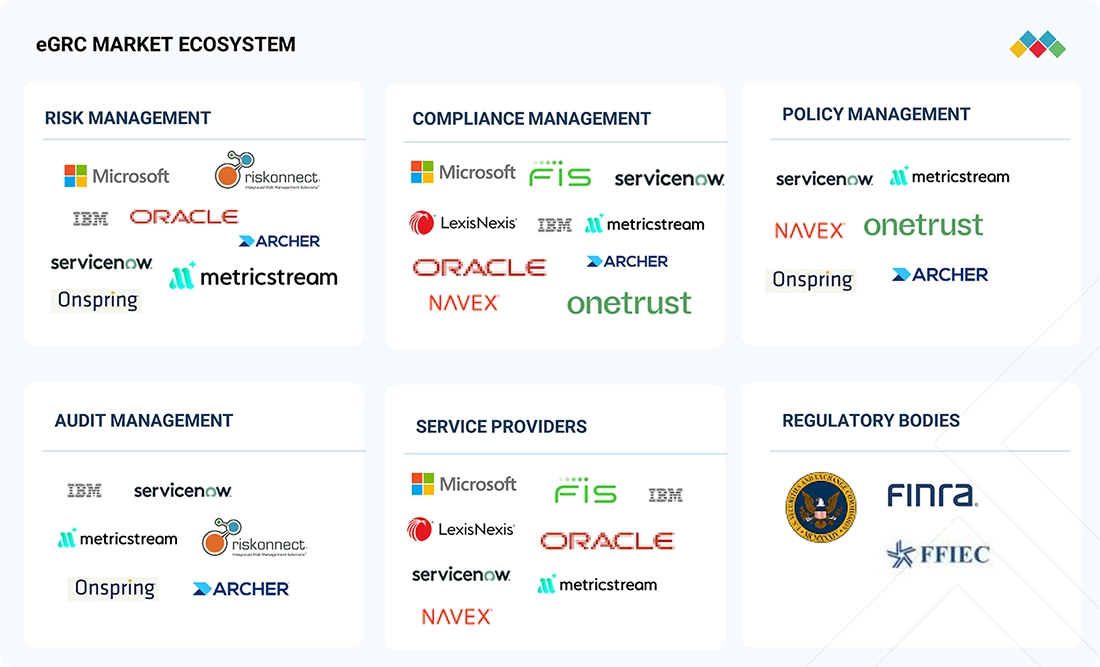
Logos and trademarks shown above are the property of their respective owners. Their use here is for informational and illustrative purposes only.
MARKET SEGMENTS
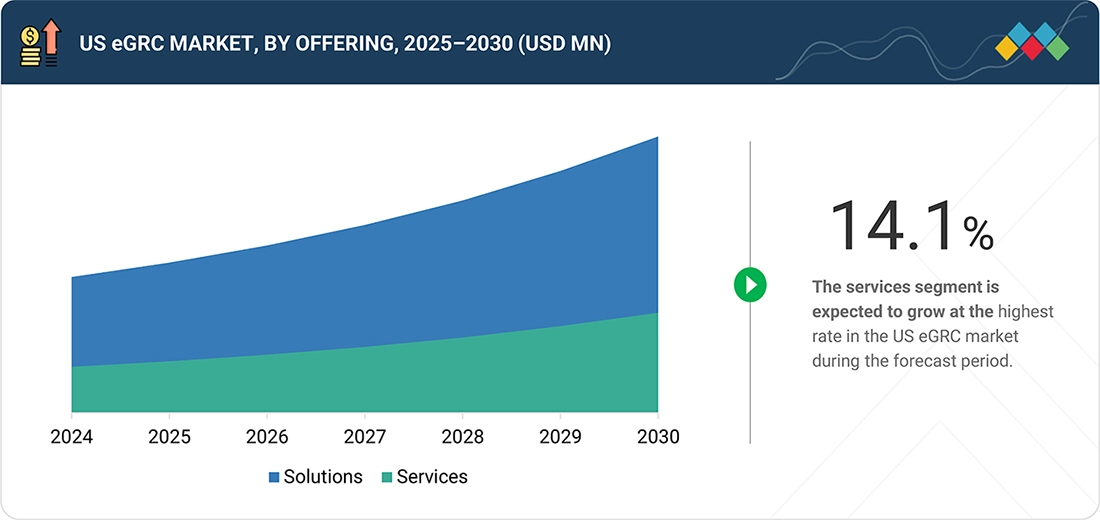
Source: Secondary Research, Interviews with Experts, MarketsandMarkets Analysis
eGRC Market, By Offering
The US eGRC market encompasses software platforms and services that integrate risk, compliance, and audit management. It also integrates privacy, vendor risk, and policy management into unified workflows. Many organizations are switching to cloud-first tools, especially those with some AI features, because they reduce the time spent testing controls, gathering evidence, or handling reporting work. Services such as consulting, managed compliance, and system integration remain essential for tailoring implementations to the complex US regulatory environment.
eGRC Market, By Deployment Mode
Shift from traditional on-premises GRC systems to cloud platforms is observed, as cloud eGRC solutions are easier to set up, updates occur automatically, and they are less expensive to maintain. That shift is universal in many verticals, including banks, government agencies, and a few other regulated sectors.
eGRC Market, By Organization Size
Large enterprises typically deploy eGRC platforms to customize workflows, automate repetitive tasks, and identify risks across multiple departments. Mid-sized companies and smaller firms are taking a different path; they’re gravitating toward SaaS tools that don’t require huge budgets or long implementation cycles. These platforms often come with built-in frameworks like SOC 2, ISO, or NIST, which makes it easier for them to get started without heavy internal support. The SME segment market is growing quickly because smaller firms are being held to higher standards in terms of cyber, privacy, and vendor-related expectations than they were previously.
eGRC Market, By Business Function
Inside companies, eGRC tools has been used in a lot of areas now—risk teams, IT and cybersecurity, compliance, internal audit, legal, procurement and even vendor management. Modern systems help teams keep risk information in one spot, map controls to different standards and pull data from IT, HR and security tools. That makes coordination a bit smoother and helps during audits when everyone needs to be on the same page.
eGRC Market, By Vertical
A wide range of US industries rely on eGRC today, including BFSI, government, healthcare, tech, manufacturing, energy, and retail. Each sector has its own set of rules, including FFIEC, HIPAA, SOX, NERC, PCI DSS, CCPA/CPRA, and NIST, among others. The industries with heavier regulatory pressure tend to use eGRC more aggressively, especially for continuous monitoring, incident handling, third-party oversight, and making sure operations stay resilient. With digital adoption increasing and regulators adding new requirements every year, eGRC adoption continues to spread across nearly all major verticals.
REGION
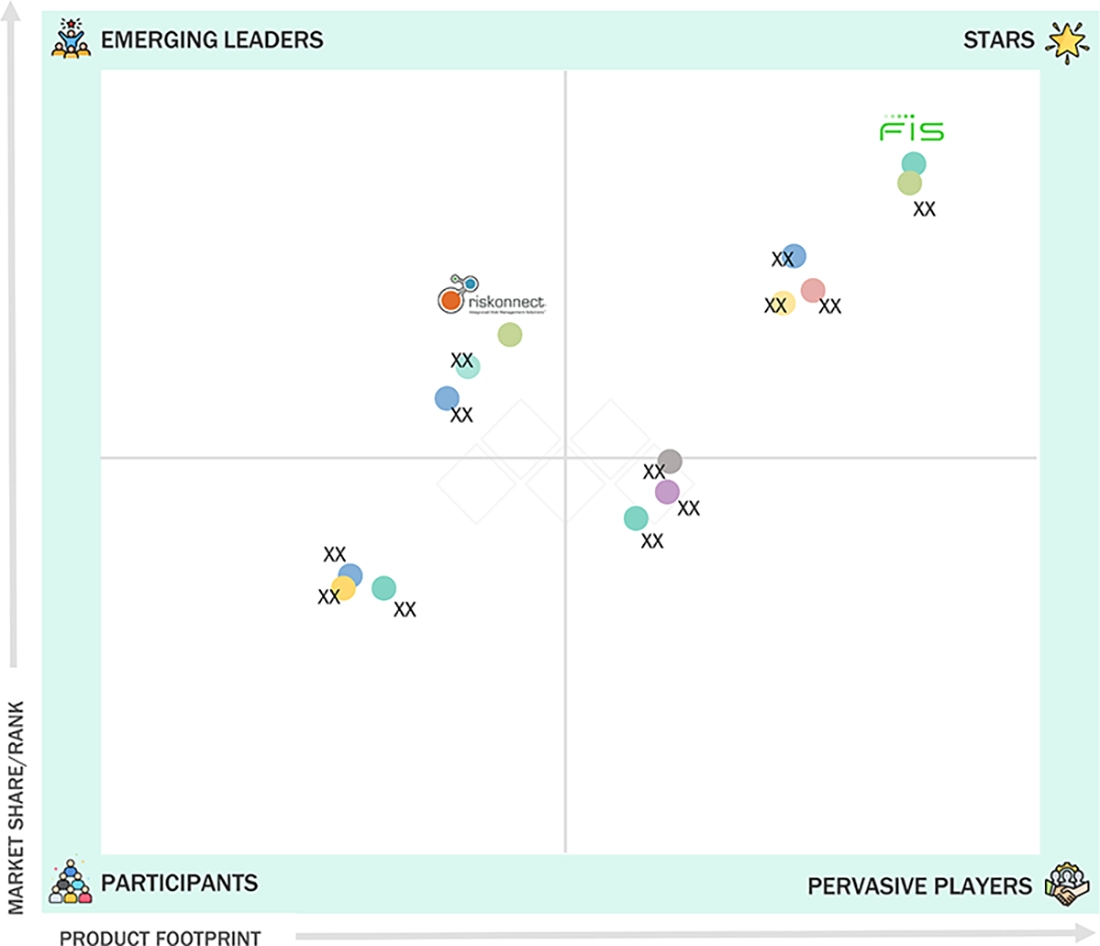
US EGRC MARKET: COMPANY EVALUATION MATRIX
The US eGRC market today comprises a mix of mature enterprise platforms and a newer wave of cloud-native tools that are experiencing rapid growth. ServiceNow is one of the established players, offering a comprehensive suite that encompasses risk, compliance, audit, and third-party management. Other vendors tend to compete by offering more modular features, better analytics, or deeper integrations. On the newer side, SaaS providers like Riskonnect are picking up momentum because their tools are easier to use, faster to roll out, and built around flexible cloud models. Across the board, most vendors are putting more emphasis on automation, simpler workflows, and tighter connections with security, ESG, and data governance systems as enterprise needs continue to shift.
Source: Secondary Research, Interviews with Experts, MarketsandMarkets Analysis
KEY MARKET PLAYERS
- IBM (US)
- Microsoft (US)
- Oracle (US)
- RSA Security (US)
- SAS Institute (US)
- ServiceNow (US)
- FIS (US)
- LexisNexis (US)
- MetricStream (US)
- Riskonnect (US)
- Navex Global (US)
- OneTrust (US)
- LogicManager (US)
- Allgress (US)
- Onspring (US)
- Optimiso (US)
- Comensure (US)
- LogicGate (US)
- VComply (US)
- SmartSuite (US)
- Hyperproof (US)
- Drata (US)
- Vanta (US)
- Secureframe (US)
MARKET SCOPE
| REPORT METRIC | DETAILS |
|---|---|
| Market Size in 2024 (Value) | USD 4.92 Billion |
| Market Forecast in 2030 (Value) | USD 10.17 Billion |
| Growth Rate | CAGR of 13.3% during 2025-2030 |
| Years Considered | 2019-2030 |
| Base Year | 2024 |
| Forecast Period | 2025-2030 |
| Units Considered | Value (USD Billion) |
| Report Coverage | Revenue forecast, company ranking, competitive landscape, growth factors, and trends |
| Segments Covered |
|
WHAT IS IN IT FOR YOU: US EGRC MARKET REPORT CONTENT GUIDE
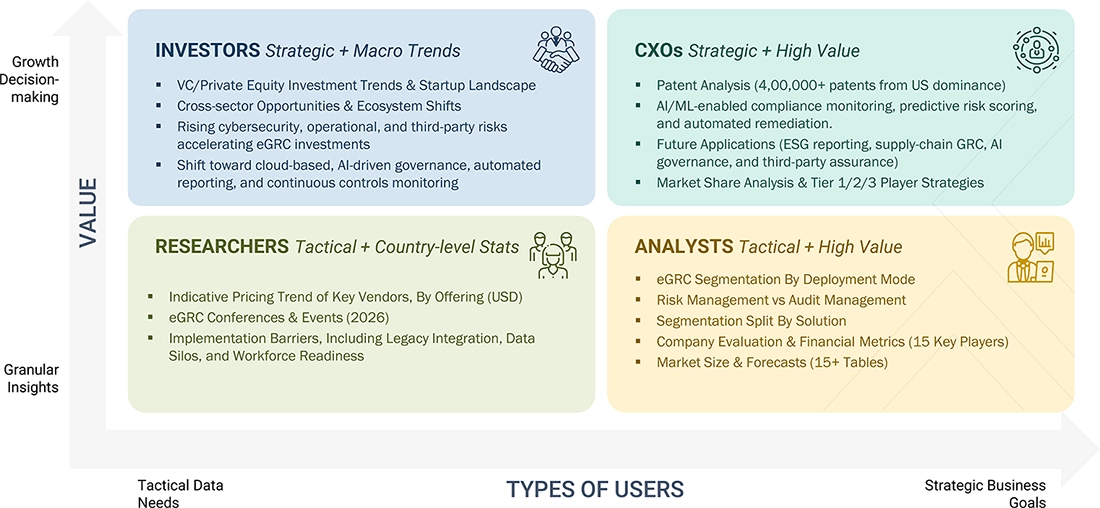
DELIVERED CUSTOMIZATIONS
We have successfully delivered the following deep-dive customizations:
| CLIENT REQUEST | CUSTOMIZATION DELIVERED | VALUE ADDS |
|---|---|---|
| Leading Solution Provider (US) | Product Analysis: eGRC Solution Matrix offering, an in-depth comparison of each vendor’s capabilities, including enterprise risk management, compliance automation, audit workflows, policy lifecycle management, ESG reporting, third-party risk oversight, data privacy controls, workflow orchestration, analytics, and cloud/on-premises deployment flexibility. | Stronger understanding of competitive eGRC positioning, product breadth, regulatory content depth, integration maturity, and automation capabilities to support strategic investment planning, platform enhancement, and multi-year governance, risk, and compliance transformation initiatives. |
RECENT DEVELOPMENTS
- March 2024 : MetricStream entered a strategic partnership to implement MetricStream's Connected GRC across Glencore's industrial assets. This partnership would automate global enterprise risk and audit programs, empowering the team to unlock actionable insights and enable a long-term, sustainable risk strategy
- March 2024 : FIS SecurLOCK card fraud management solution is designed to deliver an increase in accurately identified and prevented fraudulent card transactions, utilizing a new collaboration with FIS Fintech Accelerator alumnus Stratyfy.
- February 2024 : Onspring launched its new CMMC Management product, CMMC 2.0 automation software, that simplifies and centralizes the data collection, testing, and reporting processes for organizations requiring certification for the Department of Defense’s (DoD) CMMC 2.0 framework.
- February 2024 : ServiceNow and EY broadened their strategic alliance to provide strong solutions for generative AI (Gen AI) compliance, governance, and risk management. Initially focusing on transforming finance and tax services, the expanded partnership aimed to enhance AI oversight and governance, aiding organizations in meeting regulatory standards. The companies offer solutions covering AI discovery, inventory management, policy enforcement, risk classification, and automated monitoring through close collaboration.
Table of Contents
 Exclusive indicates content/data unique to MarketsandMarkets and not available with any competitors.
Methodology
This research study used extensive secondary sources, directories, and databases, such as D&B Hoovers and Bloomberg BusinessWeek, to identify and collect information useful for this technical, markett-oriented, and commercial study of the US eGRC markett. The primary sources were mainly several industry experts from the core and related industries and preferred suppliers, manufacturers, distributors, service providers, technology developers, alliances, and organizations related to this industry's value chain segments. In-depth interviews were conducted with various primary respondents, including key industry participants, subject matter experts, C-level executives of key markett players, and industry consultants, to obtain and verify critical qualitative and quantitative information and assess prospects.
Secondary Research
In the secondary research process, various secondary sources were referred to to identify and collect information regarding the study. The secondary sources included annual reports, press releases, investor presentations of eGRC market solution vendors; forums; certified publications, such as GRCI Publications, Compliance, and Regulatory Journal, GRC Professional Magazine, GRC Journal, From GRC 1.0 to GRC 5.0: A History of Technology for GRC; and whitepapers such as "Governance, Risk and Compliance (GRC) Framework" by MetricStream, "Governance, Risk, and Compliance Whitepaper" by Secure Digital Solutions. Secondary research was mainly used to obtain key information about the industry's value chain, the total pool of key players, markett classification, and segmentation from the markett- and technology-oriented perspectives.
Primary Research
In the primary research process, various primary sources from the supply and demand sides of the US eGRC market were interviewed to obtain qualitative and quantitative information for the study. The primary sources from the supply side included industry experts, such as Chief Executive Officers (CEOs), Vice Presidents (VPs), marketting directors, technology and innovation directors, and related key executives of various vendors providing eGRC solutions and services, associated service providers, and system integrators operating in the targeted regions. All possible parameters that affect the markett covered in this research study have been accounted for, viewed in extensive detail, verified through primary research, and analyzed to obtain the final quantitative and qualitative data.
After the complete markett engineering process (including calculations for markett statistics, markett breakups, markett size estimations, markett forecasting, and data triangulation), extensive primary research was conducted to gather information and verify and validate the critical numbers arrived at. The primary research helped identify and validate the segmentation types, industry trends, key players, a competitive landscape of eGRC solutions and services offered by several markett vendors, and fundamental markett dynamics, such as drivers, restraints, opportunities, challenges, industry trends, and key strategies.
In the complete markett engineering process, the bottom-up and top-down approaches and several data triangulation methods were extensively used to perform the markett estimation and forecasting for the overall markett segments and subsegments listed in this report. An extensive qualitative and quantitative analysis was performed on the complete markett engineering process to list the key information/insights throughout the report.
Following is the breakup of the primary study:
markett Size Estimation
Top-down and bottom-up approaches were used to estimate and validate the size of the US eGRC market and the size of various other dependent sub-segments in the overall US eGRC market. The research methodology used to estimate the markett size includes the following details: critical players in the markett were identified through secondary research, and their markett shares in the respective regions were determined through primary and secondary research. This entire procedure included the study of the annual and financial reports of the top markett players, and extensive interviews were conducted for key insights from the industry leaders, such as CEOs, VPs, directors, and marketting executives.
All percentage splits and breakdowns were determined using secondary sources and verified through primary sources. All possible parameters that affect the markett covered in this research study have been accounted for, viewed in extensive detail, verified through primary research, and analyzed to get the final quantitative and qualitative data. This data is consolidated and added to detailed inputs and analysis from markettsandmarketts.
Data Triangulation
After arriving at the overall markett size using the markett size estimation processes explained above, the markett was split into several segments and subsegments. The data triangulation and markett breakup procedures were employed, wherever applicable, to complete the overall markett engineering process and arrive at the exact statistics of each markett segment and subsegment. The data was triangulated by studying various factors and trends from both the demand and supply sides.
markett Definition
markettsandmarketts defines eGRC as the umbrella term that covers an organization's approach across the areas of GRC. GRC typically encompasses corporate governance, enterprise risk management, and compliance with applicable laws and regulations. It allows organizations to achieve their goals by automating workflows while complying with policy guidelines and government regulations, reducing financial risks, and safeguarding the company's brand image. The latest development of artificial intelligence (AI)-)-enabled eGRC solutions would enhance the compliance process, making it more effective.
Key Stakeholders
- eGRC solution and service providers
- GRC staff
- IT governance directors/managers
- IT risk directors/managers
- IT compliance directors/managers
- IT audit directors/managers
- Information security directors/managers
- IT directors/consultants
- End-users/consumers/enterprise users
- Government organizations
- Consultants/advisory firms
- System integrators and resellers
- Training and education service providers
- Managed service providers
Report Objectives
- To describe and forecast the US eGRC market by offering, deployment mode, organization size, solution usage, business function, vertical, and region from 2024 to 2029, and analyze the various macroeconomic and microeconomic factors that affect markett growth
- To analyze the subsegments of the markett concerning individual growth trends, prospects, and contributions to the overall markett
- To provide detailed information regarding major factors (drivers, restraints, opportunities, and challenges) influencing the growth of the markett
- To analyze the opportunities in the markett for stakeholders and provide details of the competitive landscape for the major players
- To profile the key markett players; provide a comparative analysis based on the business overviews, regional presence, product offerings, business strategies, and critical financials; and illustrate the markett's competitive landscape.
- To track and analyze the competitive developments, such as mergers and acquisitions, product developments, partnerships and collaborations, and research development (R&D) activities, in the markett
Customization Options
With the given markett data, markettsandmarketts offers customizations based on company-specific needs. The following customization options are available for the report:
Company Information
- Detailed analysis and profiling of additional markett players (up to 5)
Key Questions Addressed by the Report
What is the current size of the US eGRC market?
The US Enterprise Governance, Risk, and Compliance (eGRC) market is valued at USD 5.45 billion in 2025 and is projected to reach USD 10.17 billion by 2030, growing at a CAGR of 13.3% during the forecast period.
What is driving the growth of the US eGRC market?
The market is growing due to increasing regulatory requirements, rising investments in compliance programs, greater adoption of third-party risk automation, and stricter privacy regulations such as CCPA and CPRA. Organizations are also seeking unified platforms that improve governance, risk visibility, and compliance management.
Which industries are the major adopters of eGRC solutions in the US?
The BFSI, government, healthcare, IT & ITeS, manufacturing, energy & utilities, telecommunications, retail & eCommerce, and transportation & logistics sectors are among the leading adopters due to their complex regulatory and risk management requirements.
Which deployment model is expected to dominate the US eGRC market?
The on-premises deployment segment is expected to hold the largest market share during the forecast period, particularly among organizations with stringent security, compliance, and data governance requirements.
What are the key opportunities in the US eGRC market?
Key opportunities include AI-driven risk analytics, automated compliance monitoring, integrated governance platforms, third-party risk management, privacy compliance solutions, and cloud-based eGRC platforms that help organizations simplify regulatory compliance while improving operational resilience.


Personalize This Research
- Triangulate with your Own Data
- Get Data as per your Format and Definition
- Gain a Deeper Dive on a Specific Application, Geography, Customer or Competitor
- Any level of Personalization
Let Us Help You
- What are the Known and Unknown Adjacencies Impacting the US eGRC Market
- What will your New Revenue Sources be?
- Who will be your Top Customer; what will make them switch?
- Defend your Market Share or Win Competitors
- Get a Scorecard for Target Partners

Custom Market Research Services
We Will Customise The Research For You, In Case The Report Listed Above Does Not Meet With Your Requirements
Get 10% Free CustomisationTESTIMONIALS






Growth opportunities and latent adjacency in US eGRC Market