US Microgrid Market

US Microgrid Market by Connectivity (Grid-Connected, Off-Grid), Offering (Hardware, Software, Services), End User (Commercial & Industrial Buildings, Remote Areas), Power Source (Solar PV, Combined Heat and Power, Natural Gas) - Forecast to 2030




OVERVIEW
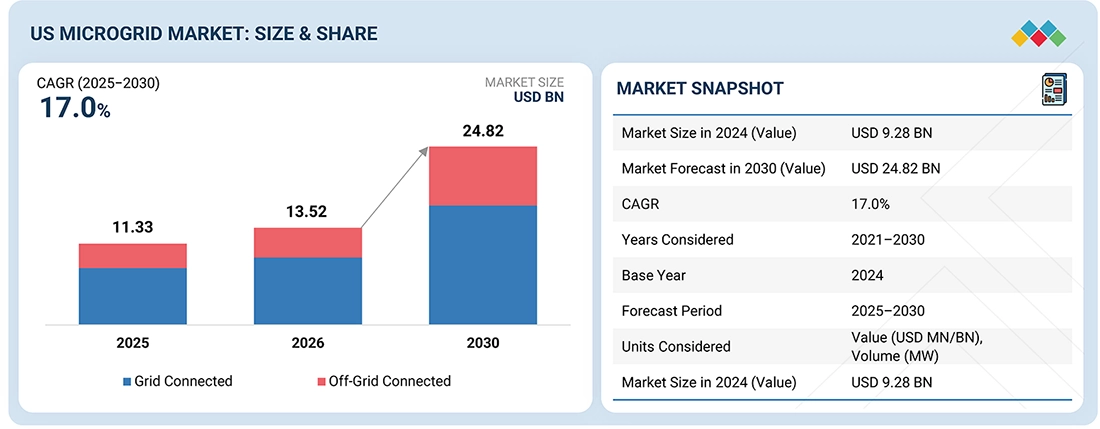
The US microgrid market is projected to reach USD 24.82 billion by 2030 from USD 11.33 billion in 2025, at a CAGR of 17.0% from 2025 to 2030. The market is projected to witness strong growth over the forecast period, driven by increasing investments in grid resilience, rising integration of renewable energy sources, and growing demand for reliable and uninterrupted power supply. The market is expanding steadily with increasing deployment across commercial & industrial facilities, data centers, military installations, and remote areas. Additionally, advancements in energy storage systems, microgrid control technologies, and digital energy management platforms are enabling efficient and flexible microgrid operations. The expansion of EV charging infrastructure and increasing focus on decentralized energy systems are further accelerating microgrid adoption across the US.
Source: Secondary Research, Interviews with Experts, MarketsandMarkets Analysis
KEY TAKEAWAYS
-
By OfferingThe hardware segment is projected to account for the largest market share of 58.0–63.0%, driven by high demand for energy storage systems, generators, and power distribution equipment.
-
By ConnectivityGrid-connected microgrids are expected to dominate the market with a share of 67.0–72.0%, owing to their ability to operate in parallel with the main grid while ensuring reliability.
-
By Power RatingThe above 10 MW segment is expected to grow at the fastest CAGR, driven by increasing deployment in data centers and large industrial facilities.
-
By End UserCommercial & industrial buildings are expected to hold the largest share of 30.0–35.0%, supported by rising demand for energy cost optimization and reliability.
-
Competitive Landscape - Key PlayersKey players in the US microgrid market include Schneider Electric, Siemens, ABB, Eaton, Honeywell, GE, Tesla Energy, Bloom Energy, Ameresco, and PowerSecure. These companies are supported by strong capabilities in energy management, system integration, and distributed energy solutions.
-
Competitive Landscape - Startups/SMEsEmerging players such as Scale Microgrids, Spirae, Power Analytics, Heila Technologies, and BoxPower are gaining traction in the US microgrid market, focusing on software-driven solutions, microgrid-as-a-service models, and niche applications across commercial, industrial, and remote deployments.
The US microgrid market is witnessing strong growth driven by increasing investments in grid resilience, renewable energy integration, and electrification of transport. Growing deployment of distributed energy resources, energy storage systems, and digital energy management platforms is accelerating adoption across utilities, commercial & industrial facilities, and data centers. Additionally, rising demand for reliable, decentralized power and advancements in microgrid control technologies are supporting efficient, flexible, and scalable energy systems across modern power infrastructure.
TRENDS & DISRUPTIONS IMPACTING CUSTOMERS' CUSTOMERS
Trends in grid resilience, renewable energy integration, electrification of transport, and digital energy management are reshaping the adoption of microgrids across the US. Utilities, renewable energy developers, EV infrastructure providers, and data center operators are increasingly deploying microgrid solutions to enable decentralized power generation and real-time energy optimization. These trends are accelerating demand for solar + storage microgrids, AI-enabled control systems, and microgrid-as-a-service models across commercial, industrial, and utility applications, enabling improved power reliability, efficient renewable integration, lower energy costs, reduced emissions, and faster deployment of resilient energy systems.

Source: Secondary Research, Interviews with Experts, MarketsandMarkets Analysis
MARKET DYNAMICS

Level
-
Increasing demand for grid resilience and outage mitigation due to extreme weather events and aging grid infrastructure

-
Rising adoption of renewable energy and energy storage systems driving decentralized microgrid deployments


Level
-
High initial capital investment and integration costs associated with microgrid infrastructure

-
Regulatory and interconnection complexities varying across states, delaying project deployment


Level
-
Growing demand from data centers and commercial & industrial sectors for reliable and uninterrupted power

-
Expansion of microgrid-as-a-service (MaaS) models enabling wider adoption with lower upfront costs


Level
-
Complexity in managing multiple distributed energy resources (DERs) and ensuring system interoperability

-
Cybersecurity risks associated with digital and connected microgrid control systems

Source: Secondary Research, Interviews with Experts, MarketsandMarkets Analysis
Driver: Increasing demand for grid resilience and outage mitigation due to extreme weather events and aging grid infrastructure
Increasing frequency of extreme weather events and aging grid infrastructure in the US are driving investments in resilient energy systems, accelerating microgrid adoption. Utilities, commercial facilities, and critical infrastructure operators are deploying microgrids to ensure uninterrupted power supply, enable islanding during outages, and enhance overall grid reliability. Microgrids support integration of distributed energy resources and provide localized energy security, making them a key component of modern grid modernization strategies.
Restraint: High initial capital investment and integration costs associated with microgrid infrastructure
High upfront costs associated with microgrid deployment remain a significant barrier to widespread adoption in the US. Microgrid systems require substantial investment in generation assets, energy storage, control systems, and integration with existing infrastructure. Additionally, engineering complexity and customization requirements increase project costs, limiting adoption primarily to large-scale commercial, industrial, and government-funded projects.
Opportunity: Growing demand from data centers and commercial & industrial sectors for reliable and uninterrupted power
The increasing need for reliable and high-quality power in data centers and commercial & industrial facilities presents strong growth opportunities for microgrids in the US. Rising electricity demand, coupled with the need to minimize downtime and optimize energy costs, is driving adoption of microgrids with integrated renewable energy and storage systems. These deployments enable energy independence, operational efficiency, and sustainability, supporting long-term growth in the market.
Challenge: Cybersecurity risks associated with digital and connected microgrid control systems
As microgrids increasingly rely on digital control systems, IoT devices, and connected energy management platforms, cybersecurity risks have become a critical challenge. Vulnerabilities in communication networks and control software can expose microgrid systems to potential cyber threats, impacting reliability and operational safety. Ensuring secure system architecture, real-time monitoring, and robust cybersecurity frameworks is essential for maintaining trust and stability in microgrid deployments.
US MICROGRID MARKET: COMMERCIAL USE CASES ACROSS INDUSTRIES
| COMPANY | USE CASE DESCRIPTION | BENEFITS |
|---|---|---|
 |
Deployment of integrated microgrid solutions using EcoStruxure platform for commercial, industrial, and campus applications, enabling real-time monitoring and optimization of distributed energy resources | Improved energy efficiency | Enhanced grid resilience | Advanced energy management and automation |
 |
Development of grid-connected and islanded microgrid systems with advanced control platforms for utilities and industrial facilities, supporting renewable integration and grid stability | Bidirectional power flow | Improved power quality | Flexible and reliable grid operations |
 |
Deployment of turnkey microgrid solutions integrating energy storage, backup generation, and EV charging infrastructure for commercial and industrial customers | Reduced energy costs | Improved system reliability | Enhanced power quality and resilience |
 |
Implementation of microgrid control systems and digital grid solutions for utilities, campuses, and smart infrastructure projects | Optimized energy flow management | Grid stability | Scalable and flexible system operations |
 |
Development of AI-enabled microgrid control and energy management platforms for critical infrastructure and commercial facilities | Real-time monitoring | Predictive analytics | Enhanced cybersecurity and operational efficiency |
Logos and trademarks shown above are the property of their respective owners. Their use here is for informational and illustrative purposes only.
MARKET ECOSYSTEM
The US microgrid market ecosystem comprises component and technology providers, solution designers and equipment manufacturers, system integrators and service providers, and end users. Component suppliers such as Schneider Electric, ABB, Siemens, and LG Energy Solution provide key technologies, including power electronics, energy storage systems, and control components. Solution providers, including Eaton, Hitachi Energy, GE, and Tesla Energy, develop integrated microgrid architectures and advanced energy management platforms. System integrators such as Wärtsilä, Black & Veatch, and ENGIE support project design, deployment, and long-term operations across commercial, industrial, and utility applications. End users, including utilities, data center operators, and large enterprises such as Google and Walmart, drive adoption through increasing demand for energy resilience, cost optimization, and renewable energy integration.

Logos and trademarks shown above are the property of their respective owners. Their use here is for informational and illustrative purposes only.
MARKET SEGMENTS

Source: Secondary Research, Interviews with Experts, MarketsandMarkets Analysis
US Microgrid Market, by Offering
Hardware is expected to hold the largest share of the US microgrid market due to high demand for physical infrastructure, such as generators, energy storage systems, and power distribution equipment. Meanwhile, the software segment is projected to register the highest CAGR during the forecast period, driven by increasing adoption of advanced energy management systems, real-time monitoring, and AI-enabled optimization platforms.
US Microgrid Market, by End User
Commercial & industrial buildings are expected to account for the largest share of the US microgrid market, supported by rising demand for energy cost optimization, reliability, and sustainability initiatives. Meanwhile, remote areas are projected to grow at the fastest rate, driven by the need for reliable electricity access, reduced dependence on diesel generation, and increasing deployment of renewable-based microgrids.
US Microgrid Market, by Connectivity
Grid-connected microgrids are expected to dominate the US microgrid market due to their ability to operate in parallel with the main grid while providing enhanced reliability and flexibility. In contrast, off-grid microgrids are projected to witness the highest growth, driven by increasing deployment in remote locations, resilience-focused applications, and areas with weak or no grid infrastructure.
US Microgrid Market, by Power Rating
The 1–5 MW segment is expected to hold the largest share of the US microgrid market due to its suitability for commercial, institutional, and small industrial applications. Meanwhile, the above 10 MW segment is projected to grow at the fastest rate, driven by rising deployment in large-scale applications such as data centers, utility projects, and industrial facilities requiring high-capacity and reliable power systems.
US MICROGRID MARKET: COMPANY EVALUATION MATRIX
In the US microgrid market matrix, Schneider Electric is positioned as a Star, supported by its strong global presence, comprehensive microgrid portfolio, and advanced energy management platforms, enabling scalable and resilient deployments across commercial, industrial, and utility applications. Honeywell is identified as an Emerging Leader, driven by its growing focus on digital microgrid control solutions, cybersecurity capabilities, and increasing adoption across critical infrastructure and commercial facilities.

Source: Secondary Research, Interviews with Experts, MarketsandMarkets Analysis
KEY MARKET PLAYERS
- Schneider Electric
- Siemens
- GE Vernova
- Eaton
- ABB
- Hitachi Energy Ltd.
- Honeywell International Inc.
- S&C Electric Company
- Bloom Energy
- Caterpillar Inc.
MARKET SCOPE
| REPORT METRIC | DETAILS |
|---|---|
| Market Size in 2024 (Value) | USD 9.28 Billion |
| Market Forecast in 2030 (Value) | USD 24.82 Billion |
| Growth Rate | 17.0% |
| Years Considered | 2021-2030 |
| Base Year | 2024 |
| Forecast Period | 2025-2030 |
| Units Considered | Value (USD Million/Billion), Volume (MW) |
| Report Coverage | Revenue Forecast, Company Ranking, Competitive Landscape, Growth Factors, and Trends |
| Segments Covered |
|
| Regions Covered | North America, Europe, Asia Pacific, RoW |
WHAT IS IN IT FOR YOU: US MICROGRID MARKET REPORT CONTENT GUIDE

DELIVERED CUSTOMIZATIONS
We have successfully delivered the following deep-dive customizations:
| CLIENT REQUEST | CUSTOMIZATION DELIVERED | VALUE ADDS |
|---|---|---|
| Electric Utility / Grid Operator |
|
|
| Renewable Energy Developer / IPP |
|
|
| Data Center Operator / Hyperscale Cloud Provider |
|
|
| EV Charging Infrastructure Provider |
|
|
| Commercial & Industrial (C&I) End Users |
|
|
| Government / Defense / Municipal Authorities |
|
|
RECENT DEVELOPMENTS
- January 2026 : Ameresco secured multiple contracts across US military bases to design and deploy advanced microgrid systems, integrating solar PV, battery energy storage, and backup generation. These projects focus on enhancing energy security, enabling islanding capability, and reducing reliance on centralized grids. The solutions incorporate intelligent control platforms for real-time optimization, supporting mission-critical operations and long-term cost savings.
- December 2025 : Schneider Electric expanded deployment of its EcoStruxure Microgrid platform across commercial and industrial facilities in the US, enabling AI-driven energy management, predictive analytics, and seamless integration of distributed energy resources. The platform enhances operational efficiency, supports decarbonization goals, and allows facilities to achieve higher levels of energy independence and resilience.
- November 2025 : Scale Microgrids partnered with a leading US real estate and infrastructure investor to develop a portfolio of distributed microgrid projects across commercial and industrial sites. The initiative focuses on microgrid-as-a-service (MaaS) offerings, reducing upfront capital investment while ensuring reliable and sustainable power through integrated solar and storage systems.
- October 2025 : Bloom Energy expanded deployment of its fuel cell-based microgrid solutions for data centers and industrial facilities in the US, providing continuous, low-emission power with high reliability. The systems are designed to support high-load applications, offering scalable and modular configurations that enhance uptime and reduce carbon footprint.
- March 2025 : ABB strengthened its presence in the US microgrid market by enhancing its digital energy management and automation solutions, enabling scalable and modular microgrid architectures for industrial and commercial applications requiring high reliability and efficiency.
Table of Contents
 Exclusive indicates content/data unique to MarketsandMarkets and not available with any competitors.
Methodology
The research process for this study included systematic gathering, recording, and analysis of data about customers and companies operating in the US Microgrid Market. This process involved the extensive use of secondary sources, directories, and databases (Factiva and Oanda) to identify and collect valuable information for the comprehensive, technical, market-oriented, and commercial study of the US Microgrid Market. In-depth interviews were conducted with primary respondents, including experts from core and related industries and preferred manufacturers, to obtain and verify critical qualitative and quantitative information and assess growth prospects. Key players in the US Microgrid Market were identified through secondary research, and their market rankings were determined through primary and secondary research. This research included studying annual reports of top players and interviewing key industry experts such as CEOs, directors, and marketing executives.
Secondary Research
Various sources were used in the secondary research process to identify and collect information important for this study. These include company annual reports, press releases, investor presentations, white papers, technology journals, certified publications, articles by recognized authors, directories, and databases.
Secondary research was mainly used to obtain key information about the industry’s value chain, the total pool of market players, the market classification according to industry trends to the bottom-most level, regional markets, and key developments from market and technology-oriented perspectives.
Primary Research
Primary research was also conducted to identify the segmentation types, key players, competitive landscape, and key market dynamics, such as drivers, restraints, opportunities, challenges, and industry trends, along with key strategies adopted by players operating in the US Microgrid Market. Extensive qualitative and quantitative analyses were performed on the complete market engineering process to list key information and insights throughout the report.
Extensive primary research has been conducted after acquiring knowledge about the US Microgrid Market scenarios through secondary research. Several primary interviews have been conducted with experts from the demand (end user and region) and supply side (heating equipment, cooling equipment, ventilation equipment, implementation type, system type, technology) across four major geographic regions: North America, Europe, Asia Pacific, and RoW. Approximately 60% and 40% of the primary interviews were conducted from the supply and demand sides, respectively. These primary data have been collected through questionnaires, emails, and telephonic interviews.
To know about the assumptions considered for the study, download the pdf brochure
Market Size Estimation
In the market engineering process, the top-down and bottom-up approaches and data triangulation methods have been used to estimate and validate the size of the US Microgrid Market and other dependent submarkets. The research methodology used to estimate the market sizes includes the following:
- Identifying stakeholders in the US Microgrid Market, including regulatory bodies and policy authorities (US Department of Energy, Federal Energy Regulatory Commission [FERC], International Electrotechnical Commission [IEC]), certification agencies, industry associations, consulting firms, technology providers, equipment manufacturers, project developers, utilities, EPC contractors, and end users across sectors such as commercial & industrial buildings, remote areas, military facilities, campuses, healthcare facilities, and utilities
- Analyzing major providers of microgrid solutions and services and their key offerings, including control systems, energy management systems (EMS), distributed energy resources (DERs) integration, advanced metering infrastructure, power electronics (inverters, converters), battery energy storage systems, renewable energy generation units (solar PV, wind, biomass), and dispatchable generation (diesel, natural gas)
- Studying trends of microgrid adoption across end users, segmented by connectivity, power source, power rating, offering, end user, and region
- Tracking recent market developments, including regulatory updates, policy incentives, technology advancements (AI- and IoT-integrated microgrid controllers, blockchain-based energy trading, peer-to-peer energy platforms), deployment of advanced storage technologies, integration of electric vehicle (EV) charging infrastructure, and mergers & acquisitions by key players to forecast market size and identify emerging opportunities
- Conducting multiple discussions with key opinion leaders, including microgrid solution providers, EPC contractors, utilities, renewable energy developers, and regulatory consultants to understand real-time deployment trends, technical challenges, and the growing focus on resilience, energy security, decarbonization, and cost optimization
- Validating market estimates through in-depth consultations with industry experts, ranging from CTOs of leading microgrid technology companies to energy planners, project managers, and sustainability officers, and aligning insights with domain specialists at MarketsandMarkets for accurate and reliable market projections
Data Triangulation
After arriving at the overall market size by the market size estimation process explained in the earlier section, the overall US Microgrid Market has been divided into several segments and subsegments. The data triangulation and market breakdown procedures have been used to complete the overall market engineering process and arrive at the exact statistics for all segments, wherever applicable. The data was triangulated by studying various factors and trends from the perspectives of demand and supply. Along with data triangulation and market breakdown, the market has been validated by top-down and bottom-up approaches.
Market Definition
A microgrid is a localized energy system that integrates distributed energy resources (DERs), such as solar PV, wind turbines, generators, energy storage, and advanced control systems, to supply electricity to a defined group of consumers. Operating as a single controllable entity, it can function in either grid-connected or island (off-grid) mode to enhance reliability, resilience, and efficiency across campuses, hospitals, military facilities, utilities, commercial & industrial sites, and remote communities. The market encompasses microgrid-integrated DERs across a capacity range from less than 1 MW to above 10 MW.
Key Stakeholders
- Raw Material & Component Suppliers
- Microgrid Developers & EPC Contractors
- Distribution Network Service Providers
- Power-Generating Companies & Energy Producers
- Electric Utilities & Retail Energy Providers
- Technology & Equipment Manufacturers
- Government & Regulatory Agencies
- Standardization Bodies, Forums, and Industry Associations
- Consulting & Advisory Firms
- Research & Academic Institutions
- Financial Institutions & Investors
- End Users
Report Objectives
- To define, describe, segment, and forecast the size of the US Microgrid Market, by offering, connectivity, power rating, power source, end user, and region, in terms of value
- To describe the US Microgrid Market based on types, patterns, and architecture types
- To forecast the size of various segments for four regions, namely North America, Asia Pacific, Europe, and the Rest of the World (RoW), in terms of value and volume
- To offer detailed information on drivers, restraints, opportunities, and challenges influencing market growth
- To provide a detailed overview of the US Microgrid Market value chain
- To strategically analyze the micromarkets concerning individual growth trends, prospects, and contributions to the overall market
- To analyze industry trends, pricing data, patents and innovations, technology analysis, ecosystem analysis, relevant case studies, Porter’s five forces analysis, key stakeholders and buying criteria, key conferences, trends/disruptions impacting customers’ businesses, regulatory landscape, and trade data (export and import data), the impact of AI/Gen AI, and the 2025 US tariff on the market under study, along with the macroeconomic outlook for each region
- To analyze opportunities for various stakeholders by identifying the high-growth segments of the market
- To benchmark the key players and analyze their market position in terms of revenue, market share, and core competencies, and detailed competitive landscape for the market leaders
- To analyze competitive developments, such as product launches, contracts, acquisitions, partnerships, and agreements, carried out by players in the US Microgrid Market
Customization Options
With the given market data, MarketsandMarkets offers customizations according to the specific requirements of companies. The following customization options are available for the report:
Country-wise Information:
- Country-wise breakdown for North America, Europe, Asia Pacific, and the Rest of the World
Company Information:
- Detailed analysis and profiling of additional market players (up to five)


Personalize This Research
- Triangulate with your Own Data
- Get Data as per your Format and Definition
- Gain a Deeper Dive on a Specific Application, Geography, Customer or Competitor
- Any level of Personalization
Let Us Help You
- What are the Known and Unknown Adjacencies Impacting the US Microgrid Market
- What will your New Revenue Sources be?
- Who will be your Top Customer; what will make them switch?
- Defend your Market Share or Win Competitors
- Get a Scorecard for Target Partners

Custom Market Research Services
We Will Customise The Research For You, In Case The Report Listed Above Does Not Meet With Your Requirements
Get 10% Free CustomisationTESTIMONIALS

Tetsuya Ohhira
Business Development Manager-Technology Business
Nikon Corporation,
Leading Japanese MNC specializing in optics and imaging productswww.nikon.com
MarketsandMarkets™ response
is quick. Their attitude is flexible and positive. Analyst Insights are globally considered and
significant. Client Services quickly respond to our inquiry and demand. Their wide range of global
surveys help us make our strategic plan.
We hope Knowledge Store will be easier to search
for a report.
VP - Marketing & Business Development
Leading Provider of Process Control Solutions
We engaged with MarketsandMarkets on a study to perform an analysis and recommend a Go-To-Market strategy for metrology and process control in the semiconductor market. The study was tailored to our targets and needs with well-defined milestones. Our overall experience with the MarketsandMarkets team was very good throughout the project in all aspects including the analysis methodologies used, the quality and depth of primary and secondary data sets, the professionalism and flexibility of the team and the ability to meet the target schedule and milestones. We want to thank MarketsandMarkets team for a job well done.






Growth opportunities and latent adjacency in US Microgrid Market