US Quantum Computing Market Size, Share & Growth, 2030

US Quantum Computing Market by Offering (Services, Systems, Application Software), Deployment (On-Premises and Cloud-based), Technology (Trapped lons, Quantum Annealing, Superconducting Qubits) - Forecast to 2030




OVERVIEW
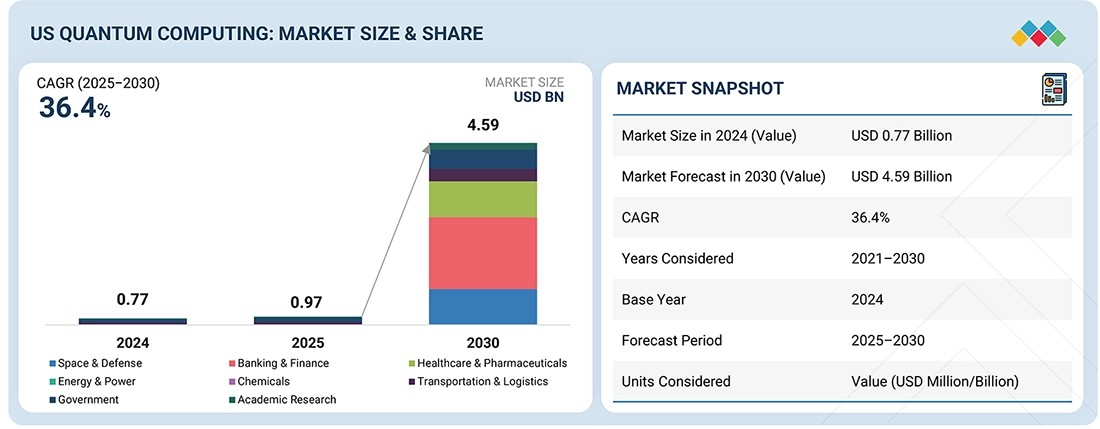
Source: Secondary Research, Interviews with Experts, MarketsandMarkets Analysis
The US quantum computing market is projected to reach USD 4.59 billion by 2030 from USD 0.97 billion in 2025, at a CAGR of 36.4%. Quantum computing represents a revolutionary approach to computation that leverages quantum mechanical phenomena to solve complex problems beyond the reach of classical computers. These systems utilize quantum bits or qubits that can exist in multiple states simultaneously, enabling unprecedented processing capabilities for applications in drug discovery, financial modeling, cryptography, and optimization problems across various industries.
KEY TAKEAWAYS
-
By TypeThe services segment in quantum computing is set to dominate the market due to growing startup investments in research and development activities.
-
By ApplicationMachine learning applications are poised to experience the highest growth rate as quantum computing capabilities expand to address complex computational challenges in artificial intelligence and data analytics.
-
By End-use IndustryEnergy & power is projected to grow significantly during the forecast period due to its need for advanced optimization of complex grid operations, renewable integration, and energy systems.
-
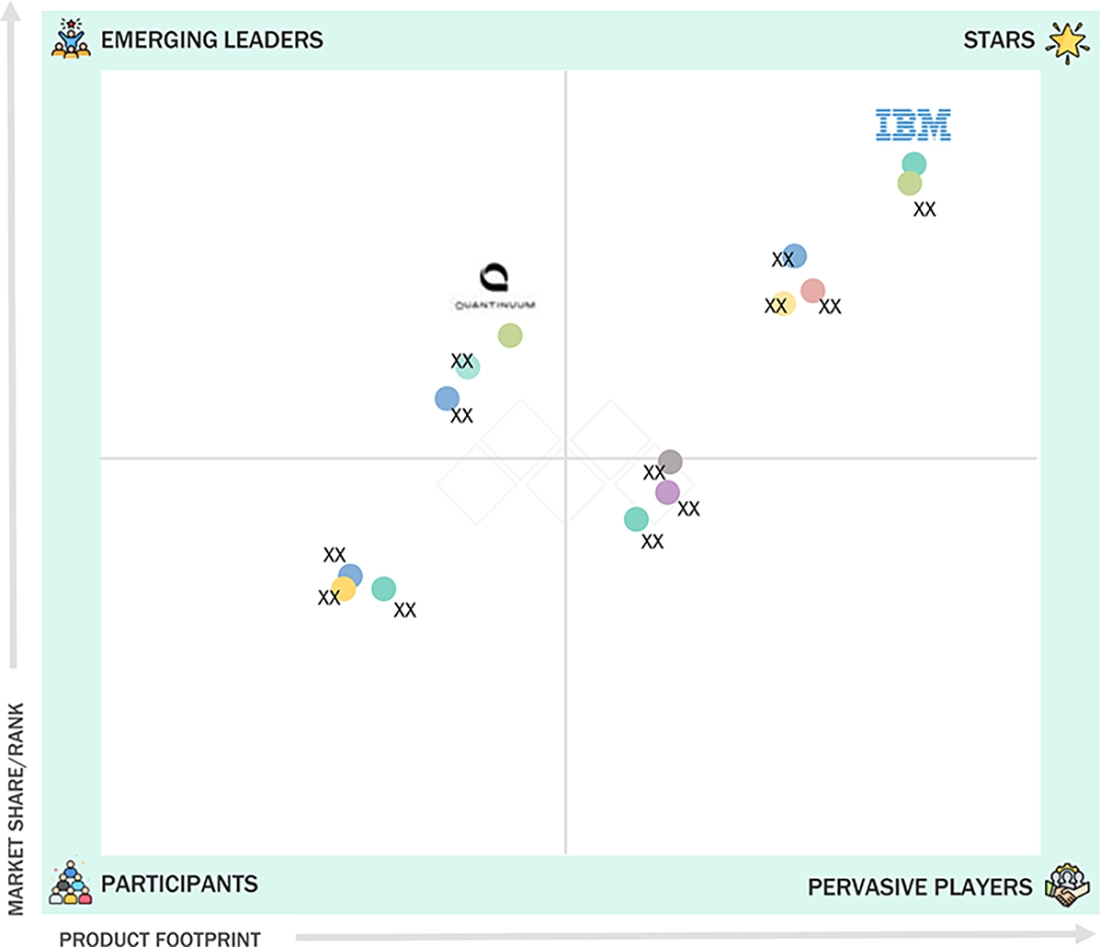
Competitive Landscape - Star PlayersIBM, Microsoft, Amazon Web Services, and D-Wave Quantum Inc. were identified as star players in the US Quantum Computing market, given their strong market share, extensive research and development infrastructure, and established Quantum Computing-as-a-Service platforms.
-
Competitive Landscape - StartupsQuEra, Quantum Motion, and Pasqal have distinguished themselves among startups and SMEs by securing strong footholds in specialized niche areas, underscoring their potential as emerging market leaders.
The US quantum computing market is experiencing transformative growth driven by substantial government investments, technological breakthroughs by major corporations, and expanding commercial applications across multiple sectors, including finance, healthcare, and cybersecurity.
TRENDS & DISRUPTIONS IMPACTING CUSTOMERS' CUSTOMERS
The US quantum computing market is experiencing a phase of innovation and rapid adoption. Technology corporations, financial institutions, healthcare organizations, and government agencies across the US are witnessing advancements in quantum computing development and commercialization. This progress aligns with emerging trends in optimization algorithms, quantum simulation, and fault-tolerant quantum systems. In the US, the use of superconducting qubits, trapped ion technologies, and other quantum computing architectures is increasing among enterprises and research institutions. These technologies facilitate the development of solutions for complex optimization problems, molecular simulations, and cryptographic applications, which promote faster computational speeds, reduce time-to-solution for critical problems, and align with cloud-based and accessible quantum computing approaches. Government agencies and technology leaders are encouraging domestic innovation, the development of Quantum Computing-as-a-Service platforms, and public-private research and development programs. These initiatives help accelerate commercialization timelines and promote the adoption of scalable, commercially viable quantum computing platforms tailored to the needs of diverse industry applications.
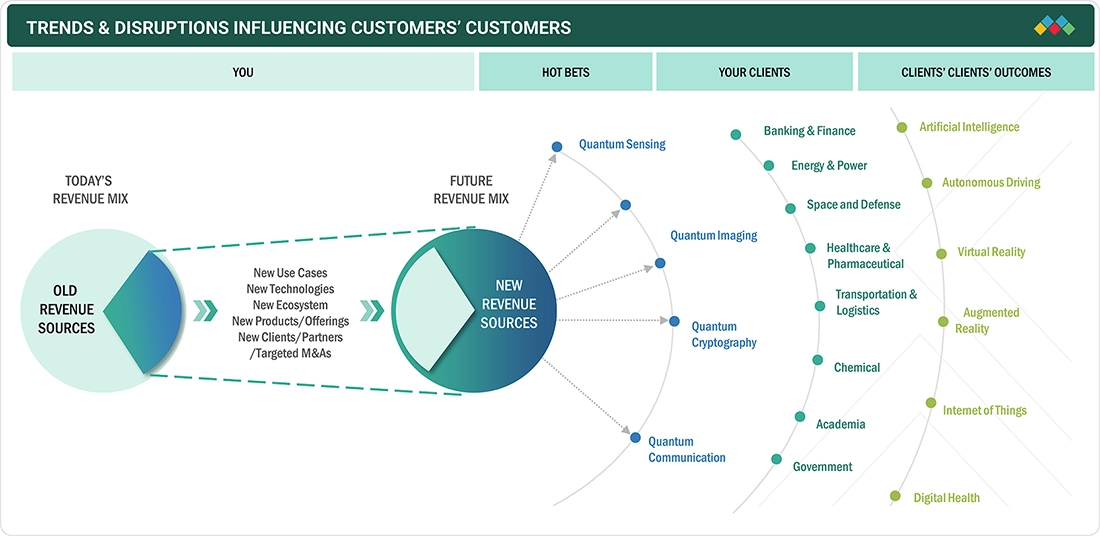
Source: Secondary Research, Interviews with Experts, MarketsandMarkets Analysis
MARKET DYNAMICS

Level
-
Increasing adoption of quantum computing technologies in finance and banking sectors

-
Substantial government support through the National Quantum Initiative and related programs


Level
-
High costs and technical expertise requirements for quantum computing systems


Level
-
Expanding commercial applications in optimization and simulation across industries


Level
-
Complexity of developing stable quantum computing systems and integration with existing IT infrastructure

Source: Secondary Research, Interviews with Experts, MarketsandMarkets Analysis
Driver: Increasing adoption of quantum computing technologies in finance and banking sectors
The increasing adoption of quantum computing technologies in the finance and banking sectors is driving significant market growth as these institutions seek faster processing speeds and better solutions for trading optimization and risk management. Financial organizations are exploring quantum computing capabilities to enhance portfolio optimization, fraud detection, and complex financial modeling, which is accelerating investment in quantum technologies and supporting greater adoption of quantum computing solutions.
Restraint: High costs and technical expertise requirements for quantum computing systems
High costs and technical expertise requirements remain significant barriers to widespread quantum computing adoption. Quantum computing systems are expensive to develop, maintain, and operate, requiring specialized talent that is not yet widely available in the market. The scarcity of quantum computing experts and the substantial capital investment needed for quantum infrastructure create challenges for organizations trying to implement quantum computing solutions.
Opportunity: Expanding commercial applications in optimization and simulation across industries
The expanding commercial applications in optimization and simulation offer immense growth potential for the US quantum computing market. Innovations in Quantum Computing-as-a-Service open doors for enterprises of all sizes to access quantum computing capabilities without significant investment in infrastructure, enabling broader adoption across healthcare, logistics, materials science, and other sectors that can benefit from quantum-enhanced computational power.
Challenge: Complexity of developing stable quantum computing systems and integration with existing IT infrastructure
The complexity of developing stable quantum computing systems that can outperform classical systems remains a major challenge in the market. Quantum systems require extremely controlled environments and face issues with qubit stability and error correction. Additionally, integrating quantum computing systems within existing IT infrastructures poses further difficulties, as organizations must develop hybrid classical-quantum workflows and ensure compatibility with current technology stacks.
US QUANTUM COMPUTING MARKET: COMMERCIAL USE CASES ACROSS INDUSTRIES
| COMPANY | USE CASE DESCRIPTION | BENEFITS |
|---|---|---|
 |
IBM provides quantum computing systems and cloud-based quantum computing services through IBM Quantum, enabling financial institutions to optimize investment strategies and risk management, while healthcare organizations leverage quantum capabilities for drug discovery and molecular simulations. | Delivers advanced computational power for complex optimization problems | Supports faster time-to-solution for critical business challenges | Enables access to cutting-edge quantum technology through cloud platforms |
 |
AWS offers quantum computing services through Amazon Braket and partners with enterprises like BMW to apply quantum computing to optimize supply chains, logistics operations, and complex scheduling problems across manufacturing and automotive sectors. | Provides scalable quantum computing access without infrastructure investment | Enables experimentation with multiple quantum hardware platforms | Supports integration with existing cloud-based workflows and data systems |
Logos and trademarks shown above are the property of their respective owners. Their use here is for informational and illustrative purposes only.
MARKET ECOSYSTEM
The US quantum computing industry is a collaborative ecosystem where technology corporations, quantum hardware developers, software companies, research institutions, and end-user organizations work together to develop and implement quantum computing solutions across industries. Companies in the US supply a variety of quantum computing technologies, including superconducting qubit systems, trapped ion platforms, and quantum annealing solutions. Research institutions, national laboratories, and universities support the fundamental research and development stages, as well as the advancement of quantum algorithms and error correction techniques. Cloud service providers enable access to quantum computing capabilities through Quantum Computing-as-a-Service platforms. Ultimately, enterprises across finance, healthcare, logistics, and other sectors in the United States utilize quantum computing solutions, benefiting from government support through the National Quantum Initiative and growing commercial availability of quantum technologies.
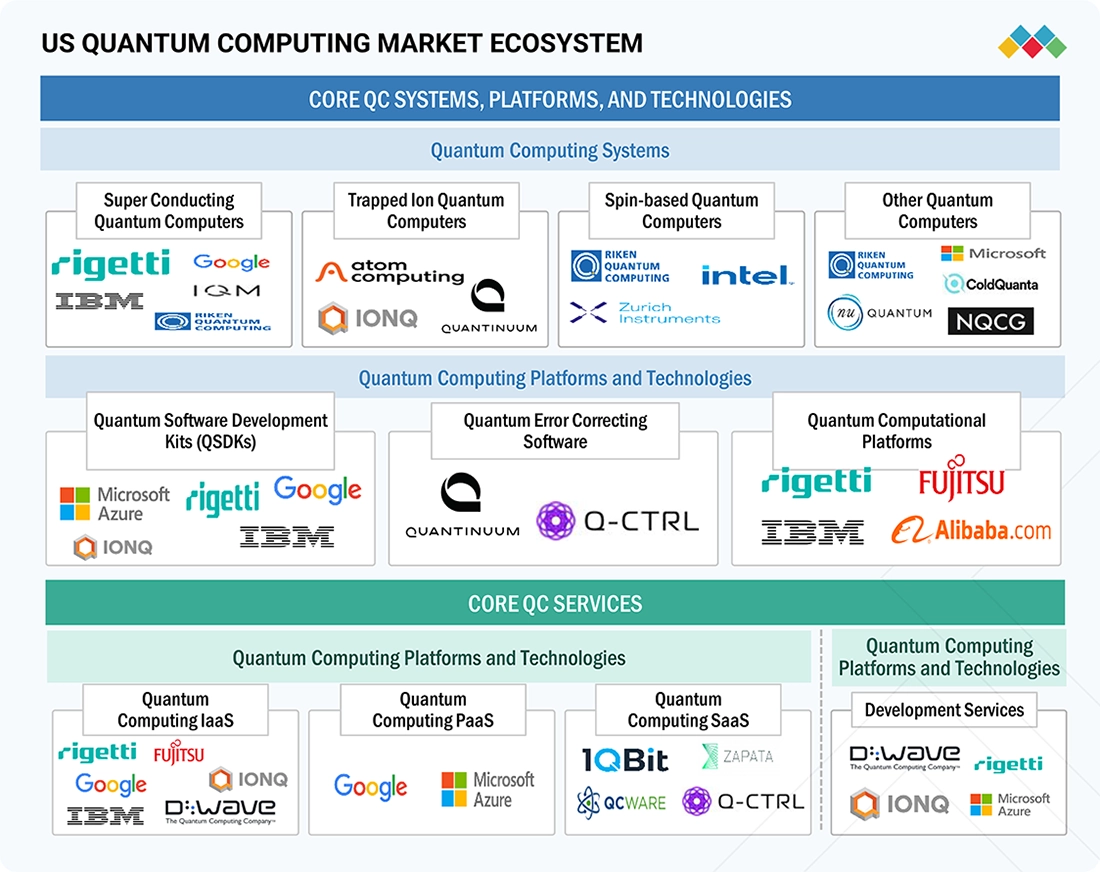
Logos and trademarks shown above are the property of their respective owners. Their use here is for informational and illustrative purposes only.
MARKET SEGMENTS
Source: Secondary Research, Interviews with Experts, MarketsandMarkets Analysis
US Quantum Computing Market, by Application
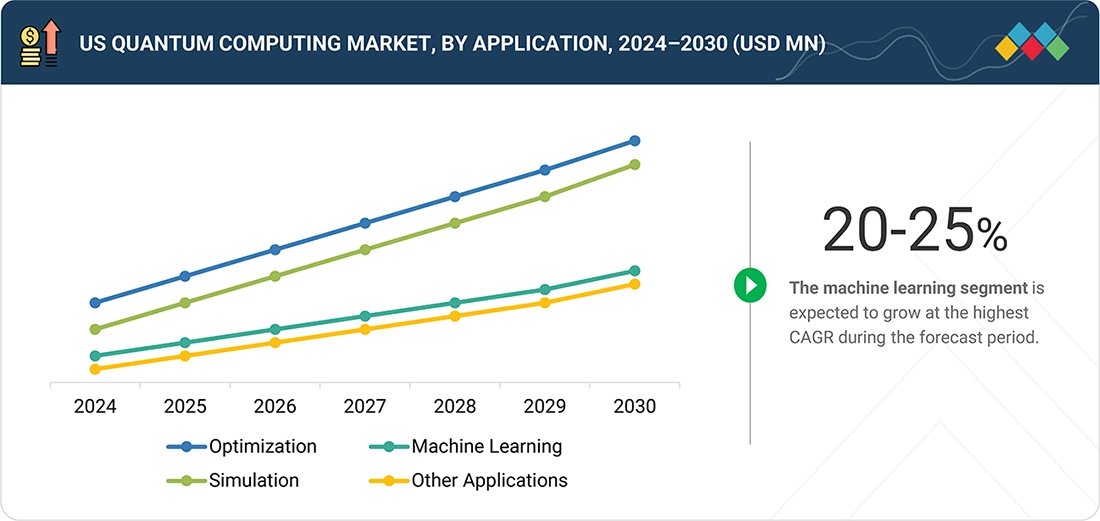
Machine learning emerged as the fastest-growing application segment in the US quantum computing market, driven by the rising complexity of AI and advanced data analytics use cases. The growing need to process large-scale datasets, develop more advanced AI models, and address complex optimization challenges in pattern recognition and predictive analytics is accelerating the adoption of quantum computing across research institutions and industrial enterprises.
US Quantum Computing Market, by Type
The services segment is expected to dominate the US quantum computing market during the forecast period, driven by increasing investments in quantum research, pilot deployments, and commercialization initiatives. As enterprises and research institutions lack in-house quantum expertise, demand for consulting, system integration, and cloud-based quantum services is rising significantly.
US Quantum Computing Market, by End-use Industry
The energy & power sector is projected to witness significant growth in the US quantum computing market, driven by the need to optimize increasingly complex grid operations and support the integration of renewable energy. Quantum computing enables advanced optimization of energy distribution, load balancing, and predictive maintenance, addressing challenges associated with decentralized energy systems.
REGION
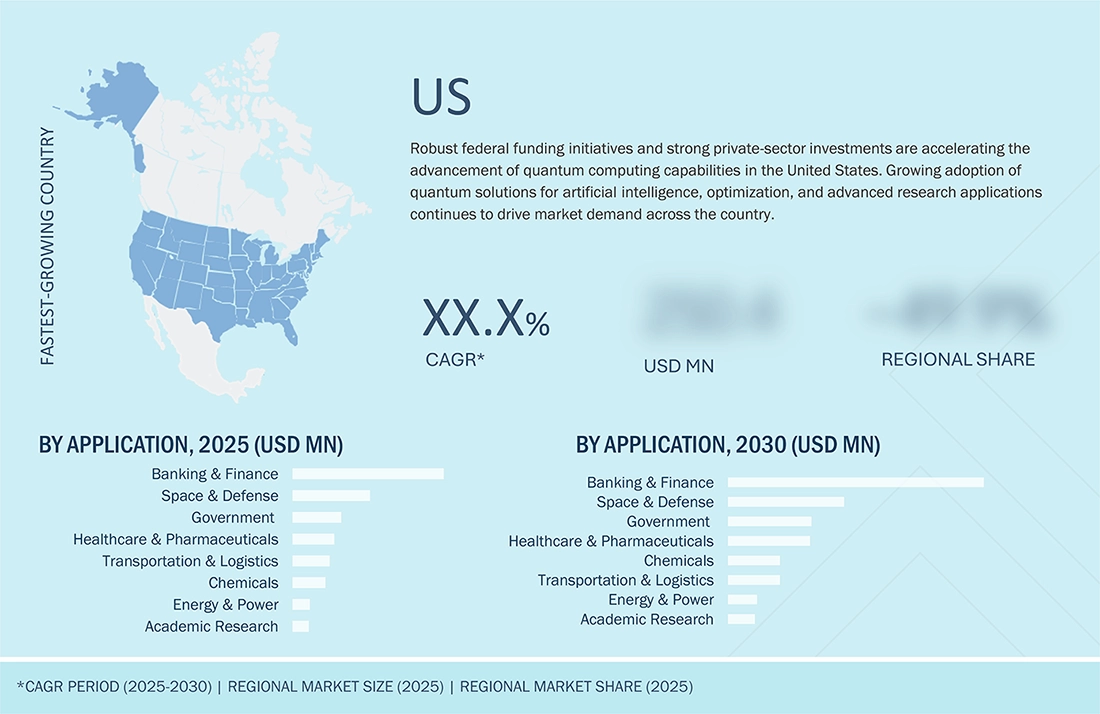
US leading quantum computing market growth during forecast period
The US is the leading country in the quantum computing market, driven by its mature technological ecosystem, substantial government investments through the National Quantum Initiative, and the presence of major technology corporations actively developing quantum computing solutions. The demand for quantum computing applications in finance, healthcare, cybersecurity, and optimization is increasing, along with the expansion of Quantum Computing as a Service platforms. Additionally, robust research and development infrastructure facilitated by academic institutions, national laboratories, and governmental collaborations is accelerating the transition of quantum computing from research environments to commercial applications across diverse industries.
US QUANTUM COMPUTING MARKET: COMPANY EVALUATION MATRIX
IBM, recognized as a leading player in the US quantum computing companies , offers a comprehensive portfolio that includes quantum computing systems, cloud-based quantum services, and quantum software development tools. The company boasts a strong research and development presence and collaborates with enterprises, research institutions, and government agencies across finance, healthcare, and scientific research sectors. Another significant player in the US market is Microsoft, identified as a major innovator. The company is strengthening its position by developing advanced quantum computing platforms, partnering with organizations like PsiQuantum to develop fault-tolerant quantum computers, and integrating quantum capabilities into its Azure cloud platform for enterprise applications.
Source: Secondary Research, Interviews with Experts, MarketsandMarkets Analysis
KEY MARKET PLAYERS
- IBM (US)
- Microsoft (US)
- Amazon Web Services (US)
- D-Wave Quantum Inc. (Canada)
- Rigetti Computing (US)
- QuEra (US)
- Atom Computing (US)
- Quantum Motion (US)
- Pasqal (France)
MARKET SCOPE
| REPORT METRIC | DETAILS |
|---|---|
| Market Size, 2024 (Value) | USD 0.77 Billion |
| Market Forecast, 2030 (Value) | USD 4.59 Billion |
| Growth Rate | CAGR of 36.4% from 2025-2030 |
| Years Considered | 2023–2030 |
| Base Year | 2024 |
| Forecast Period | 2025–2030 |
| Units Considered | Value (USD Million/Billion) |
| Report Coverage | Revenue Forecast, Company Ranking, Competitive Landscape, Growth Factors, and Trends |
| Segments Covered |
|
WHAT IS IN IT FOR YOU: US QUANTUM COMPUTING MARKET REPORT CONTENT GUIDE
DELIVERED CUSTOMIZATIONS
We have successfully delivered the following deep-dive customizations:
| CLIENT REQUEST | CUSTOMIZATION DELIVERED | VALUE ADDS |
|---|---|---|
| Understanding adoption patterns for quantum computing across US industry sectors | Assessed quantum computing usage trends across key US industries, including banking and finance, healthcare and pharmaceuticals, automotive, and logistics, highlighting differences in adoption of optimization, simulation, and machine learning applications across various enterprise use cases | Helps clients align technology development roadmaps with industry-specific demand drivers, application maturity levels, and commercial readiness timelines |
| Identifying quantum computing service providers and technology partnerships | Mapped quantum computing hardware developers, cloud service providers, and software companies across the US, with insights into Quantum Computing-as-a-Service platforms, hybrid classical-quantum systems, and enterprise partnership models | Supports go-to-market strategies, reduces technology selection risk, enables faster proof-of-concept development, and improves access to quantum computing capabilities |
RECENT DEVELOPMENTS
- April 2024 : D-Wave Quantum Inc. completed a merger with DPCM Capital to go public, enhancing capital access for growth and expansion of its quantum annealing technology platform. The transaction provided additional resources for research & development and commercial deployment of quantum computing solutions.
- January 2024 : Amazon Web Services signed a contract with BMW to apply quantum computing to optimize supply chains and manufacturing processes. The collaboration demonstrated the growing commercial application of quantum computing in automotive and logistics optimization.
- December 2023 : Rigetti Computing announced the release of a new 84-qubit processor, focusing on quantum simulations and optimization workloads. The processor represented a substantial advancement in qubit count and connectivity, enabling more complex quantum algorithms and applications.
- September 2023 : IBM launched its new Quantum System Two, marking a significant leap in qubit stabilization and error correction capabilities. The system demonstrated enhanced performance for quantum simulations and optimization applications, supporting the advancement of practical quantum computing solutions for enterprise customers.
- July 2023 : Microsoft partnered with PsiQuantum to develop fault-tolerant quantum computers, combining Microsoft's quantum software expertise with PsiQuantum's photonic quantum computing approach. The partnership aimed to accelerate the development of commercially viable, error-corrected quantum computing systems.
Table of Contents
 Exclusive indicates content/data unique to MarketsandMarkets and not available with any competitors.
Methodology
The study involved four major activities in estimating the size of the US Quantum Computing market. Exhaustive secondary research has been done to collect information on the market, peer, and parent markets. The next steps are to validate these findings, assumptions, and size with industry experts across the value chain through primary research. Both top-down and bottom-up approaches have been employed to estimate the global market size. After that, market breakdown and data triangulation have been used to estimate the market sizes of segments and subsegments.
Secondary Research
Secondary sources for this research study include corporate filings (such as annual reports, investor presentations, and financial statements), trade, business, and professional associations, white papers, certified publications, articles from recognized authors, directories, and databases. Secondary data was collected and analysed to determine the overall market size, further validated by primary research.
Primary Research
Extensive primary research was conducted after understanding and analysing the US quantum computing market scenario through the secondary research process. Several primary interviews were conducted with key opinion leaders from the demand- and supply-side vendors across four major regions—North America, Asia Pacific, Europe, and RoW (including the Middle East, Africa, and South America). After interacting with industry experts, brief sessions were conducted with highly experienced independent consultants to reinforce the findings from our primary research. This and the in-house subject matter experts’ opinions have led us to the findings described in the remainder of this report.
To know about the assumptions considered for the study, download the pdf brochure
Market Size Estimation
Both top-down and bottom-up approaches have been used to estimate and validate the total size of the US quantum computing market. These methods have also been extensively used to estimate the sizes of various market subsegments. The research methodology used to estimate the market sizes includes the following:
- Identifying various applications that use or are expected to use the US quantum computing market.
- Analyzing historical and current data pertaining to the size of the US quantum computing market for each application
- Analyzing the average selling prices of quantum computing based on different technologies
- Studying various paid and unpaid sources, such as annual reports, press releases, white papers, and databases
- Identifying leading providers of quantum computing, studying their portfolios, and understanding features of their products and their underlying technologies, as well as the types of quantum computing products offered
- Tracking ongoing and identifying upcoming developments in the market through investments, research and development activities, product launches, expansions, and partnerships, and forecasting the market size based on these developments and other critical parameters
- Carrying out multiple discussions with key opinion leaders to understand the technologies used in quantum computing, and products wherein they are deployed, and analyzing the breakdown of the scope of work carried out by key manufacturers of quantum computing providers
- Verifying and cross-checking estimates at every level through discussions with key opinion leaders, such as CXOs, directors, and operations managers, and finally with domain experts at MarketsandMarkets
Data Triangulation
The market has been split into several segments and subsegments after arriving at the overall market size, using the market size estimation processes explained above. Data triangulation and market breakdown procedures have been employed to complete the overall market engineering process and arrive at the exact statistics of each market segment and subsegment, wherever applicable. The data has been triangulated by studying various factors and trends from both the demand and supply sides.
Market Definition
Quantum computing involves phenomena such as quantum entanglement and quantum mechanics superposition that quantum computers use for their enhanced computing power. The improved computing power of quantum computers can be attributed to how data is represented. Conventional computers use bits that can either be 1s or 0s, while quantum computers use qubits (quantum bits), which can be both 0s and 1s simultaneously due to superposition. Quantum computing devices or quantum computers operate with nanoscale components at low temperatures, and they have the potential to address some of the most challenging computational problems.
Key Stakeholders
- Research organizations and universities
- Original equipment manufacturers (OEMs)
- Technology standard organizations, forums, alliances, and associations
- Analysts and strategic business planners
- Government bodies, venture capitalists, and private equity firms
- End users
Report Objectives
- To define, describe, segment, and forecast the US quantum computing market in terms of value based on offering, deployment, technology, application, end-user, and region.
- To estimate the size of the market and its segments concerning four main regions, namely, North America, Europe, Asia Pacific, and the Rest of the World (RoW), along with their key countries.
- To provide detailed information regarding the key factors influencing market growth, such as drivers, restraints, opportunities, and challenges
- To offer a detailed analysis of the quantum computing value chain
- To analyze the opportunities in the market for stakeholders and provide a detailed competitive landscape of the market leaders
- To strategically profile the key players and comprehensively analyze their market ranking and core competencies
- To analyze key growth strategies such as expansions, contracts, joint ventures, acquisitions, product launches and developments, and research and development activities undertaken by players operating in the US quantum computing market.
Available Customizations
With the given market data, MarketsandMarkets offers customizations according to the specific requirements of companies. The following customization options are available for the report:
Company Information:
- Detailed analysis and profiling of 34 market players


Personalize This Research
- Triangulate with your Own Data
- Get Data as per your Format and Definition
- Gain a Deeper Dive on a Specific Application, Geography, Customer or Competitor
- Any level of Personalization
Let Us Help You
- What are the Known and Unknown Adjacencies Impacting the US Quantum Computing Market
- What will your New Revenue Sources be?
- Who will be your Top Customer; what will make them switch?
- Defend your Market Share or Win Competitors
- Get a Scorecard for Target Partners

Custom Market Research Services
We Will Customise The Research For You, In Case The Report Listed Above Does Not Meet With Your Requirements
Get 10% Free CustomisationTESTIMONIALS

Tetsuya Ohhira
Business Development Manager-Technology Business
Nikon Corporation,
Leading Japanese MNC specializing in optics and imaging productswww.nikon.com
MarketsandMarkets™ response
is quick. Their attitude is flexible and positive. Analyst Insights are globally considered and
significant. Client Services quickly respond to our inquiry and demand. Their wide range of global
surveys help us make our strategic plan.
We hope Knowledge Store will be easier to search
for a report.
VP - Marketing & Business Development
Leading Provider of Process Control Solutions
We engaged with MarketsandMarkets on a study to perform an analysis and recommend a Go-To-Market strategy for metrology and process control in the semiconductor market. The study was tailored to our targets and needs with well-defined milestones. Our overall experience with the MarketsandMarkets team was very good throughout the project in all aspects including the analysis methodologies used, the quality and depth of primary and secondary data sets, the professionalism and flexibility of the team and the ability to meet the target schedule and milestones. We want to thank MarketsandMarkets team for a job well done.
Growth opportunities and latent adjacency in US Quantum Computing Market






Thomas
Apr, 2026
If I invest now, am I entering a transformative long-term technology shift, or is this still a speculative market with uncertain scalability.
Alex
Apr, 2026
What kind of ROI timeline should I expect when investing in quantum computing companies, given the long development cycles.