U.S Ammunition Market Size, Share & Forecast report 2026-2031

US Ammunition Market by Rifle (5.56 MM, 7.62 MM), Handgun (9X19 MM, 5.7X28 MM), Autocannon (20 MM, 35 MM), Artillery (130 MM, 155 MM), Tank (105 MM, 120 MM), Mortar (81 MM, 120 MM), Naval (57 MM, 76 MM), Rocket (70 MM, 122 MM) - Forecast to 2031




OVERVIEW

Source: Secondary Research, Interviews with Experts, MarketsandMarkets Analysis
The US Ammunition Market is projected to grow from USD 6.93 billion in 2026 to USD 12.13 billion in 2031 at a CAGR of 11.9% during the forecast period. The market is driven by capacity ramp-ups at domestic production facilities and accelerated contract awards for artillery and tactical munitions. The rise in export demand from allied nations and continued funding support under long-term defense appropriations further augment the market growth in the US.
Market Size & Forecast
• 2025 Market Size (Value): USD 6.40 Billion
• 2031 Market Forecast (Value): USD 12.13 Billion
• CAGR: 11.9% from 2026-2031
• Large-Caliber Ammunition Segment: Most Dominant During the Forecast
• Military Segment: Highest CAGR of 12.4%
KEY TAKEAWAYS
-
By CaliberBy caliber, the large-caliber ammunition segment is projected to be the most dominant during the forecast period.
-
By End UserBy end user, the military segment is expected to register the highest CAGR of 12.4% between 2026 and 2031.
-
By GuidanceIn terms of guidance, the non-guided segment accounted for a 92% share of the US ammunition market in 2025.
-
Competitive LandscapeGeneral Dynamics, CSG and Northrop Grumman were identified as some of the star players in the US ammunition market, given their strong market share and product footprint.
The US Ammunition Industry is witnessing strong demand due to high defense spending, ongoing stockpile replenishment, and the expansion of domestic production capacity. Moreover, steady procurement of conventional and advanced munitions to maintain military readiness and support allied requirements and the increasing focus on strengthening supply chain resilience and reducing dependence on foreign suppliers will drive the market.
TRENDS & DISRUPTIONS IMPACTING CUSTOMERS' CUSTOMERS
The impact on trends/disruptions on customers’ customers in the US ammunition market is driven by requirements for large-caliber artillery replenishment, guided and extended-range ammunition, and tank and direct-fire munition modernization across active operational theaters. Rapid expansion of domestic production capacity and allied co-production programs accelerate the need for energetics, fuze systems, and projectile manufacturing capabilities. Ongoing modernization programs within the US Army and Marine Corps also boost the demand for precision mortar, medium-caliber rounds, and air defense munitions to counter evolving aerial threats.

Source: Secondary Research, Interviews with Experts, MarketsandMarkets Analysis
MARKET DYNAMICS

Level
-
Sustained wartime consumption and stockpile rebuilding

-
Long-term government commitment to industrial base expansion


Level
-
Production capacity and throughput limitations

-
Supply chain and skilled labor constraints


Level
-
Capital investments in new facilities and automation

-
Growing export demand and allied co-production


Level
-
Issues in scaling output while maintaining quality and safety

-
Complexities in managing long-term demand uncertainty

Source: Secondary Research, Interviews with Experts, MarketsandMarkets Analysis
Driver: Sustained wartime consumption and stockpile rebuilding
High ammunition usage in ongoing conflicts, along with the need to rebuild US and allied stockpiles, is keeping demand structurally strong. This is driving steady production increases, particularly for artillery and high-consumption calibers. Long-term procurement contracts and multi-year funding commitments are further improving the demand visibility for manufacturers.
Restraint: Production capacity and throughput limitations
Although funding has increased, expanding ammunition output requires facility upgrades, new equipment, and certification cycles. These constraints have slowed the pace at which production targets can be achieved. Supply chain bottlenecks in critical components, such as propellants and energetics, also continue to limit rapid scale-up.
Opportunity: Capital investments in new facilities and automation
Significant government investments in new plants and automated manufacturing systems are strengthening long-term industry capacity. This creates sustained revenue opportunities for prime contractors and mid-tier suppliers. Modernization of legacy production lines is also improving efficiency, yield rates, and cost competitiveness over time.
Challenge: Issues in scaling output while maintaining quality and safety
As production volumes rise, maintaining strict safety standards and consistent product quality becomes more complex. Managing operational risks while expanding capacity remains a key industry challenge. Workforce training and compliance with evolving regulatory standards add additional layers of operational complexity.
US AMMUNITION MARKET: COMMERCIAL USE CASES ACROSS INDUSTRIES
| COMPANY | USE CASE DESCRIPTION | BENEFITS |
|---|---|---|
 |
Increased participation in recreational and competitive shooting in the US has driven sustained demand for handgun and rimfire ammunition, particularly 9 mm and .22 LR. Vista Outdoor expanded production capacity across its ammunition brands to support civilian range and competition shooting markets. | Supports high-volume commercial sales | Improves manufacturing utilization rates | Strengthens brand loyalty in the sporting segment | Stabilizes revenue through repeat consumer purchases |
 |
Growing demand from US state and municipal law enforcement agencies for duty and training ammunition led Winchester to secure multi-year supply contracts for handgun and rifle rounds, while also expanding commercial sales channels. | Provides stable contract-backed revenue | Improves long-term production planning | Increases economies of scale | Strengthens presence in commercial and law enforcement segments |
 |
Rising demand for precision hunting and long-range shooting ammunition, including environmentally compliant and specialty calibers, has driven product expansion in premium rifle cartridges for big-game hunting across multiple US states. | Enables premium pricing strategy | Expands share in the high-margin hunting segment | Supports innovation-led differentiation | Aligns with evolving state-level environmental regulations |
Logos and trademarks shown above are the property of their respective owners. Their use here is for informational and illustrative purposes only.
MARKET ECOSYSTEM
The US ammunition ecosystem includes major OEMs, such as General Dynamics Ordnance and Tactical Systems, Hanwha Aerospace, Northrop Grumman, and BAE Systems. These companies supply combat munitions to key end users, including the US Army, US Marine Corps, Department of Homeland Security, and the FBI. The ecosystem is driven by strong federal procurement programs and coordinated efforts to maintain operational readiness and production capacity.

Logos and trademarks shown above are the property of their respective owners. Their use here is for informational and illustrative purposes only.
MARKET SEGMENTS

Source: Secondary Research, Interviews with Experts, MarketsandMarkets Analysis
US Ammunition Market, By Caliber
Large-caliber ammunition is expected to dominate the US market mainly due to the steady purchases of 155 mm artillery shells, tank rounds, and naval gun ammunition. High-volume replenishment contracts and expansion of domestic production lines help stabilize the demand. More artillery use in training exercises and real operations is also increasing overall consumption. Long-term modernization programs still place strong focus on maintaining heavy firepower capabilities.
US Ammunition Market, By End Use
The military segment continues to lead the US market, owing to structured buying programs across the Army, Navy, Air Force, and Marine Corps. Budget support for readiness activities, live fire exercises, and rebuilding reserve stocks lead to bulk purchases. Multi-year contracts and investments in the industrial base provide better order visibility to suppliers. Overall, operational preparedness remains the main priority area for spending.
US Ammunition Market, By Guidance
Non-guided ammunition continues to hold the largest share since it is widely used in day-to-day training and regular combat roles. Small caliber rounds, artillery shells, and mortar systems are manufactured in high volumes each year to meet routine demand. Their lower unit cost and smooth compatibility with existing platforms make them practical for large-scale deployment across the forces.
US Ammunition Market, By Component
Projectiles and warheads hold the largest share as they are the main functional part of any ammunition system. Demand stays strong due to high volume production of artillery shells and tactical rounds. Continuous improvements in material composition and performance are helping increase lethality and extend range.
REGION
US to be fastest-growing country in North America ammunition market during forecast period
The US ammunition market is expected to see solid growth during the forecast period, mainly supported by large-scale artillery shell procurement programs. Expansion of government owned production facilities is also adding momentum to the market. At the same time, the rising demand for precision-guided munitions is creating new opportunities. Continued funding support to strengthen domestic manufacturing capacity is further helping overall market growth.

US AMMUNITION MARKET: COMPANY EVALUATION MATRIX
In the US ammunition market matrix, General Dynamics Ordnance and Tactical Systems (Star) leads with strong defense contracts and a broad product footprint, backed by its extensive range of large-caliber artillery, tank, and precision munitions deployed across US and allied programs. Hornady Manufacturing (Emerging Leader) is strengthening its position through advanced premium hunting and precision rifle ammunition that supports expanding commercial and law enforcement demand. While General Dynamics maintains dominance through its integrated production capacity and long-term Department of Defense programs, Hornady shows significant potential to advance toward the leaders’ quadrant as demand grows for high-performance and specialized ammunition across civilian and security sectors.

Source: Secondary Research, Interviews with Experts, MarketsandMarkets Analysis
KEY MARKET PLAYERS
List of Top US Ammunition Market Companies
- General Dynamics Ordnance and Tactical Systems (US)
- CSG (Czech Republic)
- Northrop Grumman (US)
- Winchester Ammunition (US)
- Hornady Manufacturing (US)
- SIG Sauer (US)
- Ammo, Inc. (US)
- Hanwha Aerospace (South Korea)
- CBC Global Ammunition (Brazil)
- BAE Systems (UK)
- FN America (US)
- Prvi Partizan A.D. (Serbia)
- Black Hills Ammunition (US)
MARKET SCOPE
| REPORT METRIC | DETAILS |
|---|---|
| Market Size in 2025 (Value) | USD 6.40 Billion |
| Market Forecast in 2031 (Value) | USD 12.13 Billion |
| Growth Rate | CAGR of 11.9% from 2026-2031 |
| Years Considered | 2021-2031 |
| Base Year | 2025 |
| Forecast Period | 2026-2031 |
| Units Considered | Value (USD Million/Billion), Volume (Units) |
| Report Coverage | Revenue forecast, company ranking, competitive landscape, growth factors, and trends |
| Segments Covered |
|
| Countries Covered | US |
WHAT IS IN IT FOR YOU: US AMMUNITION MARKET REPORT CONTENT GUIDE

DELIVERED CUSTOMIZATIONS
We have successfully delivered the following deep-dive customizations:
| CLIENT REQUEST | CUSTOMIZATION DELIVERED | VALUE ADDS |
|---|---|---|
| Leading Manufacturer | Additional segment breakdown for countries | Additional country-level market sizing tables for segments/sub-segments covered at the regional/global level to gain an understanding of market potential by each country |
| Emerging Leader | Additional company profiles | Competitive information on targeted players to gain granular insights on direct competition |
| Regional Market Leader | Additional country market estimates | Additional country-level deep dive for a more targeted understanding of the total addressable market |
RECENT DEVELOPMENTS
- September 2025 : The US Army is investing nearly USD 640 million to procure 155 mm high-explosive rounds under its Special Ammunition and Weapons Systems program. The firm-fixed-price contract, awarded to Global Military Products, runs through July 10, 2027 and represents one of the Army’s largest munitions procurements this year.
- December 2025 : The US Army has awarded Northrop Grumman (US) a contract valued at over USD 200 million to produce the XM1211 High Explosive Proximity fuzed medium-caliber round. The award supports the delivery of next-generation short-range air defense munitions designed to counter small unmanned aerial systems.
- August 2025 : The US Army has awarded MSM Group North America a USD 635 million contract to design, construct, and operationalize the Future Artillery Complex at the Iowa Army Ammunition Plant. The contract is being executed through the Joint Program Executive Office Armaments and Ammunition, Project Lead Joint Services, in coordination with the Army Contracting Command at Rock Island.
Table of Contents
 Exclusive indicates content/data unique to MarketsandMarkets and not available with any competitors.
Methodology
This research study conducted on the US ammunition market involved extensive use of secondary sources, directories, and databases such as D&B Hoovers, the Global Firepower, the Small Arms Survey, UN COMTRADE, and Factiva to identify and collect information relevant to the US ammunition market. Details regarding the procurement and consumption patterns of military and law enforcement applications in terms of contracts, supply agreements, and joint ventures, among others, were also available only for a limited set of countries.
Thus, manufacturer websites and annual reports, published news articles, defense blogs, government publications of different countries, and documents published by RAND Corporation (US), among others, were also referred to and used as a part of secondary research during the course of the study.
Primary sources considered included industry experts from the concerned market as well as preferred suppliers, manufacturers, solution providers, technology developers, alliances, and organizations related to all segments of the value chain of this industry. US ammunition is a sensitive topic, and therefore, several challenges were faced while conducting primary research.
Secondary Research
The share of companies in the US ammunition market was determined using secondary data made available through paid and unpaid sources and by analyzing product portfolios of major companies operating in the market. These companies were rated based on the performance and quality of their products. These data points were further validated by primary sources.
Secondary sources that were referred to for this research study on the US ammunition market included government sources such as the US Department of Defense (DoD); defense budgets; military modernization program documents; corporate filings such as annual reports, investor presentations, and financial statements; and trade, business, and professional associations. The secondary data was collected and analyzed to arrive at the overall size of the US ammunition market, which was further validated by primary respondents.
Primary Research
Extensive primary research was conducted after obtaining information about the current scenario of the US ammunition market through secondary research. Several primary interviews were conducted with market experts from both demand and supply sides across major countries of North America, Europe, Asia Pacific, the Middle East, Latin America, and Africa. This primary data was collected through questionnaires, emails, and telephonic interviews.
To know about the assumptions considered for the study, download the pdf brochure
Market Size Estimation
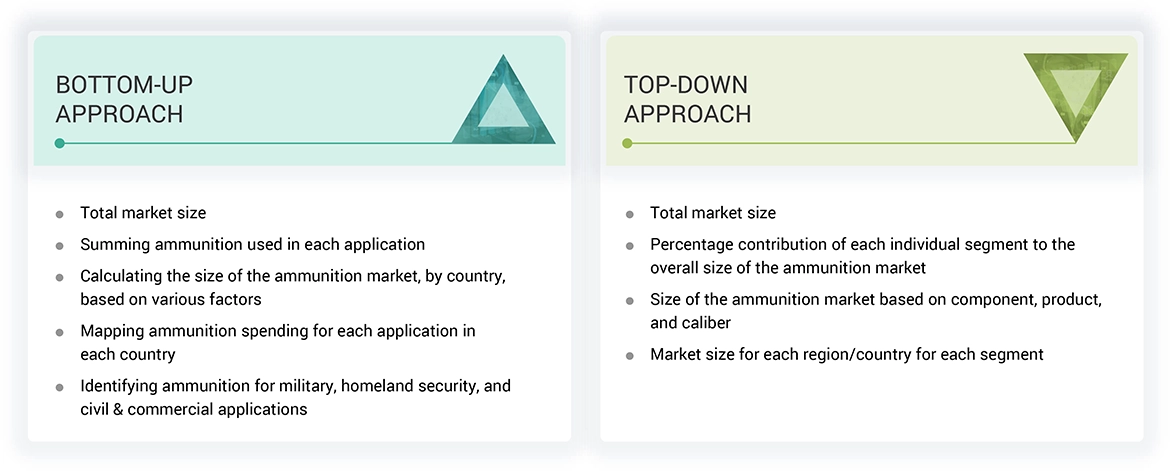
Both top-down and bottom-up approaches were used to estimate and validate the size of the US ammunition market. The following figure offers a representation of the overall market size estimation process employed for the purpose of this study on the US ammunition market.
Data Triangulation
After arriving at the overall size of the US ammunition market from the market size estimation process explained above, the total market was split into several segments and subsegments. The data triangulation and market breakdown procedures explained below were implemented wherever applicable to complete the overall market engineering process and arrive at the exact statistics for various market segments and subsegments.
The data was triangulated by studying various factors and trends from both the demand and supply sides. Along with this, the market size was validated using both top-down and bottom-up approaches. The following figure indicates the market breakdown structure and data triangulation procedure that was implemented in the market engineering process to make this report on the US ammunition market.
Market Definition
US ammunition is fired, scattered, or dropped from a weapon or a weapon system. It can be broadly classified into four categories: Small-Caliber US ammunition, Medium-Caliber US ammunition, Large-Caliber US ammunition, and others. US ammunition is mainly procured by military and law enforcement agencies such as state police and federal police. Small-caliber US ammunition is used by civilians in hunting, sports activities, and self-defense applications.
The small-caliber US ammunition category includes rounds that are 5.56 mm, 7.62 mm, 12.7 mm, and 14.5 mm in size, while the Medium-Caliber US ammunition includes rounds that are 20 mm, 25 mm, 30 mm, and 40 mm in size. The large-caliber US ammunition category includes mortar shells, tank US ammunition, and artillery shells of size 60 mm, 81 mm, 120 mm, 122 mm, and 155 mm. Illumination rounds, hand grenades, and rubber bullets are being considered under other categories. Illumination rounds and hand grenades are not launched as weapons in the air but are thrown or manually lit at targets.
Stakeholders
Various stakeholders of the market are listed below:
- Armed Forces
- Defense Regulatory Bodies
- Law Enforcement Agencies
- Home Ministries/Ministries of Interior
- US ammunition Manufacturers
- Component Manufacturers
- Distributors and Suppliers
- Research Organizations, Forums, Alliances, and Associations
- Sporting and Hunting Associations
Report Objectives
- To define, describe, segment, and forecast the size of the US ammunition market in terms of value based on application, caliber, guidance mechanism, product, component, lethality, and region from 2023 to 2028
- To identify and analyze key drivers, restraints, opportunities, and challenges influencing the growth of the US ammunition market
- To forecast the size of various segments of the US ammunition market with respect to six major regions: North America, Europe, Asia Pacific, the Middle East, Latin America, and Africa
- To identify the opportunities for stakeholders in the market by identifying key market and technology trends
- To analyze competitive developments such as contracts, agreements, acquisitions & partnerships, product launches & developments, and research & development (R&D) activities in the US ammunition market
- To anticipate the status of the US ammunition procurements by different countries, the number of their military personnel, their defense spending; technological advancements in US ammunition; and joint developments undertaken by leading players to analyze the degree of competition in the market.
- To provide a comprehensive competitive landscape of the US ammunition market, along with an overview of the different strategies adopted by the key market players to strengthen their position in the market


Personalize This Research
- Triangulate with your Own Data
- Get Data as per your Format and Definition
- Gain a Deeper Dive on a Specific Application, Geography, Customer or Competitor
- Any level of Personalization
Let Us Help You
- What are the Known and Unknown Adjacencies Impacting the US Ammunition Market
- What will your New Revenue Sources be?
- Who will be your Top Customer; what will make them switch?
- Defend your Market Share or Win Competitors
- Get a Scorecard for Target Partners

Custom Market Research Services
We Will Customise The Research For You, In Case The Report Listed Above Does Not Meet With Your Requirements
Get 10% Free CustomisationTESTIMONIALS






Growth opportunities and latent adjacency in US Ammunition Market