Warehouse Robotics Software Market Size, Share & Trends

Warehouse Robotics Software Market by Software Type (Fleet Management & Orchestration, Picking Optimization, Warehouse Execution Systems, Simulation & Digital Twin), Deployment (Cloud/SaaS, On-Premises, Hybrid), Robot Type (AMR, AGV, Robotic Arms, AS/RS) - Forecast to 2031




WAREHOUSE ROBOTICS SOFTWARE MARKET OVERVIEW
The global Warehouse Robotics Software Market Size is projected to grow from USD 2.45 Billion in 2025 to USD 4.47 Billion by 2031, at a CAGR of 10.5%. Edge-enabled fleet-orchestration software is the fastest-growing layer as operators seek real-time optimization. RaaS models are converting upfront licenses into monthly fees that scale with activity. Cloud visibility across multi-site networks enables cross-dock balancing and capacity optimization.
REPORT SCOPE
| REPORT METRIC | DETAILS |
|---|---|
| Market Size in 2025 | USD 2.45 Billion |
| Market Forecast in 2031 | USD 4.47 Billion |
| CAGR | CAGR of 10.5% from 2025–2031 |
| Years Considered | 2021–2031 |
| Base Year | 2024 |
| Forecast Period | 2025–2031 |
| Units | USD Billion |
| Report Coverage | Revenue Forecast, Company Ranking, Competitive Landscape, Growth Factors, and Trends |
| Top Companies |
|
| Growth Driver |
|
| Segments Covered |
|
| Regions Covered | North America, Europe, Asia Pacific, Rest of the World |
KEY TAKEAWAYS
-
BY DEPLOYMENTCloud/SaaS dominates driven by multi-site visibility and reduced IT overhead. RaaS models making automation accessible to mid-market operators.
-
BY ROBOT TYPEAMR software holds the largest share. Sortation and AS/RS software growing rapidly. Multi-robot interoperability is an emerging requirement.
-
BY END USERE-commerce & retail fulfillment holds largest share. 3PL is fastest-growing deploying multi-client automation platforms.
-
BY REGIONAsia Pacific dominates installations (China 44% spike in 2024). North America holds 25.1% share. US projected to reach USD 3.1B total warehouse robotics by 2030.
-
COMPETITIVE LANDSCAPE - KEY PLAYERSSymbotic, Locus Robotics, 6 River Systems, Zebra Technologies, and GreyOrange lead through AI-powered fleet orchestration and enterprise deployment scale.
-
COMPETITIVE LANDSCAPE - STARTUPS/SMESinVia Robotics, Covariant, Ambi Robotics, Plus One Robotics, and RightHand Robotics are gaining traction through AI-first picking and manipulation software.

Source: Secondary Research, Interviews with Experts, MarketsandMarkets Analysis
TRENDS & DISRUPTIONS IMPACTING CUSTOMERS' CUSTOMERS
The Warehouse Robotics Software Market Trends is being reshaped by the shift from hardware-centric to software-defined automation, the emergence of RaaS and outcome-based pricing models, AI-powered real-time slotting and demand forecasting, multi-robot interoperability standards, generative AI for warehouse layout planning, and edge-cloud hybrid architectures enabling low-latency fleet coordination. Key trends include heterogeneous fleet management, digital twin-based facility optimization, and the integration of computer vision with mobile robot navigation.

Source: Secondary Research, Interviews with Experts, MarketsandMarkets Analysis
WAREHOUSE ROBOTICS SOFTWARE MARKET DYNAMICS

Level
-
E-commerce fulfillment revolution requiring faster, more accurate operations

-
Rising labor costs and chronic workforce shortages across logistics


Level
-
High integration complexity with existing WMS and legacy infrastructure

-
Upfront investment barriers for comprehensive automation deployments


Level
-
RaaS subscription models making automation accessible to mid-market

-
Generative AI for warehouse layout planning and demand forecasting


Level
-
Multi-vendor robot coordination and interoperability gaps

-
ROI justification challenges for mid-market operators

Source: Secondary Research, Interviews with Experts, MarketsandMarkets Analysis
Driver: E-commerce fulfillment
The explosive growth of e-commerce and consumer demand for same-day/next-day delivery puts immense pressure on warehouses, driving adoption of robotic automation software to increase throughput, accuracy, and operational flexibility.
Restraint: Integration complexity
Integrating robotics software with existing warehouse management systems, ERP platforms, and diverse robot hardware from multiple vendors creates significant implementation challenges and extended deployment timelines.
Opportunity: RaaS models
Robotics-as-a-service converts capital expenditure into monthly operational fees, lowering barriers to entry for mid-market operators and enabling flexible scaling based on seasonal demand patterns.
Challenge: Multi-vendor coordination
Warehouses increasingly deploy heterogeneous robot fleets from multiple vendors, creating coordination challenges that require interoperable software platforms capable of orchestrating diverse autonomous systems.
WAREHOUSE ROBOTICS SOFTWARE MARKET: COMMERCIAL USE CASES ACROSS INDUSTRIES
| COMPANY | USE CASE DESCRIPTION | BENEFITS |
|---|---|---|
 |
AI-powered platform orchestrating autonomous bot fleets in high-density storage; GreenBox JV with SoftBank for warehouse-as-a-service; major Walmart, Target, Albertsons deployments | AI fleet orchestration | WaaS model | Enterprise retail deployments |
 |
LocusOne cloud platform managing AMR fleets for collaborative picking; 2B+ units picked globally; ML-optimized robot-to-worker assignments and zone balancing | 2B+ units picked | 3x throughput | Cloud fleet management |
 |
Fetch Robotics AMR platform + Photoneo 3D vision (USD 350M acquisition); enterprise fleet management across fulfillment, manufacturing, and healthcare | AMR + 3D vision | USD 350M Photoneo | Enterprise scale |
 |
GreyMatter fulfillment orchestration platform with AI-driven real-time slotting optimization, dynamic inventory management, and multi-robot coordination | AI slotting optimization | Real-time orchestration | Multi-robot |
 |
Goods-to-person AMR fleet software with global deployment across Asia Pacific, Europe, and North America; smart warehouse management and AI-optimized picking | Global AMR deployments | G2P leader | AI-optimized picking |
Logos and trademarks shown above are the property of their respective owners. Their use here is for informational and illustrative purposes only.
WAREHOUSE ROBOTICS SOFTWARE MARKET ECOSYSTEM
The Warehouse Robotics Software Market Growth ecosystem comprises fleet orchestration platform providers (Symbotic, Locus Robotics, GreyOrange), AMR and AGV hardware manufacturers (Geek+, 6 River Systems, Fetch/Zebra), WMS and WES vendors (Manhattan Associates, Blue Yonder), cloud and edge computing providers (AWS, Azure, Google Cloud), vision and sensor providers (Cognex, Photoneo), system integrators (Dematic, Swisslog, Bastian Solutions), e-commerce fulfillment operators, 3PL providers, and industry standards organizations. These stakeholders collaborate to deliver integrated software-defined warehouse automation solutions.

Logos and trademarks shown above are the property of their respective owners. Their use here is for informational and illustrative purposes only.
WAREHOUSE ROBOTICS SOFTWARE MARKET SEGMENTS

Source: Secondary Research, Interviews with Experts, MarketsandMarkets Analysis
By Software Type
Fleet management & orchestration holds largest share. AI-powered picking optimization fastest-growing. WES critical middleware layer. Simulation/digital twin emerging.
By Deployment
Cloud/SaaS dominates. RaaS converting CapEx to OpEx. On-premises significant for large enterprises with data sovereignty needs.
By Robot Type
AMR software largest. Sortation and AS/RS growing rapidly. Multi-robot interoperability emerging as key requirement.
By End User
E-commerce & retail largest. 3PL fastest-growing. Manufacturing, healthcare, cold chain also significant.
By Region
Asia Pacific dominates installations (China 44% spike 2024). North America 25.1% share. Europe growing with sustainability-driven automation.
WAREHOUSE ROBOTICS SOFTWARE MARKET BY REGION
Asia Pacific leads installations while North America holds largest software revenue
Asia Pacific dominates warehouse robot installations with China recording a 44% spike in new installations during 2024, driven by massive e-commerce scale and government automation incentives. North America holds 25.1% of the global warehouse robotics market with the US projected to reach USD 3.1 billion by 2030, driven by labor shortages, e-commerce growth, and enterprise automation investment. Europe is growing steadily supported by EU sustainability initiatives.

WAREHOUSE ROBOTICS SOFTWARE MARKET: COMPANY EVALUATION MATRIX
In the warehouse robotics software market matrix, Symbotic (Star) leads with AI-powered autonomous bot orchestration, GreenBox warehouse-as-a-service JV, and major retail deployments with Walmart and Target. Locus Robotics (Star) has surpassed 2 billion units picked with its LocusOne cloud platform and ML-optimized operations. Zebra Technologies (Emerging Leader) strengthened its position through the USD 350M Photoneo acquisition and Fetch Robotics AMR platform. GreyOrange (Emerging Leader) provides the GreyMatter AI fulfillment orchestration platform with real-time slotting. Geek+ (Emerging Leader) leads global goods-to-person AMR deployments.

Source: Secondary Research, Interviews with Experts, MarketsandMarkets Analysis
KEY MARKET PLAYERS
WHAT IS IN IT FOR YOU: WAREHOUSE ROBOTICS SOFTWARE MARKET REPORT CONTENT GUIDE

DELIVERED CUSTOMIZATIONS
We have successfully delivered the following deep-dive customizations:
| CLIENT REQUEST | CUSTOMIZATION DELIVERED | VALUE ADDS |
|---|---|---|
| E-Commerce / Retail Fulfillment Operator |
|
Inform warehouse automation software selection and RaaS vs CapEx deployment decisions |
| 3PL / Logistics Provider |
|
Support automation strategy for serving diverse customer portfolios with flexible robotic solutions |
| Warehouse Robotics Software Vendor |
|
Inform product development strategy and competitive positioning in warehouse automation software |
| Venture Capital / Private Equity |
|
Support investment decisions in warehouse robotics software startups and growth-stage companies |
RECENT DEVELOPMENTS
- December 2024 : Zebra Technologies acquired Photoneo for USD 350 million to secure 3D vision IP for warehouse robotics, strengthening its Fetch Robotics AMR platform with advanced perception capabilities.
- 2025 : Symbotic expanded its AI-powered warehouse automation platform through major deployment partnerships with Walmart, Target, and Albertsons for high-density case-level automation.
- 2025 : Locus Robotics surpassed 2 billion units picked globally using its LocusOne cloud-based fleet management platform, demonstrating large-scale collaborative picking maturity.
- 2025 : GreyOrange launched an expanded GreyMatter fulfillment orchestration platform with AI-driven real-time slotting optimization and dynamic inventory management capabilities.
- 2025 : Geek+ continued global expansion with new goods-to-person AMR deployment partnerships across Asia Pacific, Europe, and North America.
- February 2023 : KION Group (Dematic parent) entered a strategic partnership with Li-Cycle for lithium-ion battery recycling for warehouse robotics, with the agreement extending through 2030.
- 2024 : 6 River Systems expanded its Chuck AMR platform with enhanced pick-to-light and zone-based orchestration software for Shopify Fulfillment Network operations.
- 2025 : inVia Robotics launched an enhanced version of its AI-powered warehouse orchestration platform with improved multi-robot coordination and real-time demand-based slotting.
Table of Contents
 Exclusive indicates content/data unique to MarketsandMarkets and not available with any competitors.
Methodology
The study involved four major activities in estimating the current size of the warehouse robotics market. Extensive secondary research was conducted to gather information on the market, adjacent industries, and the broader automation ecosystem. This was followed by primary research with industry stakeholders across the value chain, including warehouse robot manufacturers, system integrators, software providers, distributors, logistics companies, and end users, to validate assumptions and market sizing. Both top-down and bottom-up approaches were used to estimate the overall market size. Market breakdowns and data triangulation techniques were then applied to derive the size of individual segments and subsegments. Secondary and primary sources were jointly used to support a comprehensive technical and commercial analysis of the warehouse robotics market.
Secondary Research
Various secondary sources were referred to in the secondary research process to identify and collect information relevant to the warehouse robotics market. These sources include annual reports, press releases, and investor presentations of key companies; white papers; technical journals; certified publications; and articles from recognized authors, industry websites, directories, and databases. Secondary research was conducted to obtain key insights into the market's supply chain, value chain, competitive landscape, and segmentation across software types, deployment types, robot types, functions, applications, end-use industries, and regions. It also helped analyze industry trends, technology advancements, adoption patterns, and recent developments in warehouse automation. The collected data was further analyzed to estimate the overall market size and validate findings, which were subsequently refined through primary research with industry experts and stakeholders.
Primary Research
Extensive primary research was conducted after gaining knowledge about the current scenario of the warehouse robotics market through secondary research. Several primary interviews were conducted with experts from both the demand and supply sides across four major regions: North America, Europe, Asia Pacific, and Rest of the World (RoW). This primary data was collected through questionnaires, emails, and telephonic interviews
Breakdown of Primaries:
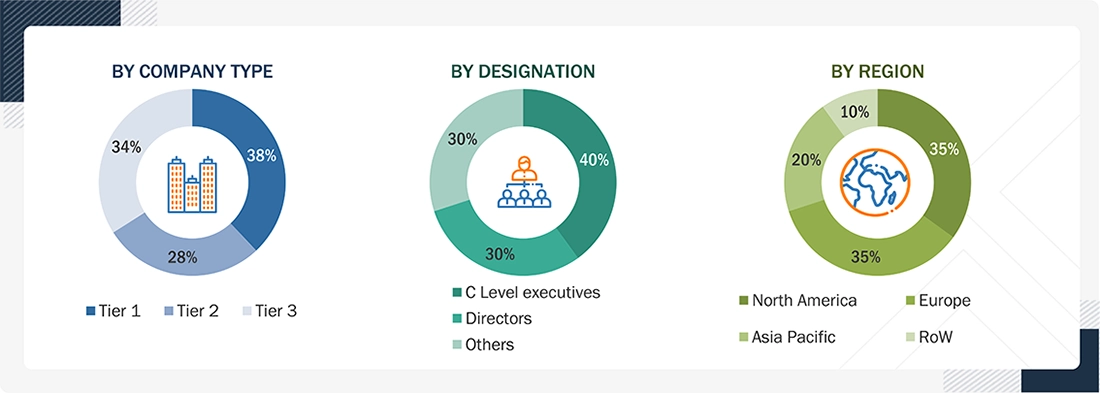
Note: The three tiers of the companies are defined based on their total revenue in 2023: Tier 1 - revenue greater than or equal to USD 1 billion; Tier 2 - revenue between USD 100 million and USD 1 billion; and Tier 3 revenue less than or equal to USD 100 million. Other designations include sales managers, marketing managers, and product managers.
To know about the assumptions considered for the study, download the pdf brochure
Market Size Estimation
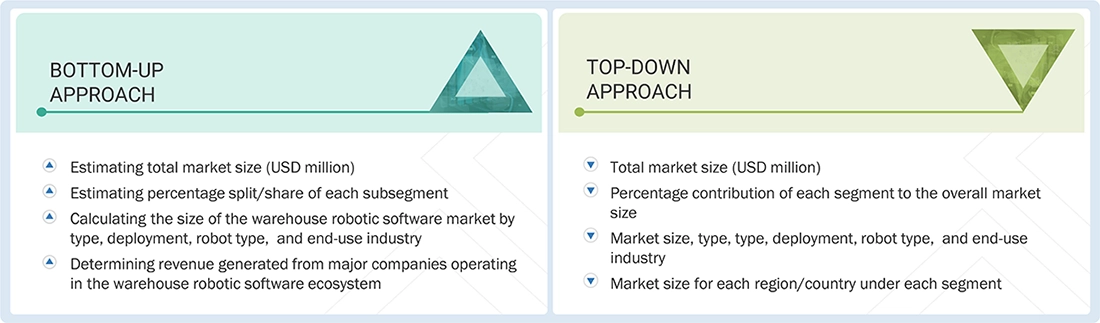
Both top-down and bottom-up approaches have been used to estimate and validate the total size of the warehouse robotics software market. These methods have also been used extensively to estimate the size of various subsegments in the market. The following research methodology has been used to estimate the market size:
- Major players in the industry and markets have been identified through extensive secondary research.
- The industry’s value chain and market size (in terms of value) have been determined through primary and secondary research processes.
- All percentage shares, splits, and breakdowns have been determined using secondary sources and verified through primary sources.
Warehouse Robotics Software Market : Top-Down and Bottom-Up Approach
Data Triangulation
After arriving at the overall size of the warehouse robotics software market from the market size estimation process explained above, the total market has been split into several segments and subsegments. Data triangulation and market breakdown procedures have been employed, wherever applicable, to complete the overall market engineering process and arrive at the exact statistics for all segments and subsegments of the market. The data has been triangulated by studying various factors and trends from both the demand and supply sides. Along with this, the market size has been validated using both top-down and bottom-up approaches.
Market Definition
The warehouse robotics software market comprises software platforms that control, coordinate, and optimize robotic systems within warehouse and fulfillment center environments. This includes fleet management and orchestration platforms, AI-powered picking optimization engines, warehouse execution systems (WES), autonomous navigation software, multi-agent coordination engines, simulation and digital twin tools, robotics-as-a-service (RaaS) subscription platforms, and WMS integration middleware. The ecosystem includes pure-play robotics software vendors, integrated robot-software providers, cloud platform operators, system integrators, and logistics technology consultants.
Key Stakeholders
- Warehouse Robotics Software Providers
- Autonomous Mobile Robot (AMR) Manufacturers
- Warehouse Management System (WMS) Vendors
- E-Commerce & Retail Fulfillment Operators
- Third-Party Logistics (3PL) Providers
- System Integrators & Automation Consultants
- Cloud & Edge Computing Providers
- Venture Capital & Private Equity
- Industry Standards Organizations
Report Objectives
- To define, describe, and forecast the warehouse robotics software market in terms of software type, robot type, deployment type, industry, and region
- To forecast the market size, in terms of value, by region—North America, Europe, Asia Pacific, and Rest of the World (RoW)
- To provide qualitative information about the applications of warehouse robotics software across industries
- To provide detailed information regarding the major factors influencing the growth of the market, namely drivers, restraints, opportunities, and challenges
- To strategically analyze micro markets with respect to individual growth trends, prospects, and contributions to the total market
- To study the complete value chain of the warehouse robotics software ecosystem, including solution providers, system integrators, and end users
- To analyze opportunities in the market for stakeholders by identifying high-growth segments
- To strategically profile key players and comprehensively analyze their core competencies, along with detailing the competitive landscape for market leaders
- To analyze competitive developments such as product launches, mergers, acquisitions, partnerships, and expansions in the warehouse robotics software market
- To benchmark market players using company evaluation frameworks based on various parameters within business strategies, solution portfolios, and technological capabilities
- To provide information on ecosystem analysis, case study analysis, technology trends, emerging applications, interconnected markets, and cross-sector opportunities, along with the impact of evolving clean energy and safety regulations on the warehouse robotics software market.
Key Questions Addressed by the Report
What is the current and projected market size of the warehouse robotics software market?
The market is valued at USD 2.45 billion in 2025 and is projected to reach USD 4.47 billion by 2031.
What is the expected growth rate of the market?
The market is expected to grow at a CAGR of 10.5% from 2025 to 2031.
What are the key growth drivers of the warehouse robotics software market?
Growth is driven by rapid e-commerce expansion, rising warehouse automation, labor shortages, and increasing demand for operational efficiency and faster order fulfillment.
What are the major trends shaping this market?
Key trends include AI-powered optimization, digital twin technology, robotics-as-a-service (RaaS), multi-robot interoperability, and edge-cloud hybrid systems.
Which industries are major adopters of warehouse robotics software?
Major adopters include e-commerce & retail, third-party logistics (3PL), manufacturing, and distribution & fulfillment centers.
Which software segment dominates the market?
Fleet management & orchestration software holds the largest share due to demand for real-time robot coordination and workflow optimization.
Which region leads the warehouse robotics software market?
Asia Pacific dominates in installations, while North America holds a significant share (~25%) due to early adoption of advanced technologies.
Who are the key companies in the market?
Major players include Symbotic, Locus Robotics, 6 River Systems, Zebra Technologies, GreyOrange, Geek+, Dematic, and inVia Robotics.
What challenges does the market face?
Challenges include high implementation costs, integration complexity, interoperability issues, and reliance on advanced infrastructure.
How is the market analyzed in the report?
The report uses top-down and bottom-up approaches, data triangulation, and segmentation by software type, deployment, robot type, industry, and region.


Personalize This Research
- Triangulate with your Own Data
- Get Data as per your Format and Definition
- Gain a Deeper Dive on a Specific Application, Geography, Customer or Competitor
- Any level of Personalization
Let Us Help You
- What are the Known and Unknown Adjacencies Impacting the Warehouse Robotics Software Market
- What will your New Revenue Sources be?
- Who will be your Top Customer; what will make them switch?
- Defend your Market Share or Win Competitors
- Get a Scorecard for Target Partners

Custom Market Research Services
We Will Customise The Research For You, In Case The Report Listed Above Does Not Meet With Your Requirements
Get 10% Free CustomisationTESTIMONIALS

Tetsuya Ohhira
Business Development Manager-Technology Business
Nikon Corporation,
Leading Japanese MNC specializing in optics and imaging productswww.nikon.com
MarketsandMarkets™ response
is quick. Their attitude is flexible and positive. Analyst Insights are globally considered and
significant. Client Services quickly respond to our inquiry and demand. Their wide range of global
surveys help us make our strategic plan.
We hope Knowledge Store will be easier to search
for a report.
VP - Marketing & Business Development
Leading Provider of Process Control Solutions
We engaged with MarketsandMarkets on a study to perform an analysis and recommend a Go-To-Market strategy for metrology and process control in the semiconductor market. The study was tailored to our targets and needs with well-defined milestones. Our overall experience with the MarketsandMarkets team was very good throughout the project in all aspects including the analysis methodologies used, the quality and depth of primary and secondary data sets, the professionalism and flexibility of the team and the ability to meet the target schedule and milestones. We want to thank MarketsandMarkets team for a job well done.






Growth opportunities and latent adjacency in Warehouse Robotics Software Market