Water-Based Barrier Coatings Market

Water-Based Barrier Coatings Market by Component, Resin Type, Barrier Type (Water Vapour, Oil/Grease), Substrate (Paper & Cardboard), End-use Industry (Food & Beverage Packaging), and Region - Global Forecast to 2031




OVERVIEW
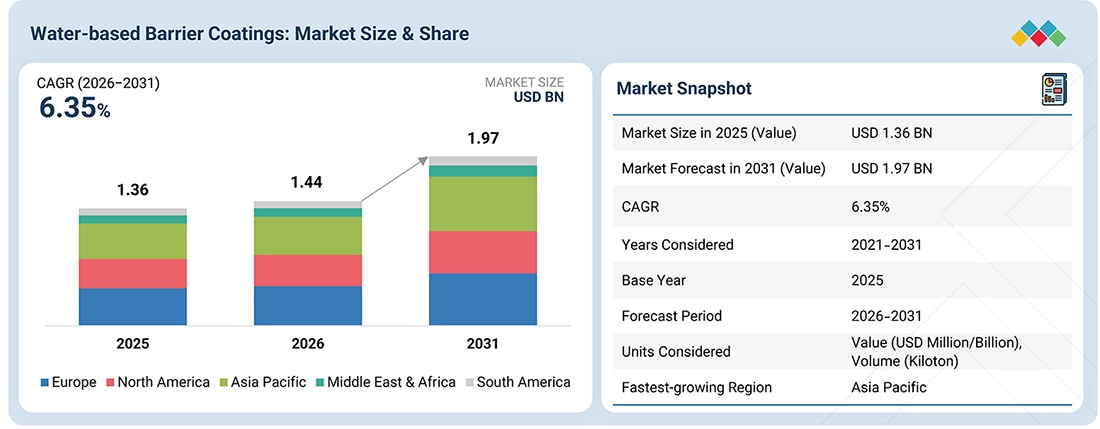
Source: Secondary Research, Interviews with Experts, MarketsandMarkets Analysis
The water-based barrier coatings market is projected to grow from USD 1.44 billion in 2026 to USD 1.97 billion by 2031, at a CAGR of 6.35%. Water-based barrier coatings are aqueous formulations applied to substrates to provide resistance against moisture, grease, oil, oxygen, and other external factors while supporting improved product protection and surface performance. They are increasingly used as alternatives to solvent-based and conventional plastic barrier layers due to their lower volatile organic compound emissions and compatibility with sustainable packaging requirements. Market growth is fueled by rising demand across food & beverage packaging, pharmaceutical packaging, personal care, and industrial packaging, along with increasing emphasis on recyclable and fiber-based packaging solutions.
KEY TAKEAWAYS
-
BY REGIONEurope dominated the global water-based barrier coatings market in 2025, accounting for a share of 31.8%, in terms of value.
-
BY BARRIER TYPEBy barrier type, the water vapor segment led the overall water-based barrier coatings market, accounting for a share of 48.3% in 2025.
-
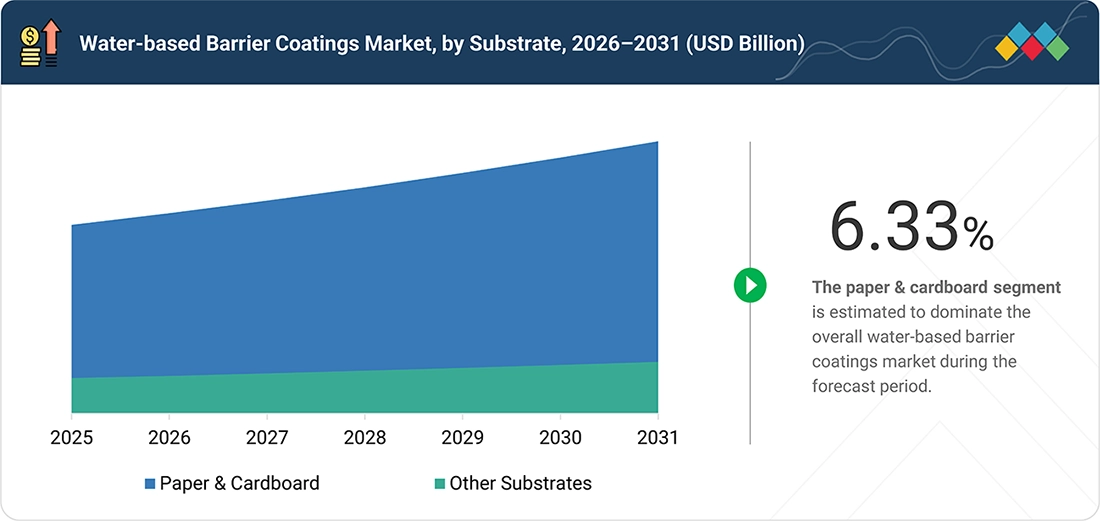
BY SUBSTRATEBy substrate, the paper & cardboard segment dominated the overall water-based barrier coatings market, accounting for a share of 84.2% in 2025.
-
BY END-USE INDUSTRYThe food & beverage packaging segment is projected to register the highest CAGR of 6.40%, in terms of value, during the forecast period.
-
COMPETITIVE LANDSCAPE - KEY PLAYERSALTANA AG, H.B. Fuller Company, Solenis, Michelman, Inc., and Sonoco Products Company are identified as key players in the global water-based barrier coatings market. These companies have strong market presence and extensive product portfolios.
-
COMPETITIVE LANDSCAPE - STARTUPSArtemyn, Huber Group, and Kemira Oyj, among other emerging players, hold strong positions in specialized niche segments, underscoring their potential to become future market leaders in the water-based barrier coatings market.
The water-based barrier coatings market is projected to grow steadily over the next decade, supported by advancements in aqueous coating technologies and the shift toward recyclable, fiber-based, and sustainable packaging. Packaging manufacturers are increasingly adopting water-based barrier coatings to improve resistance to moisture, grease, oil, and oxygen while maintaining the recyclability advantages of paper and cardboard substrates. Growing emphasis on reducing plastic content, improving packaging functionality, and meeting sustainability requirements further strengthens the role of water-based barrier coatings as an important solution for next-generation packaging applications.
TRENDS & DISRUPTIONS IMPACTING CUSTOMERS' CUSTOMERS
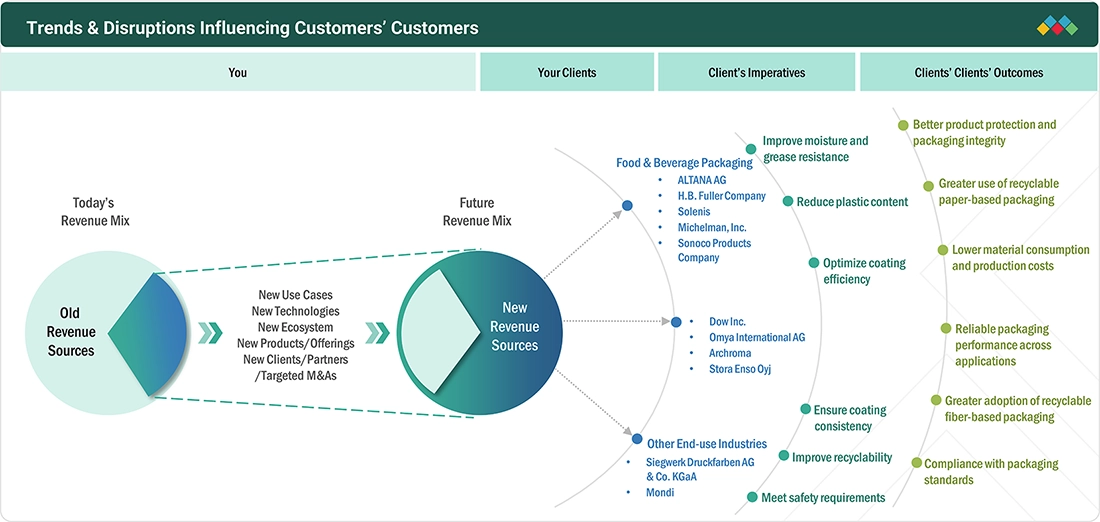
The impact on consumers’ business arises from evolving customer requirements and industry disruptions. Raw material suppliers and distribution partners are closely linked with water-based barrier coatings manufacturers, while packaging applications represent the primary demand base for these coatings. Market shifts, including changes in packaging formats, sustainability requirements, regulatory standards, and demand for recyclable materials, directly influence the revenues of packaging producers and brand owners. Changes in end-user demand subsequently affect procurement volumes across suppliers and distributors, which in turn impact the revenues of water-based barrier coatings manufacturers throughout the value chain.
Source: Secondary Research, Interviews with Experts, MarketsandMarkets Analysis
MARKET DYNAMICS

Level
-
Growing demand for sustainable and biodegradable products in the packaging industry

-
Longer shelf life of products, oil and grease-free packaging, and moisture resistance


Level
-
Performance limitations in harsh environments

-
High initial costs and equipment investment


Level
-
Rising demand for sustainable packaging

-
Advancements in coating technologies


Level
-
Fluctuating raw material prices and market awareness challenges

Source: Secondary Research, Interviews with Experts, MarketsandMarkets Analysis
Driver: Growing demand for sustainable and biodegradable products in the packaging industry
The water-based barrier coatings market is being driven by the growing demand for sustainable and biodegradable packaging solutions. Brand owners and packaging converters are increasingly seeking alternatives to conventional plastic laminations and solvent-based coatings to reduce environmental impact while maintaining essential barrier performance. Water-based formulations can provide resistance against moisture, grease, oil, and oxygen while supporting paper and paperboard-based packaging formats. The shift toward recyclable and fiber-based packaging in food, beverage, pharmaceutical, and consumer goods applications is further strengthening adoption. Growing corporate sustainability commitments and the transition toward circular packaging models are encouraging manufacturers to develop coatings that maintain recyclability without compromising package functionality. This trend is particularly significant for applications where lightweight paper-based substrates are being considered as alternatives to plastic-intensive structures. As packaging producers prioritize lower environmental footprints and improved end-of-life compatibility, demand for water-based barrier coatings is expanding across both established and emerging packaging markets.
Restraint: Performance limitations in harsh environments
Performance limitations under harsh environmental and operating conditions remain a restraint for the water-based barrier coatings market. Although these coatings can provide effective protection against moisture, grease, and oxygen, achieving high barrier performance under extreme humidity, temperature variations, prolonged liquid exposure, or aggressive chemical contact can be technically challenging. Water-based formulations may require carefully engineered polymer dispersions, additives, and multilayer structures to maintain coating integrity under demanding conditions. In food packaging, for example, exposure to hot filling, refrigeration, freezing, or high-moisture contents can place additional demands on the coating system. Similarly, applications involving oily or highly acidic products may require specialized formulations to prevent barrier deterioration. These performance requirements can limit the replacement of conventional high-barrier plastic structures in certain applications. Consequently, water-based coatings are currently more suitable for applications where environmental conditions remain within manageable performance ranges, while demanding end uses require continued formulation improvements.
Opportunity: Advancements in coating technologies
Advancements in polymer chemistry, dispersion technology, and coating processes are creating significant opportunities for the water-based barrier coatings market. Manufacturers are developing advanced formulations that combine multiple barrier properties within thinner coating layers, improving protection while reducing material consumption. Innovations in acrylic, polyurethane, styrene-butadiene, and bio-based polymer systems are enabling better resistance to water, grease, oxygen, and other external influences. Improvements in crosslinking technologies and surface treatment methods are also enhancing adhesion and coating durability on paper and paperboard substrates. Furthermore, developments in multilayer coating architectures allow different functional layers to work together, enabling improved barrier performance without relying heavily on conventional plastic films. These technological advances are expanding the potential use of water-based coatings in food packaging, beverage packaging, bakery products, and other sensitive applications. Continued investment in formulation research and high-speed coating technologies is expected to improve performance consistency, reduce coating weights, and support broader commercialization.
Challenge: Fluctuating raw material prices and market awareness challenges
Fluctuating raw material prices and limited awareness of advanced water-based barrier coating solutions remain key challenges for market development. The production of these coatings relies on polymers, additives, pigments, dispersing agents, and specialty chemicals whose costs can vary with feedstock availability, energy prices, and supply conditions. Such fluctuations can affect formulation economics and make it difficult for coating suppliers to maintain competitive pricing against established packaging materials. At the same time, some converters and end users have limited familiarity with the performance capabilities and processing requirements of water-based barrier coatings. Concerns regarding equipment compatibility, drying requirements, coating weight, and achievable barrier levels can make customers cautious about transitioning from familiar technologies. This is particularly relevant in cost-sensitive markets where packaging producers prioritize proven solutions and immediate production efficiency. Greater technical education, converter trials, application demonstrations, and collaboration between coating suppliers and packaging manufacturers can help build confidence and accelerate adoption.
WATER-BASED BARRIER COATINGS MARKET: COMMERCIAL USE CASES ACROSS INDUSTRIES
| COMPANY | USE CASE DESCRIPTION | BENEFITS |
|---|---|---|
 |
Application of water-based barrier coatings on paperboard and fiber-based packaging for beverages to improve resistance to moisture and liquid penetration. | Enhanced package integrity, reduced fiber weakening, improved recyclability potential, and reliable performance during storage and transportation. |
 |
Use of water-based barrier coatings on paper and paperboard packaging for snacks and beverages to provide grease and moisture resistance. | Improved food protection, extended packaging functionality, reduced reliance on plastic layers, and enhanced compatibility with fiber-based recycling streams. |
 |
Application of water-based barrier coatings to paper-based food packaging to provide resistance against grease, moisture, and product migration. | Improved package durability, better product protection, reduced plastic content, and support for recyclable packaging designs. |
 |
Use of water-based barrier coatings on fiber-based packaging for food ingredients and agricultural products requiring moisture and oil resistance. | Enhanced packaging strength, improved protection against environmental exposure, reduced material complexity, and improved sustainability performance. |
Logos and trademarks shown above are the property of their respective owners. Their use here is for informational and illustrative purposes only.
MARKET ECOSYSTEM
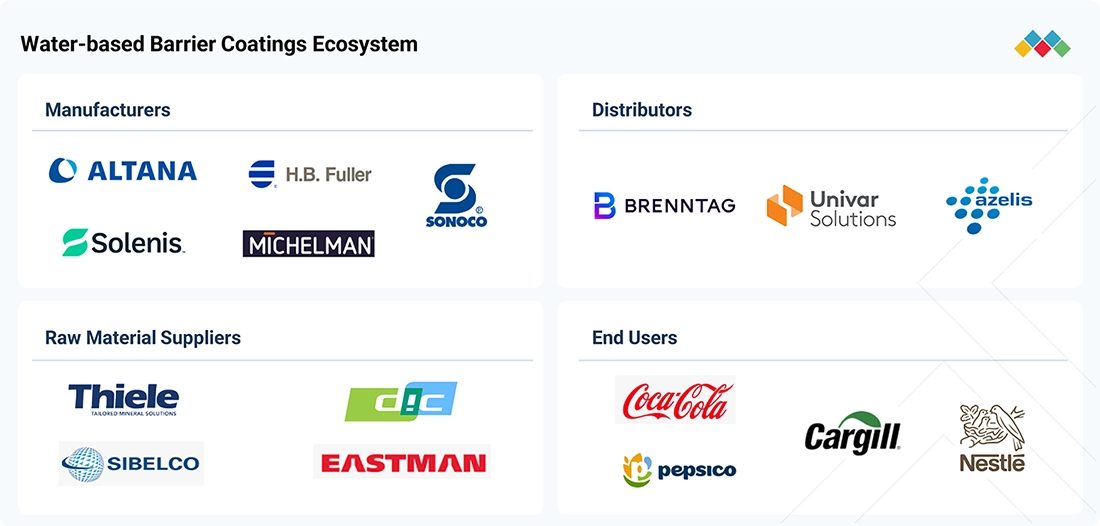
The water-based barrier coatings market ecosystem consists of raw material suppliers (Thiele Kaolin Company, Sibelco N.V., Nippon Talc Co., Ltd., and Eastman Chemical Company), manufacturers (ALTANA AG, H.B. Fuller Company, Solenis, Michelman, Inc., and Sonoco Products Company), and end users (The Coca-Cola Company, Nestle S.A., PepsiCo, Inc., and Cargill, Incorporated). Raw materials such as acrylic polymers, polyurethane dispersions, waxes, styrene-butadiene polymers, and specialty additives are processed into water-based barrier coatings and customized formulations that provide moisture, grease, oil, oxygen, and aroma resistance. End users in food & beverage packaging, pharmaceutical packaging, personal care, and industrial packaging sectors drive demand for high-performance, sustainable coating solutions, while producers ensure consistent coating quality and substrate-specific performance. Collaboration across the value chain is crucial to improve recyclability, reduce plastic content, ensure compliance with packaging regulations, and drive growth in water-based barrier coating solutions.
Logos and trademarks shown above are the property of their respective owners. Their use here is for informational and illustrative purposes only.
MARKET SEGMENTS
Source: Secondary Research, Interviews with Experts, MarketsandMarkets Analysis
Water-Based Barrier Coatings Market, By Barrier Type
Water vapor barriers held the largest share of the water-based barrier coatings market, in terms of value, in 2025. Demand is rising from food products that readily interact with moisture during storage and distribution. Products such as powdered beverages, instant foods, spices, salt, sugar, and dry mixes require packaging with controlled moisture transfer to preserve flow, texture, and handling quality. Paper and paperboard formats used for these products require suitable barrier properties to maintain package performance across the product life cycle. Water-based barrier coatings provide a practical route to improve moisture protection while supporting paper-based packaging structures. Food manufacturers are therefore placing greater emphasis on moisture management when selecting packaging materials. The wider use of dry and powdered products is creating a distinct demand base for water vapor barrier coatings.
Water-Based Barrier Coatings Market, By Substrate
The paper & cardboard substrate segment held the largest share of the water-based barrier coatings market, in terms of value, in 2025. Investment in recyclable fiber systems is encouraging paper producers to develop barrier coatings that maintain useful substrate performance while supporting established recycling practices. Coating suppliers are focusing on formulations that can provide surface functionality without creating complex material structures that require separate recovery routes. This is encouraging closer collaboration among paper mills, coating producers, converters, and recycling operators. The focus is also shifting toward coatings with controlled application levels and improved compatibility with fiber recovery processes. Such developments are increasing the technical value of water-based barrier coatings within paper manufacturing. As circular material systems receive greater investment, paper and cardboard substrates are gaining opportunities for higher-value applications supported by advanced coating technology.
Water-Based Barrier Coatings Market, By End-use Industry
The food & beverage packaging segment accounted for the largest share of the water-based barrier coatings market, in terms of value, in 2025. Advances in coating chemistry are expanding the range of functions delivered through a single aqueous coating layer. Recent development includes formulations that combine liquid resistance, oil and grease protection, heat sealability, and surface properties. This allows converters to design packaging structures around finished-pack performance rather than relying on several separate material layers. New polymer dispersions, bio-based components, and functional additives are also improving coating performance at lower application levels. Such innovation supports wider use in food-contact formats and creates opportunities for suppliers to offer application-specific grades for chilled, hot-fill, frozen, and dry food packaging conditions across markets.
REGION
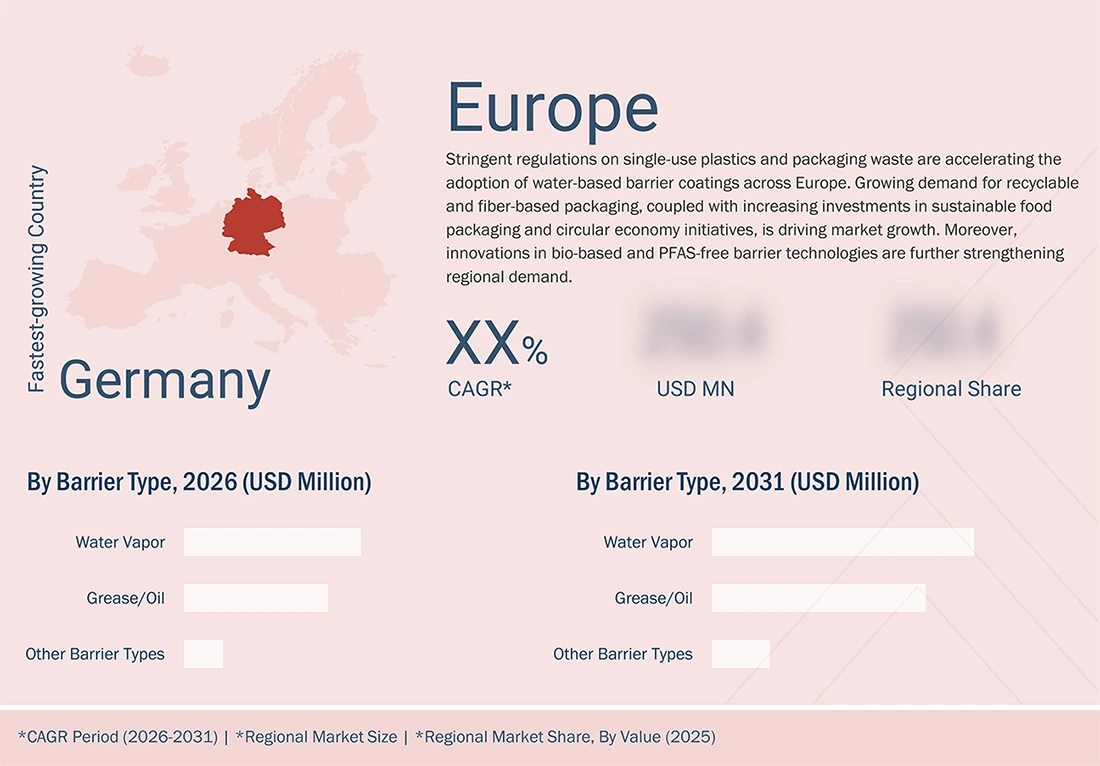
Europe accounted for the largest share of the global water-based barrier coatings market in 2025.
Europe accounted for the largest share of the global water-based barrier coatings market in 2025. European coating producers are focusing on technologies that deliver strong barrier performance while using less coating material. Advances in polymer design, particle size control, dispersion quality, and coating application methods are enabling manufacturers to improve moisture, oxygen, grease, and water vapor resistance while using thinner coating layers. Lower coating weights can support material efficiency and help maintain the recyclability characteristics of paper substrates. These developments also improve production economics by reducing raw material use and enabling faster coating operations. Strong research capabilities across European specialty chemical and paper industries are accelerating the development of high-performance water-based barrier coatings for demanding commercial applications.
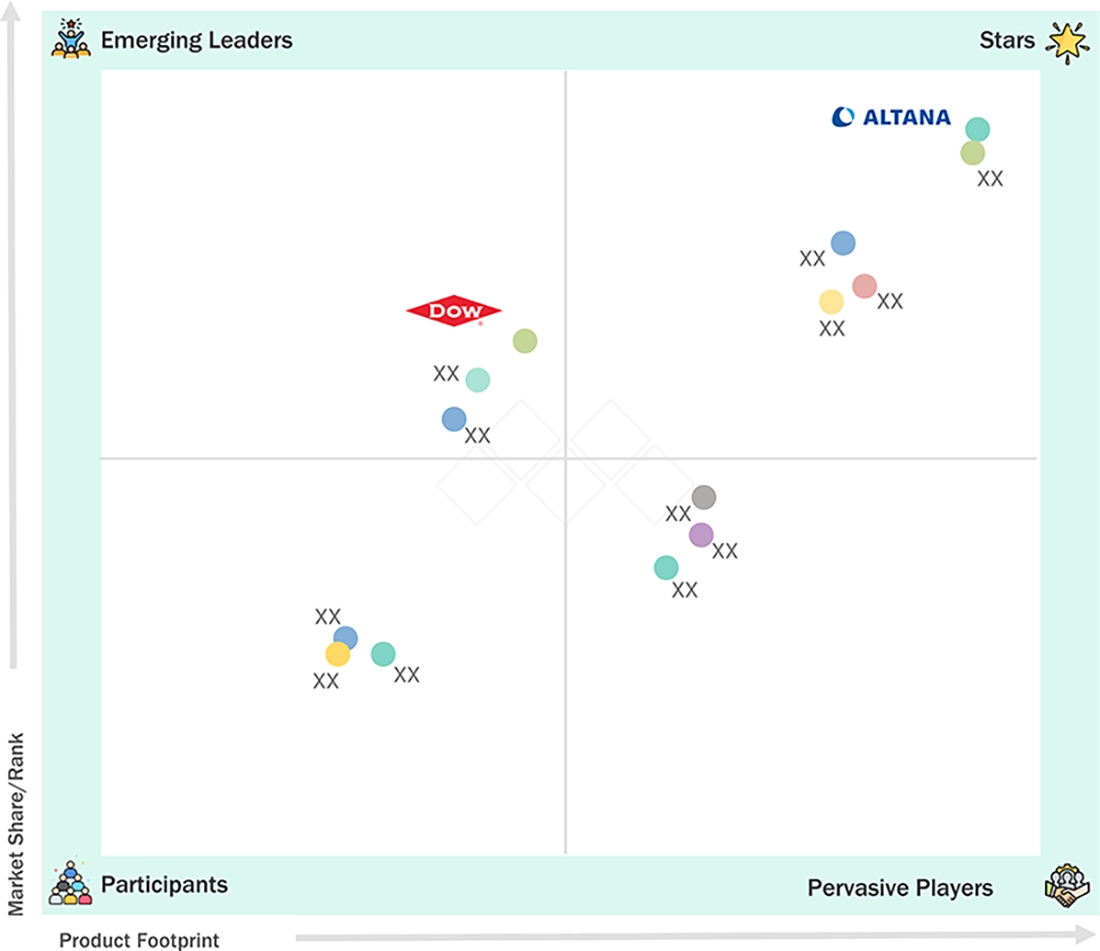
WATER-BASED BARRIER COATINGS MARKET: COMPANY EVALUATION MATRIX
In the water-based barrier coatings market matrix, ALTANA AG (Star) leads with a strong market presence and advanced coating and specialty materials capabilities, supporting adoption across food & beverage packaging, paper & cardboard, pharmaceutical packaging, and industrial applications. Dow Inc. (Emerging Leader) is gaining traction through its broad materials expertise and development of water-based technologies that enhance moisture, grease, and oxygen barrier performance. While ALTANA dominates through its formulation expertise, specialty materials portfolio, and application capabilities, Dow demonstrates strong growth potential through technology development, global customer reach, and increasing focus on sustainable coating solutions, positioning it to advance toward the leaders' quadrant.
Source: Secondary Research, Interviews with Experts, MarketsandMarkets Analysis
KEY MARKET PLAYERS
- ALTANA AG
- H.B. Fuller Company
- Solenis
- Michelman, Inc.
- Sonoco Products Company
- Dow Inc.
- Omya International AG
- Archroma
- Stora Enso Oyj
- Siegwerk Druckfarben AG & Co. KGaA
- Mondi
MARKET SCOPE
| REPORT METRIC | DETAILS |
|---|---|
| Market Size in 2025 (Value) | USD 1.36 Billion |
| Market Forecast in 2026 (Value) | USD 1.44 Billion |
| Market Forecast in 2031 (Value) | USD 1.97 Billion |
| Growth Rate | CAGR of 6.35% from 2026 to 2031 |
| Years Considered | 2021–2031 |
| Base Year | 2025 |
| Forecast Period | 2026–2031 |
| Units Considered | Value (USD Million/Billion) and Volume (Kiloton) |
| Report Coverage | Revenue forecast, company ranking, competitive landscape, growth factors, and trends |
| Segments Covered |
|
| Regional Scope | Asia Pacific, Europe, North America, Middle East & Africa, and South America |
WHAT IS IN IT FOR YOU: WATER-BASED BARRIER COATINGS MARKET REPORT CONTENT GUIDE
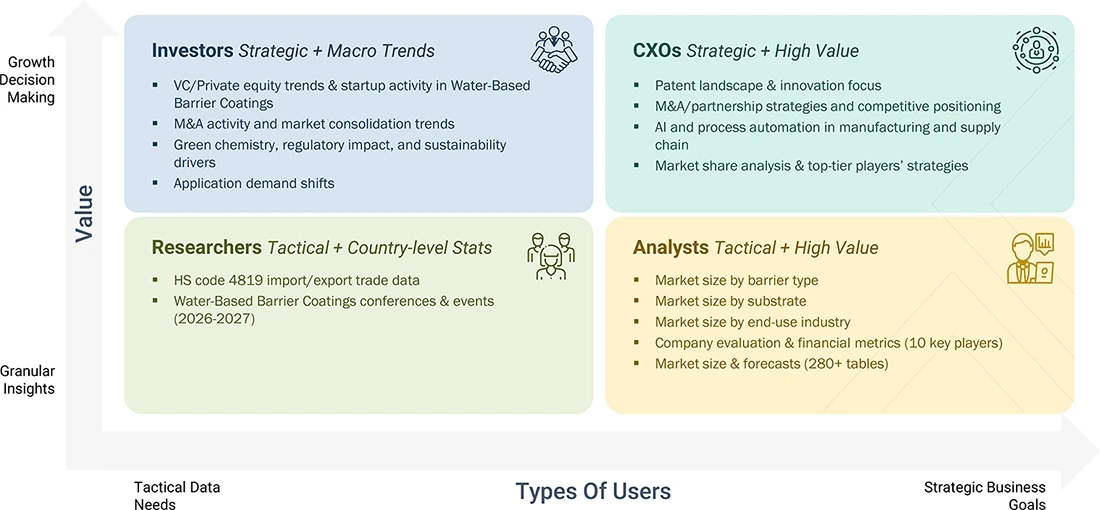
DELIVERED CUSTOMIZATIONS
We have successfully delivered the following deep-dive customizations:
| CLIENT REQUEST | CUSTOMIZATION DELIVERED | VALUE ADDS |
|---|---|---|
| Europe-based Water-Based Barrier Coatings Manufacturer |
|
|
| Asia Pacific-based Water-Based Barrier Coatings Producer |
|
|
RECENT DEVELOPMENTS
- May 2026 : Michelman launched Nuvita Life 4002, a bio-based, plastic-free coating for fiber-based retail food packaging.
- April 2026 : Dow and RDM Group collaborated to develop and commercialize Multiboard CirculaRR, a recycled food packaging and barrier solution made entirely from recyclable materials.
- September 2025 : Archroma Packaging Technologies opened three Global Centers of Innovation located in Mumbai, India; Prat, Spain; and Charlotte, US.
- February 2025 : ALTANA’s ACTEGA and Standridge Color Corporation (SCC) have partnered to develop and commercialize water-based barrier-coated paperboards.
- September 2024 : Solenis, a leading producer of specialty chemicals collaborated with Heildelberg, an innovative company based in the UK, with a leading position in global printing industry, to develop print-applied eco-friendly barrier coatings for paper packaging.
Table of Contents
 Exclusive indicates content/data unique to MarketsandMarkets and not available with any competitors.
Methodology
The study involved four major activities in estimating the market size for water-based barrier coatings. Exhaustive secondary research was done to collect information on the market, the peer market, and the parent market. The next step was to validate these findings, assumptions, and sizing with industry experts across the value chain through primary research. Both top-down and bottom-up approaches were employed to estimate the complete market size. After that, the market breakdown and data triangulation procedures were used to estimate the market size of the segments and subsegments.
Secondary Research
Secondary sources used in this study included annual reports, press releases, and investor presentations of companies; white papers; certified publications; articles from recognized authors; and gold-standard and silver-standard websites, such as Factiva, ICIS, Bloomberg, and others. The study verified its findings through primary research, including extensive interviews with key officials such as CEOs, VPs, directors, and other executives. The breakdown of profiles of the primary interviewees is illustrated in the figure below:
Primary Research
The water-based barrier coatings market comprises several stakeholders, such as raw material suppliers, end-product manufacturers, and regulatory organizations in the supply chain. Various primary sources from both the supply and demand sides of the market were interviewed to obtain qualitative and quantitative information.
BREAKDOWN OF PRIMARY PARTICIPANTS
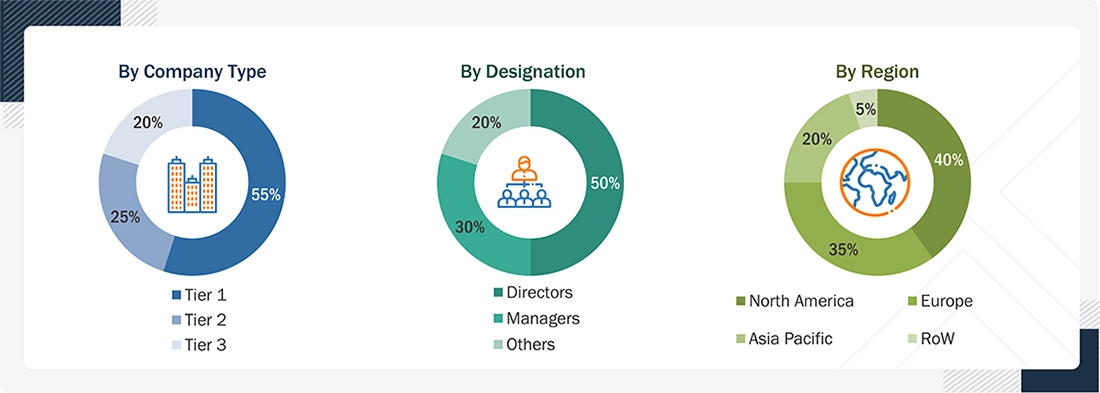
Notes: Tier 1, Tier 2, and Tier 3 companies are classified based on their market revenue in 2024/2025 available in the public domain, product portfolios, and geographical presence.
Other designations include consultants and sales, marketing, and procurement managers.
|
COMPANY NAME |
DESIGNATION |
|
ALTANA AG |
Senior Manager |
|
H.B. Fuller Company |
Innovation Manager |
|
Solenis |
Development Manager |
|
Michelman, Inc. |
Production Supervisor |
|
Sonoco Products Company |
Sales Manager |
To know about the assumptions considered for the study, download the pdf brochure
Market Size Estimation
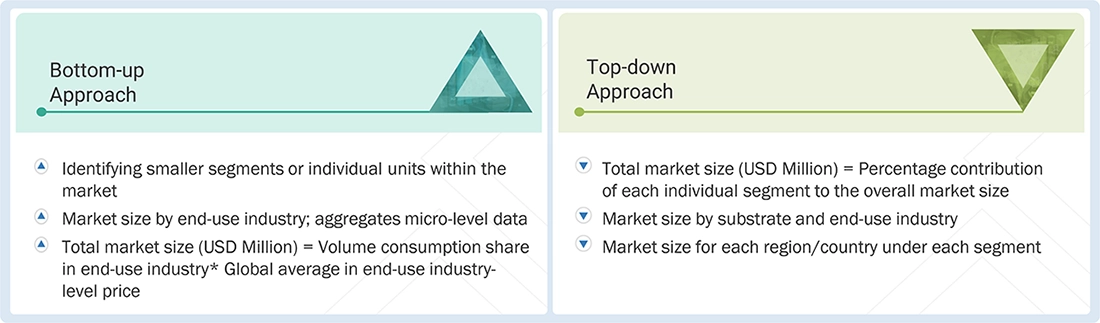
Both top-down and bottom-up approaches were used to estimate and validate the total size of the water-based barrier coatings market. These methods were also used extensively to estimate the size of various subsegments in the market. The research methodology used to estimate the market size includes the following:
- The key players in the industry have been identified through extensive secondary research.
- The supply chain of the industry has been determined through primary and secondary research.
- All percentage shares, splits, and breakdowns have been determined using secondary sources and verified through primary sources.
- All possible parameters that affect the markets covered in this research study have been accounted for, viewed in extensive detail, verified through primary research, and analyzed to obtain the final quantitative and qualitative data.
Water-Based Barrier Coatings Market: Top-Down and Bottom-Up Approach
Data Triangulation
After determining the overall market size using the market size estimation processes explained above, the market was divided into several segments and subsegments. To complete the overall market engineering process and determine the exact statistics for each market segment and subsegment, data triangulation and market breakdown procedures were employed, as applicable. The data were triangulated by studying various factors and trends from both the demand and supply sides in the water-based barrier coatings industry.
Market Definition
According to the European Organisation for Packaging and the Environment, Water-based barrier coatings are aqueous dispersion coatings that create a hydrophobic barrier on paper. These coatings are derived from natural sources and are plastic-free, making them biodegradable and compostable. They consist of water, fillers, additives, and binders. The primary purpose of water-based barrier coatings is to seal the paper substrate and protect packaging from external and internal factors. They keep packaging visually appealing and functional without compromise. Depending on the product, these coatings protect against substances such as fat, water, water vapor, dairy products, alcohol, oil, or alkali throughout the packaging's lifespan. Water-based barrier coatings are versatile and find applications in packaging conversion, printing, and the paper industry. Their adaptability and eco-friendly nature make them a valuable choice for enhancing packaging performance and sustainability.
Key Stakeholders
- Water-based barrier coatings manufacturers
- Water-based barrier coatings distributors
- Raw material suppliers
- Government and research organizations
- Investment banks and private equity firms
Report Objectives
- To analyze and forecast the size of the global water-based barrier coatings market in terms of value and volume
- To provide detailed information about the major drivers, restraints, challenges, and opportunities influencing the market growth
- To define, describe, and segment the market based on barrier type, substrate, end-use industry, and region
- To forecast the size of the market segments based on regions such as Asia Pacific, North America, Europe, the Middle East & Africa, and South America
- To strategically analyze micromarkets with respect to individual growth trends, prospects, and their contribution to the overall market
- To strategically analyze the segmented markets with respect to individual growth trends, prospects, and contributions to the overall market
- To identify and analyze opportunities for stakeholders in the market
- To analyze competitive developments such as expansions, partnerships, joint ventures, mergers & acquisitions, agreements, and product launches in the market
- To strategically profile the key companies and comprehensively analyze their core competencies
Available customizations:
Along with the provided market data, MarketsandMarkets offers customizations to meet the company’s specific needs. The following customization options are available for the report:
Regional Analysis
- Further breakdown of a region with respect to a particular country or additional application
Comapany Information
- Retailed analysis and profiles of additional market players (up to five)
Key Questions Addressed by the Report
Who are the major players in the water-based barrier coatings market?
Key players include ALTANA AG (Germany), BASF SE (Germany), H.B. Fuller Company (US), Kuraray Co., Ltd. (Japan), Michelman, Inc. (US), Imerys (France), Dow Inc. (US), Sonoco Products Company (US), Omya AG (Switzerland), and Archroma (Switzerland).
What are the drivers and opportunities for the water-based barrier coatings market?
Major drivers include the increasing demand for biodegradable and sustainable packaging, longer shelf life of products, and growth in the food & beverage packaging industry. Opportunities lie in developments in coating technologies, rising demand for sustainable packaging, entry into developing markets, and advancements in bio-based and high-barrier coatings.
Which strategies are the key players focusing upon in the water-based barrier coatings market?
Key strategies include product launches, partnerships, mergers & acquisitions, agreements, and expansions to enhance global presence.
What is the expected growth rate of the water-based barrier coatings market between 2025 and 2030?
The market is projected to grow at a CAGR of 6.3% during the forecast period.
Which major factors are expected to restrain the growth of the water-based barrier coatings market during the forecast period?
Restraints include performance limitations in harsh environments, high costs, and the need for significant equipment investment.


Personalize This Research
- Triangulate with your Own Data
- Get Data as per your Format and Definition
- Gain a Deeper Dive on a Specific Application, Geography, Customer or Competitor
- Any level of Personalization
Let Us Help You
- What are the Known and Unknown Adjacencies Impacting the Water-Based Barrier Coatings Market
- What will your New Revenue Sources be?
- Who will be your Top Customer; what will make them switch?
- Defend your Market Share or Win Competitors
- Get a Scorecard for Target Partners

Custom Market Research Services
We Will Customise The Research For You, In Case The Report Listed Above Does Not Meet With Your Requirements
Get 10% Free CustomisationTESTIMONIALS
We at Nissan Chemicals Corporation have been clients of MarketsandMarkets for more than a year now. We recently consulted MarketsandMarkets for a study, the team at MarketsandMarkets was extremely professional and organized. The business insights were very detailed and aligned well with our expectations that really helped us formulate the Business Plans and device new strategies for development themes. MarketsandMarkets offers a unique combination of expertise and dedicated engagement model. Their research findings have helped us in designing our Pricing Strategy which will make it easier for us to predict the future sales and profits for the next ten years. We look forward to working with MarketsandMarkets in the future.
VP of Strategy & New Business Development
Leading Specialty Chemical Company
The MarketsandMarkets Engagement Model, composed of both the Knowledge Store and advisory custom research, has greatly helped us in understanding our markets and making strategic decisions. The Knowledge Store is a fast way to allow everyone in our organization to understand more about most any market they are interested in. The ability to then get custom research done and get answers to specific strategic questions and market insight has been spectacular. The Markets and Markets team feel more like colleagues than vendors and their services have helped us change our culture where statements of things like growth opportunities and competitive position are always backed by industry research.

Rich Gibson,
Director, Corporate Strategy
Milliken & Company,
Leading Industrial Manufacturer of specialty chemical, floor covering, performance and protective textile materials, and healthcaremilliken.com
MarketsandMarkets is a trusted resource that helps us to better understand markets that are near-adjacencies-whether its technology, value chain or geography. Their Knowledge Store platform provides a dashboard of markets and their characteristics which is easy to use and saves us time.
Adam Shaw,
Market Development and Strategy Manager
AdvanSix Inc. USA,
An American Leader in Chemicalswww.advansix.com
The Knowledge Store from MarketsandMarkets is a valuable tool which has helped my team acquire greater insight in to the end markets that our business serves. This has enabled us to help our company build stronger strategies throughout our planning process.
TOSHIO KINOSHITA
Senior Chif Consultion Research & Consulting Division
Mitsubishi Chemical Research Corporation,
Leading Manufacturer of Chemical Productswww.mitsubishichem-res.co.jp/en/

We recently engaged with MarketsandMarkets for a study, the team not only clearly understood our business objectives but was also extremely professional in the way they handled the entire project. The study was efficiently conducted in a phase-wise manner, and the engagement model furnished us with high-quality business insights that far exceeded our expectations at each phase. We were especially happy that MarketsandMarkets could provide us with both, an English as well as a Japanese version of the study. A special thanks to the Analyst Team and Client Services Team, whose fluency in Japanese enhanced our comfort level, as we could converse with them in our preferred language.
Independent entrepreneurs
Arrow Precision
We approached MarketsandMarkets for study on Proppants Market, and their work exceeded our expectations. The study conducted was comprehensive and enabled us to view the market through the various dimensions. In addition, the team was extraordinarily responsive throughout the process and resolved our queries on time. I strongly recommend MarketsandMarkets and will certainly consider them for additional market assessments we will need in the future.
Global engineering company, Japan
Deputy Manager,
Strategic Planning OfficeThe high-quality insights shared by the MarketsandMarkets team helped us understand the pharmaceutical plant designers in a specific geography. It also captured the risks that we may likely face in communicating with our potential partners. The study would enable us identify partners, which would impact our future growth.
- GCC Countries Water-based Barrier Coatings Market
- -Rest Of The GCC Countries Water-based Barrier Coatings Market
- -Saudi Arabia Water-based Barrier Coatings Market
- -UAE Water-based Barrier Coatings Market
- Rest Of South America Water-based Barrier Coatings Market
- China Water-based Barrier Coatings Market
- India Water-based Barrier Coatings Market
- Japan Water-based Barrier Coatings Market
- South Korea Water-based Barrier Coatings Market
- Indonesia Water-based Barrier Coatings Market
- Germany Water-based Barrier Coatings Market
- UK Water-based Barrier Coatings Market
- France Water-based Barrier Coatings Market
- Italy Water-based Barrier Coatings Market
- Turkey Water-based Barrier Coatings Market
- Canada Water-based Barrier Coatings Market
- Mexico Water-based Barrier Coatings Market
- US Water-based Barrier Coatings Market
- South Africa Water-based Barrier Coatings Market
- Brazil Water-based Barrier Coatings Market
- Argentina Water-based Barrier Coatings Market
- Rest Of Europe Water-based Barrier Coatings Market
- Rest Of Asia Pacific Water-based Barrier Coatings Market






Growth opportunities and latent adjacency in Water-Based Barrier Coatings Market