Wire and Cable Insulation Market

Wire & Cable Insulation Materials Market by Insulation Material (PVC, PE, PP, CPE, EPM, EPDM, EPM Silicone, Fluoropolymer), Conductor Material, Product Type, Voltage, Installation, End-use Industry (Building & Construction, Transportation, Utility, Renewable Energy, Telecommunication, Automotive, Medical Equipment, Industrial), and Region - Global Forecast to 2031


OVERVIEW
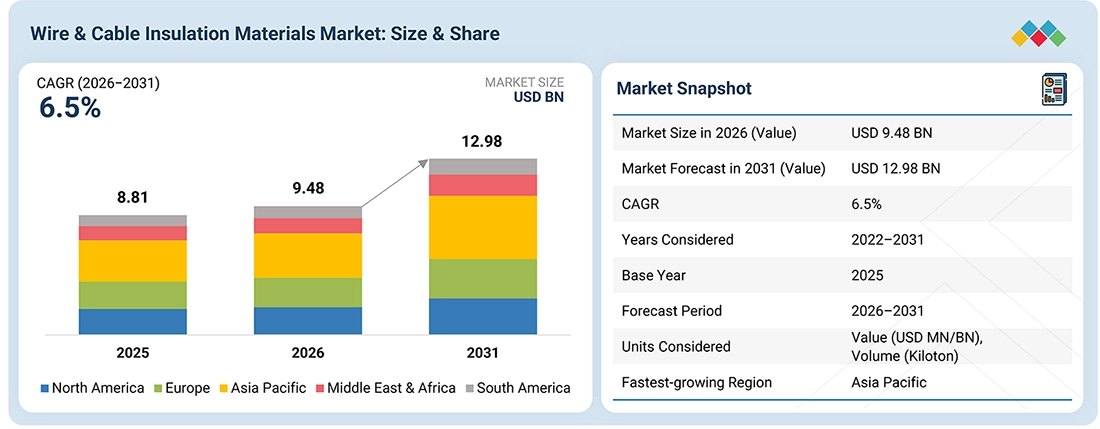
Source: Secondary Research, Interviews with Experts, MarketsandMarkets Analysis
The wire & cable insulation materials market is projected to grow from USD 9.48 billion in 2026 to USD 12.98 billion by 2031, at a CAGR of 6.5% during the forecast period. Increasing demand for wire and cable insulation materials across power and energy, building and construction, automotive, telecommunications, renewable energy, and industrial sectors is driving market growth. Rising investments in power transmission and distribution networks, renewable energy projects, electric vehicles, and data centers are supporting higher consumption of insulation materials. Key market trends include advances in polymer compounding and cross-linking technologies, growing demand for high-performance, application-specific materials and increasing adoption of halogen-free and sustainable insulation solutions. Asia Pacific is expected to remain the largest regional market, supported by rapid industrialization, urbanization, infrastructure development, and expanding electricity networks. However, fluctuating raw material prices, environmental regulations, high production costs, and technical challenges associated with developing advanced insulation compounds are key factors that may restrain market growth.
KEY TAKEAWAYS
-
By RegionAsia Pacific is projected to grow at the highest CAGR of 7.3% during the forecast period.
-
By Product TypeBy product type, the polyethylene (PE) product type dominated the market with a share of 36.5% in terms of value in 2025.
-
By ApplicationBy application, the power cables segment dominated the market with a share of 36.7% in terms of value in 2025.
-
By VoltageThe high-voltage segment is projected to grow at the highest CAGR during the forecast period.
-
By InstallationThe underground segment is projected to grow at the highest CAGR during the forecast period.
-
By End-Use IndustryBy end-use industry, the building & construction segment held the largest market share, in terms of value, in 2025.
-
Competitive Landscape-Key PlayersBorealis GmbH (Austria), Evonik Industries (Germany), Avient Corporation (US), Hanwha Group (South Korea), Electric Cable Compounds, Inc. (US), Melos GmbH (Germany), Orbia (US), Dow (US), LyondellBasell Industries Holdings B.V. (US), AGC Inc. (Japan), Benvic Group (France), Teknor Apex (US), Arkema (France), Daikin Industries, Ltd. (Japan), and Syensqo (Belgium), among others, are the key players in the wire & cable insulation materials market.
-
Competitive Landscape-Startups/SMEsLion Elastomers (US), Gujarat Fluorochemicals (India), Shandong Dongyue Polymer Material (China), HaloPolymer (Russia), and Elkem (Norway), among others are the startups/SMEs in the wire & cable insulation materials market.
The wire and cable insulation materials market is growing as demand for high-performance insulation solutions increases across various end-use industries. These materials offer essential properties, including electrical insulation, thermal stability, flame resistance, flexibility, and mechanical durability. Rising investments in power infrastructure, construction, renewable energy, automotive, and telecommunications are driving this market expansion.
TRENDS & DISRUPTIONS IMPACTING CUSTOMERS' CUSTOMERS
The impact on end users' businesses arises from changing customer preferences, demand patterns, and industry developments. These shifts influence the revenues and production levels of wire and cable-consuming industries, including power and energy, building and construction, automotive, telecommunications, renewable energy, and industrial sectors. Changes in end-user revenues and cable production volumes affect demand for insulation materials, which in turn influence the revenue potential of insulation material manufacturers, compound suppliers, and distributors.
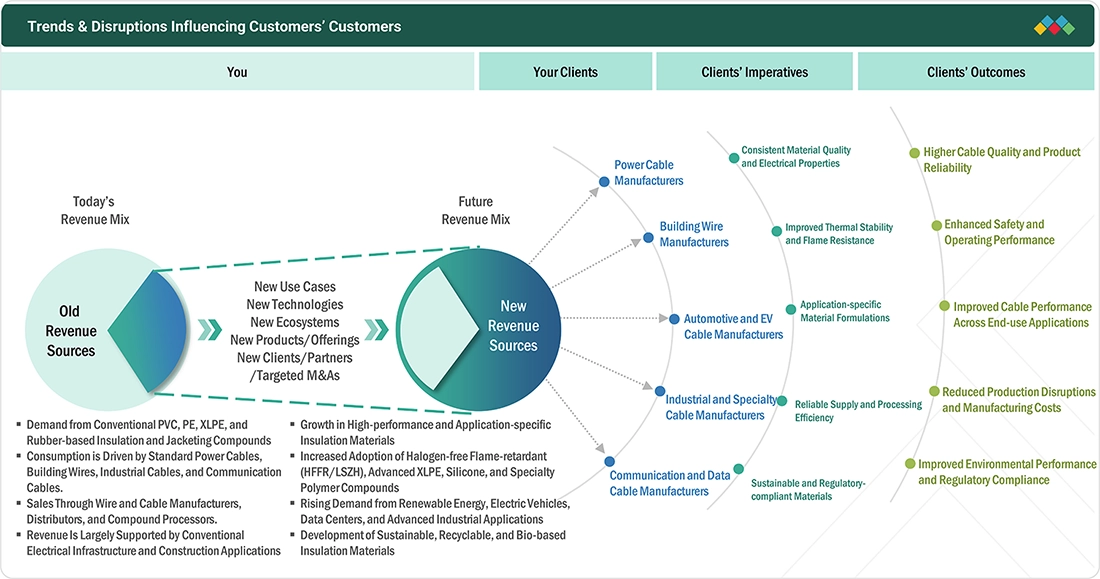
Source: Secondary Research, Interviews with Experts, MarketsandMarkets Analysis
MARKET DYNAMICS

Level
-
Increasing Investments in Power Infrastructure

-
Growing Demand from Construction and Infrastructure


Level
-
Volatility in Raw Material Prices

-
High Cost of Advanced Insulation Materials


Level
-
Growing Adoption of Halogen-free Insulation Materials

-
Expansion of Data Center Infrastructure


Level
-
Technical Complexity of Material Formulation

-
Variations in Regional Standards and Certification

Source: Secondary Research, Interviews with Experts, MarketsandMarkets Analysis
Driver: Increasing Investments in Power Infrastructure
Increasing investments in power generation, transmission, and distribution infrastructure are driving demand for insulated power cables and advanced insulation materials. The rising consumption of electricity, coupled with rapid urbanization, industrialization, and the expansion of renewable energy installations, is necessitating the development and modernization of existing power networks. Governments and utility providers are investing in upgrading aging electrical infrastructure, expanding grid connectivity, and strengthening transmission and distribution capabilities to ensure reliable and efficient electricity supply. These developments are increasing the demand for high-performance insulation materials that offer superior dielectric strength, thermal stability, mechanical durability, and resistance to environmental stress. Furthermore, the growing deployment of underground and subsea power cables is creating opportunities for advanced insulation materials capable of withstanding high electrical loads and challenging operating conditions.
Restraint: High Cost of Advanced Insulation Materials`
The high cost associated with advanced insulation materials is a significant restraint for market growth. Specialized materials such as cross-linked polyethylene (XLPE), silicone-based compounds, and halogen-free flame-retardant formulations require sophisticated manufacturing processes, specialized equipment, and stringent quality-control procedures. The production of these materials also involves relatively expensive raw materials, specialized additives, and chemical processing techniques, increasing overall manufacturing costs. Additionally, fluctuations in the prices of petrochemical-based feedstocks and specialty chemical ingredients can further affect production economics and create pricing uncertainties for manufacturers. These higher costs can increase the overall procurement and installation expenses of insulated power cables, particularly in large-scale infrastructure projects where material consumption is substantial. Consequently, cost-sensitive customers and smaller utility providers may continue to prefer conventional insulation materials, potentially limiting the adoption of advanced formulations.
Opportunity: Expansion of Data Center Infrastructure
The rapid expansion of data center infrastructure presents significant growth opportunities for the market. Increasing investments in hyperscale data centers, cloud computing facilities, colocation infrastructure, and artificial intelligence (AI)-enabled computing facilities are driving the need for reliable and efficient electrical distribution systems. Data centers require extensive power infrastructure to support high-density computing equipment, uninterrupted operations, and increasing electricity consumption. This is creating demand for advanced insulated power cables and high-performance insulation materials that provide excellent electrical insulation, thermal stability, flame retardancy, and long-term operational reliability. Furthermore, the growing adoption of liquid cooling systems, high-density server racks, and advanced power distribution architectures is increasing the need for insulation materials capable of operating under demanding thermal and electrical conditions. As data center operators continue to expand their infrastructure and prioritize energy efficiency, operational safety, and system reliability, demand for technologically advanced insulation materials is expected to increase.
Challenge: Technical Complexity of Material Formulation
The technical complexity involved in developing advanced insulation material formulations remains a key challenge for market participants. Insulation materials used in power cables must deliver a combination of electrical insulation, thermal resistance, mechanical strength, flexibility, and resistance to environmental degradation to ensure reliable performance throughout their operational life. Achieving an optimal balance among these properties is challenging, as improvements in one characteristic may adversely affect other material properties. For instance, increasing flame-retardant content may influence mechanical flexibility and dielectric performance, while enhancing thermal resistance may require specialized additives and complex formulation techniques. Additionally, manufacturers must ensure that insulation materials comply with stringent electrical safety standards, fire-resistance requirements, and application-specific performance specifications. The development of formulations suitable for high-voltage, underground, and subsea cable applications further increases technical requirements. Consequently, manufacturers must invest continuously in research and development, material testing, and process optimization, increasing development timelines and costs while creating barriers to innovation and commercialization.
WIRE AND CABLE INSULATION MARKET: COMMERCIAL USE CASES ACROSS INDUSTRIES
| COMPANY | USE CASE DESCRIPTION | BENEFITS |
|---|---|---|
 |
Uses polymer-based insulation materials, including XLPE and PVC, in power cables for transmission, distribution, and renewable energy applications. | Improved electrical insulation, thermal resistance, durability, and cable reliability |
 |
Uses PE, XLPE, and other polymer compounds in power and communication cables for energy infrastructure and industrial applications. | Enhanced electrical performance, mechanical strength, and resistance to environmental stresses |
 |
Uses XLPE insulation in medium-, high-, and extra-high-voltage power cables for transmission and distribution networks. | Improved voltage resistance, thermal stability, and long-term cable performance |
 |
Uses polymer-based insulation materials in power, automotive, and industrial cables to support electrical safety and performance. | Enhanced insulation properties, heat resistance, flexibility, and operational reliability |
Logos and trademarks shown above are the property of their respective owners. Their use here is for informational and illustrative purposes only.
MARKET ECOSYSTEM
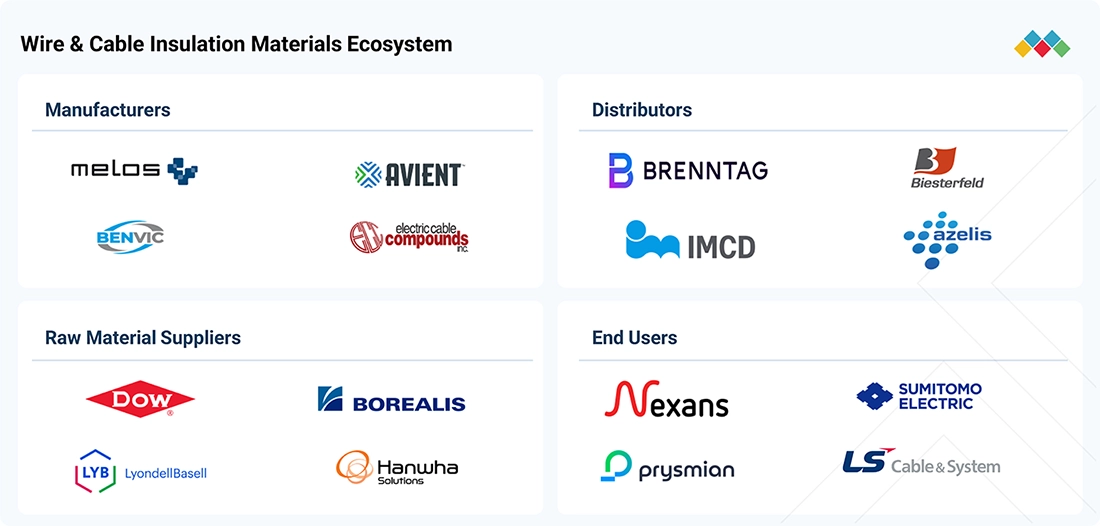
The wire & cable insulation materials market ecosystem comprises polymer resin suppliers, additive manufacturers, insulation compound producers, specialty compound manufacturers, wire and cable manufacturers, distributors, and end users. Coordination across the value chain supports the development and supply of high-performance insulation and jacketing materials, including PVC, PE, XLPE, PP, rubber, silicone, and halogen-free flame-retardant compounds. Effective partnerships between raw material suppliers, compound manufacturers, cable producers, and end-use industries enable the development of application-specific solutions for power and energy, building and construction, automotive, telecommunications, renewable energy, and industrial applications. Advanced polymer compounding, cross-linking technologies, material testing, quality control, technical support, and efficient distribution networks help improve product consistency, cable performance, and reliability across end-use applications.
Logos and trademarks shown above are the property of their respective owners. Their use here is for informational and illustrative purposes only.
MARKET SEGMENTS
Source: Secondary Research, Interviews with Experts, MarketsandMarkets Analysis
Wire & Cable Insulation Materials Market, by Product Type
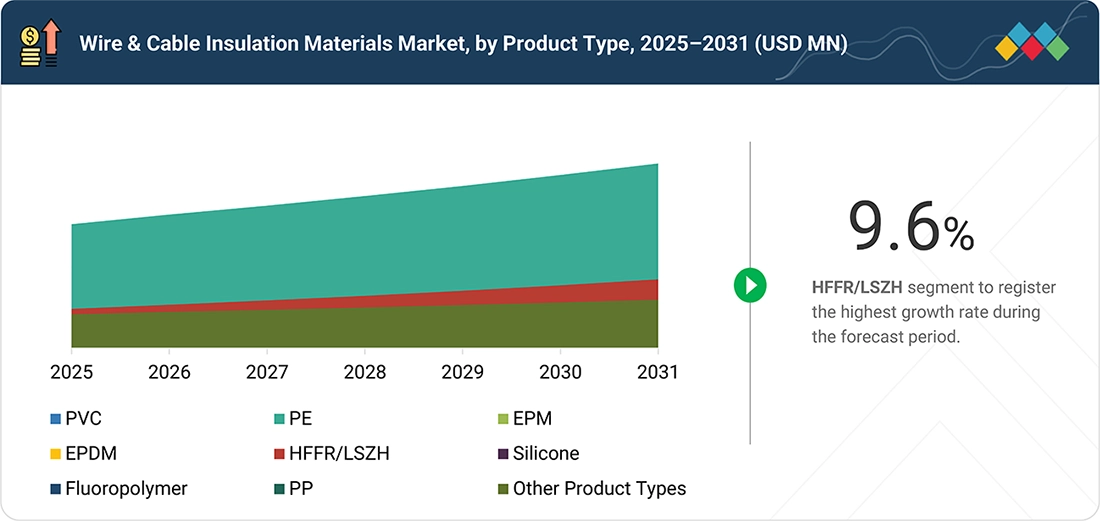
Polyethylene (PE) accounts for the largest market share among all insulation material types globally, driven by its excellent electrical insulation properties, moisture resistance, chemical stability, flexibility, and cost-effectiveness. PE offers a low dielectric constant, good mechanical strength, and reliable performance across various operating conditions, making it suitable for a wide range of cable applications. Its use in manufacturing power cables, communication cables, automotive wires, and industrial cables contributes to its significant market share. PE is widely used in cable insulation and jacketing, while its cross-linked form (XLPE) is extensively adopted in medium-, high-, and extra-high-voltage power cable applications.
Wire & Cable Insulation Materials Market, by Application
Power cables account for the largest market share across all application segments in the global wire & cable insulation materials market, driven by rising electricity demand, expanding power transmission and distribution networks, and growing investments in renewable energy infrastructure. Insulation materials such as PVC, PE, and XLPE provide essential electrical insulation, thermal stability, moisture resistance, and mechanical protection required for reliable power cable performance. Their extensive use in low-, medium-, and high-voltage power cables across residential, commercial, industrial, and utility applications contributes to the segment's leading market share. Growing grid modernization, urbanization, and renewable energy installations are further supporting demand for insulation materials used in power cable manufacturing.
Wire & Cable Insulation Materials Market, by Voltage
Low-voltage cables account for the largest market share among all voltage segments in the global wire & cable insulation materials market, driven by their extensive use in residential, commercial, and industrial electrical installations. Insulation materials such as PVC, PE, and XLPE provide electrical safety, flexibility, thermal resistance, and mechanical protection in low-voltage cable applications. Their widespread use in building wiring, lighting systems, electrical equipment, appliances, and distribution networks contributes to the segment's leading market share. Growing construction activities, urbanization, and increasing demand for electrical infrastructure further support the consumption of insulation materials in low-voltage cables.
Wire & Cable Insulation Materials Market, by Installation
Underground cables account for the largest market share among all installation segments in the global wire & cable insulation materials market, driven by increasing investments in urban power distribution networks, grid modernization, and infrastructure development. These cables require insulation materials such as XLPE and PVC to provide electrical insulation, moisture resistance, thermal stability, and mechanical protection under buried operating conditions. Their extensive use in urban electricity distribution, industrial facilities, commercial infrastructure, and utility networks contributes to the segment's leading market share. Growing urbanization, demand for reliable power supply, and the need to reduce exposure to weather-related disruptions are further supporting the adoption of underground cables.
Wire & Cable Insulation Materials Market, by End-use Industry
Building and construction accounts for the largest market share among all end-use industries in the global wire & cable insulation materials market, driven by increasing residential, commercial, and infrastructure development worldwide. Insulation materials such as PVC, PE, and XLPE are widely used in electrical wires and cables to provide electrical insulation, flame resistance, flexibility, and mechanical protection. Their extensive application in building wiring, lighting systems, power distribution, HVAC systems, security installations, and other electrical infrastructure contributes to the segment's leading market share. Rapid urbanization, smart building development, and growing investments in residential and commercial construction are further supporting demand for wire and cable insulation materials.
REGION
Asia Pacific to be the fastest-growing market during the forecast period
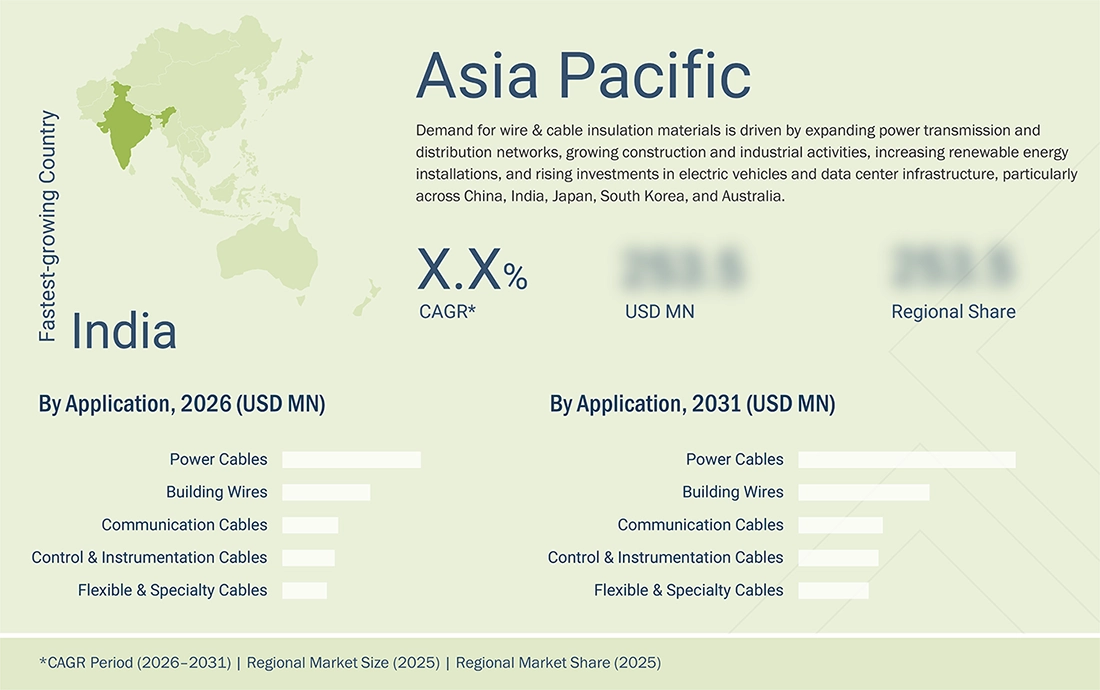
Asia Pacific accounts for the largest market share in the global wire & cable insulation materials market, driven by rapid industrialization, urbanization, infrastructure development, and rising electricity consumption across the region. Increasing investments in power transmission and distribution networks, renewable energy projects, telecommunications, and residential and commercial construction are driving demand for wire and cable insulation materials. Countries such as China, India, Japan, and South Korea contribute significantly to regional demand through expanding manufacturing activities, infrastructure modernization, and growing energy requirements. The strong presence of wire and cable manufacturers, expanding production capacities, and increasing adoption of electric vehicles and data centers further support Asia Pacific's leading market position.
WIRE AND CABLE INSULATION MARKET: COMPANY EVALUATION MATRIX
In the global wire & cable insulation materials market, SABIC (Star) maintains a strong competitive position through its broad portfolio of insulation materials, extensive manufacturing capabilities, advanced polymer technologies, and established global presence across power, construction, automotive, telecommunications, and industrial applications. Hanwha Group (Emerging Leader) is strengthening its market position through an expanding product portfolio, manufacturing capabilities, technological advancements, and focus on serving diverse cable applications. While the leading player maintains an advantage through its comprehensive product offerings, production footprint, technical expertise, and global market presence, the emerging leader has the potential to strengthen its position as demand for high-performance, sustainable, application-specific insulation materials continues to rise.
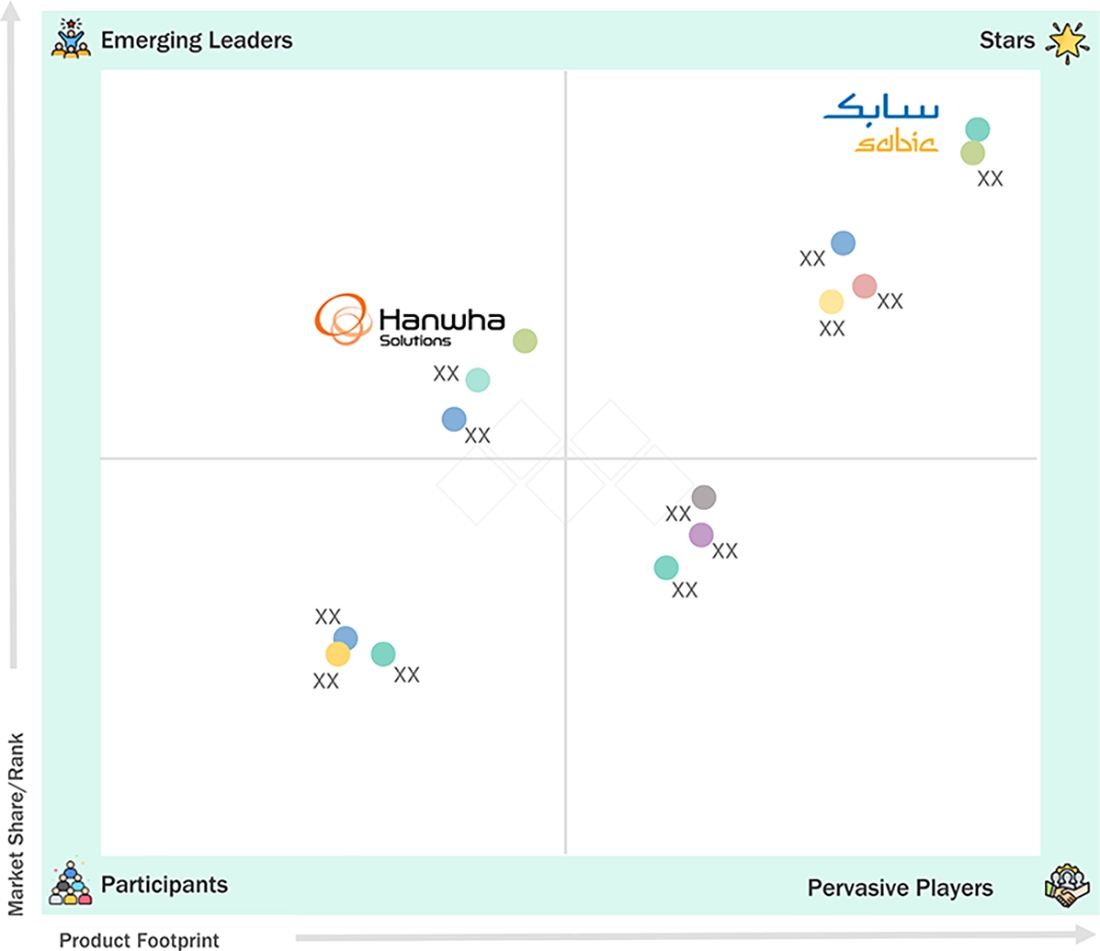
Source: Secondary Research, Interviews with Experts, MarketsandMarkets Analysis
KEY MARKET PLAYERS
- Borealis GmbH (Austria)
- Evonik Industries (Germany)
- Avient Corporation (US)
- Hanwha Group (South Korea)
- Electric Cable Compounds, Inc. (US)
- Melos GmbH (Germany)
- Orbia (Mexico)
- Dow (US)
- LyondellBasell Industries Holdings B.V. (Netherlands)
- AGC Inc. (Japan)
- Benvic Group (France)
- Teknor Apex (US)
- Arkema (France)
- Daikin Industries, Ltd. (Japan)
- Syensqo (Belgium)
MARKET SCOPE
| REPORT METRIC | DETAILS |
|---|---|
| Market Size in 2025 (Value) | USD 8.81 Billion |
| Market Size in 2026 (Value) | USD 9.48 Billion |
| Market Forecast in 2031 (Value) | USD 12.98 Billion |
| CAGR | CAGR of 6.5% from 2026–2031 |
| Years Considered | 2022–2031 |
| Base Year | 2025 |
| Forecast Period | 2026–2031 |
| Units Considered | Value (USD Million/Billion), Volume (Kiloton) |
| Report Coverage | Revenue Forecast, Company Ranking, Competitive Landscape, Growth Factors, and Trends |
| Segments Covered | By Product Type (PVC, PE, EPM, EPDM, HFFR/LSZH, Silicone, Fluoropolymer, PP), Application (Building Wires, Power Cables, Control & Instrumentation Cables, Communication Cables, Flexible & Specialty Cables), Voltage (Low Voltage, Medium Voltage, High Voltage, Extra-high Voltage), Installation (Overhead, Underground, Submarine), End-use Industry (Building & Construction, Transportation, Utility, Renewable Energy, Telecommunication, Automotive, Medical Equipment, Industrial, Data Center, Other Industries) |
| Regions Covered | North America, Europe, Asia Pacific, Middle East & Africa, and Latin America |
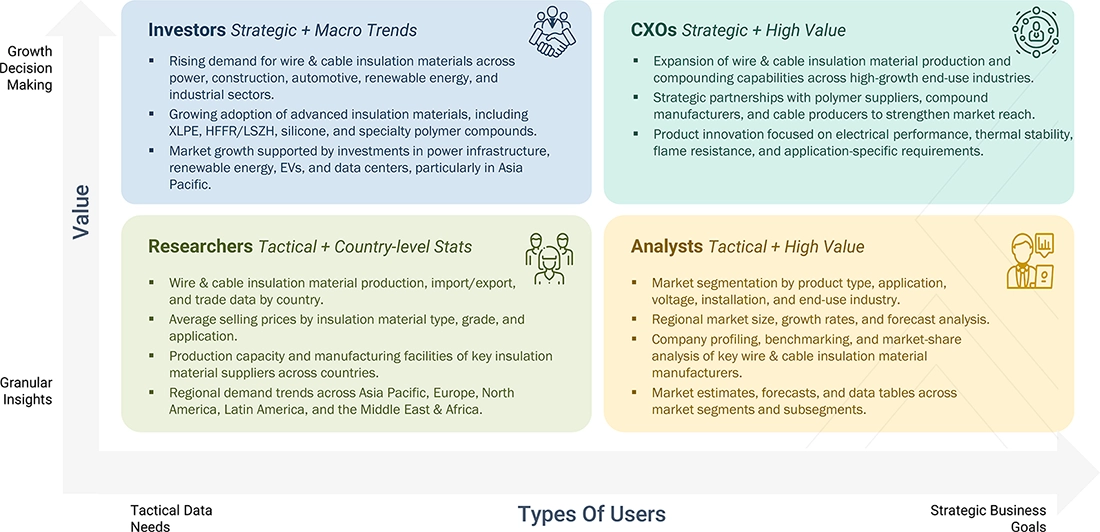
WHAT IS IN IT FOR YOU: WIRE AND CABLE INSULATION MARKET REPORT CONTENT GUIDE
DELIVERED CUSTOMIZATIONS
We have successfully delivered the following deep-dive customizations:
| CLIENT REQUEST | CUSTOMIZATION DELIVERED | VALUE ADDS |
|---|---|---|
| Raw Material Suppliers (Polymer Resins, PVC, PE, PP, Rubber Polymers, Additives, Fillers, and Specialty Chemicals) |
|
|
| Insulation Compound Manufacturers & Cable Material Producers |
|
|
| Wire & Cable Manufacturers, OEMs & EPC Contractors |
|
|
| End-use Industries (Utilities, Renewable Energy, Building & Construction, Automotive, Data Centers, Oil & Gas, Mining, Railways, and Industrial) |
|
|
RECENT DEVELOPMENTS
- September 2026 : Hanwha Solutions (South Korea) signed an MOU with ZTT (China) to jointly develop and verify materials for 132 kV-class wet-type offshore wind cables. Hanwha Solutions will supply materials and technical support, while ZTT will manufacture cable samples for performance verification.
- April 2026 : Evonik Industries (Germany) opened a dedicated laboratory in China for magnet-wire coating development, extrusion trials, and reliability testing. The facility strengthens its application-development capabilities for electric-motor insulation, particularly for new-energy vehicles.
- March 2026 : Borealis (Austria) commercially launched FR6012, a halogen-free, flame-retardant monolayer sheathing compound for medium- to extra-high-voltage cables that meets ST12 fire-performance requirements.
Table of Contents
 Exclusive indicates content/data unique to MarketsandMarkets and not available with any competitors.
Methodology
The study to estimate the current size of the wire & cable insulation materials market involved two key steps. First, comprehensive secondary research was conducted to gather data on the market and related and parent markets. This was followed by primary research, where insights, assumptions, and market estimates were validated through interviews with industry experts across the value chain. Both top-down and bottom-up methodologies were applied to determine the overall market size. Finally, the market was segmented, and data triangulation techniques were used to refine and validate the estimates for each segment and subsegment.
Secondary Research
Secondary sources consulted for this research included financial reports of wire & cable insulation materials manufacturers, along with data from trade organizations, business publications, and professional associations. The secondary research provided essential insights into the industry's value chain, identified key players, and helped classify and segment the market based on prevailing industry trends at regional and sub-regional levels. The information gathered was thoroughly analyzed to estimate the overall size of the wire & cable insulation materials market, which was then validated through primary research with industry experts.
Primary Research
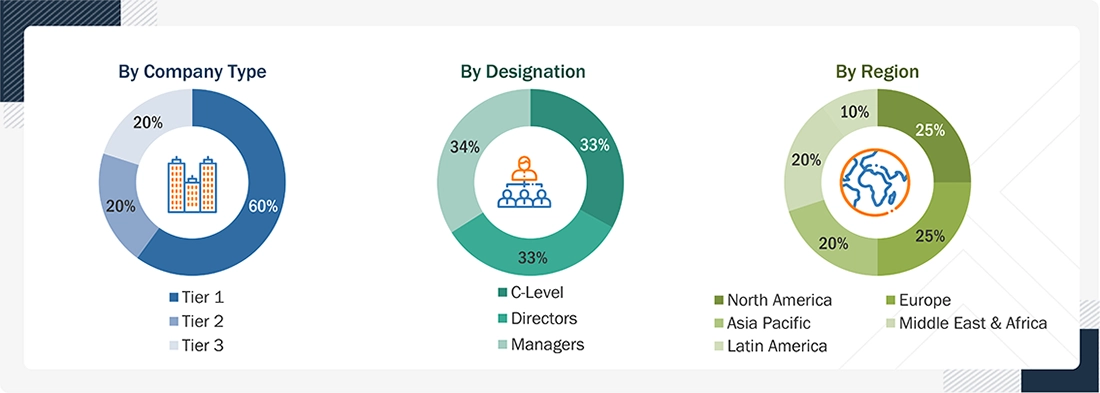
Extensive primary research was carried out after collecting market insights through secondary research to validate the wire & cable insulation materials market scenario. Several interviews were conducted with industry experts from the demand and supply sides across North America, Europe, Asia Pacific, the Middle East & Africa, and Latin America. Primary data was gathered through structured questionnaires, emails, and telephonic interviews. On the supply side, respondents included industry professionals such as CXOs, vice presidents, directors, product innovation teams, system integrators, component suppliers, distributors, and other key opinion leaders. These interviews provided valuable insights into market statistics, revenue data, segmentation, size estimations, and forecasts, and enabled data triangulation. On the demand side, stakeholders such as CIOs, CTOs, CSOs, and installation teams from end-user companies were consulted to better understand customer perspectives, current usage patterns, supplier evaluations, and the outlook for wire & cable insulation materials.
Breakdown of Primary Research:
To know about the assumptions considered for the study, download the pdf brochure
Market Size Estimation
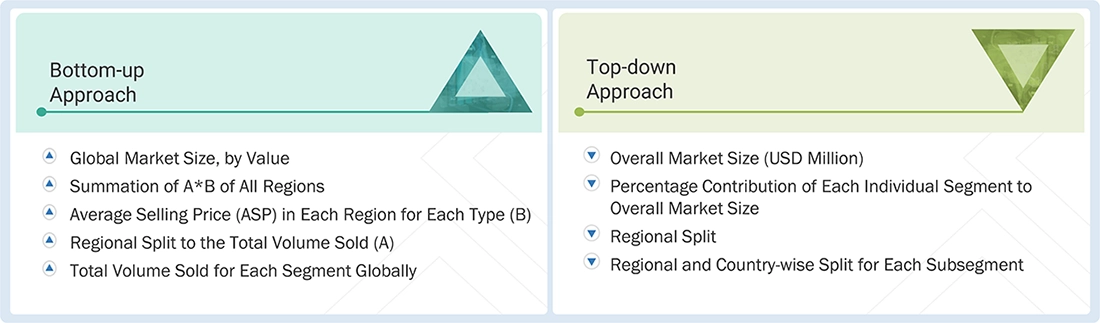
The research methodology used to estimate the size of the wire & cable insulation materials market primarily focused on a demand-side approach. Market sizing was conducted by analyzing procurement activities and modernization efforts involving wire & cable insulation materials products across various applications at the regional level. These procurement trends offered valuable insights into the demand patterns within the wire & cable insulation materials industry for each application segment. All relevant segments were thoroughly mapped and integrated to provide a comprehensive view of the market structure and size across different end-use applications.
Wire and Cable Insulation Market: Top-Down and Bottom-Up Approach
Data Triangulation
After estimating the overall market size through the process explained above, the total market was further segmented into various segments and subsegments. To ensure accuracy, data triangulation and market breakdown techniques were applied wherever relevant, forming a key part of the overall market engineering process. This involved analyzing multiple factors and trends from both the demand and supply sides. Additionally, the final market size and segment-level figures were validated using a combination of top-down and bottom-up approaches to ensure precision and reliability of the statistical estimates.
Market Definition
Wire & cable insulation materials are polymers, compounds, and other specially engineered materials that serve as an electrical insulator for conductors and shield cables against various environmental factors like thermal, physical, and chemical stresses. Examples of insulation materials include polyvinyl chloride (PVC), polyethylene (PE), cross-linked polyethylene (XLPE), polypropylene (PP), rubber, silicone, and halogen-free flame-retardant (HFFR/LSZH) compounds. The above-mentioned materials are engineered and compounded into insulation material with unique electrical, thermal, mechanical, and flame-retardant characteristics to meet various cable performance needs. They find applications in power cables, communication cables, flexible cables, and specialty cables, among other applications.
Key Stakeholders
- Wire & cable insulation material manufacturers and compound suppliers
- Wire and cable manufacturers
- Raw material and polymer resin suppliers
- Power generation, transmission, and distribution companies
- Construction, automotive, and industrial equipment manufacturers
- Telecommunications and data center operators
- Industry associations and regulatory bodies
- Universities, research institutions, and R&D organizations
- Government agencies and standardization authorities
- Market research and consulting firms
Report Objectives
- To define, describe, segment, and forecast the size of the wire & cable insulation materials market, by product type, application, voltage, installation, end-use industry, and region, in terms of volume and value
- To forecast the size of market segments across five major regions (along with country-level data), namely North America, Europe, Asia Pacific, the Middle East & Africa, and Latin America
- To identify and analyze key drivers, restraints, opportunities, and challenges influencing market growth
- To strategically analyze micromarkets with respect to individual growth trends, prospects, and contributions to the overall market
- To analyze opportunities for stakeholders in the market
- To assess recent developments and competitive strategies, such as acquisitions, agreements, contracts, and product developments/launches, to draw the competitive landscape
- To strategically profile the key market players and comprehensively analyze their core competencies
Available customizations:
MarketsandMarkets offers the following customizations for this market report:
- Additional country-level analysis of the wire & cable insulation materials market
Product Analysis
- Product matrix, which provides a detailed comparison of the product portfolio of each company in the market


Personalize This Research
- Triangulate with your Own Data
- Get Data as per your Format and Definition
- Gain a Deeper Dive on a Specific Application, Geography, Customer or Competitor
- Any level of Personalization
Let Us Help You
- What are the Known and Unknown Adjacencies Impacting the Wire & Cable Insulation Materials Market
- What will your New Revenue Sources be?
- Who will be your Top Customer; what will make them switch?
- Defend your Market Share or Win Competitors
- Get a Scorecard for Target Partners

Custom Market Research Services
We Will Customise The Research For You, In Case The Report Listed Above Does Not Meet With Your Requirements
Get 10% Free CustomisationTESTIMONIALS
We at Nissan Chemicals Corporation have been clients of MarketsandMarkets for more than a year now. We recently consulted MarketsandMarkets for a study, the team at MarketsandMarkets was extremely professional and organized. The business insights were very detailed and aligned well with our expectations that really helped us formulate the Business Plans and device new strategies for development themes. MarketsandMarkets offers a unique combination of expertise and dedicated engagement model. Their research findings have helped us in designing our Pricing Strategy which will make it easier for us to predict the future sales and profits for the next ten years. We look forward to working with MarketsandMarkets in the future.
VP of Strategy & New Business Development
Leading Specialty Chemical Company
The MarketsandMarkets Engagement Model, composed of both the Knowledge Store and advisory custom research, has greatly helped us in understanding our markets and making strategic decisions. The Knowledge Store is a fast way to allow everyone in our organization to understand more about most any market they are interested in. The ability to then get custom research done and get answers to specific strategic questions and market insight has been spectacular. The Markets and Markets team feel more like colleagues than vendors and their services have helped us change our culture where statements of things like growth opportunities and competitive position are always backed by industry research.

Rich Gibson,
Director, Corporate Strategy
Milliken & Company,
Leading Industrial Manufacturer of specialty chemical, floor covering, performance and protective textile materials, and healthcaremilliken.com
MarketsandMarkets is a trusted resource that helps us to better understand markets that are near-adjacencies-whether its technology, value chain or geography. Their Knowledge Store platform provides a dashboard of markets and their characteristics which is easy to use and saves us time.
Adam Shaw,
Market Development and Strategy Manager
AdvanSix Inc. USA,
An American Leader in Chemicalswww.advansix.com
The Knowledge Store from MarketsandMarkets is a valuable tool which has helped my team acquire greater insight in to the end markets that our business serves. This has enabled us to help our company build stronger strategies throughout our planning process.
TOSHIO KINOSHITA
Senior Chif Consultion Research & Consulting Division
Mitsubishi Chemical Research Corporation,
Leading Manufacturer of Chemical Productswww.mitsubishichem-res.co.jp/en/

We recently engaged with MarketsandMarkets for a study, the team not only clearly understood our business objectives but was also extremely professional in the way they handled the entire project. The study was efficiently conducted in a phase-wise manner, and the engagement model furnished us with high-quality business insights that far exceeded our expectations at each phase. We were especially happy that MarketsandMarkets could provide us with both, an English as well as a Japanese version of the study. A special thanks to the Analyst Team and Client Services Team, whose fluency in Japanese enhanced our comfort level, as we could converse with them in our preferred language.
Independent entrepreneurs
Arrow Precision
We approached MarketsandMarkets for study on Proppants Market, and their work exceeded our expectations. The study conducted was comprehensive and enabled us to view the market through the various dimensions. In addition, the team was extraordinarily responsive throughout the process and resolved our queries on time. I strongly recommend MarketsandMarkets and will certainly consider them for additional market assessments we will need in the future.
Global engineering company, Japan
Deputy Manager,
Strategic Planning OfficeThe high-quality insights shared by the MarketsandMarkets team helped us understand the pharmaceutical plant designers in a specific geography. It also captured the risks that we may likely face in communicating with our potential partners. The study would enable us identify partners, which would impact our future growth.



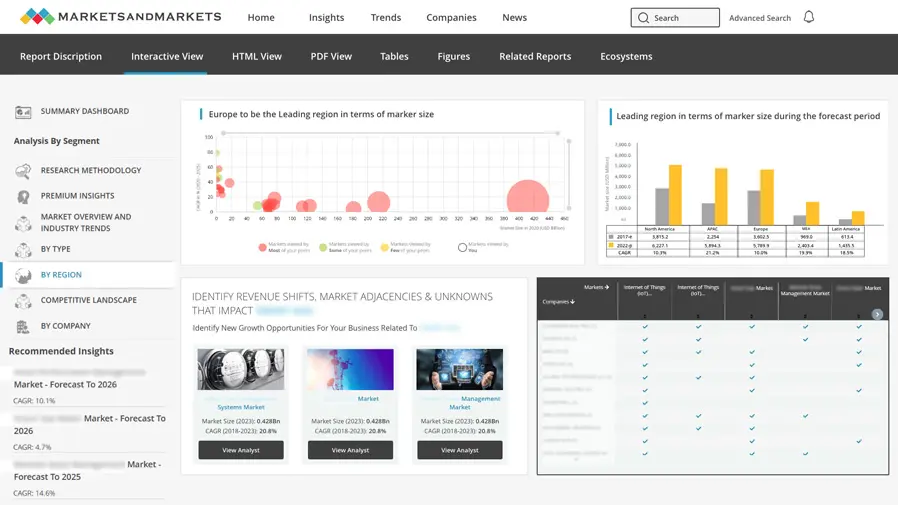
Growth opportunities and latent adjacency in Wire & Cable Insulation Materials Market